The Dangers of SEL Assessment Data to Students with LD Social Disabilities and Autism
Today, I would like to bring attention to the dangers of social-emotional learning assessment to a segment of our student population.
The focus on behavioris becoming the new purpose of school, and that alone should raise questions. School boards, PTA’s, and school organizations should be discussing how these curriculum changes impact what and how students learn.
Many children and teens exhibit a kind of learning disability where they misperceive social interactions. For students, such a disorder could mean that they react to SEL (Social-Emotional Learning) assessments in an inferior manner that type casts them as troubled students, when they are not, at least not in the usual sense.
Also, children with Autism Spectrum Disorder (ASD) might misjudge test questions and not respond well, because social interactions are often challenging.
Students who fall into either of these categories could have personal data collected about them, based on these assessments, that unjustly cause difficulties later in life.
There’s only one education champion in Wisconsin’s race for governor
Wisconsin Gov. Scott Walker has taken to calling himself a “pro-education governor”—a laughable claim to educators in the state.
Here are just a few reasons to question Walker’s commitment to education:
During Gov. Walker’s first five years, he cut state funding for K-12 schools by $1.2 billion. It was a devastating blow to the state’s public schools.
Walker has worked hard to expand the state’s voucher program. Like Betsy DeVos, Gov. Walker supports diverting scarce public school funding to private schools through such schemes. Vouchers have not been shown to significantly improve student performance, but they have been shown to undermine student civil rights.
Under Walker, public university funding was slashed by $250 million
Walker stripped educators and other public workers of collective bargaining rights, despite public outcry. Unions bargain for better working conditions for educators, as well as students’ learning conditions.
Walker’s record could not be more dismal on education. Standing in sharp contrast is his opponent, a proven champion of public education.
Dr. Tony Evers has decades of experience in public education, serving first as a classroom teacher, then as principal and the state superintendent of public instruction. Here are his plans and priorities:
Evers’ budget plan increases public school funding by $1.4 billion. It restores the state’s commitment to covering two-thirds of public education funding, and increases the state’s share of special education funding to 60 percent.
Evers will freeze the school voucher program as a first step toward its eventual phase-out.
He strongly supports: community schools that help meet the needs of students and families in the local community; expanding mental health services; increased funding for education support professionals.
Evers plans to place in statute requirements for teacher voice to be part of all education-related decision and policy-making initiatives.
“We – and I – have been waiting for this day for a long, long time,” Evers said at an election rally in September. “We’re going to take back control of our schools.”
Evers earned the recommendation of the Wisconsin Education Association Council (WEAC), the state’s largest educator union. Members like Kay Hansen, a special needs paraeducator and WEAC member, are highly enthusiastic about the upcoming election.
“As a special education paraprofessional in a rural, northeastern Wisconsin school, I see firsthand how Scott Walker’s huge cuts to public schools have hurt my most vulnerable students,” said Hansen.
“Dr. Evers, on the other hand, is a teacher himself and has vowed to restore state funding for my special education students.”
Evers listens to the concerns of educators like Hansen for their students and their profession.
“Our educators are on the front lines of these challenges, so when they speak up about bad education policy, deteriorating schools, or the massive teacher exodus we’re facing, they’re doing right by our kids,” said Evers at a gathering of WEAC educators in September.
“They’re reminding us that education—like democracy—doesn’t come for free. It must be nurtured, sustained, and invested in over time.”
After Teacher Walkouts, Arizona Republicans Jostle Onto Education Platform
PHOENIX — Campaign signs are clustered on street corners and highway ramps across this low-slung, sun-baked city, proclaiming “#YesforEd” and “Protect Public Education.” In TV commercials, the Republican governor promises to “put more money in the classroom, not bureaucracy.” “Our schools are falling apart,” his Democratic challenger counters. Six months after tens of thousands of red-clad teachers swarmed the Arizona Capitol in a weeklong walkout, demanding higher pay and more funding for schools, education is a dominant issue in the state’s elections next month. The teachers’ protest movement, which calls itself #RedforEd, has transformed the political battleground. The movement remains so popular in Arizona that candidates and causes across the ideological spectrum are competing to identify with it — including conservatives who, in years past, might have been more likely to criticize teachers or unions than associate with activist educators.
That has left some Democrats — teachers’ traditional allies — scrambling to differentiate themselves. It is a pattern that has played out in several states where teachers have walked off the job this year, including Oklahoma, West Virginia and Kentucky. The teachers’ movement has energized Democrats in red states, with record numbers of educators running for office. But it may have had an even greater impact on Republican politics. In primaries, it Continue reading: After Teacher Walkouts, Arizona Republicans Jostle Onto Education Platform - The New York Times
EXAMINING THE MYTH OF ACCOUNTABILITY, HIGH-STAKES TESTING AND THE ACHIEVEMENT GAP
We are proud to announce a new peer-reviewed paper entitled Examining the myth of accountability, high-stakes testing and the achievement gap In this article, we outline how notions of accountability and the achievement gap have relied upon the massive expansion of high-stakes exams in our nation’s schools. Texas-style test and punish accountability manifested in various ways within schools and school culture across the nation via NCLB, which undermined notions of trust within the teaching profession. More than decade of national education policy focused on high-stakes testing and accountability—despite that the fact that the rise of high-stakes testing also involved considerable legal, ethical, and social considerations. We argue the practice of spending large amounts of time on test preparation and test taking must be reversed lest we continue on the path of maintaining schools solely as machinery for stratification. We conclude that market- and business-oriented ideology, has reinforced the racist under- and overtones of testocracy in the United States and has neither closed the achievement gap nor fomented meaningful accountability or success.
Examining the Myth of Accountability, High-Stakes Testing, and the Achievement Gap
Julian Vasquez Heilig, California State University Sacramento
Jameson Brewer, University of North Georgia
Jimmy Ojeda Pedraza, California State University Sacramento
Popularity and Common Belief: Birth of Texas-Style Accountability
In the late 1990s, students of color in the large, urban high schools in Houston were reporting that they had 0% dropouts, and it was claimed that the achievement gap on the Texas Assessment of Academic Skills (TAAS) was closing rapidly. Education reformers attributed all of this purported success directly to Texas’s implementation of high-stakes testing and accountability (Vasquez Heilig & Darling-Hammond, 2008). The Houston Independent School District and many other traditionally underperforming districts across the state were suddenly a success—it was a Texas miracle (Haney, 2000). But had Houston, and Texas, really experienced a miracle that would justify codifying high-stakes testing and accountability for every student in the entire nation?
Although the standards, testing, and accountability education reform movement is firmly situated as an offspring of the 1983 release of A Nation at Risk (ANAR), surely the passage of the No Child Left Behind (NCLB) Act of 2001 was rooted in policy making in Texas (Vasquez Heilig, Brewer, & White, 2018). In the 1980s and 1990s, there was a concerted push by Texas policymakers and business leaders to reform the state’s schools (Vasquez Heilig & Darling-Hammond 2008). Texas was one of the earlier states to develop statewide testing systems during the 1980s, adopting minimum competency tests for school graduation in 1987 (Carnoy, Loeb, & Smith, 2003). In the early 1990s, the Texas Legislature passed Senate Bill 7 (1993), which mandated the creation of Texas-style public school accountability to rate school districts and evaluate campuses. Signed into law by Democratic Governor Ann Richards in 1993, S.B. 7 represented a bipartisan attempt to remedy the state’s educational woes as it was passed by a wide margin in both the Texas House and Senate.
The first Texas accountability system, an information forum that used test scores and other measures of student progress to determine whether school districts should remain accredited by the state, was implemented in 1994. The Texas accountability system was undergirded by data in the Public Education Information Management System Continue reading: Examining the myth of accountability, high-stakes testing and the achievement gap | Cloaking Inequity
My Reflections on the Fifth Annual Conference of the Network for Public Education in Indianapolis
I have waited a few days to digest the exciting events of last weekend.
My first thought is: I wish you had been there.
You would have seen teachers, parents, school board members, superintendents, researchers, college students, and lots of others who want to save their schools from privatization and save their students from endless over-testing. They came not to defend the status quo, but to fight the status quo.
At every NPE conference–in Austin, Chicago, Raleigh, Oakland, and Indianapolis–the spirit and goodwill were infectious. The same was true in Indianapolis.
Many people saw friends that they met at last year’s conference, or met their favorite blogger or researcher.
Every year, I hear the same statement: “This was the best conference yet.” And I believe it.
I won’t report on all the keynotes but want to be sure that you watch Pasi Sahlberg.
Pasi Sahlberg was amazing. He talked about the “Global Education Reform Movement” (GERM) and accompanied his talk with slides and even a video (all of which were posted by him on Twitter @pasi_sahlberg. Pasi wrote the wonderful book Finnish Lessons and Finnish Lessons 2.0. His new book, with William Doyle, is Let the Children Play. Pasi talked about the birth of GERM as a reflection of the exuberant belief in the 1980s that markets and standardization solved all problems. Pasi showed the spread of GERM, especially in English-speaking countries. He is now based in Australia, and he told us that the government of New Zealand has dropped national standards and will soon eliminate national testing. Continue reading: My Reflections on the Fifth Annual Conference of the Network for Public Education in Indianapolis | Diane Ravitch's blog
Understanding the Propaganda Campaign Against Public Education There is no evidence from any other nation that replacing a public system with a privatized choice system produces anything but social, economic, and racial segregation.
A few years ago, when I was blogging at Education Week with Deborah Meier, a reader introduced the term FUD. I had never heard of it. It is a marketing technique used in business and politics to harm your competition. The term and its history can be found on Wikipedia. FUD stands for Fear, Uncertainty, and Doubt. The reader said that those who were trying to create a market-based system to replace public education were using FUD to undermine public confidence in public education. They were selling the false narrative that our public schools are obsolete and failing.
This insight inspired me to write Reign of Error to show that the “reform” narrative is a fraud. Test scores on NAEP are at their highest point in history for white students, black students, Hispanic students, and Asian students. Graduation rates are the highest in history for these groups. The dropout rate is at an historic low point.
Why the FUD campaign against one of our nation’s most treasured democratic institutions? It helps the competition. It makes people so desperate that they will seek out unproven alternatives. It makes the public gullible when they hear phony claims about miracle schools, where everyone graduates and everyone gets high test scores, and everyone goes to a four-year college. No such school exists. The “miracle school” usually has a high suspension rate, a high expulsion rate, a high attrition rate, and such schools usually do not replace the kids they somehow got rid of. Some “miracle schools” have Continue reading: Understanding the Propaganda Campaign Against Public Education | HuffPost
Advocates for Public Schools Have Good Reasons to Keep on Fighting Against Privatization and Corporate Reform
I was privileged to participate in the 5th Annual Conference of the Network for Public Education (NPE) in Indianapolis last weekend. This will be the last of a series of reflections on what I learned at that important meeting. Overall, NPE’s 2018 Conference proclaimed reasons for hope.
Neoliberal corporate reform just isn’t working out the way its proponents had planned. Diane Ravitch introduced last weekend’s conference by describing, “the slow, sure collapse of corporate reform.” “The facts and evidence are on our side,” she said. “We are driven by conviction and passion and not by money. Charters do not save poor children from failing schools. Charters are more likely to fail than the public schools they replace. Charters that get high test scores do so by kicking out the kids they don’t want. Evidence on vouchers is now unequivocal, and it’s bad… High stakes testing has been a disaster for children of color who are labeled and stigmatized year after year… NCLB was a disaster. Race to the Top was a disaster… National Assessment of Education Progress scores for 2015 declined for the first time in 20 years… Many reformers have been confessing that the reforms didn’t work. They know the evidence is not on their side.”
In a second keynote, the Finnish educator Pasi Sahlberg described the worldwide growth over several decades of privatization and top-down, business-accountability-driven school reform, the same policies we have been experiencing in the United States—and what he believes is the growing global rejection of such policies. What’s been happening in our U.S. education system has also been occurring in Britain, Sweden, Chile, and Australia. And it has been imposed by colonialist philanthropists and the World Bank in Africa. Sahlberg calls what’s been Continue reading; Advocates for Public Schools Have Good Reasons to Keep on Fighting Against Privatization and Corporate Reform | janresseger
Arranging Classroom Furniture: A Glimpse into How Teachers Teach
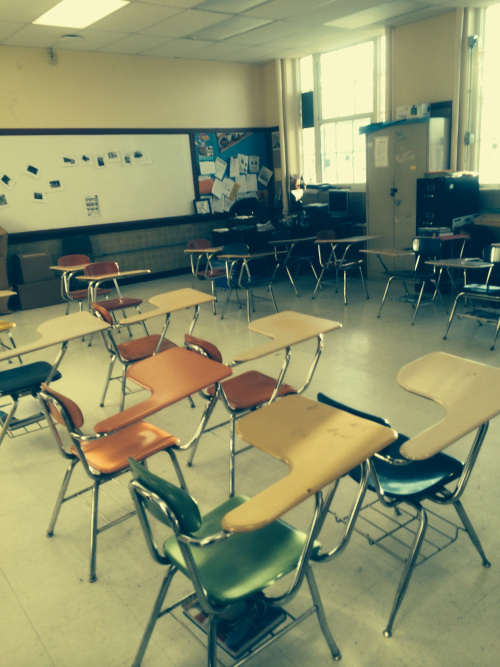
How teachers arrange the furniture in classrooms gives a peek into how teachers teach. Look at these photos taken last year of elementary and secondary classrooms that have different furniture arrangements.
Note the different arrangements of desks. In the first photo, rows of movable desks face the front of the classroom where the teacher’s desk is located. The second photo has a horseshoe pattern of tablet armchairs across from one another. The third photo is of an elementary classroom that is chock-full of materials and children working on different activities with adults sitting on the rug and chair working with individual pupils. And the final photo is one of a Continue reading: Arranging Classroom Furniture: A Glimpse into How Teachers Teach | Larry Cuban on School Reform and Classroom Practice
A REMINDER ABOUT TEACHING STUDENTS MATH IN NYC (AND BEYOND)
“So what you’re saying is that the statement at the top of this paper is for me to prove using these equations?”
I nod.
“OK, but I don’t get what f and g actually do. That’s making like no sense.”
[scribbles a bunch of notes on a board and, over the course of five minutes, gets to why mathematicians decided to write “f of g” with a dot but not explain how it actually works]
“OK, that was really good.”
“Was it?”
After all these years of taking time after school to show my former students – now high schoolers – what their teacher meant, I turned to the work I need to do from 8am – 2:20pm: my current students. I’ve had hundreds of students come back either in person or through video chats to concretize the math they’re learning outside of my schools. Each session, I’m taking a few minutes of free time and then imploring them to talk privately with their current math teachers. Some come out with more confidence in advocating for themselves. Others say their teacher won’t slow down for them. Others Continue reading: A Reminder About Teaching Students Math in NYC (And Beyond) | The Jose Vilson
Indy Voters: Here’s Your Chance to Oust an Ed-Reform School Board Incumbent.
When it comes to killing traditional public education in favor of market-based ed reform models that remove the community control from its own schools, market-based ed reformers means business– and the public would do best to believe that there is a market for the usurping of community influence over schools.
Consider the situation of Indianapolis Public Schools (IPS), as captured in this July 12, 2018, Washington Post feature written by my friend and colleague, Network for Public Education (NPE) communication director, Darcie Cimarusti, and presented here in part:
When schools reopen in Indianapolis, Indiana in July, the doors of three legacy high schools will remain shuttered. The Indianapolis Public School (IPS) board voted last fall to close them after six months of raucous meetings where community members accused the board and superintendent of ignoring community concerns. Like many school closures, the recent shuttering of what were once three great high schools would disproportionately impact low-income children of color.
Superintendent Lewis Ferebee cited budget concerns and declining enrollment throughout the district as justification. But as the traditional public high schools the community fought to keep open were closed, the district opened a charter high school co-founded by Mitch Daniels, former Indiana governor and education reform stalwart.
Daniels, now president of Purdue University and a founder of Purdue Polytechnic High School, spoke to the inaugural class of 159 students on their first day of school, July 31, 2017. Before Daniels’s new high school had even completed its first year, the Indianapolis Charter School Board approved the charter’s request to open an additional location.
In my last post I wrote that ISTA was “joining” with Stand for Children (SFC) to work for more state funding for education. At least that’s what I think they meant when they said,
ISTA is reaching out to a broad number of groups to help achieve increased school funding and teacher compensation – Stand is just one of these organizations.
I don’t know any more details than that.
ISTA’s President told a colleague that we should talk to her directly instead of posting on social media. I admit…the first thing I did when I heard that ISTA was “reaching out” to SFC was to tweet a “say it isn’t so” tweet. Since then, however, I have emailed the leadership twice – once on October 21, and again on October 23.
[I understand that they are busy. I’m retired. The leadership of ISTA is not. I have noticed that they have been having a variety of meetings lately. So, I’m not complaining that I haven’t heard from them. I appreciate the work they do for the teachers of Indiana. That’s why I was a member every year that I taught, and have Continue reading: ISTA and Stand for Children. For or Against? – Live Long and Prosper
It’s time Sacramento City School Board knuckled down and genuinely dealt with the budget. As a parent/advocate, I have been deeply engaged in district issues and aggressively pushed back when board decisions weren’t good for families. I helped lead a collaborative effort to mitigate the negative impacts following the board’s decision to close seven schools. Now I’d like to bring my success to our school board.
My hands-on experience gives me a thorough understanding of the dire, complex budget issues faced by our district. I have a clear vision, ideas for stabilizing our budget, and the fundamental understanding necessary to be effective and successful in implementing meaningful solutions.
Good schools create vibrant neighborhoods. Healthy school districts increase home values and benefit families, neighborhoods and the community. My commitment is entirely grounded in serving the families that make up our amazing community. Let’s bring our community together, get the right skills to the table, collaborate with teachers, and find effective solutions that work for the students and communities we serve.
I would be honored to have your vote on Tuesday, November 6.
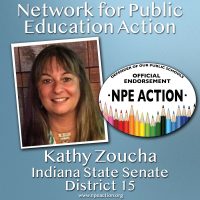
When we discover outstanding candidates that support our issues, and it is a race that we are able to support, we endorse. Candidates must complete a questionnaire and have the support of our supporters in the area. We do our best to contact all candidates in the race. For more information contact carol@npeaction.org.