Latest News and Comment from Education

Tuesday, June 27, 2017

Democratic Senators Condemn Betsy DeVos’ Record on Civil Rights - ProPublica

Democratic Senators Condemn Betsy DeVos’ Record on Civil Rights - ProPublica:

Democratic Senators Condemn Betsy DeVos’ Record on Civil Rights

More than 30 “disappointed and alarmed” senators penned a letter chastising civil rights enforcement at the Department of Education.


Image result for Democratic Senators Condemn Betsy DeVos’ Record on Civil Rights


In a letter sent today, more than 30 Democratic senators rebuked Education Secretary Betsy DeVos for scaling back civil rights enforcement at the Department of Education.
“You claim to support civil rights and oppose discrimination, but your actions belie your assurances,” wrote the senators, who said that the secretary’s recent moves to curtail civil rights efforts heightened their longstanding concerns about her commitment to protecting students from discrimination and harassment.
As ProPublica has reported, the Department of Education quietly laid out plans to scale back investigations into civil rights complaints in an internal staff memo earlier this month.
Under the Obama administration, the department’s civil rights investigators applied a broad approach to investigating complaints, often widening probes to look for patterns of harassment or discrimination in schools or districts. Investigators were frequently required to obtain multiple years of data to assess whether civil rights violations were systemic in nature.
In the recent memo, acting Assistant Secretary for Civil Rights Candice Jackson instructed her staff to narrow this approach. Under the new directive, civil rights staffers will only look for systemic violations if the original complaint raises such concerns or the investigative team suggests it.
“Limiting use of the systematic approach may cause investigators to miss issues of Democratic Senators Condemn Betsy DeVos’ Record on Civil Rights - ProPublica:

Randi Weingarten: Senate Health Care Bill: Medicaid Matters for Public Schools | Time.com

Senate Health Care Bill: Medicaid Matters for Public Schools | Time.com:

The Senate Health Care Bill Would 'Rip Away' Supports In Schools

Image result for The Senate Health Care Bill Would 'Rip Away' Supports In Schools


Randi Weingarten and Daniel Domenech


What does Medicaid have to do with schools? The answer is, plenty.
For millions of children, the health screenings and services they receive at school serve as a critical lifeline. Schools use Medicaid funding to provide basic health screenings for vision, hearing and mental health problems. For many children, this is their only interaction with a health professional all year.
Seventy-eight percent of school districts use Medicaid funding to hire school nurses, social workers and psychologists, speech-language pathologists, and other health professionals.
Medicaid funding is especially vital for children with special needs; it ensures schools have the resources for wheelchairs, feeding tubes, specialized playground equipment, medicine, and equipment to assist with seeing and hearing, as well as the staff to support these students. And for children with asthma and other chronic conditions, Medicaid funding means there’s always a health professional onSenate Health Care Bill: Medicaid Matters for Public Schools | Time.com:

Help wish Diane a Happy Birthday! - Network For Public Education

Help wish Diane a Happy Birthday! - Network For Public Education:

Help wish Diane a Happy Birthday!


 July 1st is Diane’s birthday.  She asks for only one gift: the hope that America’s public education system will thrive for the sake of our children – all of our children.

The Network for Public Education, the organization she founded and leads, is dedicated to helping Diane get her birthday wish.   And so she asks that you help her celebrate by making a tax deductible donation to NPE in her name.
If you make a donation of $10 dollars or more, we will put your name on a special card we are preparing for Diane.
Give a donation to something that matters. Help NPE fight privatization and Betsy DeVos.  Nothing will make Diane happier.
Happy 79th birthday, Diane!
 You can make your donation  here.
Happy Birthday, Diane!

Winner of Special Education Learning Award - Year 2017 (CA Dept of Education)

Winner of Special Education Learning Award - Year 2017 (CA Dept of Education):

State Schools Chief Tom Torlakson Congratulates Winner of Special Education Learning Award


SACRAMENTO— State Superintendent Tom Torlakson today congratulated the Rising Sun Transition Program in the Patterson Joint Unified School District on winning the 2017 Grazer Outstanding Achievement in Learning (GOAL) award, which recognizes outstanding programs in special education.
Rising Sun Transition Program is an agriculture-based school that provides services to students ages 18-22 with moderate to severe disabilities.
“Rising Sun provides its students with 21st century skills that can help them succeed in life,” Superintendent Torlakson said. “These young adults are learning a vocation in addition to learning the kinds of tasks—shopping, cleaning and financial responsibility—that will allow them to live independently.”
The school opened in 2010 with the goal of teaching students to become self-sufficient, active, contributing members in their communities. These goals are in addition to the personal goals established by an Individual Education Plan (IEP) for each student.
“We call the young adults that attend our school, clients versus students,” said David Hodge, Executive Director of Special Education. “We do this because we are serving them and we want them to understand that they deserve to be treated and regarded with the same level of respect and maturity that their typical peers receive at this age.”
The school has seen its alumni achieve significant milestones. More than 45 percent of the students who have graduated have obtained paid, part time, or full time employment.
Rising Sun provides community-based instruction allowing students to assist at a business or organization. The school also enjoys a unique collaboration with agricultural professionals who share their time and expertise with the students on campus.
Rising Sun Transition Program serves between 16-21 students each year. In the last seven years, the school has quickly become an important landmark of the Patterson Joint Unified School District programs and initiatives.
California Department of Education Special Education Division Director Kristin Wright presented the prestigious $5,000 GOAL award to representatives from the Rising Sun Transition Program during the June 22 California Advisory Commission on Special Education (ACSE) meeting in Sacramento.
The GOAL award was established in the 2005-06 school year and was funded by Hollywood producer Brian Grazer’s family to recognize exemplary practices in special education and to celebrate programs that serve California youth with disabilities along with the professionals who provide them.
For more information about the GOAL award, visit the ACSE on the CDE GOAL Web page.
For more information about Rising Sun Transition Program visit their Web site External link opens in new window or tab..

# # # #
Tom Torlakson — State Superintendent of Public Instruction
Communications Division, Room 5602, 916-319-0818, Fax 916-319-0100
 Winner of Special Education Learning Award - Year 2017 (CA Dept of Education):


Image result for Early Education


SACRAMENTO—State Superintendent of Public Instruction Tom Torlakson today announced that he has appointed Sarah Neville-Morgan as Director of the California Department of Education (CDE) Early Education and Support Division.
Neville-Morgan will oversee a division that provides leadership and support to the early learning and care community, providers, and contractors statewide, ensuring high-quality early education programs for young children.
Neville-Morgan most recently served as Deputy Director of Program Management at First 5 California, and she worked as a CDE Child Development Consultant from 2011 to 2013.
“I am pleased to have such an experienced and dynamic early education leader back on the CDE team,” Torlakson said. “Sarah brings tremendous knowledge, dedication, and teamwork that will help provide top-quality services for our earliest learners.”
As State Superintendent, Torlakson has placed a priority on early childhood education and serving the whole child so that young students arrive at kindergarten prepared to learn and able to succeed in classroom settings.
“As CDE realigns its organization to meet the needs of students, teachers, and educators, Sarah will be able to foster deeper collaboration with our partners in early education,” Torlakson said.
At First 5 California, Neville-Morgan managed a team of professional staff and managers focused on closing the achievement gap and enhancing early brain development. She also worked as the Deputy Executive Director of the California Early Learning Council and as an Academic Child Development Specialist at the UC Davis Center for Child and Family Studies.
Neville-Morgan earned a B.A. in Psychology at Earlham College in Richmond, Indiana and a M.S. in Child Development at UC Davis.

# # # #
Tom Torlakson — State Superintendent of Public Instruction
Communications Division, Room 5602, 916-319-0818, Fax 916-319-0100

Supreme Court rules on church playgrounds; are vouchers for California religious schools next? | EdSource

Supreme Court rules on church playgrounds; are vouchers for religious schools next? | EdSource:

Supreme Court rules on church playgrounds; are vouchers for religious schools next?


U.S. Secretary of Education Betsy DeVos and other supporters of school choice are hailing a U.S. Supreme Court decision Monday as one more step toward tearing down states’ opposition to tuition vouchers for private and religious schools.
Opponents in California and in other states whose constitutions ban using taxpayer money for religious schools, while disappointed with the ruling, are warning not to read too much into it.
In Trinity Lutheran Church of Columbia, MO. v. Comer, the court ruled 7-2 that the state of Missouri violated a church’s right to freely exercise religion by denying it a state-funded grant to improve the church’s preschool playground. Speaking for the majority, Chief Justice John Roberts wrote that Missouri’s policy excluding churches from participating in the playground retrofit program “expressly discriminates against otherwise eligible recipients by disqualifying them from a public benefit solely because of their religious character.” This, Roberts wrote, “is odious to our Constitution all the same, and cannot stand.”
The state funded 14 of 44 schools that had sought money to fix their playgrounds. Trinity Lutheran’s application had been rated 5th-most eligible before state officials ruled that the Missouri Constitution prohibited using public money to support religious schools.
California, like Missouri, is one of three dozen states that in the late 19th century passed the “Blaine Amendment,” named for a prominent politican from Maine, prohibiting the use of public money for religious schools. California’s version also bans teaching “any sectarian or denominational doctrine … directly or indirectly,” in any public school.
In a footnote to the decision, Roberts implied that the decision applied only to playground resurfacing, not school vouchers and other uses of public dollars. “We do not address religious uses of funding or other forms of discrimination.”
But two Supreme Court justices, Clarence Thomas and the court’s newest justice, Neil Gorsuch, Supreme Court rules on church playgrounds; are vouchers for religious schools next? | EdSource:

NEA Today: Supreme Court Ruling Sidesteps Questions Regarding State Constitutional Protections for Public Education

Supreme Court Ruling Sidesteps Questions Regarding State Constitutional Protections for Public Education:

Supreme Court Ruling Sidesteps Questions Regarding State Constitutional Protections for Public Education

Image result for tap dancing off animated gif


In a narrowly written decision, the Supreme Court held in Trinity Lutheran Church of Columbia, Inc. v. Comer that Missouri could not refuse a playground grant to a church solely due to the fact that the church is a religious institution. In so holding, the court noted that the case involved express discrimination based on religious identity with respect to such a grant, and that the court was not “address[ing] religious uses of funding or other forms of discrimination.”
The court’s refusal to rule broadly will surely be a disappointment to school voucher proponents who had sought to use the dispute over playground resurfacing grants to undermine state constitutional protections for public education.
The 7–2 decision both leaves intact the Missouri constitutional provision at issue in the case insofar as it prohibits state funding of religious actions and leaves undisturbed the similar provisions of 38 other states. These “no aid” provisions were enacted to protect the common schools and have been applied for decades to ensure that resources for those schools were not diverted to private religious institutions.
The National Education Association (NEA) filed an amicus brief in the case arguing that these state constitutional provisions should not be swept aside and that a state’s independent interpretation of their constitutional provisions regarding church-state separation should be respected.
NEA applauded the Supreme Court’s decision. The Court’s refusal to accept the invitation of voucher proponents to issue a broad ruling, said NEA President Lily Eskelsen García, preserves the ability of states to protect their public education system by refusing to divert public school funding to private religious schools.
“State constitutional provisions and decades of precedent protect our public education system from voucher programs. The court’s ruling is a big setback for those who want to push voucher programs that take taxpayer dollars out of public schools to divert them to private religious schools,” Eskelsen García explained.
“Rather than continue the flawed policy of vouchers, let’s focus on what works to provide students with the great public schools they deserve.”Supreme Court Ruling Sidesteps Questions Regarding State Constitutional Protections for Public Education:

The Beginning of the End for Blaine? | Jay P. Greene's Blog

The Beginning of the End for Blaine? | Jay P. Greene's Blog:

The Beginning of the End for Blaine?

ganges18762

(Guest Post by Jason Bedrick)
Yesterday, the U.S. Supreme Court ruled in Trinity Lutheran that the U.S. Constitution prohibits the government from excluding otherwise eligible religious organizations from benefitting from publicly funded programs merely because they are a religious organization. (I discussed the implications here.) However, Footnote 3 said:
This case involves express discrimination based on religious identity with respect to playground resurfacing. We do not address religious uses of funding or other forms of discrimination.
So, does the case have broader implications beyond playgrounds? Interestingly, Chief Justice Roberts “delivered the opinion of the Court, except as to footnote 3,” and two additional justices, Gorsuch and Thomas, concurred in the opinion but not in the footnote, explaining:
Of course the footnote is entirely correct, but I worry that some might mistakenly read it to suggest that only “playground resurfacing” cases, or only those with some association with children’s safety or health, or perhaps some other social good we find sufficiently worthy, are governed by the legalrules recounted in and faithfully applied by the Court’s opinion. Such a reading would be unreasonable for our cases are “governed by general principles, rather than ad hoc improvisations.”[…] And the general principles here do not permit discrimination against religious exercise—whether on the playground or anywhere else.
Today, SCOTUS has indicated that its ruling in Trinity indeed does have implications beyond the playground. The Court has vacated the Colorado Supreme Court’s decision that struck down the Douglas County voucher program based on the state’s Blaine Amendment, and ordered the The Beginning of the End for Blaine? | Jay P. Greene's Blog:

Image result for big education ape Blaine

6 Ways to Make the Most of Student Teaching - Teacher Habits

6 Ways to Make the Most of Student Teaching - Teacher Habits:

6 Ways to Make the Most of Student Teaching

student teaching


I received an email from a reader who is anxious about her upcoming student teaching experience and wanted to know if I could share some advice. After throwing some ideas around with a much younger teacher (that hurts to type) and reflecting on my own experiences, I’ve come up with some ideas. Please add your own in the comments so that aspiring teachers may benefit.
To make the most of student teaching, do as Stephen Covey commands:
Keep the main thing the main thing.
The main thing is getting a full-time teaching job next year. Yes, you also want to develop skills, collect ideas, network, and connect with students, but none of that stuff matters much if you don’t get your own classroom. Keep your eye on the prize. You are about to start a long interview process.
To that end, and before you get a placement, fight for the grade level you want. Your college will tell you it doesn’t matter. What else are they supposed to say? They have limited placement opportunities, so not everybody can get what they want. But we know how squeaky wheels work. So squeak. Your student teaching will be going on your resume. If you want to teach third grade, administrators are going to favor candidates with third grade experience over those who have only taught fifth graders. It’s not disqualifying if you student teach in a grade other than the one for which you’re applying, but in a close competition with another candidate, it may disadvantage you. Try to get the grade you want to teach for your student teaching.
Now, here’s one thing you do not need to worry much about: how good 6 Ways to Make the Most of Student Teaching - Teacher Habits:

Michigan: State Takeover Effort Collapses, Schools Will Return to Detroit Public School District | Diane Ravitch's blog

Michigan: State Takeover Effort Collapses, Schools Will Return to Detroit Public School District | Diane Ravitch's blog:

Michigan: State Takeover Effort Collapses, Schools Will Return to Detroit Public School District


Michigan’s Education Achievement Authority is closing down, and the low-performing schools put into the state-controlled district will be returned to the Detroit public schools.
The EAA was a disaster from the beginning. Its leaders had total control, and they used it to run experiments on the children, using technology. They ran up the bills and produced no academic improvements. The first leader was Robert Bobb, with Barbara Byrd-Bennett as chief academic officer (BBB is now sentenced to jail time for taking bribes in her role as superintendent of the Chicago public schools). Then there was Broad-trained John Covington, who increased the deficit, then moved on. At all times, Eli Broad was deeply involved in creating and staffing the EAA. This Friday is the last day for the EAA.
The EAA’s 15 schools will stay open, but they’ll be absorbed back into the Detroit Public Schools Community District. Sonya Mays, treasurer for the DPSCD school board, says the district is working with the EAA to make it a smooth transition for students.
The two districts are coordinating on transferring school records, communicating with families, and hiring administrators and teachers, among other things.
“And so it’s our hope, and we’ve tried to be very intentional about this, that students themselves will see very little disruption,” Mays said.
Big Education Ape: CURMUDGUCATION: The Takeover Lie - http://bigeducationape.blogspot.com/2017/05/curmudgucation-takeover-lie.html
 
Big Education Ape: STATE TAKEOVER: An Achievement School District Primer - Mitchell Robinson: Reforming Reform - http://bigeducationape.blogspot.com/2015/07/state-takeover-achievement-school.html

Big Education Ape: Experts warn of murky results from State Takeover charter schools - http://bigeducationape.blogspot.com/2016/06/experts-warn-of-murky-results-from.html

We have become too Permissive, not Progressive. | DCGEducator: Doing The Right Thing

We have become too Permissive, not Progressive. | DCGEducator: Doing The Right Thing:

We have become too Permissive, not Progressive.

images

Defined as granting or inclined to grant permission as in permissive parents; characterized by freedom of personal behavior or a disregard of social mores, the term was heavily used to describe the parenting practices of my generation of baby boomers. It was sparked by the changes of the 1960s and a revolt against the practices of their far stricter parents. As in every decision in life, there were intended and unintended consequences to this generational decision. Were the consequences of the acceptability of permissiveness the far-reaching social, economic, and political issues we face today in our wild and wacky society?
I am a proud independent, anti-authoritarian, libertarian, liberal and moderate progressive. (If you know me, pick your own label.) But folks, somehow we got things totally screwed up. I know what I am about to go on record saying may piss off a bunch of you but tough shit. See, I already did, but made George Carlin Proud.
Speaking of my comic hero, why is it that the most anti-authoritarian, independent, libertarian, liberal, progressives in our country today are comics We have become too Permissive, not Progressive. | DCGEducator: Doing The Right Thing:

John Thompson: North Highland Elementary an important history lesson - NonDoc

North Highland Elementary an important history lesson - NonDoc:

North Highland Elementary an important history lesson

North Highland


It would have been a mistake to follow through with an initial plan to abruptly close North Highland Elementary School without taking time to consult with the community or to make plans. To her credit, Superintendent Aurora Lora has backed off from that approach.
Also to its credit, the current OKCPS administration now acknowledges the need for wraparound services. In announcing a change to its plans after the school was burglarized and vandalized Friday night, the administration explained,
… district teams will work to staff the building with additional supports including an extra assistant principal, full-time counselor, and two social workers, all of which were allocated to North Highland prior to the consideration of a temporary closure.
 North Highland vandalism

Classrooms, hallways and offices were vandalized at North Highland Elementary School following news it would be temporarily closed. The school will now remain open. (OKCPS)

North Highland problems in 2012 led to brief closure

In 2012, then-Oklahoman reporter (and current school board member) Carrie Coppernoll covered the brief closure of the school to discuss its rampant disorder. OKCPS said that half of the faculty was new, but turnover was a long-standing problem. It admitted, “Sometimes we may Band-Aid something when really we need a full 9-1-1 effort,”
The district pledged to get to the roots of the situation. Instead, it focused on the easy “areas of teacher training, including behavior, [and] classroom management.”

Segregation by any other name …

Many of the problems facing today’s North Highland neighborhood can be traced to the way the Oklahoma Industries Authority conducted urban renewal, wrecking a proud African-American community and the way that families were relocated to the Highland.
For unnerving accounts of how urban renewal created the same destruction across the North Highland Elementary an important history lesson - NonDoc:

LILY ESKELSEN GARCÍA: The Supreme Court just let a church use public funds to fix its playground. Will this shift public education’s terrain? - The Hechinger Report

OPINION: The Supreme Court just let a church use public funds to fix its playground. Will this shift public education’s terrain? - The Hechinger Report:

OPINION: The Supreme Court just let a church use public funds to fix its playground. Will this shift public education’s terrain?
Here’s why the ruling in favor of Trinity Lutheran may not be a green light for vouchers


hen the U.S. Supreme Court agreed in 2016 to hear arguments in Trinity Lutheran Church of Columbia, Inc. v. Comer, school voucher advocates saw an opportunity.
The case actually revolved around the specific question of whether the state of Missouri could refuse a grant to resurface a playground to a church solely due to the fact that the church is a religious institution.
But a broad enough ruling in favor of the church could dismantle so-called “no aid” provisions that states have enacted to ensure that state resources for public schools were not diverted to private religious institutions. This was the invitation voucher proponents made to the nine justices.
On Monday, the court turned down the offer.
In a 7-2 ruling, the justices ruled that while Missouri could not refuse a playground grant to a church solely due to the fact that the church is a religious institution, the court was not “address[ing] religious uses of funding or other forms of discrimination.” In other words, the ruling was not a green light for school vouchers.
Educators and parents across the country should applaud the court’s refusal to place in doubt decades of precedents enforcing state constitutional protections of our public schools.
It doesn’t matter how their backers try to disguise them — “education savings accounts,” “tuition tax credits,” “opportunity scholarships” — vouchers are a destructive and misguided program that take scarce funding away from public schools, where 90 percent of America’s students attend, and give it to private schools that are unaccountable to the public.
Unlike public schools, private schools have almost complete autonomy with regard to how they operate: who they teach, what they teach, how they teach, how — if at all — they measure student achievement, OPINION: The Supreme Court just let a church use public funds to fix its playground. Will this shift public education’s terrain? - The Hechinger Report:

2016 BackPack Index : Communities In Schools

2016 BackPack Index : Communities In Schools:

2016 BackPack Index


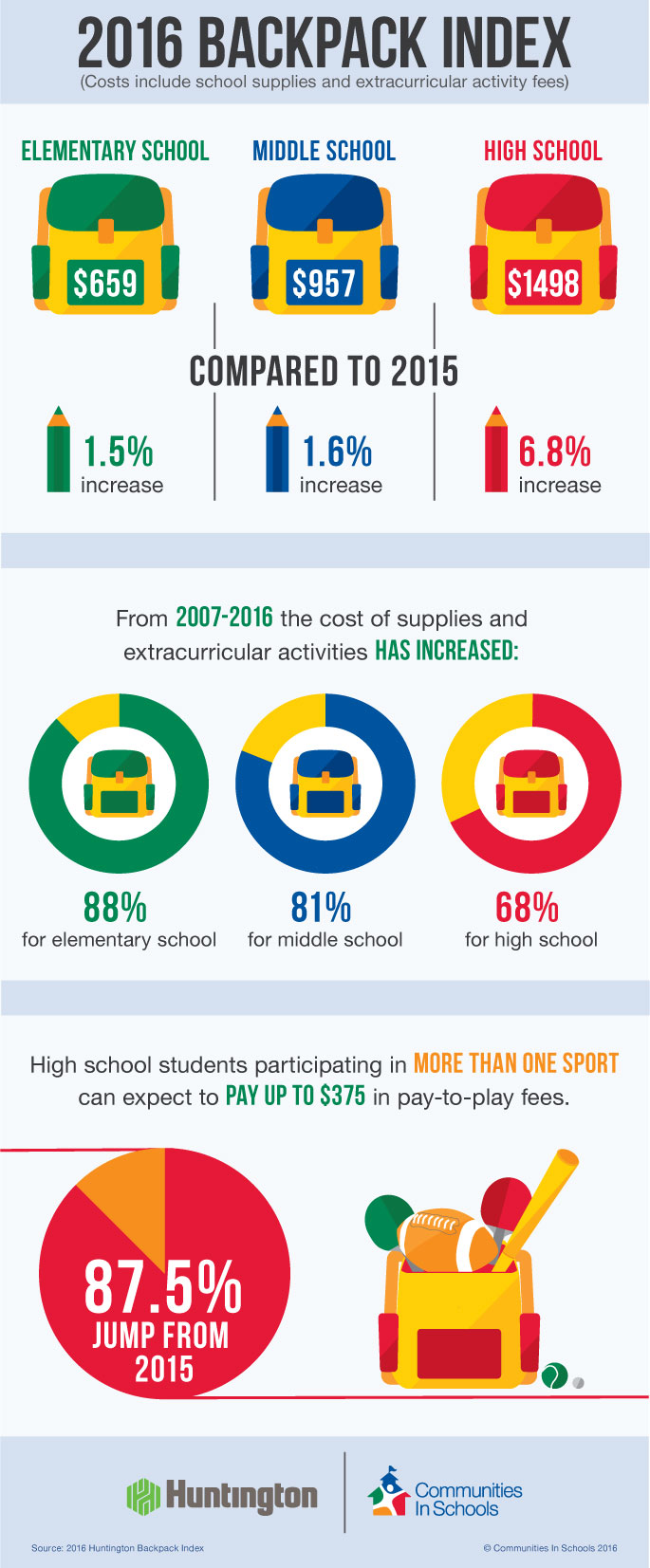
 At the 10-year mark for the Huntington Backpack Index, the cost of supplies and extracurricular activities has increased from 2007-2016 by 88 percent for elementary school students, 81 percent for middle school students and 68 percent for high school students.
For the 2016-2017 school year, according to the Backpack Index parents can expect to pay per child:
  • $659 for elementary school children, a 1.5 percent increase compared to 2015.
  • $957 for middle school children, a 1.6 percent increase compared to 2015.
  • $1,498 for high school students, a 6.8 percent increase compared to 2015.


Devos: School Choice Vouchers Don't Improve Performance | Time.com

Devos: School Choice Vouchers Don't Improve Performance | Time.com:

Betsy DeVos Wants to Spend Millions on School Vouchers. Two New Studies Say They Don't Actually Work


President Donald Trump's proposed 2018 budget includes $250 million for voucher initiatives, state-funded programs that pay for students to go to private school. Another $1 billion is set aside for encouraging schools to adopt school choice-friendly policies. Betsy DeVos, Trump's education secretary, is an outspoken advocate for such programs, which she has argued would lead to better educational outcomes for students.
But a pair of new studies released Monday provide evidence that voucher programs don't improve students' performance on standardized tests, one quantifiable method of testing educational outcomes.
"There may be some places where vouchers are working for some students, but generally we need to understand a lot more about the conditions under which vouchers are effective or not," Mark Berends, co-author of the Indiana study, told TIME.
The first study, a joint project from Tulane University's Education Research Alliance and the University of Arkansas' School Choice Demonstration Project, found that voucher programs did not produce improvement on students' test scores.
The researchers used standardized test scores spanning from 2012 to 2015 to analyze students' outcomes from the Louisiana Scholarship Program, an initiative that paid for 7,000 children from low- and moderate-income families to attend private schools. They found that students in the Louisiana voucher program initially had lower test scores, but after three years, their scores matched those of students who stayed in public schools.
A second study, meanwhile, examined the statewide school voucher program in Indiana, one of the largest initiatives of its kind in the U.S. The unpublished study from the University of Notre Dame and the University of Kentucky, which is pending peer review, found that Indiana's 34,000-student program had a Devos: School Choice Vouchers Don't Improve Performance | Time.com:


School choice programs pay off for donors - Longform Story

School choice programs pay off for donors - Longform Story:

School choice programs pay off for donors
Are tax benefits too generous?


Dibye Bass’ 12-year-old son, like thousands of children, has benefitted from a school choice program championed by the Trump administration that offers big-money donors tax breaks which critics say are too generous.

Bass’ son was bullied in a Virginia public school and a scholarship tax credit program was his way out and into a private school that the single mother said has made a difference in her son’s life. Regardless of questions raised about the way the programs are financed, she said she is grateful.

“I see it as something that encourages you to give more. Not just for a tax break but because you’re doing something good,” she said.

 But here’s what’s unusual, if not controversial, about the scholarship programs: Wealthy donors can potentially “profit” from their contributions through extensive tax benefits that can drain money from state treasuries which fund public services — including public schools.


The programs are available in 17 states and are being considered by legislators in several others. They are praised by Secretary of Education Betsy DeVos — a longtime school choice advocate — and are the focus of two congressional bills that seek to create a federal version of the program.

All the programs basically work this way: Individuals and businesses make cash or stock donations to scholarship granting organizations. The organizations award scholarships to qualifying families with K-12 students, primarily children in failing public schools or whose families' income meets the state’s poverty threshold. Students can then attend a private or religious school of their choice. What makes these programs unique is that donors get a full or partial credit toward their state taxes, which they are not allowed when donating to most other charities, and this allows them to realize a sizable tax advantage when combined with a federal deduction on the same gift. Plus, in some states, donors also get a state deduction.

“What these scholarship tax credits do is they super charge that incentive up to 100 percent of the amount donated,” Carl Davis, senior tax expert with the Institute on Taxation and Economic Policy, said. “And in the right set of circumstances, they’re receiving more back in tax breaks than they ever donated in the first place. … They’re able to claim a state tax credit and a federal deduction on a single donation and this is often profitable for them to do so.”

Davis’ organization released a report last month in conjunction with the School choice programs pay off for donors - Longform Story:

Have You Heard

Have You Heard:

Have You Heard


Putting the ‘i’ in School
Tweet Have You Heard Episode #20: Personalized Learning and the Disruption of Public Education Fantastic news, listener. The cure for what ails our long failing public schools has finally been found and it’s personalized learning! Except that as our special guest, Bill Fitzgerald, breaks down for us, a more accurate term for this miracle cure-all is *algorithmically-mediated learning, which is ab
No Clean Hands
Tweet I’m responsible for the appointment of Betsy DeVos as Secretary of Education. Are you? By Alicia 18 th century political and moral philosopher Joseph de Maistre said every country gets the leader it deserves. More recently, professor and public intellectual Tressie McMillan Cottom pointed out there are no innocent parties in the expansion of market-based education. That’s over two centuries
Labor Pains
Tweet I talk to veteran union critic Mike Antonucci about what’s next for unions, whether charter school teacher organizing is *a thing,* and whether he has any advice for teacher union heads Randi Weingarten and Lily Eskelsen Garcia… Jennifer Berkshire : You’ve been predicting that it’s only a matter of time until the Supreme Court delivers a crushing blow vs. public sector unions. This intervie

JUN 06

Buying Influence
Tweet Have You Heard Episode #19: Big Money and School Board Elections Today’s $17 million question: how did school boards become the must-have accessory for the donor who has everything? That’s the question that Jack Schneider and I put to researcher Rebecca Jacobsen, who has been studying the role of big donors in school board races across the country. Jacobsen walks us through the emergence of

MAY 26

Screw U
Tweet Betsy DeVos’ top advisor led a for-profit university that defrauded students and hoovered up federal student aid. Now Robert Eitel is tasked with *right-sizing* the Department of Education. What could possibly go wrong? Jennifer Berkshire : This week Betsy DeVos announced that she was tasking one of her top advisors, Robert Eitel , formerly of Bridgepoint Education, Inc., with overseeing th
DNA Test: The Ancestry of Charter Schools
Tweet Did you hear the one about how charter schools were the brainchild of Albert Shanker, the legendary teachers union head? Writer Rachel Cohen did, but when she began tracing the tale back to its origins, she found that the real 
 Have You Heard: