Latest News and Comment from Education

Tuesday, June 20, 2017

VOUCHER WATCH LAUNCHED TO COMBAT USE OF PUBLIC FUNDS FOR PRIVATE SCHOOLING | Education Law Center

VOUCHER WATCH LAUNCHED TO COMBAT USE OF PUBLIC FUNDS FOR PRIVATE SCHOOLING | Education Law Center:

VOUCHER WATCH LAUNCHED TO COMBAT USE OF PUBLIC FUNDS FOR PRIVATE SCHOOLING
ELC AND MUNGER TOLLES TO HELP ADVOCATES PROTECT NATION’S PUBLIC SCHOOLS


Education Law Center (ELC) and Munger, Tolles & Olson LLP announce the launch of Voucher Watch, an initiative to inform and assist advocates as they oppose the establishment and expansion of vouchers in their states.
Voucher Watch, located on the ELC website, will track voucher proposals in state legislatures and from the federal government, provide details on existing state voucher programs, and compile research on the impact of vouchers on student outcomes.
“Vouchers divert public funds from already under-resourced public schools,” said David Sciarra, ELC Executive Director. “With Voucher Watch, we’ll be ready to help parents, teachers, advocates and lawmakers oppose vouchers and protect and improve their public schools.”
ELC and Munger Tolles are launching Voucher Watch after their successful collaboration on a legal challenge to Nevada’s unlimited “Education Savings Account” (ESA) voucher program. ELC and Munger Tolles represented public school parents pro bono in Lopez v. Schwartz, which resulted in a Nevada Supreme Court decision finding ESA vouchers unconstitutional because they diverted funding allocated for the public schools to private education expenditures.
“The pro-voucher movement presents a serious challenge for public schools across the nation,” said Tamerlin Godley, the Munger Tolles attorney who argued the Nevada voucher case before the State Supreme Court. “Every effort must be made to ensure that public dollars remain where they are most needed and do the most good – in our public schools.”
ELC, a non-profit organization working to secure the education rights of public school children, opposes using taxpayer dollars to pay for private and religious schooling. Established in 1973, ELC is the nation’s leading advocate for fair public school funding and has assisted advocates and lawyers in advancing school finance reform in almost every state.
Voucher Watch builds on ELC’s national network of advocates, law firms, and civil rights and advocacy organizations working to secure high quality educational opportunities for public school children.
“ELC is pleased to continue our partnership with Munger Tolles through the Voucher Watch initiative,” said Greg Little, ELC Chief Trial Counsel. “Tammy Godley and her team at Munger Tolles did an outstanding job of representing Nevada public school parents in securing a permanent injunction against Nevada’s unlimited ESA vouchers. We look forward to working together to bring much needed help to those fighting vouchers in other states.”
About Munger, Tolles & Olson LLP
For more than 50 years, Munger, Tolles & Olson LLP has been a full-service law firm known for trying bet-the-company cases and negotiating deals that shape our corporate landscape. Our 200 lawyers represent clients in a broad range of complex and high-profile matters in the areas of corporate, litigation, real estate and financial restructuring. Munger Tolles has been consistently ranked on The American Lawyer’s A-List since its inception in 2004, including four years in the top spot. For more information, please visit www.mto.com.

Please visit the Voucher Watch web pages frequently for up-to-date information.

CURMUDGUCATION: Finn Backs Accountability-- Hard

CURMUDGUCATION: Finn Backs Accountability-- Hard:

Finn Backs Accountability-- Hard

Image result for big education ape Chester Finn

The Great Divide in the reform world continues to be right along the lines of accountability, with DeVos and her DeVotees being pretty much against it in any meaningful sense. Just let the marketplace sort it out, they say, and Jeanne Allen, of the Center for Education Reform (a hard core charter-backing group), put together a whole book to help argue the point.


It can happen
Several folks have taken a shot at reviewing that tome. I'm not one of them (because I have two week old twins at my house), but here's a good look at parts of the work by Mercedes Schneider. And here's a review by Chester Finn, head honcho emeritus of the Thomas B. Fordham Institute, a reliable backer of education reform, and a guy I generally disagree with (just search his name on this blog). 

So let me mark this occasion on which I not only agree with part of what Finn has written, but would gladly written it myself. Finn first sums up the notion that "the market will provide all the quality control that’s necessary. Quality is in the eye of the beholder, i.e., the parent—and the school operator. The heck with school outcomes." And then he unloads this paragraph:

This is idiocy. It’s also entirely unrealistic in the ESSA era. It arises from the view—long since 
CURMUDGUCATION: Finn Backs Accountability-- Hard:


Well-Funded Non-Profits Pave the Way to Privatization - Living in Dialogue

Well-Funded Non-Profits Pave the Way to Privatization - Living in Dialogue:

Well-Funded Non-Profits Pave the Way to Privatization 

Image result for big education ape billionaires

By John Thompson.
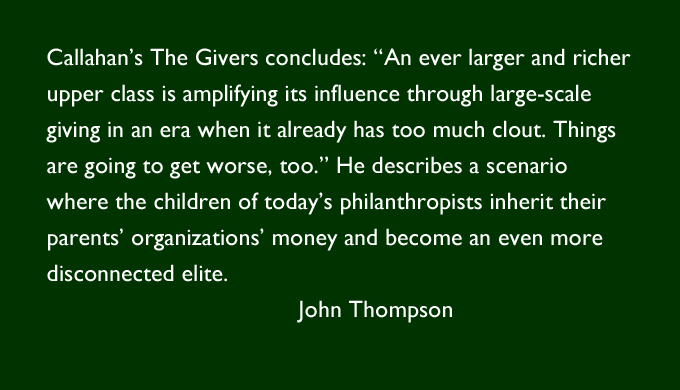
David Callahan’s The Givers begins with the first politicized think tanks of the 1960s and 1970s, such as the American Enterprise Institute. Callahan may be right and the AEI may have been one of the more intellectually honest of the conservative alternatives to academic research, but still it didn’t abide by the rules of evidence that apply in universities.  These first generation think tanks were designed to “excel at framing the terms of public debates” and to “wage big-picture ideological warfare.” 
The rise of Silicon Valley prompted the growth of what ProPublica’s Jesse Eisenberg called “a society of oligarchs.” I used to think it is an exaggeration to speak of “new Silicon Valley overlords.” After all, the tech world is collaborative as well as competitive.

Besides, as a pro-choice lobbyist, I had personal experience with the care with which the reproductive rights movement, at least, took to obey the spirit and the letter of the laws regulating charitable organizations. We took special care to ensure that it was our 501(c)(4) non-tax exempt organization, not the 501(c)(3), that engaged in political action.  I had no idea that the IRS would allow the shenanigans recently documented by the Washington Post.

The Post’s Robert O’Harrow Jr. and Shawn Boburg document the efforts by Donors Capital Fund, Donors Trust, the Bradley Foundation, the Scaife family, and David Horowitz’s Freedom Center as they “financed nonprofit organizations that promoted free enterprise and small government and opposed the environmental movement and other issues favored by progressives.” They also paved the way for the election of Donald Trump. Big donors used tax exempt charities to create what Horowitz dubbed, “a shadow political universe.”
But those are rightwingers. Surely more progressive and neoliberal donors would respect the rule of law and the principles of our democracy….

Callahan’s new book, along with other research, further documents the overreach of the “Billionaires Boys Club” which Well-Funded Non-Profits Pave the Way to Privatization - Living in Dialogue:

Image result for big education ape billionaires
Image result for big education ape 501c4

CURMUDGUCATION: Digital Native Naivete

CURMUDGUCATION: Digital Native Naivete:

Digital Native Naivete

Image result for digital natives are hugely naïve about technology

The cliché is a fifty-year-old asking some ten year old student for help in making the computer work. Having trouble making working with your device or your software? Just grab one of those digital natives to handle it for you!

Well, not so fast. Here's Jenny Abamu at Edsurge saying what I've been arguing for over a decade-- our digital natives are hugely naïve about technology.

With the adoption of any new technology, there's a curve. In the 1910s, if you owned an automobile, you were also a reasonably savvy mechanic who knew how to work on his own machine. But in the century since, cars have become advanced in a way that has led to fewer and fewer car owners who could actually repair their own vehicle. 


It's a simple fact of marketing-- early adopters may be willing to know the nuts and bolts of the tech, but to expand my market, I have to be able to say to non-savvy buyer, "Don't worry-- the tech will take care of everything for you." I have to make the tech user-friendly, and the friendlier it is, the less my customers need to know. The goal is to move from a product that only an aficionado can handle to a product that any dope can use. We are well into Any Dope territory with computer tech (spoiler alert: Linux is not the PC wave of the future).

Fifteen to twenty years ago, I could count on a few students in each class who could code. I used student helpers to build the school website from scratch. But nowadays I have to explain to my 
CURMUDGUCATION: Digital Native Naivete:


 Image result for digital natives are hugely naïve about technology

NOBODY Wants To Work for Betsy DeVos Staffing Woes at the Education Department

Federal pick to lead higher ed policy drops out of consideration:

Staffing Woes at the Education Department

Claude Pressnell, apparent choice as assistant secretary for postsecondary education, removes himself from consideration, further stalling efforts to fill leadership ranks at the Education Department.


The Trump administration’s pick to oversee higher ed policy at the Department of Education is out of the running.
In an email last week, Claude Pressnell, president of the Tennessee Independent Colleges and Universities Association, said he was withdrawing his name from consideration for the job of assistant secretary for postsecondary education.

It’s the second time in recent weeks that a candidate for a high-profile role at the department has said “no thanks” to the department deep in the vetting process. And it underscores the slow progress since January in making key political hires to round out Education Secretary Betsy DeVos’s team.
Pressnell said in the email to presidents of TICUA member institutions that he and DeVos had discussed since April the possibility of his being appointed to the assistant secretary position by President Trump.
“Whereas it was a great honor to be approached about accepting the appointment, after arduous consideration I have decided to withdraw my name from consideration,” he wrote. “The TICUA Board of Directors very graciously worked with me through this process. This was one of the most difficult decisions of my career, but I am thrilled to continue my work with TICUA.”
Pressnell declined to comment on the email or the reasons for his decision.
The department declined to comment about its hiring efforts. Some well-connected Republicans cautioned Federal pick to lead higher ed policy drops out of consideration:

Debate heats up over teaching climate change in US schools

Debate heats up over teaching climate change in US schools:

Debate heats up over teaching climate change in US schools

Image result for DeVos  Climate Change Education


COLUMBUS, Ohio (AP) — The struggle over what American students learn about global warming is heating up as conservative lawmakers, climate change doubters and others attempt to push rejected or debunked theories into the classroom.
An overwhelming majority of climate scientists say manmade emissions drive global warming, but there’s no such consensus among educators over how climate change and its causes should be taught.

Several U.S. states recently considered measures allowing or requiring teachers to present alternatives to widely accepted viewpoints on such topics. For example, a stalled proposal in Iowa would have required teaching “opposing points of view” on topics such as global warming, and proposed science standards in Idaho would have students taught that human impact is driving global warming and that natural factors also contribute.
The debate is arriving on teachers’ doorsteps nationwide, as thousands are being mailed the book “Why Scientists Disagree about Global Warming” from a Chicago-area advocacy group called The Heartland Institute that challenges the assertion that there is consensus about a human-caused climate crisis. In a follow-up statement, the institute’s president said science instructors should “keep an open mind” and shouldn’t teach “dogma pushed by some environmental activist groups.”

The National Center for Science Education made rebuttal flyers explaining that Heartland relies on debunked theories. The National Science Teachers Association dismissed the mailing as propaganda and urged educators to recycle the books.

Meanwhile, President Donald Trump’s decision to withdraw the United States from an international agreement aimed at curbing global warming is reinforcing some teachers’ sense of urgency about discussing humans’ role in accelerating climate change.

“This isn’t just something we’re talking about because it’s going to be on the test,” said Jim Reding, a high school teacher in Granville, Ohio, who said he wants his students to think critically and have civil, reasoned conversations on the topic. “This is something that could have an impact on my life or my children’s life going forward.”

An NCSE survey released last year of 1,500 public middle- and high-school science teachers found about three-quarters taught something about climate change during the 2014-15 school year. About a quarter give equal time to “perspectives that raise doubt about the scientific consensus,” the survey found.

Approaches to teaching climate science depend largely on state science standards and decisions by districts and instructors, because the federal government doesn’t dictate curriculum, said Glenn Branch, deputy director of the science education center. Many schools teach climate change in some way, but teachers varyDebate heats up over teaching climate change in US schools:


 Related image
Image result for DeVos  Climate Change Education

Elizabeth Warren: Gay Pride Month Love Letter (Exclusive) | Billboard

Elizabeth Warren: Gay Pride Month Love Letter (Exclusive) | Billboard:

Senator Elizabeth Warren: Love Letter to the LGBTQ Community


For Gay Pride Month, Billboard asked numerous pop culture luminaries to write 'love letters' to the LGBTQ community. Below, Senator Elizabeth Warren of Massachusetts -- a champion of LGBTQ rights -- shares hers. Read more Pride Month love letters here.
Right after I was elected, the organizer of Boston Pride asked if I would march again in next year's parade. I said no, absolutely not--I would not march.  
We stared at each other for a minute, and I shouted, "I don't want to march at Pride--I want to dance!"
And that's what I do every year--dance!  I dance with people young and old, black and white, Latino and Asian, lesbian, gay, bisexual, transgender and straight. And this year I’m happy to dance in the parade once again with my friends from the Boston Alliance of Gay Lesbian Bisexual & Transgender Youth (BAGLY), a terrific group working to support and empower members of the Boston LGBTQ youth community.
Pride shows our country at its best: diverse, inclusive, united, and strong. We'll cheer the progress we’ve made toward building a more welcoming society for all, and we'll recommit to protecting the rights of all Americans, so that everyone in this country is treated with dignity and respect--so everyone gets a chance to dance!Elizabeth Warren: Gay Pride Month Love Letter (Exclusive) | Billboard:
Gay Pride Month 2017


 Elizabeth Warren: Gay Pride Month Love Letter (Exclusive) | Billboard:

Newpoint Education Partners owner faces criminal charges

Newpoint Education Partners owner faces criminal charges:

Newpoint Education Partners owner faces criminal charges


The owner of Newpoint Education Partners, an organization that managed public charter schools in six Florida counties including Escambia County, has been charged with racketeering and organized fraud.
Marcus May, the owner of Newpoint, is accused of misusing more than $1 million in public funds, according to a news release from the State Attorney's Office.
The state alleges May used "shell companies" he held undisclosed ownership of, or financial interest in, to sell goods and services to Newpoint-managed schools at inflated prices, then pocketed the proceeds.
Hundreds of thousands of state and county dollars meant for Newpoint schools actually went to paying portions of May and his family's property purchases, business dealings, trips abroad, household bills and even plastic surgery, a state affidavit alleges.
May could not be reached for comment Monday.
Assistant State Attorney Russell Edgar, who is prosecuting the case for the state, said May is not in custody, but that the State Attorney's Office is in communication with May's attorney. 
The charges against May stem from a wider investigation of grade tampering, teacher misconduct and financial improprieties at Newpoint schools. Newpoint, as a business entity, has been charged with grand theft, money laundering and aggravated white collar crime.
Edgar said May was also charged individually because, "From the evidence, it appears he instigated this."
From 2007 to 2016, Newpoint managed 15 public charter schools in Escambia, Bay, Duval, Hillsborough, Pinellas and Broward counties. All told, the schools received more than $57 million in public funds from the state of Florida and various school districts.
The state affidavit alleges May used those public funds to buy goods and services — at extreme markups — from companies he or his business partners owned.
May created some businesses "solely to do business with Newpoint," according to the Newpoint Education Partners owner faces criminal charges:


The Whole Newpoint Charter School Scandal  – Rick’s Blog - http://ricksblog.biz/?p=53801


 Image result for marcus may newpoint education partners


June Solstice - Summer and Winter Solstice

June Solstice - Summer and Winter Solstice:

June Solstice: Longest and Shortest Day of the Year

Image result for Summer Solstice

The June solstice is the Summer Solstice in the Northern Hemisphere and the Winter Solstice the Southern Hemisphere.


Illustration image
The June Solstice. (Not to scale)


The date varies between June 20 and June 22, depending on the year, and the local time zone.
June Solstice in Citrus Heights, California, USA is on

Tuesday, June 20, 2017 at 9:24 pm PDT (Change city)
June Solstice in Universal Coordinated Time is on

Wednesday, June 21, 2017 at 04:24 UTC

Zenith Furthest Away from the Equator

A solstice happens when the sun's zenith is at its furthest point from the equator. On the June solstice, it reaches its northernmost point and the Earth’s North Pole tilts directly towards the sun, at about 23.4 degrees.
It's also known as the northern solstice because it occurs when the sun is directly over the Tropic of Cancer in the Northern Hemisphere.

Meaning of Solstice

'Solstice' (Latin: 'solstitium') means 'sun-stopping'. The point on the horizon where the sun appears to rise and set, stops and reverses direction after this day. On the solstice, the sun does not rise precisely in the east, but rises to the north of east and sets to the north of west, meaning it's visible in the sky for a longer period of time.
Although the June solstice marks the first day of astronomical summer, it's more common to use meteorological definitions of seasons, making the solstice midsummer or midwinter.


Illustration image
Stonehenge in England.
©bigstockphoto.com/dubassy


Solstices in Culture

Over the centuries, the June solstice has inspired countless festivals, midsummer celebrations and religious holidays.
One of the world's oldest evidence of the Summer Solstice's importance in culture is Stonehenge in England, a megalithic structure which clearly marks the moment of the June Solstice.
In the Southern Hemisphere, where the June solstice is known as the shortest day of the year, it marks the first day of astronomical winter, but the middle of winter in meteorological terms.

Midnight Sun or Polar Night?

On the June solstice, the midnight sun is visible (weather permitting) throughout the night, in all areas from just south of the Arctic Circle to the North Pole.
On the other side of the planet, south of the Antarctic Circle there's Polar Night, meaning no Sunlight at all, on the June Solstice.

Solstice Dates Vary

Even though most people consider June 21 as the date of the June Solstice, it can happen anytime between June 20 and June 22, depending on which time zone you're in. June 22 Solstices are rare - the last June 22 Solstice in UTC time took place in 1975 and there won't be another one until 2203.
The varying dates of the solstice are mainly due to the calendar system – most western countries use the Gregorian calendarwhich has 365 days in a normal year and 366 days in a Leap Year.
tropical year is the time it takes the Earth to orbit once around the Sun. It is around 365.242199 days long, but varies slightly from year to year because of the influence of other planets. The exact orbital and daily rotational motion of the Earth, such as the “wobble” in the Earth's axis (precession of the equinoxes), also contributes to the changing solstice dates.

Moving to Other Seasons


Equinox and solstice illustration.
Equinoxes and Solstices


After the June solstice, the sun follows a lower and lower path through the sky each day in the Northern Hemisphere until it reaches the point where the length of daylight is about 12 hours and eight to nine minutes in areas that are about 30 degrees north or south of the equator.
Areas 60 degrees north or south of the equator have daylight for about 12 hours and 16 minutes. This is the September Equinox, the Autumnal Equinox in the Northern Hemisphere.
Earth does not move at a constant speed in its elliptical orbit. Therefore the seasons are not of equal length: the times taken for the sun to move from the March Equinox to the June Solstice, to the September equinox, to the December solstice, and back to the March equinox are roughly 92.8, 93.6, 89.8 and 89.0 days respectively.
The consolation in the Northern Hemisphere is that spring and summer last longer than autumn and winter.June Solstice - Summer and Winter Solstice:
Image result for Summer Solstice


U.S. Department of Labor Funds States to Link Workforce to Education Data | Truth in American Education

U.S. Department of Labor Funds States to Link Workforce to Education Data | Truth in American Education:

U.S. Department of Labor Funds States to Link Workforce to Education Data

This isn’t new. Student data privacy advocates have warned about the expansion of these databases to track your student from birth or preschool all the way to their participation in the workforce.


The U.S. Department of Labor announced they awarded $11.4 million in state grants to “develop, enhance state workforce databases.”
Here’s the text of the press release from Friday:
The U.S. Department of Labor announced today the award of $11.4 million in federal Workforce Data Quality Initiative grants. The grants are designed to increase efficiency and effectiveness of these programs.
The department awarded six grants – each approximately $1 million – to eligible State Workforce Agencies in Alabama, Indiana, Iowa, Kentucky, Massachusetts and Missouri for the development or enhancement of a state workforce longitudinal administrative database. These databases include information on programs that provide training and employment services and allow tracking of similar information on identical subjects at multiple points in time.
For the first time, the department awarded two grants of $2.7 million to SWAs for the integration of their states’ case management, performance reporting, and/or fiscal reporting systems with their states’ longitudinal administrative databases. The grants are awarded to SWAs in Mississippi and Rhode Island.
“This administration is committed to reinvigorating workforce development systems in America,” said U.S. Secretary of Labor Alexander Acosta. “Access to high-quality data is essential to making good, evidence-based decisions. These Workforce Data Quality Initiative grants help states and local agencies improve the quality and breadth of workforce data, which will benefit businesses, workers and job seekers.”
Grantees will be expected to use their longitudinal databases to conduct research and analysis aimed at determining the effectiveness of workforce and education programs, and to develop tools to better inform customers about the benefits of the publicly funded workforce system.
WDQI databases include information on programs that provide training and employment services, and connect with education data. They may be linked at the individual level and are capable of generating workforce training provider performance information and outcomes, including information and outcomes relevant to Workforce Innovation and Opportunity Act performance reporting, in a standardized, easy-to-understand format to help customers select the education and training programs that best suit their needs.
Grantees will be expected to achieve multiple objectives during the three-year grant 
U.S. Department of Labor Funds States to Link Workforce to Education Data | Truth in American Education:

Is School Choice Just Expanding Privilege? | HuffPost

Is School Choice Just Expanding Privilege? | HuffPost:

Is School Choice Just Expanding Privilege?

Students who need the most support are not well-served by choice policies.

Image result for big education ape school choice


When my father was 19 years old, he got into a serious car accident. At the time he was a college student studying to be a math teacher. The car accident kept him out of school for several months, and when he was ready to return, the scholarships that allowed him to attend college were no longer available to him.
He and his father went to the bank to take out a $500 loan in order to enroll in classes. The bank denied him the loan, and my father never went back to college ― instead, the bank hired him to work as a teller.
Despite the fact that he went on to be an officer and director in 37 banks throughout the Midwest, he always felt embarrassed when anyone discovered he didn’t have a college degree. To him, being “educated” was a sign of prestige.
My father’s success as a banker allowed him to live in nice homes, drive nice cars, travel the world, and live a very privileged lifestyle, but the one thing that mattered to him most was that his children receive the best possible education. His professional success allowed him to choose where our family would live and he chose Ames, Iowa because of the quality of the public school system. He was able to choose where we went to school, and it was a choice he took very seriously.
In a perfect world, all parents would be able to locate themselves in a neighborhood with a school that meets all of their needs. Those who advocate for “school choice” would have you believe that using tax dollars to build for-profit charter schools and vouchers Is School Choice Just Expanding Privilege? | HuffPost:
 Image result for big education ape school choice
Image result for big education ape school choice

Frederick M. Hess: Parents Need to Play a Role in Their Children's Education | US News

Parents Need to Play a Role in Their Children's Education | Knowledge Bank | US News:

Don't Give Parents a Pass on Education

Hold schools accountable – but parents play a role helping their kids learn, too.

Image result for big education ape parents can

America's schools are caught in a peculiar vise. We've made it clear that we expect schools to succeed with every child. That wasn't always the norm. Over the past 25 years, though, reformers on the left and right fought to ensure that schools be expected to educate every child. Today, we largely take that mission for granted. That represents a tectonic shift and a tremendous victory.
Back in the 1980s and 1990s, American education paid a lot of attention to the quality of parenting and far too little to the quality of teaching and schooling. It wasn't unusual to hear educators declare that certain students were unteachable or that they couldn't be blamed for not teaching kids who weren't there to learn.
In the early 1990s, I was supervising student teachers for Harvard University's Graduate School of Education and I'll always recall one exchange that crystallized the old ethos for me. I was visiting an iconic Boston high school that had seen better days. The bell rang and the social studies class I was observing got started. In a room of 30 or 35 kids, there were maybe a dozen who were taking notes, participating, and paying attention. The rest were passing notes, staring out the window and generally tuning out. My student teacher tried all manner of teaching strategies, but none made much difference.
The class finally ended and the students shuffled out. The student teacher, his mentor teacher and I sat down to talk. I asked the mentor, "So, how'd you think the class went?"
He said, "What really impressed me was how engaged the students were."
I wondered if he was kidding. He didn't seem to be. I said, "Here's the thing. To me, it looked like maybe 10 students were really involved. Did I miss something?"
What he said next has always stuck with me: "No, that's about right. But he had all of the students who were here to learn. The others, the knuckleheads, well, you just want to keep them in line."
Times have changed. Today, that kind of mindset is deemed unacceptable. If educators say such things, they mutter them privately. That shift is a wonderful thing.
It's come at a cost, though. The insistence that parents need to also do their part has been lost along the way. Talk of parental responsibility has come to be seen as little more than a case of blaming the victim. Reformers worry that such talk will let schools and Parents Need to Play a Role in Their Children's Education | Knowledge Bank | US News:
 Image result for big education ape parents can vote

Texas law bars parents from suing schools — even when their children fall into a den of rattlesnakes

Texas law bars parents from suing schools — even when their children fall into a den of rattlesnakes:

Texas law bars parents from suing schools — even when their children fall into a den of rattlesnakes


According to personal injury lawyer John Kemmrer Ivey, “the State of Texas and the school district doesn’t care” about children harmed due to negligence at school.
The Houston Press described the horrifying incident of a boy playing in a sandbox on the school playground when the ground caved in and he dropped into a den of rattlesnakes. He was bitten multiple times and nearly died, but because the incident didn’t occur in a school vehicle, nothing can be done.
The reason is that Texas has the strongest laws in the country protecting schools against litigation. The only way a school can be sued is if an injury occurs in a motor vehicle.
Houston attorney Al Durrell’s five-year-old son was carried upside down from the cafeteria to the principal’s office and his jaw was broken in the process. The school called Durrell saying there was blood on his son and his clothing and they didn’t know whose it was. When he picked up his son, the boy wasn’t talking and pointed to his mouth. His father rushed the child to the dentist where two teeth had to be pulled and they discovered the broken jaw.
Court documents show program coordinator “Krystal Perkins stated that her elbow had come into contact with C.B.D.’s face in the hallway. Beth Bonnette [school principal] also stated that she had contact with C.B.D.” The third school employee involved was listed as a school administrator. C.B.D. are the initials used to protect Durrell’s son’s identity.
But despite his best efforts, the boy’s father still doesn’t know what happened, despite cameras recording the incident. The reason is that the school falls under the doctrine of sovereign immunity.
The State of Texas “has long recognized that sovereign immunity, unless waived, protects the State of Texas, its agencies, and its officials from lawsuits for damages, absent legislative consent to sue the State,” according to “A Synopsis of Texas and Federal Sovereign Immunity Principles.” There’s also a $100,000 cap on any damages given to a single person or a single incident.
Durrell was first told he could have a copy of the footage of the incident but was then Texas law bars parents from suing schools — even when their children fall into a den of rattlesnakes:

Seattle Schools Community Forum: SPD Shooting of Mother Sparks Loss for SPS Communities

Seattle Schools Community Forum: SPD Shooting of Mother Sparks Loss for SPS Communities:

SPD Shooting of Mother Sparks Loss for SPS Communities

Image result for Charleena Lyles


I was away this weekend and so am just coming to learning about the terrible shooting of a black pregnant mother of three, Charleena Lyles, at transitional housing for people coming out of homelessness.  Her children - two in Seattle schools - may have been present at the shooting.

I heard the audio tape of the incident and it's hard to grasp how quickly the police apparently felt threatened by what is to be a small woman with mental health issues.  And especially since the police knew she had mental health issues.  I'm sure I am not alone in believing that had Ms Lyles been white, she would be alive today.

SEA will have a rally at 5 pm followed by a press conference/vigil tonight at 6 pm at Brettler (the re-settlement site at Magnuson).  Teachers are being encouraged to wear their Black Lives Matter t-shirts today. 

But to the point of affecting Seattle Schools communities comes this from Director Geary via Facebook:
I have visited Thornton Creek, Sand Point and Laurelhurst this morning and have heard families want to help, so let's come up with a plan for long term support. Soup for Teachers will also be posting on things that can be done.

SPS Communications via Twitter:
Our thoughts are with the Brettler Family Place community. SPS provided more staff to support those needing help to make sense of tragedy. 

From Soup for Teachers:

We have gotten plenty of schools signed on for care pack items. If there's not a point person coordinating at your school who has the drop-off address, please 
Seattle Schools Community Forum: SPD Shooting of Mother Sparks Loss for SPS Communities:


Charleena Lyles, a pregnant Seattle mother, was fatally shot Sunday, June 18, by police officers responding to her North Seattle home. Lyles, 30, had reported a burglary attempt at her home.
Media: Levi Pulkkinen / SeattlePI