Latest News and Comment from Education

Tuesday, June 6, 2017

NYC Public School Parents: “Another Squandered Opportunity”: Parents and Educators Slam NY State Education Department’s Flawed ESSA Proposal & Process

NYC Public School Parents: “Another Squandered Opportunity”: Parents and Educators Slam NY State Education Department’s Flawed ESSA Proposal & Process:

“Another Squandered Opportunity”: Parents and Educators Slam NY State Education Department’s Flawed ESSA Proposal & Process

Image result for Another Squandered Opportunity

Brooklyn, NY—Frustrated public school parents, activists, and educators gathered in front of the Prospect Heights Education Complex this evening to protest the New York State Education Department’s new schools accountability proposal and the sham process that supposedly generated it. Inside the building, department officials were setting up for one of several hearings scheduled across the state in order to gain feedback on the proposal, which was created to comply with recent federal legislation.  

The federal Every Student Succeeds Act (ESSA) is the successor legislation to the Bush-era No Child Left Behind (NCLB) bill. While ESSA preserves much of NCLB, including an onerous and misguided annual testing requirement for all children in grades 3-8, it also gives states more latitude in defining their school accountability systems than did NCLB, primarily through the inclusion of an additional “school quality indicator.”

For this reason, New York’s families and educators were looking forward to the state creating an accountability system that incentivized schools to provide children with a high quality, well-rounded education. ESSA also includes a statement that explicitly recognizes a parent’s right to opt their child out of testing without consequences for the school or district, a point that is crucial in a state where hundreds of thousands of parents have boycotted the tests as developmentally inappropriate and deleterious to their children’s educations.

Instead of benefiting from the flexibility of  the legislation, New York State Education Department, under Commissioner MaryEllen Elia, let down New York’s children, parents, educators, and schools, by submitting an accountability proposal for Board of Regents approval that squanders the  opportunities that ESSA confers. Its proposed accountability system doubles down on testing, counts opt out students as having failed the exams for the purpose of school accountability, and guarantees the continuation of narrowed test-prep curriculum that has spurred the nation’s largest test refusal movement.

Leonie Haimson, Executive Director of Class Size Matters and a member of the NYSED ESSA Think Tank’s Accountability work group, said, “Even though the largest number of people who responded to the NYSED survey wanted an Accountability system that would include elements of a well-rounded, holistic education providing the Opportunity to Learn, including small classes, and sufficient instruction in art, music, science and physical education, their input was ignored. Many schools in New York City and elsewhere have already narrowed the curriculum because of the over-emphasis on state exams.  Instead, NYSED proposes to add only a very few high-stakes indicators, such as student attendance and, in high school, access to advanced coursework.  This may have the unwanted effect of making schools offer even less art and music in favor of more AP courses. It is time that the State took account of what matters in providing children with a quality education.  This is their chance to do so by incorporating an Opportunity to Learning index in their formula.”

Johanna Garcia, NYC parent of public school students, contended that the proposal’s use of chronic absenteeism as the sole additional indicator for elementary and middle schools, along with test scores and ESL proficiency, meant that the accountability system would disproportionately punish high-poverty and high-immigrant school populations, while doing little to level the playing field among schools. “It is disheartening to see NYSED once again fail to take the opportunity to finally do right by students who have been ignored, penalized, and re-victimized by the very institution entrusted to lift them out of poverty. It doesn’t take a rocket scientist to understand that schools with high chronic absenteeism are suffering from concentrated numbers of homelessness, children in foster care, undocumented immigrant status, economic instability and special health and developmental needs. The proposed policies will further the inequities in our children’s education, while giving credence to the misconception that students from low income neighborhoods are less competent. This disconnect continues to be inexcusable and can no longer be accepted as the status quo.”

Kemala Karmen, the parent of children who attend a 6-12 school in New York City, served on the Standards and Assessments work group of the Think Tank. “NYSED seemed intent on perpetuating the narrow strictures of NCLB. The nonpunitive plan (i.e., ask districts to analyze participation to ensure that students had not been systematically excluded, as per the intent of the law) that the majority of my work group proposed to address ESSA’s 95% testing participation mandate was rejected by the NYSED group leader who said it wouldn’t align with the Commissioner’s  expectations. This decision to reject the plan was not reflected in the official notes sent later. Leadership insisted that parents just needed to be ‘educated’ about the assessments, rather than acknowledging that the test refusal movement grew out of legitimate concerns with how testing is reshaping classrooms. Moreover, I couldn’t believe that research-based evidence was never shared or apparently considered during our deliberations.”

Jeanette Deutermann, Nassau county parent and founder of Long Island Opt Out, expressed particular consternation for the way that opt-out students will be figured into the accountability system. “It is clear that the option exists to leave opt out students out of the test score accountability formula. To choose instead, and arbitrarily, to count these students as having received low scores, solely for the purpose of rating schools, would make the entire  accountability system invalid. While we understand SED's temptation to discourage test refusals, accountability regulations will not change a parent's decision to protect their child from an unfair and unreliable testing regime.”

Eileen Graham, Rochester City School District parent advocate and founder of Black Student Leadership, sent a statement to be read: “Accountability needs to flow not only from the school to the state, but from the state to the schools. In order to succeed, the students of Rochester need the state to deliver well-resourced school facilities, prepared professional educators, and opportunities for teacher-created relevant curriculum. They should be ensuring that parents' voices are heeded and that capable leadership is at the helm. Regrettably, Commissioner Elia’s current ESSA proposal is just a continuation of the test-based accountability that we've had for decades and that has done little to lift Rochester City School District out of a state of educational emergency.”

Lisa Rudley, Ossining public school parent and founding member of NYSAPE, said, “As long as Commissioner Elia is steering the ship, the winds of discredited former Chancellor Tisch and NY Education Commissioner John King will remain. If real significant and meaningful change is going to occur, the Board of Regents needs to replace Elia with someone who represents what's in the best interest of the children. Otherwise, New York’s education policies will remain punitive and harmful to children and schools.”
nysapelogo.jpegClass-Size-Matters-Logo-Transparent.png


New York State Allies for Public Education (NYSAPE) is a grassroots coalition with over 50 parent and educator groups across the state. Class Size Matters is a non-profit organization that advocates for smaller classes in NYC’s public schools and the nation as a whole.


 NYC Public School Parents: “Another Squandered Opportunity”: Parents and Educators Slam NY State Education Department’s Flawed ESSA Proposal & Process:

Schooling and Immigration; Education Budget: on the next Education Town Hall – Education Town Hall Forum

Schooling and Immigration; Education Budget: on the next Education Town Hall – Education Town Hall Forum:

Schooling and Immigration; Education Budget: on the next Education Town Hall

Image result for big education ape school budget cuts

How are schools responding to immigration-related stresses on students and families? How will recent budget decisions affect DC students and teachers? Join the Education Town Hall, Thursday June 8, 11 a.m. — noon Eastern, for the latest. Listen via TuneIn or check back for recording, posted shortly after air time.
Allyson Criner Brown, of Teaching for Change, will update us on the school-sanctuary movement and the impact of immigration-related detentions and scare tactics on students in DC and beyond. Top of the hour.
DC budget watchers Emily Mechner and Mary Levy join parent/blogger Valerie Jablow and long-time education activist Peter MacPherson to discuss results of recent budget decisions. Second segment begins 11:30.
The Education Town Hall with Thomas Byrd
broadcasts from Historic Anacostia
in Washington, DC,
on We Act Radio,
Thursdays at 11:00 a.m. Eastern
Listen live via TuneIn.
Shows are archived for convenient listening shortly after broadcast.
After years of weekly broadcasts, the program now focuses one show each month on local issues and one on “the BUS,” organized by BadAss TeachersUnited Opt Out, and SOS March  Schooling and Immigration; Education Budget: on the next Education Town Hall – Education Town Hall Forum:

What we just learned from Betsy DeVos’s painful appearance before Congress - The Washington Post

What we just learned from Betsy DeVos’s painful appearance before Congress - The Washington Post:

What we just learned from Betsy DeVos’s painful appearance before Congress

Image result for big education ape devos homeschool

Education Secretary Betsy DeVos said Tuesday on Capitol Hill that she won’t offer protections to ensure that public money is not used by for-profit education companies to make their owners rich.
She also said that private schools accepting federal funds in a voucher program would have to follow federal laws but would not promise to protect LGBTQ or other students from discrimination if the law on the issue is foggy.
These were just some of the things DeVos said in defense of the Trump administration’s proposed 2018 Education Department budget, which cuts more than 13 percent, including programs favored by both Democrats and Republicans. After appearing May 24 before a House appropriations panel to talk about the proposed budget, this time she went beforethe SenateSubcommittee on Labor, Health and Human Services, Education and Related Agencies.
And this time, DeVos was put on notice at the very start of the hearing that it was going to be a painful appearance. Sen. Roy Blunt of Missouri, the Republican chairman, told her that the proposed budget proposalwas unacceptable to his committee, saying:
“This is a difficult budget request to defend. I think it’s likely that the kinds of cuts that are proposed in this budget will not occur, so we need to fully understand your priorities and why they are your priorities.”

Republicans challenged her priorities, too, with some of them criticizing the budget for halving the work study program that helps students get through college, cutting a popular college preparation program called TRIO, and slashing funds for career and technical education. Blunt also cited “the outright elimination of several large formula grant programs — like the 21st Century Learning Centers — I think will be all but impossible to get through this committee.”
And Democrats went after her hard. Sen. Patrick J. Leahy of Vermont called the budget proposal “abysmal.” Sen. Chris Murphy (D-Conn.) said that DeVos was throwing students “out into a market-driven system that seems mostly about enriching the salaries of the CEOs who run” for-profit education companies. And Sen. Patty Murray of Washington, the top Democrat on the panel, accused DeVos of refusing to compromise or “work with us in good faith,” allowing potential conflicts of interest and ethics “to exist in your 

 What we just learned from Betsy DeVos’s painful appearance before Congress - The Washington Post
 Image result for big education ape devos homeschool

NYC Public School Parents: What the Trump budget cuts would do to class size and "priceless moments" in the classroom

NYC Public School Parents: What the Trump budget cuts would do to class size and "priceless moments" in the classroom:

What the Trump budget cuts would do to class size and "priceless moments" in the classroom

Image result for class size

Trump would cut $9 billion from education -- while transferring millions of dollars into private hands through the expansion of charter schools and vouchers.  His cuts could imperil NYC class sizes, already far too large.  The biggest proposed cut in education is the total elimination of nearly $2.3 billion of Title IIA funds.  Of those funds, $101 million come to NYC and are exclusively spent on reducing class size in the public schools, paying for the salaries of approximately 1000 classroom teachers. (The DOE spreadsheet is here.)

See below, a video interview with Katie Kurjakovic, a Queens teacher from PS 11,  who explains that the addition of one classroom teacher is able to reduce class size from about 32 to 25 across a grade at her school -- which makes all the difference in the world in being able to provide her ESL kids the attention they need.  She describes the "priceless moment" when she helped one of her 6 year old students learn how to read:


Why do educators make smaller class sizes their top wish?
It’s because of “the moments.” For every child who is added, I lose the ability to give all my students the moments they need with me. These are moments when the important work happens.
These are the moments when I sit next to John, one of my students. We tap out words together every day. Then the day finally arrives when he looks at me with his face shining and says, “I read that by myself!” It clicks, and he never stops reading.
More of the interview is here; and also see Diane Ravitch onNYC Public School Parents: What the Trump budget cuts would do to class size and "priceless moments" in the classroom:

Image result for class size

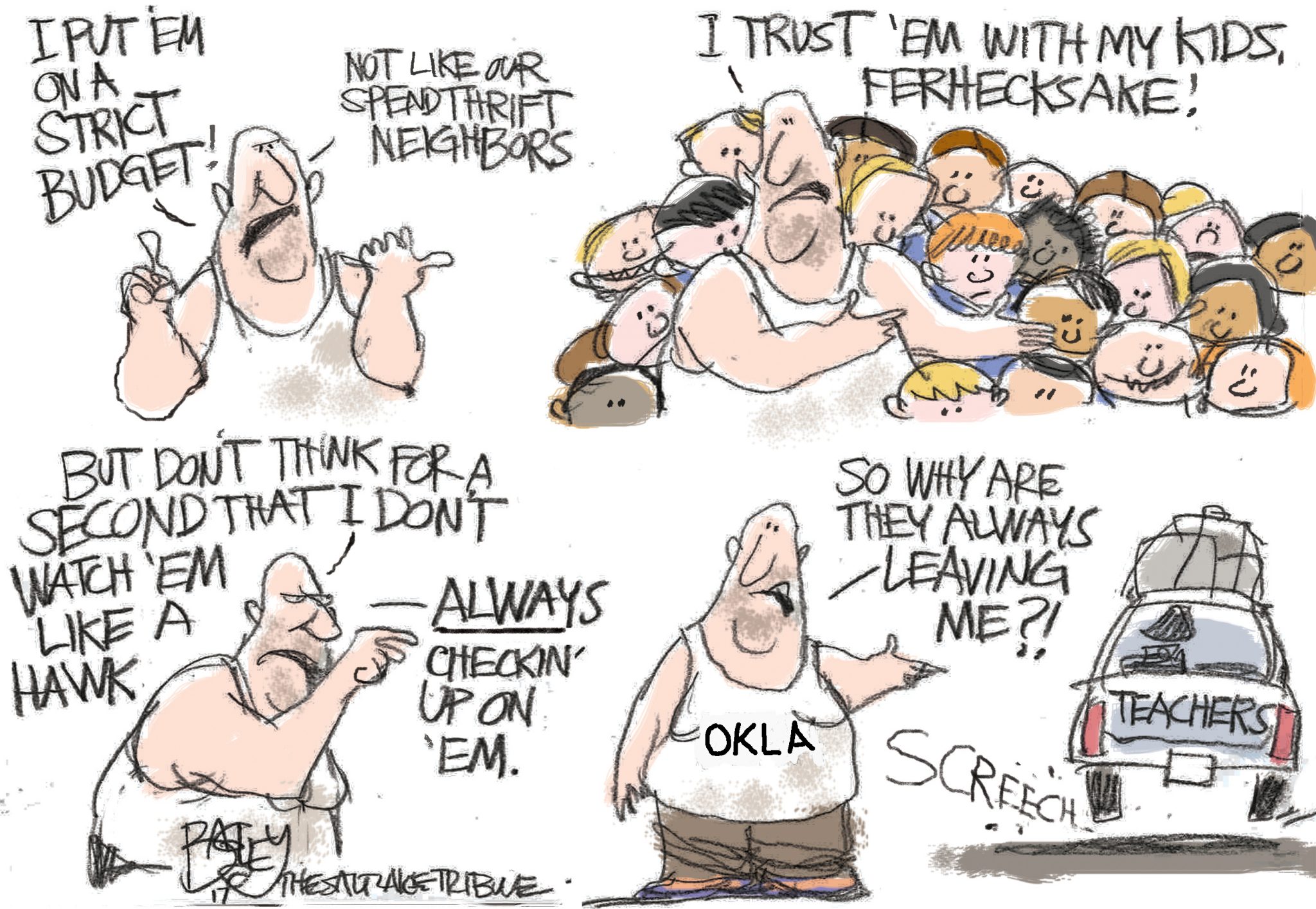
John Thompson: 'Teaching in Oklahoma is a dysfunctional relationship' - NonDoc

'Teaching in Oklahoma is a dysfunctional relationship' - NonDoc:

‘Teaching in Oklahoma is a dysfunctional relationship’

Image result for dysfunctional relationship animated gif

Following the absurd last week of the 2017 regular legislative session, Oklahoma made the front page of The Washington Post for gutting education funding to the point where 96 of the state’s 513 school districts will be reducing the school week to four days. The Post reviews the sorry story of how Oklahoma has cut education spending more than any other state, driving it down 14 percent since 2008. Only three states spend less per student than we do.
Moreover, the Post reports minimum teacher salaries have not been raised since 2008, putting us at 49th in the nation, and “teachers are leaving in droves for better-paying jobs.”
The Post recounts the evidence about how four-day school weeks hurt students. It explains, “Oklahoma stands out for the velocity with which districts have turned to a shorter school week,” as it notes that another 44 districts are considering a four-day week. It mentions our state’s hospitals and overcrowded prisons that also are suffering. The article didn’t get around to the most likely scenario that will make conditions much worse.
Soon afterward, Diane Ravitch, one of the nation’s most influential education writers, reposted the Post article. Washington Post columnist Valerie Strauss also weighed in on the exodus of teaching talent from Oklahoma. She reposted “All my ex’s teach in Texas,” by Shawn Sheehan, the 2016 Oklahoma Teacher of the Year and a National Teacher of the Year finalist. As he leaves for a job in Texas, Sheehan writes, “Teaching in Oklahoma is a dysfunctional relationship.”
Then, Governing Magazine featured the headline: “Nation’s Least-Funded Schools Get What They Pay for,” which starts its story on our education crisis: “Nowhere is the 'Teaching in Oklahoma is a dysfunctional relationship' - NonDoc:
Image result for Teaching in Oklahoma is a dysfunctional relationship

Why You Shouldn't Care About Your Teacher Evaluation - Teacher Habits

Why You Shouldn't Care About Your Teacher Evaluation - Teacher Habits:

Why You Shouldn’t Care About Your Teacher Evaluation

evaluation

Evaluations are in. All of your good intentions, hard work, and personal sacrifice has been boiled down to a number and a label. Are you “highly effective” or “innovating,” or merely “developing,” like you’re an insect in its larval stage instead of a professional educator?
Whatever your label or your number, you shouldn’t take too much pride or allow yourself to feel any disappointment or shame over it. Your evaluation is meaningless.
My district uses Marzano and everything is entered into iObservation. The last step in the evaluation process is for me, the teacher, to go in and “acknowledge” my scores. Why this is necessary is a bit of a mystery, since I am in no way allowed to question or challenge my final score. The state of Michigan gives districts total power when it comes to teacher evaluations. No due process. No appeals. No presumption of effectiveness. It’s all very democratic, and obviously designed to help teachers get better (he said sarcastically).
Once I acknowledged my rating, I was then provided the opportunity to leave a comment. I guess this is iObservation’s way of throwing teachers a bone. We may not be allowed to tell our principal, “Actually, the stupid learning goal was on the board. You just didn’t see it,” but we can sound off in the comments section. As a reminder, that’s the section nobody reads.
Nevertheless, it was my only chance to offer any thoughts, so here’s what I wrote:
I continue to find the evaluations arbitrary, based on questionable data, and demoralizing to the profession. That 75% of any teacher’s evaluation is in the hands of a single individual should be cause for concern. That that individual, Why You Shouldn't Care About Your Teacher Evaluation - Teacher Habits:

Beware of Billionaires Bearing Gifts: A Review of "The Givers" - Living in Dialogue

Beware of Billionaires Bearing Gifts: A Review of "The Givers" - Living in Dialogue:


Image result for David Callahan The Givers


By John Thompson.
I began David Callahan’s The Givers with a commitment to avoid three types of confirmation bias. As Callahan observes, plenty of teachers (like me) detest corporate school reform, but if he turned out to be supportive of accountability-driven, competition-driven policies, I shouldn’t let that prejudice my reading of his book. As it turned out, Callahan’s analysis of edu-philanthropy is objective and outstanding – and he repeatedly returns to school reformers’ strategies when illustrating the dangers of today’s philanthropy. (A second post will focus on my second bias and how it was clobbered by Callahan’s book.)
The Givers often used education philanthropists as examples of “the rising confidence of the donor class.” The best example of the new, rushed approach to reform is the Gates Foundation that didn’t conduct research on its technocratic theories until after it “dangled millions of dollars before school districts to enact certain policies.” Bill Gates and many other entrepreneurs forgot that:
Making a bundle in software or short trading doesn’t mean you’ll know the first thing about, say, K-12 education, and it’s easy for misguided philanthropists to do a lot of damage. … Overconfidence is a dangerous thing when combined with great wealth and little in the way of accountability.
Similarly, philanthropists such as Eli Broad who made their money in a more old-fashioned economy share the young elites’ hubris. Broad says that since he doesn’t worry about getting fired, his foundation exists to “take big risks.” Younger and older venture philanthropists believe that “disruptive” innovation and competition can unleash “transformational change.” As Warren Buffett says, they can provide “society’s risk capital,” and thus become “society’s passing gear.”
In the inner city where I taught, we need more disruption like we need another gang war.
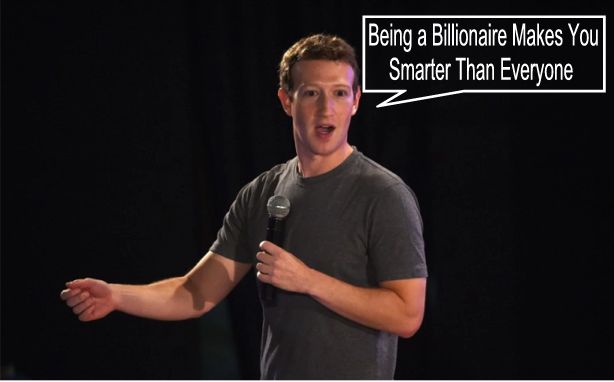
In terms of the outcomes produced by outcome-driven education donors, Callahan concludes, “It’s hard to think of many social entrepreneurs who’ve succeeded in bringing about changes on a truly large scale.” For example, Mark Zuckerberg’s attempt to transform Newark schools shows “what happens when things accelerate too quickly, without enough careful thought.” In Newark, philanthropists were in passing gear but lacking community buy-in, they “end(ed) up in a ditch.”
Moreover, the scaling up of charter schools to use competition as a driver of change has created turmoil without producing much improvement. Callahan notes, “The only thing that’s really clear is that, compared to the systematic revolution that charter funders were hoping for, the results have been disappointing.”
Callahan further explains that charters “don’t necessarily exert pressures on traditional schools to improve” and they can hurt neighborhood schools by leaving behind the more challenging students in high-poverty schools, while draining away their funding.
On one hand, Callahan observes that some “charter funders absorbed hard-earned lessons.” Now, Priscilla Chan says that she and her husband Zuckerberg learned from Newark, and “we are deeply connected to Beware of Billionaires Bearing Gifts: A Review of "The Givers" - Living in Dialogue:
 Image result for big education ape free lunch

Does majority black school, open to all, uphold segregation? | McClatchy Washington Bureau

Does majority black school, open to all, uphold segregation? | McClatchy Washington Bureau:

Does majority black school, open to all, uphold segregation?

Image result for black school


A federal appeals court is set to hear arguments on whether the opening of a charter school in rural Louisiana violated a decades-old desegregation order.
Court briefs state that Greater Grace Charter Academy is in a district west of New Orleans that is 62 percent black. But the school opened with a 93 percent black enrollment.
Louisiana's education board approved the school's charter and U.S. District Judge Martin Feldman allowed the opening last August. He noted the school has a non-discriminatory enrollment policy. He said blocking the opening would punish students who chose to enroll there.
Opponents argue that approving a nearly one-race school "is contrary to the goals of desegregation."
Arguments were scheduled Tuesday morning at the 5th U.S. Circuit Court of Appeals in New Orleans.
Greater Grace Charter Academy is one of a growing number of public schools operated by independent authorities with permission from state or local education authorities. Greater Grace was granted a charter by the Louisiana Board of Elementary and Secondary Education, according to court records.
Feldman's approval for opening was required under state law because the district has been under longstanding desegregation orders since the 1960s, according to the court record.
Among those arguing that Feldman should allow the school to open were the U.S. Justice Department and the St. James Parish School Board. According to the court record, the operators of Greater Grace received a charter from BESE after being rejected by the St. James board.
In it's brief, the St. James Board says the court should reverse Feldman's order allowing the school to open, or, as an alternative, establish guidelines under which charter schools can operate in districts that are still under desegregation orders.
Image result for new orleans black school

Betsy DeVos Testifies Before Senate Subcommittee About Education Department's Budget |TIME - YouTube

Betsy DeVos Testifies Before Senate Subcommittee About Education Department's Budget  TIME - YouTube:

Betsy DeVos Testifies Before Senate Subcommittee About Education Department's Budget 


Betsy DeVos Testifies Before Senate Subcommittee About Education Department's Budget  TIME - YouTube:

Education Secretary Betsy DeVos will testify before the Senate Appropriations Subcommittee on Labor, Health and Human Services, Education and Related Agencies on Tuesday about the proposed education budget, which includes a 13.5 percent cut in spending.
Education Secretary Betsy DeVos will speak about the proposed budget at 10 a.m. EST Tuesday. Watch live in the player above.
Late last month, Devos said the Trump administration was going after “the most ambitious expansion” of school choice in American history. Neither Devos nor Trump have offered many details about how that program would work.

Oakland is the latest big district turning to an insider to head schools | EdSource

Oakland is the latest big district turning to an insider to head schools | EdSource:

Oakland is the latest big district turning to an insider to head schools

When the Oakland Unified School District last month announced that it had settled on Kyla Johnson-Trammel to be its next superintendent, it was another example of a growing trend: school boards are turning increasingly to candidates with deep attachments to their districts to fill the top administrative post.
The 41-year-old Johnson-Trammell, who has never been a superintendent, attended elementary and middle schools in the district – and then returned to spend the last 18 years – her entire professional career – as a teacher, principal, and associate superintendent.
In announcing her selection, the district noted that she was born and raised in East Oakland, one of the city’s most troubled neighborhoods, and is in fact a third-generation Oakland resident. She also earned her doctorate in education from nearby UC Berkeley. “You have before you someone who embodies what it means to be of this town,” school board president James Harris declared.
Oakland is not alone in turning to an insider to head its schools. The move appears to be an increasingly popular – and unproven – strategy by California school districts as an antidote to the revolving door of school superintendents that can have a debilitating impact onOakland is the latest big district turning to an insider to head schools | EdSource:

Diane Ravitch: The Demolition of American Education | The New York Review of Books

The Demolition of American Education | by Diane Ravitch | NYR Daily | The New York Review of Books:

The Demolition of American Education

Image result for big education ape trump devos wrecking ball

Donald Trump and Betsy DeVos’s proposed budget for the US Department of Education is a boon for privatization and a disaster for public schools and low-income college students. They want to cut federal spending on education by 13.6 percent. Some programs would be eliminated completely; others would face deep reductions. They want to cut $10.6 billion from existing programs and divert $1.4 billion to charter schools and to vouchers for private and religious schools. This budget reflects Trump and DeVos’s deep hostility to public education and their desire to shrink the Department of Education, with the ultimate goal of getting rid of it entirely.
The proposed budget would shrink the assistance programs that now enable 12 million students to attend college: funding for college work-study programs would be cut in half, thus “saving” $490 million. It would eliminate a student loan forgiveness program, enacted in 2007, that encourages college graduates to enter careers in public service—such as social work, teaching, or working as doctors in rural areas—by relieving them of their college debt at the end of ten years of such employment. Some 550,000 young people have joined this program in the past decade; the first wave are due to have their debts forgiven in 2017, but it is not clear if the administration will follow through on the promise to cancel their debt.
The proposed budget would maintain funding for Pell grants for needy college students, but would eliminate more than $700 million in Perkins loans for disadvantaged students. No attempt would be made to lessen the burden of escalating college costs for students, whether middle-income or poor. Student debt is currently about $1.4 trillion, and many students, whether they graduate or not, spend years, even decades, repaying their loans. These cuts will reduce the number of students who can afford to attend college.
The most devastating cuts are aimed at programs for public schools. Nearly two dozen programs are supposed to be eliminated, on the grounds that they have “achieved their original purpose, duplicate other programs, are narrowly focused, or are unable to demonstrate effectiveness.” In many cases, the budget document says that these programs should be funded by someone else—not the US Department of Education, but “federal, state, local and private funds.” These programs include after-school and summer programs that currently serve nearly two million students, and which keep children safe and engaged in sports, arts, clubs, and academic studies when they are out of school. They have never been judged by test scores, but the budget claims they do not improve student achievement, and aims to save the government $1 billion byThe Demolition of American Education | by Diane Ravitch | NYR Daily | The New York Review of Books: 
Image result for big education ape trump devos wrecking ball
 Image result for big education ape  devos  trump

Image result for big education ape  devos  trump

An (Epic) Interview with Captain Underpants Creator - NEA Today

An (Epic) Interview with Captain Underpants Creator - NEA Today:

An (Epic) Interview with Captain Underpants Creator


From the banned books list to a major motion picture, the Captain Underpants series has had its share of adventures almost as epic as those of pranksters George and Harold and their unwitting superhero himself, their principal Mr. Krupp, aka Captain Underpants. NEA Today talked to creator Dav Pilkey about his popular comic series, how to encourage kids to read, and the Captain Underpants movie.
What qualities do superheroes share?
It seems like most superheroes are born of adversity.  Superman, Batman, and Spiderman each found their purpose after the deaths of parents or guardians.  Dog Man (the hero from my new graphic novel series) is also brought to life after a tragedy.  I think this is what makes superheroes so relatable.  When times get tough, we must all dig deep and find our own superpowers.
Why does each book in your Captain Underpants series contain a mini-comic?
I made mini-comics when I was a child, and I really wanted to inspire my readers to start making their own comics.  The mini-comics in Captain Underpants look like they were made by children— the drawing style is very primitive, and the spelling had many mistakes in the early books.  My hope was that kids would see these very imperfect creations and feel like making comics was something they could do— and it didn’t matter if they made mistakes.
The spelling and artwork in these mini-comics has gradually improved as the series has progressed (by book 12, there are no spelling errors).  I did this to subtly show that although creativity doesn’t have to be perfect, we should always try to improve and grow.
George and Harold receive an assignment to write 100 pages on “good citizenship” – how would you define good citizenship for students today?
I think putting yourself before others is a good start.  Empathy doesn’t always come naturally, but just like any skill, the more you practice the better you get.  In the An (Epic) Interview with Captain Underpants Creator - NEA Today:

The Silicon Valley Billionaires Destroying America’s Schools - The New York Times

The Silicon Valley Billionaires Remaking America’s Schools - The New York Times:

The Silicon Valley Billionaires Remaking America’s Schools

Image result for big education ape Billionaires

In San Francisco’s public schools, Marc Benioff, the chief executive of Salesforce, is giving middle school principals $100,000 “innovation grants” and encouraging them to behave more like start-up founders and less like bureaucrats.
In Maryland, Texas, Virginia and other states, Netflix’s chief, Reed Hastings, is championing a popular math-teaching program where Netflix-like algorithms determine which lessons students see.
And in more than 100 schools nationwide, Mark Zuckerberg, Facebook’s chief, is testing one of his latest big ideas: software that puts children in charge of their own learning, recasting their teachers as facilitators and mentors.
In the space of just a few years, technology giants have begun remaking the very nature of schooling on a vast scale, using some of the same techniques that have made their companies linchpins of the American economy. Through their philanthropy, they are influencing the subjects that schools teach, the classroom tools that teachers choose and fundamental approaches to learning.
The involvement by some of the wealthiest and most influential titans of the 21st century amounts to a singular experiment in education, with millions of students serving as de facto beta testers for their ideas. Some tech leaders believe that applying an engineering mind-set can improve just about any system, and that their business acumen qualifies them to rethink American education.
“They are experimenting collectively and individually in what kinds of models can produce better results,” said Emmett D. Carson, chief executive of Silicon Valley Community Foundation, which manages donor funds for Mr. Hastings, Mr. Zuckerberg and others. “Given the changes in innovation that are underway with artificial intelligence and automation, we need to try everything we can to find which pathways work.”
But the philanthropic efforts are taking hold so rapidly that there has been little public scrutiny.The Silicon Valley Billionaires Remaking America’s Schools - The New York Times:
Image result for big education ape Billionaires zuckerbergImage result for big education ape Billionaires reed hasting
Image result for big education ape Billionaires zuckerberg

Troy LaRaviere: With Police Reform Flip-Flop, Mayor Emanuel Fails Leadership Test – Troy LaRaviere's blog

With Police Reform Flip-Flop, Mayor Emanuel Fails Leadership Test – Troy LaRaviere's blog:

WITH POLICE REFORM FLIP-FLOP, MAYOR EMANUEL FAILS LEADERSHIP TEST


Having lived and worked under a flawed system of school accountability institutionalized by the Bush administration in 2002, and wholly embraced by Rahm Emanuel when he took control of Chicago Public Schools in 2011, I find his latest backward decision regarding Chicago Police Department reform profoundly hypocritical. Mayor Emanuel’s rhetoric on school accountability is centered on one key concept: consequences.
As a teacher and principal in CPS under Rahm Emanuel, the “accountability and consequences” ideology meant that my colleagues and I worked under the threat of school closures, poor school ratings, and loss of funding tied to student enrollment. The basic idea being that if there are no consequences, then schools and educators have no real incentive to improve. Although I have some serious issues with the assumptions that underlie this logic, my issues are irrelevant to the topic at hand. What is relevant is the fact that this is the logic that Emanuel embraces: Where there are no consequences, there is no accountability.

This is the logic that Emanuel embraces: Where there are no consequences, there is no accountability.

If he embraces consequence-based accountability for educators, then he should embrace it for himself in terms of holding his own administration accountable for effective police reforms. It was this kind of accountability that the mayor committed our city to in January when he signed an agreement in principle with the Justice Department to negotiate a consent decree that would be overseen by a federal judge who would have the power to hold City Hall accountable by levying consequences should it fail to live up to its promises.

If Emanuel embraces consequence-based accountability for educators, then he should embrace it for himself.

The U.S. Department of Justice stated Chicago’s problems were too “deep,” and With Police Reform Flip-Flop, Mayor Emanuel Fails Leadership Test – Troy LaRaviere's blog:

Why Betsy DeVos Is Wrong about Privatization of Education: Growing Consensus about Charters | janresseger

Why Betsy DeVos Is Wrong about Privatization of Education: Growing Consensus about Charters | janresseger:

Why Betsy DeVos Is Wrong about Privatization of Education: Growing Consensus about Charters

Image result for big education ape devos

U.S. Secretary of Education, Betsy DeVos relentlessly promotes school privatization—framed as parental choice—through such schemes as charter schools and virtual charter schools, and vouchers and neo-vouchers like tax credits and education savings accounts.  If you need clarification, Valerie Strauss, in the Washington Post, has published a primer to explain all these ways of redirecting public money to schools that are not publicly operated.
As DeVos relentlessly assaults our system of public education, a danger for our society is that, becoming exhausted, citizens will merely accommodate themselves to what begins to seem inevitable or capitulate and accept some sort of compromise. In the case of school choice, any compromise that directs tax dollars away from the public institution that serves the majority of our children is a poor policy.
Those who have watched charter school growth in their communities, academic researchers, and national organizations continue to explore the challenges posed by the expansion of charter schools.
Last week the Network for Public Education (NPE) released a comprehensive critique—a Statement on Charter Schools—which begins by reviewing the primary importance of public education: “A common school is a public institution, which nurtures and teaches all who live within its boundaries, regardless of race, ethnicity, creed, sexual preference or learning ability. All may enroll—regardless of when they seek to enter the school or where they were educated before…. (T)axpayers bear the responsibility for funding those schools and… funding should be ample and equitable to address the needs of the served community.”
Despite the claims of their proponents who dub them “public”charter schools, NPE explains: “By definition, a charter school is not a public school. Charter schools are formed when a private organization contracts with a government authorizer to open and run a school. Charters are managed by private boards, often with no connection to the community they Why Betsy DeVos Is Wrong about Privatization of Education: Growing Consensus about Charters | janresseger:
Image result for big education ape devos
 Image result for big education ape devos

ONE PARENT’S VOICE ON SCHOOL CHOICE « Dad Gone Wild

ONE PARENT’S VOICE ON SCHOOL CHOICE « Dad Gone Wild:

ONE PARENT’S VOICE ON SCHOOL CHOICE 

Image result for ONE PARENT’S VOICE
I started this blog some four years ago due to encouragement and inspiration by a blogger named Crazy Crawfish. Crazy would say, I’m not the smartest man in the room but my job is to make enough noise to get the smartest people possible in to the room to start having a real convesation about the issues. I’ve always aspired for this blog to be a similar tool. In ordere to have a real conversation, you need to have as many perspectives as possible. Education policy discussions tend to produce a lot of tshirt slogans while in reality things are much more nuanced then they appear. Over the years I’ve been blessed to have readers share their experiences with me. Which might actually be the best part of doing this blog. When given permission, I try to share. These are the words of Aidan Hoyal, a parent brave enough and kind enough to give us insight into her families education decision making process. In my opinion, hearing people’s stories is critical to making good policy. So thank you Aidan for allowing me to share and all of you please take these words in the spirit they are shared. We may not agree but remember all of our experiences are not identical.
Disclaimer: I am a parent. I don’t work for a school or a school board or school district. I taught Spanish for a long time, but not K-12. These opinions are my own.
*********************************************
“One Parent’s Voice on School Choice”
The dialogue around school choice in Nashville needs to include more parent and student voices. The discussion about charter schools has become so polarized that it sometimes seems completely divorced from the realities faced by Nashville families. As a parent who opted for a charter school, I am by definition a “charter ONE PARENT’S VOICE ON SCHOOL CHOICE « Dad Gone Wild:
Image result for big education ape parents can