Latest News and Comment from Education

Thursday, May 18, 2017

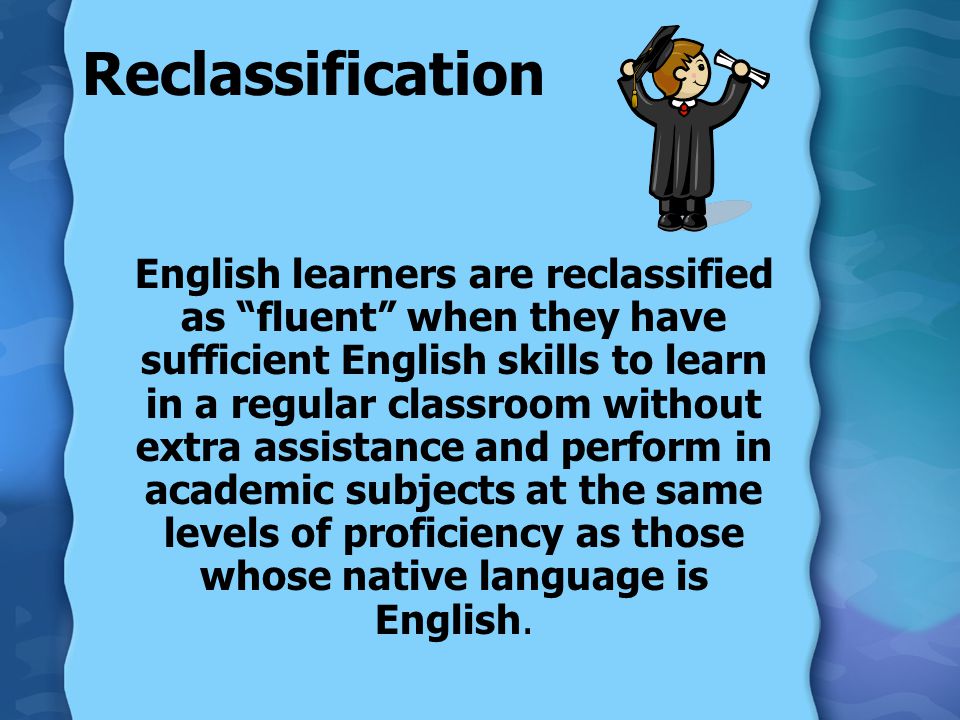
Researchers, advocates divided over reclassifying English learners | EdSource

Researchers, advocates divided over reclassifying English learners | EdSource:

Researchers, advocates divided over reclassifying English learners

Image result for reclassifying English learners

Researchers and language experts have long criticized the subjectivity and variations in criteria that California districts have used to determine when English learners are proficient in English. But proposed legislation to create uniform, statewide standards for doing so has hit a snag, with some of the nation’s leading academic experts expressing strong opposition to the bill.
Rather than fix inconsistency in how districts reclassify English learners, Senate Bill 463 “risks exacerbating the state’s long-term English learner problem,” 28 researchers and academicians wrote in an April 28 letter to California Senate leaders and the administration of Gov. Jerry Brown. Lead signers were California’s noted experts on English learners: Robert Linquanti, a project director on English learners at the San Francisco research agency WestEd, and Kenji Hakuta, a linguistics professor emeritus at the Stanford University Graduate School of Education.Researchers, advocates divided over reclassifying English learners | EdSource:


Someone is driving the curriculum in Seattle Public Schools and it’s not educators, parents or the school board | Seattle Education

Someone is driving the curriculum in Seattle Public Schools and it’s not educators, parents or the school board | Seattle Education:

Someone is driving the curriculum in Seattle Public Schools and it’s not educators, parents or the school board

scP97ZNqA7-6.png
Shortly after publishing a post titled The Seattle school board is asking the question: Where should technology fit into the education of K-12 students? on how the school board wanted to deliberate and have a conversation on the role of technology in Seattle public schools and therefore hold off on large purchases of computers and software, the board voted the next week to buy laptops for half of the students in seven schools.
What will be on the laptop is anyone’s guess.
The curriculum for Seattle Public Schools is overdue for a review and has not been done by the school board. The reason for this delay is because the staff involved with curriculum within the Seattle Public School administration has been dragging their feet.  My guess is that the software  installed on these laptops will have the narrow focus of the Common Core Standards with its concomitant testing and whatever else someone decides to upload to the computers but at this time, it’s anyone’s guess.
At Middle College high school in Seattle with a mostly minority population, a software called Edgenuity was installed for students. The focus of the school is theoretically on social justice. Now there are complaints by students and staff that the software Someone is driving the curriculum in Seattle Public Schools and it’s not educators, parents or the school board | Seattle Education:

Government Accountability Office faults Education Department’s oversight of grants - The Washington Post

Government Accountability Office faults Education Department’s oversight of grants - The Washington Post:

Government Accountability Office faults Education Department’s oversight of grants

Image result for big education ape duncan


Each year, the U.S. Education Department distributes billions of dollars in grants to schools, districts, states and nonprofits, and the agency needs to do a better job making sure that it is adequately monitoring whether the money is achieving its intended goals, according to a Government Accountability Office report.
Many grants are doled out over multiple years, and grantees are supposed to show “substantial progress” toward their goals  to receive their next installment of funds. The GAO found that in 2015, during the Obama administration, department employees did not consistently adhere to protocols for documenting their efforts to monitor grants, making it impossible for outside investigators to determine whether grantees made enough progress to get the money they received.
The GAO studied 75 grants worth $272 million that Education awarded in fiscal  2015, a small sample of the $4 billion in grants distributed to thousands of recipients that year. In 69 of those 75 cases, official Education grant files were missing documentation of performance. For instance, grantees’ progress should have been documented in 179 separate reports, but GAO investigators could find only 121 such reports in the official files.
In a March letter appended to the GAO report, Education Department officials said that all of the performance reports had been completed, though some were not stored in official grant files. They agreed with a GAO recommendation to establish new written procedures describing how supervisors should ensure that employees are appropriately monitoring grantees, but emphasized that no federal funds were improperly distributed.
Sen. Lamar Alexander (R-Tenn.), who requested the GAO investigation, said he hopes that Secretary Betsy DeVos makes “serious improvements” to correct the deficiencies.
“When taxpayers spent $4 billion on competitive grants administered by the Obama administration’s Education Department in 2015, they expected proper oversight — to ensure the money was spent as intended and the results were measured,” Alexander said in a statement. “Today’s report shows us the department didn’t deliver.”


Education Department spokeswoman Liz Hill also noted that the GAO identified problems that occurred during the previous administration. “Secretary DeVos finds this report appalling and unacceptable and is committed to ensuring the U.S. Department of Education delivers on its commitment to serving students while prudently safeguarding taxpayer dollars,” Hill said.Government Accountability Office faults Education Department’s oversight of grants - The Washington Post:
Image result for big education ape duncan

Image result for big education ape duncan money charter
Image result for big education ape duncan

Celebrating 25 Years of Supporting Education Justice | Schott Foundation for Public Education

Celebrating 25 Years of Supporting Education Justice | Schott Foundation for Public Education:

Celebrating 25 Years of Supporting Education Justice


Marking 25 years of supporting movements to end educational injustices in America’s public schools, the Schott Foundation rang in our silver anniversary by honoring grassroots, community and philanthropic figures who have led the charge. More than 200 guests helped us celebrate at New York City's Metropolitan Pavilion this evening.
Among our honorees was noted civil rights leader Rev. Dr. William J. Barber II, who received the foundation’s Lifetime Achievement Award, and The Atlantic Philanthropies former Chief Strategy Advisor for Equity Initiatives and Human Capital Development Kavitha Mediratta, who received the Philanthropy Changemaker Award.
We also honored the Campaign for Fiscal Equity (CFE) with the Lilo Leeds Legacy Award and suprised Senior Vice President Cassie Schwerner and founding presidents Greg Jobin-Leeds and Dr. Rosa Smith with awards as well.
Celebrating 25 Years of Supporting Education Justice | Schott Foundation for Public Education:

 Image result for Celebrating 25 Years of Supporting Education Justice

Student data privacy webinar Tuesday May 23 | Parents Across America

Student data privacy webinar Tuesday May 23 | Parents Across America:
Student data privacy webinar Tuesday May 23


Amid growing concerns about data privacy and surveillance, the Parent Coalition for Student Privacy (PCSP) and the Campaign for a Commercial-Free Childhood (CCFC) have created an important resource for parents to understand and safeguard students’ personal information.
The Parent Toolkit for Student Privacy: A Practical Guide for Protecting Your Child’s Sensitive School Data from Snoops, Hackers, and Marketers is a vital resource in an age where nearly all school records are stored digitally, and where learning, homework, and administrative tasks are increasingly conducted online. Available free to parents on CCFC and PCSP’s websites, the Toolkit offers clear guidance about federal laws that do—and don’t—protect students’ privacy, helps parents ask the right questions about their schools’ data policies, and offers simple steps parents can take to advocate for better privacy policies and practices in their children’s schools.
“The Parent Toolkit for Student Privacy is a powerhouse resource for parents, educators and school districts,” said Laura Bowman, President of the PAA-Roanoke Valley chapter of the public education advocacy group Parents Across America. “By providing easily understood explanations of laws and legal rights, best practices, questions to ask, and ways to advocate for their children, the Toolkit empowers parents with the information they need to ensure their child’s sensitive information is safeguarded.”
The Parent Toolkit for Student Privacy can be downloaded at www.studentprivacymatters.org/toolkit.
Join our WEBINAR
PCSP, CCFC and PAA will co-sponsor a webinar on May 23, 2017, to help parents effectively use the toolkit’s resources. The webinar starts at 8 pm ET, 5 pm PT. PAA’s Laura Bowman will be on the webinar panel along with PAA co-founder Leonie Haimson, Rachael Stickland from PCSP and Josh Golin from CCFC. Please register here.
The purpose of the webinar is to review the main points of the toolkit and talk about ways to take action. There will also be time for Q! and A.Student data privacy webinar Tuesday May 23 | Parents Across America:

 May 18, 2017 newsletter brief | Parents Across America - http://parentsacrossamerica.org/?p=6856

ESQUIRE CHARLES P. PIERCE: Betsy DeVos' Proposed Budget Cuts for Education

Betsy DeVos' Proposed Budget Cuts for Education:

Is There a Point to All This Cruelty?

Betsy DeVos knows nothing about public education.

Image result for big education ape devos

While we're on the subject of bad hiring in the executive branch, let's not forget that Betsy DeVos, the Secretary of Education, was the single most obviously unqualified Cabinet nominee—Grizzlies!—in the history of the republic. On Thursday, from The Washington Post, we find that DeVos is finding ways to fulfill her life's dream of destroying public education and monetizing all those bright shiny faces.
The cuts would come from eliminating at least 22 programs, some of which Trump outlined in March. Gone, for example, would be $1.2 billion for after-school programs that serve 1.6 million children, most of whom are poor, and $2.1 billion for teacher training and class-size reduction. The documents obtained by The Post — dated May 23, the day the president's budget is expected to be released — outline the rest of the cuts, including a $15 million program that provides child care for low-income parents in college; a $27 million arts education program; two programs targeting Alaska Native and Native Hawaiian students, totaling $65 million; two international education and foreign language programs, $72 million; a $12 million program for gifted students; and $12 million for Special 
Betsy DeVos' Proposed Budget Cuts for Education:
 Image result for big education ape devos
Related image


Making our Schools Safe for Muslim Students in a Climate of Hate

Making our Schools Safe for Muslim Students in a Climate of Hate:

Making our Schools Safe for Muslim Students in a Climate of Hate

Muslim students

by  on MAY 18, 2017 · 0 COMMENTS
Muslim studentsThere’s a survey highlighting that a large number of Muslim students are being bullied at school. Our school district picks up on it and looks at ways to make them feel safe on their campuses. And before you can say “Way to go!” to the school system, a bunch of hateful folks come up with some “reverse discrimination” kind of BS.
They whine about those students being given “special treatment.” They blabber about the schools surrendering to Sharia law and caving into demands made by the Council for American-Islamic Relations (CAIR). They claim falsely that CAIR is a “covert supporter of Islamic fundamentalism rather than a supporter of a reformed Islam compatible with the Constitution and laws of the United States.”
Blah-Blah-Blah-Doo-Wa!
Well, putting nonsense aside, the truth is these young people are not being given special treatment: they’re being treated the way they should be treated — with respect, as citizens of our country, as human beings who are simply trying to live good lives as they pursue the “American Dream.” It’s so sad that yahoos have to pop up every time somebody from a “minority” group gets a slight leg up in the scheme of things, making them live out, against their will, the reality that freedom isn’t free – for them.
What the district is trying to do, teach students about Islam and include Islamic holidays on the district’s calendars, is an act of human decency. It’s what’s called for in times like these when onMaking our Schools Safe for Muslim Students in a Climate of Hate:

Great New Documentary–“Backpack Full of Cash”–is Finished and Ready for Screenings in Your Community | Diane Ravitch's blog

Great New Documentary–“Backpack Full of Cash”–is Finished and Ready for Screenings in Your Community | Diane Ravitch's blog:

Great New Documentary–“Backpack Full of Cash”–is Finished and Ready for Screenings in Your Community
Image result for Backpack Full of Cash

Sarah Mondale and Vera Aronow announce that their long-awaited film “Backpack Full of Cash” has been completed, and they are now taking it to film festivals and community screenings. This is the film that tells the story of the dangers of public school privatization and the undermining of public education in many districts.
Dear BACKPACK Friends and Supporters,
We want to share some good news. BACKPACK FULL OF CASH––a documentary film narrated by Matt Damon, that explores the impact of privatizing public schools––is now finished, updated and complete with a new Epilogue. With the appointment of U.S. Secretary of Education Betsy DeVos––a longtime advocate of charter schools, vouchers and online schools, there is a pressing need for public awareness of these issues. BACKPACK seems to be striking a nerve with audiences.
We just showed BACKPACK to sold-out crowds at film festivals in Nashville and Washington, DC where the film won Runner Up–Audience Award, Best Documentary. We are getting many requests for screenings from around the country–and the world! If you or someone you know would like to host a screening, please visit our website. You can also make a donation––now urgently needed––to help us launch the outreach/ distribution campaign for the film.
We have been invited to show BACKPACK FULL OF CASH in Seattle, WA and Alberta, Canada in May/June. If you know anyone in these areas who would be interested, please help us spread the word. Here is the schedule and ticket info:
BACKPACK FULL OF CASH SCREENINGS
SEATTLE INTERNATIONAL FILM FESTIVAL

(filmmakers in attendance at June screenings only)

Friday, 5/19 at 3:30pm at SIFF Cinema Uptown

Tuesday, 6/6 at 7:00pm at AMC Pacific Place

Wednesday, 6/7 at 4:30pm at AMC Pacific Place Click here for tickets.
ALBERTA, CANADA

presented by Support Our Students Alberta,

sponsored by Alberta Federation of Labour

(filmmakers in attendance in Calgary only)
Thursday, 5/25 at 7:00pm in CALGARY, Globe Cinema

Saturday, 5/27 at 7:00pm EDMONTON, Art Gallery of Alberta, Ledcor Theater

Tuesday, 5/30 at 7:00pm in LETHBRIDGE, City of Lethbridge Sterndale Bennett Theater

Thursday, 6/1 at 7:00pm in RED DEER, Red Deer College, Welikoland Cinema

Click here for tickets.
Thanks again for your support.


Sarah Mondale, Vera Aronow, and the BACKPACK Film Team
Great New Documentary–“Backpack Full of Cash”–is Finished and Ready for Screenings in Your Community | Diane Ravitch's blog:

Image result for Backpack Full of Cash
Narrated by Matt Damon, this feature-length documentary explores the growing privatization of public schools and the resulting impact on America’s most vulnerable children. Filmed in Philadelphia, New Orleans, Nashville and other cities, it takes viewers through the tumultuous 2013-14 school year, exposing the world of education “reform” where public education – starved of resources- hangs in the balance. ​


BACKPACK FULL OF CASH - http://www.backpackfullofcash.com/

Betsy DeVos should know robbing Peter to pay Paul is a sin in education - The Hechinger Report

Betsy DeVos should know robbing Peter to pay Paul is a sin in education - The Hechinger Report:
Betsy DeVos should know robbing Peter to pay Paul is a sin in education
Education budget could end proven programs in favor of perilous policies


President Trump’s full education budget cuts funding for college work-study programs in half, eliminates public-service loan forgiveness and takes away hundreds of millions of dollars that schools use for mental health services and advanced coursework in order to pay for one of his campaign promises – more school choice, according to budget documents obtained by The Washington Post.
Trump and his besieged education secretary Betsy DeVos would rob Peter, the public schools, to pay the Paul of charter schools and vouchers. Specifically, the administration plans to spend approximately “$400 million to expand charter schools and vouchers for private and religious schools, and another $1 billion to push public schools to adopt choice-friendly policies,” the Post reports.
Work-study provides low-income students the opportunity of a part-time job that helps pay for school. By limiting work hours and offering many on-campus job options, work-study increases the likelihood of graduation and reduces indebtedness. Public-service loan forgiveness also reduces indebtedness that burdens low-income students while encouraging college graduates to seek jobs in areas of critical need, including education and public health.
It’s a budget that justifies the instincts of the Bethune-Cookman College graduates who turned their backs to DeVos when she spoke at their commencement. The cuts the administration is proposing proves Trump and DeVos don’t have interests of these students at heart.
DeVos should know that taking away real income, job opportunities and community development resources from the people who need it Betsy DeVos should know robbing Peter to pay Paul is a sin in education - The Hechinger Report:


CURMUDGUCATION: So Now Failure Is Okay, Apparently

CURMUDGUCATION: So Now Failure Is Okay, Apparently:

So Now Failure Is Okay, Apparently


"Fail better," says Michael Q. McShane (Show-Me Institute, AEI) in a piece at US News, arguing to reformsters for the virtue of admitting failure and building upon it. Part of his point is vaid, part is hugely self-serving and part of it is just plain annoying.Policy ideas like charter schools, teacher evaluation and high standards first exist in the abstract. When they are actually implemented, they look quite different from state to state or district to district. What one state calls "charter schooling" might look different from charter schooling in another state. So if charter schools struggle in one state, it isn't necessarily an indictment on the idea as a whole. It might just be that the particular manifestation didn't match the context of the specific environment where it was tried. In an ideal world, we'd learn from that, and do better.

In other words,even when a policy has been tested and it has failed, that doesn't mean it's not a great policy that we should keep trying in new and different markets. This is just a variation of that golden oldie that folks used to defend Common Core-- "The policy is brilliant; you're just implementing it wrong." The policy may look like an utter failure, even after over a decade of reforminess, but honest-- any day now it's finally going to work the way we imagined it would.

This is part of a valid idea. But his list of possible causes for failure is missing one critical possibility-- your policy idea is a bad policy idea, and that sad pig won't fly no matter what shade of lipstick you try smearing on it.

He does offer a good description of the process often involved with reformy policy failures:

When a new study comes out that says a policy has "failed," we man the ramparts. Opponents (who were against the policy before any data were available) come out and tut-tut at advocates, telling them to "follow the data" or not to "cling to ideology." Advocates circle the wagons. They spin the 
CURMUDGUCATION: So Now Failure Is Okay, Apparently:


John Thompson: OKCPS must choose path in wake of new testing rules - NonDoc

OKCPS must choose path in wake of new testing rules - NonDoc:

OKCPS must choose path in wake of new testing rules

new testing rules


 The headline of Ben Felder’s front-page story in the May 5 edition of The Oklahoman proclaimed wonderful news: State Re-Examines Testing.

Felder reviewed examples of outrages unleashed by test-driven accountability. He described a Duncan teacher fighting back tears as she read the notes left by some of her algebra students. One wrote, “I hate testing so much,” while another scribbled, “help.”
Yes! A bipartisan grassroots coalition of students, parents and educators, combined with State Superintendent of Public Instruction Joy Hofmeister’s leadership, beat back the testing frenzy of the last decade and a half.
My question is: Will the Oklahoma City Public School System re-examine its bubble-in instruction and change course?

Teach-to-the-test malpractice takes over

Through most of my career, OKCPS high schools were at least semi-successful in resisting “drill and kill” basic skills instruction. By the end of my full-time teaching in 2010, however, my students who came from the poorest elementary and middle schools complained that they had been completely robbed of an education. Nonstop worksheet-driven test prep drove the joy of learning out of school.
It wasn’t until the launch of end-of-instruction graduation exams and the threat of value-added teacher evaluations (when individual students and adults could be punished for low test scores) that teach-to-the-test malpractice took over.
I taught part-time during those maddening years. We could mourn with our students about the damage that was being done to them, but we also had to subordinate our OKCPS must choose path in wake of new testing rules - NonDoc:

SCHOOL IS IN BEYOND THE FEMINIST CLASSROOM | Bitch Media

School Is In | Bitch Media:

SCHOOL IS IN

BEYOND THE FEMINIST CLASSROOM

Student with vines creeping near.
Illustration by Chris Kindred

This article appears in our 2016 Winter issue, Nerds. Subscribe today!
One of my most striking lessons in gendered classroom dynamics came in a history seminar during my final year at a women’s college. The college allowed men into its graduate program in teacher education, and one of those men sat across from me in this seminar, dominating discussions even when he clearly hadn’t done the reading. Still, the nine women, including myself, who filled out the rest of the class found ourselves deferring to him: We gestured that, yes, he could speak before us; we quietly pursed our lips when he talked over us without realizing it, and we shifted uncomfortably rather than challenge him on questionable interpretations of history.
Finally, the professor, a man and an avowed feminist, intervened. “Hey, let me stop you there,” he said to the student. “You’ve spoken a lot this class. You need to make space for the women in the class to speak.” The professor enforced the policy for the rest of the class, and for the remainder of the semester actively intervened to prevent the male student from monopolizing the conversation. If he hadn’t intervened, the semester could have been unproductive, demoralizing, and incessantly frustrating.
And it wasn’t just that one man in that one seminar. Since beginning my graduate studies in history at a major (coed) research institution, the same dynamic emerges, ever more fierce in an environment where grad students battle for professorial favor, and women, while increasingly present, still make up less than half of my department. From the time we were children, we have navigated classrooms that—from test questions that favor wealthy, white, male students to unconscious bias on the part of educators—too often reinforce society’s broader, structural inequalities.
Feminist classroom practices, when implemented, can play an important role in creating a learning atmosphere where students from all backgrounds can engage in critical analysis of course materials and in challenging prevailing modes of thought and discourse.
Yet despite the importance of feminist pedagogy in combating structural oppression, we should also be clear: Feminist pedagogy alone is inadequate to the barriers facing women, people of color, and queer people in institutions of higher education.
Instead, we should look toward changing the institutions that structure our teaching. Just as we teach students to contextualize the texts and people we study, we must understand our classrooms as products of the broader university environment.
Today’s universities are hardly the wood-paneled rooms filled with old men smoking pipes. Higher education has changed, but not in a singular direction. The legacies of the Black freedom struggle and the women’s liberation School Is In | Bitch Media:

Jeff Bryant – Trump’s Education Budget Feeds School Privatization At The Expense of Students

5/18/2017 – Trump’s Education Budget Feeds School Privatization At The Expense of Students:

Trump’s Education Budget Feeds School Privatization At The Expense of Students

Image result for Trump’s Education Budget

THIS WEEK: Truth About Vouchers … Segregation Worsens … School Choice Poll … Vouchers Fail Special Ed … Bad News From LA

TOP STORY

Trump’s Education Budget Feeds School Privatization At The Expense of Students

By Jeff Bryant

“The vision of ‘education reform’ coming from the Trump administration and Secretary of Education Betsy DeVos entails cutting direct aid to students, especially those from low-income families, in order to expand the private sector’s financial footprint in education. That at least is what’s reflected by a leaked budget document obtained by the Washington Post … Deep spending cuts … sever funding to … federal government supports that largely serve children and youth from low-income households … More money would go to incentivize ‘alternatives to traditional public schools’ at the K-12 level and increase the costs of college loans, a federal program with significant ties to the financial services industry.”
Read more …

NEWS AND VIEWS

The Promise And Peril Of School Vouchers

NPR

“‘Social justice has come to Indiana education,’ Gov. Mitch Daniels said in 2011 after the state made several big changes to its education system. Among those changes was the new voucher program … In 2013, Mike Pence … oversaw a dramatic expansion of the program. Lawmakers added new pathways for students to qualify, making the voucher more accessible to children who had never attended a public school. They also expanded the program’s reach to include some middle-class families. Voucher enrollment doubled … Today, more than half of all voucher students in the state have no record of attending a public school.”
Read more …

GAO Study: Segregation Worsening In U.S. Schools

USA Today

“America’s public schools – 62 years after the Supreme Court’s historic Brown v. Board of Education decision – are increasingly segregated by race and class … Both the percentage of K-12 public schools in high-poverty and the percentage comprised of mostly African-American or Hispanic students grew significantly, more than doubling, from 7,009 schools to 15,089 schools. The percentage of all schools with so-called racial or socio-economic isolation grew from 9% to 16%. Researchers define ‘isolated schools’ as those in which 75% or more of students are of the same race or class … Charter schools … may take minority and poor students from larger more diverse public schools and enroll them into less diverse schools.”
Read more …

AP-NORC Poll: Most Know Little About Charter Schools

ABC News

“Americans know little about charter schools or private school voucher programs. Still, more Americans feel positively than negatively about expanding those programs … 55% of respondents say parents in their communities had enough options with regard to schools, about 4 in 10 feel that the country in general would benefit from more choice … About 7 in 10 respondents feel that both charter schools and private schools funded with taxpayer money should meet the same education standards as public schools.”
Read more …

For Families With Special Needs, Vouchers Bring Choices, Not Guarantees

NPR

“When it comes to vouchers for special ed, the problem, say legal experts, is twofold: not enough rights and not enough money … The federal Individuals with Disabilities Education Act, or IDEA, guarantees children with disabilities a ‘Free Appropriate Public Education,’ known as FAPE … Religiously based schools, which make up a majority of private schools … don’t even have to follow the Americans with Disabilities Act, the federal law that guarantees basic accommodations like wheelchair access.”
Read more …

Charter Supporters Win Control Of Los Angeles School Board

Diane Ravitch’s Blog

Education historian Diane Ravitch writes, “Two pro-charter candidates swept to victory … in Los Angeles … It was the most expensive school board race in U.S. history. At least $14 million was spent, most of it by the charter forces … Only 75,000 people voted. This marks the first time that the board of LAUSD has a pro-charter majority. It was an exceptionally dirty campaign … Charter operators want a larger share of LAUSD construction funds and more of its buildings. They will now encounter no opposition from the board … LAUSD will now become a dual school system, with no constraints on charter growth.”
Read more …
5/18/2017 – Trump’s Education Budget Feeds School Privatization At The Expense of Students:


Image result for Trump’s Education Budget

The Canary in the Mine | The Merrow Report

The Canary in the Mine | The Merrow Report:

The Canary in the Mine

Image result for big education ape Broad Prize
If you are looking for convincing evidence that “test-based accountability” and test-score obsessions are counter-productive, the ‘Canary in the Mine’ is the Broad Prize for Excellence in Urban Education.  Without much publicity, the Broad Foundation did not award the $1,000,000 Broad Prize for Excellence in Urban Education in 2015 or 2016 and has no plans to begin awarding it in the future.
Here’s why: It turns out that the NAEP scores of most of the Broad Prize winners (public school districts) have been flat for years. These districts have been living and dying by test scores, and it’s not working well enough to impress the Foundation’s judges.
Ben Weider of the blog 538 deconstructed the issue in a well-reasoned piece, “The Most Important Award in Public Education Struggles to Find Winners.”  Not long after, the Foundation decided to ‘pause’ the $1 million award, citing ‘sluggish’ changes in urban schools.   As Howard Blume of the Los Angeles Times hasThe Canary in the Mine | The Merrow Report:

School Closure as a Strategy to Remedy Low Performance | National Education Policy Center

School Closure as a Strategy to Remedy Low Performance | National Education Policy Center:

School Closure as a Strategy to Remedy Low Performance

Image result for big education ape School Closure

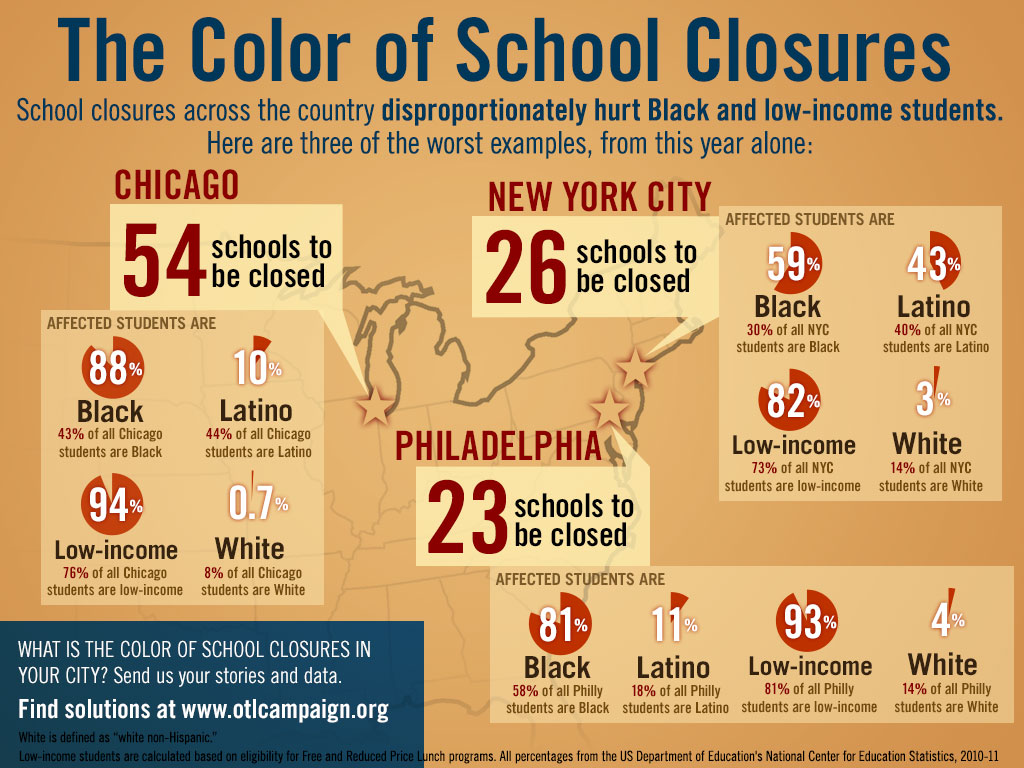
This brief investigates whether closing schools and transferring students for the purpose of remedying low performance is an option educational decision makers should pursue. The authors draw on a relatively limited evidence base that consists of peer-reviewed research studies and well-researched policy reports.
The authors conclude that school closures as a strategy for remedying student achievement in low-performing schools is a high-risk/low-gain strategy that fails to hold promise with respect to either student achievement or non-cognitive well-being. It causes political conflict and incurs hidden costs for both districts and local communities, especially low-income communities of color that are differentially affected by school closings. It stands to reason that in many instances, students, parents, local communities, district and state policymakers may be better off investing in persistently low-performing schools rather than closing them.
Share


 School Closure as a Strategy to Remedy Low Performance | National Education Policy Center:

Image result for big education ape School Closure