Latest News and Comment from Education

Monday, April 10, 2017

Defending Public Education in the Era of Privatization - Morning Session - Network For Public Education

Defending Public Education in the Era of Privatization - Morning Session - Network For Public Education:

Defending Public Education in the Era of Privatization – Morning Session

Network For Public Education


Defending Public Education in the Era of Privatization - Morning Session

Start: April 30, 2017  9:15 AM

Gowanus Warehouse 156 6th Street , Brooklyn, NY 11215

Host Contact Info: info@networkforpubliceducation.org

Morning_session_final

You can sign up for one, two, or three sessions—but if you sign up, please think of it as a commitment and show up. Too small an audience will lessen the impact of what we are trying to do. We also ask that you be present for the duration of the session(s) you sign up for, as we will need to keep the doors closed while filming is in progress.
MORNING SESSION (9:15-12:45)
Linda Lyon                        
Privatization: Be Careful What You Wish For
Linda Lyon, a retired Air Force colonel, is president-elect of the Arizona School Boards Association and serves on the board of Support Our Schools AZ. She blogs about education at RestoreReason.com.
Jesse Hagopian            
The Destruction of the Teaching Profession
Jesse Hagopian is a Seattle-based high school teacher, speaker, and activist. He edits the journal Rethinking Schools and also edited the book More Than a Score: The New Uprising Against High-Stakes Testing.
John Kuhn                        
A New Paradigm for “Accountability”
John Kuhn is the superintendent of the Perrin-Whitt School District in Texas and author of the book Test and Punish: How the Texas Education Model Gave America Accountability without Equity.


Defending Public Education in the Era of Privatization – Evening Session
The post Defending Public Education in the Era of Privatization – Evening Session appeared first on Network For Public Education .
Defending Public Education in the Era of Privatization – Afternoon Session
The post Defending Public Education in the Era of Privatization – Afternoon Session appeared first on Network For Public Education .


Defending Public Education in the Era of Privatization – Morning Session
The post Defending Public Education in the Era of Privatization – Morning Session appeared first on Network For Public Education .

Defending Public Education in the Era of Privatization - Morning Session - Network For Public Education:

Mike Klonsky's SmallTalk Blog: WEEKEND QUOTABLES

Mike Klonsky's SmallTalk Blog: WEEKEND QUOTABLES:

WEEKEND QUOTABLES


Vallas/Solomon/Synesi connection was ignored when he ran with Quinn. 
The Watch Dogs

In a series of letters to Louisiana officials who oversaw the New Orleans district, Vallas vouched for Synesi Associates, an education consulting firm that recently had been started in Chicago by a former high school teacher named Gary Solomon.
“This out-of-state provider has a record of demonstrated effectiveness,” Vallas wrote in 2007, citing the “unique experience” of the firm’s staff.  -- Sun-Times
Rev. Jesse Jackson: 

Latinos building the border wall is like blacks building slave ships...If they were going to build slave ships to take blacks back to Africa, I hope blacks would not try to get the contracts. -- USA Today
Glenn Greenwald

Mocking “the instant elevation of Trump into a serious and respected war leader,” Glenn Greenwald in the Intercept recalled John Jay, one of the authors of the Federalist Papers, who wrote more than 200 years ago: “However disgraceful it may be to human nature . . . nations in general will make war whenever they have a prospect of getting anything by it.”
In fact, Jay wrote, “absolute monarchs will often make war when their nations are to get nothing by it” — except, of course, to scratch that eternal itch for military glory, revenge or self-aggrandizement. -- Washington Post
Rex Tillerson 

Tillerson said that once the threat of the Islamic state "has been reduced or eliminated," the U.S. can focus on stabilizing Syria. -- Politico
 Mike Klonsky's SmallTalk Blog: WEEKEND QUOTABLES:

Folsom Prison Graduation Address (No Blues or Jeans) – Cloaking Inequity

Folsom Prison Graduation Address (No Blues or Jeans) – Cloaking Inequity:

Folsom Prison Graduation Address (No Blues or Jeans)


 Last Friday, I was honored to give a graduation address at Folsom Prison.

Folsom State Prison (FSP) is a California State Prison in Folsom, CaliforniaU.S., approximately 20 mi (30 km) northeast of the state capital of Sacramento… It opened 137 years ago in 1880, Folsom is the state’s second-oldest prison..  Folsom was also one of the first maximum security prisons, and as such witnessed the execution of 93 condemned prisoners over a 42-year period.
Folsom is probably best known in popular culture for concerts performed at the facility by musician Johnny Cash, particularly in 1968, when the two shows of January 13 were made into a live album. He had written and recorded the song “Folsom Prison Blues” over a decade earlier. Source.

images
The prison is as the end of a long, beautiful winding road through cow pastures and is located in front of Folsom Lake.
I was instructed not to wear blue or denim (which is basically my entire wardrobe plus a blazer). I also had to leave behind my Apple Watch, iPhone and my doctoral tam (no hats).
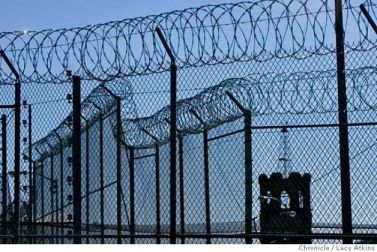
The security to enter and exit the prison is incredible! I first had to sign in and show a state issued id at the gate. One of the prison’s employees picked me up in a golf cart to drive me to B-wing. Once we arrived at the second gate. There was a double 20 foot fence topped by razor wire. In between the fence was an electrified fence. The employee mentioned that every week the prison retrieves birds that have met their demise from coming into contact with the fence. There is another guard station at the triple fences where you sign in and show state issued id again.
Folsom-Prison-periphery-modern-razor-wire-electric-fence-1880-tower-110707-by-Lucy-Atkins-SF-Chron
We entered the B-wing through a set of stairs that were remotely locked at the top and bottom. We then walked down a few hallways. To enter the graduation auditorium, we then had to pass another guard station with two sets of locked doors. Here we showed our id for a third time. Strangely, the entire experience reminded me Lockdown, a zombie podcast that I recently listened to where the apocalypse setting is a prison.
When I entered the auditorium, there were about 50 prisoners sitting that were receiving diplomas and certificates of different types. One student was finishing his four-year college degree and two others were finishing two-year associates degrees. There were about 10 other prisoners that had finished their high school equivalency. The other 35 or so were receiving honors such as Microsoft, technology and parole program certificates.
The audience also contained a section of supportive prison staff on the left. The prisoners that were receiving diplomas were allowed by the prison to invite family members to celebrate with them— the family section was to the right of the prisoners.
The instructors of the prison education program opened the graduation program with congratulatory comments. Then two of the prisoners Folsom Prison Graduation Address (No Blues or Jeans) – Cloaking Inequity:

Seattle Schools Community Forum: Does Your Student Know about CTE?

Seattle Schools Community Forum: Does Your Student Know about CTE?:

Does Your Student Know about CTE?

Image result for Career and Technical Education

That would be Career and Technical Education, what we used to call vocational education.  
Seattle Schools has really kicked this department into gear.  This follows a national reawakening (finally) that not every student is or wants to go to college.  

Here's how the district describes it:


Career and Technical Education (CTE) is a planned program of courses and learning experiences that begins with exploration of career options, supports academic and life skills, and enables achievement of high academic standards, leadership, and preparation for career and college.

Cross-crediting is where a Career and Technical Education course provides high school students with core credit towards graduation and college and university admissions. It blends academic and career & technical studies. This is an alternative way for students to meet graduation requirements, and supports pursuit of preparatory Career and Technical Education course sequences.

Transition services are services above and beyond conventional high school classes that provide extra support for students who need assistance in preparing for college, in obtaining and sustaining employment, in independent living skills, and in other areas necessary to independent and successful adult life. These services are mandated for students with disabilities, but there are many more students who need and will benefit from them.
From The Atlantic (bold mine):

Why should students have to go to college to find ways to be good at what they love? And why should what they love not sync in authentic, empowering ways with what they do in high school?

In Kentucky and other states around the U.S., dual-credit programs and community-college initiatives receive quite a bit of attention, and although I am not suggesting that these programs are unnecessary, I do believe it is important to be intentional in the creation and execution of such initiatives to avoid perpetuating biases and tracking students onto paths that do not empower them to capitalize on their strengths. 

 Although it is easy to proclaim to students coming of age that “you will make more money if you get a degree,” it is much more difficult to shed light on the intricacies of such a claim. I believe students should hear the whole story and more than one traditional path should be laid out before them.
From The Bellingham Herald, a story not directly about CTE but about the same kind of support for adults.

A new, federally funded apprenticeship program aimed at diversifying the tech workforce in Washington has drawn interest from more than 1,000 applicants in just a few months.
And two of its earliest participants have already started yearlong, paid apprenticeships.

The program, called Apprenti, is being run by an industry trade association, the Washington Technology Industry Association 
Seattle Schools Community Forum: Does Your Student Know about CTE?:

Jersey Jazzman: Teacher Tenure and Seniority Lawsuits: A Failure of Logic

Jersey Jazzman: Teacher Tenure and Seniority Lawsuits: A Failure of Logic:

Teacher Tenure and Seniority Lawsuits: A Failure of Logic


New Jersey's teacher tenure and seniority lawsuit continues to grind away. Part of a trio of suits here and in New York and Minnesota, these lawsuits are all being brought to the various state courts by the Partnership for Educational Justice, Campbell Brown's secretly funded organization.

Their Minnesota lawsuit was thrown out of court last fall; in New Jersey, however, we had to wait for a state Supreme Court ruling on a Christie administration motion to tie tenure and seniority laws to school funding. The Court ruled it wasn't going to opine on these laws until a lower court takes up the PEJ's case. So now we wait for that ruling -- and the PEJ continues its public relations campaign against tenure and last in-first out (LIFO) seniority rules.

To their credit, PEJ has posted all of the filings in the case. But it's clear after reviewing them that PEJ doesn't have a leg to stand on. Not to say they won't prevail: bad legal reasoning didn't stop Judge Rolf Treu in California from issuing a terrible ruling in Vergarawhich was inevitably overturned on appeal. Similarly, the only way PEJ can win here in New Jersey is if the lower court hearing the case sets aside all logic and reason...

Because the PEJ's case simply makes no sense.

When a group like the PEJ goes before the courts to get a statute overturned as unconstitutional -- by which I mean in violation of the state's constitution, not the federal Constitution -- the burden of proof is on them. They may have a problem with the NJ tenure and LIFO statutes, or any other law on the books, but getting the court to overturn a law isn't simply a case of arguing against the law's merits: they have to show how it violates the state's constitution.

The constitution states (Article VIII, Section IV): "The Legislature shall provide for the maintenance and support of a thorough and efficient system of free public schools for the instruction of all the children in the State between the ages of five and eighteen years." Unless and until the PEJ can demonstrate to the courts that tenure and LIFO laws violate this clause, the courts cannot act.


The Public Should Pay Only for Public Schools, not Religious Schools | Diane Ravitch's blog

The Public Should Pay Only for Public Schools, not Religious Schools | Diane Ravitch's blog:

The Public Should Pay Only for Public Schools, not Religious Schools


Robert Natelson, a retired constitutional law professor who is allied with the ultra-conservative Heartland Institute, writes in this opinion article that the Supreme Court may well strike down the state prohibitions on funding religious schools (known as “baby Blaine Amendments) because of their origins in anti-Catholic bias. If this happened, it would pave the way for government to divert public funding to the vouchers for religious schools that Secretary of Education Betsy DeVos advocates for.
The Blaine Amendment was proposed by Speaker of the U.S. House of Representatives James G. Blaine in 1875. Blaine was an ambitious politician from Maine who ran for president in 1876, 1880, and 1884. He was interested in a wide range of issues, including trade, monetary policy, and foreign affairs. He is remembered today for the Constitutional amendment he proposed, which passed the House but not the Senate:
“No State shall make any law respecting an establishment of religion, or prohibiting the free exercise thereof; and no money raised by taxation in any State for the support of public schools, or derived from any public fund therefor, nor any public lands devoted thereto, shall ever be under the control of any religious sect; nor shall any money so raised or lands so devoted be divided between religious sects or denominations.”
Although the Blaine Amendment was not adopted as an amendment to the U.S. Constitution, it was adopted by many states and incorporated into their state constitutions to prohibit spending public money on religious schools.
Natelson is right that the public schools of the nineteenth century were deeply imbued with Protestant teachings and practices. I wrote about the battle between Protestants and Catholics in my history of the New York City public schools (The Great School Wars). The arrival of large numbers of Irish immigrants in the 1840s, mostly Catholic, concurred with the beginnings of public school systems in urban areas.
In New York City, Bishop John Hughes (later Archbishop Hughes) fought the local school authorities over the content of the textbooks, which contained anti-Catholic selections, and the daily Protestant prayers and rituals in the schools. Hughes became politically active and demanded equal funding for Catholic schools, since the public schools–in reality, as he said–were Protestant schools. Even if they cleansed the textbooks of The Public Should Pay Only for Public Schools, not Religious Schools | Diane Ravitch's blog:

CURMUDGUCATION: Trump Education Sad Argle Bargle

CURMUDGUCATION: Trump Education Sad Argle Bargle:

Trump Education Sad Argle Bargle

So, Donald Trump held a town hall, if your idea of a town is a place where only CEOs live. It included some Presidential word chunks on the subject of education, and happened all the way back on last Tuesday and yet somehow I missed it (almost as if I'm not actually a CEO) but Valerie Strauss was right on top of things for the Washington Post.


As one might expect, the entire conversation was a fact-free zone. It included some fact-free questioning from Catherine Engelbert, the head honcho at Deloitte, a consulting/accounting company you're probably not important enough to know about. But to be clear, this is a consulting firm that does not actually do anything, but describes itself with language like this:

Clients count on Deloitte to help them transform uncertainty into possibility and rapid change into lasting progress. Our people know how to anticipate, collaborate, and innovate, and create opportunity from even the unforeseen obstacle.

Englebert walked straight out of Lehigh University with her BS in Accounting and into a partnership at the multinational company. So when she talks about the “disconnect between what employers need and what are our students coming into the workforce are prepared to deliver,” you know that she backs that up with all the first-hand knowledge of a multinational bean counting consultant. Englebert throws in some statistics-- NYC schools graduate 70%, and only 37% are assessed as college and career ready. The first number may have some basis in reality, but the second has none. That's 
CURMUDGUCATION: Trump Education Sad Argle Bargle:

Report: The Failure of Policy Planning in California’s Charter School Facility Funding – In the Public Interest

Report: The Failure of Policy Planning in California’s Charter School Facility Funding – In the Public Interest:

Report: The Failure of Policy Planning in California’s Charter School Facility Funding

California has more charter schools than any other state in the nation, in large part because of generous public funding and subsidies to lease, build, or buy school buildings. But much of this public investment, hundreds of millions of dollars, has been misspent on schools that do not fulfill the intent of state charter school policy and undermine the financial viability of California’s public school districts.
In the report, Spending Blind: The Failure of Policy Planning in California’s Charter School Facility Funding, In the Public Interest reveals that a substantial portion of the more than $2.5 billion in tax dollars or taxpayer subsidized financing spent on California charter school facilities in the past 15 years has been misspent on: schools that underperformed nearby traditional public schools; schools built in districts that already had enough classroom space; schools that were found to have discriminatory enrollment policies; and in the worst cases, schools that engaged in unethical or corrupt practices.
                                                           downloadreport2
The report’s key findings include:
  • Over the past 15 years, California charter schools have received more than $2.5 billion in tax dollars or taxpayer subsidized funds to lease, build, or buy school buildings.
  • Nearly 450 charter schools have opened in places that already had enough classroom space for all students—and this overproduction of schools was made possible by generous public support, including $111 million in rent, lease, or mortgage payments picked up by taxpayers, $135 million in general obligation bonds, and $425 million in private investments subsidized with tax credits or tax exemptions.
  • For three-quarters of California charter schools, the quality of education on offer—based on state and charter industry standards—is worse than that of a nearby traditional public school that serves a demographically similar population. Taxpayers have provided these schools with an estimated three-quarters of a billion dollars in direct funding and an additional $1.1 billion in taxpayer-subsidized financing.
  • Even by the charter industry’s standards, the worst charter schools receive generous facility funding. The California Charter Schools Association identified 161 charter schools that ranked in the bottom 10% of schools serving comparable populations last year, but even these schools received more than $200 million in tax dollars and tax-subsidized funding.
  • At least 30% of charter schools were both opened in places that had no need for additional seats and also failed to provide an education superior to that available in nearby public schools. This number is almost certainly underestimated, but even at this rate, Californians provided these schools combined facilities funding of more than $750 million, at a net cost to taxpayers of nearly $400 million.
  • Public facilities funding has been disproportionately concentrated among the less than one-third of schools that are owned by Charter Management Organizations (CMOs) that operate chains of between three and 30 schools. An even more disproportionate share of funding has been taken by just four large CMO chains—Aspire, KIPP, Alliance, and Animo/Green Dot.
  • Since 2009, the 253 schools found by the American Civil Liberties Union of Southern California to maintain discriminatory enrollment policies have been awarded a collective $75 million under the SB740 program, $120 million in general obligation bonds, and $150 million in conduit bond financing.
  • CMOs have used public tax dollars to buy private property. The Alliance College-Ready Public Schools network of charter schools, for instance, has benefited from more than $110 million in federal and state taxpayer support for its facilities, which are not owned by the public, but are part of a growing empire of privately owned Los Angeles-area real estate now worth in excess of $200 million.
We’d love to hear from you. Send us an email: info@inthepublicinterest.org.
If you’d like to know when we release information like this, please sign up for our mailing list.
Report: The Failure of Policy Planning in California’s Charter School Facility Funding – In the Public Interest:

Charter schools are growing in number where they are not needed, new report says - LA Times

Charter schools are growing in number where they are not needed, new report says - LA Times:

Charter schools are growing in number where they are not needed, new report says

Charter schools are proliferating where they aren’t needed while state funding continues to support even those charters that violate state law, according to a report released Monday by a research and advocacy group.
The new research by an Oakland group called In The Public Interest looks at where charter schools are increasing in number and where schools are needed based on enrollment. The two trend lines do not correspond, researchers found — especially in the Los Angeles Unified School District, where the number of school-age children has declined even as the number of charters has exploded.
Charters are privately operated, taxpayer-funded public schools that are exempt from some rules that govern traditional campuses.
The report points out that traditional school districts can’t build new schools when real or potential enrollment fails to justify expansion. But those rules don’t apply to charter schools, which can open anywhere and qualify for state funding or subsidies to build or lease facilities. The report says public funds helped open and sustain at least 450 charters in areas with plenty of existing classroom space.
“Paying for more schools than are needed wastes taxpayer dollars,” the report says. “Furthermore, an oversupply of schools serves to undermine the viability of any individual school.”
The latter argument has been made repeatedly by L.A. Unified officials, who assert that rapid and widespread charter growth is one of several factors threatening the solvency of the nation’s second-largest school system.
The report’s lead researcher, Gordon Lafer, an associate professor at the University of Oregon’s Labor Education and Research Center, attributes the problem to a lack of clarity and vision in state policy.
Charter supporters insist the need for such schools isn’t based on a shortage of classroom capacity but on a shortage of classrooms providing a high-quality education.


They also believe parents should have more choices, especially in low-income neighborhoods where student achievement and graduation rates at traditional public Charter schools are growing in number where they are not needed, new report says - LA Times: