Latest News and Comment from Education

Tuesday, January 24, 2017

CURMUDGUCATION: Competition vs. Quality

CURMUDGUCATION: Competition vs. Quality:

Competition vs. Quality

Image result for business competition
Image result for stairs illusion animated gif

It is an oft-stated truism-- competition creates excellence.

If you are running a race, you will run faster and harder to beat people who are also running fast. If you are playing football, you will train to be better than the team facing you on the field. It seems sensible.


There are some problems with this model just on its face. The people in the front of the pack, the winners, will get stronger perhaps, but the race will also separate out some losers, who will either have to either accept losing as their lot in life. Or they'll figure out ways to cheat. After all, if the definition of winning too narrow, like "being first to cross the finish line"-- well, there are plenty of ways to accomplish that without having to run the whole race faster than anyone else.

If we really believe that every student in America should get to attend a school that's a winner, then a competition that only a few can win seems like a poor model.

Competition may deliver excellence for a few, but it will not deliver excellence for everyone. 

But there are other issues. If we make the reward for winning something important like, say, your food, then by losing, racers lose the very thing they need to compete. Competition will make them weak and hungry, the very opposite of breeding excellence.

But competition often does not breed excellence at all-- in fact, it can create the opposite effect.

Consider a market competition this way-- that vendors are competing for the chance to sell their 
CURMUDGUCATION: Competition vs. Quality:


Diane Ravitch vs Sen. Alexander: Yes, Betsy DeVos is an education extremist. Don’t confirm her as education secretary. - The Washington Post

Diane Ravitch to Sen. Alexander: Yes, Betsy DeVos is an education extremist. Don’t confirm her as education secretary. - The Washington Post:

Diane Ravitch to Sen. Alexander: Yes, Betsy DeVos is an education extremist. Don’t confirm her as education secretary.


Sen. Lamar Alexander (R-Tenn.), chairman of the Senate committee that is voting on the nomination of Michigan billionaire Betsy DeVos as President Trump’s education secretary, is the author of “The Little Plaid Book,” a list of rules and lessons for anyone seeking a leadership position. Rule 168 says, “Read whatever Diane Ravitch writes about education.”
Ravitch worked as assistant education secretary under Alexander, who was education secretary in the administration of former president George H.W. Bush. Since Alexander wrote that, Ravitch has undergone a radical change in her views about education reform after seeing the consequences of school choice and standardized test-based accountability systems on students and teachers. An education historian and public school advocate, Ravitch became the titular leader of the movement against corporate school reform after the 2010 publishing of her book, “The Death and Life of the Great American School System.”
In a previous post on The Answer Sheet,  Alexander made his case for why he supports DeVos and accuses DeVos’s critics of opposing her because they don’t like charter schools and vouchers and they don’t like the fact that she is wealthy.
In this post, Ravitch writes in an open letter to Alexander why she believes that DeVos is an education extremist and should not be confirmed.
DeVos went before Alexander’s committee for her confirmation hearing and stumbled. She revealed a lack of understanding of basic education issues, such as the Individuals with Disabilities Education Act. Alexander was criticized by Democrats for refusing to give them enough time to question her at the hearing, and he has rejected a request for a second hearing before the panel votes on her confirmation.
Ravitch posted the following open letter on her blog, and she gave me permission to republish it.
Here is the open letter Ravitch wrote to Alexander:
Dear Lamar,
I hope you don’t mind my taking the liberty of writing you a public letter.
I was just reading your book of sayings, the Little Plaid Book. For those who don’t know, this is your book of “311 rules, lessons, and reminders about running for office and making a difference whether it’s for president of the United States or president of your senior class.”
The main lesson of the book for me is that you should be honest with people. You shouldn’t bore them. You shouldn’t lecture them or try to impress them. You should get to know them, listen to them, respect their concerns, and try to understand their problems.
Sen. Alexander: Betsy DeVos is not an education extremist and should be education secretary


President Trump’s nomination of Michigan billionaire Betsy DeVos as U.S. education secretary may well have resulted in the most contentious confirmation process among his Cabinet picks. DeVos’s supporters say she is a strong supporter of school “choice” who will not harm traditional public schools, while her critics say that her decades-long activism in education show that her priority is the privatization of public education.
At her confirmation hearing last week, DeVos was peppered with tough questions from Democrats on the Senate education committee, and some of her responses were criticized for revealing a lack of understanding of basic issues in education. The hearing became further charged when Democrats repeatedly asked the committee chairman, Sen. Lamar Alexander (R-Tenn.), for a second round of questioning and he declined. He has also declined to hold a second hearing, as requested by Democrats. One Republican on the panel expressed some concern about DeVos’s education vision at the hearing.
Alexander has gone defensive, giving speeches and writing op-eds saying that DeVos is not an extremist, as her critics contend, but in the mainstream of education thought. This is an op-ed he wrote that was published on Medium, and I was given permission to republish it.
By Lamar Alexander
Democrats desperately are searching for a valid reason to oppose Betsy DeVos for U.S. education secretary because they don’t want Americans to know the real reason for their opposition.
That real reason? She has spent more than three decades helping children from low-income families choose a better school. Specifically, Democrats resent her support for allowing tax dollars to follow children to schools their low-income parents’ choose — although wealthy families choose their children’s schools every day.
Tax dollars supporting school choice is hardly subversive or new. In 2016, $121 billion in federal Pell Grants and new student loans followed 11 million college students to accredited public, private or religious schools of their choice, whether Notre Dame, Yeshiva, the University of Tennessee or Nashville’s auto diesel college. These aid payments are, according to Webster’s — “vouchers”-exactly the same form of payments that Mrs. DeVos supports for schools.
America’s experience with education vouchers began in 1944 with the GI Bill. As veterans Sen. Alexander: Betsy DeVos is not an education extremist and should be education secretary

Make your school a safe zone for all students

Make your school a safe zone for all students:

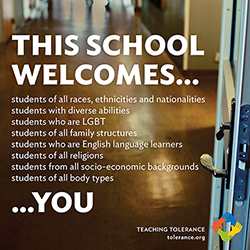
All students are welcome. Make your school a safe zone

Image result for All students are welcome. Make your school a safe zone

Ensuring that all students have the right to a public-school education—no matter where they live or where they’re from—is our primary responsibility. That makes us social justice warriors as well as educators. In that spirit, we are championing the cause of undocumented students who are at risk of deportation.
Today’s climate means we must do even more to mobilize against and resist actions that diminish the dignity of these vulnerable students and deny them the education they deserve. Many school districts are making their campuses “safe zones” for immigrant students and communities. You can be part of this movement
To help you, we’ve created sample resolutions and a policy template that boards can adopt. The goal is to reassure immigrant students and families who fear raids by immigration law enforcement agents, and are concerned that Donald Trump’s dangerous rhetoric has made them targets of hate. They need to know we are standing with them on the front lines and will always be their advocates.
For more information, take a look at this list of Frequently Asked Questions (FAQ) about safe zones and then join your local NEA association in lobbying the local board to pass a resolution. A sample resolution appropriate for a college or university board is also available.
Incredulous as we all may be, yes: It’s actually come to this. Trump has promised to deport undocumented immigrants en masse, build a wall along the entire length of the border with Mexico and create a registry of all Muslim immigrants.
And if Trump succeeds in having Senator Jeff Sessions confirmed as Attorney General, he’ll be closer to achieving his goals. Sessions wants to end the Deferred Action for Child Arrivals (DACA) program and refuses to distance himself from anti-immigrant organizations such as the Federation for American Immigration Reform (FAIR), founded by John Tanton, whom  the Southern Poverty Law Center calls the “architect of the modern anti-immigration movement.”
We can’t let anyone get in the way of our efforts to make every school and campus a more inclusive, welcoming place.
Our safe zone measures build on other actions we’ve taken. Earlier this month, we threw our support behind the BRIDGE Act, a bill to extend three years of protection of Deferred Action for Childhood Arrivals (DACA) recipients and DACA-eligible DREAMers, people who came to the United States as children. It’s a short-term fix, but it is a step in the right direction.
In November, we co-hosted a webinar with the National Immigration Law Center, Know Your Rights, to help Make your school a safe zone for all students:

Betsy DeVos’ big education idea doesn’t work.

Betsy DeVos’ big education idea doesn’t work.:

Betsy DeVos’ Big Education Idea Doesn’t Work

She embraces an outmoded version of school choice without government interference—even though the movement she claims to champion has realized that model is bunk.


Of all Betsy DeVos’ stated priorities as America’s presumed next education chief—and there have not been very many—her desire to let parents pick the best schools, public or private, for their children remains one of the most consistent and emotionally resonant.
At her confirmation hearing on Tuesday, Trump’s nominee for secretary of education told senators: “My orientation is around parents and children. When parents choose charter schools, they are doing so because they think it’s a great choice for their children.” “Parents,” she said, “no longer believe that a one-size-fits-all model of learning fits the needs of every child.” If you have a kid in school, that’s an easy sentiment to nod to. It’s also, if it’s poorly applied, an outdated and potentially destructive one—especially, the evidence tells us, when it comes to educating the children of lower-income families.
DeVos is sounding an old tune in her insistence on the power of parental choice as a lever to improve education in America. In the late 1980s and early 1990s, the notion became a rallying cry for conservatives—and some liberals—eager for states to embrace private school voucher programs, charter schools, or both. (Charter schools are public-private hybrids that typically must follow the reporting requirements of traditional public schools, including test scores and graduation rates. Voucher programs, by contrast, divert public funds—often in the form of “tuition vouchers”—to private schools that lack the regulations and transparency of public ones. Charter schools generally garner more bipartisan support than voucher programs, but several Democrats, particularly black ones, have endorsed vouchers as a potential boon for low-income families of color.)
Although DeVos’ exhortations on behalf of parental school choice are familiar to anyone who follows education reform, today she is wildly out of touch with a large part of the movement she purports to represent. The nearly 30-year history of school vouchers and charters in America has shown that parental choice—in the absence of government intervention—will not improve the quality of education in America and could inflict significant damage on the poorest communities. Indeed, even many of the staunchest early supporters of unchecked parental choice have moderated that stance over the past 15 years. By all appearances, DeVos hasn’t faced a similar moment of reckoning.
Howard Fuller, an early and well-known supporter of school vouchers who founded Marquette University’s Institute for the Transformation of Learning, has long advocated for providing poor parents with more educational options. He still believes strongly in the power of school choice. Yet based on experience and evidence, he came to see the need for a greater governmental role—eitherBetsy DeVos’ big education idea doesn’t work.:

GOP Senate chair rejects Democrats' bid for second hearing on Trump education nominee

GOP Senate chair rejects Democrats' bid for second hearing on Trump education nominee:

GOP Senate chair rejects Democrats' bid for second hearing on Trump education nominee


The Republican chairman of the Senate Health, Education, Labor and Pensions (HELP) Committee on Monday rejected a formal request from Democrats to hold a second confirmation hearing for Betsy DeVos, President Trump’s choice to head the U.S. Department of Education.
A vote on DeVos’ confirmation, originally scheduled for Tuesday, had already been delayed until Jan. 31 to allow her to answer lawmakers' hundreds of questions, many about her financial disclosures.
In a letter sent on Monday to the panel’s chairman, Sen. Lamar Alexander (R- Tenn.), Democrats said education is too important an issue — and the education secretary’s position too important a position — “to jam a nominee through without sufficient questioning and scrutiny.”
Alexander last Tuesday introduced her to the committee in a rare evening hearing, saying DeVos, a well-known Michigan billionaire and school choice proponent, is “in the mainstream of public opinion — and her critics are not.”
During the hearing, Democrats peppered DeVos with a series of detail-oriented queries about the USA’s public school system, criticizing her lack of experience in the system. DeVos, 59, a GOP mega-donor who once led the Michigan Republican Party, admitted that she had neither attended public school nor sent her children there. She also said no family members have ever relied on federal college loans.

CLOSE
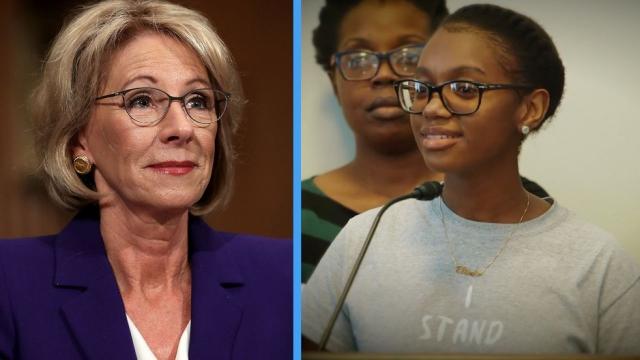
Detroit student Dana Wilson went to the potential education secretary's hearing. Now, she's speaking out. Video provided by Newsy Newslook
In a particularly sharp exchange, Sen. Elizabeth Warren, D-Mass, asked about her family's experiences with college loans, then noted that Trump last year paid a $25 million settlement to students of Trump University who complained that they didn’t get what they paid for. Asked if she would enforce rules that require career colleges to GOP Senate chair rejects Democrats' bid for second hearing on Trump education nominee:

Betsy DeVos’s ethics review raises further questions for Democrats and watchdogs - The Washington Post

Betsy DeVos’s ethics review raises further questions for Democrats and watchdogs - The Washington Post:

Betsy DeVos’s ethics review raises further questions for Democrats and watchdogs

Image result for Betsy DeVos’s ethics

Betsy DeVos, President Trump’s nominee to lead the Education Department, promised late last week to divest from more than 100 entities to avoid potential conflicts of interest with her new job. But there are important unanswered questions about the considerable financial interests — including, it appears, in education-related companies — that DeVos will continue to hold, according to Democrats and ethics watchdogs.
DeVos’s supporters point out that DeVos’s handling of her investments have been blessed by the Office of Government Ethics (OGE), which signed off on her financial disclosures and ethics agreement last week. They accuse her critics of mounting a groundless political attack.
“The OGE was created to be an independent and impartial mechanism for preventing conflicts of interest among executive branch officials, and OGE certification is broadly considered the gold standard of ethics reviews,” said Ed Patru, spokesman for Friends of Betsy DeVos, a group of supporters. “The OGE has spent weeks reviewing Betsy’s financial holdings, it produced a sterling report that is both thorough and comprehensive, and Betsy intends to abide fully by OGE’s findings. I hope Betsy’s political opponents are not suggesting a return to the pre-Watergate era in which ethics judgments were determined by partisan personal opinions instead of objective and independent guidance.”
Under her agreement with federal ethics officials, DeVos will continue to serve as a co-trustee in three family trusts that benefit her and her husband, Dick DeVos Jr.
Her disclosures do not list assets for two of the trusts, so there is no sense of whether they have investments in education companies that might present potential conflicts of interest. Patru declined to say why she did not disclose information about the assets in those two trusts.
OGE spokesman Vincent Salamone would not discuss the specifics of DeVos’s review, but he said that nominees are under no obligation to identify the assets in a trust. What’s most important, he said, is that assets are listed for ethics officials to do the conflict of interest review.
“Someone has got to find out what the holdings are, so they can advise her what she needs to recuse from,” said Kathleen Clark, a law professor at Washington University. “The holdings would have to be revealed to someone at the very least in the Department of Education or the Office of Government Ethics, so that person can adequately help put in place procedures so she doesn’t end up violating the statute.”
DeVos disclosed her holdings in a third trust. It has an indirect financial stake in Sextant Education, which operates a chain of for-profit colleges, through its parent company AEA Investors. The trust also holds an interest in Discovery Communications, which is perhaps best known for operating cable television channels such as Animal Planet and TLC, but which also sells services and products to schools, including digital textbooks and teacher training, according to its website.
“If she has some kind of investment in an entity involved in these issues, then she should recuse herself from making decisions affecting those issues,” said Meredith McGehee, a government Betsy DeVos’s ethics review raises further questions for Democrats and watchdogs - The Washington Post:


Dear students, Betsy DeVos may not be prepared for office, but you must prepare for her - The Hechinger Report

Dear students, Betsy DeVos may not be prepared for office, but you must prepare for her - The Hechinger Report:

Dear students, Betsy DeVos may not be prepared for office, but you must prepare for her

The confirmation vote on the Secretary of Education nominee has been delayed amid criticism

Image result for The confirmation vote no on devos
Dear students:
The confirmation vote on the U.S. Secretary of Education nominee has been delayed until January 31, but the Senate needs to give her a few more years, not days, to prepare.
If you watched Betsy DeVos’s (first) Senate confirmation hearing last week, it might have brought back memories of the last time you took an oral exam. Specifically, an oral exam you hadn’t properly prepared for. Maybe you got very religious, praying for a few questions you could confidently answer. But your least favorite teacher wouldn’t let you off the hook. And yes, she saw sweat dampen your shirt as you stuttered and mumbled, responding with too many or too few words because you didn’t have the right ones.
Now review the DeVos hearing. Notice any similarities? Would you have given her passing marks? Her responses to questions about the Individuals with Disabilities Education Act alone would have failed her.
Join the conversation later on Andre Perry’s radio show, “Free College,” hosted Tuesdays on WBOK1230 in New Orleans at 3pm Central/4pm Eastern 504.260.9265.
In response to former Democratic Vice Presidential nominee Senator Tim Kaine, who asked, “Should all schools that receive taxpayer funding be required to meet the requirements of the Individuals with Disabilities Education Act?” DeVos replied, “I believe that’s a matter best left to the states.”
But states’ unequal treatment of people with disabilities was the very reason Congress passed that important act. Clearly, DeVos hadn’t done her homework. And as if that weren’t enough, she actually defended school personnel possessing guns, because they might need “to protect from potential grizzlies.”
(An aside: If you’re on the pro-guns-in-schools side in a debate, don’t invoke grizzlies if you want people to take you seriously.)
No, Betsy DeVos is not prepared to lead our country’s educational system, but students, you must prepare for her.
Image result for The confirmation vote no on devos


The NPE Toolkit: Stop Betsy DeVos - Network For Public Education - http://wp.me/p3bR9v-27I

Five misconceptions about Michigan education and Betsy DeVos - The Hechinger Report

Five misconceptions about Michigan education and Betsy DeVos - The Hechinger Report:

Five misconceptions about Michigan education and Betsy DeVos

Cutting through the partisan noise

Image result for big education ape devos michigan schools


Image result for big education ape  Betsy DeVos
President Trump’s nomination of Betsy DeVos — a Michigan philanthropist and school choice advocate — for Secretary of Education is thrusting Michigan education into the national education debate.
DeVos played a role in Michigan education reform, so in a world of alternative facts, suddenly claims and counter-claims about Michigan schools are all over blogs, social media and mainstream media.
To help cut through the noise, we created this comprehensive fact base about education in Michigan to serve as an impartial resource during the confirmation hearings and beyond.
The facts reveal a complicated story about education reform on the ground in Michigan that bolsters the case both of DeVos’ boosters and her critics.
Michigan has aggressively moved to expand school choice and other reform efforts for more than two decades, but has struggled at times to implement effective oversight of these reforms — especially in Detroit, the nation’s lowest performing, large, urban district.
Michigan does not tell us everything about what DeVos might do or not do as Secretary of Education, but it offers some clues.
Here are five misconceptions we’ve fact-checked about Michigan education during the DeVos debate, from both supporters and opponents of the Secretary of Education nominee:
First claim: Increases in Michigan student achievement are leading to greater college and career readiness among the state’s high school graduates.
The facts: Schools in Michigan have not been performing well in recent years — the state generally ranks in the bottom third in the National Assessment of Educational Progress (NAEP), and new state assessments show wide achievement gaps across grade levels, especially for low-income students and students of color. While graduation rates have gone up, they still fall below the national average, and when 11th grade students in Michigan took the SAT last year, only 35 percent hit the “college ready” benchmark.
Second claim: Reports that Michigan lacks school accountability are “false news.
The fact: While Michigan has various accountability mechanisms for schools, those systems have not been very effective, and were under scrutiny even before DeVos’s nomination.
Responsibility for education in Michigan is shared between the State Board of Education, the state superintendent, the governor, and over 40 charter school authorizers, making it tough to know for sure who is responsible for what. Only in 2014 (after 20 years of charter schools) did the state Department of Education start closely overseeing charter school authorizers’ effectiveness. School accountability systems are being revised at the state and local level in Michigan — the state is putting together a new statewide plan under the Every Student Succeeds Act (ESSA), and a recently passed law mandates an A-F grading system for all schools in Detroit, implemented by the governor’s School Reform Office. It will take a few more years to know whether these new systems will yield any Five misconceptions about Michigan education and Betsy DeVos - The Hechinger Report:
Image result for big education ape Betsy DeVos michigan