Latest News and Comment from Education

Wednesday, January 4, 2017

CURMUDGUCATION: Six Reasons To Oppose Betsy DeVos

CURMUDGUCATION: Six Reasons To Oppose Betsy DeVos:

Six Reasons To Oppose Betsy DeVos


Senate hearings on Herr Trump's cabinet picks are coming up soon, and you should be calling your Senator. There are many good reasons for opposing Betsy DeVos as a Secretary of Education.


1) No experience with pubic education.

This is not like appointing someone to the post of Attorney General who is not a lawyer-- this is like appointing someone Attorney General who has never been to court. DeVos grew up in private school, sent her kids to private school, and has spent her adult life advocating for private schools. She has literally no first hand knowledge of how the public education system works, for better or worse.


2) No organizational experience.

DeVos's experience is strictly in philanthropic advocacy, a sort of checkbook lobbying that has never required her to work with people with whom she disagrees. As Secretary of Education, she will need to work with governors, congresspersons, and the sprawling USED staff, many of whom are going to disagree with her in matters of policy and philosophy. As a philanthropic advocate, she has been able to surround herself with people who are like-minded and/or beholden to her. That would not be her situation as Secretary; she would have to build coalitions, reach compromise, earne trust and cooperation, and all without the use of her checkbook. One of the great criticisms of Arne Duncan was that he could not play well with Congress, instead insisting on dictating as if he were The Boss. Everything in DeVos's background, including her dismissal of both political parties as failures, suggests that she would be even worse.

3) No administrative experience.

DeVos has never run an organization or corporation close to the size of the Department of Education. The department has 5,000 employees and oversees a budget of around $73 billion. Windquest, the energy investment she runs with her husband, has ten employees with revenue 
CURMUDGUCATION: Six Reasons To Oppose Betsy DeVos:


Dear friends, help free a friend, please and thank you! | Bill Ayers

Dear friends, help free a friend, please and thank you! | Bill Ayers:

Dear friends, help free a friend, please and thank you!

Image result for Judith Clark

As you probably know, Governor Andrew Cuomo granted clemency to our friend and comrade Judith Clark, who has served 35 years in New York State prison for her participation in the Brinks robbery in 1981 that resulted in the deaths of two police officers and a Brinks guard. The attached NewYork Times articles detail her amazing record in prison, her work with mothers and families and with HIV-positive people in Bedford Hills, as well as her meeting with the governor at the prison last fall. Now Governor Cuomo is being bombarded with opposition to his decision and, since she must appear before the Parole Board soon, her freedom is by no means guaranteed. We need to make voices of compassion and forgiveness and simple justice heard immediately to ensure that the governor knows his pardons and clemency for those convicted as juveniles and others, including Judy, have a strong base of support in New York and nationally.  Below is a sample letter, some talking points, and information on how to contact the governor’s office. Time is of the essence, and a thousand THANKS!
Dear Governor Cuomo:
I write to support your courageous exercise of your clemency/pardon and commutation powers this holiday season. Your actions highlighted the need to give second chances, to acknowledge that people change, and that lengthy sentences often keep people in prison longer than necessary. Your commutation of the sentences of Judith Clark and others is exactly the kind of leadership on criminal justice reform that New York State and our country need.
Granting clemency to people imprisoned for violent crimes is a real breakthrough—as you point out in the New York Times interview on January 4, 2017. Ms. Clark is as “corrected” as possible and has a contribution to make to the larger society.  Your recognition that those convicted of a violent offense may also change, grow, and deserve a second chance. 
[OR]
1. I support Governor Cuomo’s clemency for Judith Clark and others because of his vision for the need for broad criminal justice reform, as reflected in his pardons and clemency actions.
2. His pardons and position on raise-the-age recognize that
juveniles should not be judged as adults.
3. He recognizes that people can change, grow and mature, and that it is unjust to freeze them into the crime that they committed. He recognizes that when they have demonstrated growth and are not a risk to public safety, they deserve a second chance.
4. He recognizes that keeping people in prison for extremely long sentences regardless of rehabilitation and lack of threat to public safety makes no sense, and contributes to unfair and unsustainable mass incarceration.
On-line:
Phone: 518-474-8390
Mail:
The Honorable Andrew Cuomo
Governor, New York State
Executive Chamber, State Capitol, Albany NY 12224
FROM the NYT:
and
Dear friends, help free a friend, please and thank you! | Bill Ayers:

Will Governor Malloy propose boondoggle for charter schools under guise of new education funding formula? - Wait What?

Will Governor Malloy propose boondoggle for charter schools under guise of new education funding formula? - Wait What?:

Will Governor Malloy propose boondoggle for charter schools under guise of new education funding formula?


Connecticut’s existing school funding formula is unfair, inappropriate and unconstitutional.  It leaves Connecticut’s public schools without the resources they need and places an unfair burden on Connecticut’s middle income families.
The CCJEF v. Rell lawsuit, which should have been called the CCJEF v. Malloy suit, made the problem extremely clear.
The time has come to return to the fundamental principles that served as the underpinning of the Educational Cost Sharing (ECS) Formula before it was gutted by Governor Malloy and previous Connecticut governors and legislatures.
However, rather than step up and address the major flaws with the existing failed funding system, Governor Dannel Malloy made a thinly veiled reference today, in his State of the State Address, that he plans to propose a new state education funding formula, one that would likely pump even more scarce public funds to Connecticut’s privately owned and operated charter schools.
In addition, Malloy appears poised to suggest that any increase in education funding be restricted to only the poorest communities and that it come with strict new red tape and mandates, a move that will make it Will Governor Malloy propose boondoggle for charter schools under guise of new education funding formula? - Wait What?:

Organizing for Our Students - Lily's Blackboard

Organizing for Our Students - Lily's Blackboard:

Organizing for Our Students

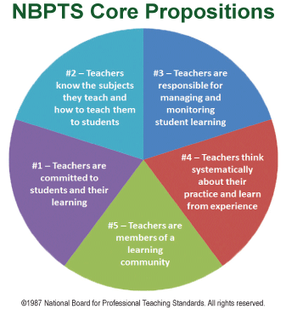
Image result for National Board Five Core Propositions for Teaching
The National Board for Professional Standards  in 1989 published What Teachers Should Know and Be Able to Do and re-released this seminal work recently.  It outlines the National Board’s Five Core Propositions for Teaching, concepts that  accomplished teachers should know and be able to promote to spur student achievement. They are:
Proposition 1: Teachers are committed to students and their learning. 
Proposition 2: Teachers know the subjects they teach and how to teach those subjects to students. 
Proposition 3: Teachers are responsible for managing and monitoring student learning. 
Proposition 4: Teachers think systematically about their practice and learn from experience. 
Proposition 5: Teachers are members of learning communities. 
 It’s worth noting that  the very first proposition speaks to our commitment as teachers to our students’  learning. Our students come from diverse backgrounds, their lives are complex and many of them face challenges most of us can’t even imagine. Yet, as education professionals, we must find ways to inspire natural curiosity, imagination and the desire to learn in them all.  National Board Certification helps us achieve that goal.
There’s no question that the road to National Board Certification can be long and winding, but the journey provides opportunities for amazing professional and personal growth.  National Board Certified Teacher  Ambereen Khan-Baker from Maryland blogs about how certification has helped her pay particularly close attention to issues of fairness and equity as she encourages student learning.
If we do not address safety, equity and diversity in our classrooms—now, today—then we will continue to fail large numbers of our students.  During the past six months, I have heard and seen threatening messages reported by the media that have caused me, a Muslim, Pakistani-American National Board Certified Teacher, to question the standard of fairness, equity and diversity in a renewed and urgent way.
Knowing your students is step one of the Architecture of Accomplished Teaching (AAT).  It is important for us, as Organizing for Our Students - Lily's Blackboard:

It’s National Mentoring Month. Are You Paying it Forward?
I stepped into my first full-time teaching gig at Orchard Elementary as a 4 th grade teacher fresh out of the university and student teaching. After one full day on the job, I realized how much I still had to learn. What I didn’t realize at the 

2017–18 SBP and SFSP Start-up and Expansion Grants - School Nutrition (CA Dept of Education)

2017–18 SBP and SFSP Start-up and Expansion Grants - School Nutrition (CA Dept of Education):

2017–18 SBP and SFSP Start-up and Expansion Grants

Image result for big education ape devos tom t

Nutrition Services Division Management Bulletin

Purpose: Beneficial Information
Date: February 2017
Number: SNP-01-2017, SFSP 01-2017
To: Public School Districts, Direct Funded Charter Schools, and County Superintendent of Schools
Attention: Food Service Director, Chief Business Official, and Chief Financial Officer
Reference: California Education Code Section 49550.3; 2017–18 State Budget Act
Subject: Availability of the School Breakfast Program and Summer Food Service Program Start-up and Expansion Grants for State Fiscal Year 2017–18

This Management Bulletin announces the availability of the School Year (SY) 2017–18 School Breakfast Program (SBP) and Summer Food Service Program (SFSP) Start-up and Expansion Grants. The application deadline is March 1, 2017.
Background Information
The state Legislature appropriates approximately $1.017 million in the annual state budget for SBP and SFSP Start-up and Expansion Grants. California EC, Section 49550.3, authorizes the California Department of Education (CDE) to award competitive grants of up to $15,000 per school site for nonrecurring expenses incurred when initiating or expanding an SBP or SFSP.
Additionally, on June 27, 2016, Governor Jerry Brown signed SB 828, which prioritizes an additional $2 million in grant funds for school food authorities (SFA) that want to start-up or expand Breakfast After the Bell (BATB) meal service models starting in SY 2017–18. The funds, available over a two-year period (SYs 2017–18 and
2018–19), prioritize grants for BATB in schools that have at least 60 percent of enrolled students approved for free or reduced-price meals (F/RP). BATB service models integrate breakfast into the school day (i.e., provide breakfast sometime after the start of the school day). Detailed information about strategies for serving BATB is available on the BreakfastFirst Web site at http://www.breakfastfirst.org.
The following types of grants are available:
For the $1.017 million original SBP and SFSP funding:
  • Start-up grants for costs associated with starting an SBP or SFSP site
  • Expansion grants for costs associated with increasing program participation at an existing SBP or SFSP site
For the $2 million BATB funding:
  • Start-up grants for costs associated with starting a BATB service model
  • Expansion grants for costs associated with expanding a BATB service model
Who Can Apply?
Public school districts, county offices of education, and directly funded charter schools can apply for this grant funding. Each SFA may apply for no more than 10 sites, for up to $15,000 per site. Please note that private schools, residential child care institutions, and juvenile detention centers are ineligible to apply for or receive these grants. SFAs participating in the Seamless Summer Option (SSO) are also ineligible to apply for or receive these grants at SSO sites. Only school sites are eligible for a grant.
For SBP grants, the SFA must have at least 20 percent of students enrolled at the site approved for F/RP meals. For SFSP grants, sites must meet all SFSP eligibility criteria, which are available on the CDE SFSP Information Web page at http://www.cde.ca.gov/ls/nu/sf/sfspinfo.asp.
Also, an SFA must have a current vendor number on file with the California State Controller’s Office to be eligible for an SBP or SFSP grant. SFAs can obtain a vendor number from the CDE as part of the application process to participate in the National School Lunch Program (NSLP), SBP, or SFSP. To begin the NSLP, SBP, or SFSP application process, please contact Tara Chambers, School Nutrition Programs Specialist, by phone at 916-323-7177 or by e-mail at tchambers@cde.ca.gov. Grant recipients must be approved to participate in the SBP or SFSP prior to receiving the first grant payment.
Grant Criteria
These grants are competitive, and detailed scoring criteria is available on the CDE Funding Web page at http://www.cde.ca.gov/fg/fo/r9/sbsf17rfa.asp. SFAs should keep the following criteria in mind when applying for this grant:
  • The CDE will give priority to school sites with a high F/RP eligible percentage.
  • For the additional $2 million in funding, the CDE will give priority to SFAs that implement a BATB meal service model.
  • SFAs may receive a grant for the same site no more than once every three years (unless they serve BATB).
  • Eligible SFAs may apply for the SBP grant and/or the SFSP grant on their application; however, SFAs may not request both grants for one site.
  • The CDE may consider SFAs with excess net cash resources (NCR) to be ineligible to receive a grant. In accordance with Title 7, Code of Federal Regulations, Section 210.14(b), an SFA shall limit its NCRs to an amount that does not exceed three months’ average expenditures from its food service account. SFAs with excess NCRs must include a detailed explanation in their application for their excess NCRs.
  • SFAs must be in good standing in all child nutrition programs in which they participate.
Grant Award Information
  • SFAs must obtain and submit board or other approval with their grant application for sites that require approval from their district or agency’s governing board before accepting grant funds. The CDE will not process an application without these approvals (if needed).
  • All grant recipients must sign and return the original Grant Award Notification (GAN) before the CDE will release grant funds. An original GAN includes the signature of the State Superintendent of Public Instruction Tom Torlakson.
  • The CDE will bill SFAs for any funds that they have received or may withhold final payment if they do not fulfill the requirements of the grant. Please note that awarded SFAs must be approved to participate in the SBP or SFSP before receiving the first grant payment.
  • If an SFA knowingly submits false information on its grant application or invoices, the CDE may deny or recover the SFA’s grant funding.
  • The CDE will provide funding for SBP/SFSP grants as long as funds are available. Please note that the CDE will provide grant recipients with 90 percent of the funding at the time of award and the remaining 10 percent upon approval of all invoices. The CDE will recover funds from SFAs that do not submit invoices for approved budget items within the grant award time frame.
  • The CDE will send grant awardees an approved procurement form, which represents an estimate of approved grant expenses for claim submittal.
  • The CDE administers these grants and reserves the right to make changes to the approved budget, which includes reducing the amount of funding to reflect actual, allowable, and reasonable costs.
Application Deadline
The CDE must receive signed and dated hard copies of grant applications (with original signature) on or before Wednesday, March 1, 2017. The CDE will not:
  • Accept any applications received after 5 p.m., on March 1, 2017
  • Process incomplete, illegible, or late applications
  • Accept fax or e-mail submissions
  • Accept placeholder applications of any type
SFAs can download the SBP/SFSP grant instructions and application on the CDE SBP/SFSP Grants Funding Profile Web page at http://www.cde.ca.gov/fg/fo/r9/sbsf17rfa.asp.
Proposed Grant Timeline
The CDE will conduct two rounds of grant awards per fiscal year. Each round has different timelines; however, there is not a separate application process for the reallocation round. The CDE may offer recovered funds to SFAs from the original scoring list. The second round will reallocate leftover funding from awardees that surrendered their funds.
Round 1—Standard Round
ActivityDeadline
All SBP/SFSP grant applications due to the CDEMarch 1, 2017
The CDE mails GAN letters to awardeesNo later than June 1, 2017
SFAs must submit signed GAN to the CDEWithin 30 days of award
Grant periodJuly 1, 2017 to March 1, 2018
SFAs submit Midyear Progress Report to the CDENovember 1, 2017
Deadline for grantees to report all expenditures to the CDENo later than March 1, 2018
Round 2—Reallocation Round
ActivityDeadline
The CDE mails GAN letters to awardeesApril 2018
SFAs must submit signed GAN to the CDENo later than May 15, 2018
Reallocation periodJune 1, 2018, to July 1, 2019
Deadline for grantees to report all expenditures to the CDENo later than July 1, 2019
Contact Information
If you have any questions regarding SBP/SFSP grants, please contact the Breakfast Grant team by e-mail at breakfastgrant@cde.ca.gov.
Questions:   Nutrition Services Division | 800-952-5609
Last Reviewed: Wednesday, January 4, 2017


 2017–18 SBP and SFSP Start-up and Expansion Grants - School Nutrition (CA Dept of Education):

Seattle Schools Community Forum: This Week: Please Call Senators Murray and Cantwell about DeVos Appointment

Seattle Schools Community Forum: This Week: Please Call Senators Murray and Cantwell about DeVos Appointment:

This Week: Please Call Senators Murray and Cantwell about DeVos Appointment

Image result for npe Please Call Senators
From the Network for Public Education:

The confirmation hearings for Betsy DeVos will happen shortly. Please call your senators this week and let them know you oppose her appointment as Secretary of Education. If you called already, please call again.

It is most effective to call a local office. Below is the list of local office locations to drop off a letter, and local numbers to call your senators.

If you want a script for your call, you can find it here.

Please pick up the phone and call.  Tell your Senator to lead the fight. Here is a link to share with family and friends: http://wp.me/p3bR9v-2bb

Washington Maria Cantwell
Seattle
915 Second Avenue, Suite 3206
Seattle, WA 98174
Phone: (206) 220-6400
Fax: (206) 220-6404

Washington Patty Murray
Washington, D.C. Office
154 Russell Senate Office Building
Washington, D.C. 20510
Phone: (202) 224-2621
Fax: (202) 224-0238
Toll Free: (866) 481-9186


Seattle Schools Community Forum: This Week: Please Call Senators Murray and Cantwell about DeVos Appointment:


Southeast Seattle Education Coalition Calls For Budget Protections for High Poverty Schools
From the South Seattle Emerald via Beacon Hill International School teacher, Rebecca Chase-Chen: I am writing to call Seattle Public Schools (SPS) to shield high poverty schools from these budget cuts. It is challenging to write this because, in order to prove the importance of this move, some may feel the need to hear about what communities lack. I want to focus on the assets of our community and
Wednesday Open Thread
The subject for every speaker on tonight's Board meeting public testimony list? The Student Assignment Transition Plan for next year. As well, there is now an Amendment 5 , put forth by Directors Pinkham and Burke. It gives Licton Springs K-8 the same amount of space they currently have at Lincoln with t

Mike Klonsky's SmallTalk Blog: 2017 will be a year of resistance

Mike Klonsky's SmallTalk Blog: 2017 will be a year of resistance:

2017 will be a year of resistance

Alabama NAACP leaders arrested after sit-in at Session's office. 
After months of suffering in despair and taking badly-needed recovery time from Trump shock and awe, many left and progressive activists, including education activists, are awakening, finding their bearings and hitting the ground running in the days leading up to the inauguration. A new resistance movement is building and gathering momentum.

Signs of the awakening this morning...


Full-page ad in today's Times
A full-page ad in the Times this morning reads: "In The Name of Humanity, We Refuse To Accept A Fascist America". The call to action is signed by activists and celebs like Ed Asner, Cornel West, Thurston Moore to Debra Messing, Saul Williams, Henry Giroux, Bill Ayers, John Landis and hundreds more. I signed it, as I hope you will, without any hesitation or concern over which "left" faction or sectarian group initiated it. When it comes to resistance, let a hundred flowers bloom.

In Alabama, six NAACP activists, including President and CEO Cornell William Brooks have been arrested during a sit-in staged at the Mobile office of Sen. Jeff Sessions, protesting his appointment as Trump's Attorney General.

Sessions's appointment is also opposed by more than 1,100 law school professors nationwide who sent a letter to Congress urging rejection. Signatories include: Laurence H. Tribe of Harvard Law School, Geoffrey R. Stone of the University of Chicago Law School, Pamela S. Karlan of Stanford Law School and Erwin Chemerinsky of the University of California at Mike Klonsky's SmallTalk Blog: 2017 will be a year of resistance:


Senate schedules confirmation hearing for Betsy DeVos, Trump’s pick for education secretary - The Washington Post

Senate schedules confirmation hearing for Betsy DeVos, Trump’s pick for education secretary - The Washington Post:

Senate schedules confirmation hearing for Betsy DeVos, Trump’s pick for education secretary


The Senate education committee has scheduled a confirmation hearing for Betsy DeVos, President-elect Donald Trump’s pick to helm the education department, for Jan. 11.
DeVos, who has spent more than two decades advocating for charter schools and taxpayer-funded school vouchers, is one of eight Trump nominees that Democrats have singled out for additional scrutiny. Two of the others are Sen. Jeff Sessions, Trump’s pick for attorney general, and ExxonMobil CEO Rex Tillerson, Trump’s pick for secretary of state.
DeVos’s hearing is scheduled to take place on the second day of Sessions’s scheduled two-day hearing with the Judiciary Committee and the same day that Tillerson is tentatively scheduled to face the Senate Foreign Relations Committee.
A billionaire power broker and major Republican donor, DeVos has not held elected public office nor worked as an educator. She is likely to face questions about her advocacy track record, particularly in her home state of Michigan, where she played a key role in shaping a fast-growing charter-school sector that even many charter-school supporters criticize as lacking in oversight and quality. Senators also are likely to ask her about her support for using public money to pay tuition at private and religious schools — one of the most polarizing ideas in education.
But committee members also likely will use the confirmation to question DeVos about her views on a range of other Education Department subjects about which she has previously said little or nothing publicly. Those include her view of for-profit colleges, which have faced intense scrutiny under the Obama administration; her plans for implementing the new Every Student Succeeds Act; and her plans for the Office for Civil Rights, which is responsible for enforcing anti-discrimination laws in schools and which some Trump surrogates have said should be stripped of power.Senate schedules confirmation hearing for Betsy DeVos, Trump’s pick for education secretary - The Washington Post:
Image result for big education ape DeVos, Trump

Inside Donald Trump's Extremist Education Agenda | Alternet

Inside Donald Trump's Extremist Education Agenda | Alternet:

Inside Donald Trump's Extremist Education Agenda

The Hillsdale College connection links Trump to the right-wing evangelical community of Betsy DeVos.

Image result for right-wing evangelical community


Donald Trump’s election to the U.S. presidency left education policy experts at a complete loss to explain what this would mean for the nation’s schools. During his campaign, Trump gave few clues about what would inform his education leadership, only that he had some antipathy for the Department of Education, he was no fan of Common Core and he would advocate for more “school choice.”
After his election, experienced education journalists at Education Week predicted Trump would embrace conservative Beltway think tanks and state education policy leaders who had bristled under the rule of Obama’s education department, and would reject the influence of teachers unions, civil rights groups, and politically centrist education “reform” groups.
Many who pointed out “personnel is policy,” speculated Trump would pick an education secretary from the ranks of his transition advisers who came mostly from the above-mentioned DC-based circles and state government centers. Other knowledgeable sources predicted Trump might draw education policy knowhow from “outsider” sources, such as the military, big business or the charter school industry.
Not a single source I can find anticipated Trump would look for education Inside Donald Trump's Extremist Education Agenda | Alternet:
 Image result for right-wing evangelical community

Don’t Count on Grading, Ranking Educational Quality | radical eyes for equity

Don’t Count on Grading, Ranking Educational Quality | radical eyes for equity:

Don’t Count on Grading, Ranking Educational Quality

Image result for Grading, Ranking Educational Quality

Having been a long-time advocate for and practitioner of de-testing and de-grading the classroom, I also reject the relentless obsession of mainstream media to grade and rank educational quality among states as well as internationally (see Bracey and Kohn).
As Kohn recognizes: “Beliefs that are debatable or even patently false may be repeated so often that at some point they come to be accepted as fact.”
And thus, with the monotonous regularity and mechanical lack of imagination of a dripping faucet, Education Week once again trumpets Quality Counts.
Like a college course no one wants to register for, Quality Counts 2017 gives the nation a C while no state makes an A or an F.
The appeal of all this much ado about nothing includes:
  • The U.S. has a perverse obsession with quantification that is contradicted by a people who are equally resistant to science and expertise.
  • People love the overly simplistic use of charts and interactive maps.
  • These grades and rankings always confirm the enduring narrative that public schools are failing.
However, the real problem is not how states and the nation rank, but that we persist at the grading and ranking as if that process reveals something of importance (it doesn’t) or as if that process somehow is curative (it isn’t).
How, then, does grading and ranking educational quality fail us?
  • As with regularly changing standards and high-stakes testing as part of accountability, grading and ranking educational quality is part of the larger failure of imagination, a belief in doing the same thing over and over while expecting different results. Media have been grading and ranking for decades, and the narrative of failing schools has continued; in other words, this process has no positive impact on education reform—but it feeds a media and social need to bash public schooling.
  • Anything can be quantified and ranked, and the statistics needed to quantify and rank are necessarily what drive both; thus, A-F grades and Don’t Count on Grading, Ranking Educational Quality | radical eyes for equity: