One of the fully screwed-up features of modern standardized assessments is the time frame.
A standardized test is the only place where students are told, "Starting from scratch, read this, reflect on it, answer questions about it, and do it all in the next fifteen minutes." We accept the accelerated time line as a normal feature of assessment, but why?
Never ever in a college course was a student handed a book for the first time and told, "Read this book and write an intelligent, thoughtful paper about the text. Hand it in sixty minutes from now."
Reflective, thoughtful, deep, even close reading, the kind of reading that reformsters insist they want, takes time. The text has to be read and considered carefully. Theories about the ideas, the themes, the characters, the author's use of language, the thoughtful consideration of the various elements of the writing-- those all need time to percolate, to simmer, to be mulled by the reader. Those of us who teach literature and reading in high school never have to tell our students, "Hurry up and zip through that faster." Most commonly we have to find ways to encourage our students to slow down, pay attention, really think about what they're reading instead of trying to race to the end.
School Bus Driver Bus Rallies Community Around a Sock Drive for Needy Students
Martha Alvarez (right) oversees donations generated by the Warm Toes Sock Drive.
One morning last February, Martha Alvarez pulled out of the bus barn of Traverse City Area Public Schools in Northern Michigan as she’s done for almost two decades. It was 18 degrees outside.
“In cold weather like that, I get my students inside the bus as efficiently as possible, especially the little ones,” says Alvarez. When a kindergartener boarded the bus at one of the last stops, she was in tears. Her feet were cold, she told Alvarez.
“It was a Thursday,” says Alvarez, who sat the five-year-old girl near a heater and immediately noticed through a broken zipper in the child’s vinyl boots that she was not wearing socks. “It shook me up visibly, really bad.”
Alvarez instructed the girl to find her school’s lost-and-found box for a pair of socks, then telephoned the principal “so I knew she’d be taken care of.”
After parking her bus, she approached her supervisor, Tyson Burch, and asked if there was something she and the other drivers could do to help the child and her family.
Burch said: “What would you like us to do?”
“I couldn’t answer him, but I knew I was going to do something,” says Alvarez. “These are our kids and we have a responsibility for them that goes beyond just transporting them safely to and from school.”
It didn’t matter why the kids didn’t have socks. Maybe it was due to poverty or neglect. What mattered was that they needed socks to stay healthy and be ready to learn” – Martha Alvarez
That day, Alvarez mentioned the kindergartener to other school staff and was shocked to learn that there were many students attending school without socks, or with mismatched or worn-out socks. On the drive back to school the next morning, Alvarez asked bus passengers if they needed warm socks. About six hands shot straight up on her first route with another six on her second route. She carries about 45 students on each route.
The term “neoliberalism” is not in my old college dictionary. And most people I’ve asked don’t know what it is. For that reason, the public is not been able to recognize the ideology behind many of our public policies…
We have become victims of sabotage —of our own doing.
An economic approach is only one component of neoliberalism.
We are political pawns in the neoliberal game.
The situation looks daunting. But don’t despair. Shedding light on the neoliberal agenda will enable you to better understand the concept and determine for yourself if you have unknowingly adopted this ideology as your own.
“Everything that promotes the market, i.e., privatization, deregulation, mobility of finance and capital, abandonment of government-provided social welfare, and the reconception of human beings as human capital, [is] encouraged.
It should be said that neoliberalism thrives on prompting crisis after
Massachusetts Teachers Association Calls for SEC Investigation of Possible “Pay to Play” Scheme
Contact: Steve Crawford, Crawford Strategies, 857-753-4132, steve@crawfordstrategies.com
Teachers Call for SEC Investigation into Possible Pay-to-Play Scheme
BOSTON – Deeply troubled by campaign contributions from investment firms overseeing millions of dollars in teacher pension funds, the presidents of the two Massachusetts educators’ unions today are calling for an investigation by the federal Securities and Exchange Commission and state authorities into a possible pay-to-play scheme involving large donors supporting Question 2, the charter school expansion question that will be on the November ballot in Massachusetts.
A report published today by the International Business Times reveals that management of eight financial firms has contributed more than $778,000 to groups backing Question 2. Together, these financial firms manage over $1.275 billion in state money.
“This is about the integrity of our pension investments and the integrity of our elections,” said Massachusetts Teachers Association President Barbara Madeloni. “We need an investigation to find out whether these firms are wielding inappropriate influence in state government.”
“These disclosures are an indication of the degree to which forces seeking to undermine our public schools are spending huge sums to promote Question 2,” Madeloni added.
The IBT report details the ways in which the investment industry circumvents federal rules designed to restrict financial executives from giving campaign cash to governors with the power to influence state pension business. Governor Charlie Baker is a leading proponent of Question 2. Earlier this week, he held a series of private meetings in New York with financial industry executives whose names remain undisclosed.
Although federal law does not cover money donated to the governor’s policy initiatives, executives whose firms are prohibited from donating directly to Baker are still able to give to the dark money groups backing Question 2. But questions need to be answered about the propriety of these donations.
Baker appoints three members of the state pension board.
“Retirees need to know that investment decisions are being made based on their financial security, not to curry favor with Governor Baker and his pension board appointees,” said Tom Gosnell, president of the American Federation of Teachers Massachusetts.
On Monday, Governor Baker addressed the members of the conservative, pro-charter Manhattan Institute about his work on Question 2. Paul Singer, chair of the Manhattan Institute’s Board of Trustees, is a major financial backer of charter school expansion around the nation. Singer also owns Elliott Capital Advisors, one of the hedge fund companies in which the state pension board invests its money.Massachusetts Teachers Association Calls for SEC Investigation of Possible “Pay to Play” Scheme | Diane Ravitch's blog:
Talk to the Hand – When Schools Dismiss Family Partnership
At last Tuesday’s Board of Education Meeting, the African American Parent Advisory Council was asked to share an update of our work. I felt lucky to be able to present alongside some of the AMAZING parent leaders in our district! (In case you missed it, I’ll share more about THAT in a future post! In the meantime, you can see it a video of the entire meeting here.)
While I was there, I took the opportunity to speak up during Public Comment about my experiences as a SFUSD parent and parent advocate. While I am humbled by the amazing work I and other parents have achieved this year, and by all the amazing support structures that have recently been put in place to help parents like me, I am also very aware of the work we still need to do in our schools around truly partnering with families.
I am a big believer in Truth Telling. Though it may be difficult at times, it is important to speak up, even when what you have to say causes folks discomfort. Change is uncomfortable. And, if you are about racial and social justice, that necessarily means you are about challenging what’s comfortable, or in other words, the status quo.
With this in mind, I’m sharing my statement with you, dear readers. (With a few additions/revisions). I do this in the hopes that in hearing MY truth, you may connect with some truths of your own. And together we can work together to make all our schools warm, welcoming, inclusive places for all families and children.
Talk to the Hand
When my family first arrived at our new middle school we were excited. We had come from a small elementary with a deeply caring staff and a principal that always welcomed parent partnership. We looked forward to having similar experiences at their middle school.
Unfortunately, our recent experiences have not lived up to our expectations.
Texas pastor: ‘A classroom is a holy place of learning — not a marketplace of financial gain’
Charles Foster Johnson is the executive director ofPastors for Texas Children, an independent ministry and outreach group that comprises nearly 2,000 pastors and church leaders from across Texas and works to support public education. Johnson recently testified in Austin about school vouchers — which use public funds to pay for private school tuition — and corporate school reform before the Texas House Education Committee, chaired by state Rep. Jimmie Don Aycock (R), and his words are worth reading.
A voucher bill passed in the Texas Senate, as it does every year, but members of the Texas House have voted against it in past years, and Johnson’s organization is fighting against it again. Here is the powerful testimony as written and submitted to Aycock’s committee. When talking to the panel, Johnson diverged somewhat from the text, and you can watch him on this video, starting at the 3:50 mark.
Corporate school reform refers to policies that broadly seek to treat the U.S. public education system, a civic institution, as if it were a business. Those policies include: replacing public governance of schools by either appointed leaders or organizations that are not accountable to the public; vouchers and tax credit subsidies for private school tuition; the weakening or elimination of due-process rights of educators; and standardized test-based accountability for educators, students and schools.
In his testimony, Johnson explains why the business model shouldn’t be imposed on public schools:
Chairman Aycock, thank you for the opportunity to testify before you and your committee today about what we have witnessed in our fine neighborhood and community public schools throughout our great state. My name is Charles Johnson, pastor of Bread Fellowship, Fort Worth. I am also executive director of Pastors for Texas Children, a statewide organization mobilizing the faith community for public education support and advocacy. We do two things: We minister to children in our local schools, and we advocate for just policy for our
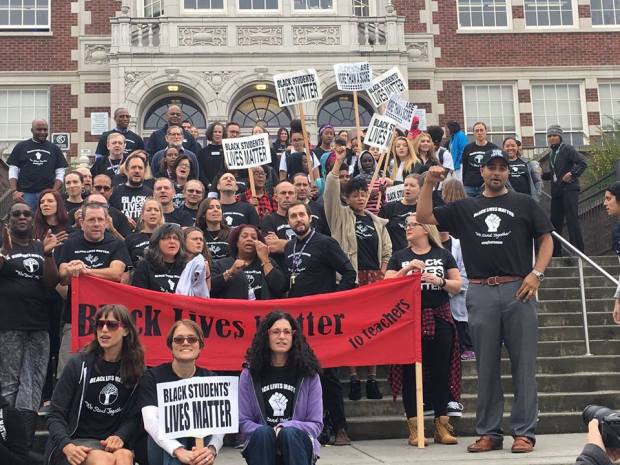
The hallways of Seattle schools were packed as always on Wednesday, October 19, but the difference was that thousands of teachers, students and staff were wearing similar t-shirts affirming Black lives. The Black Lives Matter at School day originated among teachers committed to social justice and was ultimately endorsed by the teachers’ union, the NAACP, the Seattle Council PTSA, and event supported by school district.
Brian Jones: THE WEDNESDAY of Black Lives Matter at School was pretty special. How did your day start?
Jesse Hagopian: IT WAS an incredible day–like none I’ve ever experienced before. It started with getting dressed and putting on my own Black Lives Matter shirt, and my older son’s shirt, and then my 3-year-old’s shirt.
I began by taking my second grader to school. We get to school, and on the front door is a letter from the school’s PTA stating why it fully supports teachers wearing BLM shirts to school.
L.A. Teachers’ Union Challenges Charter School Lobby
In a full-page advertisement in the Sunday October 23, 2016 edition of the Los Angeles Times, the union representing Los Angeles teachers, challenged the California Charter Schools Association (CCSA) to a “public debate on key educational issues relating to equity, access and accountability.” United Teachers Los Angeles (UTLA) also posted the challenge in Spanish in Hoy and La Opinion.
The advertisement, written as an open letter to parents, attacks CCSA for “indefensible tactics, such as trying to shield charters from financial accountability and lobbying to defeat a bill protecting charter students from unfair expulsion.”
According to Alex Caputo-Pearl, UTLA President. “We believe it is time for the community and parents to hear CCSA explain why they oppose financial transparency, student equity and access, open meeting laws and a democratically elected oversight body in schools that are funded by taxpayers. While charter schools use taxpayer money, they are privately run. This has led to documented cases of financial malfeasance, self-dealing and profiteering.”
Groups associated with the California Charter Schools Association (CCSA) are pouring money into legislative campaigns trying to elect a pro-charter majority in California. According to California’s Secretary of State pro-charter forces spent more than $3 million on contested races. More than $1 million is being used to influence voters in just one state senatorial district. According to Colin Miller, acting Senior Vice President for Government Affairs at the CCSA, the group’s top legislative priority is to make it easier to open new charter schools and expand existing schools.
With support from private philanthropy, the number of charter schools in the L.A. Unified school district has exploded to 225, the most in any American school system, attracting about 16% of enrollment. Many educators in traditional schools worry that this expansion could force L.A. Unified into bankruptcy, hurting public school students.
School Takeovers Outside Georgia Have Shown Mixed Results
NNA BEECH / WABE
Listen
Listening...
4:30
Hear the broadcast version of this story.
Georgia voters will decide this fall whether to give the state the authority to take over schools it labels “chronically failing.” The plan would create a separate, state-run district for those schools. This idea has only been tried in a few other states, with mixed results.
Earlier this month, a coalition of groups held a rally at the state Capitol to express their opposition to the plan. They marched to Liberty Plaza, across the street from the Gold Dome, chanting, “You can’t take our public schools! Local control rules!”
The group then delivered hundreds of wooden rulers to Gov. Nathan Deal’s office, signed by teachers and students, which said, “Local control rules!”
What’s Been Tried
Representatives from different groups, including the state PTA and the Committee to Keep Georgia Schools Local, explained why they opposed the plan.
“Every place that this model has been tried – including New Orleans, Memphis, Tennessee, Nashville – everywhere this model has gone, it has failed,” said Georgia Association of Educators President Sid Chapman.
Whether school takeover models have “failed” in other states is up for debate. Georgia’s plan is partly inspired by a system used in Louisiana to rebuild New Orleans’ schools after Hurricane Katrina, but it’s more closely based on a model used in Tennessee. State officials there created an “Achievement School District” in 2012. It now runs more than 20 low-performing schools.
Gary Henry, a professor of public policy at the Peabody College of Education at Vanderbilt, studied the results of the ASD after three years.
“We found no evidence that the students performed either better or worse than the priority schools that were not a part of the Achievement School District,” Henry said.
Tom Hayden speaking on Dec. 3, 2015, at a rally by environmentalists at Pershing Square in Los Angeles.
On Sunday, October 23rd, 2016, Tom Hayden, former California politician and lifelong activist, passed away in Santa Monica, California surrounded by family. Hayden, beloved husband, father, and brother was 76 years old.
A private family ceremony will take place this weekend. A public memorial is being planned for a future date not yet determined. In leu of flowers the family suggests donations be made to the Peace and Justice Resource Center, which will aide in the continued promotion and preservation of Tom's good works.
His family respects privacy at this time and thanks all those who have reached out with condolences.
A simmering, closed-door legal argument over the judge’s charge in the Bridgegate trial this morning led to an abrupt and mysterious cancellation of the session that was supposed to see defense attorneys present their closing arguments. After federal Judge Susan D. Wigenton sent the jurors home–with no explanation beyond that a “legal issue” had come up–lawyers for both sides were uncharacteristically closed-lipped about the reason.
Judge Wigenton gave her charge Wednesday and defense lawyers, while refusing to speak publicly, were unhappy about two sections–one dealing with the application of a statute generally used in civil, rather than criminal, cases and the other about motive.
One of the media outlets that paid for daily transcripts of the trial and had access to what was recorded at closed conferences reported earlier this week that Judge Wigenton ruled in a closed session with lawyers that prosecutors did not have to prove that defendants Bridget Anne Kelly and Bill Baroni misused resources of the Port Authority of New York and New Jersey with the specific intent of punishing Fort Lee Mayor Mark Sokolich–just that they misused those resources.
That issue appeared to be resolved Wednesday morning. However, after court adjourned that day–and after the judge’s charge–sources close to the defense expressed unhappiness about how Wigenton spoke of the federal civil rights statute Baroni and Kelly are charged with violating.
Judge rejects challenge to Minnesota teacher tenure laws
Lawsuit filed by education reform groups was third of its kind in the nation.
In April, four families from across the state of Minnesota, joined by Partnership for Educational Justice and Students for Education Reform Minnesota, announced a lawsuit challenging the constitutionality of Minnesota's teacher tenure. The suit was dismissed Wednesday.
A Ramsey County judge on Wednesday dismissed a lawsuit challenging Minnesota teacher tenure laws, rejecting its arguments that the laws protect ineffective teachers and deprive low-income and minority students of a high-quality education.
The suit, filed in April by national and local education reform groups, argued that state laws shield veteran teachers from layoffs even when they perform poorly. Senior teachers receive notice if their job is in question and a hearing to defend themselves against termination, whereas teachers with less seniority lack those protections.
The lawsuit, the third of its kind in the nation, was dismissed by Ramsey District Judge Margaret Marrinan on the grounds that it failed to establish a link between low academic achievement and the due process provided by the tenure laws.
Denise Specht, president of Education Minnesota, the state’s teachers union, said Wednesday that she was not surprised.
“We are really hoping that we can move beyond today’s decision,” she said. “I hope we can talk about ways to recruit and retain great educators. … Talking about how teachers are laid off is simply not how we are going to get better outcomes for students.”
Court vs. Legislature
In July, state and school district lawyers asked the court to dismiss the suit. Changing tenure laws should be considered by the Legislature and not the court, Alethea Huyser, an associate attorney solicitor general, argued at the time.
She said districts already can fire ineffective teachers and that the plaintiffs didn’t show that tenure laws directly hurt their children.
The Minnesota lawsuit, filed on behalf of the parents of five children, sparked concern among teachers’ advocates after a California judge ruled that state’s tenure laws unconstitutional. They were heartened in April when the California Appeals Court rejected the claims of harm and said it was up to the state legislature to set education policy. In August, the California Supreme Court declined to hear the case.
For the plaintiffs, the case is not over. “We are not pleased with the result,” said Jesse Stewart, an attorney representing the plaintiffs. “An appeal is certainly an option.”
Partnership for Education Justice, a group founded by former CNN anchor Campbell Brown that sponsored a similar tenure challenge in New York, backed the Minnesota case on behalf of the parents, as did Students for Education Reform Minnesota.