Latest News and Comment from Education

Wednesday, December 2, 2015

Put the brakes on the ESEA reauthorization bill | Seattle Education

Put the brakes on the ESEA reauthorization bill | Seattle Education:

Put the brakes on the ESEA reauthorization bill

The ESEA reauthorization bill was released on Monday, November 30th. The bill is over 1,000 pages long and is scheduled for a vote this week on the House floor. It is not possible for citizens to properly review and vet this bill in just a few days.
Please call your Congressperson and ask that a vote on the bill be delayed at least 60 days.
There are other reasons to put the brakes on this bill and Nancy Bailey clearly describes many of those issues in her piece:
Policy
Arne Duncan and others are bragging that both political parties get along when it comes to the Elementary and Secondary Education Act (ESEA) reauthorization. It is one big happy family when it comes to education. There was bipartisan agreement over No Child Left Behind too, and look what a colossal disaster that was.
Now, with the reauthorization in full swing, there are groups that are for, groups that are against, and groups that were for, but are now against. And then there is the occasional reminder that ESEA was once meant to help disadvantaged children get a chance to catch up in school. Victoria Young has written a lot about ESEA and it is worth checking the subject out on her blog. Here is one of her posts about it. 
I find the ESEA reauthorization ambiguous and difficult to decipher. I just write here about a few concerns. If you want to debate anything, or feel inclined to tell about something I left out, feel free to do so. Much is being written about the reauthorization. But because there is so much confusion, and concern, I support stopping the passage of this bill in its current form.
Twitter #StopESEA or #SlowDownESEA and call President Obama at 202-456-1111 and Congress at 202-224-3121/225-3121.
Here are my specific concerns with the reauthorization of ESEA, some of which I derived from Education Week articles, A Summary and Call to Action from the American Superintendent’s Association, the Council for Exceptional Children (CEC), and the National Association of Education for Young Children (NAEYC).
What’s In a Name?
I personally don’t like the name Every Child Achieves Act. It sounds suspiciously like an updated version of No Child Left Behind.
It’s an Improvement but Not Great
There are many involved in education who claim the bill isn’t perfect but it is the best that can be done—the “we need something” excuse. Like Frederick Hess, the director of education policy at the American Enterprise Institute, who said, it’s clearly a profound improvement over the status quo and if this does not make it through it’s not like a better, leaner alternative is going to get enacted (Klein. Ed. Week Nov. 13, 2015).
I disagree and so do many others. Why settle on mediocrity or a lousy bill? Why claim it’s the best that can be done when it could be better?
Testing: States and Local School Districts Get their Way
There is much talk about rolling back the federal government’s influence, but one can find plenty of corruption at the state and local levels too. I see no triumph in governors being given more responsibility for school reform. The states have driven draconian Put the brakes on the ESEA reauthorization bill | Seattle Education:


Educators General Assembly this Sunday | Seattle Education

Educators General Assembly this Sunday | Seattle Education:

Educators General Assembly this Sunday

12115840_10100341672302845_5477743005327438807_n


Calling all educators and youth workers!
Sunday, December 6 Time: 2PM- 5PM
New Freeway Hall
5018 Rainer Ave. S., Seattle, WA 98118
Come together to network, discuss and act on issues facing educators and students in the Seattle region.
Whether you’re already part of an organization, working on education issues or just looking to connect with other concerned educators, the Educators General Assembly invites you to join us this Sunday.
Possible issues include the school-to-prison pipeline, transformative justice, high-stakes testing, recess, workplace conditions, school funding, school board elections, and our unions!
Let’s share our common struggles and organize around creating more socially just schools in the Puget Sound region.
Hosted by the Ad Hoc Educators General Assembly Organizing Committee
Link to FB Event: Educators General Assembly

Dannel Malloy – Stonewalling an investigation by Connecticut’s State Elections Enforcement Commission. - Wait What?

Dannel Malloy – Stonewalling an investigation by Connecticut’s State Elections Enforcement Commission. - Wait What?:

Dannel Malloy – Stonewalling an investigation by Connecticut’s State Elections Enforcement Commission.


When Connecticut Democratic Governor Dannel Malloy accepted $6.5 million in taxpayer funds to pay for this 2014 gubernatorial campaign he signed a contract promising not to accept any other funds to pay for his campaign.
But despite that commitment Malloy and his political operatives funneled millions of dollars through the Connecticut Democratic State Central Committee’s Federal Account in an unethical effort to beat his Republican opponent.  The money that flowed through the Democratic Party’s special account included hundreds of thousands of dollars from people who directly benefited from lucrative state contracts, a move that also violated Connecticut state law.
Connecticut’s bi-partisan State Elections Enforcement Commission authorized an investigation into the illegal activities engaged by Malloy and his political operatives.
But rather than address the issues, Team Malloy have been fighting to stop the investigation.
Not only has he ducked his legal responsibilities as governor and as candidate for governor, but he is forcing the state to waste massive amounts of public funds trying to get the Malloy campaign and the Democratic Party to stop stonewalling the investigation by the Connecticut State Elections Commission.
The Connecticut State Elections Commission is hardly a partisan body.
Anthony J. Castagno of North Stonington was elected Chairman of the Connecticut State Elections Enforcement Commission in December 2012.  He was nominated to the Dannel Malloy – Stonewalling an investigation by Connecticut’s State Elections Enforcement Commission. - Wait What?:

A testing tantrum sanctioned by the Portland School Board - OregonLive

A testing tantrum sanctioned by the Portland School Board: Editorial Agenda 2015 | OregonLive.com:
A testing tantrum sanctioned by the Portland School Board: Editorial Agenda 2015


Apparently, the Portland School Board has identified an epidemic of poor reading comprehension in the district. But it's not a problem among students, it's their parents. 
These families, some board members worried, might not realize that a letter with "OREGON DEPARTMENT OF EDUCATION" written at the top was sent by the Oregon Department of Education. So, to make it clear, a four-member majority voted on Tuesday to require the district to staple an extra note to the Oregon Department of Education letter making it clear that the letter, printed on Oregon Department of Education stationery, doesn't necessarily represent the position of Portland Public Schools. 
Why such handwringing? The letter concerns the state-mandated Smarter Balanced standardized exam given to third-through-eighth graders and high school juniors in Oregon public schools. Designed to be tougher than previous tests, the exam has drawn the ire of teachers, whose evaluations rely to a small degree on how well students perform, and conservatives, who see the exam and its associated Common Core State Standards as a federal assault on state sovereignty. Others, including Portland School Board member Steve Buel, object to a testing culture that they believe has overtaken classrooms – despite the fact that Portland students bear one of the lowest testing burdens in the country among big cities. 
Still, after relentless lobbying by the teachers' union, legislators passed a new state law this year that allows families to opt their students out of taking the challenging exam for any reason they choose. Previously, the state allowed exemptions for religion or disability. The new law, HB2655, also requires the state to notify families about the test and provide a form for them to opt out. 
Hence, the letter from the Oregon Department of Education that was up for discussion Tuesday. Buel, a co-founder of the anti-testing group Oregon Save Our Schools, complained that some of the language in the notice was "extremely biased and very misleading" and he didn't want families to be confused that Portland Public Schools was making the argument. He and other opponents have been particularly angered by a warning on the opt-out form that tells parents they could lose "valuable information" about their student's progress in English language arts and math and that opting out could impact a school and district's "efforts to equitably distribute resources and support student learning."  
Board Vice Chair Amy Kohnstamm, however, backed by board members Pam Knowles and Julie Esparza Brown, pointed out a couple flaws in Buel's stance. The letter is clearly from the Oregon Department of Education and the statement on the opt-out form is true.  
Consider that the federal government requires a 95 percent participation rate A testing tantrum sanctioned by the Portland School Board: Editorial Agenda 2015 | OregonLive.com:


When the Focus on ‘Grit’ in the Classroom Overlooks Student Trauma - The Atlantic

When the Focus on ‘Grit’ in the Classroom Overlooks Student Trauma - The Atlantic:

The Limitations of Teaching‘Grit’ in the Classroom

“We are asking students to change a belief system without changing the situation around them.”


The first time I heard a preschooler explaining a classmate’s disruptive behavior, I was surprised at how adult her 4-year-old voice sounded.
Her classmate “doesn’t know how to sit still and listen,” she said to me, while I sat at the snack table with them. He couldn’t learn because he couldn’t follow directions, she explained, as if she had recently completed a behavioral assessment on him.
Months before either of these children would start kindergarten, they had formed judgements about who was smart and capable of learning and who was not. They had absorbed ideas on why some students wrote their names neatly, and others broke crayons.
This precocious little girl talked about her classmate matter-of-factly and without any malice in a classroom where the teachers were well trained and supportive of a diverse student body that was racially and economically mixed.
What the little girl didn’t know about her classmate was that his family life was chaotic, without consistent routines or caregivers. He had suffered some traumas at home, which showed in his behavior at school.
This young boy’s ability to learn wasn’t going to be transformed by a change in his mindset. He needed significant changes in his home life.
I was reminded of this conversation during a recent presentation by Tyrone C. Howard on how student culture affects learning. Howard, the associate dean for equity and inclusion at UCLA provided a reality check to the heavy investment in skills such as grit that might help more students succeed.
“We are asking students to change a belief system without changing the situation around them,” he said. It can be irresponsible and unfair to talk about grit without talking about structural challenges, he said, referring to the recent When the Focus on ‘Grit’ in the Classroom Overlooks Student Trauma - The Atlantic:

Jersey Jazzman: Return To Teachers Village, Part II: Who's Teaching At Teachers Village?

Jersey Jazzman: Return To Teachers Village, Part II: Who's Teaching At Teachers Village?:

Return To Teachers Village, Part II: Who's Teaching At Teachers Village?


Here's Part I of this series.

Just exactly how much money have taxpayers put into Teachers Village?


The project received nearly $40 million in tax credits from the state Economic Development Authority and $60 million in federal New Markets tax credits as well as Qualified School Construction bonds. It also received public funding from Newark and the Casino Reinvestment Development Authority.
Goldman Sachs, Prudential Financial, TD Bank, Brick City Development, New Jersey Community Capital and others provided private equity, as well as billionaire investor Nicholas Berggruen.
Between grants, tax breaks, and government-backed bonds, the public has paid quite a bit to make Teachers Village a reality. But what have they received in return? The developers of TV would have us believe they have, thanks to the largess of the taxpayers, created a new sort of complex that will attract and retain the sorts residents necessary for Newark's revival:

If Ron Beit has his way, the next big thing in urban renewal won't come from any of the political elite or the CEOs in cocktail attire who gathered in a parking lot here Wednesday morning for the ribbon-cutting on his latest project.
It will come from teachers.
A founding partner and CEO of the Newark-based developer RBH Group, Beit said his shift in vision came from walking into THRIVE Academy, a charter school in Newark's central ward. 
"I was blown away by the work they were doing," he recalled. "The teachers were really energizing, they were focusing on education -- I want to harness that energy. These people were top of the class, they could go anywhere for
- See more at: http://jerseyjazzman.blogspot.com/2015/12/return-to-teachers-village-part-ii-whos.html#sthash.ABi7ClCu.dpuf


CURMUDGUCATION: Is Educational Philanthropy Jumbo Shrimp?

CURMUDGUCATION: Is Educational Philanthropy Jumbo Shrimp?:
Is Educational Philanthropy Jumbo Shrimp?


The announcement that Mark Zuckerberg and his wife intend to give away $45 billion in Facebook stock raises all sorts of questions, including this one:

Does anybody even understand what philanthropy is any more?

The word means "love of humanity," and the idea goes back-- way back. Early philanthropic effortsoften cited include Plato's bequest of a farm to support students and faculty at his school, and Pliny (the Younger, not the old guy) giving one-third the cost of a school for Roman students. So yes-- philanthropy has been mucking around schools forever. (Said Pliny, arguing for Roman schools for Roman students, "You cannot make your children a more handsome present than this, nor can you do your native place a better turn. Let those who are born here be brought up here, and from their earliest days accustom them to love and know every foot of their native soil.")

We've had philanthropy in this country as long as we've had a country, often synonymous with "charity" and the idea of giving money to people who need it, either directly or through some do-gooding church or charitable organization.

We generally consider John. D. Rockefeller the grand-daddy of modern philanthropy (and to his credit, Rockefeller was a philanthropist before he was a rich guy). Once he became a rich guy, he hired people and started organizations to help him manage the giving away of money "scientifically." (One group led in 1928 to the Brookings Foundation). Rockefeller's system became one of finding smart people who could figure out how to solve an issue, giving them a bunch of money, and leaving them alone.

Rich Guy Philanthropy has always been a bit subject to... cognitive dissonance. Like many Carnegie 
CURMUDGUCATION: Is Educational Philanthropy Jumbo Shrimp?:


Mike Klonsky's SmallTalk Blog: No Paris trip for Rahm. Staying home to close more schools.

Mike Klonsky's SmallTalk Blog: No Paris trip for Rahm. Staying home to close more schools.:

No Paris trip for Rahm. Staying home to close more schools.


CHICAGO — It was strange to watch Mayor Rahm Emanuel’s hands tremble behind the podium as he talked to reporters about his new task force aimed at improving accountability in a police department that a lot of Chicagoans don’t trust. -- Mark Konkol at DNAInfo
While Rahm trembles, all the national news shows this a.m. began with the story of his  possible departure. But the Little Emperor tells Natasha Koreki at Politico,he's staying, like a good captain, ready to go down with the ship come election time. I'm wondering what the other ship officers, like his big-money campaign patrons, think about those prospects? They've invested a lot in Rahm and stand to lose a lot when the ship sinks.

Yesterday's New York Times editorial reads:
Mayor Rahm Emanuel demonstrated a willful ignorance... All along, Mr. Emanuel’s response, either by design or because of negligence, was to do as little as possible — until the furor caused by the release of the video forced his hand. The residents of Chicago will have to decide whether that counts as taking responsibility.
They're right. We will. 

Rahm tells Korecki, "I'm staying." We'll see. 
One thing I know for sure.Rahm isn't leaving for Paris as planned or anytime soon. If he's read his history, he knows that coups d'etat happen happen most when the emperor is out of town. Beware the Ides of December. 

Another thing I know is that Rahm's newly-formed, so-called, Task Force on Police Accountability, is a farce and those who accepted appointments to it have now made themselves complicit in the cover-up the mayor Mike Klonsky's SmallTalk Blog: No Paris trip for Rahm. Staying home to close more schools.:

CURMUDGUCATION: The New ESEA: Sturm or Drang?

CURMUDGUCATION: The New ESEA: Sturm or Drang?:
The New ESEA: Sturm or Drang?


The new version of ESEA is called the Every Student Succeeds Act, which is a fine sine of the sort of aspirational nonsense that legislators are capable of. Why not the Every Child Gets a Pony Act, or the Every Child Is Smart, Good-Looking and Above Average Act?

The most notable thing about the act is that it is 1,061 pages long. It is the Moby Dick Travels to Middle Earth of regulation. The second most-notable thing is that it has been spit out by committee on a fast track that allows pretty much nobody to actually look at the thing, including the people who are poised to vote on it. Make a note of this fast-track legislative prestidigitation the next time some some pundit ponders how politics got so tangled in education. Once again, politics have been hardwired into public education's dna.

I am not exactly a low-information voter on these issues, and I have not a chance to really check out those 1,061 pages. But some folks have been doing super work with it. The folks at EdWeek's K-12 have been doing super work (herehere, or here for starters) and Mercedes Schneider has apparently doing without sleep to work on this (here and here). Daniel Katz has put together a good compendium of what's out there as well.

There are things to hate. TFA, charter schools, and the folks who love social impact bonds have gotten good value from their lobbyists. The path has been leveled for Competency Based Education. And probably most hateable of all, the damned stupid Big Standardized Test is all its yearly waste-of-timeliness has been enshrined in law once again.

There are things to love. Most notably, in what may really be an historic moment, a federal agency has had power taken away. USED is told to go sit in the corner and shut up. Although there are also 
CURMUDGUCATION: The New ESEA: Sturm or Drang?:

A Real Solution to the Infinitesimal Cases of Child Predators in Our Schools | gadflyonthewallblog

A Real Solution to the Infinitesimal Cases of Child Predators in Our Schools | gadflyonthewallblog:

A Real Solution to the Infinitesimal Cases of Child Predators in Our Schools
110401_toomey_ap_605


Pat Toomey is obsessed with child predators in our public schools.
When I came to Washington, D.C., this summer to visit 
the U.S. Senator from Pennsylvania, he was lobbying to get his “Passing the Trash” bill included in theElementary and Secondary Education Act (ESEA).
His proposed legislation – now part of the Senate version of the ESEA – would ban school districts from helping known pedophiles from finding teaching jobs at different schools. Toomey is hopeful the provision will remain in the final version of the law that eventually will reach President Obama’s desk.
I met with his education aide who cheerily told me her job was to comb through the nation’s newspapers everyday and count the number of teachers accused of acting inappropriately with children. I’d mention issues like inequitable funding,standardized testing and Common Core. She’d solemnly quote back the number she’d found in her research.
There was definitely a disconnect between our priorities. After all, I’m a public school teacher. I work in our school system everyday. She and her boss only know about our schools through what they read in the newspaper. And according to the media every school in American houses child predators. They lurk behind every A Real Solution to the Infinitesimal Cases of Child Predators in Our Schools | gadflyonthewallblog:

Civil Rights and Education Groups Respond to Final ESEA Bill

Civil Rights and Education Groups Respond to Final ESEA Bill:

Civil Rights and Education Groups Respond to Final ESEA Bill

The Leadership Conference on Civil and Human Rights  & The Leadership Conference Education Fund


WASHINGTON – 37 civil rights and education groups issued the following statement after the release of the final conference bill to reauthorize the Elementary and Secondary Education Act (ESEA), the Every Student Succeeds Act.
“The Elementary and Secondary Education Act is our nation’s most important civil rights law for promoting educational achievement and protecting the rights and interests of students disadvantaged by discrimination, poverty and other conditions that may limit their educational opportunity.
Throughout the year, the civil rights community has fought to make sure that the long-overdue reauthorization of this law would ensure that vulnerable children get the education they’re entitled to. As a result of our diverse communities working together with a common goal, we’ve seen significant improvement in this legislation since January. We are grateful for the hard work of congressional champions and their staff. And in all of our diversity, we speak both as a coalition and as individual organizations highlighting individual priorities and areas of focus.
We believe the Every Student Succeeds Act is an improvement over the waivers and is a chance to move beyond the No Child Left Behind Act for the millions of students of color, students with disabilities, and English learner students we represent. However, the compromise that has resulted in the Every Student Succeeds Act is not the bill that we would have written
There are provisions in the proposed legislation that we believe will help remedy deep-seated disparities in our nation’s schools. For example, with collaboration from the Department of Education and policymakers at the state and local level, we believe this law can fulfill its purpose as stated in Title I, to ‘provide all children a significant opportunity to receive a fair, equitable, and high-quality education and to close educational achievement gaps.’
The process of implementing this law will not be legitimate without the inclusion of communities we represent in all federal, state, tribal and local decisions. State and local control has too often been an obstruction to narrowing disparities, and we will not let jurisdictions with millions of dollars in federal aid off the hook for failing to equitably and adequately educate all children. This bill’s passage is a call to action for parents and stakeholders in every school district and every state to hold decisionmakers and administrators accountable for educating all students, and to demand a seat at the table as this law is implemented in their communities.”


  • The Leadership Conference on Civil and Human Rights
  • Alliance for Excellent Education
  • American Association of University Women (AAUW)
  • Association of University Centers on Disabilities (AUCD)
  • Children's Defense Fund
  • Council of Parent Attorneys and Advocates
  • Democrats for Education Reform
  • Disability Rights Education & Defense Fund
  • Easter Seals
  • The Education Trust
  • The Expectations Project
  • GLSEN
  • Judge David L. Bazelon Center for Mental Health Law
  • The Lawyers' Committee for Civil Rights Under Law
  • MALDEF        
  • NAACP
  • NAACP Legal Defense and Educational Fund, Inc.
  • National Association of Councils on Developmental Disabilities
  • National Center for Learning Disabilities
  • National Center for Special Education in Charter Schools
  • National Center on Time & Learning
  • National Council of La Raza (NCLR)
  • National Disability Rights Network
  • National Down Syndrome Congress
  • National Indian Education Association
  • National Urban League
  • National Women's Law Center
  • New Leaders
  • PolicyLink
  • Southern Education Foundation
  • Stand for Children
  • TASH
  • Teach For America
  • Teach Plus
  • TNTP
  • UNCF
  • United Way Worldwide

15 Years of Bill Gates’s Experimentation

NEWSLETTER: 15 Years of Bill Gates’s Experimentation:

NEWSLETTER: 15 Years of Bill Gates’s Experimentation

In his October 7 speech as he ruminated on how his foundation shaped educational policy and practice for the past fifteen years, Bill Gates spoke of the importance of what he called “high impact” strategies. His speech contained only one acknowledgement of error on his and Melinda’s part – and it was an error of the most innocent sort. He said they had been “naïve” in the way in which they rolled out the Common Core. Apparently they did not anticipate that democracy might get in the way of their plans.
For Bill Gates this has all been a grand experiment, one that he believes he is entitled to conduct on our children, our teachers and our schools. It is astounding that a man, who has no qualifications to guide our nation’s educational system has been allowed, by virtue of his fortune, to meddle in it as he has.
Although he spoke of the importance of continuous learning, (even admitting that the Gates Foundation still had a great deal to learn), Bill Gates did not show any signs of veering from the checkered record of their past 15 years of pushing the United States to adopt his vision of K12 education reform.
We at the Network for Public Education, however, will not let Mr. Gates, his wife or his Foundation off the hook. And so we bring you this special report on the grand experiment of Bill Gates. The breadth and scope of meddling is breathtaking. The evidence of success is not.
by Carol Burris and Anthony Cody

NPE is proud to share this interactive infographic detailing the last 15 years of Bill Gates’s public education experiments. It contains links to 13 reports from 12 of the nation’s leading pro-public education advocates (which you will also find in the “Around the States” entries below.)
Click on the infographic to be taken to our website, then hover your cursor over the green, yellow, and red entries to reveal links to the reports. You’ll also find a video of Gates embedded in the center quote. Please share widely to let others know the full extent of the destructive influence Bill and Melinda Gates have had, and continue to have, on the democratic institution of public education.
Carol BurrisExecutive Director, Network for Public Education, former New York principal
In 2008, Florida’s Hillsborough School District received a $10 million grant to revamp their teacher evaluation system and salary system. In 2015, the experiment ended with the district footing the bill for $50 million in cost overruns and student achievement goals not met.


Congress Fails – Again – This time on the re-write of National Education Policy - Wait What?

Congress Fails – Again – This time on the re-write of National Education Policy - Wait What?:

Congress Fails – Again – This time on the re-write of National Education Policy


The George W. Bush/Barak Obama legacy of destroying public education in the United States will continue thanks to the “bi-partisan” re-write of the No Child Left Behind Act (NCLB).
Now called the Every Student Succeeds Act (ESSA), Republican and Democratic Leaders, along with the Corporate Education Reform Industry and the leadership of the teacher’s unions are heralding the new system which continues the effort to privatize public education, turn schools into little more than testing factories and undermine teachers and the teaching profession.
The most substantive difference is that rather than the federal government “mandating” these dangerous and damaging policies, the federal government will “mandate” that the States do the dirty work in their own name.
Both the United States House of Representatives and the United States Senate will be voting on the Every Student Succeeds Act in the coming days.  The President will certainly sign the legislation since it ensure the education reform industry continues to drain off billions of dollars in scarce public funds.
The following are links to some of the latest articles on the bill;
BATs Respond to Every Student Succeeds Act (Report from the BATs organization)
Numerous questions about the impact of the new law remain but on the opt-out issue it Congress Fails – Again – This time on the re-write of National Education Policy - Wait What?:

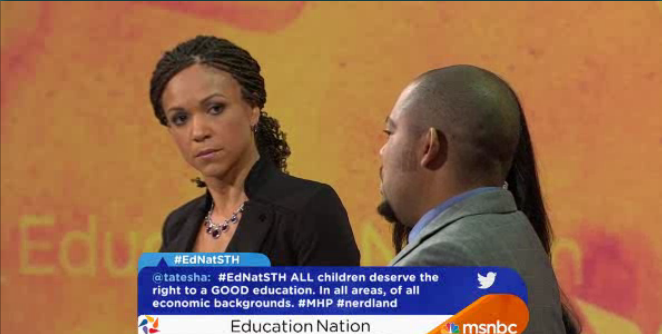
Behind-the-Scenes @MSNBC @MHPshow | Cloaking Inequity

Behind-the-Scenes @MSNBC @MHPshow | Cloaking Inequity:

Behind-the-Scenes @MSNBC @MHPshow


Have you ever wondered what is like behind-the-scenes when you are on a national television show? My first visit to MSNBC was in 2012. I had given interviews about various education policy topics on on local and national radio, but I had never participated LIVE on a national TV network. I was really nervous. Live TV is difficult because you have no idea what questions will be asked, although you usually have a general idea which direction the discussion will go— more on this later in the post. Well, suffice to say that my first experience on national TV was an eventful visit. Jonathan Alter, then the editor at Newsweek, head popped off when I started talking about my research published in the Berkeley Review of Education showing that 40% of African American students had left KIPP charter schools before graduating. (See the post Melissa Harris-Perry Show: Demanding accountability from charters)
ptii-education-nation
The behind-the-scenes backstory that most people don’t know is that my disagreements with Jonathan Alter’s “reformer” perspectives had started backstage where I had told him that most of the information that he was providing in his media interviews about education was wrong. It just went forward from there on LIVE TV. During the commercial break we also had a very vigorous discussion Behind-the-Scenes @MSNBC @MHPshow | Cloaking Inequity:

Fact Check: Why Did it Take So Long for ESEA to Get Done? - Politics K-12 - Education Week

Fact Check: Why Did it Take So Long for ESEA to Get Done? - Politics K-12 - Education Week:

Fact Check: Why Did it Take So Long for ESEA to Get Done?

Politics K-12


Everyone is excited that the Elementary and Secondary Education Act is finally moving and agrees it's taken way too long law to get a facelift. But what exactly accounted for the big delay?
Sen. Harry Reid, D-Nev., the Senate minority leader, pointed the finger directly across the aisle in a speech Wednesday, just before the House was set to take up the bill to reauthorize the ESEA. He said Republicans obstructed past efforts.
"I'm happy to have participated in getting something done with Elementary and Secondary Education, led by, on our side, the senior senator from Washington [Sen. Patty Murray]," he said on the Senate floor. "We were able to get it done because of her good work and others. But it wasn't that we didn't try before. We couldn't get it done before because of the obstruction of Republicans."
Actually, it was a lot more complicated than that.
There were many, many reasons that a bipartisan Senate bill to revise ESEA didn't make it over the finish line back in 2011, even though it had the support of three education committee Republicans, including Sens. Mike Enzi, the top GOP lawmaker on the panel at the time and Lamar Alexander, the current chairman of the panel and the co-author the current Every Student Succeeds Act. Both of them said publicly at the time that they wanted to see the legislation get to the floor. (Rep. Mark Kirk, R-Ill., also supported the bill.)
So what were the major obstacles? Sure, some Republicans (like Sen. Rand Paul of Kentucky) hated the bill and would have probably tried to kill it, or at least not helped along the process.
But the Obama administration wasn't exactly in love with the legislation, either, in part because it didn't include a requirement for teacher evaluation through student outcomes. (Administration officials may now be privately regretting not doing more to move that bill forward, since it was arguably stronger from their perspective than the legislation on the table now.)
The civil rights community was also not a huge fan of the 2011 legislation (it's given a measured endorsement to this version).  And accountability hawks were worried the bill would only get weaker on the floor (because of Republicans, but also because of teachers' unions and Democrats allied with them).  
So the 2011 bill's sponsor, former Sen. Tom Harkin, D-Iowa, said he didn't want to move forward, since a parallel process in the House was partisan. And that was it for ESEA in 2011. 
Similarly, in 2013, Harkin tried to move another bill (this time with support from Democrats only, although Alexander made it clear he wanted to see it move to the floor). House Republicans, meanwhile moved a GOP-only version. 
And the administration was pretty aloof to these efforts. It didn't threaten to veto the Senate Democrats' bill, of course, but it also didn't rush out to help its path forward, either. The administration didn't even put out a statement of support on it.  (Officials were worried the bill would get weaker on the floor, advocates told me at the time.)
The very earliest attempt to get ESEA across the finish line was back in 2007. And it failed largely because of lack of support from the Bush administration and teachers' unions. 
On the other hand? Reid's comments on Murray's efforts seem to be right on the money. The top Democrat on the Senate education committee, is considered an ace negotiator. (As is Alexander). Their cooperation helped save the bill when it appeared doomed earlier this year.
And, working with their House counterparts, Reps. John Kline, R-Minn., and Bobby Scott, D-Va., they ended up with a product that governors and state chiefs love and the civil rights community is (relatively) happy with. That's no small feat, considering negotiations started with an effort to ditch annual testing.  Fact Check: Why Did it Take So Long for ESEA to Get Done? - Politics K-12 - Education Week:

Top 12 Concerns About Every Student Succeeds Act (S 1177 & HR 5) | Truth in American Education

Top 12 Concerns About Every Student Succeeds Act (S 1177 & HR 5) | Truth in American Education:

Top 12 Concerns About Every Student Succeeds Act (S 1177 & HR 5)

Photo credit: FEMA/Bill Koplitz (Public Domain)


The information below is a collaboration between Mary Byrne, EdD of Missouri Coalition Against Common Core, Emmett McGroarty of American Principles Project, Jane Robbins of American Principles Project, Erin Tuttle of Hoosiers Against Common Core, Karen Effrem, MD of Education Liberty Watch and Florida Stop Common Core Coalition, Glyn Wright of Eagle Forum and Kevin Baird of Eagle Forum.

Top 12 concerns about the Every Student Succeeds Act (ESEA reauthorization):

  1. PROCESS VIOLATES TENENTS OF AMERICAN GOVERNMENT – OF TRANSPARENCY IN THE BILL PROCESS AND DELIBERATIVE DEBATE. Process of forwarding conference report echoes the process of (Un) Affordable Care Act “You have to pass it to see what’s in it” – that is. Congress won’t be reading it.
  2. HEAVILY INCENTIVIZES STATES TO MAINTAIN COMMON CORE STATE STANDARDS: As a requirement of the Act, states must “demonstrate” to the Secretary that they have adopted standards that are aligned to the same definition of “college and career” standards used to force states into adopting Common Core under NCLB waivers.
  3. ASSESSSMENT OF NON-COGNITIVE ATTITUDES, BEHAVIORS, and MINDSETS: Bill will maintain momentum for increasing non-academic data collection of student and family information into statewide longitudinal data systems.
  4. PARENT RIGHTS: The Salmon Amendment in HR5 that allowed parents to opt out of high-stakes state assessments is no longer included. Students whose parents opt them out of the test, must be included in the 95% participation formula.
  5. EROSION OF STATE POWER OVER EDUCATION: The state accountability system must be structured as per the federal bill.
  6. FEDERAL CONTROL OF STANDARDS CONTENT: Bill language appears to require standards that align with career and technical education standards, indicating that the standards must align to the federally approved Workforce Innovation and Opportunity Act.
  7. NO CHECKS ON FEDERAL POWER, FEDERAL GOVERNMENT IS JUDGE AND JURY OF ITS OWN ACTIVITY – NO SUNSET OF LAW: The framework would only “authorize” ESEA for four more years, as opposed to the typical five, but, there’s no sunset provision in the bill, so it could go on in perpetuity.
  8. EXPANSION OF GOVERNMENT ROLE IN CHILDCARE/DISINCENTIVE TO ACTIVELY SEEK EMPLOYMENT: Bill is said to expand Head Start to childcare with Child Care Development Block Grant Act of 2014 so that no work requirements will be expected of low income parents to access grant money to pay for childcare.
  9. ADVANCES PROFITING BY PRIVATE CORPORATIONS USING EDUCATION DOLLARS THAT SHOULD GO TO CLASSROOMS: Increasing the education budget to fund private investors to implement government- selected social goals is outside the scope of improving education, and outside the authority of Congress as described in the U.S. Constitution.
  10. INCREASED ESEA SPENDING: ESSA authorizes appropriations for fiscal years 2017-2020. Spending authority will increase by 2% each year.
  11. EROSION OF LOCAL CONTROL: The conference report language encourages states to form consortia that, without congressional approval, may be determined illegal.
  12. DATA PRIVACY: Language in the conference report appears to rein in the Secretary of Education’s power and protect student data by inserting prohibitions of collecting additional student data, but makes no attempt to reverse the harm already done by Secretary Duncan’s modification of the Family Education Rights and Privacy Act (FERPA)

Introduction
Legislators are headstrong in staying the course and passing a 2015 reauthorization of ESEA currently known as the No Child Left Behind Act. They say this law is fundamentally broken and we need to fix it this year. But, the rush to do so, undermines the democratic process of public Top 12 Concerns About Every Student Succeeds Act (S 1177 & HR 5) | Truth in American Education