Latest News and Comment from Education

Tuesday, November 24, 2015

Seattle Schools Community Forum: Teacher/Substitute Shortage a Strain in Washington State

Seattle Schools Community Forum: Teacher/Substitute Shortage a Strain in Washington State: "

Teacher/Substitute Shortage a Strain in Washington State


OSPI has released their survey and its subsequent findings about teacher shortages in Washington State.

The survey

The findings.

From the survey:

This survey was distributed on November 11, 2015, to public school principals in Washington by the Association of Washington School Principals. As of the date of this report, 733 principals have responded of the estimated 2,100 principals, for a return rate of 35%. The survey was developed by OSPI, the Rural Education Center, PESB, AWSP, and ESD representatives. It was piloted with the Elementary School Principals’ Board of AWSP.

The first question sets the stage:

In fall 2015, were you able to employ all of your needed classroom teacher positions with fully-certified teachers that met the job qualifications (not including individuals with emergency certificates)? 

The answer was yes but only by 55.3% versus no at 44.8%.

To another question about "your school's ability to hire candidates for your teaching openings," 23.8% said they were in "crisis mode - We cannot find qualified certificated candidates."  (The "struggling but getting by mode"category was 68.9% and the "doing fine, no difficulty finding candidates" was 7.2%.)

 The most difficult category to find certificated teachers was - no surprise - Special Education by far.  The second most difficult category to fill was 
Seattle Schools Community Forum: Teacher/Substitute Shortage a Strain in Washington State: "


Big Education Ape: Teaching Vacancies and Difficult-to-Staff Teaching Positions in Public Schools http://bit.ly/1OfiOpg

Privateers and Profiteers in Our Schools - Living in Dialogue

Privateers and Profiteers in Our Schools - Living in Dialogue:

Privateers and Profiteers in Our Schools


By Anthony Cody.
I was recently invited to speak at a conference in another state. Since I could not make it there in person, I recorded my thoughts on this video.
Here is the text of my remarks:

Privateers and Profiteers: How and Why are they Undermining Public Education?

As we near the end of the Obama administration, it is a good time to take a closr look at what has happened to public education over the past seven years.
Some very powerful people have used money and the political influence that money buys to undermine and set the stage for the elimination of public education as we have known it for the past 100 years.
To be sure public education has always been flawed, but there was an aspiration in what the Washington state supreme court recently called “common schools,” that we should have schools funded and governed by citizens, that serve all members of our communities. That social compact is in the process of being ripped up by people who believe that in the absence of a profit motive, public institutions are incapable of innovation.
How is this being done?
There are two major thrusts under way. The first project is to transfer tax dollars out of public schools and into private schools, parochial schools and semi-private charters. Organizations like the Gates, Walton and Broad Foundations have promoted charter schools as the way to “break the public school monopoly.” Charter schools will insist they are public, but any time there is a legal conflict, they will state over and over again that they are private entities. In California, charter operators go to their authorizing public agency only once every several years for a perfunctory renewal. Only in cases of gross malfeasance is a charter ever revoked. Other than this, public oversight is nil, which is one reason a recent report found that nearly $4 billion in federal funds have disappeared into a “black hole” of fraudulent charter schools – some of which took millions of dollars and never even opened their doors. And these schools divert scarce public funding, Privateers and Profiteers in Our Schools - Living in Dialogue:

ESEA Deal Opens (Trap?) Door for Use of Noncognitive Measures in Accountability - Politics K-12 - Education Week

ESEA Deal Opens (Trap?) Door for Use of Noncognitive Measures in Accountability - Politics K-12 - Education Week:


Cross-posted from the Rules for Engagement blog
By Evie Blad
Boosters of school climate, student engagement, and social-emotional learning should be closely watching the debate over replacing the federal No Child Left Behind law with a shiny, new version of the Elementary and Secondary Education Act.
That's because a late-stage draft for the proposed bill, which is due up soon for votes in both chambers of Congress, calls for states to incorporate factors beyond standardized test scores into their accountability systems.
But is that putting the noncognitive cart before the horse? In the past, big-name researchers of traits like grit, persistence, and growth mindsets have all said such factors should not be measured for accountability purposes, at least until more sophisticated measures can be developed. It's an issue worthy of further exploration.

The proposed ESEA bill would give states big discretion on accountability.

If you haven't been reading the amazing, comprehensive coverage of my colleagues at Education Week's Politics K-12, I recommend you check it out (as soon as you finish reading this post, that is). Politics K-12 posted a great cheat sheet this morning, breaking down what we know about the proposed new ESEA.
That post includes a link to draft language of the bill, which says state accountability systems would be required to include "not less than one indicator of school quality or student success that allows for meaningful differentiation in school performance and is valid, reliable, comparable, and statewide, which may include measures of - (I) Student engagement; (II) Educator engagement; (III) Student access to and completion of advanced coursework; (IV) Postsecondary readiness; (V) School climate and safety; and (VI) any other indicator the state chooses that meets the requirements of this clause."
That seems pretty broad. And it's not unreasonable to assume that states could use the "any other indicator" language to support inclusion of students' social and emotional skills, grit, or growth mindsets in their accountability models. Under a unique local-level waiver from the current version of No Child Left Behind, a group of California districts is developing a system that does just that.

This is a big win for 'whole child' advocates, right?

It's easy to see why some would frame it that way. Some education leaders and policy folks have argued for years that test scores provide too narrow a view of school success and ignore all of the hard work teachers must do to nurture the non-academic traits students need to succeed in school and in life outside of the classroom. Recently, some philanthropy groups have funded work to develop new measures for these traits, arguing that, in education, what's not counted doesn't count.
But some may also argue that the proposed new federal education bill may encourage states to judge schools with flawed measures.
That's because researchers who've popularized this work have consistently warned that current measures of student traits are imprecise, imperfect, and subject to all kinds of biases. Or, as researchers Angela Duckworth and David Yeager put it in a May essay "perfectly unbiased, unfakeable, and error-free measures are an ideal, not a reality."
Duckworth, a University of Pennsylvania associate professor of psychology known for her research on grit, and Yeager, ESEA Deal Opens (Trap?) Door for Use of Noncognitive Measures in Accountability - Politics K-12 - Education Week:

National Council on Teacher Quality (NCTQ) Report on States’ Teacher Evaluation Systemshing | VAMboozled!

National Council on Teacher Quality (NCTQ) Report on States’ Teacher Evaluation Systemshing | VAMboozled!:

National Council on Teacher Quality (NCTQ) Report on States’ Teacher Evaluation Systemshing


The controversial National Council on Teacher Quality (NCTQ) — created by the conservative Thomas B. Fordham Institute, funded (in part) by the Bill & Melinda Gates Foundation, and “part of a coalition for ‘a better orchestrated agenda’ for accountability, choice, and using test scores to drive the evaluation of teachers (see here; see also other instances of controversy here and here) — recently issued a 106 page document report titled: “State of the States 2015: Evaluating Teaching, Leading and Learning.” In this report, they present “the most comprehensive and up-to-date policy trends on how states [plus DC] are evaluating teachers” (p. i). The report also provides similar information about how principals are also being evaluated across states, but given the focus of this blog, I focus only on the information they offer regarding states’ teacher evaluation systems.
I want to underscore that this is, indeed, the most comprehensive and up-to-date report capturing what states are currently doing in terms of their teacher evaluation policies and systems; however, I would not claim all of the data included within are entirely accurate, although this is understandable given how very difficult it is to be comprehensive and remain up-to-date on this topic, especially across all 50 states (plus DC). Therefore, do consume the factual data included within this report as potentially incorrect, and certainly imperfect.
I also want to bring attention to the many figures included within this report. Many should find these of interest and use, again, given likely/understandable errors and inconsistencies. The language around these figures, as well as much of the other text littered throughout this document, however, should be more critically consumed, in context, and primarily given the original source of the report (i.e., the NCTQ — see above). In other words, while the figures may prove to be useful, the polemics around them are likely of less value…unless, of course, you want to read/analyze a good National Council on Teacher Quality (NCTQ) Report on States’ Teacher Evaluation Systemshing | VAMboozled!:

Teaching Vacancies and Difficult-to-Staff Teaching Positions in Public Schools

Teaching Vacancies and Difficult-to-Staff Teaching Positions in Public Schools:
Teaching Vacancies and Difficult-to-Staff Teaching Positions in Public Schools


This Statistics in Brief describes the percentages of public schools that reported that they had teaching vacancies and subject areas with difficult-to-staff teaching positions in the 1999–2000, 2003–04, 2007–08, and 2011–12 school years.
Teaching Vacancies and Difficult-to-Staff Teaching Positions in Public Schools

How ‘twisted’ early childhood education has become — from a child development expert - The Washington Post

How ‘twisted’ early childhood education has become — from a child development expert - The Washington Post:

How ‘twisted’ early childhood education has become — from a child development expert


Nancy Carlsson-Paige is an early childhood development expert who has been at the forefront of the debate on how best to educate — and not educate — the youngest students. She is a professor emerita of education at Lesley University in Cambridge, Ma., where she taught teachers for more than 30 years and was a founder of the university’s Center for Peaceable Schools. She is also a founding member of a nonprofit called Defending the Early Years, which commissions research about early childhood education and advocates for sane policies for young children.
Carlsson-Paige is author of “Taking Back Childhood.” The mother of two artist sons, Matt and Kyle Damon, she is also the recipient of numerous awards, including the Legacy Award from the Robert F. Kennedy Children’s Action Corps for work over several decades on behalf of children and families. She was just given the Deborah Meier award by the nonprofit National Center for Fair and Open Testing.
In her speech accepting the award (named after the renowned educator Deborah Meier), Carlsson-Paige describes what has happened in the world of early childhood education in the current era of high-stakes testing, saying, “Never in my wildest dreams could I have foreseen the situation we find ourselves in today.” Here’s the speech, which I am publishing with permission:

 Thank you FairTest for this Deborah Meier Hero in Education Award. FairTest does such great advocacy and education around fair and just testing practices. This award carries the name of one of my heroes in education, Deborah Meier—she’s a force for justice and democracy in education. I hope that every time this award is given, it will allow us to once again pay tribute to Deb. Also, I feel privileged to be accepting this honor alongside Lani Guinier.
When I was invited to be here tonight, I thought about the many people who work for justice and equity in education who could also be standing here. So I am thinking of all of them now and I accept this award on their behalf — all the educators dedicated to children and what’s fair and best for them.
It’s wonderful to see all of you here — so many family and friends, 
How ‘twisted’ early childhood education has become — from a child development expert - The Washington Post:

The Big Sleazy: All-Charter “Achievement Districts”

Charter Chains: Eager to Turn SC Kids into Cash Cows.  :


The Big Sleazy:
All-Charter “Achievement Districts”


After battling shamelessly for 20 years, SC policymakers are under court-order to do“something” for our poorest students.

Momentum is building to turn SC kids over to parasitic charter chains as part of a statewide “ACHIEVEMENT DISTRICT”, like the one in New Orleans.

Once you:

  • CLOSE neighborhood schools
  • FIRE thousands of career teachers & replace them with untrained temps
  •  FORCE kids into charter school chains


Closing the ACHIEVEMENT GAP is actually CHEAP & EASY!!!

Let free-markets do the work!

Many of these charter chains are overtly for-profit, while others pay exorbitant rentsand fees to partner” corporations.


Now, who would fall for such horse puckey?

Anybody desperate for a cheap, easy fix.


Egged on by corporate-funded Astroturf groups like Michelle Rhee’s StudentsFirst, some have grown sweet on the idea of an all-charter system built on temp labor that replaces democratically-controlled public schools.


Tell policymakers to reject this gift to privatized McSchools:

COPY & PASTE to EMAIL: SCSuptEd@edu.sc.gov, ritaallison@schouse.gov, kennybingham@schouse.gov, billcyburn@schouse.gov, joedaning@schouse.gov, jerrygovan@schouse.gov, jackiehayes@schouse.gov, dwightloftis@schouse.gov, dlongshorejr@gmail.com, roberthayes@scsenate.gov, harveypeeler@scsenate.gov, johncourson@scsenate.gov, vincentsheheen@scsenate.gov, nikkisetzler@scsenate.gov, bradhutto@scsenate.gov, johnmatthews@scsenate.gov, geraldmalloy@scsenate.gov, clementapinckney@scsenate.gov

MUCH More Below...Charter Chains: Eager to Turn SC Kids into Cash Cows.  :


Teacher Evaluations Fall Off The Education ‘Reform’ Agenda

11/24/2015 – Teacher Evaluations Fall Off The Education ‘Reform’ Agenda:

Teacher Evaluations Fall Off The Education ‘Reform’ Agenda


THIS WEEK: Opt Outs Hit Half Million … Teachers Need Affordable Housing … NCLB For Higher Ed … High School Student Activism … States Take Over Education

TOP STORY

Teacher Evaluations Fall Off The Education ‘Reform’ Agenda

By Jeff Bryant

“Democratic presidential candidate Hillary Clinton recently shook up the education policy world when she challenged one of the pillars of the education establishment for the last 10-15 years, that teachers’ job evaluations and pay should be linked to how students – even students they don’t teach – perform on standardized tests … The important story isn’t as much about what Clinton said as it is about the response it got from the establishment that’s been in charge of education policy for nearly three decades.”
Read more …

NEWS AND VIEWS

At Least 500,000 Students In 7 States Sat Out Standardized Tests This Past Spring

The Washington Post

“About 500,000 public school students in seven states ‘opted out’ and refused to take federally required standardized tests in math and reading in the spring … New York 240,000 students opted out, New Jersey 110,000, Colorado 100,000, Washington state 50,000, Oregon 20,000, Illinois 20,000 and New Mexico 10,000… A study released last month found that the number of standardized tests US public school students take has exploded in the past decade, with most schools requiring too many tests of dubious value.”
Read more …

Can Affordable Housing Help Retain Teachers?

American Prospect

“A great deal of evidence has shown how homelessness and housing insecurity can negatively impact a student’s behavior … Less attention has been paid to the relationship between educators and their housing … Efforts to attract, or retain, teachers through subsidized housing is growing more pronounced, and debates over how such projects impact their surrounding communities are likely to intensify in the coming years … Maybe subsidized housing that targets young professionals won’t be what it takes to help attract career educators, yet it’s clear that cities do want to help recruit and retain educators who actually live in the communities in which they serve – an effort that may require more than just a salary increase.”
Read more …

The University Of North Carolina’s New President Should Scare Anyone Who Cares About Higher Ed

The Nation

Zoë Carpenter writes, “After the board that governs the University of North Carolina unexpectedly fired system president Tom Ross … it chose someone outside the state’s conservative machinery: Margaret Spellings, former secretary of education under George W. Bush. Spellings is a seasoned political operative; Karl Rove introduced her to Bush … Spellings went on to work in the troubled for-profit [college] industry after leaving the White House – an experience, she told UNC’s board of governors, that taught her ‘a lot about how we can serve our students and think of them as customers in providing a product in convenient ways for them.'”
Read more …

The Other Student Activists

The Atlantic

“A surge of student activism has swept across academia in recent weeks as black students and their allies forcefully call attention to racist climates on American college campuses … High-school youth are flexing their collective muscles for equity: fighting budget cuts and out-of-school suspensions as they take on racial issues and academic offerings …. Many youth today are not content to be on the sidelines. Like several hundred Chicago teens who rallied against public-school cutbacks and potential teacher layoffs earlier this month … Similarly, Philadelphia students, rocked by a severe school-funding crisis, took to the streets this fall to protest cuts to neighborhood schools … At the root of student organizing is the demand for fair and equal treatment.”
Read more …

The Fight Over K-12 Education Appears Headed Back To The States

The Washington Post

“Congress is expected to take a final vote on a bill to replace No Child Left Behind, the current federal law, after Thanksgiving … The bill is expected to pass and the White House has indicated that President Obama will sign it … The greatest change in the proposed law is a dismantling of the federal accountability system that defined whether K-12 schools were successful, prescribed actions to improve struggling schools, and imposed penalties on states and schools that failed to make progress. It also prevents the federal government from requiring states to evaluate teachers and principals and adopt specific academic standards … Decisions about how to identify successful and struggling schools and teachers, how much weight to give to test scores, and how and when to intervene in struggling schools will be left to each state.”
Read more …
11/24/2015 – Teacher Evaluations Fall Off The Education ‘Reform’ Agenda:

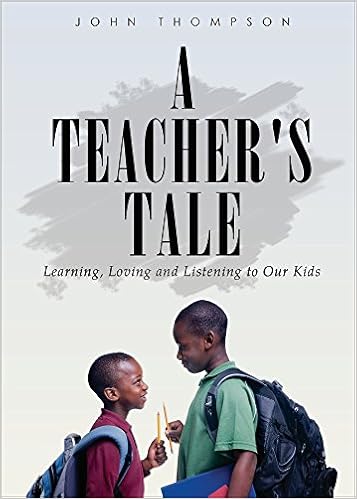
Book Review: A Teacher’s Tale by John Thompson

Book Review: A Teacher’s Tale by John Thompson:

Book Review: A Teacher’s Tale by John Thompson


Every so often, I will pick up a book that illuminates my own experiences, opens my eyes to the truth behind those events, and often helps me put a name to whatever I have been muddling through on my own. Oklahoma City educator John Thompson has written one such book.
Prior to downloading the Kindle version of A Teacher’ s Tale: Learning, Loving, and Listening To Our Kids on a Saturday evening, I’d followed Mr. Thompson’s writings in theHuffington PostScholastic Administrator, and Diane Ravitch’s blog. I had an opportunity to meet him at a workshop or event once, and we follow each other on Twitter. All that said, I had not really had a chance to delve into his teaching philosophy until a review of his new bookshowed up on my Facebook news feed.
The review including the following snippet from his book:
I was never a hat-snatcher. I did not believe in grabbing students’ contraband, whether it was hats, cell phones, marijuana, or gambling proceeds. So how did I find myself firmly holding half of a gang leader’s hat, ignoring the teenager’s threatening look?
I have been in the same boat a few times. I do not consider myself authoritarian, but yet I’ve had to take on that role in my classroom in order to maintain a semblance of order. My vision of teaching includes constructivist, project-based learning in which the students revel in the process of creating authentic learning artifacts, discovering truths about themselves and others, and mastering the skills they need to be effective communicators in our ever-changing world. Yet, I have had to take on a role of disciplinarian that I’m most uncomfortable with, particularly when students (and sometimes their parents) don’t appreciate that I’m trying to help them become the people they are capable of being, to reach the dreams they tell me about in their first-week-of-school writing exercises.
This has been true whether I’ve taught in a rural high school with a 35 percent poverty rate (based on free/reduced lunch eligibility), a racially diverse suburban middle school with a 85 percent poverty rate, a rural middle school with a 74 percent poverty rate, or a rural high school with a 64 percent poverty rate.
Over the years, I’ve struggled with the pedagogical dichotomy between the supportive teaching philosophy I aspire to, and the realities of managing 25 to 30 teenagers in a classroom during 7th hour. My ideas have worked in some schools, where principals Book Review: A Teacher’s Tale by John Thompson:

CURMUDGUCATION: MA: How To Gut a School District

CURMUDGUCATION: MA: How To Gut a School District:

MA: How To Gut a School District


Back in April of 2014, Jim Peyser was managing director of the NewSchools Venture Fund, a group set up to support "venture philanthropy" in the charter school world with grant-funneling, consulting, lobbying, etc. Think of them as bag men and enforcers for hedge funders interested in making a charter school buck or two.

That would make Jim Peyser and ordinary charter-pushing well-connected money man, but that was Peyser in April of 2014. But two days before Christmas of 2014, Santa brought Peyser a gift of the job of Secretary of Education for the state of Massachusetts. Not since the fox was hired to stand guard over the henhouse has a job been so cleverly filled, but Governor Charlie Baker loves him some charters and has thrown open the gate to every kind of charter shilling under the sun.

But the case of Peyser is unique, because as NewSchools Venture Honcho, Peyser laid out his ideas about how the path forward for gutting redesigning school districts. Take for instance the piece he published in that long-ago April, "Redesigning School Districts: The Way Forward."

He opens by quoting an imaginary friend who bemoans the fact that although charters are swell, they only serve a few students, and in order to "close the achievement gap at scale," the "real work" of fixing school districts must be done.

These friends and allies believe charters have successfully proven that it’s possible to create high-performing public schools in high-need neighborhoods, but now charters need to step aside so that their practices and systems can be taken to scale by enlightened district leaders.

Peyser wants to point out two problems with that view. You will perhaps be surprised to learn that neither of the problems are that charters have not actually successfully proven anything. Okay-- they've proven that will an infusion of resources and a carefully chosen student population, you can test prep your way to higher test scores. But we've known that since before charter schools were a 
CURMUDGUCATION: MA: How To Gut a School District:

New York Superintendents call for an end to evaluating teachers on standardized test results - Wait What?

New York Superintendents call for an end to evaluating teachers on standardized test results - Wait What?:

New York Superintendents call for an end to evaluating teachers on standardized test results


Labeling children on the basis of unfair, inappropriate and discriminatory standardized tests is bad public policy.  Evaluating teachers on the scores their students get on those tests is equally wrong, yet that is exactly what the policy is in the State of Connecticut.
Last spring, more than 500,000 students across the country were opted out of the standardized testing craze.
This unprecedented development was the direct result of a growing awareness by parents, students, teachers and public education advocates that the standardized testing scheme isn’t useful and that the Corporate Education Reform Industry is turning public schools into little more than testing factories.
While school superintendents and administrators have been a major part of the anti-standardized testing coalitions in New York, far fewer Connecticut school administrators have been willingly to step forward and speak up on behalf of the students, parents, teachers and public schools they are sworn to serve.
In contrast, in the Constitution State Madison Superintendent of Schools Thomas Scarice has consistently been one of the school leaders who has been willing to provide his students, parents, teachers and community with the appropriate information about the extraordinary problems that come with a public education system that is overly reliant on standardized testing.
With parents increasingly recognizing the inherent negative consequences that stems from the Common Core testing program, attention is now turning to the second major problem with the pro-Common Core, Pro-Common Core testing initiatives that have been sponsored by Connecticut Governor Dannel Malloy, New York Governor Andrew Cuomo and the other political allies of the “Education Reformers” — and that is  — the inappropriateness of New York Superintendents call for an end to evaluating teachers on standardized test results - Wait What?:

New Push to Hire Male Teachers of Color - WSJ

New Push to Hire Male Teachers of Color - WSJ:
New Push to Hire Male Teachers of Color
New York City initiative aims to have teaching staff better reflect student population
Timothy Chen, a computer-science teacher at Urban Assembly Gateway School for Technology in Manhattan, with students Raymercy Hiciano and Andrew Guerrero,  during an introductory class on software engineering.
Timothy Chen, a computer-science teacher at Urban Assembly Gateway School for Technology in Manhattan, with students Raymercy Hiciano and Andrew Guerrero, during an introductory class on software engineering. PHOTO: STEVE REMICH FOR THE WALL STREET JOURNAL


New York City is rolling out a $16.5 million initiative to recruit and retain nonwhite male teachers so that its teaching staff better reflects its student population.
The effort, led by the city’s Young Men’s Initiative, a group comprising dozens of local programs serving young black and Latino men, aims to add a total of 1,000 black, Latino and Asian men to New York City classrooms or into a teaching track by the fall of 2017.

WE WANT TO HEAR FROM YOU

Have something to say about an article in Greater New York? Email us, along with your contact information, atgnyltrs@wsj.com. Letters will be edited for brevity and clarity. Please include your city and state.
According to data from the city’s Department of Education, Black, Latino and Asian male students comprise 43% of the one million students in the city’s public prekindergarten, elementary, middle and high schools. But men of the same races make up 8.3% of the approximately 76,000 teachers at those schools.
“Our teaching force does not look like the students in the classroom,” said Richard Buery,deputy mayor for strategic policy initiatives. “The city’s workforce should look like the city.”
The money behind the initiative is going toward professional development, advertising, guidance counselors and support for people getting teacher certification. The hiring effort is also intended to break a backward slide.
Most of the nonwhite men currently working as teachers have been employed by the city for 10 to 20 years, according to W. Cyrus Garrett, director of the Young Men’s Initiative, and some are nearing retirement age. At the same time, 8% of new hires, regardless of race or gender, quit in their first few years of teaching.
The city loses 450 to 500 nonwhite male teachers a year, Mr. Garrett said, and hires about 350.
Mr. Garrett and Mr. Buery said there was poor recruitment and retention of male teachers of color and cited several factors that they see as contributing to the problem.
Many such teachers are thrust into roles as school disciplinarians, called in frequently to de-escalate situations between students, Mr. Buery said. He described the phenomenon as the “ Joe Clark problem,” referring to the legendary baseball-bat-wielding principal of a school in Paterson, N.J., and the subject of the 1989 film “Lean On Me.”
ENLARGE
At the same time, these teachers are often the ones whom male students of color seek out for mentorship and support, as well as to serve as spokesmen or advocates, according to Amy Wells, a professor of sociology and education at Columbia University’s Teachers College.
Often male teachers of color “feel like they have to defend a lot of students against implicit biases or microaggressions,” said Ms. Wells. “If you’re the only teacher of color on a predominantly white faculty, that can get exhausting, especially when you’re working in an environment where most of your colleagues don’t necessarily understand what you’re saying.”
Timothy Chen, a second-year computer-science teacher at Urban Assembly Gateway School for Technology in Manhattan’s Hell’s Kitchen neighborhood, doesn’t remember having a single teacher of Chinese descent in his hometown of Chelmsford, Mass., but he is one of three at his current school. He has heard from other teachers that some male students look up to him as a role model, he said, and relate to him by talking about videogames.
At the same time, “students can say some culturally insensitive things, both intentionally and innocently,” he said. “The conversation you have with the student following that had potential to be a very powerful New Push to Hire Male Teachers of Color - WSJ:

Arne Duncan Pinpoints Where Schools Fail - WSJ

Arne Duncan Pinpoints Where Schools Fail - WSJ:

Arne Duncan Pinpoints Where Schools Fail

The departing secretary of education says students aren’t getting the education the U.S. economy needs them to have


Arne Duncan has been pushing the cause of education all his career. And as he prepares to step down as education secretary after seven years, he is asking CEOs to join him in the fight.
In today’s global marketplace, it’s critical for the U.S. to develop in young people the skills that will keep America competitive. But across the nation, says Mr. Duncan, businesses continue having trouble finding enough college graduates with those skills.
Mr. Duncan, in discussing the successes and setbacks of his tenure, asked CEOs for help to improve education from top to bottom, and discussed other challenges in an interview with Wall Street Journal Deputy Editor in Chief Matt Murray. Edited excerpts follow.
MR. MURRAY: What skills do employers want and how well prepared is our education system to give them people with those skills?
MR. DUNCAN: People who can think critically, work in diverse teams, and who can take complex information, come to a conclusion and make a recommendation.
I can’t tell you how many CEOs I’ve met who say they can’t find young people with the skills they’re looking for.
So my request and my challenge is: We have lots of what I call phony debates about silly stuff. Could CEOs lend their considerable voice to, “Do we need high standards or not? Do we want to continue to reduce the dropout rate or not? Do we want to make sure our high-school graduates are truly college-ready? Do we want to lead the world in college-completion rates or not?”
These issues aren’t left or right or Democratic or Republican. This is in our nation’s best interest.
‘A better economy’
MR. MURRAY: What is the biggest undone item to better align the education system with the needs of the labor market?
MR. DUNCAN: Unfortunately, there are lots. I’m a huge believer in early childhood education. The return on investment is remarkable. But we have so many kids entering kindergarten a year, year-and-a-half behind. We often don’t catch them up.
The majority of our public-school students are African-American, Latino. We have to make sure we’re fighting the equity battle, we’re fighting for civil rights, we’re making sure that every young person has access to a great education. And we need folks at every level who are willing to fight not on small-ball stuff, not on sound bites, but on, “Are we educating our way to a better economy?”
MR. MURRAY: Sen. Bernie Sanders wants to make college free. How do we make college accessible and affordable?
MR. DUNCAN: These things should not be reduced to sound bites. Is college too expensive for many people? Yes, and we have to find ways to continue to reduce debt. We’ve talked about free community colleges. If we reduce costs and still have these same outcomes, it’s not good enough. The worst debt is the debt you get when you don’t complete your degree. The vast majority of young people who graduate from college get good jobs and pay back their debt.
With college completion rates so low, when you have debt and no diploma to show for it, that’s the conversation we need to be having.
ENLARGE
MR. MURRAY: College debt has roughly tripled in the past decade. How do we fix this?
MR. DUNCAN: Again, to be very clear, the vast majority of folks who are defaulting are folks who didn’t complete their degree. Yes, we can contain costs. That takes federal investment. It takes state investment. It takes universities containing their own costs. We put $40 billion into Pell grants without going back to taxpayers for a nickel. The goal has to be not just access. The goal has to be completion. It’s got to be around outcomes. That conversation around outcomes I’m not hearing on either side of the political spectrum.
College scorecards
MR. MURRAY: One of the big issues you’ve been involved in is college scorecards. You ran into opposition from the colleges on that front.
MR. DUNCAN: When you challenge the status quo, you get pushed back. That’s totally fine. We’re pushing very hard for transparency.
It’s a very difficult process to navigate. Young people should know, “What are the graduation rates,” not what the one-year cost is. “What’s the four-year cost? What are people like me making once they graduate from college?”
It’s interesting: 7,000 institutions of higher education, best system in the world, but it’s a broken marketplace. It’s absolutely inefficient. The vast majority of young people fill out the financial-aid form—they apply to one school.
I’m a believer in choice and competition. We think we all have this great choice. We really don’t. So we’re trying to expand more options, get that out there, and get more young people good information.
MR. MURRAY: Do you see room for the next secretary of education or president to advance this? You’ve run headfirst into opposition on that front a lot from all the higher educational institutions.
MR. DUNCAN: No worries.
MR. MURRAY: Can we make it happen?
MR. DUNCAN: It is happening. We’ve put unprecedented information out there to empower young people, their parents and college counselors to make good choices.
MR. MURRAY: Where does vocational training come in?
MR. DUNCAN: I’m a huge fan. Department of Labor has put $2 billion behind community colleges where real training is leading to real jobs.There are so many good jobs out there with a two-year community-college degree. We want to do more career and technical ed in the high-school space.
MR. MURRAY: The No Child Left Behind renewal, that may be coming out of committee?
MR. DUNCAN: This law’s been broken for seven, eight years. Folks are trying to work Arne Duncan Pinpoints Where Schools Fail - WSJ: