Latest News and Comment from Education

Monday, September 29, 2014

A Prof Debunks Standardized Testing & Pearson Strikes Back

A Prof Debunks Standardized Testing & Pearson Strikes Back:


A Prof Debunks Standardized Testing & Pearson Strikes Back

Don't Tread on My PROFITS!


 Rebellions sometimes begin slowly, and Walter Stroup had to wait almost seven hours to start his. The setting was a legislative hearing at the Texas Capitol in the summer of 2012 at which the growing opposition to high-stakes standardized testing in Texas public schools was about to come to a head. Stroup, a University of Texas professor, was there to testify, but there was a long line of witnesses ahead of him. For hours he waited patiently, listening to everyone else struggle to explain why 15 years of standardized testing hadn’t improved schools. Stroup believed he had the answer.

Using standardized testing as the yardstick to measure our children’s educational growth wasn’t new in Texas. But in the summer of 2012 people had discovered a brand-new reason to be pissed off about it. “Rigor” was the new watchword in education policy. Testing advocates believed that more rigorous curricula and tests would boost student achievement—the “rising tide lifts all boats” theory. But that’s not how it worked out. In fact, more than a few sank. More than one-third of the statewide high school class of 2015 has already failed at least one of the newly implemented STAAR tests, disqualifying them from graduation without a successful re-test. As often happens, moms got mad. As happens less often, they got organized, and they got results.
Texas Education Commissioner Robert Scott, long an advocate of using tests to hold schools accountable, broke from orthodoxy when he called the STAAR test a “perversion of its original intent.” Almost every school board in Texas passed resolutions against over-testing, prompting Bill Hammond, a business lobbyist and leading testing advocate, to accuse school officials of “scaring” mothers. State legislators could barely step outside without hearing demands for testing relief. So in June 2012, the Texas House Public Education Committee did what elected officials do when they don’t know what to say. They held a hearing. To his credit, Committee Chair Rob Eissler began the hearing by posing a question that someone should have asked a generation ago: What exactly are we getting from these tests? And for six hours and 45 minutes, his committee couldn’t get a straight answer. Witness after witness attacked the latest standardized-testing regime that the Legislature had imposed. Everyone knew the system was broken, but no one knew exactly why.
Except for one person. Stroup, a bookishly handsome associate professor in the University of Texas College of Education, sat patiently until it was his turn to testify. Then Stroup sat down at the witness table and offered the scientific basis behind the widely held suspicion that what the tests measured was not what students have learned but how well students take tests. Every other witness got three minutes; it is a rough measure of the size of the rock that Stroup dropped into this pond that he was allowed to talk and answer lawmakers’ questions for 20 minutes. 
A tenured professor at UT with a doctorate in education from Harvard University, Stroup isn’t frequently let out of the lab to address politicians in front of cameras. He talks with no evident concern that he might upset the powerful, and he speaks so quickly that his sentences have to hurry to keep up as he darts down tangents without warning. He taught in classrooms for almost a decade—it must have been a nightmare for his students.
But his testimony to the committee broke through the usual assumption that equated standardized testing with high standards. He reframed the debate over accountability by questioning whether the tests were the right tool for the job. The question wasn’t whether to test or not to test, but whether the tests measured what we thought they did.
Stroup argued that the tests were working exactly as designed, but that the politicians who mandated that schools use them didn’t understand this. In effect, Stroup had caught the government A Prof Debunks Standardized Testing & Pearson Strikes Back:

Gene V Glass: Education in Two Worlds: How Charter School Owners Feather Their Nets & Other Conflicts of Interest

Gene V Glass: Education in Two Worlds: How Charter School Owners Feather Their Nets & Other Conflicts of Interest:


How Charter School Owners Feather Their Nets & Other Conflicts of Interest


Many people in one of my home states — Arizona — seem to have no concept of a conflict of interest.When charter schools were authorized in Arizona in the mid-1990s, it wasn’t long before a young woman “researcher” at the Goldwater Institute was appointed Chairperson of the State Charter School Board. And that very same Chairperson quickly issued a charter to a non-profit foundation — that was really an artifice created by K12 Inc. — that created the Arizona Virtual Academy (AVA), a huge cybercharter. Then Arizona Virtual Academy soon hired that very same Chairperson as its Director, who decided that all materials and services of the AVA would be purchased from K12 Inc. And before long and shortly after the Chairperson resigned from the State Charter School Board, K12 Inc. hired Chairperson into the position of Senior Vice President for Education, and Policy & External Affairs. So you see, this person is not only the director of one of the largest online Charter schools in the nation, but she also serves as a vice president of the company from which her charter school purchases nearly everything. (Incidentally, AVA is the cybercharter that got caught outsourcing essay grading to India.) Anybody have a problem with this? Not in Arizona.

One of the first brick-and-mortar charter schools in Arizona was named Citizen 2000. In the middle of its second year of operation, its 1,000 enrolled students showed up for class only to find a note of the door informing them that Citizen 2000 was closed for business. The Director was on her way to Chicago for good. She had been paying her divorce lawyer out of school funds, paying her mother’s mortgage, and had hired her sister as assistant director at an exorbitant salary. I was being deposed in a FOIA case by an Assistant Attorney General at about that time, and I asked whether the state had plans to pursue a case against the former Director of Citizen 2000. “No, we’re not interested.” Fine, so seemingly nobody in Arizona cares about conflicts of interest.

However, now and then the powers that be in Arizona will come down on some small fry in an attempt to prove that they are policing double dealing. Years ago, an assistant superintendent of public instruction got canned because he was running a textbook company on the side while subtlely suggesting to teachers and administrators that he knew where they could buy some really good textbooks. More recently, a school board member in a suburban Phoenix school district was nearly indicted when it was discovered that the board on which he sat was contracting with his HR company for some minor services.

Why then, is a blind eye turned to massive conflicts of interest in the charter school domain?

Consider the case of BASIS charter schools. If you have spent the last 15 years in Antarctica without internet access and no subscription to US News and World Report, then you probably haven’t heard of the BASIS charter schools. BASIS operates about a dozen charter schools, mostly in Arizona but also in San Antonio and Washington, D.C. BASIS is the creation of Michael Block, a retired econ professor from the University of Arizona. To read what the media write about BASIS, this econ prof has discovered the magic bullet, the secret to taking ordinary students and turning them into National Merit Scholars with their pick of any Ivy League college. But the truth is that BASIS charter schools — which claim to admit students only by lottery — put out a sales pitch that scares the bejeebers out of any parent whose kid isn’t already National Merit potential and then flunks out 90% of the students with a daunting gauntlet of tests from Gene V Glass: Education in Two Worlds: How Charter School Owners Feather Their Nets & Other Conflicts of Interest:

Computer Essay Grading v. Student Journals

Computer Essay Grading v. Student Journals:


ba-ay602_previe_g_20120428004636

Computer Essay Grading v. Student Journals

The beauty of being an English or language arts teacher is helping students develop the skill of writing. Next to learning how to read, learning how to express your ideas through writing is a valuable form of communication. And in today’s world, being able to communicate and relate to others is more critical than ever.
But if you want a taste of the future, with Common Core PARCC writing and assessment, an article by Les Perelman in The Boston Globe last April, told how Pearson is using student essays to train their “robo-grader” to replace human readers who grade test essays. There is no sign that this is anything positive…no research to indicate it works to improve writing. It sounds like it is being done for efficiency. The robo-graders are trying to match human scores, looking at the essay length and counting particular words.
There are problems the article identifies:
  • Three MIT computer science students have shown this machine doesn’t measure “human communication.”
  • There’s a lack of transparency of the private vendors and their resources.
  • Using computers to score is not as effective as real teachers.
  • Machines are involved in corporate secrecy.
This sadly reminds me of student journal writing which I first learned about through a teaching workshop with the National Writing Project. Students write their thoughts and ideas in a journal, usually at the beginning of class, and teachers can directly respond. Journal writing is more pointed and values the thoughts and ideas of the student. Journal writing, in general, is being criticized by the Common Core enthusiasts as not incorporating critical thinking skills. Really, it doesn’t tidily fit with having a robo-grader scorer.
College Board President and Common Core English Lang. Arts developer David Coleman’s disregard for this kind of writing (“no one gives an ‘expletive’ about narrative writing”), most of us saw as reprehensible, because it is indicative of the coldness Computer Essay Grading v. Student Journals:

What I Saw, Who I Met and What You Should Know About My Back to School Tour - Lily's Blackboard

What I Saw, Who I Met and What You Should Know About My Back to School Tour - Lily's Blackboard:


What I Saw, Who I Met and What You Should Know About My Back to School Tour

I am on a plane, heading home for the first weekend I’ve had off in six weeks. I’m not tired. Maybe it’s the six cups of coffee I had this morning, but I’m not tired. My mind is racing with events from the Road Trip I’ve been on. It’s a classic case of “Be Careful What You Ask For, You Might Just Get It”.
I told my colleagues at NEA that I wanted to have in my mind and in my heart the stories of real educators, real parents, real students who face today’s challenges and who are finding ways to succeed in spite of Racing to the Top of some testing food chain to avoid being eaten alive by the sharks of corporate factory school reform.14815366420_5530f12701_z
I didn’t want to memorize stats and bar graphs that prove that the pillars of factory school reform: Standardize, Privatize, De-Professionalize is a house of cards falling not so softly from the commanding heights of a deregulated market place of bad ideas for students. I wanted a conversation. I wanted to hear voices and see faces. I told my peeps, “If I’m NOT whining about being over-scheduled, you’re not doing your job.”
Oh, lord. So far I’ve been to Alaska, CaliforniaFloridaTexasNew JerseyWisconsinIllinoisMichigan and New York. I’ve visited preschools and elementary schools and high schools and university campuses. I’ve spoken with teachers and custodians and college professors and mommies and principals and superintendents and school board members and gubernatorial candidates. My head is full. My heart is fuller.
In Fairbanks, Alaska I visited the Effie Kokrine Early College Charter School with a curriculum wrapped around Native Alaska culture, often taught by Native Alaska elders who had their own gathering room near the library – The goals of the school is for every student to go on to higher education, and the results are impressive. They’ve put paper-pencil tests in perspective, and are moving forward by focusing on culture and respect.
LilyHoweElemtIn Wisconsin, I visited Howe Elementary where I spoke with a group of kindergarten bilingual boys and girls. I asked,
“Dime una palabra que describe tu maestra.” Tell me one word that describes your teacher.
They said, “Bonita – pretty”,
“Inteligente – Smart”, “
Divertida – fun”… then one student who couldn’t fit it into one word..
“Ella nos quiere – She loves us.”
We walked outside to see a garden the students had planted. The garden boxes had been built by a teacher who volunteered to write a grant for the materials and built it in his spare time. One family volunteered to come several times a week to water it and help the children weed it and watch the vegetables grow.
We were shown an odd old building in the middle of the parking lot that looked like it was for storage.
LilygardenThe teacher guiding us said, “You have to see what we’ve got in here.” The familiar smell hit you as soon as you entered. A dentist’s office. They had a dentist’s office. They partnered with an outside organization that offered free dental care to the families.
There was another community organization that had a small office in the building that worked with pregnant women and did home visits to explain how these new moms could help prepare their infants to be ready for the school’s preschool in three years. They were amazing, positive women who saw the school as the foundation of their outreach. And the school saw them as their angels.
I visited Washington Irving Elementary in Oak Park, Illinois. The principal was so proudly walking us around the building that was over 100 years old, showing us how clean it was and how safe and healthy, and the custodian walked by. The principal said, “It looks like this because of him.” He looked confused, but I introduced myself and told him, “I’m here to see schools that shine.” And he smiled and told me that some mornings on snowy days, he has to come at 4am to get everything ready, then added, “But it’s worth it. The kids know that somebody cares about What I Saw, Who I Met and What You Should Know About My Back to School Tour - Lily's Blackboard:

9-29-14 Hemlock on the Rocks

Hemlock on the Rocks:


Big Education Ape: LAUSD spends like Billionaires while being a Tyrant about Teacher’s Salaries - Lydia Gutierrez
http://bigeducationape.blogspot.com/2014/09/lausd-spends-like-billionaires-while.html LAUSD spends like Billionaires while being a Tyrant about Teacher's Salaries - Lydia Gutierrez Lydia Gutierrez: LAUSD spends like Billionaires while being a Tyrant about Teacher's SalariesLos Angeles: When charges were filled against LAUSD for not enforcing policy in protecting children from sexual predators,
Come ride The BUS with SOS, United Opt Out, and The Badass Teachers’ Association | DCGEducator: Doing The Right Thing
http://dcgmentor.wordpress.com/2014/09/29/come-ride-the-bus-with-sos-united-opt-out-and-the-badass-teachers-association/ Teaching and Speaking Out What happens to teachers who speak out about problems they see in their work? Teachers shared their first-hand stories on the Education Town HallBUS, Thursday, September 25. Francesco Portelos, a New York City teacher had been praised by his principal
9-28-14 Hemlock on the Rocks
Hemlock on the Rocks: Breakfast is served | The Crimson Chroniclehttp://www.thecrimsonchronicle.com/2014/09/breakfast-is-served/ Breakfast is served Posted on September 26, 2014 by Erika Salazar in News Erika Salazar Editor-In-Chief Breakfast in the Classroom, a district-wide initiative that aims to offer morning meals to those students who do not eat one on a regular basis, will be implemented on


9-29-14 Ed Notes Online

Ed Notes Online:


EIA: Providence Teachers Union Prefers Convicted Felon to Charter School Director

My question to Mike Antonucci is: What exactly is the difference? Providence Teachers Union Prefers Convicted Felon to Charter School DirectorThe executive board of the Providence Teachers Union “overwhelmingly” endorsed Vincent “Buddy” Cianci Jr. for mayor. “Mr. Cianci had a little bit more experience in terms of the city’s schools and had a better understanding of the fundamental needs of the sc


9-28-14 Ed Notes Online
Ed Notes Online: NYCFIRST LEGO League Kickoff - PhotosI had a great time yesterday at NYU/Poly on Jay Street at our annual FLL kickoff. We have about 170 NYC teams registered so far for the Challenge which is called World Class, all about learning. Kids not only build a robot for the game field - below - represent different styles of learning - but also do and present an extensive research project


Blue Jersey:: Camden parents protest "Urban Hope Act" outside Assembly Session

Blue Jersey:: Camden parents protest "Urban Hope Act" outside Assembly Session:


Camden parents protest "Urban Hope Act" outside Assembly Session

by: Rosi Efthim

Mon Sep 29, 2014 at 03:15:19 PM EDT


Camden NJ parents protest "Urban Hope Act" at NJ LegislatureA group of Camden parents is walking the halls of the New Jersey legislature today in advance of the Assembly's vote in this afternoon's session on the "Urban Hope Act".

I'm told by the parents that they've been unable to talk to voting members; unclear whether they were unsuccessful in setting up appointments to lobby members today or didn't set up meetings in advance, or if members ignored them. A reworked and expanded "Urban Hope Act" passed the Senate overwhelmingly last week.

Both Education Law Center in Newark and Save Our Schools NJ asked the legislature to withhold their approval as they see the legislation as a threat to the city's public schools. There are numerous questions which should throw cold water on this legislation, including legal questions. Rutgers Camden PhD candidate Rasheda Weaverhighlighted distrust on both the local and state level directed at Christie, Mayor Dana Redd and those behind the bill, and posts insinuating the bill amounts to educational experimentation on the children of Camden.

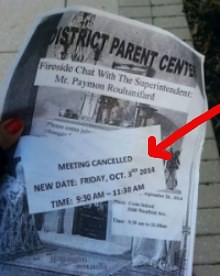
Camden schools meeting - canceledJersey Jazzman, in a well-sourced piece of the sort policy-makers should find useful, walked through the evidence that suggests Urban Hope will not work the way Steve Sweeney suggests it must.

But maybe the biggest question is this one, raised most directly by NJ Spotlight:Debates in Camden continue - - but is anyone listening to the community?

The continuing answer would seem to be No.  Blue Jersey:: Camden parents protest "Urban Hope Act" outside Assembly Session:
Rosi Efthim :: Camden parents protest "Urban Hope Act" outside Assembly Session

9-29-14 Curmudgucation - Gates at Politico. Wrong. So Wrong.

CURMUDGUCATION:


Gates at Politico. Wrong. So Wrong.
Bill Gates popped up once again, spicing up a Politico interview with some of his standard educational wrongness.First, he proposes that Common Core is simply a technocratic solution for education. He then compares the standards to the standardized railroad gauge or standardized plugs for appliances. Let me take a deep breath and see if I can put in words (beyond the obvious "children are not

The Market Hates Losers
Fans of market forces for education simply don't understand how market forces actually work.What they like to say is that free market competition breeds excellence. It does not, and it never has.Free market competition breeds excellent marketing. McDonald's did not become successful by creating the most excellent food. Coke and Pepsi are not that outstandingly superior to RC or any store brand. Be

Data Dopiness Survives in Indiana
You may recall that back in the day, one of the items on our List of Terrible Things About Reformy Stuff was data mining. Featured in RttT and RttT Lite Waivers, the mandate to hoover up giant mounds of data was one of the great hated evils of reformsterdom, loathed by conservatives and liberals alike.The Leonie Haimson led a fight against InBloom in New York, and won.Since then, we've dialed back
9-28-14 Curmudgucation - One More Way To Kill Public Schools
CURMUDGUCATION: One More Way To Kill Public SchoolsAEI has a new video about education. It's slick and well-produced, featuring Muchael McShane walking through a school while telling us how things should be. He has a three-point program which features, among other things, school choice on steroids. It also has numbers and facts, and I'm not even going to address whether they're accurate or not, be


Choosing Democracy: California Enacts First-in-the-Nation Law to Eliminate Student Suspensions for Minor Misbehavior

Choosing Democracy: California Enacts First-in-the-Nation Law to Eliminate Student Suspensions for Minor Misbehavior:


California Enacts First-in-the-Nation Law to Eliminate Student Suspensions for Minor Misbehavior


 AB 420 signing caps landmark year for school discipline reform in the state

Roger Dickinson 
SACRAMENTO, CA  – Today California becomes the first state in the nation to eliminate suspensions for its youngest children, and all expulsions for all students for minor misbehavior such as talking back, failing to have school materials and dress code violations. Gov. Jerry Brown’s signing today of AB 420 caps a landmark year for the movement away from harsh discipline policies and toward positive discipline and accountability approaches that keep children in school.

AB 420 places limits on the use of school discipline for the catch-all category known as “willful defiance,” which also includes minor school disruption. Willful defiance accounts for 43% of suspensions issued to California students, and is the suspension offense category with the most significant racial disparities.  For the next 3.5 years, the law eliminates in-school and out-of-school suspensions for children in grades K-3 for disruptive behavior currently captured in Education Code section 48900(k) and bans all expulsions for this reason. The bill was co-sponsored by Public Counsel, Children Now, Fight Crime Invest in Kids, and the ACLU of California and supported by a statewide coalition of organizations.

“In just a few short years, school discipline reform has become an important education policy priority in California because the stakes are very high – research has shown that even one suspension can make it five times more likely that a child will drop out of school and significantly increase the odds they will get in trouble and head into our juvenile delinquency system,” said Assm. Roger Dickinson (D-Sacramento), author of AB 420 and a longtime champion of positive school discipline in California. 


The signing of AB 420 is the latest in a series of influential local and state reforms and milestones to reform harsh, disciplinary practices in California in 2014, including:

·       New agreements between school policing agencies and school districts to limit the filing of criminal charges and citations against students for minor infractions and instead refer them to counseling and other support services and put in place other protections.  These agreements are now in place in Los Angeles, Oakland, Pasadena, and San Francisco Unified School Districts.

·       Decisions by a growing number of school boards to go beyond AB 420 and ban the use of the catch-all category of “willful defiance” as a cause for suspensions and expulsions and instead rely on the other 24 more specific rationales for suspension spelled out in the California Education Code.  These policies have been adopted by San Francisco and Los Angeles (all grades, suspension and expulsion), Oakland (expulsion), and Azusa Unified School District (phased out over the next 3 years).

·       A first-in-the-nation decision by the California Commission on Teacher Credentialing to require training in best practices in classroom management and positive school discipline for new school principals and administrators.

·      Significant investments in positive school discipline programs and strategies under the state’s new Local Control Funding Formula law that includes a new requirement that schools reduce suspensions and expulsions, develop specific strategies for doing so, and monitor data as a way of assessing “school climate” and the quality of the learning environment.  Highlights of reforms and investments include:
o   Santa Rosa City School’s Local Control Accountability Plan (LCAP) includes training for all middle and high school personnel staff on restorative practices and hiring 10 restorative practice specialists to address discipline issues and a goal of a 75% reduction in suspensions and expulsions for Latino students in 3 years.
o   Santa Ana Unified’s LCAP includes $4.5 million to support school and district operations to create welcoming and productive school environments and to conduct anti-bullying awareness, as well as $1.5 million to for School-wide Positive Behavior Interventions and Supports training, implementation of restorative justice strategies and instituting School Climate Oversight Committees at each school that include parents and students as co-facilitators.
o   Azusa Unified ’s LCAP includes the elimination of willful defiance suspensions over the next three years and implementation of SWPBIS in all schools by 2015-16 and tracking office discipline referrals.
o   Berkeley Unified’s LCAP includes a system to track and reduce office discipline referrals and fund restorative practices, SWPBIS and other alternatives at the classroom level.
·       A sharp decline in suspensions, with a 14.1% decrease in suspensions in the 2012-13 school year and a 27% drop in the last three years, according to California Department of Education data released in January.
Though this progress is significant and hopeful, California still suspended 329,142 students in the 2012-13 school year and issued more than 600,000 suspensions, with 43% being suspended for minor misbehavior and students of color being on the receiving end of significantly more harsh discipline.  In 2012-13, African-American students made up 6.3 percent of total enrollment, but 16.2 percent of suspensions.  Latino students made up 52.7 percent of total enrollment, but 54.6 percent of suspensions. White students made up 25.5 percent of total enrollment, but 20.9 percent of suspensions.
More reforms are needed in local and state policies, as well as monitoring the implementation of existing policies and programs.   AB 420 includes a sunset provision in 3.5 years, and statewide coalition partners will be returning with legislative proposals to expand the protections for students and increase investments in effective alternatives.  California’s coalition of state and local school discipline reform parents, educators, students, community, law enforcement, civil rights leaders will continue to work toward:
·       Ending the use of “willful defiance” suspensions for all students, not just young children
·       Increased state funding for positive school discipline approaches including Positive Behavior Intervention and Restorative Practices
·       Promoting best practices in schools, including reforms in teacher and administrator training,
·       Developing stronger Local Control Accountability Plans that include funding and training for alternative discipline practices
·       Reducing use of all suspensions for any reason by at least 80% by 2020
California community and statewide leaders have issued the following statements regarding the passage of AB 420 and the importance of continuing to build momentum for the state’s expanding school discipline reform movement.


Here is what some of California leaders are saying about AB 420:
“AB 420 is a significant step forward in California’s school discipline reform movement and sends a clear message about the importance of creating calm, safe and successful learning environments where suspension is used only as a last resort.  This statewide change is key to understanding what is needed to improve academic achievement, Choosing Democracy: California Enacts First-in-the-Nation Law to Eliminate Student Suspensions for Minor Misbehavior:

Mike Klonsky's SmallTalk Blog: Shooting the messenger

Mike Klonsky's SmallTalk Blog: Shooting the messenger:


Shooting the messenger

On Friday, I received the following missive from SEIU Pres. Christine Boardman via the union's general counsel Tyson Roan.


First, I'm glad to find that the president of SEIU Local 73 is such an avid reader of SmallTalk. I remember meeting Mayor Emanuel at a social event a while back (got friends in low places) and as he shook my hand, he said to the hosts, "Yeah, I know Klonsky. I read his blog." I retorted, "...and you're still talking to me?" The mayor answered, "It's a free country. Your entitled to you're opinion."


Pres. Boardman, a quasi-public figure like the mayor, is not so generous.


Not wanting to impugn anyone's integrity and certainly not wanting to face the full might and fury of SEIU's legal department, I took Pres. Boardman's charges seriously and reread my Sept. 16th post, "The rats are having a field day at CPS"(boy, are they ever). And you know what? I think Pres. Boardman raises two good points.


First, she says my statement that she signed off on an agreement between CPS and private custodial subcontractors" is "entirely false, and has no basis whatsoever in Mike Klonsky's SmallTalk Blog: Shooting the messenger:


Did Rheeformers Rhee and Henderson Actually Close Any of Those Achievement Gaps in DC Public Schools? | GFBrandenburg's Blog

Did Rheeformers Rhee and Henderson Actually Close Any of Those Achievement Gaps in DC Public Schools? | GFBrandenburg's Blog:


Did Rheeformers Rhee and Henderson Actually Close Any of Those Achievement Gaps in DC Public Schools?

Part Sixteen and Final


Today we look at the black-white and hispanic-white achievement gaps in the Washington, DC public school system, which has now been under mayoral control for seven full years.
My four graphs and tables today will show how laughably pitiful their claims of success really are.
You will see that the achievement gap is pretty much unchanged since the year I retired (2009), but the gap between Rhee’s promises and reality has been getting wider and wider.
A lot of their promises had to do with closing the ‘achievement gaps’ between white and more-affluent students on the one hand, and black, white, and impoverished students on the other hand. As you probably are aware, standardized test scores are very strongly linked to family income and educational levels. You may not be aware that the white population of Washington DC is generally very well-educated.and fairly affluent (unlike rural white populations in, say, West Virginia or Kentucky). Washington has the highest-scoring white student body in the nation on the National Assessment of Educational Progress (NAEP), and the widest gap between the scores of white students and of hispanic or black students.
However, Michelle Rhee and her minions promised spectacular reductions in those gaps, as measured by the relative percentages of students scoring ‘proficient’ or ‘advanced’ on the DC-CAS among white students, hispanic students, black students, and students who are eligible for free and reduced-price lunches (versus those not eligible).
What I found is a complete and utter failure to make any progress whatsoever since 2008 or 2009 — the year that Rhee twisted the arms of every single principal in the school system to come up with miraculous gains, and when many of those principals (and Did Rheeformers Rhee and Henderson Actually Close Any of Those Achievement Gaps in DC Public Schools? | GFBrandenburg's Blog:

LAUSD spends like Billionaires while being a Tyrant about Teacher’s Salaries - Lydia Gutierrez

Lydia Gutierrez:


LAUSD spends like Billionaires 
while being a Tyrant about Teacher’s Salaries


Los Angeles: When charges were filled against LAUSD for not enforcing policy in protecting children from sexual predators, i.e. Mark Berndt, LAUSD School Board decided to hire 2 law firms, Sedgwick and Andrade, at $350 to $460 an hour, spending over $7 million dollars and still counting, to litigate the Miramonte Elementary School Case. LAUSD ignored its own lawyers, who bill at $150 to $175 an hour, and have had the experience of litigating cases like this.
Sedgwick and Andrade law firms have spent much of their time creating roadblocks in providing evidence of Mark Berndt’s misdeeds for over the last 30 years. When LAUSD Superintendent Deasy, said with all supposed sincerity that LAUSD would provide all documentation for this case to be resolved so the children involved would not have to endure this tragedy was not accurate. Lydia Gutierrez remarked, “It is painful enough knowing what these children have had to endure, while LAUSD Administration ignored all the warning signs, that LAUSD would prolong the disclosure of information that would help expedite this case for these children. The LAUSD School Board should have been at the forefront in assuring this, but are MIA (Missing In Action).”
LAUSD has given every excuse possible for why they are not able to pay standard wages for LAUSD public school teachers. And yet, the LAUSD School Board has been able to find funding for a billion dollar high school, Belmont Learning Center, about half a billion for a failed Payroll System, and now a billion for funding iPads, that Superintendent Deasy is being questioned for favoritism in purchases, while the school structures are in shambles.
Lydia commented, “Under the leadership of Richard Vladovic, School Board President of LAUSD, fiscal accountability has been lacking. School Board members are elected to watch over the taxpayers’ money to assure it is being used to educate our children, instead of lining the pockets of special interest groups.” She further stated, “When I am elected, I will call for an audit of all expenditures, review all cases before the Inspector General, and request that the School Board seek out administrators who have had actual experience in the educational field and have a thorough understanding of the academic expectations. It is time to stop hiring people who come with an agenda that is self-serving and does not serve the needs of our children and does not give the support our teachers need in the classroom.”
Lydia Gutierrez is running for LAUSD School Board District 7 to replace Richard Vladovic. She was born and raised in District 7, Harbor Gateway, went to school at Meyler Elementary School, Stephen M. White Middle School and Narbonne High School, and resides in San Pedro. Lydia has over 20 years teaching experience. She has been a neighborhood board member for 7 years. She holds 2 teaching credentials, a master’s and has been a master teacher for the UCLA Mathematics projects. Before teaching, she was an administrator and acting cost estimating supervisor in the aerospace industry.
Lydia Gutierrez: