Latest News and Comment from Education

Wednesday, December 4, 2013

Broken communities -> disconnected students = skyrocketing truancy rates Parents United for Responsible Education

Parents United for Responsible Education » Blog Archive » Broken communities -> disconnected students = skyrocketing truancy rates:

Broken communities -> disconnected students = skyrocketing truancy rates

disconnected
From 2013 “Halve the Gap” report on disconnected youth
According to a new study to be unveiled Thursday, Chicago and Illinois school dropout rates appear to be declining, but truancy and chronic truancy are dramatically escalating.
The study, by Dr. Andrew Sum of Boston’s Northeastern University, will be presented at a forum which will also feature panelists from CPS, the state legislature, and local alternative school administrators. Pre-registration for the event has closed, but you can still probably show up and get in to hear the presentation scheduled from 9:30 to noon at Chicago’s Union League Club, 65 W. Jackson.
I don’t know what Dr. Sum will say tomorrow and I’m no scientist, but it’s clear to me that city policies have completely sabotaged the feelings of belonging and engagement that students need to stick with school. Chicago’s formerly proud, vibrant and close-knit communities have been decimated by Mayor Emanuel’s devastating school closings. Neighborhood schools that are still open are forced to compete with self-contained charter schools which generally have little connection to the community where they are sited.
How many students have been rejected by a charter school? How many have no neighborhood school at all? How many have given up going to school out of fear for their safety? Whose set our children up this way?
I am suspicious of upbeat drop out numbers from the “cook-the-books” folks at CPS. There have also been changes in the way dropouts are counted. Though I can’t prove it, I believe that more
- See more at: http://pureparents.org/?p=21031#sthash.Dl4VtIrv.dpuf

John Kuhn: Our Kids -- Coddled or Confident? - Living in Dialogue - Education Week Teacher

John Kuhn: Our Kids -- Coddled or Confident? - Living in Dialogue - Education Week Teacher:

John Kuhn: Our Kids -- Coddled or Confident?

Guest post by John Kuhn.


Frank Bruni recently wrote an article for the New York Times in which he argued that American children are coddled. In related news, Frank Bruni apparently doesn't know any poor children.
I'm not as upset about the Bruni column as many of my friends because he's right about a subset of American kids. We do have coddled children. But we also have hungry children. Bruni comes off as strangely uncurious and out-of-touch with the realities of that tiny sliver of America that isn't Manhattan. He wrote the column primarily to advocate for the Common Core State Standards, a collection of nationally-adopted learning expectations adopted by a coalition of state leaders who had been incentivized to do so by Washington, D.C., in a pretty brazen gambit to sidestep laws prohibiting the US Department of Education from exercising "any direction, supervision, or control over the curriculum."
Bruni, like the Department of Ed., feels that high-quality, nationally-shared minimum learning standards will improve our students' outcomes on standardized tests. He's probably right about that. The nations that do the best on tests like PISA tend to all have national standards. They also don't have our history--we started our government with 

Petrilli’s Hammer & the poverty has nothing to do with PISA argument | School Finance 101

Petrilli’s Hammer & the poverty has nothing to do with PISA argument | School Finance 101:

Petrilli’s Hammer & the poverty has nothing to do with PISA argument

Posted on December 4, 2013


Rate This

He frames his argument in terms of Occam’s Razor, as if to sound well informed, deeply intellectual and setting the stage to share profound logical argument, summarized as follows:
“among competing hypotheses, the hypothesis with the fewest assumptions should be selected.”
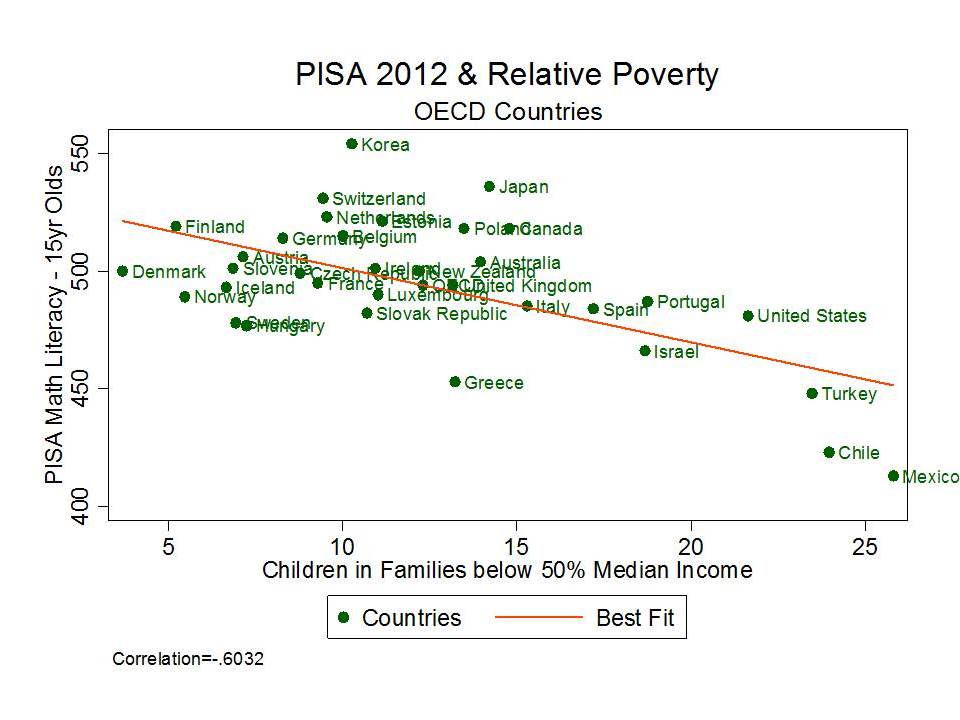
Petrilli asserts that while some might perceive a modest association (actually, it’s pretty strong) between national economic context and average tested outcomes in math, for example… like this…
Slide1
…that it is entirely illogical to assert that child poverty has anything to do with national aggregate differences in math performance at age 15.
That is, the various assumptions that must be made to accept this crazy assertion – that economic context matters in math performance – simply don’t hold water in Petrilli’s mind. Rather, the 

The Education You Deserve | EduShyster

The Education You Deserve | EduShyster:

The Education You Deserve


 An open letter to my students at a “no excuses” charter school in Boston…
By Barrett Smith
Last month I resigned from my position as a tutor and teaching assistant at a “No-Excuses” Charter School in Boston. What follows is an open letter to my students.
First, I need to get something off my chest. I came to your middle school for some selfish reasons. I wanted to tutor you not only to help you but also to help myself. I came to Boston temporarily and as an outsider, looking for a year of training in skills that I could take with me to my future home, and to benefit my future students.
That’s not to say that I don’t care about you. Working with you was the best part of my job, and I learned from each of you every day.
I came to your middle school hoping to give you the best possible education, but what I saw at your “No Excuses” charter startled me and still troubles me deeply. I was trained on how to discipline you, but not on the best way to help you understand material. I was lectured on how to turn your learning into data points, but was never told who you are and 

The Digitally Literate Teacher

The Digitally Literate Teacher:

The Digitally Literate Teacher

Digital Literacy


I was reading my Twitter list of “Key Educators” and came across a question, “what does it take for a teacher to be digitally literate?” I thought about this for a bit and came up with a list of competencies which would make a teacher digitally literate in my opinion. This list is not intended to be complete, merely a start for teachers interested in enhancing their digital literacy.
Being literate in SEARCH skills is something in which all teachers need to be accomplished. Searching involves not only knowing a few of the major search engines, but being able to use their advanced features and understanding their limitations. Being able to effectively evaluate the various sources which are found is also a necessary part of a competent search.
Having a SOCIAL MEDIA presence is something which digitally literate teachers need to develop. This presence could include various social media such as Twitter, Facebook, Instagram, Tumblr, and Flickr, blogs and web pages. While these are given only as representatives of the many social 

Tribune cartoon castrates public employees | Reclaim Reform

Tribune cartoon castrates public employees | Reclaim Reform:

Tribune cartoon castrates public employees

Be offended by the word castration. The Tribune editorial cartoon demonstrates that the entire so-called pension crisis is/was never about pensions. The editorial cartoon was meant to offend and humiliate you.
castration
Yesterday the Democratic controlled super-majority Illinois state legislature voted to cut pensions for active and retired teachers and other public employees. The cartoon depicts a spike collared dog with a cone around its head and the euphemism “Fixed” as the cartoon title. The collar is labeled with “Pension Reform” on it. The tag on the dog’s collar is labeled specifically “AFSCME” but the editorials on the page are more about teachers than any other public employees. (AFSCME is the American Federation of State, County and Municipal Employees.)
This cartoon is way beyond offensive. It is an act of psychological humiliation that reduces people to tamed domestic animals that have been slashed into a submissive and harmless state by castration. The legislation itself is anti-teacher, anti-public employee, anti-public 

12-4-13 Schools Matter

Schools Matter:


What Does the PISA Report Tell Us About U.S. Education?
When the OECD releases the PISA report every three years, many people use the ranking to claim public education in the U.S. is failing and push their corporate education reform agenda. But looking at the data, lessons that can be learned from the highest performing countries point in a completely different direction. For more information: http://go.aft.org/pisa #ReclaimIt


12-3-13 Schools Matter
Schools Matter: Harry and the Common CoreA couple of nights ago I was at a small gathering where Harry's mom was responding to comments about how much Harry, now "five and a half" as he is quick to tell you, has shot up in the past few months. Oh, he's doing great, says Harry's mom, except for a bit of a dexterity problem in his hands.  And how do we know of this problem?  It has been po

12-4-13 Ms. Jablonski's Class Blog

Ms. Jablonski's Class Blog:


Google Glass Incident
A few months ago, Cecilia Abadie, a computer technician , got a citation for allegedly "using" a google glass while driving. She claimed that the google glass only turned on when she looked up at the officer.  At first the officer was suspicious of Abadie driving 80 mph on a 65 mph freeway. But the officer then saw she was wearing a google glass and decided to give her a citation for peo
12-2-13 Ms. Jablonski's Class Blog
Ms. Jablonski's Class Blog: The New American CenterVery relevant to the class discussion today, this article, which can be accessed here, reveals that the constant idea of great division in this country apparent through the 80s to now of 40% on the left 40% on the right and 20% in the middle is fundamentally incorrect. The recent survey reveals 21% on the left 28% on the right and 51% in the middl


Ms. Jablonski's Class Blog 11-30-13
Ms. Jablonski's Class Blog: Phillipine Government S The typhoon that struckby Dennis Wu / 10h Census ‘faked’ 2012 election jobs reportThe unemployment rate suspiciously fell sharply right before the 2012 presidential election; now the facts have been revealed, the numbers were manipulated. Two years before the election an employee was caught fabricating data and a source says that this deceit was


Ms. Jablonski's Class Blog: Government Preparing for Impact of Global Warming
Ms. Jablonski's Class Blog: Government Preparing for Impact of Global Warming: "Ms. Jablonski's Class Blog"Government Preparing for Impact of Global WarmingOn Friday November 1, 2013, President Obama order that the government must put " effort to boost preparation in state and local communities for the impact of global warming." Natural disaster are affecting communities, our n

by mike simpson / 1h 

10-27-13 Ms. Jablonski's Class Blog: Germany's Confidence in America is Declining
Ms. Jablonski's Class Blog: Germany's Confidence in America is Declining: Germany's Confidence in America is DecliningSince learning that the United States National Security Agency monitored Chancellor Angela Merkel's cell phone, Germany's interior minister has declared that their confidence in their American allied nation is shaken. He also stated "If the Americans intercepted cell phones in
10-25-13 Ms. Jablonski's Class Blog
Ms. Jablonski's Class Blog: Russell Brand on the RevolutionLast night's edition of the UK's BBC Newsnight featured this remarkable interview with Russell Brand by host Jeremy Paxman.   Brand's explains to a weary-sounding Paxman why he doesn't vote (and never will) and believes a revolution is inevitable.   No matter what you think, Brand is certainly not the "trivial man" that Paxman ca
10-15-13 Ms. Jablonski's Class Blog
Ms. Jablonski's Class Blog: Government ShutdownnAre we finally close to a deal between the Republicans and Democrats concerning the shutdown ?1 by Aidan Flynn / 6h Obamacare Vs. Affordable Care Act     Unfortunately our society is not well informed about its own governments plans. Today the the big question is,"which is better? 'Obamacare' or 'Affordable Care Act'?" For those of you who

Mother Crusader: SSSHHHHH! Statewide Charter Applies For Expansion, Doesn't Tell 20 Districts It Serves...

Mother Crusader: SSSHHHHH! Statewide Charter Applies For Expansion, Doesn't Tell 20 Districts It Serves...:

SSSHHHHH! Statewide Charter Applies For Expansion, Doesn't Tell 20 Districts It Serves...

On October 5th, 2013 the Hatikvah International Academy Charter School submitted an expansion request to the New Jersey Department of Education. You can read or download the application here.


The expansion would allow Hatikvah to add a middle school (grades 6-8) and also add an additional class of 25 students per grade. (an increase from 50-75 students in each grade) This would mean that in the next five years Hatikvah will more than double in size.

And that would not be the end of their expansion either. This expansion request only fills seats in grades K-5 with 75 students by the year 2018-2019.

This certainly implies that when their charter is up for renewal in the 2018-19 school year there will be another expansion request. My guess is the next logical step would be to request to add a high school. At 

Common Core Webinar Series - Advocacy - National PTA

Common Core Webinar Series - Advocacy - National PTA:


Common Core Webinar Series


This four-part webinar series is designed to educate parents on the Common Core State Standards and empower them to support the transition at school and at home. The webinars highlight three key principals:
    • We need clear, consistent and rigorous standards across the country to ensure all students—regardless of their zip code—graduate with the higher order thinking skills needed for college and careers.
    • The standards reflect the relevant knowledge and skills that young people need to succeed in college and to build and maintain an American workforce that can compete in the global economy.
    • National PTA’s goal is for parents to be knowledgeable about the standards and new assessments and to support them every step of the way as states transition to the standards.

    CCSSI Webinars

    Common Core State Standards Overview

    CCSS Webinar
    An in depth look at the history of the standards, what is new and improved and an understanding of the key differences between old state standards and the benefits of the Common Core State Standards.

    Mythbusters (Coming Soon)

    CCSSMythBusters
    An overview of the biggest myths surrounding the standards and information that will help parents separate fact from fiction.

    Best Practices (Coming Soon)

    CCSSBestPractices
    A look at the Kentucky PTA 15th district’s work on Common Core, including ideas that any parent or PTA can use in their area.

    Resource Overview (Coming Soon)


    A summary of Common Core resources National PTA has developed for parents.

    Glenda Ritz says movement afoot to oust her as ed board chairwoman

    Glenda Ritz says movement afoot to oust her as ed board chairwoman:


    Glenda Ritz says movement afoot to oust her as ed board chairwoman

    -education6.jpg20131114.jpg
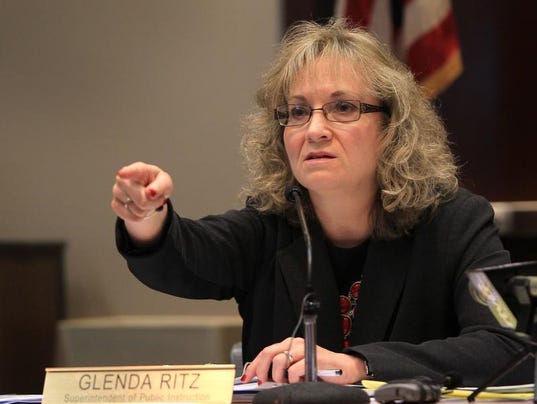
    State Superintendent of Public Instruction Glenda Ritz speaks during the Indiana State Board of Education meeting at the Indiana Government Center South, Wednesday, November 13, 2013. The State Board of Education voted Wednesday to shift Indiana's A-F grading system to one that's more similar to the way students are evaluated, but the testing and other data used to determine the grades are still to be determined. Kelly Wilkinson / The Star

    The tension in the room was evident earlier today when members of the state board of education met with a national mediator to try to settle their differences.
    The public orientation session aimed to outline roles and responsibilities for Superintendent of Public Instruction Glenda Ritz, a Democrat who chairs the board, and other members appointed to the board by Republican governors.
    But as discussions got underway, issues in the ongoing squabble surfaced again.
    Ritz said she has a document showing the Gov. Mike Pence's newly created Center for Education and Career Innovation is trying to remove her as chairwoman of the board of education through possible legislation.
    A CECI spokesman said there is no such plan.
    Earlier this fall, Ritz sued board members, accusing them of having an improper private meeting without her. The lawsuit was later thrown out. She also walked out of a recent board meeting.
    The National Association of State Boards of Education, at the suggestion of Pence, facilitated the discussion on board procedures and operation.
    This story will be updated.

    12/4/2013 – Ensuring Quality Teachers

    12/4/2013 – Ensuring Quality Teachers:


    Education Opportunity Network -


    Time To Change The Way We Ensure Quality Teachers

    By Jeff Bryant

    “The agenda [Arne] Duncan ‘began to advance in 2009 has now hit serious roadblocks’ … Particularly anger-inducing has been the way the Duncan/reform agenda has faltered on the need to expand access that poor and language-minority kids have to the best teachers … The idea of getting more successful teachers to work in schools that poor kids attend is not without merit … An important new document lays out a holistic view of how to address the many factors that influence “teaching quality” and more equitable distribution of high-quality teachers to schools that need them the most.”
    Read more …

    NEWS AND VIEWS

    Only 42 Percent Of Eligible Children Participate In Head Start

    Education Week

    ” Despite funding increases for Head Start over the past six years, only 42% of eligible children are now served, and just 4% of those eligible are served by Early Head Start … Although money for the programs got a $1.2 billion funding boost from 2006 to 2012, 33 states did not meet benchmarks for either class size or adult-to-child ratios … Only four states – Connecticut, North Dakota, Oregon, and Vermont – filled their classes … Despite increases in funding, the barrier to participation is still money.”
    Read more …

    Music Training Sharpens Brain Pathways, Studies Say

    Education Week

    “New research suggests that the complexity involved in practicing and performing music may help students’ cognitive development … Music training may increase the neural connections in regions of the brain associated with creativity, decisionmaking, and complex memory, and they may improve a student’s ability to process conflicting information from many senses at once … Starting music education early can be even more helpful … Not only does [playing music] require attention and coordination of multiple senses, but it often triggers emotions, involves cooperation with other people, and provides immediate feedback to the student on how well he or she is progressing.”
    Read more …

    What Happens When Great Teachers Get $20,000 to Work in Low-Income Schools?

    Slate

    Veteran education journalist Dana Goldstein writes, “The results of a new study … found merit pay can work … The good news is … a significant pay raise can move good veteran teachers to struggling schools and keep them there. The bad news is that less than a quarter of the 1,500 effective teachers asked to participate in this experiment chose to apply … Our school reform debate has focused almost obsessively on the individual teacher within the classroom. In reality, a school’s working climate – the complex interplay between a principal and teams of teachers – matters just as much … Efforts to recruit good teachers to low-income schools will probably be more successful if transfer teachers are guaranteed not to be overwhelmed by higher head counts … We should listen to what teachers are telling researchers about their preferences: Class sizes should be reasonable, and principals matter. But money matters too.”
    Read more …

    ‘PISA Day – An Ideological And Hyperventilated Exercise

    Economic Policy Institute

    Economists Richard Rothstein and Martin Carnoy write, “National average scores of students on the 2012 Program for International Student Assessment (PISA) will be released Tuesday, and we urge commentators and education policymakers to avoid jumping to quick conclusions … The U.S. Department of Education (ED) and the Organization for Economic Cooperation and Development (OECD) are planning a highly orchestrated event, ‘PISA Day,’ to manipulate coverage of this release … Advocates participating in Tuesday’s staged PISA Day release include several who, a quarter century ago, warned that America’s inadequate education system and workforce skills imperiled our competitiveness and future. Their warnings were followed by a substantial acceleration of American productivity growth in the mid-1990s, and by an American economy whose growth rate surpassed the growth rates of countries that were alleged to have better prepared and more highly skilled workers.”
    Read more …

    For Returning Veterans, Back-To-School Brings New Battles – And Not Enough Help

    The Hechinger Report

    “The road to higher education will remain fraught with challenges for U.S. veterans, some two million men and women who have or will return from Iraq, Afghanistan and elsewhere … It’s a sad state of affairs for a country that educated about 10 million returning veterans after World War II … Today’s veterans often have difficulty accessing their benefits … Some are finding themselves deep in debt due to predatory lenders; others scammed by for-profit colleges that lure them in – and don’t deliver what they’ve promised … They also often struggle to find answers for their unique range of issues – everything from transferring credits to studying full-time while supporting a family to post-traumatic stress and physical injuries.”
    Read more …

    Young Men of Color Leading in the Classroom | ED.gov Blog

    Young Men of Color Leading in the Classroom | ED.gov Blog:

    Young Men of Color Leading in the Classroom

    The Life and Times of Jose Vilson
    Growing up in San Luis, Ariz., a town located near the Mexican border, Jorge Ontiveros never imagined he’d want to become a middle school teacher. His goal was to “follow the money” and become a lawyer or businessman, just like many young men his age had wanted to do. To his surprise, what was initially intended to be a short-term job as a high school football coach, quickly changed his perspective on the teaching profession.
    Now in his fifth year of teaching sixth graders at Palomino Intermediate School in Phoenix, Ontiveros is just one of two Hispanic male teachers in his school. Across the country, just seven percent of teachers are Hispanic, and only two percent are males. For the last decade, Hispanic students have represented the largest minority group in our schools—one of every four students in the nation’s K-12 schools. With the Hispanic population projected to represent 60 percent of the population growth by 2050, the importance of recruiting teachers that reflect the diverse student body of our country is not only necessary but critical.
    At a time when the high school graduation rate for Latino males is 60 percent and the college enrollment rate is 34 percent, having a teacher that reflects his or her student body may lead to better attendance, fewer suspensions and higher test scores. Ontiveros teaches in the same community he grew up in and he believes his Mexican, Spanish-speaking upbringing allows him to connect to his students and their parents. “Being able to relate and ultimately communicate with parents and students effectively is crucial to the success of the student, both inside and outside of my classroom.”  
    The U.S. Department of Education also believes in the importance of increasing the number of diverse and qualified teachers in the classroom. Last week, Secretary Duncan participated in the launch of a national teacher recruitment campaign to raise the nation’s awareness on the need to recruit the next generation of great teachers, particularly minority men. Providing students with a diverse representation of teachers who are role models in their communities will be a key component of this campaign’s success.
    Ontiveros believes that young men don’t see enough male teachers to consider a career in teaching. “I want them to see a successful, young, male Hispanic teacher, so I wear a dress shirt and tie every day to show that I am proud of what I do,” Ontiveros said. He also asks his students to dress-up each Thursday for what he calls “Professional’s Day.” “Their job is to be good students,” he told us. “They show up to class and do their part, so I treat them professionally, calling them Miss or Mister.”
    Ontiveros may have decided not to “follow the money” but being a role model and teaching and coaching students has fulfilled him in more meaningful ways. He talked about his day, his routine, and we listened and couldn’t help but notice the passion and commitment seeping through every word. Teaching clearly has become not only his career, but his life’s mission.
    Alejandra Ceja is the executive director for the White House Initiative on Education Excellence for Hispanics

    A Matter of Shared Responsibility

    In 1985, 14-year-old Ryan White and his family successfully battled myths and hysteria about HIV and AIDS so that he could attend his public middle school. In light of the observation of World AIDS Day this past Sunday, it is useful to reflect on how much has improved over the past three decades when it comes to ensuring people with HIV/AIDS equal access to education. But it’s also important to acknowledge the work still to be done.
    World_Aids_Day_RibbonApproximately 636,000 people in the United States with an AIDS diagnosis have died since the epidemic began. As we strive for a world free of HIV/AIDS, we cannot forget those who are currently living with it. More than 11,000 school-age children in the United States are currently living with a diagnosis of HIV infection or AIDS, as are almost 30,000 young adults (ages 20-24). This disease crosses all socio-economic strata and is not limited to a particular region or zip code in this nation.  HIV/AIDS can afflict individuals of every race, national origin, gender, sexual orientation, religion, and age. We as a community must band together to address any myths, misconceptions, stereotypes, and to eliminate discriminatory behavior concerning people with HIV/AIDS.
    Most schools have embraced a spirit of inclusion and non-discrimination that allows students with HIV/AIDS to participate equitably in classrooms and extracurricular activities. In some schools, however, myths and fears about HIV/AIDS can still lead to exclusion, discrimination, and bullying. In those instances, schools must be reminded in no uncertain terms that it is illegal under federal civil rights laws enforced by the Department to prohibit a student with HIV/AIDS from attending school or to permit harassment of a student because he or she has, or is regarded as having, HIV/AIDS.
    Here are some of the ways you can make a difference:
    • Learn the facts about HIV/AIDS, how it is spread and how it isn’t. Find resources and organizations near where you live and help share this information with your fellow community members.
    • Arm students, parents, teachers, administrators, and families with tools to stop bullying in schools, including bullying and against students with HIV/AIDS.
    • Review the Department’s guidance documents  that address when harassment on the basis of disability, including HIV/AIDS, can violate the civil rights laws.
    • Understand that students who are living with HIV/AIDS, are regarded as such, or are associated with others living with HIV/AIDS (such as parents, guardians, and other family members), are protected from discrimination under federal civil rights laws including Section 504 of the Rehabilitation Act of 1973 and the Americans with Disabilities Act of 1990.
    Let’s continue to educate ourselves and others about HIV/AIDS. Let’s renew our commitment to support our colleagues, classmates, friends, and neighbors living with HIV/AIDS.  Our actions can make a big difference. We owe those living with this disease, and ourselves, no less.
    Arne Duncan is U.S. Secretary of Education