Latest News and Comment from Education

Tuesday, January 22, 2013

Diane in the Evening 1-22-13 Diane Ravitch's blog

Diane Ravitch's blog:


Danger: Privatization in Texas

The new leadership of the Texas legislature has a plan. State Senator Dan Patrick, the new chair of the Senate Education Committee, wants vouchers, more charters, and a fast track for closing down public schools. He and Lt. Gov. David Dewhurst want to shorten the time that schools have to improve or close–from five years to only two. That should clear the way for lots of vouchers and charters!
Allen Weeks, who heads the Save Texas Schools coalition in the state, wrote an article about the privatization agenda.
He wrote:
“How many schools would close under their two-year axe? Based on 2010-11 ratings, 40 Texas schools — 

More Imagine Charters Close in Indiana

Ball State University announced that it was not renewing seven charters.
Among the seven were three Imagine charters, one in Indianapolis and two in Fort Wayne.
Imagine is one of the nation’s biggest for-profit charter operators.
Last year, Imagine lost all its charter schools in Missouri and the remainder of its schools in Georgia.
This year, Imagine was closed in St. Petersburg, Florida, and one of its schools in D.C. is in trouble.
These closures raise an interesting question about the risk involved for corporations that invest in charter schools. Imagine is backed by a Real Estate Investment Trust (REIT) called Entertainment Properties, which 

LISTEN TO DIANE RAVITCH 1-22-13 Diane Ravitch's blog

coopmike48 at Big Education Ape - 2 hours ago
Diane Ravitch's blog: [image: Click on picture to Listen to Diane Ravitch] An Assessment Expert Explains What’s Wrong with Computer Adaptive Tests by dianerav Jem Muldoon has decided that it is time to speak and act. It is time to do what is right, not what is expedient. She wrote to tell me she has become an activist for education and will not follow orders that conflict with her knowledge and ethics. Hem is trying to find meaning and purpose at a time when public policy requires NYC’s Biggest Tutoring Company Under Investigation by dianerav Ah, those private companies sure k... more »

Gates Foundation $$$ connections

Gates Foundation $$$ connections:


Parents, Beware Gates $$$$ Connections! Teachers, You’d Better Watch Out Too

Idealist Blog » Blog Archive » How a New York City teacher stays committed to social change

Idealist Blog » Blog Archive » How a New York City teacher stays committed to social change:


How a New York City teacher stays committed to social change

joseonlinephoto

Photo via Jose Vilson
Jose Vilson’s journey as an educator began during his senior year in college when, after leading a workshop on Cesar Chavez, he decided to forgo his intended career as a computer scientist and enter the field of teaching.According to a McKinsey study, 14 percent of teachers leave after one year, and nearly half leave the profession before their fifth year, citing difficult working conditions. Now, having taught in the Washington Heights section of Manhattan for eight years, Jose is proving to be an exception to the rule, and is tackling issues on education everywhere from CNN, to GOOD, the Huffington Post, and TEDx.
How does Jose make a job with such high turnover work for him? His drive is rooted in his commitment to education equality and long-term success for African-American and Latino youth. Staying focused on this greater goal has kept him in the field, and brought him recognition as a thought-leader, following his media presence and 

Where’s the ‘collective action’ in Obama education policy?

Where’s the ‘collective action’ in Obama education policy?:


Where’s the ‘collective action’ in Obama education policy?

(by Toni L. Sandys/The Washington Post)
President Obama’s second term now officially begins, and in his inaugural address he spoke about the need for “collective action” to solve America’s problems. Here’s an argument that his own education policies have violated that principle, with suggestions on what he can do to remedy that. This was written by Arthur H. Camins, director of the Center for Innovation in Engineering and Science Education at the Stevens Institute of Technology in New Jersey.
By Arthur H. Camins
In his 2013 Inaugural Address, President Obama issued a call for “collective action,” arguing forcefully that we cannot “meet the demands of today’s world” by acting alone. “Now, more than ever,” he said, “we must do these things together, as one nation, and one people.”  But, this is not the philosophy that guides education policy today. Bill Clinton nailed the policy choice starkly in his speech at the Democratic National Convention in 

High Stakes Testing Ground Zero...And the Revolution that Followed - Lily's Blackboard | Lily's Blackboard

High Stakes Testing Ground Zero...And the Revolution that Followed - Lily's Blackboard | Lily's Blackboard:


Lily's Blackboard Rotating Header Image

High Stakes Testing Ground Zero…And the Revolution that Followed

IMG_5815
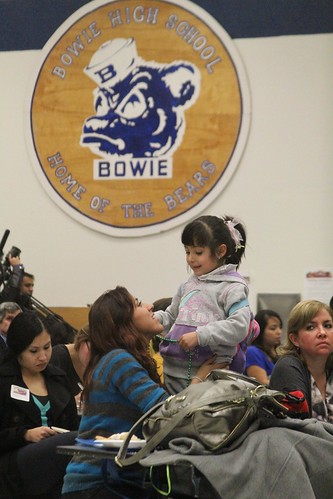
Norma de la Rosa didn’t sleep the night before because she was afraid.  Norma is the president of the El Paso Teachers Association and she’s not afraid of much.  Not politicians or reporters or giving speeches before hundreds of people, but she was about to do something no one in El Paso had done before.  She had invited the entire community to come to what is being called their Ground Zero.  She was afraid that no one would come.
Ground Zero is what we call the pit left after an explosion.  After an attack.  Bowie High School was Ground Zero for hundreds of students whose futures were attacked.  The students at Bowie are smart, energetic teenagers with as much right to a future as anyone else’s kids.  The school is located along the border.  You can throw a rock and hit Mexico.  There is a high poverty rate among families. High unemployment.  Many students are English Language Learners.  These boys and girls need an excellent education to meet the challenges that are part of their lives.

Words Can Hurt: No Name-Calling Week 2013 — Whole Child Education

Words Can Hurt: No Name-Calling Week 2013 — Whole Child Education:


Kristen Pekarek

Words Can Hurt: No Name-Calling Week 2013

Inspired by the young adult novel, The Misfits, where characters work together to create a no name-calling day in their schools, this annual event aims to end name-calling of all kinds in schools and communities everywhere. The No Name-Calling Week Coalition, created by whole child partner the Gay, Lesbian and Straight Education Network, provides students and educators with opportunities and resources to help celebrate the event. Below are 10 simple ways you and your school community can participate.

  1. Enter the No Name-Calling Week Creative Expression Exhibit and download art lesson plans.Engage students and community members in expression-based activities focused on name-calling and bullying and submit the artwork to the National Creative Expression Exhibit. Download art lesson plans(PDF) as well as exhibit guidelines and entry forms.
  2. Conduct No Name-Calling Week lessons. Use one of the many lesson plans available for free download to engage students in educational and creative activities. Aimed at ending name-calling and bullying, these lesson plans are organized by grade categories K–5, 6–8 and 9–12 and address name-

Mike Klonsky's SmallTalk Blog: The party's over...

Mike Klonsky's SmallTalk Blog: The party's over...:


The party's over...


"For we, the people, understand that our country cannot succeed when a shrinking few do very well and a growing many barely make it. We believe that America’s prosperity must rest upon the broad shoulders of a rising middle class." -- Pres. Obama
“One day we must ask the question, ‘Why are there forty million poor people in America?’ And when you begin to ask that question, you’re raising a question about the economic system, about 

School Tells Mother To Get Daughter Breast Reduction After Harassment | FOX2now.com – St. Louis News & Weather from KTVI Television FOX2

School Tells Mother To Get Daughter Breast Reduction After Harassment | FOX2now.com – St. Louis News & Weather from KTVI Television FOX2:


School Tells Mother To Get Daughter Breast Reduction After Harassment

Posted on: 6:34 pm, January 17, 2013, by updated on: 07:34pm, January 18, 2013


MOLINE ACRES, MO (KTVI) — A north St. Louis County mother claims her 13-year-old daughter is being harassed because of her breast size and was floored by the response she got after calling the school district.
Tammie Jackson says her daughter Gabrielle is being sexually harassed because of her large breasts at Central Middle School in Moline Acres. She says the sixth grader has been dealing with bullying since last semester.
Jackson called the Riverview Gardens School District to complain and was shocked by what she was told.
“It makes me feel like now you are telling me it’s my fault, it’s God’s fault the way he made her. The lady on the phone said they could transfer my daughter and said her boobs were so large 

Seattle Schools Community Forum: MAP Updates

Seattle Schools Community Forum: MAP Updates:


MAP Updates

  • Rally for teachers/parents/students against MAP tomorrow, Wednesday, the 23rd, at 4 pm (just before the School Board meeting).  It's billed as "Scrap the MAP; Students are not Test Scores."
Also of note, there was another press conference yesterday at Garfield with some updates from teachers.

- Noted national educators added their support; Diane Ravitch, Chicago Teachers Union President Karen Lewis, Jonathan Kozol and professor Nancy Carlsson-Paige (Matt Damon's mom; he also supports the effort.) and the AFT.  
Others supporting this effort: Noam Comsky, MIT, Anthony Cody of Education Week magazine and Leonie Haimson of Class Size Matters/Huffington Post plus 70 other educators and researchers.

- other schools showing support include Franklin High, Roosevelt High, West Seattle High and Center School.  Center School has an interesting situation where they are able to give MAP without infringing on class time.  

Tuesday Open Thread

What's on your mind?

New Arguments-and Arguers-in Bridging Differences - Bridging Differences - Education Week

New Arguments-and Arguers-in Bridging Differences - Bridging Differences - Education Week:


New Arguments-and Arguers-in Bridging Differences

Dear Readers, and Alfie,
Forty years ago Diane Ravitch and I wrote scathing reviews of each other's written work. It would be nice to think that blogging together on Bridging Differences is what "bridged" the differences. (I was brought up in a near-mystical belief in the power of The Word to set us free.) But the truth is we'd come together on many things long before we blogged. And, as many of you know, she's gone on to write more books while also blogging every hour, sometimes every half-hour, day after day after day. And spreading not only her words, but the words of so many others—including, bless you, Diane, classroom teachers.
Pedro Noguera and I were located in offices about 20 feet apart. He had windows, I had none. But we rarely had time to finish a sentence—so it seemed like it would be fun to blog back and forth. But, like Diane, he is off to engage in very valuable work and one hard for us to "bridge" unless I went along with him to South Africa. (Hint, hint, Pedro.)
So, now, I'm embarking on a new chapter for Bridging Differences and an experiment in blogging with a changing cast of co-bloggers. The plan is for me to debate different guest bloggers, starting today, each for a month or so. I think it's going to be fun and stimulating, and my hope is to explore and reignite the "differences" side of this blog.
My first guest is Alfie Kohn, who is joining me for the next four weeks. Years back, we had the opportunity to go out for lunch or dinner in Boston at least once a month and, what did we do? We argued. Some of you may think we agree, so how could we argue so much? Of course, if you know me well, you know it's not hard for me to find something to argue about. We do agree on 95 percent of all issues, and perhaps we're closer than most on the other 5 percent.
But now that I don't visit Boston often we've decided to take our arguments from the restaurant table to Bridging Differences. But, be warned, we are not likely to argue about the so-called Big Questions. But, in fact, what I miss now that I'm not in the classroom are those wonderful arguments about the details. So here's my chance. We both hope you'll find it interesting.
Of course, I'm assuming you know Alfie's many books, essays, popular rebuttals, speeches, and other provocations. Imagine a book titled Punished by Rewards and you imagine what a delight all his work is. During the time we spent in Boston arguing, Alfie also became the parent of school-age kids, so that added a new topic. I think our last argument was about the words "play" and "work" as applied to schooling.
I realize there was a thread that ran through all our arguments. As with Diane, some of our differences related to the focus of our work—where we were coming from and where we were hoping to go. But there's more to it ... that may even explain the choices we've made about our job lives.
Here are some of the topics we've argued about over the years:
  • Is punishment ever productive, or should we drop the whole idea?
  • Should young people be motivated by wanting to please adults with more power than they possess?
  • Is there a positive role for competition?
  • While parents who love unconditionally makes sense, should we expect that of our children's teachers? Is it not merely foolish, but perhaps unwise? And more.
They all share some things in common, overlapping everywhere I suspect, and our disagreements may not always be "fundamental," but rather "tactical" or "strategic." But let's start with some combination of the first and second questions above.
Actually, I was raised in a family that, as I recall, never used punishment and was short on praise. I probably raised my own children the same way, although I think I praised outright more than my parents did. Or at least I did so more directly rather than in my parents' subtle, nuanced ways. (Or am I just hoping so? Alfie, you would have enjoyed my parents.)
But few of the young people I encountered in school, or adults I encountered outside of school, had that kind of childhood. I also don't remember a lot of that kind of discipline in the schools I attended—independent, progressive New York City schools. As a result, unlike many others, it wasn't until I substituted inside Chicago schools that I truly encountered a reward/punishment culture.
But two things made me accept the "need" for building one in my own classrooms and eventually in the schools I helped start in East Harlem and Boston. There was no way I could expect the parents, my fellow teachers, OR the kids themselves to understand my position. And there were many reasons for them to misread it—even to imagine that it was a sign of me not caring enough. And "explaining" didn't get me too far. When we started Central Park East in 1974 I assumed, wrongly, that the colleagues who joined me agreed with me on EVERYTHING. But one thing we disagreed about was the need for imposed consequences: punishments. So we worked, with parents and kids, on a modified discipline code that tried to base itself on "natural consequences," but we soon realized we were kidding ourselves. We were exercising our power.
We had very few clear "if you ... then" rules. It depended, we said, as does our judicial system, on circumstances, "excuses" if you will, not to mention our past experience, etc. If asked, "What happens if I ...," we largely answered, "We'll see if and when it happens."
Underneath this wishy-washy stand was a very clear stand on the role of adult authority and adult judgment. We wanted kids to see us as people of authority whose judgments were respected by others for whom we were accountable. That was behind our strong stand on the teacher's role in running the school itself, choosing subject matter, and assessing student work. Plus some assumptions that they'd want to please us.
I think, Alfie, that you'd see such exercise of authority and judgment as dangerous and unproductive in the long run—maybe that's worth exploring. Maybe I think children are less dependent on adults as well as more dependent, in different ways?
I focused far more on building a community of equals with the staff, and with the children's families rather than the children. Possibly because I was responsible for a public institution and felt I needed to build the trust that would over time allow us greater freedom, and in part ... I'm not sure.

Deborah
- Deborah Meier

Teachers could be next to retire en masse | The Columbus Dispatch

Teachers could be next to retire en masse | The Columbus Dispatch:


Teachers could be next to retire en masse


By  Charlie Boss
The Columbus Dispatch Sunday January 20, 2013 6:47 AM
 
EAMON QUEENEY | DISPATCH
Dick Noble, 56, has taught and coached at Groveport Madison Junior High School for 35 years. He’ll retire this year because of pension changes.
The first wave of public-employee retirements struck during the past three months, a dash to the exits before changes to the state’s public pension systems took effect last week.
Another wave is expected, this time from teachers and other school staff members.
Changes in the teachers pension system will influence those who can retire this year to do so, said Ohio Education Association spokeswoman Michele Prater, and more baby boomers will be eligible.
 There’s no way to tell how many more teachers will retire this year. But at Groveport Madison schools, which offered incentives to teachers who 

UPDATE: FCMAT » Fiscal Crisis & Management Assistance Team

FCMAT » Fiscal Crisis & Management Assistance Team:


Oakland's American Indian charter schools one step closer to closure


Education Headlines

Tuesday, January 22, 2013

Schools watching governor's education funding proposal closely

Local school districts are cautiously optimistic about a new funding formula Gov. Jerry Brown announced last week that will distribute state funds based in part on the degree to which districts serve poor students and English learners.

Transitional kindergarten hailed as success

This is transitional kindergarten in the Lodi Unified School District, and by all accounts, the course that is one-notch-above-preschool-but-not-quite-kindergarten is a booming success after the first half of its inaugural year.

A look at school security in SLO County after Sandy Hook

In the wake of the Connecticut attack, the topic is the subject of much discussion throughout the county as districts evaluate their campuses and consider changes.

Rosenblatt: Let’s bring the Brown Act into the 21st century

We can preserve the essence of the Brown Act to ensure transparency and openness but also update it to recognize that school boards (and other elected bodies) have the opportunity to leverage multiple communications tools, including social media, in a very powerful way that would actually increase community involvement and transparency

Oasis teachers ask for late start on smoky days

Oasis Elementary School teachers are circulating a petition to begin classes at 10 a.m. whenever nearby farmers set fires to protect their crops from freezing temperatures.

Clovis Unified turns to solar project for energy savings

California school districts -- beset by state funding cuts -- are looking for any way under the sun to slash costs. Literally. Clovis Unified School District figures its districtwide solar projects will lower its $7 million annual electric bills by $2.3 million, freeing up money for instructional programs.

Ramona officials vie with school needs

Ramona is the only unified school district in the county to have never passed a school bond. The small, rural district has sought to pass a bond measure for decades to finance desperately needed infrastructure improvements and maintenance. Its fifth and most recent attempt was in November, when the $66 million Proposition R garnered 50.61 percent of the vote, short of the required 55 percent.

Parents pull students from school over cell tower fears

A group of parents have pulled their children from a charter school in Encinitas because of concerns about potential health threats from cellphone antennas near a classroom.

Schools help students grapple with grief

Inland school districts send in grief counseling teams when tragedy hits a whole school. But the private grief of students who have lost a close relative is far more common than the tragedies that make news.

Santa Clara County School Board used wrong map, illegally seated member, DA says

The Santa Clara County Board of Education used the wrong boundary map when it chose its newest trustee, Darcie Green, and should hold an election to fill the seat, the county district attorney has said.

Oakland's American Indian charter schools one step closer to closure

It boasts some of the highest test scores in the state, but Oakland's American Indian Model Schools organization has failed to safeguard its schools from corrupt fiscal practices and should be shut down, Oakland school district administration has concluded.

Study: High school graduate rate highest since 1976

The nation's high school graduation rate is the highest since 1976, but more than a fifth of students are still failing to get their diploma in four years, the Education Department said in a study released Tuesday.

San Leandro pulls back program cuts after passage of Prop. 30

Some $2.65 million in personnel and program cuts are off the table in the San Leandro Unified School District after the November passage of Gov. Jerry Brown's statewide Proposition 30 tax initiative.

California retreats on class-size reduction

Several years ago, classes at the kindergarten through third-grade level in California commonly had only 20 students. But in the face of deep state budget cuts, school districts across the state have laid off teachers, combined classes and all but abandoned the 20-student target.

Los Angeles teachers union approves use of testing data in evaluations

A landmark agreement to use student test scores for the first time to evaluate Los Angeles Unified instructors was approved by the teachers union Saturday.

Frey: Advocates worry foster youth will be left behind under Brown’s budget

Gov. Jerry Brown’s budget proposal is perplexing advocates of foster youth, who are worrying that these children could be left behind in the governor’s push to overhaul the state’s school finance system.
Friday, January 18, 2013

Schools wage battle against bullying

Two major conferences are coming to town to address bullying on school campuses, and Compton Jr. High School is looking to partner with other schools to bring in singer Keenan West next month.

Paso Robles school district's budget situation improving, official says

Once on the brink of a state takeover due to its financial difficulties, the Paso Robles school district is now on a path to fiscal stability, the county schools superintendent said Thursday, though he added that the situation is still “very fragile.”

Charter schools see largest boom since their inception 20 years ago

Charter schools across the United States are proliferating and expanding at a record pace, with the trend particularly pronounced in California and Los Angeles County.

NYC Public School Parents: The testing rebellion & opt-out movement in NYC has a supporter -- inside Tweed

NYC Public School Parents: The testing rebellion & opt-out movement in NYC has a supporter -- inside Tweed:


The testing rebellion & opt-out movement in NYC has a supporter -- inside Tweed

Lisa Nielsen

A nationwide backlash has erupted against the obsession with standardized testing.  In February 2012, the Texas Commissioner of Education, Robert Perry, announced that testing had become a "perversion of its original intent.” Over the last year, 86 percent of Texas school boards representing 91 percent of the state’s students, have passed resolutionsagainst the use of high stakes testing. The view is now so mainstream that in his introductory remarks before the Legislature, Joe Straus, the new, conservative GOP Speaker of the Texas House recently announced,

"By now, every member of this house has heard from constituents at the grocery store or the Little League fields about the burdens of an increasingly cumbersome testing system in our schools…Teachers and parents worry that we have sacrificed classroom inspiration for rote memorization. To parents and educators