Latest News and Comment from Education

Thursday, August 6, 2020

As Schools Weigh Reopening, Here's How They Can Lower Coronavirus Risk : Shots - Health News : NPR

As Schools Weigh Reopening, Here's How They Can Lower Coronavirus Risk : Shots - Health News : NPR

How Safe Is Your School's Reopening Plan? Here's What To Look For
As schools across the country grapple with bringing kids back into the classroom, parents — and teachers — are worried about safety. We asked pediatricians, infectious disease specialists and education experts for help evaluating school district plans.
What we learned: There's no such thing as zero risk, but certain practices can lower the risk of an outbreak at school and keep kids, teachers and families safer.
If you're considering sending your child back to school this fall or in the coming months, start with assessing both your own family's personal risk and the level of spread in your community. The American Federation of Teachers says it doesn't consider in-person school to be safe unless fewer than 5% of coronavirus tests in an area are positive. As of late July, that one benchmark disqualified eight of the 10 largest public school districts in the country.
If your family is relatively healthy and local numbers look good, here's how to weigh the key elements of a school reopening plan.

1) Getting to school: Riding the bus

Look for: Limited capacity and physical distancing. Plus masks
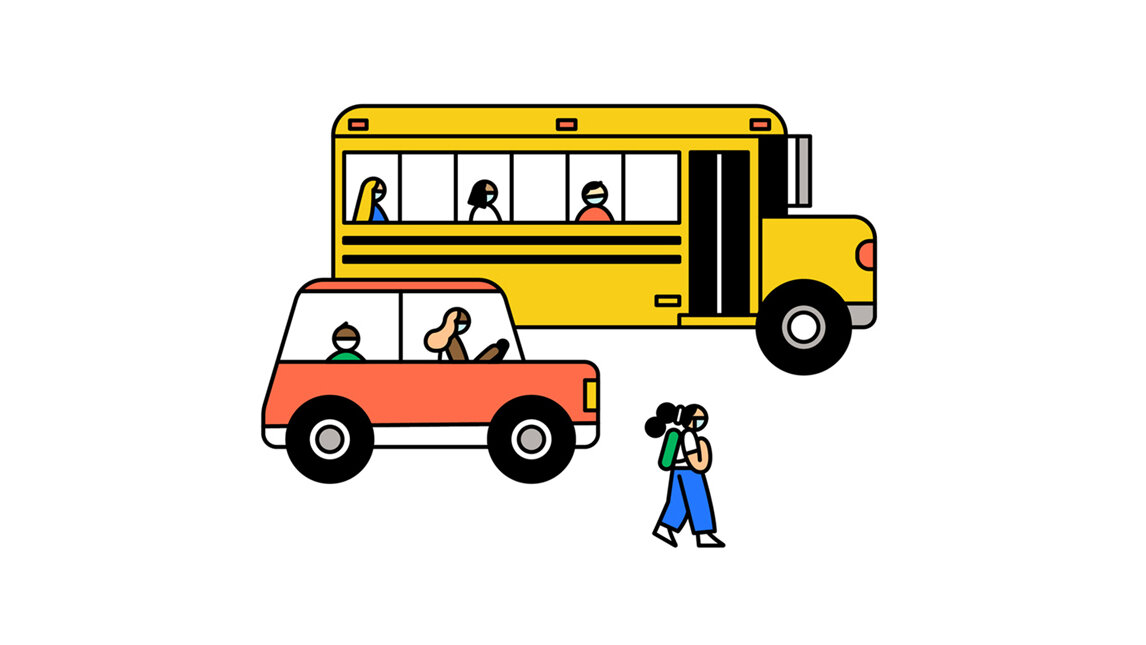
Riding the bus can be risky for kids, particularly if the bus is packed.
Buses combine several risk factors for spread: Kids are in a closed space, for an extended period of time, often with poor ventilation.
"The best option for children getting to school would be for their parents to drop them off," says Dr. Tina Tan, pediatrics infectious disease specialist at Northwestern University in Chicago. Or walk or bike to school.
But that's not an option for many families, so to make busing safer, limit capacity to 50%, says Dr. Ravina Kullar, an epidemiologist and spokesperson for the Infectious Disease Society of America. The children and the driver should be physically distanced by at least 6 feet, and everyone should wear masks. Ideally there's assigned seating, and tape marks designating where kids should sit, she says.
If possible, keep the bus windows open to improve ventilation, says Dr. Judith Guzman-Cottrill, a pediatric infectious disease specialist at Oregon Health & Science University. Airflow helps dilute the virus, this reducing the risk of infection.
"Students' hands should be sanitized before they enter the bus," says Laurie Combe, president of the National Association of School Nurses. Combe suggests mounting a sanitizer dispenser at the entrance of the bus.

2) Entry-to-school guidelines

Look for: Clear policies requiring sick kids and teachers to stay home
Our experts agree: Plans should drive home the message that staff and kids must stay home if they have any symptoms of COVID-19 at all.
"As a society we are going to have to learn that if we're sick, we stay home — always," says Dr. William Miller, an epidemiologist at Ohio State University. It's a big cultural shift, he says, because many of us are used to "powering through illness and sometimes we expect the same of our children."
There is no one perfect way to enforce this. Some experts suggest schools rely on messaging, while others prefer schools screen for symptoms.
Symptom checks at school may not be foolproof, but they reinforce the message that parents should keep kids home if they're sick, says Laurie Combe. "If there was optimal staffing for this situation, then the best practice would be to be able to screen as people enter the building."
The CDC currently does not recommend schools conduct widespread symptom screenings. It suggests parents check their children at home before coming to school.
Kids should stay home even if they have only very mild symptoms, "just a headache or stomach ache," says Dr. Preeti Malani, an infectious disease specialist and chief health officer at the University of Michigan. And when parents are sick, children should stay home too, adds Miller. This may be difficult for economic reasons for many families.
If teachers or staff have to miss work, then, Malani says school "policies have to CONTINUE READING: As Schools Weigh Reopening, Here's How They Can Lower Coronavirus Risk : Shots - Health News : NPR

Covid school closures: what they mean for kids with disabilities - Vox

Covid school closures: what they mean for kids with disabilities - Vox

We need to talk about what school closures mean for kids with disabilities
As schools prepare for fall, students in special education are being left out of the conversation.
When Simon’s school in Maryland closed this spring due to the pandemic, his family didn’t know what to expect.
“Like every family who has a kid in school, there was a lot of uncertainty,” Simon’s mom, Laura LeBrun Hatcher, told Vox. “Everybody was in a ‘what’s going to happen’ moment.”
But for Simon, that uncertainty also included what would happen to the one-on-one support that he needs to learn effectively, as well as the occupational and physical therapy he gets at school. Simon, who just turned 14, has complex medical needs and disabilities, including hydrocephalus, epilepsy, and autism. As the director of design and communications for the group Little Lobbyists, which works on behalf of kids with disabilities, Hatcher has been involved in advocacy for a long time. But, she said, “I’m not a trained therapist” — and providing everything at home that Simon used to get at school has been very challenging.
While Simon’s school has “been great in trying to walk us through stuff and do things remotely, the quality of the therapy is just not there,” Hatcher said. And “Simon’s attention just isn’t there for it,” she added. “He’s not in the environment that he is used to, where he has the structure that he’s used to.”
And compared with other kids with disabilities around the country, “Simon was one of the lucky ones,” Hatcher said.
When schools closed their physical buildings due to the pandemic, some made an effort to continue the services and therapies that help students with disabilities access their education — even if those services had to be remote. But other schools did little or nothing to CONTINUE READING: Covid school closures: what they mean for kids with disabilities - Vox

NEA Elects Pringle, Moss and Candelaria to Leadership - NEA Today

NEA Elects Pringle, Moss and Candelaria to Leadership - NEA Today

NEA Elects Pringle, Moss and Candelaria to Leadership

Becky Pringle, a science teacher from Philadelphia, has been elected president of the National Education Association. Pringle, who served as NEA vice president for six years, will assume her new duties on September 1. On that date, she becomes not only the leader of the nation’s largest union representing 3 million educators, but also the highest-ranking African American female labor leader.
Joining Pringle on the new NEA leadership team will be NEA Vice President Princess Moss of Virginia and new Secretary-Treasurer Noel Candelaria of Texas. NEA elections are usually conducted in-person at NEA’s Representative Assembly, but due to the coronavirus pandemic, this year they were held remotely with nearly 6,000 elected NEA delegates casting mail-in ballots. The results were announced at a tele-townhall with RA delegates on Wednesday  hosted by outgoing NEA President Lily Eskelsen García.
The delegates also reelected Hanna Vaandering, an elementary physical education teacher from Ridgewood Elementary in Beaverton, Ore., to the NEA Executive Committee.
Pringle, Moss, and Candelaria are the “right people at the right time,” Eskelsen García said. “This is an incredible leadership team. They will be the eyes and ears for our membership.”
As Secretary-Treasurer, Candelaria will bring a “wealth of experience and knowledge CONTINUE READING: NEA Elects Pringle, Moss and Candelaria to Leadership - NEA Today

The Federal Government Gives Native Students an Inadequate Education, and Gets Away With It — ProPublica

The Federal Government Gives Native Students an Inadequate Education, and Gets Away With It — ProPublica

The Federal Government Gives Native Students an Inadequate Education, and Gets Away With It
The Bureau of Indian Education has repeatedly neglected warnings that it is not providing a quality education for 46,000 Native students. Once called a “stain on our Nation’s history,” the school system has let down its students for generations.


ProPublica is a nonprofit newsroom that investigates abuses of power. Sign up to receive our biggest stories as soon as they’re published.
This story was co-published with The Arizona Republic, a member of the ProPublica Local Reporting Network.
A couple of months after Kimasha Shorty’s son started sixth grade at an Arizona public middle school, his teachers called her at home. He had trouble adding and subtracting and was struggling to read at grade level.
Shorty didn’t understand how it was possible that her oldest child could be so far behind after leaving Wide Ruins Community School, the sole elementary school in an area of about 1,000 residents at the southern edge of the Navajo Nation. He had been diagnosed with a mild learning disability that affects reading and math comprehension, but Shorty said he was doing so well by fourth grade that he skipped a grade at the urging of administrators and began attending a public middle school about 25 miles south in Sanders.
There, her son was far behind his classmates, many of whom did not grow up in his rural community and didn’t spend their early years at an elementary school overseen by the Bureau of Indian Education, a little-known federal agency that manages more than 180 schools and dormitories across the country.
Year after year, a similar pattern emerged for Shorty, the mother of nine children. Her daughter’s middle school math class started with geometry, but her fifth grade CONTINUE READING: The Federal Government Gives Native Students an Inadequate Education, and Gets Away With It — ProPublica

Pandemic Pods: Parents, Privilege, Power and Politics – Have You Heard

Pandemic Pods: Parents, Privilege, Power and Politics – Have You Heard

Pandemic Pods: Parents, Privilege, Power and Politics
Private pandemic “pods” are the latest edu-craze to sweep the land. But turns out there’s nothing new about privileged parents fleeing the public school system—or using the threat of departure as leverage. Special guests Jessica Calarco, L’Heureux Lewis-McCoy and Jon Hale help us understand the implications of pods for public education. And Jennifer and Jack discuss why pods have quickly emerged as a policy darling on the right. Hint: conservatives see the pandemic as the best opportunity they’ve ever had to dismantle public schools. Complete transcript available here. The financial support of listeners like you keeps this podcast going. Subscribe on Patreon or donate on PayPal.


Pandemic Pods: Parents, Privilege, Power and Politics – Have You Heard

High School Students Implore Cuomo – Move NYC to Remote for September | JD2718

High School Students Implore Cuomo – Move NYC to Remote for September | JD2718

High School Students Implore Cuomo – Move NYC to Remote for September
This letter was signed by a bunch of student government leaders, representing about 15% of NYC high schools, and then by about 1300 more students and parents. They sent it off to Cuomo on Wednesday August 5, because of the August 7 deadline. That’s a shame. While the letter makes good points, the authors managed to make a different one: they excluded the majority of NYC high schools that are majority Black/Brown. I don’t think it was intentional – I’m almost certain that it was not. But this is a reminder that it is not good enough not to be racist, we need to be actively anti-racist.
In any case, here’s the letter. I hope different leadership, inclusive leadership, takes up the mantle. Being inclusive takes work. It is a pretty gross display of privilege to say “we don’t have time to include Black and Brown voices.” And there is time – when NYC failed to submit an actual plan last Friday (it was an outline, not a plan) the deadlines got pushed back. 
Dear Governor Cuomo,
Over the past few weeks, Mayor de Blasio, Chancellor Carranza, and the NYC Department of Education have created a blended learning model, under which at least 33% of students are expected to attend each day and no school is permitted to conduct fully remote learning. However, this “one size fits all” model is not suitable for NYC high schools specifically. We believe that each NYC high school should be fully remote during this fall, especially schools with over 2,000 students, regardless of how other schools operate. 
First, New York City high school students have longer and riskier school commutes. While most elementary and middle school students in NYC attend schools within their own districts, high school students apply to and end up in schools all over the city. As a result, over 300,000 high school students consistently commute on crowded buses and trains, thus increasing chances of contracting and High School Students Implore Cuomo – Move NYC to Remote for September | JD2718

What I Told McKeesport Area School Directors About the Unsafe Reopening Plan Proposed by Administrators | gadflyonthewallblog

What I Told McKeesport Area School Directors About the Unsafe Reopening Plan Proposed by Administrators | gadflyonthewallblog

What I Told McKeesport Area School Directors About the Unsafe Reopening Plan Proposed by Administrators
This evening I went back to my high school to tell school board members what I thought of administration’s reopening plan during the global pandemic.

McKeesport Area School Directors have not voted on the proposal yet.

So I gathered my thoughts, put on my mask and went to the work session meeting.
Screen Shot 2020-08-06 at 12.05.02 AM
This is what I said:

“Thank you for allowing me to address you this evening. I appreciate all the time and effort you put forward to lead the McKeesport Area School District and do what’s best for students, staff, and families.

I am a life-long resident of this community. Most of my family graduated from this school as did my brother and I. Before I got a job as a teacher at a neighboring district, I subbed here in the high school for years. My daughter has attended the district for the past 6 years and has received a first rate education so far.

However, I am very concerned with Superintendent Dr. Mark Holtzman’s proposed plan to reopen schools. He would have students attend school buildings in-person for half days and do virtual instruction for the other half.

This is not a safe plan for students, staff and families. I ask you to reconsider and move to a reopening plan that begins with all students engaged in distance learning.

The reason is simple. New cases of COVID-19 are spiking throughout Allegheny County. Along with Philadelphia – where students will be getting 100% virtual instruction – we have some of the highest numbers of new cases CONTINUE READING: What I Told McKeesport Area School Directors About the Unsafe Reopening Plan Proposed by Administrators | gadflyonthewallblog

Anthony Cody: Who Is Allowed to Be Selfish? | Diane Ravitch's blog

Anthony Cody: Who Is Allowed to Be Selfish? | Diane Ravitch's blog

Anthony Cody: Who Is Allowed to Be Selfish?
Anthony Cody taught for many years in the Oakland public schools. We co-founded the Network for Public Education in 2012. His blog is called “Living in Dialogue.”
He writes:
Who is Allowed to be Selfish?
Isn’t it a bit strange – our capitalist economy is built on the glorious profit motive. The wealthy are expected to be selfish – they are rewarded for their ability to make more and more, and expected to avoid taxes, military service, and anything else that is unpleasant or risky. But only some people are allowed to be selfish.
Trump can insist that anyone who meets with him be tested. But he demands schools reopen, which means teachers will meet in closed rooms with as many as 160 students a day. Teachers must not put their own health above the needs of their students and the economy that requires they be in school six or seven hours a day.
It is unfortunate that we do not have funds to pay for nurses, counselors or librarians in our schools. But most wealthy people don’t send their children to public schools anyway. They get to make a different choice. But some of us have fewer choices. It pretty much falls along CONTINUE READING: Anthony Cody: Who Is Allowed to Be Selfish? | Diane Ravitch's blog

Audio: Most Teachers Concerned About In-Person School; 2 In 3 Want To Start The Year Online | 89.3 KPCC

Audio: Most Teachers Concerned About In-Person School; 2 In 3 Want To Start The Year Online | 89.3 KPCC

Most Teachers Concerned About In-Person School; 2 In 3 Want To Start The Year Online
As the school year starts in many districts across the country, a new national poll of teachers from NPR/Ipsos finds overwhelming trepidation about returning to the physical classroom.
Eighty-two percent of K-12 teachers say they are concerned about returning to in-person teaching this fall, and two-thirds prefer to teach primarily remotely. On the latter point, teachers are aligned with parents and the general public: Another recent NPR/Ipsos poll found two-thirds of respondents thought schools in their area should be primarily remote, including 62% of parents of children under 18.
The teacher poll was conducted July 21-24 and included 505 respondents. Half teach at low-income schools.
When it comes to going back to the classroom, 77% of teachers are worried about risking their own health. Robin Stauffer is one of them. She's taught high school English for four decades, most recently in Katy, Texas, a suburb west of Houston. She says working with kids has kept her young and lighthearted, and she has a strong sense of mission "to be the type of teacher that I wish I would have had when I was in public school, to kind of right the wrongs that I experienced."
But she's also 66 years old and has diabetes, both of which make her more vulnerable to the coronavirus. According to the U.S. Department of Education, almost 30% of teachers are 50 and older, putting them in a higher-risk category for CONTINUE READING: Audio: Most Teachers Concerned About In-Person School; 2 In 3 Want To Start The Year Online | 89.3 KPCC

Mr. G for District 3: Chris Guerrieri's Education Matters: Secrecy and subterfuge is the future of DCPS

Mr. G for District 3: Chris Guerrieri's Education Matters: Secrecy and subterfuge is the future of DCPS

Secrecy and subterfuge is the future of DCPS
I am both outraged and terrified at the districts plan to keep cases of COVID-19 secret in our schools, unless the schools are forced to close. Spoiler alert if people know there is a case, we may never get to the point where a school has to close. This planned secrecy is going to risk lives.

I have heard stories of cases at two local high schools, cases that were kept secret from the majority fo staff, and even from people who might have been exposed. Superintendent Greene has said if it was up to her despite the risks she would open schools, so I have to question the lengths she would go to keep them open.

Sadly our district may not be the only one that plans to keep people in the dark.

From the Tampa Times,

  Teachers at Pierce Middle School learned this week that a coworker tested positive for COVID-19 after coming on campus Friday to prepare for the upcoming school year.

They did not hear that news from the Hillsborough County school district, nor from principal Pablo Gallego. It came in an email Tuesday from social studies teacher Aron Zions.

“I believe Mr. Gallego followed the proper protocols,” Zions wrote, noting that CONTINUE READING: 
Mr. G for District 3: Chris Guerrieri's Education Matters: Secrecy and subterfuge is the future of DCPS

Gov, Mayor, Chanc., Pres. – keep us all alive: shut us down now | JD2718

Gov, Mayor, Chanc., Pres. – keep us all alive: shut us down now | JD2718

Gov, Mayor, Chanc., Pres. – keep us all alive: shut us down now
Today’s letter to Cuomo
(this is not by me, as you can tell from the opening line. The author is a teacher who raises important questions. She wrote similar letters to de Blasio, Carranza, and Mulgrew)(The biggest question? Why not remote? Why not start work on it today? – jd)
Dear Governor Cuomo,
I have admired and respected your leadership during this pandemic, despite serious disagreements with many of your education policies, and I was counting on your reliance on science and good sense to prevail over plans for reopening school buildings. I was very disappointed by your message yesterday, which sounded much like an abdication of your responsibility, leaving to parents and schools the task of keeping COVID numbers down and people alive.
I have sent you numerous letters citing flaws and unresolved questions in NYC’s opening plans and begging you to allow teachers to do the best by our students and staff by spending August preparing to teach fully remotely. No plan put forward has begun to reassure teachers or parents that students and CONTINUE READING: Gov, Mayor, Chanc., Pres. – keep us all alive: shut us down now | JD2718

NYC Educator: The Chancellor Sends Us Another Email

NYC Educator: The Chancellor Sends Us Another Email

The Chancellor Sends Us Another Email
Dear Colleagues,
 
I hope you and yours are safe and healthy, and experiencing a bit of rest and relaxation this summer. You'd better get as much rest as you can now, because September's coming, and we have no idea what the hell is going to happen.
 
Last month, I wrote to you with information about our plan for blended learning in the fall. Today, I am writing to share details about some newly announced health and safety protocols, which we hope will work, but who knows? They didn't work anywhere else, but we think our way is the charm. Uncertainty is a constant during this pandemic, and our plans must be flexible enough to allow us to make excuses and weasel out of blame when they fail. But in all cases, your safety and the safety of our students and families would be the first priority—no matter what, if it weren't for my boss's reckless insistence on opening buildings.
 
We all experienced anxiety and alarm from the events of this pandemic starting back in March, as we failed to close public schools after having closed Broadway. Since then, we have been working diligently and in partnership with other city agencies to build on the lessons learned and prepare fully for a new school year. Last time we failed to follow our own rules and let Covid-infested buildings linger open for a long time. We are drawing on your feedback and on the best-available public health guidance to craft our plans for the fall. This is difficult, since we haven't asked what you want, but my magic 8-ball has gotten me this far,
 
Full details of the protocols are available on the DOE websiteI also encourage you to read the plan we recently submitted to the State Department of Health, which Governor Cuomo says is an outline rather than a plan. Screw him. He doesn't pay my salary.

The major components of our health and safety planning include the following: 

·         Building Safety Measures: 
o   At all times, students and staff must wear face coverings protecting their nose and mouth while on school property or on DOE-provided transportation, unless students cannot medically tolerate a face covering or wearing the face covering is developmentally inappropriate. If other CONTINUE READING: NYC Educator: The Chancellor Sends Us Another Email

Mike Klonsky's Blog: CPS made the right decision but big challenges remain

Mike Klonsky's Blog: CPS made the right decision but big challenges remain

CPS made the right decision but big challenges remain


After floating a plan for a mix of in-person and remote learning, the mayor and CPS made the right decision by starting the Chicago school year with remote learning only. It was a decision driven by rising coronavirus numbers along with resistance to an opening from the CTU and many parents. It's also a decision that may save some lives and prevent fewer COVID casualties.

According to Sarah Karp at WBEZ:


The announcement also comes amid rising COVID-19 cases in Chicago. The district said a move to remote learning was dependent on whether the Chicago Department of Public Health determined COVID-19 cases weren’t under control. Though the city hasn’t surpassed those benchmarks, there is growing concern Chicago will reach them before too long. 
Now, Chicago parents and teachers will be looking to Chicago Public Schools to put forth a robust remote learning plan.
The initial hybrid plan would have rotated students into buildings two days a week for in-person classes. But CPS officials also said all along that the plan was "preliminary" and that they wouldn’t reopen schools unless it’s safe to do so. That determination has now been made.

But keeping schools closed for the next few months doesn't even begin to deal with either the immediate or long-term educational or health issues created by the pandemic.

There are some immediate measures that CPS, together with the teachers and other CONTINUE READING: 
Mike Klonsky's Blog: CPS made the right decision but big challenges remain


CURMUDGUCATION: Cyber Outsourcing

CURMUDGUCATION: Cyber Outsourcing

Cyber Outsourcing
It's a sort of cyber school bait and switch that has implications for students and teachers in public schools. Let me offer a specific example of how it works, courtesy of my old school district.

On the district web page, you'll find a flyer for the newly christened Franklin Area Virtual Academy, a "100% online option for families." The flyer is a nice single page, including some photos of Franklin students in action, and it lists the many positive features of FAVA:


You get a Franklin diploma. You get access to Franklin facilities. It's tuition free. There's teacher support for the student. Students do their standardized testing at Franklin. Students "have the opportunity" to develop a hybrid schedule, part cyber, part bricks and mortar. They'll get guidance from a "district liaison" as well as an "opportunity" to get "district tutoring." And if there are further questions, they can contact the high school principal.

Everything about the flyer would lead one to believe that the district had hunkered down and used its own staff and resources to create an in-house cyber school. Not exactly.

Meet VLN Partners.

This Pittsburgh-based company offers virtual leaning solutions, including "turnkey virtual academies."

The company was founded in 2007 by Alex Stone, the same year he received his doctorate in education from Duquesne. Stone had taught at a cyber school and worked as multimedia developer, CONTINUE READING: 
CURMUDGUCATION: Cyber Outsourcing