Latest News and Comment from Education

Friday, May 8, 2020

K-12 school districts warn of ‘disaster’ from covid-19-related budget cuts - The Washington Post

K-12 school districts warn of ‘disaster’ from covid-19-related budget cuts - The Washington Post

K-12 school leaders warn of ‘disaster’ from huge coronavirus-related budget cuts as layoffs and furloughs begin


Just as they face unprecedented challenges and financial costs, leaders of K-12 public school districts around the country are warning of dire consequences from sharp budget cuts from state legislatures attempting to deal with the economic fallout of the novel coronavirus pandemic.
The alarm was sounded by school superintendents in 62 cities, who sent a letter to Congress through the nonprofit Council of the Great City Schools asking Congress for billions of dollars in new federal education assistance and warning that some 275,000 teachers could be laid off in their districts alone because of budget cuts caused by a drop in state and local revenue during the crisis. (You can see the letter in full below.) Those would add to existing shortages in virtually every state.


“Dark clouds are forming on the educational horizon that will spell disaster if Congress does not intervene,” the letter said. “Significant revenue shortfalls are looming for local school districts that will exacerbate the disruption students have already faced. Some 40 to 50 percent of school district revenue, in fact, come from local sources that are expected to drop precipitously in the months ahead. This revenue decline will come on top of revenue losses in the months to come from state sources that have been more widely reported. Several big city school districts are now projecting 15 to 25 percent cuts in overall revenue going into next school year.”

In California on Thursday, Gov. Gavin Newsom (D) released a budget analysis showing a $54.3 billion budget deficit through summer 2021, with projections that the K-12 public schools could lose some 20 percent of their state funding. The superintendents of the two largest school systems in California — Austin Beutner of the Los Angeles Unified School District and Cindy Marten of the San Diego Unified School District — warned that “irreparable harm” would be done to children if that happened.
Meanwhile, some districts around the country have already started furloughing and even laying off some employees.
The Santa Monica-Malibu Unified School District in California has begun laying off dozens of employees, as has New Jersey’s Lawrence Township Public Schools, which let go 22 full-time employees and 80 school aides; and the Randolph Public School District in Massachusetts, where dozens of workers — including teaching aides and food service staff — were told they will be furloughed full time CONTINUE READING: K-12 school districts warn of ‘disaster’ from covid-19-related budget cuts - The Washington Post


Doyle and Hynes: We Welcome Bill Gates to New York if He Agrees to Three Conditions | Diane Ravitch's blog

Doyle and Hynes: We Welcome Bill Gates to New York if He Agrees to Three Conditions | Diane Ravitch's blog

Doyle and Hynes: We Welcome Bill Gates to New York if He Agrees to Three Conditions


Author William Doyle and Superintendent Michael Hynes—both known for supporting whole-child education—-say that they would welcome Bill Gates to New York if he agrees to meet three conditions.
They suggest that Gates has a chance to redeem his reputation after 20 years of failure in education.
They write:
The Gates Foundation has been a driving force behind nearly 20 years of consistently failed federal and state attempts at education reform, including the widely reviled “Common Core” state standards. In that time, little-to-no system improvement has occurred, despite the squandering of vast sums of money by the Gates Foundation and by taxpayers. In a blog post noting the flaws of Common Core and announcing plans to re-focus their funding, Gates announced, “As we have reflected on our work and spoken with educators over the last few years, we have identified a few key insights that will shape our work and investments going forward.”


A Rap About Betsy DeVos: RESIGN BETSY | Diane Ravitch's blog

A Rap About Betsy DeVos: RESIGN BETSY | Diane Ravitch's blog

A Rap About Betsy DeVos: RESIGN BETSY


Watch this video by Jeff Grossi, a high school math teacher in Buffalo, who loves rap music.
His rapping name is MC ZiLL.

Take the poll! – Educate Louisiana

Take the poll! – Educate Louisiana

Take The Poll!


In its quest to hire a new superintendent of education, the Louisiana Board of Elementary and Secondary Education conducted a survey to gather input from the public in regards to the priorities that should be considered.
More than 7000 responses were received on the BESE poll which asked participants to indicate their priorities under three basic categories: Actions, Skills, and Characteristics possessed by the candidates with the following results.
Actions: 51% of the participants indicated “Providing every student with enriching experiences and a well-rounded education that is recognized in the state’s accountability system” was most important to them.
Skills: 88% of participants indicated that “Deep knowledge of K-12 policy and practice, and experience working in the field” was the most important skill desired in a future superintendent.
Characteristics: 63% of participants indicated that it was important for the next superintendent to “Inspire the educational system through leadership, and setting the right tone through leading by example.”
To see the public results of BESE’s survey, click here —-> BESE Superintendent Search Public Survey
BESE has also provided links to lengthy interviews with the individual candidates, along with resumes and cover letters at this link—->Superintendent Candidate Interviews
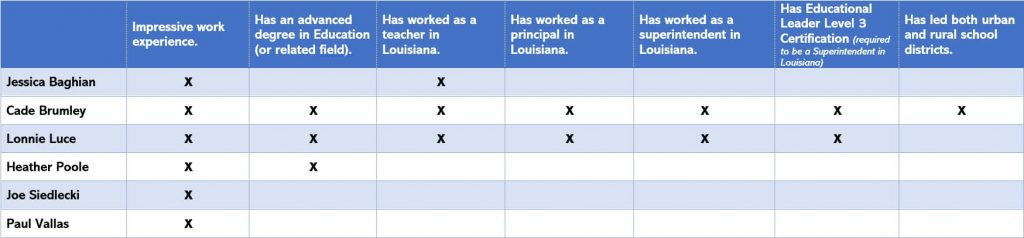
Thanks to the diligent work of Cynthia Posey, Louisiana Federation of Teachers, the candidate information has been summarized in an easy to compare graph, below.


Illustration by Cynthia Posey, Louisiana Federation of Teachers. CONTINUE READING: Take the poll! – Educate Louisiana

CDC Guidance For Reopening Schools, Child Care And Summer Camps Is Leaked | 89.3 KPCC

CDC Guidance For Reopening Schools, Child Care And Summer Camps Is Leaked | 89.3 KPCC

CDC Guidance For Reopening Schools, Child Care And Summer Camps Is Leaked


No field trips. No game rooms. No teddy bears. These are some of the CDC's guidelines for reopening schools, childcare centers and day camps safely in places where coronavirus cases are on the decline.
The guidance, which also covers restaurants, churches and other public places, was obtained by The Associated Press, which reports that the White House tried to keep it from coming to light. The New York Times quoted Mark Meadows, the chief of staff, as being concerned that the guidelines were "overly prescriptive."
The CDC does not have authority to enforce its guidance, which is intended for public information only; the actual policy decisions are up to state and local governments. Schools are closed through the end of the school year throughout much of the country, with the exception of Montana, which welcomed a handful of students back this week. Child care protocols are different in different states.
But millions of parents need child care so they can work, and socialization and stimulation for children who have been confined to home by lockdowns for weeks on end. This is the guidance that summer camps and day cares have been waiting for to make decisions about reopening safely.
The guidance says that where coronavirus is spreading rapidly, child care should only serve the children of essential workers. This is the case today in much of the country, which the guidelines refer to as "Phase 1".
In Phase 2, programs can expand to serve all children with enhanced social distancing measures, and in Phase 3, with a lower risk, social distancing will continue.
Recommended measures include:
  • Handwashing;
  • Cloth masks for staff;
  • Regular disinfection of all surfaces;
  • Six-foot distance "if possible," head-to-toe positioning with bedding;
  • As much outdoor air as possible — open windows, fans;
  • Restricting mixing of groups;
  • Restricting visitors, and staggering dropoffs and pickups to reduce contact among parents;
  • Limiting sharing of materials like art supplies or toys. Disinfecting them in between use.;
  • Avoiding soft toys that can't be easily disinfected;
  • Not using common areas like dining halls or playgrounds if possible. If it is necessary, stagger visits and disinfect in between;
  • Adjust operations based on local health data;
  • Monitor absenteeism.
The guidelines also emphasize keeping attendance at such programs local, to limit children bringing the disease from high to low transmission areas.
Copyright 2020 NPR. To see more, visit https://www.npr.org.
CDC Guidance For Reopening Schools, Child Care And Summer Camps Is Leaked | 89.3 KPCC


Teacher Tom: What Does the Word "Education" Mean?

Teacher Tom: What Does the Word "Education" Mean?

What Does the Word "Education" Mean?


Yesterday, I made an assertion that I suspected was true, but upon reflection I began to wonder. What I wrote: 
For most of the experience of Homo sapiens, work, family, and play were inseparable, an aspect of the human survival strategy that allowed our species to thrive. For ninety-five percent of our existence we've been evolving brains that function best in the context of communities that include the whole family, many families, young and old, work and play. And one of the results of living in these communities is what we could have called, had we the word for it, education. But we didn't need a word because what we today call education was, as John Dewey wrote, "life itself."

Specifically, what I began to wonder about was the actual origins of the word "education." It appears that there are two distinct roots of the word, both from Latin: educare and educereEducare means to train or mold someone, and specifically refers to a process of passing along knowledge from one generation to the next, with the goal of shaping youth in the image of their parents through rote learning and future employment in the economy. Educere, in contrast, means to "lead out," in the sense that we are preparing youth for an unknown future, which calls for thinking, questioning, and creating. That these two very different concepts have merged into the single thing that we today call "education" is only really understandable in the sense that they are similar sounding words, because the intended results -- preservation of knowledge v. creation of new ideas -- are really quite different things.

Anyone conversant in Latin can probably quibble with my CONTINUE READING: 
Teacher Tom: What Does the Word "Education" Mean?

Ohio Governor Cuts $300 Million from FY 2020 Education Funding. Crisis Across State Budgets Demands Immediate and Long Term Federal Help | janresseger

Ohio Governor Cuts $300 Million from FY 2020 Education Funding. Crisis Across State Budgets Demands Immediate and Long Term Federal Help | janresseger

Ohio Governor Cuts $300 Million from FY 2020 Education Funding. Crisis Across State Budgets Demands Immediate and Long Term Federal Help


At the end of April, Bruce Baker of Rutgers University and Matthew Di Carlo of the Albert Shanker Institute published a new report, The Coronavirus Pandemic and K-12 Education Funding.  They begin: “The most terrible and lasting effects of the coronavirus pandemic will of course be measured in loss of life. But a parallel tragedy will also be unfolding in the coming months and years, this one affecting those at the beginning of their lives, an unprecedented school funding crisis that threatens to disadvantage a generation of children. It currently is difficult to make any precise predictions about the magnitude of the economic recession caused by the coronavirus pandemic, except to say that it has already started and is likely to be severe. The revenue that funds public K-12 schools—almost 90 percent of which comes from state and local sources—will see large decreases. There will be cuts. Making things worse, school districts in many states have yet to recover from the last recession….”
Oh Tuesday, the magnitude of immediate cuts to K-12 education in Ohio became clearer. The Columbus Dispatch‘s Randy Ludlow explains: “The ordered closure of nonessential businesses during the pandemic and the accompanying loss of nearly 1.1 million jobs has devastated Ohio’s economy while also increasing demand for social services such as Medicaid.”
Ludlow describes the impact of business shutdowns and job losses on the tax revenues needed for the state to provide necessary services: “State tax revenue through April was $776.9 million below the fiscal year estimates on which the state budget was built.”  Consequently, “Ohio Gov. Mike DeWine announced immediate cuts in state spending totaling $775 million on Tuesday as the financial fallout from the coronavirus pandemic devastates state tax collections… Among the cuts, basic state aid for K-12 schools will be reduced by $300 million. That’s a 6% cut out of the total annual foundation funding for public, charter and private schools… The first year of the biennial $69.8 billion state budget must be balanced by the end of the fiscal year on June 30.”  The state has $2.7 billion in a rainy day fund. Ludlow reports CONTINUE READING: Ohio Governor Cuts $300 Million from FY 2020 Education Funding. Crisis Across State Budgets Demands Immediate and Long Term Federal Help | janresseger

NYC Educator: Why Can't We All Teach Live During the Apocalypse?

NYC Educator: Why Can't We All Teach Live During the Apocolypse?

Why Can't We All Teach Live During the Apocalypse?


Somehow this story in the Post got past me. The headline declares teachers across the city have abandoned live instruction. While it goes into the fact that some students lack the necessary technology to keep up with their peers, much of it is about people bemoaning the lack of available live streaming.

There's more to this story. For example, it was only yesterday that the DOE finally renewed the use of Zoom. But they did so with some crippling limitations.

For one thing, you can only use it with DOE email. How many city students actually have DOE email? Our school has a proprietary school email, and we signed every student up so as to enable remote instruction. However, my students with city-supplied iPads will still not be able to get on Zoom with our school address. Depend on the DOE to make things as difficult as possible.

There are other reasons why live instruction might not be ideal. I don't know how much experience Post readers have with it, but I've been doing it since the beginning. Imagine being a PE teacher, and demonstrating exercises for your students. Now they do it with you. Or maybe they don't, since all you can actually see is the avatars they've chosen for themselves. Who knows what they're doing on the other side of the screen?

Then you come to the undeniable fact that we do not, in fact, live in classrooms. I know a teacher who shares an apartment CONTINUE READING: 
NYC Educator: Why Can't We All Teach Live During the Apocolypse?

I want YOU to enroll in my course. Help me choose the topic! | Cloaking Inequity

I want YOU to enroll in my course. Help me choose the topic! | Cloaking Inequity

I WANT YOU TO ENROLL IN MY COURSE. HELP ME CHOOSE THE TOPIC!

Have you ever had the opportunity to tell a professor what course you want to take? I am taking suggestions for a course in the new University of Kentucky College of Education’s Professional Learning Series that I will teach this summer online that will be open for anyone in the public to register.
When I came to Kentucky, I realized that our world-class faculty in higher education rarely have the opportunity to teach courses for the general public. We want to make that happen. We think it is a way to expand for Kentuckians and beyond to expand their knowledge about the currently education research and public debates. It could also level up your professional skills and maybe even upgrade your job performance. Or maybe you are wondering if you are Ph.D. material and want to test out your theory?
As a result, I am pleased to announce that the University of Kentucky’s College of Education is launching  a new Professional Learning Series. We have many courses that are already available. Register by Saturday, May 30th to level up your skills from a selection of self-paced and LIVE workshops—all online this summer.
When you successfully complete a workshop, you earn a digital badge to add to your resume, email signature, LinkedIn or website to represent your new proficiency and marketability in the professional and public arena.
Our world-class faculty will cover topics in Health & Wellness, Teacher Enhancement, Education Policies, and Early Childhood Education. Designed to be enriching and affordable, the series draws on the expertise of faculty in a college ranked number one in Kentucky and among the top 30 public colleges of education in the nation by U.S. News and World Report.
Unknown-3
Workshops in the series are for anyone who has a passion for lifelong learning. Topics offered this summer are ideal for pre-service or in-service teachers (PK-12 ), nonprofit educators, parents/guardians, community professionals, activists, and business leaders. Workshops in the series do not lead to college credit, but can build toward a micro-credential if you so choose.
While the launch is a few weeks away, I still have not decided what course I should teach. Send me ideas at COElearningseries@uky.edu and I’ll choose the course I will teach from the topics submitted or perhaps even teach an educational politics course that covers all of the topics that are submitted. The course that public asks for will be entered in the database in June and will start in July.
Explore workshop offerings and choose your path today. Register by Saturday, May 30, 2020. We look forward to having you join us. Questions about the Professional Learning Series? Contact Program Coordinator Mariama Lockington at COElearningseries@uky.edu
Please Facebook Like, Tweet, etc below and/or reblog to share this discussion with others.
Check out and follow my YouTube channel here.
Twitter: @ProfessorJVH
Click here for Vitae.
I want YOU to enroll in my course. Help me choose the topic! | Cloaking Inequity

CURMUDGUCATION: "I Didn't Learn Anything"

CURMUDGUCATION: "I Didn't Learn Anything"

"I Didn't Learn Anything"


Two stories for Teacher Appreciation Week.

Story One:

At the very beginning of my career, I taught middle school students. Then one year I finally moved down to the high school and, to make the transition a bit easier, I taught many of the students as ninth graders that I had also taught as middle schoolers.


At the beginning of units, I often did a quick-and-dirty check for understanding. I'd mention the topic and then ask for a show of hands-- who thinks they already know a bunch about this stuff? who remembers going over it in class, but doesn't really remember much? who's never heard of this stuff before?

Time after time, I would get, "Mr. Greene, we never covered this stuff in middle school at all."

"Of course you did," I replied, crankily. "I'm the one who taught it to you." Thirty seconds of review, a practice sheet later-- "Oh, yeah. This stuff. I guess I did know something about this."

Story Two:

Later in my career, I taught downstream (the next graded after) from a newer hire. Her students would always insist that she had never taught them a thing. Then they would laugh and reminisce about how easily they could get her off track, or how they'd spend days of class just doing goofy stuff.

Then I would do some quick introductory quizzes about the material. Grammar, elements of short CONTINUE READING: 
CURMUDGUCATION: "I Didn't Learn Anything"


Thursday, May 7, 2020

Betsy DeVos unveils new Title IX rules: Are they aimed at "silencing survivors"? | Salon.com

Betsy DeVos unveils new Title IX rules: Are they aimed at "silencing survivors"? | Salon.com

Betsy DeVos unveils new Title IX rules: Are they aimed at "silencing survivors"?
New federal guidelines may make it harder to report sexual assault or harassment, and reduce investigations


After three years of combative deliberations, Education Secretary Betsy DeVos released controversial new rules on Wednesday governing how schools administer allegations of sexual assault and misconduct, rules that the department, by its own admission, designed in part to suppress accusations nationwide.

The Title IX overhaul mandates that schools adopt a formal and open disciplinary process that resembles a criminal trial — including cross-examination in open hearings — and affords new protections for students accused of assault or misconduct, including a presumption of innocence and the right to review any and all evidence against them.
The guidance goes into effect in August.
Legal experts and victims' rights advocates decry the new rules, arguing they will have a chilling effect on complaints. The department effectively agrees: In what seems an instance of saying the quiet part out loud, DOE admits that the changes could reduce the number of investigations, thereby saving schools millions of dollars.
Republicans characterize the changes as enhancing victims' rights. Sen. Lamar Alexander, R-Tenn., chair of the Senate Committee on Health, Education, Labor, and Pensions, said in a statement that the revision "respects and supports victims and preserves due process rights for both the victim and the CONTINUE READING: Betsy DeVos unveils new Title IX rules: Are they aimed at "silencing survivors"? | Salon.com

Cuomo partners with Bill Gates to ‘reimagine education’ - The Washington Post

Cuomo partners with Bill Gates to ‘reimagine education’ - The Washington Post

Cuomo questions why school buildings still exist — and says New York will work with Bill Gates to ‘reimagine education’
Teachers criticized the partnership


(Update: Comment from Gates foundation)
New York Gov. Andrew M. Cuomo (D) rocked the education world — and drew strong criticism from teachers and others — by questioning why school buildings still exist and announcing that he would work with Microsoft founder Bill Gates to “reimagine education,” with technology at the forefront.

Cuomo, who in the past has angered educators by supporting controversial Gates-funded school reforms, said Tuesday that the coronavirus pandemic offers an opportunity to change how students are educated, and he called Gates “a visionary” whose “thoughts on technology and education” should be advanced. The Bill & Melinda Gates Foundation has spent billions of dollars on education reform projects it has conceded did not work as hoped.
“The old model of everybody goes and sits in the classroom, and the teacher is in front of that classroom and teaches that class, and you do that all across the city, all across the state, all these buildings, all these physical classrooms — why, with all the technology you have?” Cuomo said at Tuesday’s coronavirus response news conference.
He showed a slide with questions about how technology can transform education, which it has failed to do so far despite the promises of its supporters. And he said a panel of experts would be convened to find a way forward with education and other issues. On Wednesday, he tapped another billionaire, former Google chief executive Eric Schmidt, to lead his new blue-ribbon commission to “reimagine” New York state.
The coronavirus pandemic — which shut down schools around the country and put millions of students and teachers online for remote education — has, he said, shown just how unprepared the country was for such a transition.
“When does change come to a society? Because we all talk about change and advancement, but really we like control, and we like the status quo, and it’s hard to change the status quo,” he said. “But you get moments in history where people say, ‘Okay, I’m ready. I’m ready for change. I get it.’ I think this is one of those moments. And I think education, as well as other topics, is a topic where people will say, ‘Look, I’ve been reflecting, I’ve been thinking, I learned a lot.’ We all learned a lot about how vulnerable we are CONTINUE READING: Cuomo partners with Bill Gates to ‘reimagine education’ - The Washington Post

The Disappearing Social Safety Net: Public Schools | Larry Cuban on School Reform and Classroom Practice

The Disappearing Social Safety Net: Public Schools | Larry Cuban on School Reform and Classroom Practice

The Disappearing Social Safety Net: Public Schools


Sondra Cuban and I jointly wrote this post.
Sondra Cuban is a Professor at Western Washington University and an educational sociologist studying the trajectories, aspirations, and struggles of women immigrants. She is the author of Deskilling Migrant Women in the Global Care Industry (2013).
One of our greatest social safety nets has vanished in the blink of an eye. Before the pandemic, schools were societal safeguards in having legal custody of children and youth six to 12 hours a day, granting credentials, and providing meals, social and medical services.  Now with schools closed, the importance of schools to not only parents but all citizens has become obvious.
This is the first time in a century since the flu pandemic of 1918 that government has decommissioned public schools. They are ghosts standing in our communities, unused, with yellow tape around playground bars and slides. Uncertainty over re-opening dates breeds anxiety as superintendents fumble to communicate with teachers, parents and families during the crisis.
Turn on the television to see the absence of leadership at the very top. The U.S. Department of Education website only has flow charts posted in March for whether  schools should close. No one in authority knows when they will reopen other than in the fall, creating a quiet storm in every community about what to do with children and their wellbeing as well as the health of families.
Early responses came from state governors. Because the virus spreads rapidly in crowds, gatherings of 10 or more people were prohibited. Schools, sporting and entertainment events, and businesses closed. The economy ground to a halt. By mid-March, 45 governors had acted shutting down businesses and schools for CONTINUE READING: The Disappearing Social Safety Net: Public Schools | Larry Cuban on School Reform and Classroom Practice

New York: Cuomo’s Pathetic Attempt to Pretend He is Not Really Asking Bill Gates to Reinvent Education | Diane Ravitch's blog


New York: Cuomo’s Pathetic Attempt to Pretend He is Not Really Asking Bill Gates to Reinvent Education


When Governor Cuomo got the blowback from parents and educators who were outraged at the idea that he invited Bill Gates (and now Eric Schmidt of Google) to “reinvent” education in the state, he pretended he didn’t say it.
He (or someone on his staff) wrote a message yesterday on his Facebook page:
“Teachers are heroes & nothing could ever replace in-person learning — COVID has reinforced that.
The re-imagine education task force focuses on using technology most effectively while schools are closed & to provide more opportunities to students no matter where they are.
This will be done in full partnership with educators and administrators — that’s the only way it could be successful.”
Bringing in Bill Gates only to re-imagine education during the time that schools are closed?


Wait a minute. Blogger and education activist Peter Goodman (who attends every meeting of the state CONTINUE READING: New York: Cuomo’s Pathetic Attempt to Pretend He is Not Really Asking Bill Gates to Reinvent Education | Diane Ravitch's blog

Jeff Bryant: Government Leaders Including Betsy DeVos Push Their Personal Agendas as Economic Tsunami Crashes into America’s Schools | Ed Politics

Government Leaders Including Betsy DeVos Push Their Personal Agendas as Economic Tsunami Crashes into America’s Schools | Ed Politics

GOVERNMENT LEADERS INCLUDING BETSY DEVOS PUSH THEIR PERSONAL AGENDAS AS ECONOMIC TSUNAMI CRASHES INTO AMERICA’S SCHOOLS


Due to the coronavirus pandemic, nearly all states have ordered or recommended school buildings stay closed for the rest of the academic year, according to Education Week’s most recent count, and “schools are likely to stay shut for months,” according to the New York Times. Teachers are responding to the crisis by continuing their heroic efforts to ensure students are getting fedstaying engaged, and receiving ongoing instruction via remote learning in some form. Meanwhile, economists and policy leaders are warning that public schools are headed toward a financial crater unless governments at all levels come up with emergency funds for schools.
But instead of rushing to rescue schools from financial calamity, many government leaders—including U.S. Education Secretary Betsy DeVos—are using the pandemic to advance their personal agendas, whether it’s to privatize public education or balance budgets on the backs of school kids.
The predicted shortfalls will compound harm that’s been done to a public education system already in financial trauma.
Public schools haven’t fully recovered from the beating they took as a result of the Great Recession, argues a new report from the Albert Shanker Institute, a research center affiliated with the American Federation of Teachers. The downturn in the nation’s economy that started in 2007 hit schools hardest in 2009 to 2011, after states had slashed education budgets and aid that came from the federal stimulus package had run out. The results were “fewer teachers and support staff, larger classes, and a narrower array of academic and extracurricular programs,” the report explains.
The report’s authors, Rutgers professor Bruce Baker and Shanker Institute senior fellow Matthew Di Carlo, call on the federal CONTINUE READING: Government Leaders Including Betsy DeVos Push Their Personal Agendas as Economic Tsunami Crashes into America’s Schools | Ed Politics

Teacher Tom: A Valuable Thing Children Can Learn From Their Parents Who are Working at Home

Teacher Tom: A Valuable Thing Children Can Learn From Their Parents Who are Working at Home

A Valuable Thing Children Can Learn From Their Parents Who are Working at Home

My father is a civil engineer. For most of my childhood he would leave home in the morning and return in the evening. What he did, why he did it, and who he did it with were largely mysteries to us kids who were left at home with mom. Today, it's not just dad, but mom as well who heads off to work. As we got older, we were packed off to our schools. That's the way it's supposed to work, right? Everyone in their place, surrounded by colleagues, clients, and classmates, doing our work, whatever that is. The evenings are usually too short for much social time, either within the family or with neighbors. That's what weekends are for, yet another compartment in our increasingly compartmentalized lives.


Of course, this isn't the way it's always been and, from at least one perspective, there is nothing natural about it. For most of the experience of Homo sapiens, work, family, and play were inseparable, an aspect of the human survival strategy that allowed our species to thrive. For ninety-five percent of our existence we've been evolving brains that function best in the context of communities that include the whole family, many families, young and old, work and play. And one of the results of living in these communities is what we could have called, had we the word for it, education. But we didn't need a word because what we today call education was, as John Dewey wrote, "life itself."

I hope there are a lot of kids right now who are helping their parents with their work. I hope that those working from home these days aren't just shutting themselves up in a basement CONTINUE READING: 
Teacher Tom: A Valuable Thing Children Can Learn From Their Parents Who are Working at Home