Latest News and Comment from Education

Thursday, March 12, 2020

St. Paul Educators are Striking Because their Students are Suffering | Schott Foundation for Public Education

St. Paul Educators are Striking Because their Students are Suffering | Schott Foundation for Public Education

St. Paul Educators are Striking Because their Students are Suffering


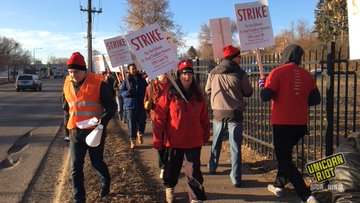
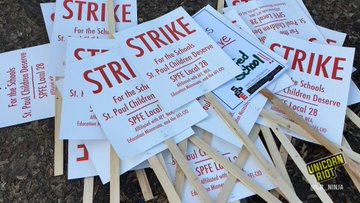
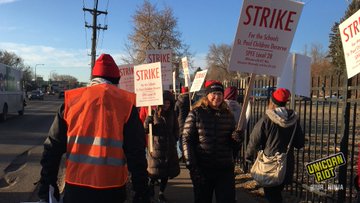
The dedicated educators in St. Paul, MN that went on strike Tuesday know full well that it takes wraparound supports for the city’s neediest children to have a fair and substantive opportunity to learn. They’ve gone on strike after ten months of failed contract negotiations because their students are suffering—and their #1 demand is more mental health supports. We see their fierce determination as an act of love.
St Paul, MN: public are closed today, March 10, due to the @SPFE28 teacher's union strike.

We spoke with some of the strikers, who told us their #1 demand is more support for their students, some of whom "face tremendous trauma in their day-to-day lives."


View image on TwitterView image on TwitterView image on Twitter

As Labor Notes reports:
“There are so many kids with so many issues,” said middle school teacher Leah Van Dassor. “Kids are depressed because they have problems at home. They don’t have anyone to talk to.”
St. Paul Federation of Educators (SPFE) Vice President Erica Schatzlein sees a wide range of needs in her work as an elementary teacher with English language learners.
“A students that had a parent pass away, instead of acting out, becomes completely withdrawn,” she said. A newly homeless student “has a meltdown, and I have to evacuate the classroom.”
In addition to its mental health demands, the union is asking for more bilingual teacher’s aides and limits on class size for special education.
“It’s too bad that all these important social services fall on the shoulder of the schools, but they do,” said Van Dassor, who is also on the bargaining team. “We have to try to figure out a way to help.”
To systematize this greater, holistic understanding of public schools and movements working to improve them, Schott released the Loving Cities Index. The Index measures access to 24 community and school-based supports, from clean air to unemployment, from healthy food to public transit.
Key measures in the Loving Cities Index include in-school support staff and mental health supports — and it's going to take broad and dynamic grassroots movements to move the needle.
Demands like these are part and parcel of a longstanding grassroots effort to create CONTINUE READING: St. Paul Educators are Striking Because their Students are Suffering | Schott Foundation for Public Education

Florida: House Passes Bill to Protect “Parents’ Rights” vs. School System | Diane Ravitch's blog

Florida: House Passes Bill to Protect “Parents’ Rights” vs. School System | Diane Ravitch's blog

Florida: House Passes Bill to Protect “Parents’ Rights” vs. School System


The House advanced sweeping, if aspirational, legislation codifying a parent’s “bill of rights” on Monday. The vote in favor was 77-41.
The House version (CS/HB 1059), sponsored by Rep. Erin Grall, now includes a technical amendment that reaffirmed parental rights to any type of school (public, private, and even home schooling).
Another Grall amendment vouchsafed parental rights to spike objectionable instructional material “based on beliefs regarding morality, sex, and religion or the belief that such materials are harmful.”
The amendments offered reassured some Democratic critics of the bill, but not enough to earn their votes.
Parents already have the right to home school or send their children to private schools.


This bill would give parents the right to “protect” their children from topics that are objectionable to their CONTINUE READING: Florida: House Passes Bill to Protect “Parents’ Rights” vs. School System | Diane Ravitch's blog

Is Penn Foster High School Diploma Legit ?

Is Penn Foster High School Diploma Legit ?

Is Penn Foster High School Diploma Legit ?


Let us discuss few most asked questions like Is Penn Foster good, Is it’s High School Diploma legit and how about the legitimacy of other online courses it offers.
Penn Foster is your online education partner that helps you learn on the go. We know you want to learn but something or the other pulls you away from the thought. Well, not anymore! Whether it is your current work responsibility or family liabilities, Penn Foster allows you to learn and grow while you cater to all other things on your plate.

Online Education – An Alien Concept?

It is 2020 and we all have at least heard about online education. The phrase “online education” is as luring as it is scary.
There is a prevailing idea that suggests online education is not as good as education from a traditional setting. Though, the idea is fading away but quite gradually. This myth needs to be broken.
Today, more and more youngsters wish to rely on online education. And although, they want to depend on flexible options, fear of investing in an illegitimate option CONTINUE READING: Is Penn Foster High School Diploma Legit ?
Big Education Ape: Another Study: Students Experience Academic Decline in Virtual Charter Schools | Diane Ravitch's blog - 
https://bigeducationape.blogspot.com/2020/03/another-study-students-experience.html

Why It Might Matter To Close Your School – Los Angeles Education Examiner

Why It Might Matter To Close Your School – Los Angeles Education Examiner

Why It Might Matter To Close Your School


It’s understandable to look at the fatality and even incidence rate of Covid-19 here in Los Angeles and think:
Huh?  Why the panic; far, far more people die of the flu annually, and we’re all healthy here. A little cold’s no big deal, most people will survive, particularly kids, and besides, I have no way to care for (or feed) the kids during the daytime.”
There are a lot of issues in there to unpack, but most importantly, the considerations surrounding school closure are not about individual risk or anyone’s personal chance of survival. At issue is a sensible, effective public health response to a local health emergency and a global pandemic.
The concern is that those who do suffer adverse effects from the novel coronavirus will need access to hospitals, hospital beds, ventilators and a sizable medical staff. With huge estimates of the ultimately infected population, if transmission happens too rapidly, the health infrastructure could be overrun and vital care unavailable when a lot of people need it.
A screenshot of a cell phone

Description automatically generated
That is why slowing the spread of Covid-19 is so important. Public health CONTINUE READING: Why It Might Matter To Close Your School – Los Angeles Education Examiner

Today’s New Resources For Teaching Online If Schools Are Closed | Larry Ferlazzo's Websites of the Day...

Today’s New Resources For Teaching Online If Schools Are Closed | Larry Ferlazzo's Websites of the Day...

TODAY’S NEW RESOURCES FOR TEACHING ONLINE IF SCHOOLS ARE CLOSED


Seattle schools and other announced closures today, and it looks like things will only get worse.
On a different note, The NY Times Learning Network’s Coronavirus Resources: Teaching, Learning and Thinking Critically is a great source for teaching about the virus. I’m adding it to A Beginning List Of The Best Resources For Learning About The Coronavirus.


CURMUDGUCATION: Administration Matters

CURMUDGUCATION: Administration Matters

Administration Matters


This tweet turned up the other day.

I interviewed a teacher who is leaving the profession in June. I asked her why she was quitting.

Her response:
“I was told to teach to the test...that if it’s not a test-taking skill, don’t teach it. I didn’t become a teacher to help kids become better test-takers.”


I wish the teacher hadn't slipped into passive vice. I wish she had said, "Principal Testy McScoresuck told me to teach to the test." Because administrators like this need to be outed. They need to be held up before the world as people helping to facilitate the creeping educational malpractice rooted in high stakes testing.


A manager's job-- and not just the management of a school, but any manager-- is to create the system, environment and supports that get his people to do their very best work. When it rains, it's the manager's job to hold an umbrella over his people. When the wind starts blowing tree limbs across the landscape, it's the manager's job to stand before the storm and bat the debris away. And when the Folks at the Top start sending down stupid directives, it's a manager's job to protect his people the best he possibly can.

NCLB, Race to the Top, Common Core, the high stakes Big Standardized Tests-- each of these bad policies is bad for many reason, but the biggest one is this: instead of helping teachers do their jobs, these policies interfere with teachers doing their jobs, even mandate doing their jobs badly. In each case a bunch of educational amateurs pushed their way into schools and said, "You're doing it all wrong from now on, you have to do it like this," like medically untrained non-doctors barging into a surgical CONTINUE READING: 
CURMUDGUCATION: Administration Matters

John White Is Officially Out; Deputy Beth Scioneaux Becomes La.’s Acting Superintendent | deutsch29

John White Is Officially Out; Deputy Beth Scioneaux Becomes La.’s Acting Superintendent | deutsch29

John White Is Officially Out; Deputy Beth Scioneaux Becomes La.’s Acting Superintendent


March 11, 2020, marked John White’s last day as Louisiana superintendent.
On his Louisiana Department of Education (LDOE) bio, White began sometime between March 2019 and July 2019 to identify himself as “the longest serving state education chief in the nation.”
He does not mention the political maneuvering and insulation that brought him there and kept him there for eight years and two months.
Well, White’s political favor ran out during the 2019 BESE elections, and with the reelection of Louisiana governor John Bel Edwards to a second term, apparent behind-closed-door negotiations likely involving some of the same political forces that maneuvered to keep White in place for eight years made a deal which led to White’s resignation announcement on January 08, 2020, only days prior to Edwards’ second inauguration, on January 13, 2020.
Given that White tendered his resignation with “‘no plans’ for his immediate future,” his exit was not likely to be of his own doing. In 2017, Education Week found White to be the third highest paid education superintendent in the nation.
Education reform pays.
White’s annual salary was $283,384 in 2012 and has been $275,000 from 2013 to 2018, as per White’s annual financial disclosure reports (which can be found here). If White’s annual salary was also $275,000 in 2019 and $22,917 per month for his final two months, then that means Louisiana, with its average teacher pay falling in the national rankings, has paid its poltically-positioned, Teach for CONTINUE READING: John White Is Officially Out; Deputy Beth Scioneaux Becomes La.’s Acting Superintendent | deutsch29

solidaridad: Open Letter to LAUSD Board regarding Citizens of the World Charter School Corporation

solidaridad: Open Letter to LAUSD Board regarding Citizens of the World Charter School Corporation

Open Letter to LAUSD Board regarding Citizens of the World Charter School Corporation


A copy of this letter was sent to each individual member via email

March 11, 2020

Dear Members of the Board of Education:

I am an educational rights attorney and law professor here in Los Angeles. I am writing you regarding the Citizens of the World Charter School Corporation (“CWC Corp.”), an alleged non-profit benefit corporation that operates a number of privately managed charter schools authorized by the Los Angeles Unified School District (“LAUSD”).

CWC Corp. is currently trying to occupy a portion of a public school, Shirley Avenue Elementary School, under the provisions of Proposition 39. I will not discuss the myriad flaws, inequities, and attendant problems associated with Proposition 39 in this communication. I do, however, want to ask you to put off any consideration of allowing CWC Corp. to move forward with its hostile occupation of a public school while they have seemingly repeatedly refused to pay their legally obligated bills to LAUSD.

As you know, charter school corporations utilizing Proposition 39 to force their hostile occupations of public schools are obligated to pay over-allocation fees in certain circumstances. CWC Corp. currently owes LAUSD hundreds of thousands of dollars in over-allocation fees. Before allowing them any further opportunities to continue operating in bad faith, LAUSD should collect all payments past due and obtain written assurances from CWC Corp. that they will pay their obligations in the future.

Children in Los Angeles public schools are starved for resources. Our students go without school librarians, full-time health-care professionals, adequate access to services, etc. Meanwhile, just three years ago, CWC Corp.’s Executive Director Mark Kleger-Heine received a staggering salary of over $231,000.00 USD (see CWC Corp.’s 2017 Form 990 Part VII). This disparity of resources is by design, and underlies the purpose of the charter school industry. Public school students go without, while charter school executives collect fat checks.

As a member of the LAUSD Board of Education, I hope you will turn your attention to resolving this matter not only with CWC Corp., but with all of the charter school corporations that are in arrears in their over-allocation fee payments with LAUSD.

-rds

solidaridad: Open Letter to LAUSD Board regarding Citizens of the World Charter School Corporation


This and that | Deborah Meier on Education

This and that | Deborah Meier on Education

This and that

Dear friends and colleagues,
I am hoping, maybe unrealistically, that I can walk well enough to ring doorbells by the fall. Even if not for Warren or, I have not given up yet – Sanders. It will make me feel less useless.
And while I immensely enjoy visits to and from family and friends, reading or listening to books and doing crossword puzzles — and slogging thru 100 emails et al a day (90% deles)—I miss being in the middle of the action.
Getting old however is better – I think – than the alternative.
Seeing almost all my friends in Chicago was wonderful. But the North Dakota Study Group gathering was frustrating for reasons that I’m sorting through. It is always good to see young and old education allies, but I felt uncomfortablyI out of synch with many of my “allies” on what our task today is. I will share my dilemma in my next blog.
I have committed to writing several essays and chapters  – focused on what schools could do to advance democracy. It boils down to “practicing it”. First and foremost, amongst the adults.
I have been reading manuscripts by teachers, and some recently published practitioner CONTINUE READING: This and that | Deborah Meier on Education

A Hidden History of Integration and the Shortage of Teachers of Color

A Hidden History of Integration and the Shortage of Teachers of Color

A Hidden History of Integration and the Shortage of Teachers of Color


Evelyn J. Chatmon, the first African American female assistant superintendent in Baltimore County Public Schoolsgrew up under Jim Crow in Maryland during the 1940s and 50s. Even though she could see the white elementary school from her house, she had to ride a bus for more than an hour to the black school, where there was no running water. Students drank from a ladle dipped into a bucket and used an outhouse, even in the bitter cold of winter.
But Chatmon also recalled that her educators were extraordinarily talented and provided her with excellent instruction despite the poor conditions.
“This is the hidden piece of history,” said Vanessa Siddle Walker, Samuel Candler Dobbs Professor of African American Educational Studies at Emory University and the president-elect of the American Educational Research Association. “What we’ve seen written about inequality and oppressive school conditions is all true, but it’s incomplete. It’s only part of the story.”
The script that was written, she said, is that segregated schools were all bad and “that nothing really good happened for black children until we desegregated them into white schools.”
That hidden history, that there were good educators and advocates within the all-black schools, she said, can also offer clues to the current shortage of teachers of color in America’s public schools today.

Exceptional Educators

According to Walker, the experience of Evelyn Chatmon was shared by many black students who had teachers of color before schools were desegregated. With limited professional options, many well-educated black people became teachers who ardently passed on a thirst for knowledge to their pupils. They developed rigorous curriculum that challenged and inspired them, and though society told black CONTINUE READING: A Hidden History of Integration and the Shortage of Teachers of Color

Wednesday, March 11, 2020

U.S. senators press Betsy DeVos for answers on Education Department’s coronavirus response - The Washington Post

U.S. senators press Betsy DeVos for answers on Education Department’s coronavirus response - The Washington Post

Senators press Betsy DeVos on Education Department’s coronavirus response


A group of Democratic senators are pressing Education Secretary Betsy DeVos to answer some key questions about her agency’s response to the spread of the novel coronavirus across the country, especially about how it plans to help vulnerable students.
More than 20 senators sent a letter late Tuesday urging answers from the secretary about what the department is doing to help students affected by the outbreak of the virus. They asked 14 questions, to be answered by March 24, including about how the department plans to ensure that all students who are asked to study at home because they are sick or their schools have closed have the resources they need to continue learning.

On March 5, DeVos testified before senators to defend the Trump administration’s 2021 budget proposal for the Education Department, and Sen. Patty Murray (D-Wash.) asked her what the department was doing to help students and schools deal with the crisis around the virus. At that time, Murray said the administration’s response to the coronavirus outbreak “hasn’t inspired confidence.”
Here’s the text of the letter:
The Honorable Betsy DeVos
Secretary of Education
U.S. Department of Education
400 Maryland Avenue, SW
Washington, DC 20202
Dear Secretary DeVos:
We write on the topic of the 2019 Novel Coronavirus (COVID-19) and the impact it is having on schools across the country. Increasing numbers of K-12 schools and institutions of higher education (IHEs) are considering school closures in order to mitigate the spread of the virus. We urge the U.S. Department of Education (“Department”) to consider several serious issues related to school closure as it works with school districts, state education agencies, educators, and institutions of higher education, as well as with the President’s Task Force and public health officials.
On February 27, 2020, the Department announced it had launched an internal Coronavirus Task Force led by Mick Zais, Deputy Secretary of Education. On March 4, 2020, the Office for Civil Rights provided guidance about educational institutions’ responsibility to address bullying and harassment of students of Asian descent due to stereotypes related to COVID-19. On March 5, 2020, the Department provided guidance and flexibility to institutions of higher education impacted by COVID-19 to comply with Title IV of the Higher Education Act, but additional questions remain.[1] The Centers for Disease Control and Prevention (CDC) has also issued interim guidance for IHEs and for K-12 schools.[2]
We do not yet know the scale at which K-12 schools and IHEs across the country may need to close in order to help contain the spread of COVID-19, but we urge you to do everything you can to ensure you are continuing to prepare stakeholders for a variety of scenarios. To date, over a dozen countries have shut down schools nationwide, and the number grows each day.[3] As the virus continues to spread throughout the United States, many schools have closed, and it is becoming increasingly likely many more will choose to do so. For example, on March 6, the University of Washington announced it would cancel in-person classes and move to online classes for its 50,000 students beginning March 9 through the end of the winter quarter on March 20.[4] Seattle University and Northeastern University’s Seattle campus have also moved to online classes, as have Stanford University and Columbia University.[5] Some K-12 schools in Washington, New York, California, and Rhode Island have also temporarily closed.[6]
As schools prepare to make these difficult decisions, they are faced with many legal and practical uncertainties and are looking for clear guidance and direction from the Department.
We are especially concerned by the adverse impact of school closures on certain students and families. In K-12 schools, many families rely on the Federal School Lunch Program and may experience food insecurity if they can no longer access meals at school. Few school districts have experience providing wide-scale educational services online for all students, and not all families have access to home computers and high-speed internet to take advantage of such online options. Online learning cannot substitute for a number of services provided in the school setting, and it raises particular challenges to ensuring equity in access to education for all students.
COVID-19 also could severely impact many students in higher education, as well as federal loan borrowers. Students rely on their colleges for on-campus food and housing services. American students enrolled abroad in foreign colleges face barriers to continuing their education, whether online or at other colleges and universities in other countries and the United States. Depending on the spread of economic effects across the country, federal student loan borrowers affected by the impacts of COVID-19 may experience difficulty in repaying their loans. Finally, online education is not the best or preferred method of learning for many students, including students who may be the first in their families to go to college or come from low-income families. If IHEs move to providing education online, we urge the Department to prioritize and ensure students continue to receive a high-quality education, including live, face-to-face, synchronous instruction between students and faculty as much as possible.
We urge you to consider these issues and provide us, and the public, answers to the following questions by no later than March 24, 2020:
1. What communication has the Department had with the United States Department of Agriculture (USDA) about the school lunch program to ensure students in schools that have closed or will close continue to have access to meals?
2. What communication has the Department had with the United States Department of Health and Human Services (HHS) about school-based health centers (SBHC) to ensure students and families who rely on health care services provided by SBHCs will continue to have access to such services in schools that have closed or will close?
3. Can the Department provide assistance to families without home computers or access to high-speed internet so they can take advantage of online educational options provided by either their school districts or IHEs if they need to?
4. What guidance will the Department provide about meeting the educational needs of students who need to stop attending school, including based on the recommendation of a doctor, because they are sick, due to school closure, or for other reasons?
5. If school districts and IHEs elect to provide online classes, they must ensure access is available for all students, including students with disabilities. What guidance is being provided to support school districts and IHEs in providing accessible instructional material, including ensuring websites are accessible, documents are compatible with screen readers, videos include closed captioning, students can participate in online video discussions, and, as applicable, accommodations for testing are provided remotely?
6. CDC guidance recommends IHEs ensure continuity of mental health services for students feeling overwhelmed with COVID-19 and associated events. What supports and assistance will the Department give to IHEs and school districts in providing remote services to all students?
7. While flexibility for colleges to use online education was addressed in the Department’s guidance, this guidance did not address issues of quality. How does the Department plan to monitor and ensure students receive regular and substantive interaction by their instructor(s) in higher education online programs?
a. What additional specific guidance is being provided to institutions on what “regular” and “substantive” interaction  CONTINUE READING: 
U.S. senators press Betsy DeVos for answers on Education Department’s coronavirus response - The Washington Post
The Case For And Against Closing Schools Over Coronavirus : NPR

The Case For And Against Closing Schools Over Coronavirus : NPR

When Should Schools Close For Coronavirus?


The spread of coronavirus has compelled hundreds of K-12 schools in the U.S. to close, affecting more than 750,000 students, according to an analysis by Education Week. And those numbers are certain to increase in the coming days, as concerned parents call for more school closures.
The growing health crisis presents school leaders with a painful choice. Closing schools — as has been done, so far, in China, Japan, Italy and elsewhere — is a proven measure that has been shown to slow the spread of disease and, in turn, save lives. But it also causes huge economic and social disruption, especially for children, millions of whom depend on the free and reduced-cost meals they get at school.
Public officials understandably don't want to close schools unless they absolutely have to, and many closures so far have been triggered by a known case of infection or exposure among staff or students. Yet research suggests the best time to close schools is before that happens.
"If you wait for the case to occur [in your school], you still have wound up closing the school, but now you've missed the opportunity to have the real benefit that would have accrued had you closed the school earlier," says Yale University sociologist and physician Nicholas Christakis.
"It's sort of closing the barn door after the cow is gone."
Christakis' Yale lab normally studies how humans spread everything from ideas to behaviors to germs, but he says he's now all-in studying how coronavirus might spread. Aside from developing a vaccine and getting everyone to wash their hands thoroughly, closing schools is one of the most effective things a community can do to slow contagion, says Christakis, author of Blueprint: The Evolutionary Origins of a Good Society. But timing matters. He points to studies of the 1918 Spanish flu, which suggest some cities may have saved lives by deciding to close schools earlier.
"Closing the schools before anyone in the schools is sick is a very difficult thing to do," Christakis acknowledges, "even though it's probably extremely beneficial and much CONTINUE READING: The Case For And Against Closing Schools Over Coronavirus : NPR

Another Study: Students Experience Academic Decline in Virtual Charter Schools | Diane Ravitch's blog

Another Study: Students Experience Academic Decline in Virtual Charter Schools | Diane Ravitch's blog

Another Study: Students Experience Academic Decline in Virtual Charter Schools


I have posted repeatedly here about the dismal academic results of virtual charter schools. Students have high attrition rates, low test scores, and low graduation rates.
This finding has been reported again and again. In 2015, CREDO at Stanford said that students lose almost a year of learning in math when they attend virtual charter schools. In many states, the virtual charters are the state’s lowest performing schools. Pennsylvania has many virtual charter schools, and none of them has ever met state benchmarks in reading and math.
The latest study comes from Indiana, as reported by Stephanie Wang in Chalkbeat.
Faced with low academic results at online schools across the country, supporters often defend virtual education because it provides a haven for struggling students.
But a new study in Indiana found that students fell further behind after transferring to virtual charter schools. The findings suggest that online schools post low outcomes not simply because the students they serve face challenges, but because of problems with how online learning works — and the shortfalls of not having a physical classroom.
The new research, to be published in the journal CONTINUE READING: Another Study: Students Experience Academic Decline in Virtual Charter Schools | Diane Ravitch's blog