Latest News and Comment from Education

Tuesday, March 3, 2020

What schools and teachers should be doing now about coronavirus, according to the experts - The Washington Post

What schools and teachers should be doing now about coronavirus, according to the experts - The Washington Post

What schools and teachers should be doing now about coronavirus, according to the experts


What should schools, teachers and everyone else on a campus be doing as the new coronavirus continues spreading around the globe, including in the United States?
Most patients confirmed to have covid-19, the disease caused by the virus, have had mild to severe respiratory illness with symptoms including fever, cough and shortness of breath. Some patients have experienced pneumonia in both lungs, and the global death count as of Monday was more than 3,000, with six deaths in Washington state. A few schools there closed as a precaution, and experts say more school closings are possible if the disease continues to spread throughout the United States.


There is no antiviral treatment specifically for the disease, but experts say there are precautionary steps everyone can and should be taking to avoid coming down with covid-19.
Here’s what experts say schools and teachers should be doing to prepare for the spread of the coronavirus. The following advice comes directly from leading health and education agencies:
ADVICE FROM THE CENTERS FOR DISEASE CONTROL AND PREVENTION
Guidance for schools that do not have covid-19 identified in their community
To prepare for possible community transmission of covid-19, the most important thing for schools to do now is plan and prepare. As the global outbreak evolves, schools should prepare for the possibility of community-level outbreaks. Schools want to be ready if covid-19 does appear in their communities.
Child-care and K-12 school administrators nationwide can take steps to help stop or slow the spread of respiratory infectious diseases, including covid-19:

I Belong to the Toothbrush Party, an Offshoot of the Democratic Party | Diane Ravitch's blog

I Belong to the Toothbrush Party, an Offshoot of the Democratic Party | Diane Ravitch's blog

I Belong to the Toothbrush Party, an Offshoot of the Democratic Party


As most of the readers of this blog know, I don’t endorse candidates in Democratic primaries.
Here is where I stand.
I read a comment a few weeks on Twitter where someone wrote that he would vote for a toothbrush over Trump.
I agreed. I am a member of the Toothbrush Party.
I would vote for my beautiful, loving, compassionate mutt Mitzi over Trump.
I think he is a danger to our society and to the world.
I think he is determined to destroy the federal government, department by department, agency by agency, by putting fools, sycophants, and those who share his contempt for government in charge at every level.
He is packing the courts with religious zealots.
Hw will completely control the Supreme Court if he is re-elected.
He is destroying the government’s ability to administer justice fairly and impartially.
He has fired dedicated career officials because they were loyal to the Constitution, not to him personally.
He has embraced dictators and autocrats while alienating our allies.
He thinks he is above the law and can do anything he wants, without regard to the Constitution.
I will vote for anyone on the Democratic ticket opposing Trump.
Do not sit home if your candidate doesn’t win the nomination.
Do not vote third party.
Vote for anyone who will save us from this stupid, arrogant, petty, ignorant man who sits in the White House.


Time To Vote – Los Angeles Education Examiner

Time To Vote – Los Angeles Education Examiner
Time To Vote

SuperCaliforniaisticexpialiTuesday is here; it’s finally here.  Please don’t embarrass your country or family and fail to turn out. It seems hard to imagine turnout hasn’t been heavy already given the widespread availability of Vote Centers open now for weeks. It seems that everyone has received a postage-paid absentee ballot whether you asked for one or not. Click here to locate your new Vote Center regardless of past performance – don’t let it predict today’s. Come 8pm tonight and it’s all over.
Just how embarrassing has been our recent turnout for LAUSD board elections? Pretty appalling. Approximately one in ten registered voters has deigned to vote since 2013 when really big-time money first suffused the LAUSD board races. That is, almost all our fellow citizens have let a tiny proportion elect the few who control a budget the size of the City of LA’s, and the weekday environment of our next generation citizens.
This really is no way to run a democracy. An informed and engaged CONTINUE READING: Time To Vote – Los Angeles Education Examiner

Whatever Happened to Interactive Whiteboards? | Larry Cuban on School Reform and Classroom Practice

Whatever Happened to Interactive Whiteboards? | Larry Cuban on School Reform and Classroom Practice

Whatever Happened to Interactive Whiteboards?


You cannot eat one potato chip. You have to have more. Technological innovations hyped to transform teaching and learning are like potato chips. No district, no school just buys one. Laptops, tablets, and Interactive whiteboards (IWB) are typical examples. Consider the history of this high-tech classroom device.
Beginning in the United Kingdom in the early 1990s, schools purchased interactive whiteboards by the truckload. British educators jumped on board this technological innovation with great enthusiasm especially after the government underwrote the buying of the technological innovation. In a glowing, enthusiastic article (2010), a writer described the results of the government largesse.
At St. Matthew Academy, a school for 3- to 16-year-olds serving a group of depressed London neighborhoods and similar to “turnaround schools” in American cities, IWBs have become fixtures in every classroom, with an eye to keeping students engaged. Assistant Principal David Cregan says that the CONTINUE READING: Whatever Happened to Interactive Whiteboards? | Larry Cuban on School Reform and Classroom Practice

La. Superintendent Search: 21 Applicants | deutsch29

La. Superintendent Search: 21 Applicants | deutsch29

La. Superintendent Search: 21 Applicants


From the Associated Press, as published March 02, 2020, Lafourche Parish Daily Comet:
BATON ROUGE, La. (AP)– More than 20 people from across the country have applied to be Louisiana’s next state education superintendent, according to the state’s top school board.
The 21 applicants include higher education professionals from schools in Louisiana, Texas and Tennessee, as well as public school teachers, a Louisiana teacher’s union representative and other consultants, administrators and educators holding posts nationwide. An Arkansas Department of Education official as well as a former Kentucky education chief have also applied for the position, news outlets reported.
The current superintendent, John White, announced in January that he would be resigning March 11 after eight years in the role.
Board of Elementary and Secondary Education member Kira Orange Jones is chairwoman of the working group that will help select White’s successor. She called the list of applicants ‘a very diverse and talented pool of educational leaders’ in an update released Saturday, one day after CONTINUE READING: La. Superintendent Search: 21 Applicants | deutsch29

Los Angeles: Teachers v. Billionaires | Diane Ravitch's blog

Los Angeles: Teachers v. Billionaires | Diane Ravitch's blog

Los Angeles: Teachers v. Billionaires


MEDIA ADVISORY
March 2, 2020
Contact: Anna Bakalis, 213-305-9654
Los Angeles — The stakes are high in the LAUSD School board race to elect Patricia Castellanos in District 7, Scott Schmerelson in District 3, Jackie Goldberg in District 5 and George McKenna in District 1. As of Monday morning, the California Charter Schools Association PAC and billionaires like Bill Bloomfield, who sits on the CCSA PAC board, have funneled more than $6.2 million into the race against these candidates, making it the most expensive primary school board race in US history. They are spending $1 million every other day since last week.
“What our kids don’t need are billionaires spending $20,000 an hour every day to buy our school board election. Imagine if the millions they are spending against public education were redirected into our schools?” said UTLA President Alex Caputo-Pearl. “Our school libraries could be open five days a week. We could hire more nurses, counselors, mental health professionals and social workers and invest in ethnic studies, arts and music programs.”
UTLA members, parents and supporters are in final sprint to get out the vote for the March 3 election. See ads in today’s LA Times and La Opinion, attached.
Monday Media Availability
Teachers in support of Patricia Castellanos in District 7
When: Today, Monday March 2
Time: 4:30 – 6 PM
Who: UTLA President Alex Caputo-Pearl, teachers and supporters will be precinct walking, phone banking and texting for Castellanos. Interviews available in English and Spanish.
Location: 103 W Carson St. (Carson and Main Sts.) near Seafood City.
Onsite Contact: Mario Valenzuela, 213-447-3957
Flash mob with teachers in support of Scott Schmerelson in District 3
When: Today, Monday March 2
Time: 4-6 PM
Who: Teachers, parents and students lining the streets with signs, cars honking in support of Schmerleson. Interviews available in English and Spanish.
3 Intersection locations:
Tampa Ave. & Nordhoff St., Northridge (main site)
Ventura Blvd & Laurel Canyon Blvd., Sherman Oaks
Topanga Canyon & Victory Blvds., Canoga Park
What: Teachers holding signs, cars honking in support
Onsite Contact: Scott Mandel, 818-970-7445
Los Angeles: Teachers v. Billionaires | Diane Ravitch's blog

Misreading Academia, and Why Education? – radical eyes for equity

Misreading Academia, and Why Education? – radical eyes for equity

Misreading Academia, and Why Education?


While I was teaching high school English in rural South Carolina, I became close friends with a colleague; I was English Department chair and also taught Advanced Placement, and he was the chair of history and also taught A.P.
But the strongest bond we shared was our similar life experiences of having been born, raised, and educated in the Deep South. We came to be ideologically quite different (radical, progressive) than how we were raised (traditional, conservative) in redneck and racist homes. And we both quickly attributed this transformation to our educations, although in slightly different ways.
My colleague often noted that when he and his father fought as they grew older and farther apart intellectually (as I did with my father), his father would often end those fights by declaring that the biggest mistake he ever made was sending my colleague to college.
While I did in fact attribute my liberation from all sorts of negative -isms to wonderful and thoughtful professors and classes in my undergraduate education, my colleague actually graduated college mostly unfulfilled, but motivated to self-educate by reading widely and deeply. Yes, college helped his transition, but he did a great deal of his own intellectual soul-searching after he graduated.
Both of us also eventually sought doctoral degrees later in life and then moved on to higher education. As a result of our backgrounds and experiences in K-12 and higher education, I think, I have noticed two important conversations on CONTINUE READING: Misreading Academia, and Why Education? – radical eyes for equity

CURMUDGUCATION: Free Market Winners and Losers

CURMUDGUCATION: Free Market Winners and Losers

Free Market Winners and Losers


One of the foundational arguments of modern ed reform is that free market forces would make education work better, that having to compete would make public and private schools work harder, smarter, better and create a rising tide of educational awesomeness that would lift all boats.

This is unlikely for a variety of reasons, but the biggest problem with the free market when it comes to public education is that by its very competitive nature, it picks winners and losers. And that's actually a couple of problems.

First, it picks winners and losers among the providers. A study by the Network for Public Education has found a staggering amount of federal money spent on charters that fail, or even pre-fail by collapsing before they even open. For free market fans, that's a feature, not a bug. In their conception of the education market, schools come and go as those that sink to the bottom are pushed out of business, to be replaced by potentially superior new competitors.  Some are sincere in this deep belief in the markets, and some are simply opportunists; when a reformster complains about the "closed system" or "education monopoly," what they mean is not a system that denies students choice, but a system that denies entrepreneurs the a chance to get in there and hustle for a piece of that mountain of sweet, sweet tax dollars.

The problem with the model of churning and burning our way to excellence is not just that the constant churn, the repeated tossing of students out to the curb with a hearty "Good luck finding CONTINUE READING: 
CURMUDGUCATION: Free Market Winners and Losers

For Many Educators, Crowdfunding for Basic Resources is a "Way of Life"

For Many Educators, Crowdfunding for Basic Resources is a "Way of Life"

For Many Educators, Crowdfunding for Basic Resources is a “Way of Life”


We all know about the lengths educators go to make sure their classrooms are stocked with school supplies for their students. They will not hesitate to spend their own money – to the tune of at least $459 every year and not likely to be reimbursed  – to purchase everything from pencils, extra notebooks, rulers, even software programs.
But these efforts don’t stop there. Paying for school supplies or classroom projects can be too expensive to pay for out-of-pocket. Which is why more educators over the past decade turned to crowdfunding, namely DonorsChoose, which connects potential donors to classrooms in need. After teachers post funding requests on DonorsChoose, individual donors review the site’s thousands of proposals and select a project to fund.
From 2009 to 2019, teachers submitted 1.8 million requests to DonorsChose. What kind of projects are educators proposing? What kind of schools do they teach in? And what sort of projects are being approved? What, if anything, do these requests tell us about what resources our classrooms lack?
Grantmakers for Education (GFE), a large network of education grantmakers, recently analyzed the DonorsChoose database of requests to answer these and CONTINUE READING: For Many Educators, Crowdfunding for Basic Resources is a "Way of Life"

Monday, March 2, 2020

"What will it take to fully resource Safe and Supportive Schools in SFUSD?" - SF PUBLIC SCHOOL MOM

"What will it take to fully resource Safe and Supportive Schools in SFUSD?" - SF PUBLIC SCHOOL MOM

“What will it take to fully resource Safe and Supportive Schools in SFUSD?”


More readers weigh in on Restorative Practices…

Since I last reblogged a letter (read it in my last post) I received in response to my questioning of SFUSD staff about the Safe and Supportive Schools Policy at a recent Board Meeting, I have received even more feedback. I really respect the time, thoughtfulness and courage they shared in responding to my question: What will it take to fully resource this important policy in our district?
If you haven’t been following this topic, I’d suggest you start at the previous post in this series. I’ve also created a new category: “Safe Schools” and tags: “Restorative Practices” “Safe and Supportive Schools” and “Bullying” so readers can follow all content I post on these topics.

The first response comes from an SFUSD educator. It reads:

“Another experienced teacher seconding every point the letter writer makes. RP on the cheap – which is what we have now – is not restorative or just.

I had a very strong negative reaction to the district seeming to claim implementation is going just great, training the trainers is the way to go, etc. because I feel like they are being disingenuous.

I know from discussions with colleagues who have limited training in RP that this message is not what they want to hear. And people who oppose RP for whatever reason hear this from the district and conclude that RP is unworkable/no consequences. Which thereby decreases support for restorative justice.

There is also no support for getting staff to use restorative practices for staff discussions and issues. When I was originally trained, the importance of staff internalizing the process and building capacity/trust/belief was strongly recommended as a first step. I don’t think this happened.

My experience of RP training is that restorative justice can surface implicit white supremacy, and that naming it and pushing back (using restorative CONTINUE READING: 
"What will it take to fully resource Safe and Supportive Schools in SFUSD?" - SF PUBLIC SCHOOL MOM

Sac City Unified Approves Motion To Lay Off More Than 50 Teachers – CBS Sacramento

Sac City Unified Approves Motion To Lay Off More Than 50 Teachers – CBS Sacramento

Sac City Unified Approves Motion To Lay Off More Than 50 Teachers


SACRAMENTO (CBS13) – The Sacramento City Unified School District could soon be laying off dozens of teachers.
In a Thursday night meeting, the district approved a motion to lay off 82 full-time equivalent positions. Of those positions on the chopping block, 54 are kindergarten to twelfth-grade teachers. Another 24 of those positions are already vacant.
District officials say they expect to send out only about 33 layoff notices due to anticipated resignations or retirements.
The motion comes as the school district faces a projected budget shortfall of nearly $20 million for the 2021-22 fiscal year.
Final layoff notices are expected to go out by May 15.

A Visit with the Mother of the Resistance, Karen Lewis | Diane Ravitch's blog

A Visit with the Mother of the Resistance, Karen Lewis | Diane Ravitch's blog

A Visit with the Mother of the Resistance, Karen Lewis


Last week, I had a whirlwind visit to Chicago to talk about my new book. Fortunately before my flight to Charleston, West Virginia, I had time in the morning to visit Karen Lewis at an assisted living facility where the care is excellent.
Karen is a brilliant charismatic woman who taught science in the Chicago public schools for more than 20 years. In 2010, Karen led a faction of the Chicago Teachers union called the Caucus of Rank and File Educators, which swept to victory in the union elections. She became president of the CTU. She was a strategic organizer who worked to build alliances with parent and community groups. In 2012, the CTU voted to strike. The legislature, egged on by Gates-funded Stand for Children, passed a law that they thought would make a strike impossible by requiring a vote of 75% of the membership. Karen and her team won the approval of about 90% of the members and led a successful strike that had the support of parents and communities because they understood that teachers were striking for their children.
Karen was an articulate and greatly admired visionary. She planned to run for mayor against Rahm Emanuel in 2015, and her own polling suggested that she would beat him handily.
Tragically, Karen was diagnosed with a brain tumor in October 2014. Since then, she has had a series of setbacks, including a stroke. Life is so unfair. Karen is only 66.
When I saw her, she was happy that I visited. As I CONTINUE READING: A Visit with the Mother of the Resistance, Karen Lewis | Diane Ravitch's blog

TIME: How Michael Bloomberg Undermines Democracy by Big Spending in Local School Board Races | Diane Ravitch's blog

TIME: How Michael Bloomberg Undermines Democracy by Big Spending in Local School Board Races | Diane Ravitch's blog

TIME: How Michael Bloomberg Undermines Democracy by Big Spending in Local School Board Races


One of the themes of my new book SLAYING GOLIATH is that billionaires are disrupting education by buying control of school districts and states. That, in conjunction with the federal government’s mean-spirited and useless mandate for annual standardized testing (no high-performing nation tests every child every year in grades 3-8), has posed a mortal threat to public schools.
TIME magazine published an article showing how one of our best known billionaires, Michael Bloomberg, has undermined democracy by buying local school board races and making it impossible for local people to compete with his spending.
The article begins:
School board elections are usually local affairs, with candidates soliciting money from neighbors at pizza parties and dragging along friends to knock on doors and ask for votes.
That’s what Chris Jackson expected when he decided to run for the school board in Oakland, Calif., in 2016. He’d previously been elected to the board of the City College of San Francisco and thought he knew how to build the ground game to win in Oakland. He started gathering CONTINUE READING: TIME: How Michael Bloomberg Undermines Democracy by Big Spending in Local School Board Races | Diane Ravitch's blog


A (Brief) History Of State Takeover Of OUSD

A (Brief) History Of State Takeover Of OUSD

A (Brief) History Of State Takeover Of OUSD


For years, It is no news for residents of Los Angeles’ Oakland Unified School District (OUSD) being an experimental lab for the reformers of the corporate education system in assaulting public education
It was at the peak of its trend in 2003 at a crucial point when the OUSD came under the control of the state of California.
It was handed over to Los Angeles billionaire Eli Broad who was renowned for advocating a rather more convenient business model for education. Since then the OUSD has been transferred from one Broad graduate to another.

This transfer of control to the state of California happened because of a $37 million deficit.
Broad has an institute called the Broad’s Urban Superintendents Academy in which he had an intern named Randolph Ward, a state-appointed administrator to whose hands he vested all the powers.
An election campaign was also run for the same and ideally funded by Broad who was also asked to name the state administrator.
Thereon, Ward got in residents from Board to cater to finance, labor relations and even small school incubators and further down the memory lane is history, when CONTINUE READING: A (Brief) History Of State Takeover Of OUSD


Challenges for America’s Forgotten and Overlooked Rural Public Schools | janresseger

Challenges for America’s Forgotten and Overlooked Rural Public Schools | janresseger

Challenges for America’s Forgotten and Overlooked Rural Public Schools

Incompetence and bureaucratic rigidity in Betsy DeVos’s U.S. Department of Education is denying the nation’s poorest rural schools the delivery of federal money these districts have already budgeted for essential services.
The NY Times‘ Erica Green reported last week: “More than 800 schools stand to lose thousands of dollars from the Rural and Low-Income School Program because the department has abruptly changed how districts are to report how many of their students live in poverty. The change, quietly announced in letters to state education leaders, comes after the Education Department said a review of the program revealed that districts had ‘erroneously’ received funding because they had not met eligibility requirements outlined in the federal education law since 2002.  The department said it would strictly enforce a requirement that in order to get funding, districts must use data from the Census Bureau’s Small Area Income and Poverty Estimates…. For about 17 years, the department has allowed schools to use the percentage of students who qualify for federally subsidized free and reduced-price meals, a common proxy for school poverty rates, because census data can miss residents in rural areas.”
Senators from rural states—Maine’s Susan Collins, Montana’s Jon Tester—have protested, and it looks as though Congress and the Education Department will find a way to solve the problem.  But here is what happened in the school districts that received the notice: “The department’s notifications rattled rural districts, which have come to rely on the program to supplement the costs of services that are far less accessible to rural students, like technology, mental health and guidance counselors, and full-day kindergarten. Congress created the Rural Education Achievement Program, recognizing that rural schools lacked the resources to CONTINUE READING: Challenges for America’s Forgotten and Overlooked Rural Public Schools | janresseger

The City Fund Spending Prolifically to Privatize Public Education | tultican

The City Fund Spending Prolifically to Privatize Public Education | tultican

The City Fund Spending Prolifically to Privatize Public Education


By Thomas Ultican 3/2/2020
The City Fund has joined the Walton Foundation, the Broad Foundation, and the Chan Zuckerberg Initiative (CZI) in the upper echelon of spending to privatize public education. (Gates is in a spending zone of his own.)  City Fund grants are of the same magnitude as CZI’s and approximately half the size as those from the Walton foundation. Since its establishment in July, 2018, City Fund reports issuing $110 million in large grants defined as more than $200,000; smaller grants not accounted for. Founders John Arnold and Reed Hastings have also provided the associated political action group, Public School Allies, with $15 million.

Reorganizing and Retooling the Attack on Public Schools

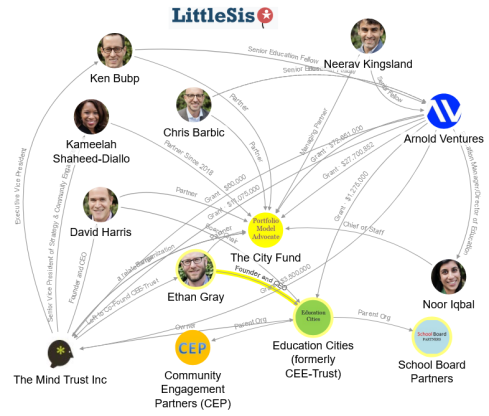
Little SiS City Fund Map
Reorganizing the Attack Little Sis Map
On the ides of March, the Indy Star reported that David Harris the CEO of Mind Trust in Indianapolis was leaving to join a new national organization. Since Julius Caesar’s assassination, events linked to the ides of March are often viewed with alarm. This event portended a reorganized attack on public education and a new billionaire financed entity dedicated to establishing the portfolio model of public school management throughout America.
Until February of 2020, the secretive City Fund did not even have a web site. On July 31, 2018, City Fund Managing Partner Neerav Kingsland took to his blog and made public The City Fund – a new non-profit – and named its founding CONTINUE READING: The City Fund Spending Prolifically to Privatize Public Education | tultican