Latest News and Comment from Education

Tuesday, July 2, 2019

A VERY BUSY DAY Larry Ferlazzo's Websites of the Day... | The latest news and resources in education since 2007

Larry Ferlazzo's Websites of the Day... | The latest news and resources in education since 2007


A VERY BUSY DAY Larry Ferlazzo's Websites of the Day... | The latest news and resources in education since 2007


“Q&A Collections: Best Ways to Begin the School Year”
Q&A Collections: Best Ways to Begin the School Year is the headline of my latest Education Week Teacher column. All Classroom Q&A posts offering advice on the best ways to begin the school year (from the past eight years!) are described and linked to in this compilation post. Here’s an excerpt from one of them:

YESTERDAY

My Most Popular Tweets Of The Month
PhotoMIX-Company / Pixabay I used to post weekly collections of my best tweets, and used Storify to bring them together. Unfortunately, Storify went under. Fortunately, however, Wakelet was a new tool that was able to import all of a person’s Storifys. So you can see all those previous Twitter “Best” lists here . I don’t want to risk putting all the work into those posts again and risk losing the
NY Times Video On “Memory Contamination”
aitoff / Pixabay This is a video from The New York Times which I will be showing to my Theory of Knowledge classes next school year when we study memory. Here’s how they describe it : I began exploring the intersection of memory and law after hearing the story of Penny Beerntsen, who was assaulted while running on a beach in 1985 — and who misidentified her assailant in the subsequent investigati
A Look Back: Home Culture Project – With New Examples & Student Handouts!
This blog has recently gained many new readers. Because of that, I thought it might be worth sharing a “A Look Back” where I periodically share my choices for the most important posts from the past twelve years. You can also see all of my choices for “Best” posts here . This post appeared earlier this year. Free-Photos / Pixabay I’ve previously posted about the Home Cultures project that my stude
Important Info On Busing & School Desegregation
Last week’s Democratic Presidential candidate debate has put desegregation and busing in the news. Here are some related and thoughtful pieces which I’m adding to The Best Resources For Learning About School Desegregation (& Segregation) – Help Me Find More : Did busing for school desegregation succeed? Here’s what research says. is by Matt Barnum. ‘Why Busing Failed’ author on Biden remarks: ‘Th
July 11th Is World Population Day – Here are Related Teaching & Learning Resources
OpenClipart-Vectors / Pixabay The United Nations has declared July 11th to be World Population Day . You might be interested in The Best Resources For Learning About Our World’s Population Of 7 Billion .
New TED-Ed Video: “The secret language of trees”
Picography / Pixabay I’m adding this new TED-Ed lesson and video to The Best Sites To Learn About Trees :
Guest Post: Equity & Access In Schools
By Antoine Germany Editor’s Note: Antoine Germany is a valued colleague who has been working with our teachers on equity and access issues. I’m adding this post to New & Revised: Resources To Help Us Predominantly White 


Big Education Ape: This Week With Larry Ferlazzo's Websites of the Day... The latest news and resources in education since 2007 - http://bigeducationape.blogspot.com/2019/06/this-week-with-larry-ferlazzos-websites_29.html


Tech Innovations and School Reform: Blood Cousins | Larry Cuban on School Reform and Classroom Practice

Tech Innovations and School Reform: Blood Cousins | Larry Cuban on School Reform and Classroom Practice

Tech Innovations and School Reform: Blood Cousins

When asked how I got interested in the uses of technology in schools and classrooms, I answer that I was the target for a quarter-century of high-tech innovations and classroom reforms when I taught high school history and as a district administrator in two urban school systems.
I then say that I have been trained as an historian and studied many efforts of reformers to improve schooling over the past century in U.S. classrooms, schools, and districts. I examined how teachers have taught since the 1890s. I investigated policymakers’ constant changes in curriculum since the 1880s. I analyzed the origins of the age-graded school and the spread of this innovation through the 19th century. And I parsed the Utopian dreams of reformers who believed that new machine technologies (e.g., film, radio, instructional television, desktop computer) would alter how teachers teach and students learn. I then conclude my answer by pointing out that these electronic devices are in the DNA of all classroom-driven reforms aimed at altering how teachers teach and how students learn.
What surprises me is that these questioners had not viewed high-tech innovations as having either a history in schools or as blood relations to constant efforts to improve schools. Instead, they saw (and see) innovative high-tech devices as singular, even exceptional, ways of transforming teaching and learning completely divorced from previous efforts at improving classroom practice through curricular (e.g., math, social studies, science), instructional (e.g., project-based learning, direct instruction) and organizational (e.g., site-based management, charters, mayoral control) reforms.
And that is a big conceptual error. Why? Because, school and classroom reforms CONTINUE READING: Tech Innovations and School Reform: Blood Cousins | Larry Cuban on School Reform and Classroom Practice

The Breaststroke (A Reflection on the 2019-2020 School Year) | The Jose Vilson

The Breaststroke (A Reflection on the 2019-2020 School Year) | The Jose Vilson

THE BREASTSTROKE (A REFLECTION ON THE 2019-2020 SCHOOL YEAR)

The last time I went into a swimming pool, I did my usual routine. I’d put my full right foot in, slowly lean with my left foot, and draft full body into the water. I’d wait a few minutes before doing an accelerated vertical drop so as to wet my shoulders and head. I wasn’t afraid, but the thought of the few seconds of instantaneous chill running through my neck gave me pause. The second thought of not actually immersing myself in the water was worse, and so I dove.
That’s how my school year went.
I never once doubted I could swim, um, teach, but depending on the day, people confused me dipping before the eventual pull-up for me drowning. Oh, I’m gonna get an “ineffective” on planning lessons? Cool. I’m gonna get a developing on a few other dimensions? Cool. Oh, people are secretly trying to humble someone who’s already humble? Cool. People are mad because kids swear by my pedagogy in times when no one else is visible? OK. Got a follow-up observation the day after Christmas break when all the kids weren’t even back yet? Alright. I’m still not that professional even as I’m moving students to their classes in my free time, spending after-school hours with students, and supporting colleagues who otherwise don’t feel supported? Cool.
Lessons cycle back into my circumference. I already went through a teacher improvement plan and thought I’d be emancipated from that treachery. In moments of reflection during the snowy CONTINUE READING: The Breaststroke (A Reflection on the 2019-2020 School Year) | The Jose Vilson

Seattle Schools Community Forum: The Strange Case of Tracy Castro-Gill

Seattle Schools Community Forum: The Strange Case of Tracy Castro-Gill

The Strange Case of Tracy Castro-Gill

On my way out the door for blogging about Seattle Public Schools, there are two last posts to write.  One is about my thoughts on the district we have today and what I see for its future.

For those who don't keep up here at the blog, I announced some time back (actually years in the making) that I would end blogging about Seattle Public Schools and focus on higher-level issues like so-called personalized learning, charter schools and student data privacy.  (I will still have twice-weekly Open Threads for those who want to discuss the district or any other public education topic.)

I do want to highly recommend a recent story in the New York Times on race and how people who live in Hawaii think of it.

What follows here is an opinion piece with supporting data. The most important takeaway is not what has been happening to me but rather, what kind of behavior will this district allow vis a vis staff at JSCEE and in the schools.  Because if vicious name-calling is the new normal, this district is in trouble.

This post is about the head of Ethnic Studies for Seattle Public Schools, Tracy Castro-Gill.  She was formerly a teacher at Denny International Middle School.

She is many things.  Bright and yet not a sophisticated thinker.  Energetic and yet she thinks no one notices how hard she works in the district and whines about it.  Sure of her stands and yet unwilling to consider that she just might CONTINUE READING: 
Seattle Schools Community Forum: The Strange Case of Tracy Castro-Gill


The Matrix and the Failure of Diversity | radical eyes for equity

The Matrix and the Failure of Diversity | radical eyes for equity

The Matrix and the Failure of Diversity

Several years ago, I wrote a confessional and tongue-in-cheek poem about having watched The Matrix a full 13 years after its release.
My childhood and adolescence had been fully steeped in science fiction—including my mother’s love of mid-twentieth century B-movies that often blurred science fiction and horror as well as Star Trek. However, just as I resisted Star Wars, I somehow never gave into the cultural phenomenon of The Matrix trilogy until 2012 when the films ran on my cable service, and I became hooked.
That initial viewing, as I explore in the poem, left me focused on how The Matrix trilogy often has at its core the Hollywood compulsion toward relatively formulaic love stories, but the films also pay homage to nerdom—or what may (dangerously) be interpreted as an endorsement of misogynistic male fantasies often embraced by incels and social media trolls.
As a child and teen, I moved from science fiction B-movies to science fiction novels and then comic book collecting. I have left none of this behind, but I also have had to confront how science fiction and superhero comic book narratives are often deeply problematic in terms of gender, race, and sexuality.
The Matrix trilogy, however, may seem at first glance to be in many ways a revolt against these flaws. The Wachowski Brothers, now trans women identified as The Wachowskis, gained their fame for the film franchise. CONTINUE READING: The Matrix and the Failure of Diversity | radical eyes for equity


Monday, July 1, 2019

My Favorite Things | Diane Ravitch's blog @dianeravitch

My All-Time Favorite Movie (and a Few Current Favorites) | Diane Ravitch's blog

Today Is My Birthday | Diane Ravitch's blog 

THESE ARE A FEW OF MY FAVORITE THINGS 


Raindrops on roses
And whiskers on kittens
Bright copper kettles and warm woolen mittens
Brown paper packages tied up with strings
These are a few of my favorite things

Cream-colored ponies and crisp apple strudels
Doorbells and sleigh bells
And schnitzel with noodles
Wild geese that fly with the moon on their wings
These are a few of my favorite things

Girls in white dresses with blue satin sashes
Snowflakes that stay on my nose and eyelashes
Silver-white winters that melt into springs
These are a few of my favorite things

When the dog bites
When the bee stings
When I'm feeling sad
I simply remember my favorite things
And then I don't feel so bad

Raindrops on roses and whiskers on kittens
Bright copper kettles and warm woolen mittens
Brown paper packages tied up with strings
These are a few of my favorite things

Cream-colored ponies and crisp apple strudels
Doorbells and sleigh bells and schnitzel with noodles
Wild geese that fly with the moon on their wings
These are a few of my favorite things

Girls in white dresses with blue satin sashes
Snowflakes that stay on my nose and eyelashes
Silver white winters that melt into springs
These are a few of my favorite things

When the dog bites
When the bee stings
When I'm feeling sad
I simply remember my favorite things
And then I don't feel so bad


My All-Time Favorite Movie (and a Few Current Favorites) | Diane Ravitch's blog 
https://wp.me/p2odLa-lG2

My Favorite Television Programs | Diane Ravitch's blog 
https://wp.me/p2odLa-mwp

My Father’s Favorite Singers and Favorite Songs | Diane Ravitch's blog
https://wp.me/p2odLa-muS


My Favorite Cause: Please Support NPE and NPE Action | Diane Ravitch's blog 
https://wp.me/p2odLa-mE9


The Education Deserts of Rural America - The Atlantic

The Education Deserts of Rural America - The Atlantic

The Education Deserts of Rural America
The college-completion gap between rural and urban residents is widening.

One in three Montanans lives more than 60 minutes from the nearest college campus. The tracts of land that separate these individuals and institutions are sometimes called “education deserts,” and they cover many patches of rural America. Add to that the fact that nearly 40 percent of first-time, full-time freshmen attend institutions fewer than 50 miles from home, and these statistics begin to sketch the outlines of a crisis.
The high-school education gap actually narrowed between 2000 and 2015—now students are just about as likely to attain a high-school diploma whether they live in a rural or an urban environment, according to a report from the United States Department of Agriculture. But during that same time period, the college-completion gap has widened. “The share of urban adults with at least a bachelor’s degree grew from 26 percent to 33 percent, while in rural areas the share grew from 15 percent to 19 percent,” the report found. The gap could be due, in part, to students leaving rural areas after college—or to adults with college degrees moving to urban or suburban areas in search of jobs. Regardless, the gap has grown by 4 percent.
“We need to take seriously the idea that everyone deserves access to a quality education, and we need to do everything we can to make that a reality,” Tara Westover, the author of the memoir Educated, said onstage at the Aspen Ideas Festival, which is co-hosted by the Aspen Institute and The Atlantic. “There’s all kinds of evidence to show that education is wildly unequal,” she said, “and CONTINUE READING: The Education Deserts of Rural America - The Atlantic

CURMUDGUCATION: This Case Could Break The Wall Between Church And School

CURMUDGUCATION: This Case Could Break The Wall Between Church And School

This Case Could Break The Wall Between Church And School

Three weeks ago, I wrote about the Espinoza v. Montana Department of Revenue case for Forbes, trying to explain why it would be a big deal if the Supremes decided to hear this case. One thing has changed since then-- the court has decided they will hear the case.

This is a big deal. Here's a slightly modified version of that Forbes piece to serve as an explainer for why we need to pay attention.


This summer the US Supreme Court has decided to hear Espinoza v. Montana Department of Revenue. Its decision will have huge repercussions for public education. To grasp why this case matters and why it's coming up now, there are two pieces of background you need to understand.

Tax Credit Scholarships
Tax credit scholarships are yet another variation on a school voucher program. With vouchers, a family picks the school it wants its child to attend, and the state hands that child's "share" of education funding to that school. The problem is that when a family chooses a religious school (as is often the case), that can run afoul of the separation of church and state in general, and Blaine Amendment laws in particular. The Blaine Amendment was a failed Constitutional amendment that prohibited spending tax dollars on sectarian schools; 38 states adopted it for their own constitutions. It's not an easy law to defend, because it rose out of nativist reaction to immigrant Catholics, even if does fit with the wall between church and state.
Tax Credit Scholarships do an end run around the wall. A business or wealthy individual gives a CONTINUE READING: CURMUDGUCATION: This Case Could Break The Wall Between Church And School

Charter School Advocates Reject Analysis | Dissident Voice

Charter School Advocates Reject Analysis | Dissident Voice

Charter School Advocates Reject Analysis


Advocates of privately-operated charter schools that siphon billions of dollars a year from public schools have been a little more defensive and restive than usual in recent months.
This is to be expected given the growing number of mainstream and academic reports exposing their long-standing problems, as well as the fact that more people are seeing charter schools for what they really are.
There is a growing unstoppable social consciousness that charter schools are not just over-hyped phenomena which regularly over-promise and frequently under-deliver, but that they are fundamentally pay-the-rich schemes masquerading as “innovations” that “empower parents,” “promote choice,” and “save minority kids.”
The pious claims, platitudes, and grandstanding of charter school advocates are becoming more worn-out, hackneyed, and tired. They mean less with each passing week. Charter school advocates think that blindly repeating the same knee-jerk assertions and one-liners over and over again is the same thing as analysis and discussion. They believe that people develop convictions in a healthy and organic way by being bombarded by clichés, buzzwords, and counterfeit solutions.
Charter school supporters and promoters have always favored disinformation and irrationalism over analysis, discussion, and coherence. They have always feared that too much discussion, especially deep discussion and analysis, would expose them too much and undermine their antisocial agenda. They do not want people to think too hard and too much about what is really going on.
It is not a coincidence that in various cities charter school advocates are striving more desperately to organize more charter school “discussions” to combat the swelling irreversible social consciousness developing about major problems in the charter school sector. Of course, such “discussions” are often sponsored by pro-business organizations (e.g., chambers of commerce) and typically led by panels made up entirely, or almost entirely, of people who unequivocally support charter schools and repeat myths and banalities about them.
Some of the key topics and issues charter school advocates are unable and unwilling to analyze seriously include the following.
Blind Embrace of High-Stakes Tests
Charter school promoters never address, let alone analyze, the role, nature, meaning, and significance of expensive, curriculum-narrowing, anxiety-producing, punitive, high-stakes standardized tests produced by a handful of CONTINUE READING: Charter School Advocates Reject Analysis | Dissident Voice


Today Is My Birthday | Diane Ravitch's blog

Today Is My Birthday | Diane Ravitch's blog

Today Is My Birthday

I was born 81 years ago in St. Joseph’s Hospital in Houston, Texas, at 12:01 am.
Eighty is the new 60. No, the new 50. Or 40.
I am third of eight children.
My mother was born in Bessarabia and came to this country when she was 9 years old. She was a very proud graduate of the Houston public schools. My grandfather in Houston was a tailor. My father grew up in Savannah. He was a mischievous boy, I hear, and he dropped out of high school.
I attended Houston public schools from kindergarten through high school graduation. I then had the good fortune to be accepted to Wellesley College, which changed my life.
I will spare you the rest of my story. I am one-third of the way through a memoir, and I will turn to that after the publication in January of Slaying Goliath. 
Big Education Ape: Pre-Order Diane's New Book - Slaying Goliath - Network For Public Education - https://bigeducationape.blogspot.com/2019/06/pre-order-dianes-new-book-slaying.html
If you share my values about the importance of public schools, the necessity of being good citizens, the recognition that all children need good nutrition, good health, play and a rich education, I think you will love the new book. It is unlike anything I have written in the past. It is a story of the heroes of the Resistance, the individuals and groups who have fought to stop the privatization of their public schools, to block insane federal mandates, and to demand that they get the resources they need to become far better than they are now.
If you want to say “Happy Birthday,” please send a donation to NPE Action.
That is the part of NPE that is involved in raising consciousness and building the resistance to privatization.
We are making a difference.
The elite disrupters of public schools are on the run, thanks to the dedication and persistence of the Resistance. Students, parents, teachers, retired teachers, principals, the millions who owe a debt of gratitude to their community’s public schools and want to see them thrive.
Thank you.
Diane
Today Is My Birthday | Diane Ravitch's blog


Big Education Ape: My Favorite Things | Diane Ravitch's blog @dianeravitch - https://bigeducationape.blogspot.com/2019/07/my-favorite-things-diane-ravitchs-blog.html


My All-Time Favorite Movie (and a Few Current Favorites) | Diane Ravitch's blog

My All-Time Favorite Movie (and a Few Current Favorites) | Diane Ravitch's blog

My All-Time Favorite Movie (and a Few Current Favorites)

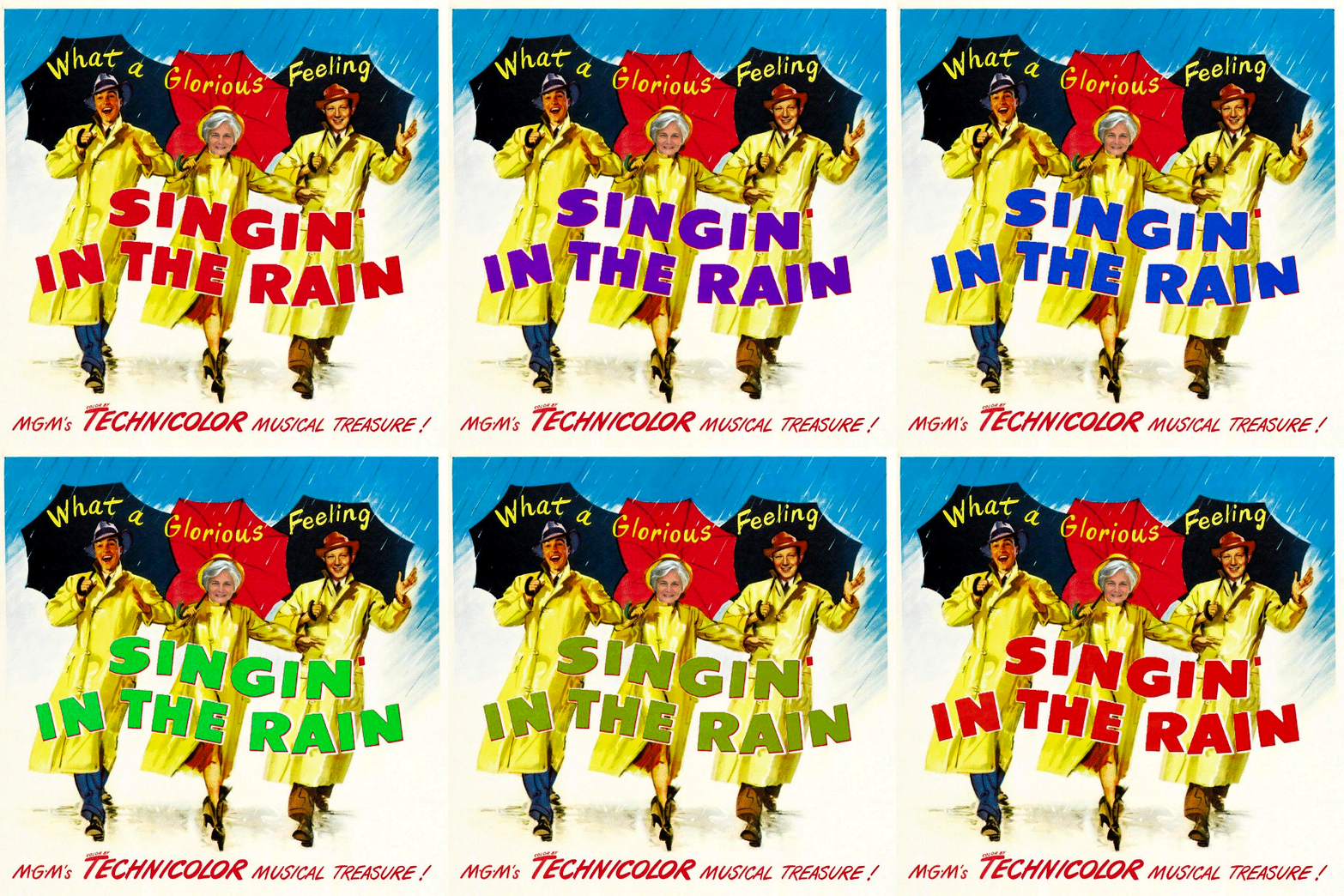
My all-time favorite movie is “Singin’ in the Rain.” I have lost track of how many times I have seen it. Every time I see it, I enjoy it all over again. Gene Kelly and Donald O’Connor are a great singing and dancing team. Nineteen-year-old Debbie Reynolds is beautiful, adorable, fresh, a wonderful ingenue. The music is delightful.
TCM has an excellent history of the movie, which is about Hollywood’s transition from silent films to talkies.
The plot hinges on Debbie Reynolds helping to save Gene Kelly’s first talkie by dubbing the voice of his co-star, who has a screechy voice.
Here is the great secret of the film, which I discovered only last year, while googling to learn more about the movie.
Debbie Reynolds’s voice was dubbed when she was supposed to be dubbing the voice of Lena Lamont!
From TCM:
“Ironically, Debbie Reynolds’ voice was dubbed by Betty Royce for the scenes where Reynolds’ character dubs CONTINUE READING: My All-Time Favorite Movie (and a Few Current Favorites) | Diane Ravitch's blog

Louisiana Educator: The Common Core Debacle Proves We Can't Educate Kids Better Than a Cave Man.

Louisiana Educator: The Common Core Debacle Proves We Can't Educate Kids Better Than a Cave Man.

The Common Core Debacle Proves We Can't Educate Kids Better Than a Cave Man.


Here is an excellent article describing the real reasons for the teacher shortage happening in other states as well as Louisiana. The following is a quote in the article from a teacher who quit teaching recently partly because she felt that the new Common Core based system imposed on her school did not allow her to address her students' individual needs in reading. She was teaching 8th grade English and had found that many of her students were reading at second or third grade level:

"At a staff meeting with a school district testing data coach and our principal, I brought up the lack of reading skills in my eighth-graders. How was I expected to bring them up five or six grade levels in one year so they could pass the state test in February and April, I asked.

Their reply was: ‘Don’t talk about kids who can’t read and our responsibility to educate them, and don’t ask questions. Head down; mouth shut. You’re no longer teachers, but managers and monitors of information."

Notice how similar this description of teacher frustration is to my earlier post on the Louisiana teacher shortage. There is now little respect for the professional opinions of teachers. The unrelenting drive is a total focus on preparing kids to score well on the state tests. But that school system has found out, just as we in Louisiana have, that the imposition of slavish prep for the state testing has not really significantly raised test scores after all.

In this post, I want to focus on the current negative effect of the CONTINUE READING: 
Louisiana Educator: The Common Core Debacle Proves We Can't Educate Kids Better Than a Cave Man.


As Ohio Budget Negotiations Drag On, Conference Committee Should Leave State School Takeovers Out of the Budget | janresseger

As Ohio Budget Negotiations Drag On, Conference Committee Should Leave State School Takeovers Out of the Budget | janresseger

As Ohio Budget Negotiations Drag On, Conference Committee Should Leave State School Takeovers Out of the Budget

This morning, July 1, marks the beginning of a new fiscal year for Ohio. Yesterday was the deadline for passage of a new budget to pay for the functions of state government for the next biennium—fiscal years 2020 and 2021.  But instead over the weekend, members of the Legislature passed a 17 day budget extension to keep the state operating while members of the Senate/House conference committee wrangle.
One of the biggest conflicts between House and Senate is over the misguided state school district takeovers established in the 2015, House Bill 70, a bill which was fast tracked through the Legislature without open hearings.
HB 70 has proven a catastrophe.  You may remember that just two months ago, the Ohio House passed HB 154 to repeal Ohio state school takeovers.  Not only did the Ohio House pass HB 154 to undo HB 70, but its members did so in spectacular, bipartisan fashion by a margin of 83/12. The House also included the repeal of HB 70 in HB 166, the House version of the FY 20-21 biennial budget.
The Ohio Senate has also been considering state school district takeovers. Distrusting teachers, school administrators, and locally elected school boards in Ohio’s poorest school districts where test scores lag, members of the Ohio Senate removed from the budget bill the House language to repeal the state school takeovers.  Senator Peggy Lehner and the Senate Education Committee she chairs convened a working group to create a complicated amendment to replace the current HB 70 state takeovers with another form of state control called the Ohio School Transformation Plan. Lehner’s committee is dominated by members of the American Legislative Exchange Council.  Lobbyists from the far-right Thomas Fordham Institute and the CONTINUE READING: As Ohio Budget Negotiations Drag On, Conference Committee Should Leave State School Takeovers Out of the Budget | janresseger

The Democratic Presidential Debate: Why Were Education and Labor Ignored (except for busing)? | Ed In The Apple

The Democratic Presidential Debate: Why Were Education and Labor Ignored (except for busing)? | Ed In The Apple

The Democratic Presidential Debate: Why Were Education and Labor Ignored (except for busing)?

As soon as the results of the 2018 congressional elections were in the race for the 2020 Democratic nomination for president began. In the era of Facebook and Twitter elections are never-ending.
There are two elections: the first will be decided on July 16th 2020: the elected delegates to the Democratic National Convention will choose a candidate, the July to November sprint to the November 3rd presidential will be a totally different election. If you don’t win the first  the second one is irrelevant.
The debates will take place almost monthly (July, September, October, November, December) with a declining field of debaters as the rules for participation narrow.
As the candidates on the stage thin, hopefully, the questioning at the debates will become more insightful.
No one will actually vote until February 3rd, the Iowa caucuses, followed by the New Hampshire primary, both dominated by older white voters, on to South Carolina, many Afro-American voters and the March 3rd super Tuesday. New York State is April 28th. (Read the primary schedule here)
Every candidate has a carefully scripted campaign.
Elizabeth Warren has focused on detailed specific policies, Bernie on Medicare for All and attacking the capitalist overlords, Biden, “experience counts,” and Booker and Harris, light on policy specifics and heavy on “its time to pass the CONTINUE READING: The Democratic Presidential Debate: Why Were Education and Labor Ignored (except for busing)? | Ed In The Apple

Jersey Jazzman: The Facts About Newark's Schools: An Update

Jersey Jazzman: The Facts About Newark's Schools: An Update

The Facts About Newark's Schools: An Update

Thanks to, among other things, Cory Booker's presidential campaign, Newark's schools remain in the spotlight. Back in 2017, Bruce Baker and I released Newark’s Schools: The Facts in an attempt to give some context to the topic. The report is admittedly long, but the story of Newark's schools can't be told in a few talking points.

That said, if I had to boil down what we found, it would be the following:


  • Newark's school system gained significant resource advantages over comparable districts, through the Abbott rulings -- a series of court cases that directed more funds to a select group of disadvantaged New Jersey school districts -- and through the proliferation of charter schools, especially those run by large charter management organizations (CMOs) such as KIPP and Uncommon Schools.
  • Much of the vaunted "growth" in Newark's test outcomes can be explained by the transition from one form of the state test (NJASK) to another (PARCC). Other, similar districts close to Newark showed similar gains in student growth, suggesting Newark wasn't doing anything unique to realize it own modest gains.
  • While Newark's charter schools have resource advantages, they aren't particularly efficient producers of student gains.
  • Newark's high-profile charter schools enroll a fundamentally different type of student than the Newark Public Schools (NPS), the city's public school district. NPS enrolls more special needs students, especially those with costly disabilities. NPS enrolls far more Limited English CONTINUE READING: Jersey Jazzman: The Facts About Newark's Schools: An Update