Latest News and Comment from Education

Tuesday, February 26, 2019

Oakland Strike: Teachers and District at Odds About Privatization | Diane Ravitch's blog #Unite4OaklandKids #WeAreOEA #WeAreCTA #strikeready #REDFORED

Oakland Strike: Teachers and District at Odds About Privatization | Diane Ravitch's blog

Oakland Strike: Teachers and District at Odds About Privatization

FOR IMMEDIATE RELEASE

Statement by Keith Brown President, Oakland Education Association, on Status of Contract Talks


I do not believe that it is helpful to bargain contracts through the media. Up until now I have refrained from discussing details to give the negotiating team on both sides room to bargain. However, after seeing a series of misleading reports come out of the administration today, I think it’s time to set the record straight.
The district says they have moved closer to OEA’s position on salary. Implied in their statement is that significant movement has happened since the strike began. This is untrue. The fact is they have yet to make an offer that will keep experienced teachers in Oakland.
The administration would lead you to believe this is only about salary. The state trustee has now joined this disinformation campaign.
Let me be clear, the union believes our students should have access to school nurses, counselors, school psychologists, librarians and other specialists. Class sizes are just too big and hinder the ability of our educators to give students the attention they deserve. These were also the issues on the table in the recent teachers’ strike in Los Angeles. In that strike, labor and management, with the help of outside mediators, crafted solutions that brought in dollars from the county and state to fund more nurses and counselors and lower class size. We should find similar creative solutions here.
We also join Los Angeles in their fight for a cap on the rapid expansion of charter schools that comes at the expense of much needed resources at our neighborhood public schools – to the tune of $57 million a year.
School closings are a critical issue in Oakland. It should be discussed at the bargaining table – they refuse.
The district’s bargaining team either lacks the creativity or the authority to craft solutions to our students’ needs and our educators’ demands.
We appreciate the Superintendent of Public Instruction’s dedication to finding a solution that puts our teachers and students front and center in this fight.
It is clear that the district does not have the support of parents and the community and are resorting to lies and misinformation to try to bring the public to their side. We ask that people be mindful of these tactics. We should expect more from our district officials. When 19 out of every 20 teachers is walking the picket line joined by parents, when our rallies attract thousands, when 97 percent of our students stay home – it’s clear that this community wants what OEA demands.

The Oakland Education Association represents 3,000 OUSD educators, including teachers, librarians, counselors, nurses, psychologists, psychiatric social workers, therapists, substitutes, and early childhood and adult teachers. OEA is affiliated with the 325,000-member California Teachers Association and the 3 million-member National Education Association.


Oakland Strike: Teachers and District at Odds About Privatization | Diane Ravitch's blog

No! We Aren't Cancelling Black History Month - We Want to Ensure Diversity Is Year Round And Diversify Our Teachers While We Are At It - Philly's 7th Ward

No! We Aren't Cancelling Black History Month - We Want to Ensure Diversity Is Year Round And Diversify Our Teachers While We Are At It - Philly's 7th Ward

NO! WE AREN’T CANCELLING BLACK HISTORY MONTH – WE WANT TO ENSURE DIVERSITY IS YEAR ROUND AND DIVERSIFY OUR TEACHERS WHILE WE ARE AT IT
Earlier this month, in these pages, Philadelphia writer Ernest Owens argued that we should cancel Black History Month and instead “recognize black history — and its people — all year round.”
I take Mr. Owens’ point, and while I don’t believe that we should cease to embrace February as a month dedicated to honoring and celebrating the many accomplishments of African Americans, I do agree that “schools must diversify their curriculums to acknowledge the existence of black people routinely,” not merely during one month of the year.
As superintendent of the School District of Philadelphia, I am proud to say that we are doing just that. We’re working to ensure that our students are exposed to rich, challenging instruction that honors their diverse backgrounds and experiences.
Our city’s schools serve a wonderfully diverse student population: as of this year, nearly half our students are African American, roughly one fifth are Hispanic, 14 percent are white, nearly 9 percent are Asian American, and several thousand identify as having multiple racial and ethnic backgrounds.
This diversity is not unique to Philadelphia; indeed, America’s public schools are more diverse than ever, especially in large cities, where students of color CONTINUE READING: No! We Aren't Cancelling Black History Month - We Want to Ensure Diversity Is Year Round And Diversify Our Teachers While We Are At It - Philly's 7th Ward


No Such Thing as a Regulated, Public, or Good Charter School | Dissident Voice

No Such Thing as a Regulated, Public, or Good Charter School | Dissident Voice

No Such Thing as a Regulated, Public, or Good Charter School


There are many diversionary dichotomies within the unscrupulous web of charter school disinformation that have long distorted social consciousness and undermined the fight for social progress and high quality education for all. Some include the following:
  1. regulated verses unregulated charter schools
  2. for-profit verses nonprofit charter schools
  3. good verses bad charter schools
  4. high-performing verses low-performing charter schools
  5. mom-and-pop verses corporate charter schools
  6. school district-approved verses “totally autonomous” charter schools
  7. well-funded verses poorly-funded charter schools
  8. no-excuses verses regular charter schools
  9. urban verses suburban charter schools
  10. small verses large charter schools
  11. online verses brick-and-mortar charter schools


These and other misleading contrasts are designed to maximize confusion and abolish the consciousness and outlook that the core underlying issue with allcharter schools is their privatized, marketized, and corporatized character. All other considerations are generally secondary, superficial, diversionary, or false in comparison to this key issue.
The privatized, marketized, and corporatized character of all charter schools is the central issue regardless of the different forms of charter schools. Form and content are not the same. Appearance and essence are not identical. It is important to look past the diversity of charter schools and appreciate their internal state; i.e., what is common and central to all of them. This will provide a much deeper understanding of charter schools. Forms and appearances are often misleading and superficial.
The privatized, marketized, and corporatized character of all charter schools is the reason why all charter schools have nothing to do with public right and instead embrace the outmoded ideologies and practices of the “free market,” private property, consumerism, competition, and possessive individualism.
The privatized, marketized, corporatized character of nonprofit and for-profit charter schools is also the reason why more than 95% of charter schools have never been started, owned, operated, or controlled by teachers since their CONTINUE READING: No Such Thing as a Regulated, Public, or Good Charter School | Dissident Voice


Amid fiscal turmoil, Sac Unified faces possible state takeover | Capitol Weekly #Unite4SACKids #WeAreSCTA #WeAreCTA #strikeready #REDFORED #SCTA #CTA

Amid fiscal turmoil, Sac Unified faces possible state takeover Capitol Weekly | Capitol Weekly | Capitol Weekly: The Newspaper of California State Government and Politics.

Amid fiscal turmoil, Sac Unified faces possible state takeover


As the Sacramento City Unified School District faces a $35 million budget shortfall and a possible takeover by the state, the teachers’ union is pointing fingers of blame at district administration.
The Sacramento City Teachers Association wrote a lengthy letterearlier this month to newly elected state Superintendent Tony Thurmond asking for the California Department of Education to investigate potential misuse of public dollars and a potential conflict of interest involving Superintendent Jorge Aguilar.
The union also requested investigation into Jorge Aguilar’s acceptance of $2,391 in honoraria for appearances at outside agencies.
“Taken as a whole, it’s a pattern of questions we have,” said David Fisher, the teacher’s union president. “We want a comprehensive investigation that won’t just look at one individual thing out of context.”

The action has received the support of Assemblymember Kevin McCarty, a Sacramento Democrat, who has called for a state audit to get to the bottom of the crisis.
But Alex Barrios, chief communications officer for the Sacramento City Unified School District, said all the accusations are a “distraction tactic” intended to shift focus away from budget challenges.
“The District has now had an opportunity to thoroughly review SCTA’s allegations,” he said in an email statement. “We have compiled evidence demonstrating that SCTA’s allegations have no merit. We look forward to presenting our evidence to (California Department of Education) as soon as we receive direction from them on whether they will consider these claims and how we should respond.”
The union’s letter outlined several areas for investigation, including a $6 million vacation buyout program for administrators.


No school board members responded to email requests for comment.
The California Department of Education is still in the process of reviewing the letter, said Cynthia Butler, the department’s spokesperson.
The union’s letter outlined several areas for investigation, including:
–Aguilar’s second part-time job at UC Merced and a subsequent data-sharing agreement between the district and UC Merced that would pay the university $1.75 million over four years.
–A $6 million vacation buyout program for administrators.
The letter also requested investigation into Aguilar’s acceptance of $2,391 in honoraria for appearances at outside agencies, potential misuse of funds at Hiram Johnson High School and the principal of New Technology High School holding a second job and not keeping CONTINUE WORKING: Amid fiscal turmoil, Sac Unified faces possible state takeover Capitol Weekly | Capitol Weekly | Capitol Weekly: The Newspaper of California State Government and Politics.


Sacramento City USD parents express concerns over 'state takeover' | abc10.com #Unite4SACKids #WeAreSCTA #WeAreCTA #strikeready #REDFORED #SCTA #CTA

Sacramento City USD parents express concerns over 'state takeover' | abc10.com

Sacramento City USD parents express concerns over 'state takeover'
Parents worry about their kids' education as the Sacramento City Unified School District continues to figure out how it can prevent being taken over by the state.


SACRAMENTO, Calif. — The Sacramento City Unified School District is still trying to figure out how it can prevent being taken over by the state.
According to SCUSD officials, the district is projected to run out of money in November. In order to avoid a state takeover, the district has to make significant cuts to balance the budget by June.

Several parents told ABC10 they're concerned about what this means for their kids' education. 
"My question is: What does that exactly mean?," said Christoper Saldaña, whose son attends a SCUSD school.
Saldaña isn't alone in feeling uncertain about what impact the state taking over will have on students.
"With things just sort of being a huge question mark right now, we're worried. We want to make sure that our school can function in the way that it needs to and that the students are getting the services that they need," added Sarah Phillips.
Parents said they received an email explaining that a takeover would mean less money to spend on students and no more local control, meaning the school board would lose its authority to make decisions.

Saldaña says he still has a lot of questions for the district about the effects of a takeover.
"We've asked the school administration and have gotten no answers," he added. "We had our parent-teacher group meeting (Tuesday), and asked, and the parent-teacher group had also gotten the email but nothing further."
Experts with the State's Fiscal Crisis and Management Assistance Team say it's taken other California school districts up to 10 years or more to recover from a state takeover.
The district says parents can stay up to date with what's going on with the budget crisis by signing up for budget alerts on its website.
Continue the conversation with Daniela on Facebook.
________________________________________________________________
The financial crisis and management team told ABC10 that the district has a long history of ups and downs - but this time the district spent more money that it has on expensive health plans for teachers. 


Oakland’s Teachers Are On Strike: How Charters Have Contributed to the School District’s Fiscal Crisis | janresseger #Unite4OaklandKids #WeAreOEA #WeAreCTA #strikeready #REDFORED

Oakland’s Teachers Are On Strike: How Charters Have Contributed to the School District’s Fiscal Crisis | janresseger

Oakland’s Teachers Are On Strike: How Charters Have Contributed to the School District’s Fiscal Crisis


In Oakland, California the school district is broke, and the teachers are on strike.
In a major report published last May, the political economist Gordon Lafer described the fiscal crisis in the Oakland Unified School District (OUSD): “In November 2017, California’s Oakland Unified School District faced a budget deficit of $15 million.  Parents, students, and teachers protested against planned cuts, which targeted everything from books and copy paper to substitute teachers and mental health professionals. ‘These cuts will touch students in every school in the district,’ said one group of parent activists, urging the Board of Education to concentrate cuts in central district offices and spare school-site staff.  Yet cutbacks at the central office also proved painful, which became apparent when the district announced plans to terminate its head librarian.  In the end, OUSD instituted $9 million in cuts, including slashing funds for academic counselors, school supplies, and even toilet paper.”
Last week, for Jacobin MagazineEric Blanc explains part of the reason: “The project of free market education reform is so widespread in America that many cities and states insist on claiming the title of ‘ground zero’ of education privatization. Whether or not Oakland can claim that unfortunate title, it’s clear that the privatizers have made huge headway in the city: Oakland is now the city in California with the highest percentage of students in privately run charters, and the city’s school district is aiming to deepen its downsizing project by closing twenty-four of the city’s eighty-seven public schools.” Blanc then publishes a who’s who of billionaires—Gary Rogers, Eli Broad, and Bill Gates—who have funded the pro-charter group, GO Public Schools, which has invested in the political campaigns of pro-charter candidates for the Oakland Board of Education, where today a majority of members support what is known as “portfolio school reform.”
Like Los Angeles, Oakland’s financial crisis is related to California’s embrace of charter schools and the school district’s adoption of a portfolio school reform governance plan by which the district manages traditional public and charter schools as though they are investments in a stock portfolio. The idea is to establish competition—launching new schools all the time and closing low scoring schools and schools that become under-enrolled.  It is CONTINUE READING: Oakland’s Teachers Are On Strike: How Charters Have Contributed to the School District’s Fiscal Crisis | janresseger

CURMUDGUCATION: FL: Further Dismantling Public Education

CURMUDGUCATION: FL: Further Dismantling Public Education

FL: Further Dismantling Public Education


Here are two not-entirely-academic questions:

Is it possible to end public education in an entire state?

Can Florida become any more hostile to public education than it already is?

Newly-minted Governor Ron DeSantis and a wild cast of privatization cronies seem to answer a resounding "yes" to both questions.

But how would you do it? What resources would you need? What tactical moves would you make? Well, as always, there's more bad education news in Florida than you can shake a "Swampland For Sale" sign at (the Tampa Bay Tims is now doing almost-daily education update columns). Remember-- Florida already has a head start with more vouchery choicey baloney than any other state, by far. But here are a couple of trends that point us in toward further privatization.

Fresh Astro-turf

Since at least the days of Governor Jeb and FEE, Florida has been fertile ground for growing well-heeled, widely-connected fake grassroots groups, and Florida's favorite face of privatization is back with yet an other group. The group is School Choice Movement, and the face is Erika Donalds.


The group launched at the start of this year (you know-- concurrently with DeSantis's term). Donalds is the lead on this group, but it also includes Shawn Frost, who graduated from Eastern Oregon University in 2006 with a BS in Experimental Psychology and a minor in philosophy. Then he picked up an MBA from Florida's Nova Southeastern University (website text- "Prepare To Dominate") and then he taught high school science for just two years at Sebastian River High School, a high-rated IBS school. There he did things like "leveraged personal network to create 'wow factor' learning experiences" and "conducted customer focus groups and survey research on student motivators and created a 'meritocracy based' incentives program." And then he got out of the classroom and back into corporate marketing work, got on a  CONTINUE READING: CURMUDGUCATION: FL: Further Dismantling Public Education


2019 Medley #4 | Live Long and Prosper

2019 Medley #4 | Live Long and Prosper

2019 Medley #4


Disrespecting Teachers,
Benefits of a Book-oriented Home,
Math is for Boys and Girls,
Poverty Affects Achievement,
Bill of Rights for School Children.


THE DISRESPECT OF TEACHERS
As professionals, teachers are disrespected.
Ed reformers blame teachers for “failing schools” but that’s because the truth is closer to home. Here we read about Michigan’s “failing schools” caused by legislative neglect or, more likely, legislative abuse.
The state’s public schools were once admired across the nation. They were well-funded and supported, and provided an excellent education for children. These schools became “the center of community life” in many places in the state, and still do in many communities.

But our state’s “new landlord”, aided and abetted by the “multi-level marketing robber barons” of West Michigan, stopped funding our schools, allowing too many of them, especially in our largest cities, to fall into neglect and disrepair. Michigan’s last governor took $1 billion from the state’s education fund, while declaring himself the “education governor”, and we wonder why Detroit’s schools don’t have the resources needed to maintain their facilities, or pay their teachers a competitive salary. Our current Secretary of Education suggested the best solution to the problems with Detroit’s schools would be to simply shut down the entire district, and let families find other places to send their children–and this is the person in charge of the nation’s public schools.
As professionals, teachers are disrespected.
The State Board of Accounts includes CPAs…the Native American Indiana Affairs Commission includes members of local Native Americans…
But a commission directly affecting teachers in Indiana has no teacher as a voting member.
Gov. Eric Holcomb followed through Tuesday on his pledge to charge a state commission with finding ways to make Indiana teacher pay more competitive with neighboring states.

However, none of the seven voting members of the Next Level Teacher Compensation Commission is a teacher.
As professionals, teachers are disrespected.
CONTINUE READING: 2019 Medley #4 | Live Long and Prosper


Education Research Report: Nonwhite school districts get $23 Billion less than white districts despite serving the same number of students

Education Research Report: Nonwhite school districts get $23 Billion less than white districts despite serving the same number of students

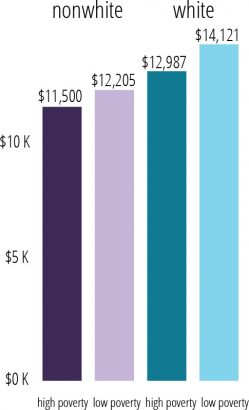
Nonwhite school districts get $23 Billion less than white districts despite serving the same number of students


The story of our communities can in many ways be told through the lens of the school districts that serve our children. More than organizations that enable learning, school districts are geographic boundaries that serve as magnifying lenses that allow us to focus on issues of race and wealth. They are both a statement of “what is” and “what could be” in our society.

School districts determine the extent to which we can integrate children in a classroom. Their borders can be used to either help remedy or further entrench a deep history of housing segregation. We can draw lines that equalize inherent disparities, or we can allow communities to isolate themselves behind unseen walls of wealth and prosperity—ensuring privilege remains solely within the grasp of the lucky few. Far too often, we choose the latter path.

The racial and economic segregation created by gerrymandered school district boundaries continues to divide our communities and rob our nation’s children of fundamental freedoms and opportunity. Families with money or status can retain both by drawing and upholding invisible lines. Many families do just that. This, in conjunction with housing segregation, ensures that—rather than a partial remedy—district geographies serve to further entrench society’s deep divisions of opportunity.

Good schools can’t solve structural inequality on their own, but neither can it be solved without them. Without an effective education, our children’s futures are all but guaranteed to succumb to the imposed conditions of their lineage and location. And even after Brown v Board, even after decades of school finance litigation meant to equalize the playing field, and even after accounting for wealth disparities, the wrenching reality endures—the United States still invests significantly more money to educate children in white communities.

Taken together, these facts lay bare a simple truth: We haven’t gone far enough.
Image result for Non White school districts get $23 Billion less than white districts despite serving the same number of students

The national story

Despite more than a half-century of integration efforts, the majority of America’s school children still attend racially concentrated school systems. This is reflective of the long history of segregation—policies related to everything from voting to housing—that have drawn lines and divided our communities. 

27% of students are enrolled in predominantly nonwhite districts. * 26% of students are enrolled in predominantly white districts. 
Race and class are inextricably linked in the U.S. When comparing the poverty level of racially concentrated systems, a clear divide emerges. Predominantly white districts are far better off than their heavily nonwhite peers. These statistics confirm what we know about income inequality and the effects of segregation. 

In the United States, 20% of students are enrolled in districts that are both poor and nonwhite,* but just 5% of students live in white districts that are equally financially challenged.
Small districts can have the effect of concentrating resources and amplifying political power. Because schools rely heavily on local taxes, drawing borders around small, wealthy communities benefits the few at the detriment of the many. 

White districts enroll just over 1,500 students— half the size of the national average, and nonwhite districts serve over 10,000 students— three times more than that average. 

For decades, courts have endorsed the idea of “local control” by demanding that states fill in the financial gaps created by district gerrymandering. In doing so, they have ignored—or even endorsed—the CONTINUE READING: Education Research Report: Nonwhite school districts get $23 Billion less than white districts despite serving the same number of students


Are these standardized test questions too hard for kids? - The Washington Post

Are these standardized test questions too hard for kids? - The Washington Post

Are these standardized test questions too hard for kids?


Texas Monthly published a story — “Are Texas Kids Failing? Or Are the Tests Rigged?” — which raises questions about whether questions on the state’s high-stakes standardized English Language Arts tests are written above grade level for many children. One Texas lawmaker, state Rep. Mary Gonzalez (D), quickly called for an investigation into the exams.
The article cites a 2012 report by two associate professors at Texas A&M University at Commerce, who analyzed English Language Arts exam reading passages and found that many were written at least two grades above grade level.
This is not a story unique to Texas, nor are the consequences of poorly worded, culturally biased or otherwise inappropriate questions on high-stakes tests. We’ve heard, for example, about problem questions for years from different states, including the infamous “talking pineapple” questions on a 2012 New York state test. Problems in New York didn’t stop, as you will learn below.
The Texas Monthly story starts this way:
Over the last few years, something strange has been happening in Texas classrooms. Accomplished teachers who knew their kids were reading on grade level by virtually all other measures were seeing those same kids fail the STAAR, the infamous State of Texas Assessments of Academic Readiness test.
The effect on students was predictable: kids who were diligently doing their homework and making good grades in class were suddenly told they were failing in the eyes of the state, which wasn’t so great for their motivation. Parents were desperate to find out why their once high-performing kids were suddenly seen as stumbling. Teachers felt like failures too but had no idea what they were doing wrong, after years of striving to adopt practices proven in successful schools across the country. What’s more, the test results were quickly weaponized by critics of Texas public schools, many of whom advocate state-funded vouchers that would allow parents to send their kids to religious and other private schools.
The stakes of such exams are perilously high. The STAAR test, developed by the Educational Testing Service in Princeton, New Jersey, had replaced one provided by the British firm Pearson, which Texas officials considered too easy. The STAAR test is used to evaluate students, teachers, individual schools and principals, school districts, and, by extension, the entire enterprise of public education in Texas. Fifth and eighth graders who fail the test can be forced to repeat a grade; high school students may not graduate if they don’t pass three of the five CONTINUE READING: Are these standardized test questions too hard for kids? - The Washington Post

Green Book Is Not Our Story – Sam Chaltain

Green Book Is Not Our Story – Sam Chaltain

GREEN BOOK IS NOT OUR STORY

Image result for GREEN BOOK IS NOT OUR STORY


It has been more than fifty years since James Baldwin first named the knotted pathology that has ensnared White and Black America in an intimate dance of mutual self-destruction for, well, ever. “The failure to look reality in the face diminishes a nation as it diminishes a person,” he wrote. America has failed, he said, because it has come to believe its own myths: The Dream. Equal Justice. The Melting Pot. And America’s greatest crime is its ongoing disinterest in any meaningful introspection. “If we are not capable of this examination,” Baldwin warned, “we may yet become one of the most distinguished and monumental failures in the history of nations.”
Which brings us to Green Book — which is, at its root, yet another story that invites us to whitewash our collective imagination in a soothing balm of Bizarro-harmony, one in which the white guy is now the driver, and the black CONTINUE READING: Green Book Is Not Our Story – Sam Chaltain


Monday, February 25, 2019

State superintendent intervenes in contract talks on Day 3 of Oakland teachers strike #Unite4OaklandKids #WeAreOEA #WeAreCTA #strikeready #REDFORED

State superintendent intervenes in contract talks on Day 3 of Oakland teachers strike

State superintendent intervenes in contract talks on Day 3 of Oakland teachers strike
Officials say Tony Thurmond will try to help both the district and the union find common ground.


CLICK HERE if you are having a problem viewing the photos on a mobile device
OAKLAND — State Superintendent of Public Instruction Tony Thurmond is stepping in today to try to settle contract talks between Oakland Unified and the local teachers union, which is striking for a third day.
Bargaining extended into the weekend, but broke down when the union’s representatives refused to lower their original demand of a 12 percent raise over three years. The district contends it can’t afford that amount because of an ongoing structural deficit, and has offered a 7 percent retroactive raise plus a 1.5 percent bonus.
Thurmond, who was endorsed and financially backed as a candidate by the California Teachers Association, will meet with both parties “to find common ground,” California Teachers Association spokesman Mike Myslinski told the Bay Area News Group.
Also over the weekend, fiscal oversight trustee Chris Learned expressed he would rescind any agreement granting the union’s proposed 12 percent raise over three years due to the district’s financial situation. Learned was appointed to oversee district financial decisions after the district went into state receivership in 2003. Though the district is no longer under receivership, it still owes the state more than $30 million from when it was. Learned has the power to veto financial decisions until the district fully pays back the loan.
“I will stay or rescind any agreement that would put the District in financial distress; A 12 percent salary increase would do just that,” Learned said in a statement released Sunday. “What the District has on the table now is what the District can afford.”
Oakland teachers are among the lowest paid in Alameda County and neighboring counties, causing a “retention crisis” in the district, a state arbitrator found. The average annual salary for Oakland teachers was $63,149 during the 2017-18 school year, according to a report from the state’s Department of Education. Salaries range from $46,570 to $83,724
Thousands of teachers, counselors and nurses took to the picket lines Thursday and Friday, and picketing resumed Monday morning. Teachers and supporters will rally at Frank Ogawa plaza around 12:30 p.m. Monday, and former U.S. Labor Secretary Robert Reich will give a speech — Reich is not involved in the contract talks, Myslinksi said. The union members will return to the picket lines around 2:30 p.m.
The district recruited fill-in teachers and assigned administrators to lead classes at its schools, although many of Oakland Unified’s 37,000 students have not attended during the strike. The union estimates only 3 percent of students attended school on Friday; the district has not released any enrollment figures for Thursday or Friday. CONTINUE READING: State superintendent intervenes in contract talks on Day 3 of Oakland teachers strike


Public Education Department plans to scrap A-F grading system | Education | santafenewmexican.com

Public Education Department plans to scrap A-F grading system | Education | santafenewmexican.com

Public Education Department plans to scrap A-F grading system


The New Mexico Public Education Department aims to scrap the state’s A-F grading system for public schools, which critics have said puts too much emphasis on student test scores.
Under proposed changes to the state’s plan to comply with the federal Every Student Succeeds Act, the agency says it will replace an accountability system that identifies schools as failing with one that classifies them by the amount of state and federal support they require.
“This is a shift in philosophy from seeing schools as failing to seeing a call to action,” said Tim Hand, deputy secretary of the education department. “This underscores how we see that our role at the Public Education Department is to lead with support.”
The effort comes as Democratic state lawmakers have introduced two measures — Senate Bill 229 by Sen. Mimi Stewart and House Bill 639 by Rep. G. Andrés Romero — that would repeal a law creating the A-F grading system.
While the House version has not yet had its first committee hearing, SB 229 has cleared the Senate Education Committee and Public Affairs Committee and is headed to the Senate floor.
But the education department won’t wait for a repeal of the school grading law to begin moving forward with its new rating system, Hand said.
“If the A-F is still in statue, then we would have to run that system,” he said. “But this is still something we can do independently.”
The agency also will be releasing a new digital dashboard in which CONTINUE READING: Public Education Department plans to scrap A-F grading system | Education | santafenewmexican.com