Latest News and Comment from Education

Saturday, July 8, 2017

Saturday Reads Diane Ravitch's blog | A site to discuss better education for all

Diane Ravitch's blog | A site to discuss better education for all:

Saturday Reads Diane Ravitch's blog
A site to discuss better education for all


Here is the Link to MAD Magazine’s Betsy Poster: “We the Unqualified”

In case you want to print out your very own Betsy poster, here is the link.

Jeff Bryant: Why Democrats Should Unite For a Charter Moratorium

Jeff Bryant argues cogently in this article that Democrats should unite on behalf of a charter school moratorium. If the ademocratic party wants to revive its base–labor and civil rights–it should heed Jeff’s sound advice. Charters and 

Jersey Jazzman: Chris Christie Show His True Colors, on the Jersey Shore

Jersey Jazzman notes that Chris Christie will soon leave office as the most unpopular governor in the nation. He loved to ridicule those who disagreed with him, and one of his favorite targets was the state’s public schools and teachers, most especially their union. He never acknowled that the state is one of the three top-performing states on national tests (NAEP), the other two being Massachuse
Indiana Voucher Study: Students Fall Behind, But Do They Really Catch Up After Four Years?

Indiana has one of the nation’s largest voucher programs (34,000 students) and has been in operation long enough to collect four years of data. The latest voucher study reached the conclusion that students who get vouchers fall behind in the first two years, notably in math, but eventually catch up to their public school peers. But do they? Steve Hinnefeld reported on the release of the study, bu
MAD Magazine “Honors” Betsy DeVos With a Poster of Her Own

A reader sent me the link to this poster, which appears in the current issue of MAD Magazine. I don’t customarily engage in ridicule, but what DeVos is doing to the public schools of America, what she is doing to civil rights enforcement, and what she is doing to college students struggling to pay for their education is beyond ridiculous.
19 State Attorneys General Sue DeVos for Delaying Rules Protecting College Students from Predatory Colleges

Led by Massachusetts Attorney General Maura Healy, the state attorneys general in 19 states sued Betsy zdezvos, who is failing to protect the interests of college students who are preyed upon by for-profit colleges, like the defunct Trump University. This Secretary has carved out a unique role as the defender of corporate interests against the rights of students. Her motto might as well be “Let t
U.S. News Kicks KIPP NYC School Off Its List of “Best High Schools” Due to Gary Rubinstein’s Analysis

Let’s begin with the stipulation that the lists of “America’s Best High Schools” based on test scores or AP coursetaking encourage schools to game the system and are invalid on their face. Then, congratulations to Gary Rubinstein! He not only demonstrated that New York City’s KIPP high school gamed the rankings by U.S. News & World Report, but the magazine noticed his critique, decided Gary was r

YESTERDAY

Your Chance to Join the Success Academy Team!

Success Academy is hiring! Of course they are always hiring teachers due to the high rate of teacher turnover. More than 50% leave every year. https://www.themuse.com/jobs/successacademycharterschools/real-estate-acquisitions-coordinator-9da675 Success Academy is looking for a Real Edtate Acquisitions Coordinator, who will report to the Associate Director of Operations, who reports to the Directo
Southold, New York: Elementary School Will Get Giant Mother Goose Shoe!

David Gamberg, superintendent of schools in both Southold and Greenport, on Long Island, in New York, had a dream. He wanted to install a custom-made Mother Goose shoe, in which children could play. He wanted it to symbolize the district’s commitment to childhood and play. He started a fundraising campaign. He was just short of his goal. A local businessman, who owns the town grocery store, contr
Borowitz: Betsy DeVos is the Only Person Who Can Stop North Korea

Andy Borowitz, who writes humorous pieces for the New Yorker, says only one person can stop North Korea. He says Betsy DeVos is enroute to North Korea to reverse its progress in math and science. Vouchers for everyone! That will cripple its nuclear program.
A Global Guide to the Power of Philanthro-Capitalism

Antonio Olmedo wrote this analysis of Philanthro-Capitalism. VENTURE PHILANTHROPY & THE NEOLIBERAL ECOSYSTEM: WHO NEEDS A MINISTRY OF EDUCATION? By Antonio Olmedo, University of Roehampton Coinciding with this year’s World Social Forum in Davos, Oxfam released a report based on Credit Suisse Global Wealth Databook [1], denouncing that the top 1% richest people have gained more income than the poo
Ohio: Kasich Vetoes Bills, Hurts Children

John Kasich likes to be unpredictable. One minute, he plays the moderate, sane Republican in contrast to irresponsible, impulsive Trump. Then he acts in Ohio and shows that he doesn’t have a clue about education, the most important responsibility and budget item in every state. Stephen Dyer of Innovation Ohio writes: “While Gov. John Kasich’s line-item veto of the Ohio Legislature’s freeze on Med


Texas: Voucher Proposal Won’t Help Children with Disabilities

They’re baaaaccckkk! The zombies called vouchers will be introduced again in the Texas State Senate, once again under the fraudulent claim that they are intended for children with disabilities. Governor Greg Abbott is calling a special 


 Diane Ravitch's blog | A site to discuss better education for all:

Keep Your Eye on These Food Policy Bills | Comstock's magazine

Keep Your Eye on These Food Policy Bills | Comstock's magazine:

Keep Your Eye on These Food Policy Bills

Image result for farm-to-school program

Since 2012, there has been a significant spike in the number of food policy legislation and ordinances passed at the state and local levels. We live in a state where 18 percent of our landfills contain edible waste and 60 percent of young children eat fast food weekly. So it’s no surprise that policymakers are taking aim at a broken food system to improve the health of California youth and the planet.

Chef Brenda Ruiz, president of the Sacramento Food Policy Council, stays abreast of multiple bills at once to educate advocates that volunteer with the council. She credits a mobilizing community for the recent burst of activity around food legislation and believes policy is the key to lasting change. The council encourages local residents to participate in the political process so their views end up reflected in the laws.

Some Sacramento advocates recently shared with Comstock’s which state legislation and local policy they’re currently watching:

SCUSD Policies

Ruiz is among the many advocates (including myself) who have provided public comment to Sacramento City Unified School District, which is taking bold steps to improve student health. In June, SCUSD announced a timeline to build a central kitchen by 2021, a facility that will expand the district’s farm-to-school program by allowing more entreés to be prepared from scratch using locally-sourced ingredients. The effort is funded by Measure R, which passed in 2012.

The SCUSD school board is also expected to approve a new school wellness policy to eliminate the marketing of junk food during Keep Your Eye on These Food Policy Bills | Comstock's magazine:


When Kids Struggle With Addiction, 'Recovery Schools' Offer Needed Support : NPR Ed : NPR

When Kids Struggle With Addiction, 'Recovery Schools' Offer Needed Support : NPR Ed : NPR:

When Kids Struggle With Addiction, 'Recovery Schools' Offer Needed Support

School For The Young And Addicted


When young people struggle through addiction or substance abuse, there's also the question of school. Getting behind academically can be detrimental to learning and future success, but traditional school can be tough for kids whose peer groups use drugs or alcohol and where treatment resources can be limited.
Research shows that students in recovery schools, designed to meet both academic and therapeutic needs, have better sobriety levels — and usually better grades, than students with addiction who remain in regular class settings. Across the country, there are just a few dozen so-called recovery schools. In Wisconsin, there is just one, with room for about 15 students.
Horizon High School sits in a strip mall on the outskirts of Madison, down the street from Target and Pick'n Save.
It's been open for 12 years and more than 150 kids have passed through the doors, at one point or another.
"At the beginning, when I first got introduced to the idea of coming here, I thought it was going to be intense, and I didn't like that idea," says Des, who's 15 and just finished her first year at Horizon. "But it's not bad, because it's a small, comfortable environment."
We aren't using Des' last name to protect her privacy. She started drinking back in middle school when, she says, her mom was in and out of jail on drug charges, which meant Des moved between guardians, neighborhoods and schools, a lot.
Des says constant uprooting led her to depression and anxiety, and she turned to alcohol, which became an addiction. After rehab and a halfway house, she says she hopes this is her last stop in recovery.
At Horizon, she gets a kind of support she didn't see at other schools. "I got in-school When Kids Struggle With Addiction, 'Recovery Schools' Offer Needed Support : NPR Ed : NPR:

Keeping retirement weird. Chipping away at public pensions: A Tier III. | Fred Klonsky

Keeping retirement weird. Chipping away at public pensions: A Tier III. | Fred Klonsky:

Keeping retirement weird. Chipping away at public pensions: A Tier III

19665469_10156331350667067_2769271255495230564_n (1)


At about the 37 minute point of our talk on Hitting Left with the Klonsky Brothers with Alderman and Democratic candidate for governor of Illinois, Ameya Pawar, and following an extended conversation about public employee pensions, I asked, “If the legislature passed a bill changing the benefit structure of the pension system, diminishing benefits, would you sign it?”
“No, I wouldn’t,” Alderman Pawar said. “Because they keep playing the same game over and over again.”
I was prescient.
Only a few hours earlier, the legislature overrode a veto by Governor Rauner, of a budget agreement.
That was good.
But part of the budget agreement was a change to the pension system that few of us knew was in the agreement.
This is bad news.
Late yesterday I received this notice from the Illinois Teachers Retirement System:
In conjunction with this week’s passage of a state budget for fiscal year 2018, the Illinois General Assembly approved a new law that significantly changes the Illinois Pension Code by creating an optional “Tier III” benefit 
Keeping retirement weird. Chipping away at public pensions: A Tier III. | Fred Klonsky:

LA’s new school board president calls for help to market district’s quality programs | EdSource

LA’s new school board president calls for help to market district’s quality programs | EdSource:

LA's new school board president calls for help to market district's quality programs


his week the school board of the nation’s second largest school district voted 4-3 to elect Ref Rodriquez, a former charter school co-founder as its new president. Rodriguez will lead the seven-member board overseeing the Los Angeles Unified School District as it recovers from a bruising set of elections in 2017 that saw $17 million spent largely by charter-school backers and teachers unions — the most in the district’s history.
Rodriguez joins three other board members who were elected this year and attracted campaign funds from charter backers. Rodriquez was elected in 2015.
His election as board president signals an ideological split within the board, as the three members who opposed him backed Richard Vladovic, a former district principal and board president. But while Vladovic has been viewed as a moderate on charter expansion in the district, his most recent campaign also enjoyed financial backing from pro-charter groups. The two other members voting against Rodriguez — Scott Schmerelson and George McKenna — have received teacher-union support.
Given the split on the board, some assume that the Rodriguez-led group will pursue an agenda that calls for an aggressive expansion of charter schools.
Last month EdSource interviewed Rodriguez and the three board members who were elected this year to gain a clearer picture of what the new charter-backed majority’s priorities will look like.
Rodriguez said he supports closing poor-performing charters and reshaping the LA’s new school board president calls for help to market district’s quality programs | EdSource:

NEA Issues Confusing Statement on Charter Schools | Dissident Voice

NEA Issues Confusing Statement on Charter Schools | Dissident Voice:

NEA Issues Confusing Statement on Charter Schools

Image result for big education ape National Education Association (NEA), the nation’s largest teachers’ union, issued a policy statement on charter schools.

On July 4, 2017 the National Education Association (NEA), the nation’s largest teachers’ union, issued a policy statement on charter schools.

The lengthy statement begins with the oft-repeated erroneous claim that charter schools “were initially promoted by educators who sought to innovate within the local public school system to better meet the needs of their students.” On the real origin of charter schools, see:
This point on the origin of charter schools is not a minor one because many sources uncritically repeat it and because it imbues the logic in the rest of the NEA’s statement.

While the NEA statement effectively highlights the many profound problems with charter schools which, properly speaking, are contract schools, it ultimately creates the impression that a charter school can be something other than a charter school, and that the real problem is unaccountable and/or privatized charter schools. In other words, charter schools can be tolerated as long as some changes are made.

Such a rendering, however, overlooks the real purpose and legal features of charter schools and why they were originally created and promoted by major owners of capital and their political representatives, not teachers and grass-roots forces. This is why, from the perspective of the rich, charter schools are not a “failed experiment.” The rich have seized tens of billions of dollars in public funds through the mechanism of charter schools.

Charter schools are contract schools, and contracting is the quintessential free market category and a main mechanism for privatization and commodification. Contract law is part of private law. This understanding is largely absent in charter school discourse. Contracting is designed specifically to remove operations, functions, funding, authority, transparency, and responsibilities from the public sphere and place them into the private sector where operational, financial, legal, and philosophical aims and standards are very different. It is worth noting that the dictionary defines “public” and “private” as the exact opposite of each other. They are distinct categories with dissimilar features and should not be confounded, as routinely happens. Properly speaking, there is really no such thing as a “public charter school.”

The NEA seems to believe that if only charter schools are authorized by locally elected members of public school boards, and if only they are held to “the same basic safeguards and standards that apply to all public schools,” then all will be well.

But charter school laws are established at the state level, and all 43 states with charter school laws explicitly and intentionally establish them as schools that can and do ignore—are meant to ignore—dozens, even hundreds, of local and state laws, rules, and regulations.

Charter school laws appeared in the neoliberal period that started aroundNEA Issues Confusing Statement on Charter Schools | Dissident Voice:

The Blackwhite World of LAUSD’s Charter Schools

The Blackwhite World of LAUSD’s Charter Schools:

The Blackwhite World of LAUSD’s Charter Schools


– George Orwell, 1984
Catherine Suitor, the Chief Development Officer of Alliance College-Ready Public [SIC] Schools is correct when she states that “encouraging parents to be involved should not be seen as a negative thing.” However, her response ignores the real issue raised by my testimony before the LAUSD School Board which is how far can a charter go before “encouragement” is actually “intimidation”? If volunteering “is not mandated,” then why does her organization keep track of the number of hours for each student? If publishing this data on the school’s website was truly meant to be “completely [the] opposite of shaming”, why are the number of hours included on the list? If the publication of this information “is a way to recognize and congratulate those who are involved”, why are the hours listed under the students’ names and not according to the people who actually “volunteered”? If the school’s “parents are eager and welcomed to be involved”, why are they not allowed to vote for their representation on the Governing Board? Instead, this Board, itself appointed by an outside organization, appoints two parents ensuring that dissension is not given a voice.
Curiously, the LA School Report article did not address the most serious allegation against the Alliance schools, which is that a list of their names is publically released on a public website.  This violates privacy rights that are supposed to be guaranteed by the Family Education Rights and Privacy Act (FERPA). Instead of responding to this allegation, Alliance quietly took down the page that linked to the information. While this is a welcome action that restores their The Blackwhite World of LAUSD’s Charter Schools:

With A Brooklyn Accent: Why The Bronx Leads the Way

With A Brooklyn Accent: Why The Bronx Leads the Way:

 Why The Bronx Leads the Way

Image result for The Bronx

They wrote us off for dead- from the halls of Congress, to the offices of banks and media conglomerates, to the announcing booth at Yankee Stadium, but we
Created a new form of music, Hip Hop, that inspired the world
Rebuilt neighborhoods devastated by fires with town houses, apartment buildings and shopping centers
Offered homes and opportunities for immigrants from every portion of the globe from Africa to Eastern Europe to Latin America and South Asia.
Became the place where those pushed out of gentrifying neighborhoods ended up settling and raising families
Showed how Muslims, Christians and Jews can live and work together in peace.
Sustained great public schools like PS 140, PS 55, Fannie Lou Hamer Freedom HS and CASA Middle School in spite of school closings, charters and vicious attacks from leaders of both parties.
We never listened to pundits. We never gave up. We created our own future
The nation has much to learn from the people of the BronxWith A Brooklyn Accent: Why The Bronx Leads the Way:


School Reform: Foolish Fads or Impossible Dream? | Larry Cuban on School Reform and Classroom Practice

School Reform: Foolish Fads or Impossible Dream? | Larry Cuban on School Reform and Classroom Practice:

School Reform: Foolish Fads or Impossible Dream?

Image result for School Reform: Foolish Fads or Impossible Dream?

“It is easier to put a man on the moon than to reform public schools.” Jerrold Zachiarias, 1966*
“Changing schools is like moving a graveyard.” Hyman Rickover, 1983**
“The history of American education is a chronicle of fads.” W.W. Charters, 1922***
“In the four decades between when I started teaching English at T.C. [Williams High School in Alexandria, Virginia] in 1970 and my retirement this year, I saw countless reforms come and go; some even returned years later disguised in new education lingo.” Patrick Welsh, 2013****
_________________________________________
These four quotes capture the clash of perspectives among ardent school reformers over the past century. Are schools rigid, unbending, self-protecting bureaucracies that seldom make deep and lasting change in governance, curriculum, and classroom practice? Or are schools faddish-driven institutions rushing to keep up with the most recent cure for whatever ails schools?
Sure, it sounds like a false either/or choice fitting the crisis-tinged rhetoric driving each wave of reform yet the historical facts are clear that all fads don’t take hold in classrooms and most schools do change in important ways. Those who indulge in the rhetoric of  reform relish dichotomies because they fit their  either-this-or-that world.  The notion of a spectrum where differences are arrayed along a continuum with a middle ground is anathema to those reformers who traffic in Chicken Little exclamations of the sky is falling.
The “chronicle of fads” crowd, mostly practitioners, point to the history of reform-after-reform and how few stick. Veteran teachers like Patrick Welsh have said repeatedly over decades that they have endured the onslaught of externally imposed “solutions” to “problems” that top officials, not teachers, had identified. Change? Schools do too much of it, this crowd says.
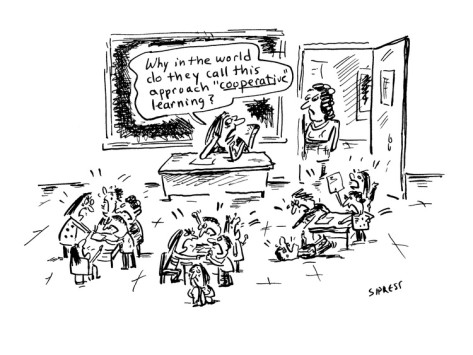
david-sipress-why-in-the-world-do-they-call-this-approach-cooperative-learning-cartoon.jpg
The “schools-never-change” crowd, mostly policy entrepreneurs, donors, and School Reform: Foolish Fads or Impossible Dream? | Larry Cuban on School Reform and Classroom Practice:

KIPP School Booted From US News Best Schools List | Gary Rubinstein's Blog

KIPP School Booted From US News Best Schools List | Gary Rubinstein's Blog:

KIPP School Booted From US News Best Schools List


U.S. News and World Report publishes an annual list of the best high schools based on a metric involving mostly AP tests.  Two months ago I noticed something strange when examining the data for a KIPP high school in New York that was ranked 29th in the country and 4th in the state on this list.  Though there is just one KIPP high school in New York, there were four KIPP high schools in the rankings.  These schools were actually middle schools.  One of those schools had 100% of their students passing an AP while the other three had 0%.  The only logical explanation for this is that KIPP manipulated their rosters, assigning kids who passed APs to one ‘school’ and kids who didn’t to the other three ‘schools’ even though they were all just part of one high school.
I wrote a post about this and some people suggested I somehow report this to US News and World Report.  I didn’t want to get into a wild goose chase about this.  I didn’t think that US News and World Report really cared if their metric had been gamed or not.
So I was pleased to learn, the other day, that US News and World Report has this update on the main page now.
Screen Shot 2017-07-07 at 9.23.03 PM
Screen Shot 2017-07-07 at 9.21.42 PM
When the original US News ranking came out, the now disqualified KIPP Academy KIPP School Booted From US News Best Schools List | Gary Rubinstein's Blog:

Friday, July 7, 2017

Julian Vasquez Heilig: An Insider's View of Charter Schools: Who Is Working Together to Improve Them? - Progressive.org

An Insider's View of Charter Schools: Who Is Working Together to Improve Them? - Progressive.org:

An Insider's View of Charter Schools: Who Is Working Together to Improve Them?

Image result for Charter Schools


During the past decades the number of students in charter schools has nearly tripled, with approximately 3.1 million students enrolled in 2016-17. In fact, one in eight black students now attends a charter in the United States. But while the popularity of charters is growing, so is concern about charter schools, particularly in the civil rights community and among grassroots educators in teachers unions.
Last summer the NAACP made national news when it called for a charter moratorium until various civil rights concerns were addressed. Other civil rights organizations—including the Journey for Justice Alliance and the Movement for Black Lives—also called for a moratorium on charter schools.
 These calls are leading the way for a shift in the national conversation about school choice, and help distinguish privatization and market-based education from real efforts to improve public education.
Last summer the leadership of the National Education Association faced an uprising of sorts from grassroots educators demanding that more critical questions be asked about transparency and accountability for charter schools. In response, NEA President Lily Eskelsen García convened a twenty-one member taskforce on Charter Schools last September, charging members to “fundamentally rethink what NEA policy should be on charter schools.”
This past week, the taskforce delivered their policy statement to a representative assembly at the NEA, and it was overwhelmingly voted into policy by educators from across the United States.
The new policy lays out three criteria charter schools must meet to provide An Insider's View of Charter Schools: Who Is Working Together to Improve Them? - Progressive.org: