
Special Nite Cap: Catch Up on Today's Post 3/7/17
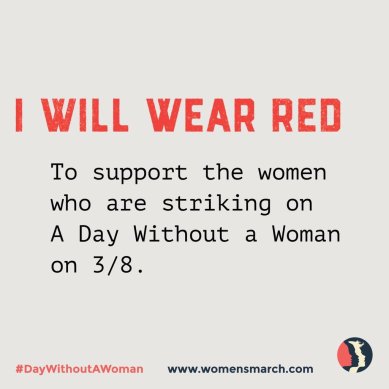
Featured PostThe 'Day Without A Woman' Strike Is Closing Schools Around The Country | The Huffington Post


Women have always been a valuable and integral part of the economy, and women’s paid work is becoming increasingly important to family well-being. In 2015, 42 percent of mothers in the United States were breadwinners, and an additional 22.4 percent were co-breadwinners, making between 25 percent and 49 percent of household earnings. The women’s strike offers an opportunity to reflect on how important women’s labor is to the country and remind Americans of what remains to be done to accurately value the work that women do to sustain the nation’s families and economy.A Day in the US Economy Without Women: Center for American Progress
How exactly would a day without women affect the economy? According to the Center for American Progress’ calculations based on the labor share of the gross domestic product, or GDP, and women’s relative pay and hours of work, women’s labor contributes $7.6 trillion to the nation’s GDP each year. In one year, women working for pay in the United States earn more than Japan’s entire GDP of $5.2 trillion. If all paid working women in the United States took a day off, it would cost the country almost $21 billion in terms of GDP. Moreover, women contribute many millions of dollars to their state’s GDP each day, making their work crucial to the health of their local economies as well.A Day in the US Economy Without Women: Center for American Progress


“That’s what America is about. A land of dreams and opportunity. There were other immigrants who came here in the bottom of slave ships, worked even longer, even harder for less. But they, too, had a dream that one day their sons, daughters, grandsons, granddaughters, great grandsons, great granddaughters might pursue prosperity and happiness in this land.”
“Obamacare is really I think the worst thing that has happened in this nation since slavery. And it is in a way, it is slavery in a way, because it is making all of us subservient to the government, and it was never about health care. It was about control.”
“There is, but it’s not where you would expect it to be. It is mostly with the progressive movement who will look at someone like me, and because of the color of my pigment, they decide that there’s a certain way that I’m supposed to think. And if I don’t think that way, I’m an Uncle Tom and they heap all kinds of hatred on you. That, to me, is racism.”

They started from the fact that there were too many students in America who did not have equal access to education. They saw that the system wasn’tTrump administration has a lot to learn about African American history. Here’s a reading list. - The Washington Post:


| Jennifer Berkshire: | Welcome to another edition of Have You Heard? I’m Jennifer Berkshire. |
| Jack Schneider: | I’m Jack Schneider. |
| Berkshire: | Jack, I think speak for America in asking the question, how exactly did you convince Michelle Rhee to be a guest on our podcast? |
| Schneider: | That’s a really good question. I promised that you and I would both agree to be evaluated in an objective way, and that we would look at the data at the Rate My Teacher – Have You Heard: |


Getting into a selective enrollment high school got even harder this year — so much Mike Klonsky's SmallTalk Blog: Two-tier school system reproducing segregation and inequality:


