Latest News and Comment from Education

Tuesday, December 6, 2016

Youth aren’t props — they need an actual seat at the policy table - The Hechinger Report

Youth aren’t props — they need an actual seat at the policy table - The Hechinger Report:

Youth aren’t props — they need an actual seat at the policy table
School discipline ranks high among concerns


Just one-third of students rate their school culture positively, according to data released this week by the San Francisco-based nonprofit YouthTruth Student.
The stat wouldn’t make for a good consumer report, but it’s amazing what we can learn when we consider youths’ perspectives.
“Students are the experts on their own experience,” said Sonya Heisters of YouthTruth, adding, “It’s important that education decision makers, from principals to superintendents, and from education funders to the education secretary, listen to this feedback.”
A positive school climate has been shown to boost academic achievement. So why aren’t there more of these studies?
Unfortunately, school leaders would rather not make any data available than share how students feel they’re treated.
Join the conversation later on Andre Perry’s radio show, “Free College,” hosted Tuesdays on WBOK1230 in New Orleans at 3pm Central/4pm Eastern 504.260.9265.
Policies dedicated for youth without their input on the front end miss a core perspective and the supposed purpose for the policy change.
Here’s a common practice: Organizers and policymakers meet for weeks planning an event or piece of legislation that is dedicated to improving the lives of youth and students. In the final hour before the policy or project’s release, someone realizes they need youth Youth aren’t props — they need an actual seat at the policy table - The Hechinger Report:

Colleges face a new reality, as the number of high schools graduates will decline - The Hechinger Report

Colleges face a new reality, as the number of high schools graduates will decline - The Hechinger Report:

Colleges face a new reality, as the number of high schools graduates will decline
An increase in low-income and minority-group students will challenge colleges to serve them better


The nation’s colleges and universities will soon face a demographic reckoning: A new report projects that the total number of high school graduates will decline in the next two decades, while the percentage of lower-income and nonwhite students will increase.


The report challenges colleges to increase the percentage of students from all demographic groups entering college and earning degrees. While more students in recent years have been enrolling in postsecondary institutions, the U.S. has struggled to enable more to graduate with a bachelor’s or associate’s degree. According to one respected tally, just under 55 percent of students who entered college in 2010 had earned degrees after six years – an increase of two percentage points since 2009.
For higher education institutions to continue at that pace or boost it, they’ll need to find new ways of educating a student body increasingly composed of people who are the first in their family to enter college. And because those students tend to have fewer financial resources, colleges may feel pressure to expend more resources to help students handle the costs of college.
“Well prepared, well resourced, full-pay students: Those are the students all institutions want because they help them meet their bottom line,” said Joe Garcia, president of the organization that released Tuesday’s report, the Western Interstate Commission for Higher Education. “But there are fewer and fewer of those students as a percentage of the total.”
Though the country’s number of high school graduates grew by 30 percent between 1995 and 2013, to 3.47 million students, by next year colleges will see a high school graduating cohort that is smaller by 81,000 students – a dip of 2.3 percent. After a few years of some Colleges face a new reality, as the number of high schools graduates will decline - The Hechinger Report:

DeVos Would Be First Ed. Sec. Who Hasn't Been a Public School Parent or Student - Politics K-12 - Education Week

DeVos Would Be First Ed. Sec. Who Hasn't Been a Public School Parent or Student - Politics K-12 - Education Week:

DeVos Would Be First Ed. Sec. Who Hasn't Been a Public School Parent or Student


President-elect Donald Trump's pick for education secretary, Betsy DeVos, would be the first person to head the department in its more than 35-year history who hasn't either attended public schools or sent her own children to them.
DeVos, a Michigan philanthropist and GOP political donor who still needs to get through U.S. Senate confirmation before she can assume the helm of the agency, studied at private schools through her entire K-12 career, graduating from Holland Christian High School in Michigan, according to a family spokesman, John Truscott. She later went on to Calvin College. 
And DeVos, a school choice and voucher advocate, sent each of her own children to private schools as well, Truscott said. He noted that some of DeVos' son and daughter-in-laws attended public schools. 
"She believes all parents should have access to the same choices her children had," said Matt Frendewey, a spokesman for the American Federation for Children, a school choice advocacy organization that DeVos chaired until recently.
DeVos' background is a departure from all past education secretaries, each of whom either attended public schools for at least a portion of their K-12 schooling, sent their own children to public schools, or both, according to a review by the Education Week Research Center of their DeVos Would Be First Ed. Sec. Who Hasn't Been a Public School Parent or Student - Politics K-12 - Education Week:

Why it's important to talk about successful black and Latino boys - LA Times

Why it's important to talk about successful black and Latino boys - LA Times:

Why it's important to talk about successful black and Latino boys

Image result for black and mexican dolls
While Chukwuagoziem Uzoegwu was growing up, his mother often would throw what he and his brothers called “educational tantrums.”
On those weekends or on random days in the long stretch of summer vacation, the Uzoegwu boys would be barred from TV “from sun up to sunset,” he said. 
“Leisure time was spent reading. Leisure time was spent writing,” said Uzoegwu, now 17 and a senior at King Drew Medical Magnet High School of Medicine and Science.
Uzoegwu attributes his upbringing with his success as a student. He has a GPA above 4.0, is taking six Advanced Placement classes and wants to attend Stanford University.
He was one of 201 L.A. County students interviewed for a new UCLA report on the experiences of successful black and Latino teenage boys in Los Angeles. 
The researchers asked faculty at six high schools to identify boys in grades 10 through 12 who either excelled academically, held leadership roles in extracurricular activities or showed resilience in their home lives. They interviewed those boys and asked them how they defined success, and what they felt had contributed to theirs.
Black and Latino students in California have lower test scores and higher rates of suspension than their white and Asian peers. Studies show that teachers treat black students more harshly than white ones as early as preschool, and some have lower academic expectations for black students. 
Tyrone Howard, a UCLA education professor and director of the school’s Black Male Institute, previously had researched achievement gaps. He started taking a close look at successful black and Latino teens about three years ago, as news of police shooting and killing young black men began to garner national attention.
“So much of what I found is that African American males were … seen as being defiant, disruptive, difficult to deal with,” Howard said. “We see young black and brown men by and large as being threats. … I don’t think we humanize them enough.”
The new report highlights how high expectations at home, safe places Why it's important to talk about successful black and Latino boys - LA Times:


Meditation Instead of Detention: Misbehavior As Learning Opportunity Rather Than a Punishment Trigger - Education Law Prof Blog

Education Law Prof Blog:

Meditation Instead of Detention: Misbehavior As Learning Opportunity Rather Than a Punishment Trigger

Image result for Meditation Instead of Detention


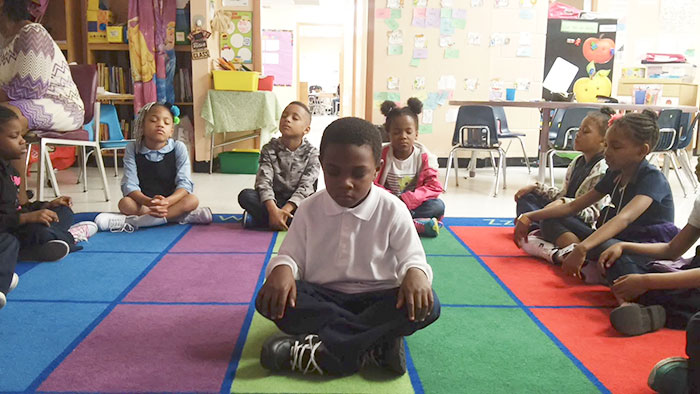
Robert Coleman Elementary School's shift from detention to meditation has been creating a lot of buzz since the media covered the story early this fall.  In late September, the school reported that it had yet to suspend a single student, attributing the fact to the increased mindfulness of students.  James Gaines describes it this way:
Instead of punishing disruptive kids or sending them to the principal's office, the Baltimore school has something called the Mindful Moment Room instead. The room looks nothing like your standard windowless detention room. Instead, it's filled with lamps, decorations, and plush purple pillows. Misbehaving kids are encouraged to sit in the room and go through practices like breathing or meditation, helping them calm down and re-center. They are also asked to talk through what happened.
I have had a number of people approach me about the story with a glow in their eye and excitement in their voice.  The results themselves are palpable, but I think the story also strikes a cord for different reasons: the approach is intuitive, humane, and strikes at the heart of the hopelessness that we so often feels in regard to the challenges our schools face.  The notion that a low-cost and effective solution is at our fingertips is simply inspiring.
My interview with Patricia Raskin digs deeper into these issues, exploring why students misbehave, why programs like these work better than punishment, and proposes other policy approaches we should incorporate.  At the heart of this conversation is the reality that students are still developing, still making honest mistakes as the navigate their changing environments, and still need the opportunity to learn from their mistakes.  In short, discipline needs to be a learning opportunity first, not a basis for exclusion. Listen to the interview here.  Also, read more about the meditation program hereEducation Law Prof Blog:

Resisting Fatalism in Post-Truth Trumplandia: Charter Schools and the End of Accountability | the becoming radical

Resisting Fatalism in Post-Truth Trumplandia: Charter Schools and the End of Accountability | the becoming radical:

Resisting Fatalism in Post-Truth Trumplandia: Charter Schools and the End of Accountability

Image result for big education ape Charter Schools and the End of Accountability

Bill asks Mike Campbell how Mike goes bankrupt, and Mike answers: “‘Two ways….Gradually and then suddenly.'”
This conversation in Ernest Hemingway’s sparse dramatization of the Lost Generation, The Sun Also Rises, also serves as a chilling characterization of how the U.S. finds itself in post-truth Trumplandia.
The paradoxes multiply for those of us in education because we can not only see but also live the reality that our post-truth U.S. is both a consequence of a country’s negligence of universal public education and the cause of that negligence—notably the uber-corrosive accountability era of the past three decades.
It seems like a distant memory, but just months ago, there appeared to be light at the end of the tunnel, a crumbling of support for charter schools on the heels of rising resistance to standards and high-stakes testing.
And then the election of Donald Trump.
And then Trump’s apparent selection of a Secretary of Education with zero experience in public education and a harsh school choice agenda.
This feels not like passing dark clouds, but a potential permanent eclipse of the sun.
However, we must resist the alluring fatalism of Trumplandia upon us even though truth and evidence have been declared defunct.
In a time of post-truth, truth becomes Kryptonite.
The Crack in Charter School Support Must Be a Harbinger of the End of the Accountability Era
“What exactly is the position of charter school supporters?” ask educators and activists Adrienne Dixson and Andre Perry, writing at The Hechinger Report. For some, the time to question charter school advocates and commitments to charter schools is well past due because the evidence is substantial that charter advocacy fails against miraculous claims and erodes community public schools.

America's Math Scores Are Getting Worse | The Huffington Post

America's Math Scores Are Getting Worse | The Huffington Post:

America’s Math Scores Are Getting Worse

New international test results show that American scores have either stagnated or slipped.


Image result for big education ape oligarchy


When it comes to literacy in math, science and reading, American teens are far from top performers, according to new results from an international exam released Tuesday.
American teens posted uninspiring results on the 2015 Program for International Student Assessment, a test taken by a sample of 15-year-olds in 70 education systems around the world. Students’ scores in reading and science remained largely stagnant since the last time the test was administered in 2012, but scores in math dropped to lows not seen since 2006. The PISA exam is administered every three years.
The United States posted average scores in reading and science compared to other countries in the Organization for Economic Cooperation and Development, an intergovernmental group of 35 mostly industrialized nations. On math, the United States scored below average, with scores of both top- and low-performing students declining. 
When disaggregated by location, the scores of students in Massachusetts, North Carolina and Puerto Rico show sharp divides. Average scores from students in Massachusetts are well above the United States average, while North Carolina scores are consistent with the nation’s overall scores. Puerto Rico’s scores were lower than the U.S. average in all three areas. 
Singapore ― while not a member of the OECD ― participated in the exam, and posted top scores in all three subjects. On the other end of the spectrum, the Dominican Republic ― also not an OECD member country ― posted the lowest scores out of any country in science and math. 
The United States had an average number of top-performing students in science and reading, but a lower than average number in math. Nine percent of American 15-America's Math Scores Are Getting Worse | The Huffington Post:

Russ on Reading: The Mis-measure of Schools and School Children

Russ on Reading: The Mis-measure of Schools and School Children:

The Mis-measure of Schools and School Children


Currently, at least 14 states grade their public schools on an A-F scale. Educators are correct to point out that this is a stupid way to hold schools accountable. Three reasons pop out right away when we think about the idiocy of giving schools a letter grade and then publicizing this grade through the media. 

  1. A letter grade cannot possibly capture the complexity of the learning society that is a school. So many factors go into what makes a school high functioning or low functioning that letter grades, leaning heavily on standardized tests, are suspect from the outset.
  2. Letter grades, again based largely on standardized test scores, narrow the curriculum and encourage poor instructional practice based on test preparation
  3. Low grades given to schools where teachers, administrators and students are working hard at overcoming the odds, destroy morale and inhibit motivation, while high grades may encourage a false complacency.
So, yes, all educators should fight against these short-sighted, narrow-cast attempts to assess their work on a school-wide basis. Unfortunately, we teachers cannot claim the moral high ground here. Teachers, after all, invented A-F grading and for the past 150 years or so have been working to convince parents, students, and community members that grades are a legitimate way to assess a student's knowledge. This is a lie. It is a lie that the public has bought into wholly and now the public, in the form of state legislatures and departments of education, is coming to punish us with our own invention.

Letter grades for students have all the same flaws as letter grades for schools, Russ on Reading: The Mis-measure of Schools and School Children:


ECOT Tries to Hold On to Over $60 Million in Tax Dollars It Collected for Phantom Students | janresseger

ECOT Tries to Hold On to Over $60 Million in Tax Dollars It Collected for Phantom Students | janresseger:

ECOT Tries to Hold On to Over $60 Million in Tax Dollars It Collected for Phantom Students


The Ohio legislature is in the midst of its lame duck session—the opportunity for lawmakers to do something about the outrageous scam at the Electronic Classroom of Tomorrow (ECOT).  And today, according to Plunderbund, Senate Bill 3, an omnibus education law with 29 amendments is to be introduced in the House Education Committee.
A big question is whether the legislature will do anything at all about regulating the out-of-control online charter sector. Here are some of the issues, according to Plain Dealer education reporter, Patrick O’Donnell, who explained last week that, “ECOT, Ohio’s largest online school, has lost a court appeal that would have blocked the state from trying to ‘claw back’ as much as $65 million the school received last year…”  ECOT—which hasn’t been keeping accurate log-in attendance records, and which has claimed that the state requires it merely to provide 920 hours of instruction for the 15,000 students the school claims it educates but not to require its students to actively use the materials for at least 20 hours per week—took the state to court earlier this year to try to block the state’s crackdown on its massive reimbursement for phantom students. ECOT has lost in court at every turn as it has appealed its case, but the school’s leaders are shameless in demanding that the state continue paying the school for the students it claims, without proper records, are enrolled.  Its total tax-dollar reimbursement is currently over $100 million, but the state wants ECOT to return over $60 million.
O’Donnell reports that now in the legislature’s lame duck session, “The schools are asking state legislators to add a ‘hold harmless’ provision to another bill in the next few weeks to stop the state from using attendance reviews of the schools to take millions of dollars of state funding away from them.”  O’Donnell describes the pressure being brought on ECOT’s behalf by Neil Clark, Ohio’s most powerful Republican lobbyist, who represents ECOT and who alleges that “the Ohio Department of Education ‘created new rules for e-schools and then applied the new rules retroactively.'”
Last March, Senate Minority Leader Joe Schiavoni of Youngstown introduced a bill to try to establish oversight of charter school enrollment.  In a press release he declared: “We need to make sure that online schools are accurately reporting attendance and not collecting tax ECOT Tries to Hold On to Over $60 Million in Tax Dollars It Collected for Phantom Students | janresseger:


NAACP moves ahead with its call for moratorium on charter schools - The Washington Post

NAACP moves ahead with its call for moratorium on charter schools - The Washington Post:

NAACP moves ahead with its call for moratorium on charter schools

Attendees listen to  Hillary Clinton speak at the NAACP annual convention at the Duke Energy Convention Center in Cincinnati on Monday, July 18, 2016. (Photo by Melina Mara/The Washington Post)
Leaders of the NAACP, the oldest civil rights organization in the United States, took a controversial stand in October by ratifying a resolution calling for a moratorium on expanding public charter school funding until there is better oversight of these schools and more transparency from charter operators.
The move by the National Association for the Advancement of Colored People — which was supported by the Movement for Black Lives and the nonprofit Journey for Justice Alliance — was hailed by public education advocates but attacked by charter school supporters. Some of the critics were from other civil rights groups, underscoring a split in that community about the privatization of public education.
Charter schools — which are publicly funded by operated independently of public districts, sometimes by for-profit companies — are one key element of corporate school reform. They are praised by supporters as offering a choice to parents whose children would otherwise be trapped in bad public schools. But critics see charters as part of the movement to privatize public education, and the growth of charter schools has drained many traditional public school systems. The charter sectors in a number of states are severely troubled because of lack of sufficient oversight.
There have been calls from within the charter movement for more accountability, but a deep divide exists, with  many advocates worrying primarily about the loss of independence that more oversight would bring. The movement is also divided on how fast to grow and even what students to embrace. For the past 25 years, charters were largely promoted to help students out NAACP moves ahead with its call for moratorium on charter schools - The Washington Post:


SKrashen: "Failing" schools, poverty and libraries

SKrashen: "Failing" schools, poverty and libraries:

"Failing" schools, poverty and libraries

Image result for poverty and libraries

S.Krashen: www. sdkrashen.com; twitter = skrashen; skrashen.blogspot.com
Presentation at Budget, Facilities and Audit Committee, Board of Education, LAUSD 
December 6, 2016

"Failing" schools, poverty, and libraries: "We are likely to find that the problems of housing and education, instead of preceding the elimination of poverty, will themselves be affected if poverty is first abolished.” (Martin Luther King, 1967) Why Dr. King was right:
1. Evidence for failure? Scores on international tests.
But: Raw scores not horrible – when poverty controlled statistically, US scores near top of the world.
Payne, K. and Biddle, B. 1999. Poor school funding, child poverty, and mathematics achievement. Educational Researcher 28 (6): 4-13;Berliner, D. 2011. The Context for Interpreting PISA Results in the USA: Negativism, Chauvinism, Misunderstanding, and the Potential to Distort the Educational Systems of Nations. In Pereyra, M., Kottoff, H-G., & Cowan, R. (Eds.). PISA under examination: Changing knowledge, changing tests, and changingschools. Amsterdam: Sense Publishers. Tienken, C. 2010. Common core state standards: I wonder? Kappa Delta Phi Record 47 (1): 14-17. Carnoy, M and Rothstein, R. 2013, What Do International Tests Really Show Us about U.S. Student Performance. Washington DC: Economic Policy Institute. 2012.http://www.epi.org/).
2. The US has a very high percentage of children living in poverty: 21%. Highest of all industrialized countries.  UNICEF Innocenti Research Centre 2012, ‘Measuring Child Poverty: New league tables of child poverty in the world’s rich countries’, Innocenti Report Card 10, UNICEF Innocenti Research Centre, Florence. Inner city (LAUSD) = 80% Finland = 4%.
- The problem is poverty. NOT: teaching, schools of ed, unions, parents, lack of national standards/tests
http://home.lausd.net/apps/news/article/344072
3. Devastating effects of poverty on school achievement (Berliner, 2009)
a. Food deprivation/nutrition

b. Lack of health care (eg school nurses in high and low poverty schools)
c. Lack of access to books (1) home; (2)  school: classroom libraries, school libraries; (3)  community: public libraries, bookstores
Beverly Hills/Watts study: (Smith, Constantino & Krashen)
Available books in the home: BH = 200; Watts = .4; Classroom libraries: BH = 400; Watts = 5 Philadelphia study (Neuman & Celano): middle-class children "deluged" with books, high poverty have difficulty getting any access

Part of the cure: libraries and librarians.

THE PIRLS Study: 4th graders in 40 countries, tested in their own language
Krashen, Lee and McQuillan (2012)
Multiple Regression Analysis: predictors of achievement PIRLS 2006 reading test
Predictor
Beta
P
SES
0.41
0.005
independent reading
0.16
0.143
library: 500 books
0.35
0.005
Instruction
-0.19
0.085
r2 = .61


Children of poverty: Library is their only source of books.
Better access to public libraries > more recreational reading
Children get many of their books for recreational reading from libraries.SKrashen: "Failing" schools, poverty and libraries:

Nevada Vouchers and More: Making Public Funds Private | deutsch29

Nevada Vouchers and More: Making Public Funds Private | deutsch29:

Nevada Vouchers and More: Making Public Funds Private

Image result for Making Public Funds Private


On September 29, 2016, the Nevada Supreme Court issued a permanent injunction against the state’s voucher, program, called the Education Savings Account (ESA) Program, also known as SB 302.
What is interesting about the ruling is that the Court did not find that the ESA Program violated the section of the Nevada Constitution prohibiting use of public money for sectarian purposes (Article 11, Section 10: “No public funds of any kind or character whatever, State, County or Municipal, shall be used for sectarian purpose.”)
As stated in the Nevada Supreme Court decision, the public money is not considered to be public because it was given from public coffers to parents:
We also conclude that funds placed in education savings accounts under SB 302 belong to the parents and are not “public funds” subject to Article 11, Section 10.
Thus, if the money does not travel directly from the public coffers to the religious school, then, according to the Nevada Supreme Court, the money is not “public money being used for sectarian purposes.”
The Nevada Supreme Court did find the ESA Program unconstitutional because it diverted money intended to fund public education from public education:
The issue remaining relates to the funding of the education savings accounts. Based on the State Treasurer’s concession that SB 302 does not operate as an appropriation bill, and that nothing in the legislative measure creating the State Distributive School Account funding for public education provides an appropriation for education savings accounts, we must conclude that the use of money that the Legislature appropriated for K-12 public education to instead fund education savings accounts undermines the constitutional mandates under Sections 2 and 6 to fund public education. Accordingly… we remand each case for the entry of a final declaratory judgment and a permanent injunction enjoining the use of any money appropriated for K-12 public education in the State Distributive School Account to instead fund the education savings accounts.
So, in order for Nevada’s ESA Program to survive, it must be funded from money specifically appropriated for the program, not from money earmarked to fund the state’s public schools.
But back to the laundering technique that makes public money “not public.”
In May 2013, the Louisiana Supreme Court declared Louisiana’s voucher program unconstitutional by a vote of 6 to 1 for a reason similar to the Nevada Supreme Court ruling: the vouchers took from funding designated for public schools. However, the Nevada Vouchers and More: Making Public Funds Private | deutsch29:


Christmas spirit at a Newark charter school–the children will “suffer” |

Christmas spirit at a Newark charter school–the children will “suffer” |:

Christmas spirit at a Newark charter school–the children will “suffer”

Image result for holiday disappointment


The Gray Charter School in Newark has warned its students they face punishment, including  reductions in their academic grades, if they do not attend and participate in a  school-sponsored holiday program scheduled off-campus at night and bring at least one adult who must purchase a $25 ticket and provide transportation after the show ends.
Verna Gray, described in school literature as the school’s founder, executive director and principal, sent a letter home to parents insisting the children in the privately-operated but publicly-funded charter school must “participate in school performances throughout the year.”
“These performances are mandatory for all students and will directly affect their Language Arts grade which includes the area of performances, public speaking, and an overall oral language grade,” Gray wrote. (Emphasis in the original letter).
If, for whatever reason, parents do not allow their children to attend the “Winter Festival,” “their grades will suffer.”
In addition, children–all of whom are in elementary grades–not attending the performance will  “be given an extra amount of homework for that evening.”
The homework, wrote Gray, will be “do in completion the next school day.” She apparently meant “due,” just as she incorrectly wrote the name of the location of the Winter Festival. She wrote it would be held at the “Roberson Campus Center” at Rutgers-Newark. The center is, in fact, named after Paul Robeson, the Christmas spirit at a Newark charter school–the children will “suffer” |:
And a Merry Christmas to you! As long as you pay for a ticker, participate, attend and find a way home.

CURMUDGUCATION: Kindergrinder Toxicity

CURMUDGUCATION: Kindergrinder Toxicity:

Kindergrinder Toxicity

Image result for kindergarten crisis


The LA Times last week ran this story aimed directly at the feels. It's the tragic cautionary tale of a poor little five year old who arrived at kindergarten only to discover that she was already behind.

At a kindergarten screening two months before her first day, she happily chattered about her dog Toodles, her favorite color pink, her Santa Claus pajamas, her nickname Gigi, her outings with dad to see SpongeBob SquarePants movies.

But many of her 21 classmates already knew most of the alphabet, colors and shapes. Two of them could even read all 100 words — at, the, there, like — that kindergartners are expected to know by the end of the year.

The story is centered around the Great Suspenseful Question-- can Gigi, who never went to pre-school and was not read to daily, ever hope to catch up?

Teresa Watanabe chronicles the tale, duly noting without question that Gigi is facing what used to be first grade work, a situation created by the Common Core. Gigi also had the great good fortune to be enrolled at Telesis Academy of Science and Math in West Covina, a school that proudly bills itself as the "first ever No Excuses Prep Academy in the nation." You'll be happy to know that thanks to a loving teacher and hard working family, Gigi's academic career was snatched from the jaws of disaster.


The whole story is immensely depressing. The major sin of Gigi's parents is that they wanted to have a childhood, one that apparently included lots of travel and outdoorsiness and familial time. Little did they realize that while they were showering their little four year old with CURMUDGUCATION: Kindergrinder Toxicity:


Rural America in the Crosshairs: A New Frontier for Profiteers - The Crucial Voice of the People

Rural America in the Crosshairs: A New Frontier for Profiteers - The Crucial Voice of the PeopleThe Crucial Voice of the People:

Rural America in the Crosshairs: A New Frontier for Profiteers


This is my plea to rural America and to all the people who carried Mr. Trump into the White House. Please remember your power and use it well. Don’t let corporate interests ruin our American small-town way of life.
Preserving our public education system is at the heart of this battle. And the public can both preserve and improve our schools…Why close them or leave them behind?education-reform-quotes-1
This past election season should give us hope. In Massachusetts (the state that has proven that true education reform is possible), voters said “NO” to lifting the cap on charter schools. Why?
“…almost all of the fiercest Question 2 opponents were cities and towns whose public schools are losing money to charter schools.”
And as one principal expressed…
“Community members and parents I talk to want to fight for the resources to improve the public schools we already have rather than opening more schools.” He [Peter Bachli] added, “It’s as if the refrigerator light went out and instead of fixing it you bought a new refrigerator.”
Many people are considering the consequences of “school choice” as we now know it. Charters, school vouchers, and technology are the main products being sold to fill the gaps in education decisively created through our laws. Yes, the market was created.
To make a buck (or billions), the education industry under the guise of education reform has put a price on the heads of children — again and still. Urban markets Rural America in the Crosshairs: A New Frontier for Profiteers - The Crucial Voice of the PeopleThe Crucial Voice of the People:

“Schools Matter” on Democrats’ Public School Betrayal | GFBrandenburg's Blog

“Schools Matter” on Democrats’ Public School Betrayal | GFBrandenburg's Blog:

“Schools Matter” on Democrats’ Public School Betrayal

Image result for too far


Jim Horn (I think) here excoriates the heads of the AFT, NEA and Diane Ravitch for helping sell out public school students, their families and their teachers to the corporate and financial oligarchs. Is he going to far? I know for a fact that Randi Weingarten is playing a very complicated double game: she personally negotiated the terrible contract in DC that started the give-back of pretty much all teacher rights in return for a mythic ally high salary that very, very few teachers will ever stick around to collect.
Is Horn going too far? Read it, and comment. I’m posting the whole thing.
Schools Matter
DeVos Will Make Democrat’s Charter Plan Easier to Sell
Posted: 05 Dec 2016 07:55 AM PST
A few years back Diane Ravitch was forced to admit openly what the opponents of testing accountability knew when No Child Left Behind became law: the ridiculous goal of 100% percent student proficiency in reading and math could never be met, and the fanciful imposition of such a pipe dream would wreak havoc across the entire K-12 education universe.
By the time Ravitch finally came around to acceding the dangerous fantasy that she had loyally promoted along with her fellow charter and voucher supporters at the Hoover Institution, almost half the schools in the U. S. had already been labeled as failures, and a reckless and corrupt corporate feeding frenzy had 
“Schools Matter” on Democrats’ Public School Betrayal | GFBrandenburg's Blog: