Latest News and Comment from Education

Thursday, November 3, 2016

Alabama governor: 'our education system in this state sucks' - WSFA.com Montgomery Alabama news.

Alabama governor: 'our education system in this state sucks' - WSFA.com Montgomery Alabama news.:

Alabama governor: 'our education system in this state sucks'


Image result for big education ape who is running the asylum


MONTGOMERY, AL (WSFA) -

The Alabama State Department of Education is reacting to Gov. Robert Bentley's critical statements in which he laid bare his thoughts on the state's education system in a single sentence. 
The comment came as Bentley spoke at the annual Alabama Association of Regional Councils Conference in downtown Montgomery.
During his speech to the 12 regional councils, which focuses on multi-jurisdictional planning and program coordination across the state, Bentley said "Our education system in this state sucks."
Bentley went on to say "I don't use that term very much but I want to tell you this: when we are 51st on our NAEP (Nations Report Card) scores in 4th-grade math in this state - that's pretty sad and it's intolerable."
NAEP, or National Assessment of Educational Progress, is the longest-lasting national trend data to gauge 4th and 8th grade math and science assessment. While it’s the only barometer of educational measurement of its kind, it only tests 4 percent of 4thand 8th grades that are randomly selected from approximately 275 schools in the state. The testing occurs every other year, on odd years. The rankings include the District of Columbia and The Department of Defense to equate to the 51st and 52ndrankings. 
New Superintendent Michael Sentance issued this statement:
“Alabama’s education system, like every public education system in America, has its fair share of challenges. When I visit classrooms, I find an enormous commitment by educators and administrators to our children and the future of Alabama. But we have to improve. I certainly share Gov. Bentley’s passion about the urgency to make every aspect of public education in Alabama better – including its performance on national assessments. I hope to make our hopes a reality in the coming years.”
Bentley's statement was followed by laughter and applause by some in the audience. 
Later when the governor was asked what exactly he meant by his statement surrounding education he said "I think that we need to look at every program and every program needs to justify their existence. If they are not working, they don't need to get money from the state...they don't need to get money from the taxpayers." 
Dr. Craig Pouncey, Jefferson County Schools superintendent, took great exception to Bentley’s statement.
"If the governor claims our educational system sucks, who has been president of the state board for the last seven years," Pouncey asked.
Pouncey was a rank and file member of the State Department of Education during the state’s many years of proration and points to lawmakers taking money from the Education Trust Fund to prop up the ailing General Fund Budget as part of the Alabama’s public education woes.    
"What we are really doing is cannibalizing ourselves in an effort to the general fund afloat. In an effort to keep our law enforcement officers on the road, Pouncey said. 
Mary Scott Hunter, the President Pro Tem of the State Board of Education, said: 
"He's obviously frustrated, and his word choice isn't constructive. But, if he's speaking to anyone it's me and my elected official colleagues. We have dedicated teachers who want their students to learn at the highest levels and parents who want so much more for their kids. But, we've had too many elected officials who, for decades, didn't expect and empower academic achievement. Today we have low household net worth, skyrocketing social services costs, crowded prisons and many other problems as a result.  Those of us in elected office now didn't create the problems that do exist nor can we take credit for all the successes. But, we can, today, have higher expectations and fight for resources to strengthen our delivery of public K-12 education."
Dr. Eric Mackey, Executive Director of the School Superintendents of Alabama issued this statement:
“It's unfortunate that the governor would insult our teachers and educators who work hard everyday to the great benefit of our state's children. His comments  are certainly demoralizing, but I can assure you that  local superintendents in counties and towns large and small all across this state will not be dissuaded in our efforts to provide the best education possible everyday for every child. We know that we have a long way to go to reach the upper tier of achievement and we have been the leading voice calling for the policy decisions to move this state's schools forward. The governor's comments disparaging educators are just unfortunate and deflating...much like when he told the PARCA meeting a few years back that we should quit teaching calculus and physics and other subjects that he suggested kids didn't need. Nevertheless, he is entitled to his opinion. Those of us doing the work don't have time to deal with this distraction.”
Alabama governor: 'our education system in this state sucks' - WSFA.com Montgomery Alabama news.:

Teaching Literature to 7th Graders: Technology Integration | Larry Cuban on School Reform and Classroom Practice

Teaching Literature to 7th Graders: Technology Integration | Larry Cuban on School Reform and Classroom Practice:

Teaching Literature to 7th Graders: Technology Integration

Image result for classic literature graphic novels

Teaching 13 year-olds takes special talents and skills. Energetic, constantly moving around, jabbing, joshing, and dozens of other behaviors are natural for these boys and girls. Teaching a 45-minute lesson on John Steinbeck’s The Pearl, then, is no easy task. And that is what faces John DiCosmo this October morning when I observe this lesson. This particular class, the teacher calls “boisterous.”
DiCosmo, an experienced teacher who has taught nearly a decade and is in his second year at Terman Middle School* is in his mid-30s. He wears a brown sport coat over a checkered red and white shirt with a slate blue tie and dark slacks. He, too, is in constant motion as he works through a series of activities with his 25 students. An instructional aide is in the room who works with about a half-dozen special education students going through the different activities that DiCosmo has planned.
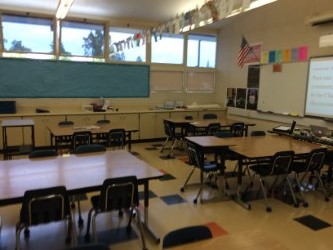
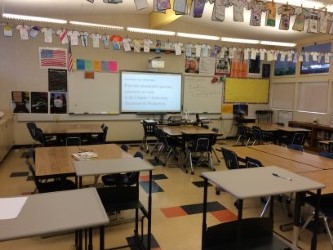
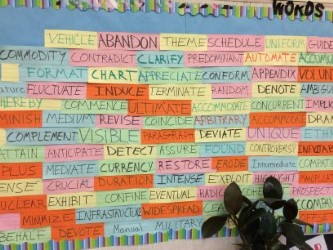
As students enter the large room and put their backpacks on tables, they go to bins in the back of the room and take copies of The Pearl and then go to a cart to grab a Macbook Laptop.  There is a word wall on one side and admonitions on the bulletin boards and walls.
dicosmo-furntables-in-dicosmo-room
word-wall
On the interactive white board (IWB), there is a “warm up” question that the teacher directs students’ attention toward: What would you do if you found a treasure of millions in cash free and clear. How would your life change?
The bell sounds and the period begins.
Students type in their answers and their answers appear on the IWB (no names attached to their answers). As DiCosmo scrolls through student responses—they are using the software called Padlet, he asks: “What’s the pattern here in the class’s answers? Students raise hands and some yell out. He calls on students. He jots down on the whiteboard what students see as patterns in their answers: buying lots of things; giving to charity.
Then the teacher asks: “Why are we asking this question?” Some students guess that the book will be about finding a treasure. After listening to student Teaching Literature to 7th Graders: Technology Integration | Larry Cuban on School Reform and Classroom Practice:

Rejecting Education by Division

Rejecting Education by Division:

Rejecting Education by Division

Charter Schools - Dividing Communities since 1991

If we accept the notion that education is the great equalizer, then we must demand that all children have equal access to education. This does not mean that we should expect that every student will have the same results. However, we should expect as a society that all children are given the opportunity to reach their full potential. Unfortunately, all of my opponents do not share the view that every child is worthy of an education.
walter-r-tweetAt first, it may seem that Walter R. Bannister, who is also running for LAUSD School Board in District 2, is one of the “deplorables” unleashed by the hate-filled campaign of Donald Trump, but the truth is that he has been spreading his message of division for a long time. In 2012 he self-published a book entitled Islam Is of the Devil that declares “the truth about Islam is that
it is a religion of war, that allows lying, and rape” and has Tweeted that we should “ban ALL nuslims [sic]  from entering the US”. He has shown his anti-semitic leanings with a post that stated that “schools need to teach the truth that most slave ships were owned and run by Jews not whites”. He calls for eliminating “forced busing” years after these desegregation programs ended. He supports “charter schools over public schools” because “charter schools tend to suspend, expel, and force out more students than public schools” and “public schools have to take everyone including drug dealers gang bangers and other trouble makers.” Bannister does not seem to recognize that these “troublemakers” often have special needs or have suffered emotional trauma and that education may be their only path to avoiding jail or homelessness.
MGAfter ten years on the LAUSD School Board, Mónica García has learned to code her language better than Bannister. Instead of naming the groups of students that she opposes, she talks about the “people I represent most”, ignoring the fact that she is supposed to represent all 640,000 students Rejecting Education by Division:


Carl J. Petersen for LAUSD School Board, District 2 because:
All Kids Are Our Kids!
The_Petersens.jpg
  • The LAUSD School Board needs a parent's perspective. None of the current Board members has a child enrolled in the district.
  • One size education does not fit all. The District must provide opportunities to all students, not just those who are college bound. We will fight to block the closure of special education centers and return funding to vocational education.Nicole_and_Carl.jpg
  • Eli Broad's plan to privatize education must be stopped. Unlike Mónica García's campaign, this campaign will not be funded by the charter industry. I will answer to the parents and students of the district, not corporate donors.
  CHANGE IS COMING!
March 7, 2017
Carl J. Petersen for LAUSD School Board 2017 (ID# 1384794) -http://www.changethelausd.com/

James Walton Paid a Consultant to Create a Colorado Charter School | deutsch29

James Walton Paid a Consultant to Create a Colorado Charter School | deutsch29:

James Walton Paid a Consultant to Create a Colorado Charter School


Walmart grandson, James Walton, wants to start a charter school in Jefferson County (Denver), Colorado, except he doesn’t want anyone to know that he is behind the school.
In August 2015, Amy Malik submitted this 738-page application to the Jefferson County Board of Education (Jeffco) in an attempt to gain approval for the Great Work Montessori School (GWMS).
However, the school’s origins are all James Walton, as I detail in this October 27, 2016, post and in this October 30, 2016, post.
But there is more.
In June 2015, Amy Malik signed a contract with one of James Walton’s nonprofits, Great Work Education Holdings (GWEH), and was paid $6,250 a month/$75,000 a year for “consulting” in order to “deliver” a charter school to James Walton, GWEH executive director:
Scope of Work: Montessori Learning Community Lead
Consulting Fee: $6,250/month – $75,000/year
Contract Period: June 25, 2015 – June 30, 2016
The following paragraph describes the duties AMY MALIK will be responsible for throughout the contract period:
Amy Malik will assist Great Work Education Holdings in developing a public charity 501c3 organization that will operate a Montessori Learning Community. Over the year Amy will develop a strong board that honors pedagogical fidelity and operational excellence. The Montessori Learning Community will aim to support families from conception through 18 years of meaningful engagement. Amy will bring her depth of experience in both the private and public school sectors to orient all practice towards human development and learning and remove as many constraints to the developmental spectrum as possible.
Deliverables:
1. By July 15th: Develop two 501c3 organizations
a. Establish by-laws, articles of incorporation
b. Distinguish the needed structure between ECE and K-12 education institutions.
2. By August 15: Develop a memorandum of understanding with Great Work Inc. documenting partnership and relationship elements between the two organizations.
3. By August 1: Investigate charter school option
James Walton Paid a Consultant to Create a Colorado Charter School | deutsch29:


Audio: California attorney general warns tech companies to follow new student data privacy laws | 89.3 KPCC

Audio: California attorney general warns tech companies to follow new student data privacy laws | 89.3 KPCC:

California attorney general warns tech companies to follow new student data privacy laws


A new report released on Wednesday by California’s Attorney General aims to send a warning to private educational technology companies hired by public schools to abide by new student data privacy laws.
“In some instances we’re seeing evidence of companies mining data from school children beyond what’s necessary for their education,” said Daniel Suvor, chief of policy for California Attorney General Kamala Harris.
That kind of data mining is illegal. Two recent laws, SB1177 and AB1584, place strict limits on how education technology companies can use public school student data. It’s illegal for these companies to collect student data to market to students or their families or take the student data and sell it to other companies.
Companies hired by public school districts must also put in writing how they’re going to keep student data secure and confidential.
Harris’s office released their report, titled "Ready for School: Recommendations for the Ed Tech Industry to Protect the Privacy of Student Data," to encourage companies to develop stronger best practices around the use of data gathered from  The intent of the recommendations is to encourage Ed Tech to focus on educational purposes, by limiting the collection and use of the student information acquired through the technology,” her office said in a written statement.
Kamala Harris’s office said the report is not timed to her run for U.S. Senator.
The report comes after meetings this year, Suvor said, with privacy advocates and technology companies.
“Most of the companies we spoke to throughout this process thought it made sense for us to lay a set of recommendations they could use to govern the sector,” he said.
The state attorney general’s office has created a way for the public to report breachesof student data privacy.
Public schools have been increasingly using technology to manage schedules, student information, and run schools. Staff also rely on technology to help them teach and test students, as well as provide educational content to students through websites and apps.
According to the report the educational technology sector has become an $8 billion yearly business.
Despite the new protections, education officials say they must remain vigilant. 
“Never assume that a company is going to follow the law,” said Alex Cherniss, superintendent of San Marino public schools. School districts need to thoroughly research a company’s reputation before signing a contract.
His school district has new electronic English curriculum this year for elementary and middle school students. Students should only need to log on with a username and password, he said, and should not have to provide any other information to access content.
The compliance is in the details of the contract between a school district and the technology company and that’s forced school districts to turn to outside lawyers for help to draw up those contracts.
“We came up with an addendum to these contracts because a lot of the vendors weren’t even aware that these laws had been passed,” said lawyer Peter Fagin of Fagen, Friedman, & Fulfrost, a law firm that represents school districts.
His firm holds workshops to train school staff and administrators on student privacy laws and how to recognize violations of the laws.
It was a struggle at first, he said, for technology companies – especially the large multinational ones – to sign off on the student privacy language school districts added to contracts but now more companies are complying.Audio: California attorney general warns tech companies to follow new student data privacy laws | 89.3 KPCC:

Proof You Shouldn't Blame Teachers For The Achievement Gap | Huffington Post

Proof You Shouldn't Blame Teachers For The Achievement Gap | Huffington Post:

Proof You Shouldn’t Blame Teachers For The Achievement Gap

New research finds that there are effective educators teaching students of all socioeconomic backgrounds.


Teachers shouldn’t be held responsible for the big gap in the achievement levels of rich and poor students, new data suggests. 
By looking at the effectiveness ratings of teachers who work with students from varying socioeconomic classes, Mathematica Policy Research determined that rich and poor children generally have access to equally impressive educators. The research, which was sponsored by the U.S. Department of Education, stands in the face of arguments that a more equitable distribution of teachers could substantially move metrics of educational attainment. 
Affluent students outperform their low-income peers on meaningful educational benchmarks. They have higher high school graduation rates and higher standardized test scores. Policymakers have said in the past that teachers might influence this gap. Indeed, previous data shows that low-income students tend to have less access to experienced teachers
“We know from past research that there is a very large gap in achievement between high- and low-income kids, and we also know some teachers are quite a bit more effective than others,” said Eric Isenberg, senior researcher for Mathematica. “So we were interested in exploring whether there’s a link between those two things ― if achievement gaps could be explained by low-income kids having less effective teacher than high income kids.” 
It surprised me its just how little difference there is on average between teachers in those two groups of kids.Eric Isenberg, senior researcher for Mathematica
The study looked at effectiveness ratings for English language arts and math teachers in 26 districts over the course of five years. These teachers worked with students in the fourth through eighth grades.
Researchers used a value-added model to measure the effectiveness of a teacher. This statistical model is controversial in the education world ― Isenberg called it an “imperfect measure,” but he said it’s the best available option. This statistical technique is used to isolate how students’ test scores change from year to year, and how much a teacher is contributing to these changes. 
Although researchers did not work with a nationally representative sample of school districts, “the study districts were chosen to be geographically diverse, with at least three districts from each of the four U.S. Census regions,” the report says. About 63 percent of the students in the studied districts qualify for free or reduced-price Proof You Shouldn't Blame Teachers For The Achievement Gap | Huffington Post:


Calif. CORE Districts Plot Privatization Measures - On California - Education Week

Calif. CORE Districts Pilot Accountability Measures - On California - Education Week:

Calif. CORE Districts Pilot Accountability Measures


Listen to the presentation from the research partnership between CORE and Policy Analysis for California Education (PACE) about the efforts to use fine-grained data about student achievement.  Heather Hough, the research project director, and Rick Miller, the CORE executive director present, accompanied by visuals.

In school accountability, flashlights work better than hammers.
That's the oft-repeated argument of California's CORE districts, a data collaborative now serving over 1.8-million students.  It's generally recognized that the practice of using data to bash schools—commonly known as naming and shaming—doesn't help them get better.  But it's still an open experiment whether illuminating school problems with more focused data will do a better job.
A recent policy briefing in Sacramento (see video above) provided crucial insights into how the data flashlight works.
Research from the partnership between CORE and Policy Analysis for California Education (PACE) suggests that data flashlights can help struggling schools pull themselves up, but that more and better data is not nearly sufficient to create a cycle of continuous improvement.  Data alone "don't drive," don't lead to immediate action, the policy brief said.
The study found that even in school districts that volunteered to become early adopters of multiple-measures accountability need additional help.  As Heather Hough, who leads the CORE/PACE research effort told the briefing session, "a lot of capacity needs to be built."  Both a culture shift and a skill shift are needed.
Partly, the capacity shift involves trying to make sense out of the numbers.  As extensive at the CORE data system is, the researchers found that districts and schools used it as a part of a larger local data system of their own making.  But the more localized indicators become, the more difficult it is to interpret the numbers.  In a couple of cases, the CORE measurement system differed slightly from the state's official one, and the schools were confounded by mixed signals. 
Partly, the culture shift comes from valuing a network of professional associations rather than relying only on formal structures.  Administrators reported informal contacts with peers in other districts, and they reported that they routinely called and texted one another on emerging issues without going through a chain of command: "There's a cross sharing that's really been...a widening and a bigger circle of collaboration than we ever had before."
Forming what are known as Professional Learning Communities has been the goal of educators for decades, and in order for these communities to be robust improvement mechanisms, they must be able to wrestle and make sense of data, said CORE executive director Rick Miller, who describes their work in the video at the top of this column.  (It's also been featured in earlier 'On California' posts about multiple indicators and how more extensive data can help intervention in struggling schools.)
But efforts to establish professional accountability were hampered by a lingering compliance mindset.  Researchers found that peer reviews of data use across districts was largely a checklist activity that did not promote reflection.
I, for one, am not discouraged that researchers found implementation efforts incomplete.  I'd be suspicious of an overly rosy report.  Implementation is always the hard part of educational policy change, and, unfortunately, it is the part that policy makers have the least patience for.
CORE created a well-constructed data and indicator system focused on equity and highlighting progress and challenges revealed by subgroups as small as 20 students.  Its districts are ahead of the curve in creating an innovative accountability measurement system in line with the needs of federal law.  I believe that CORE has great value as a research and development pilot for both the state and the nation, one that involves some of the state's largest school districts and leading research universities.
In a real way, the CORE districts serve as a real-time research and development lab for both California and the nation as it adapts to multiple measures accountability systems under the Every Student Succeeds Act.
Both for the CORE districts and for California's multiple indicator system itself rest on the ability of the schools and districts to build political confidence that they are headed in the right direction.
But as the report says, it takes time to move from a top-down to a bottom-up system.Calif. CORE Districts Pilot Accountability Measures - On California - Education Week:
Big Education Ape: InBloom Reborn: Districts join new data sharing partnership | EdSource - http://bigeducationape.blogspot.com/2016/09/districts-join-new-data-sharing.html


"Wall Street must not be allowed to hijack public education in Massachusetts," said Sen. Bernie Sanders | Common Dreams

Public Education at Stake With Mass. Voters to Decide on Pro-Charter School Measure | Common Dreams | Breaking News & Views for the Progressive Community:

Public Education at Stake With Mass. Voters to Decide on Pro-Charter School Measure

"Wall Street must not be allowed to hijack public education in Massachusetts," said Sen. Sanders

Massachusetts voters will decide the fate of Question 2, which would allow up to 12 new charter schools per year. (Photo: Save Our Public Schools)


U.S. Senator Bernie Sanders (I-Vt.) has weighed in on the most expensive statewide ballot measure voters will face November 8—Massachusetts' Question 2, which would lift the existing cap and allow for as many as 12 new charter schools per year.
Referring to the financial industry's backing of Question 2, the former presidential candidate said in a statement Tuesday, "Wall Street must not be allowed to hijack public education in Massachusetts."
"This is Wall Street's attempt to line their own pockets while draining resources away from public education at the expense of low-income, special education students and English language learners," he continued.
Indeed, the International Business Times and MapLight published last week the results of their investigation which found "that executives at eight financial firms with contracts to manage Massachusetts state pension assets have bypassed anti-corruption rules and funneled at least $778,000 to groups backing Question 2, which would expand the number of charter schools in the state. Millions more dollars have flowed from the executives to nonprofit groups supporting the charter school movement in the lead-up to the November vote."
Further, WBUR reported Sunday that while the no side "is almost entirely funded by national and local teachers' unions," over 80 percent of the contributions flowing to the yes side have come from so-called "dark money."
Foremost among those is Families for Excellent Schools, a controversial New York group whose donation total has surpassed $13.5 million so far—and keeps rising.
But other out-of-state cash comes from familiar names in support of charters, including $1.8 million from Walmart heirs Jim and Alice Walton, $240,000 from former New York mayor Michael Bloomberg and $250,000 from John D. Arnold, a Texas-based billionaire and philanthropist.
While polling last month showed the no on 2 side ahead, a Suffolk University/Boston Globe poll conducted Oct. 24-Oct. 26 showed voters equally divided —45.4 percent to 45.4 percent.
More on the Referedum in Massachusetts
Sen. Elizabeth Warren (D-Mass.) has already vocalized her opposition to the measure, expressing concern over what "this specific proposal means for hundreds of thousands of children across our Commonwealth, especially those living in districts with tight budgets where every dime matters. Education is about creating opportunity for all our children, not about leaving many behind."
That speaks to concerns of many charter school opponents—that they cherry-pick students, foster segregated schools, exclude children with disabilities, and others who may "jeopardize the academic profile of the school."

 Proponents, meanwhile, have argued that it will help "failing public schools" and offer parents a "choice." Among them is Republican Gov. Charlie Baker, who has gone "all-in"  to stump for the pro-charter measure.

According to education historian Diane Ravitch, the state is "ground zero of the charter fraud." Question 2 proponents, she wrote, are engaging in a "misleading, dishonest campaign" because "They do not explain that passage of Question 2 means that neighborhood public schools will be closed and replaced by corporate-controlled charter schools. They do not explain that more money for charter schools means less money for public schools. They do not explain that those who vote for Question 2 are voting to cut the budgets of their own public schools."
Recognizing such threats, 30 mayors in the state have come out against it, including Worcester Mayor Joseph Petty, who said the $24.5 million his city will spend on charter schools "is money that could be used to hire more teachers, improve our facilities, and invest in our students."
According to the latest count, over 200 school communities have come out against lifting the charter school cap. And support from this sector makes sense, wrote Ravitch, as "The school boards recognize that this would take money away from public schools and destroy public education in Massachusetts."
In a blog post outlining why he'll be voting no on Question 2, Christopher Martell, a professor of Social Studies Education at Boston University, wrote, "If this ballot question passes, it would have a devastating impact on our local public school districts. It would continue to weaken traditional public schools, which serve 96 percent of the state's students. This ballot question will possibly lead to a two-tiered education system in Massachusetts, with the negative impacts exacerbated in our urban communities."
Warning that so-called education reformers' success on the measure could spread to other states, Ravitch wrote: "What happens on November 8 will matter to the future of public education in America. "
School Takeovers in Georgia
Meanwhile, voters in Georgia will also vote Nov. 8 on a measure that could foster charter school expansion.
Amendment 1 would allow the state to take over "chronically failing" schools. It would take away control from local boards of education and would allow the governor to appoint a superintendent who could then choose to turn them over to charter operators. It was modeled after the Recovery School District in Louisiana and the Achievement School District in Tennessee.
WSAV calls it "the most talked about potential change to the Georgia state constitution this election year."
An 11alive poll released Tuesday found the opposition ahead—54 percent to 29 percent.
Sid Chapman, president of the Georgia Education Association, warned that if voters do choose to amend the state constitution, "Public schools as we know [them] could go away."Public Education at Stake With Mass. Voters to Decide on Pro-Charter School Measure | Common Dreams | Breaking News & Views for the Progressive Community:

5 Reasons to Fight for School Food Reform! | FoodTank.com

5 Reasons to Fight for School Food Reform! | FoodTank.com:

5 Reasons to Fight for School Food Reform!

Whether it be for our health, our environment, for social justice or education reform, changing school food can have a far-reaching impact.

 Why do I think we should care about school food reform? Here’s what my 20 years in the natural foods industry and a decade in school food tell me:


For our Health
We have been hearing a lot about the topic of health care this election cycle, and amidst the back-and-forth on the Affordable Care Act and Medicare reform, one thing always shocks me. And that’s how much time we spend talking about treating the sick and how little time we talk about preventing people from getting sick. The best preventative health initiative out there is a good diet. It reduces your risk for heart disease, cancer, stroke, and diabetes. We know that healthy eating is directly correlated to personal health and we need to invest in our future, the future of our kids and the future of our country by committing to healthy food at school.

For our Planet
Over 30 million children eat school lunch every day. Over the course of a year that adds up to 5 billion lunches served in school lunchrooms. Harnessing the purchasing power of large institutional food buyers (like schools) would have a massive impact on our environment. What if we could drive more plant forward menus in schools to reduce the amount of fossil fuel resources we expend on livestock production? How about more organics in schools? Can we move towards farmers who use eco-friendly production practices that protect and enhance the ecosystem, water quality, soil health, and bio-diversity.

For Social Justice
Packing your child a healthy, fresh lunch feels great. You zip up that lunch box and smile thinking about the nutritional love and learning fuel you’re providing.  But what about the kids who are on the free and reduced meal program? These kids step into the cafeteria at the same time as your child but get a tray of highly processed, poor quality food? Will these two kids have the same opportunity to learn?  As former Secretary of Education Arnie Duncan said, “If we are going to close the achievement gap we have to close the nutrition gap.”  To do that, we must ensure that all kids have access to a whole, fresh, nutrient dense meal, whether that be on the lunch line or from a lunch box.

For our Eating Habits
As we age we tend to become more close-minded and stuck in our ways. One of the many beauties of children is their openness to explore and try new things. This is why it’s so important to introduce fresh food, especially fruits and veggies, to our young children when they haven’t created patterned judgments already about what they do or don’t like. For example, one day my 4th grader came home raving about the Jicama she had tried on the school salad bar. I’d heard of Jicama but had never tasted it or thought of incorporating it into any food our family eats, until she made a case for it. School lunch helped sculpt her palate for healthy food, and she in turn helped change our family eating habits.  

For Our Education
What we choose to teach in school indicates to our kids what kind of knowledge adults deem important, and the same can be said for what food we choose to serve. We make sure they advance in math, reading and writing, and teach them things like cursive handwriting. But if food and nutrition education is absent from the curriculum and we compound that by serving poor quality food, what are we teaching our kids? Every child in every elementary school will eat food for the rest of their lives, and the food they eat WILL determine their ability to achieve and thrive. Improving the food in a school shows kids that food is important, and that’s something we should all care about.5 Reasons to Fight for School Food Reform! | FoodTank.com:

Wednesday, November 2, 2016

Who is advertising student data and who OWNS children’s data? – Missouri Education Watchdog

Who is advertising student data and who OWNS children’s data? – Missouri Education Watchdog:

Who is advertising student data and who OWNS children’s data?

Image result for who OWNS children’s data?

We live in a world where millions of bits of data about a person are collected and shared invisibly and your data footprint is saying things about you, predicting things about you,  that you never dreamed of.  It’s no wonder that so many people are interested in student data. Data is,  after all, moneyand there is a lot of money to be made in student data. “The SLDS data is a goldmine.”  As NEPC reports, students are under a constant state of surveillance. Requests for student data (like this from AIR) reach beyond grades, can include a student’s education record, can contain personal information about their health, their disabilities /IEPs, their income status, race, gender, age, behavior and discipline issues, and soon their emotions and social skills.  Predictive analytics and algorithms can further be used on data once it is collected, to determine everything from ADHD, attentiveness, emotion, personality, likelihood to commit future crimes, insurance risk, hire-ability score, potential career or college paths…it’s endless.  Students have no way to see how their data are predicting or choosing for them, data analtyics is getting too personal.  There are no laws regulating algorithms, they can be wrong and algorithms can be biased.  So it matters who is accessing and analyzing student data.