Latest News and Comment from Education

Tuesday, September 6, 2016

Jersey Jazzman: Back To School -- 2016

Jersey Jazzman: Back To School -- 2016:

Back To School -- 2016

Image result for Back To School -- 2016

And so another summer comes to a close, and those of us who actually teach children are headed back to our first jobs (aside from raising our families).

We'll be in our classrooms, dealing with innumerate evaluation systems put together by people who have no idea what it's like to teach in a public school. We'll be trying to figure out how we can prepare our kids for the almighty state exam without killing the love they have for learning. We'll be educating any child who walks through the doors of our schools while others extoll the virtues of "choice."

We'll be struggling -- and yes, sometimes failing -- to figure out how to run our classrooms in a way that respects all of our students, no matter who they are or where they come from. We'll fail because we're human; those of us who've been on the job for a few years are humble enough to have figured that one out. We'll fail and be our own worst critics afterward, because that's who we are and that's what we do.

We'll be working to get better, though. We'll turn to our colleagues for support and advice and we'll listen to our parents and our students and we'll keep running that long, tough mudder toward improvement. Charlotte Danielson's rubric will catch us on bad days where we're "teacher-centered" -- but we'll keep trying.

Some of us will give up. This isn't a job for everyone and a fair number of us figure that out pretty quickly. Those of us who have some wear on our tires will wave goodbye and grin ruefully. We told you. We told you...

We're already steeling ourselves for the special stupidity an election season brings to the world of education policy. We're going to get blamed for a whole host of problems: inequality, poverty, segregation, racism, economic malaise. Of course, we didn't create any of these issues on our own -- but we're the ones who are expected to fix it all.

"The best anti-poverty program is a good education!" the politicians will proclaim, all while slashing our budgets and breaking their promises to us about our middle-class benefits. If only us teachers were better! If only we really cared about our students -- you know, like the people who collect paychecks from 501(c)3's that are backed by billionaires! They are the ones speaking up for the children, not us -- and certainly not our disgusting unions!

These fine, reformy folks are the people who really know what teachers are thinking! Gadflies like me and all the others who are on my blogroll at the left are outliers! How could people like that intemperate jerk Jersey Jazzman, or Peter Greene, or Marie Corfield, or
Awo Okaikor Aryee-Price, or Katie Osgood, or Jose Luis Vilson, or Arthur Goldstein, orGary Rubinstein, or Mercedes Schneider* possibly know what teachers are actually thinking!

After all, they're only teachers...

We'll listen to this crap, mutter a few curses under our breath, and go back to our schools. We'll pick up our pointers and batons and wipeboard markers and paintbrushes and rulers 
Jersey Jazzman: Back To School -- 2016:

The Eternal Negligence of the Mainstream Media: “The World Is Not White” | the becoming radical

The Eternal Negligence of the Mainstream Media: “The World Is Not White” | the becoming radical:

The Eternal Negligence of the Mainstream Media: “The World Is Not White”

Image result for The World Is Not White

Somewhere among Urban Legend and the sort of fine-detail scholarly bickering that people outside of academia find tedious lies the truth about how many words Eskimo have for “snow.”
What is compelling about Eskimo words for “snow,” I think, is the idea that a people would become increasingly nuanced in proportion to how much something dominated their environment: Eskimo are so daily confronted with snow and the challenges of snow that they have a hundred words for all the ways it pervades their lives and world.
Conversely, in the very human effort to understand our world and human nature, one of our cliches includes a truism (speculative and mostly metaphorical) about fish being completely unaware of water since it is both ever-present and essential for their existence.
So when it comes to so-called mainstream culture in the U.S., we are, regretfully, fish and not Eskimo.
And the daily record of that obliviousness is recorded by the mainstream media.
people and black Americans
Rapinoe, a World Cup and gold-medal winner with the U.S. women’s national team, becomes the first nonblack professional athlete to join in protesting during the national anthem since Kaepernick gained notoriety for sitting out the anthem in 49ers preseason games.
I could make this a quiz, but it would be one most people would fail for the exact reason I included both examples.
The word that shall not be spoken in the U.S. is “white.”
The New York Times editors apparently believe black people are not people, but they certainly cannot cross the line and confront that it is white people who “fail to understand”—or better yet, refuse to understand—”the lives of black Americans.”
And, really ESPN? Megan Rapinoe is “nonblack”?
And if we dig beneath the “rigid refusal to look at ourselves” (read: white Americans) we are able to unmask that when politicians or the media admit the U.S. continues to have a “race” problem, that is the whitewashed code for a “racism” problem—yet the other word that dare not be uttered.
In an interview from 1984Julius Lester asked James Baldwin about “the task facing black writers,” and Baldwin replied:
This may sound strange, but I would say to make the question of color obsolete….
Well, you ask me a reckless question, I’ll give you a reckless answer—by realizing first of all that the world is not white. And by realizing that the real terror that engulfs the white world now is visceral terror. I can’t prove this, but I know it. It’s the terror of being described by those they’ve been describing for so long. And that will make the concept of color obsolete.
Baldwin’s confrontation of the power of normalizing white as that marginalizes black in the U.S. is portrayed brilliantly in a scene from Ralph Ellison’s (1952) Invisible Man where the unnamed main character finds himself in a hellish nightmare after being kicked out of college and sent on a cruel quest for work in The Eternal Negligence of the Mainstream Media: “The World Is Not White” | the becoming radical:


Has the @NAACP always had a critical view of charters? – Cloaking Inequity

Has the @NAACP always had a critical view of charters? – Cloaking Inequity:

Has the @NAACP always had a critical view of charters?


Jesse Turner, Professor of Literacy and organizer for educational change, also shares reflections and plans from the Save Our Schools march and rally. Denisha Jones, activist with all three “BUS” organizations– BadAss Teachers, United Opt Out, and SOS March — helps drive the conversation.
The Education Town Hall with Thomas Byrd is the premiere Live Wire show on We Act Radio, broadcasting from Historic Anacostia in Washington DC. It facilitates effective, community-supported approaches to education — in DC and beyond — and fosters strategic, transformational actions.
cropped-cropped-wareth61The weekly radio forum brings together public officials, advocates, students, parents, and educators to share resources and concerns. The Town Hall blog extends discussion. Participation is encouraged.

Host Thomas K Byrd is a product of DC Public Schools and a long-time education advocate in the District of Columbia.
Virginia Spatz, freelance writer/activist, serves as feature reporter.
Hear other Education Town Hall voices: http://educationtownhall.org/voices/.
Screen Shot 2016-02-25 at 9.52.32 AM
The B.U.S. Thursday program represents the perspectives of
B= Badass Teachers

U= United Opt Out

S= Save our Schools

I previously joined on the B.U.S. Thursday program on We Act Radio Education Town Hall with Rosalie Friend and we discussed the bare inequality facing US children, NPE’s national report card which is sparking national discussion and John King’s Secretary of Education confirmation hearing.
Check out and Follow my YouTube channel here.
Please Facebook Like, Tweet, etc below and/or reblog to share this discussion with others.
Want to know about Cloaking Inequity’s freshly pressed conversations about educational policy? Click the “Follow blog by email” button on the home page.
Twitter: @ProfessorJVH

CURMUDGUCATION: Brown Goes To Boston

CURMUDGUCATION: Brown Goes To Boston:
Brown Goes To Boston


Campbell Brown has decided to add her two cents to the sprawling debate about raising the charter cap in Massachusetts (and really, why not, because lord knows everyone else has added their two cents, or two million dollars).

Brown's argument is the same basic one repeated by other charter school proponents:

1) We should do it for the poor children.
2) Unions suck
3) Boston charters have had amazingly awesome results


Or as Brown puts it, "Wow. For Madeloni, her union, and their supporters, Boston charters are an extraordinary menace. Not because they are failing poor children of color, but because they are serving them so well. "


Each of these points is problematic. Let's go one at a time.

Do it for the poor children.  

Or more accurately, "do it for some poor children, but only if they speak English and are well-behaved."  Massachusetts has, to its credit, one of the best charter reimbursement formulae in the country, which means that sending Chris to a charter school doesn't mean that the ten students who stay in public school don't get totally shafted. Chris's former school still gets almost all of the per-pupil money that left with Chris-- or at least they would if Chapter 46 were fully funded, which it hasn't been for a few years now. But the proposed charter expansion is going to increase education costs for Massachusetts by many, many dollars; those dollars will either come from tax increases (unlikely) or other public education spending (more likely) or just not anywhere at all (also more likely) meaning that the charter tradition of robbing ten poor public school students to pay a charter to educate one poor student remains alive.

If charters want to do it for all the poor children, I'm listening. When you want to build a lifeboat for ten students by cannibalizing the ship that's carrying a thousand, your claim to a moral high ground is in trouble. Also, I am still waiting for charter fans to explain to taxpayers that taxes should go up so that  some few select students can be sent to private school at public expense. 

Unions suck.

Brown likes the assertion that urban public schools are entirely run by the teachers' union, and that unions only oppose charters because they are trying to preserve their big seat at the public teat.

This argument gets a little fuzzy in Massachusetts because on the one hand, Mass has some of the 
CURMUDGUCATION: Brown Goes To Boston:


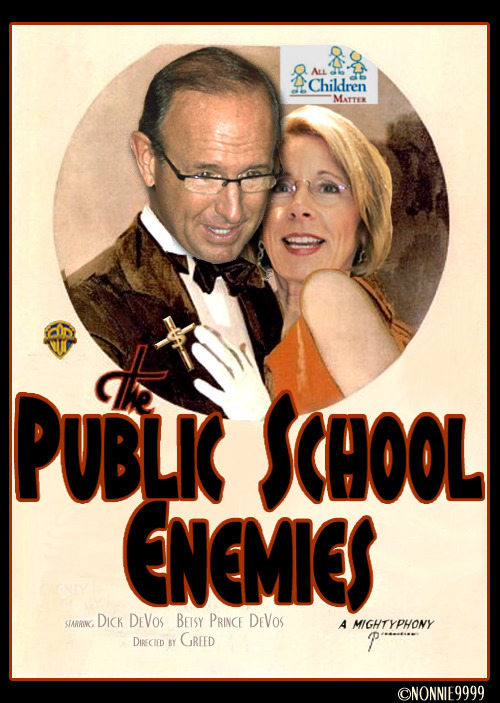
OUTRAGE: How the DeVos Family Paid the Michigan GOP to Block Charter Accountability | Diane Ravitch's blog

OUTRAGE: How the DeVos Family Paid the Michigan GOP to Block Charter Accountability | Diane Ravitch's blog:

OUTRAGE: How the DeVos Family Paid the Michigan GOP to Block Charter Accountability

Image result for DeVos Family


kay, maybe you can’t be shocked anymore to learn that billionaires have bought politicians. Still, when you read this article in the Detroit Free Press, I think you will be as outraged as I was and am. The charter lobby has outdone itself this time. I haven’t paid as much attention to the DeVos family as I should have. Their fortune comes from Amway. Betsy DeVos started a privatization organization deceptively named the American Federation for Children. The family would like to replace public education altogether, preferably with vouchers. They are devotees of the free market ideology, though they are happy to have government subsidize the free market. One thing is clear: they despise public schools and will gladly reward legislators to agree with them.
This article was written by Stephen Henderson, editorial page editor of the Detroit Free Press. If the DeVos family and the Michigan GOP wanted to help the children of Detroit, would they insist on eliminating any accountability for charter schools?
Henderson writes:
“Bought and paid for.
“Back in June, that’s how I described the Detroit school legislation that passed in Lansing — a filthy, moneyed kiss to the charter school industry at the expense of the kids who’ve been victimized by those schools’ unaccountable inconsistency.
“And now, through the wonder of campaign finance reports, we are beginning to see what it took to buy the GOP majority in Lansing, just how much lawmakers required to sell out Detroit students’ interests.
“The DeVos family, owners of the largest charter lobbying organization, has showered Michigan Republican candidates and organizations with impressive and near-unprecedented amounts of money this campaign cycle: $1.45 million in June and July alone — over a seven-week period, an average of $25,000 a day.
“The giving began in earnest on June 13, just five days after Republican members of the state Senate reversed themselves on the question of whether Michigan charter schools need more oversight.
“There’s nothing more difficult than proving quid pro quos in politics, the instances in which favor is returned for specific monetary support.
“But look at the amounts involved, and consider the DeVos’ near-sole interest in the issue of school choice. It’s a fool’s errand to imagine a world in which the family’s deep pockets haven’t skewed the school debate to the favor of their highly financed lobby.
“And in this case, it was all done to the detriment of children in the City of Detroit.
“Deep pockets, long arms
“Back in March, the Senate voted to place charter schools under the same authority as public schools in the city, for quality control and attention to population need and balance, in line with a plan that had been in the works for more than a year, endorsed and promoted by Republican Gov. Rick Snyder.
“But when the bills moved to the state House, lawmakers gutted that OUTRAGE: How the DeVos Family Paid the Michigan GOP to Block Charter Accountability | Diane Ravitch's blog:
 Image result for devos family education

Oakland Prides Itself on Being Diverse — Until It Comes Time to Send Kids to School | News Fix | KQED News

Oakland Prides Itself on Being Diverse — Until It Comes Time to Send Kids to School | News Fix | KQED News:

Oakland Prides Itself on Being Diverse — Until It Comes Time to Send Kids to School

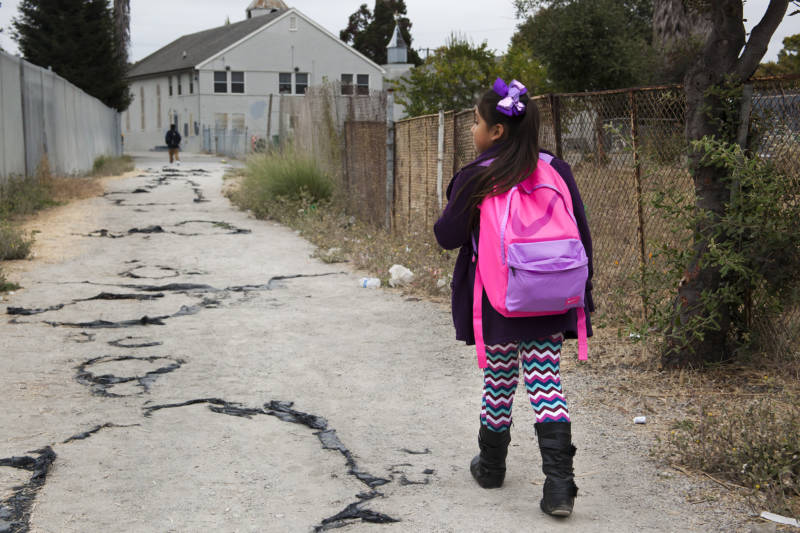
Seven-year-old Celia Fragoso walks through her neighborhood in Madison Park in the morning on her way to Sobrante Park Elementary in Oakland on Aug. 26, 2016.
Celia Fragoso, 7, walks through the Oakland neighborhood of Sobrante Park on her way to Madison Park Academy on Aug. 26, 2016.(Brittany Hosea-Small/KQED)


Walking her daughter to school in their neighborhood of Sobrante Park in East Oakland, Marina Muñoz passes an old mattress on the curb and several abandoned cars. Then she crosses an empty lot covered with old clothes and smelly trash.
“Here in East Oakland, we are all poor,” says Muñoz in Spanish. “Poor in everything, including education.”
Oakland prides itself on diversity. Students in the district’s public and charter schools are 44 percent Latino, 26 percent African-American, 13 percent Asian and 9.7 percent white. But only a handful of its public schools fully reflect the district’s diversity. They are more likely to look like their own neighborhoods, which are largely segregated by race and class. That’s due in large part to the district’s enrollment policy.
Muñoz’s kids’ school, Madison Park Academy, reflects the neighborhood. It’s 95 percent Latino and African-American, and almost all the kids qualify for free and reduced lunch. More than half the kids in elementary school are English learners. Latino kids make up the biggest ethnic group in Oakland’s public schools. They’re also the most isolated from other races and the most concentrated in high-poverty schools, here and across the state.
The principal at Madison Park Academy has made a lot of improvements in recent years, with a health clinic and wraparound services for kids and families. Still, the school has larger-than-average class sizes and low test scores, compared with the top-tier schools in the district.
That bothers Muñoz. She’s convinced her kids are not receiving the same quality education as kids in the wealthy Oakland hills. One of the most frustrating moments for her was last year, when her son was a junior in high school. She said he had a substitute teacher in one of his classes for months.
“He would say, ‘They’re not even teaching me anything. Mom, come get me, I’m not doing anything,’ ” Muñoz said. “How are we going to send our kids to college if we don’t have well-trained teachers?”Oakland Prides Itself on Being Diverse — Until It Comes Time to Send Kids to School | News Fix | KQED News:


 Read part 1 of this series.

Silicon Valley Community Foundation: Mega-Donor to Vergara and Controller of Numerous CA Nonprofits | deutsch29

Silicon Valley Community Foundation: Mega-Donor to Vergara and Controller of Numerous CA Nonprofits | deutsch29:

Silicon Valley Community Foundation: Mega-Donor to Vergara and Controller of Numerous CA Nonprofits


On August 26, 2016, I examined the 2011-2014 tax forms for the Students First Foundation (SFF), the nonprofit behind the organization, StudentsMatter, which, in turn, is the organization behind California’s recently-nixed Vergara lawsuit.
One SFF funder in particular caught my attention because of the chunk of money it sent SFF’s way in 2014:
Silicon Valley Community Foundation (SVCF): $3,191,800
SVCF (EIN 20-5205488) is located at 2440 West El Camino Real, Suite 300, Mountain View,  CA  94040.
I have been reading SVCF’s tax forms, which can be accessed here for the years 2005-2014, and I had second thoughts about downloading SVCF’s 2014 return when I saw that it is 2,970 pages long.
So much for second thoughts. Here it is: SVCF 2014 990
SVCF is a mammoth nonprofit. Here is how it describes itself:
Silicon Valley Community Foundation advances innovative philanthropic solutions to challenging social problems locally and throughout the world. Through visionary leadership and strategic grantmaking, Silicon Valley Community Foundation partners with donors and the community to strengthen the common good.
Indeed, “strengthening the common good” includes over $3 million to push Vergara.
SVCF’s 2014 beginning-of-year net assets were $3.7 billion; by the end-of year, net assets rose to $5.5 billion. Its total 2014 beginning-of-year assets (net assets plus liabilities) were $3.9 billion, and its 2014 total end-of-year assets, $5.7 billion.
Turns out that $3.6 billion of SVCF’s 2014 beginning-of-year assets come from publicly-traded securities (up to $5 billion for 2014 end-of-year).
Interestingly, SVCF listed $8 million in 2014 revenue as coming from “related organizations”– which means that SVCF is part of a network of nonprofits.
In fact, SVCF notes on its 2014 tax return that it is the “direct controlling entity” of 16 other California-based nonprofits (“supporting organizations”):
  • William H. Cilker Family Foundation
  • Driscoll Family Foundation
  • The Dirk and Charlene Kabcenell Foundation
  • The Bernard A. Newcomb Foundation
  • Raising a Reader
  • The Real Estate Trust
  • Redderre Foundation
  • Skoll Fund
  • Sobrato Foundation
  • Star Hill Fund
  • Good Ventures
  • Chong-Moon Lee Foundation
  • Intervalien Foundation
  • Innovate Public Schools
  • Startup: Education
  • Entrepreneurs’ Foundation
Here is what the SVCF website offers regarding its pitch in promoting its directly-controlled, supporting organizations:
A tax-wise alternative to a private foundation, supporting organizations allow you to hire staff and convene a board. They are far less restrictive than 
Silicon Valley Community Foundation: Mega-Donor to Vergara and Controller of Numerous CA Nonprofits | deutsch29:


Success Academy Scrubs Their Public Video Page | Gary Rubinstein's Blog

Success Academy Scrubs Their Public Video Page | Gary Rubinstein's Blog:

Success Academy Scrubs Their Public Video Page


There’s a famous saying, I think it originated with Watergate, “It’s not the crime, it’s the cover up.”
My last two blog posts have been based on videos I found on Success Academy’s public video site on Vimeo.  This is the collection of videos that they promised in The Wall Street Journal back in May after a few very public scandals.
Now Success Academy is very private about what happens in their schools so you’d figure that all their videos contain things that they are proud of.  Surely they spent considerable money producing these videos and there were many people involved in what sorts of things would be permitted to be in these videos.
There were 485 videos on the page when I first came across it a few days ago.  Randomly clicking on a few of them I found four videos among the nearly 500 that I analyzed, three in the first post and one in the second post.  I noticed in a comment today on the most recent post that the video I wrote about was taken down from the site.  Then I looked at the first post and found that two of those three videos were also removed from their site.  I went back to their site to find that all that remains of the 485 videos that were up just 24 hours ago is now down to just 56 videos.
Now you can go back and read my posts and you will see that I encourage readers to watch the videos and make their own judgements before reading my opinions on them.  Surely by posting these videos they should expect that someone might watch them and critique them, you’d figure.  But I think it is pretty sure that it isn’t a coincidence that a few days after I posted the links to these videos not only are three out of four of them removed, but over 90% of their videos are removed.
Now these videos were posted originally, presumably, to help the public schools learn what they can do to be as high performing as Success Academies.  These videos were a public service.  If this is true, it seems very harsh, cruel even, to take them down just because Success Academy Scrubs Their Public Video Page | Gary Rubinstein's Blog:

Where Students Miss the Most Class, and Why Chronic Absenteeism Is a Problem - The Atlantic

Where Students Miss the Most Class, and Why Chronic Absenteeism Is a Problem - The Atlantic:

The Long-Term Consequences of Missing School

Six million children are chronically absent, half of whom are enrolled at just 4 percent of the nation’s school districts.


The precocious teen who’s too cool for school—earning high marks despite skipping class—is a pop-culture standard, the idealized version of an effortless youth for whom success comes easy.
Too bad it’s largely a work of fiction that belies a much harsher reality: Missing just two days a month of school for any reason exposes kids to a cascade of academic setbacks, from lower reading and math scores in the third grade to higher risks of dropping out of high school, research suggests.
A new analysis of federal data shows that the problem of chronic absenteeism is both widespread and concentrated. Of the more than 6 million students who are chronically absent, half attend just 4 percent of the nation’s school districts and 12 percent of the nation’s schools. Nearly nine in 10 districts report chronically absent students, based on data from the 2013-14 school year, a figure that some experts believe is an undercount. The report defines chronic absenteeism as missing at least 15 school days each year, which is roughly 10 percent of the academic calendar.
Pinpointing the students who miss school that often is crucial, said Hedy Chang, a co-author of the report and the director of the advocacy group Attendance Works. “Is the issue that kids are coming to class but they're not learning, or is the issue that there's so much chronic absence that kids are missing out on the instruction, and not learning?” she asked during a call last week with reporters.

Robert Balfanz, the other co-author of the report and the director of the Everyone Graduates Center at Johns Hopkins University, said districts with high levels of chronic absenteeism are located in diverse settings, from large urban centers and affluent suburbs to small post-industrial towns and rural enclaves. “We have to know where we have to go to find these kids who are chronically absent, and tailor our approach to the situation,” he said. “A big benefit of this report is it helps us understand the contours of chronic absenteeism.”
In the Philadelphia school district, 37 percent of the system’s 144,000 are chronically absent. Among high-school students, the figure shoots up to 51 percent. The districts in Baltimore and Milwaukee have similar numbers. For Cleveland and Detroit, the chronic absenteeism rates are around 50 percent, and more than 60 percent of Cleveland’s high-schoolers missed more than three weeks of school a year.

The report’s authors write that one common denominator linking these cities is the “nearly 100 years of historical actions that aimed to segregate African American populations in sections of the city with the poorest housing, greatest proximity to industrial pollutants, greatest exposure to violence, and highest unemployment rates, resulting in widespread inter-generational poverty.”

Tyrone Howard, an associate dean of inclusion and an education professor at the University of California, Los Angeles, said in an email that “chronic absenteeism is typically one of the most ardent signs that something serious may be happening with a student and his or her family.” He noted that students who skip school may be caring for younger siblings, experiencing neglect or homelessness—a plight endured by 1.3 million U.S. students—or facing related traumas.

“Such episodes can lead to students avoiding school for long periods of time,” he added.

Some districts with high levels of chronic absence have more resources than others. Chang and Balfanz’s research shows that affluent suburban districts, such as those in Fairfax County, Virginia, and Montgomery County, Maryland, post some of the highest absenteeism numbers in the country, likely as a result of their growing low-income populations, though the communities’ wealth can provide the financial backstop to support students who are missing too much class. In fact, recent reporting from U.S. News & World Report found that some rich suburban districts receive more federal aid for low-income students than smaller but far poorer districts.

Also at risk are the hundreds of thousands of students in smaller, post-industrial cities, “places like Utica, Schenectady, and Albany in New York, and Syracuse and Buffalo, all of them have very high rates of chronic absenteeism, often topping 50 percent, and they all often have very high rates of concentrated poverty," said Balfanz. "That's part of the challenge, that many states have these sort of economically and socially isolated cities spread out across the state."
The economic malaise of these cities rarely receives national attention, argued Paul Jargowsky, a Rutgers University professor, at an Education Writers Association seminar in Chicago last fall on poverty and education.

UCLA’s Howard joins other scholars in advocating for more social workers and psychologists on school campuses to address the factors that may drive chronic absenteeism. An NPR story recently spotlighted a principal in St. Louis who acquired several free washers and dryers after learning some students avoided school because they lacked clean clothing.

Other researchers and school leaders point to districts collaborating with local charities or agencies to address chronic absenteeism. The Nashville school Where Students Miss the Most Class, and Why Chronic Absenteeism Is a Problem - The Atlantic:


Black Teachers Matter | Mother Jones #EDUCOLOR

Black Teachers Matter | Mother Jones:

BLACK TEACHERS MATTER


America’s schools desperately need educators like Darlene Lomax. So why are we driving them away?

One spring morning this year, Darlene Lomax was driving to her father's house in northwest Philadelphia. She took a right onto Germantown Avenue, one of the city's oldest streets, and pulled up to Germantown High School, a stately brick-and-stone building. Empty whiskey bottles and candy cartons were piled around the benches in the school's front yard. Posters of the mascot, a green and white bear, had browned and curled. In what was once the teachers' parking lot, spindly weeds shot up through the concrete. Across the street, above the front door of the also-shuttered Robert Fulton Elementary School, a banner read, "Welcome, President Barack Obama, October 10, 2010."

It had been almost three years since the Philadelphia school district closed Germantown High, and 35 years since Lomax was a student there. But the sight of the dead building, stretching over an entire city block, still pained her. She looked at her old classroom windows, tinted in greasy brown dust, and thought about Dr. Grabert, the philosophy teacher who pushed her to think critically and consider becoming the first in her family to go to college. She thought of Ms. Stoeckle, the English teacher, whose red-pen corrections and encouraging comments convinced her to enroll in a program for gifted students. Lomax remembers the predominantly black school—she had only one white and one Asian American classmate—as a rigorous place, with college preparatory honors courses and arts and sports programs. Ten years after taking Ms. Stoeckle's class, Lomax had dropped by Germantown High to tell her that she was planning to become a teacher herself.


A historic Georgian Revival building, Germantown High opened its doors in 1915 as a vocational training ground for the industrial era, with the children of blue-collar European immigrants populating its classrooms. In the late 1950s, the district added a wing to provide capacity for the growing population of a rapidly integrating neighborhood.


By 1972, Lomax's father, a factory worker, had saved up enough to move his family of eight from a two-bedroom apartment in one of the poorest parts of Philadelphia into a four-bedroom brick house in Germantown. Each month, Darlene and her younger sister would walk 15 blocks to the mortgage company's gray stucco building, climb up to the second floor, and press a big envelope with money orders into the receptionist's hand. The new house had a dining room and a living room, sparkling glass doorknobs, French doors that opened into a large sunroom, an herb garden, and a backyard with soft grass and big trees. Darlene and her father planted tomatoes and made salads with the sweet, juicy fruit every Friday, all summer long.


To the Lomax children, the fenceless backyard was ripe for exploration, and it funneled them right to the yards of their neighbors. One yard belonged to two sisters who worked as special-education teachers—the first black people Darlene had met who had college degrees. As Lomax got to know these sisters, she began to think that perhaps her philosophy teacher was right: She, too, could go to college and someday buy a house of her own with glass doorknobs and a garden. She graduated from Rosemont College in 1985, and after a stint as Black Teachers Matter | Mother Jones: