Latest News and Comment from Education

Tuesday, May 10, 2016

Charter Schools: The Next Nationwide Scandal

Charter Schools: The Next Nationwide Scandal:

Charter Schools: The Next Nationwide Scandal

As public school districts across the U.S. increasingly struggle with diminishing funds and a less-than-stellar reputation for quality education, charter schools have become a more popular option for parents — especially those in poorer urban areas where traditional private schools are not an affordable option. Charter school organizations, while generally structured as nonprofits, said they could do more with fewer resources and improve students’ academic performance.
But while they seek public funds, the evidence suggests that some of these school operators are less than transparent about how they want to spend these funds, while others have balked at disclosing how students within their schools are performing in the classroom.
One such charter school operator is KIPP, which manages 183 charter schools enrolling 70,000 students from coast to coast. According to the Center for Media and Democracy, in recent years KIPP informed the Department of Education (DOE) that some information about its revenues and classroom performance is “proprietary,” even though the company has applied for millions in grants paid for by federal taxpayers. In fact, one grant application contained redacted information related to the amount of money KIPP received from private foundations.
Meanwhile, financial statements submitted to the DOE reveal that, while receiving over $61 million in private grants in 2013, KIPP spent:
  • Over $400,000 on advertising and almost $5 million on travel expenses, including $1.2 million at Walt Disney World.
  • Almost $14 million on compensation, including over $1.2 million on nine executives, plus another $2 million on retirement packages.
  • $1.2 million to an analytics consultant in an attempt to rebuff any DOE concerns over academic performance and drop-out rates.
2011 university study also found that KIPP schools’ performance was not necessarily better than their competing schools in public education districts, and in fact, on the metrics were sometimes even worse. Many schools were found to have a higher attrition rate. And that one leading KIPP selling point, the retention of African American male students, was often a struggle — 40 percent of African American boys from the sixth to eighth grades left KIPP schools.
Other investigations found similar problems with other charter school systems across the U.S. In New Orleans, where public schools transformed into virtually an all-charter system after Hurricane Katrina, the city’s experiment has brought at best dubious results when it comes to attrition, graduation rates and the number of school suspensions. As the emphasis over the past decade focused more closely on student testing, “difficult to teach” kids have fallen through the cracks and critics say too many students are simply abandoned by the revamped school system.
And in Ohio, Politico reported that the Buckeye State’s struggles with charter schools could have damaged Gov. John Kasich’s political prospects if he had miraculously become the Republican presidential nominee. While applying for federal charter school grants, the state’s charter school director reportedly neglected to include failing grades in key charter schools’ performance analyses. The state received $71 million in federal funds. Some state leaders questioned the value of the awards given charter schools’ declining reputation in the state. The number of poorly performing schools increased from nine to Charter Schools: The Next Nationwide Scandal:
 Charter schools, KIPP, transparency, Department of Education, John Kasich

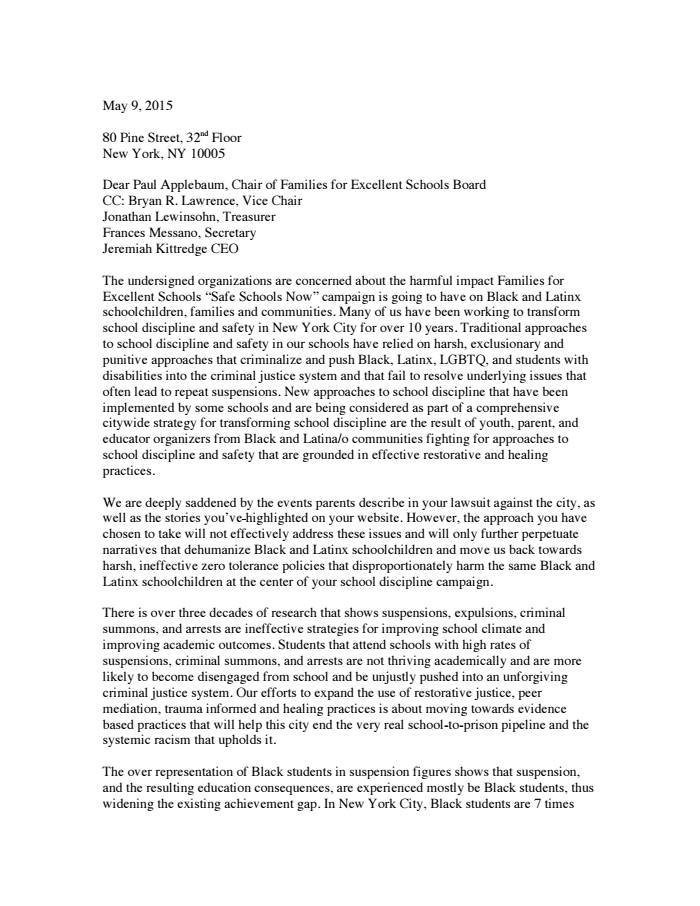
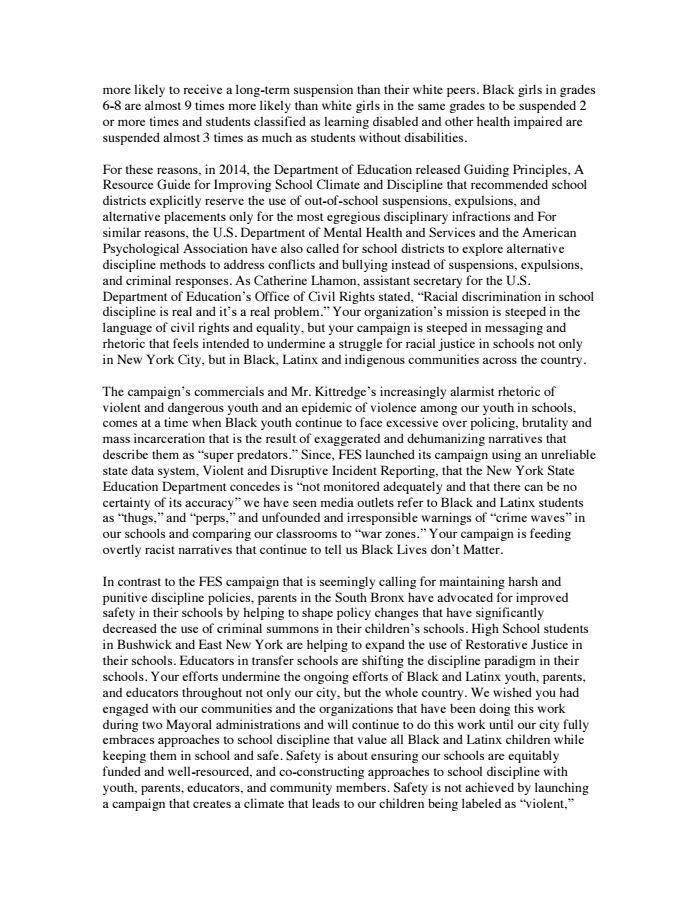
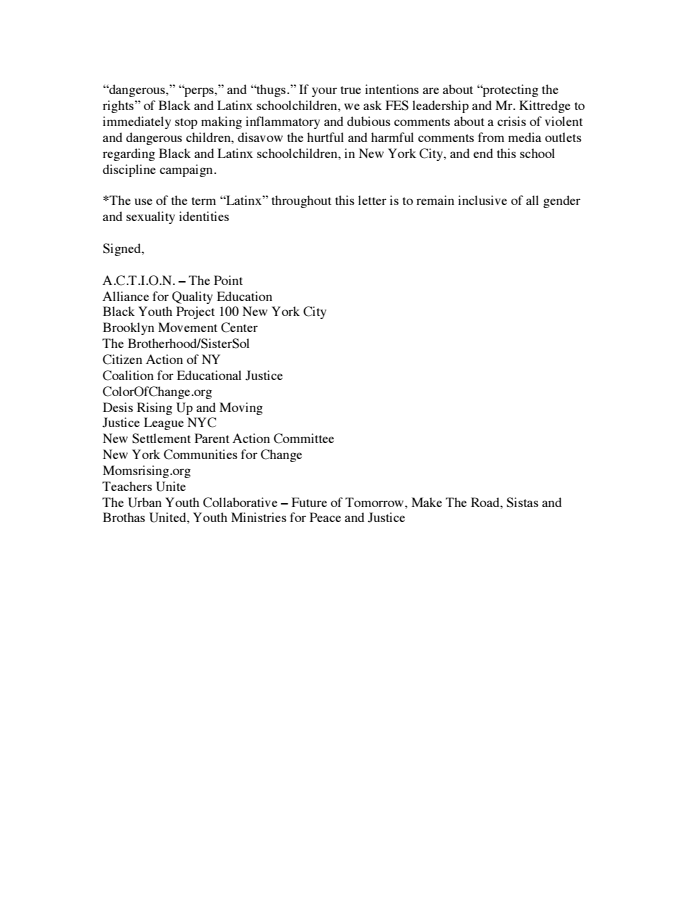
Civil rights groups call for end to school violence ads - NY Daily News

Civil rights groups call for end to school violence ads - NY Daily News:

EXCLUSIVE: Civil rights groups call on pro-charter school organization to end ad campaign on public school violence

NYC PAPERS OUT. Social media use restricted to low res file max 184 x 128 pixels and 72 dpi

“They offer no solutions and are simply politicizing a real issue in order to push their agenda of harsh discipline practices,” Billy Easton said.


More than a dozen progressive education and civil rights groups signed onto a letter calling for a pro-charter school organization to end its ad campaign on public school violence, the Daily News has learned.
The groups, including the union-backed Alliance for Quality Education, accuse Families for Excellent Schools’ “Safe Schools Now” TV and digital media campaign of fear-mongering at the expense of students. The letter also accuses the hedge fund-backed group of promoting disciplinary policies that disproportionately affect black and Hispanic students.
“Your organization’s mission is steeped in the language of civil rights and equality, but your campaign is steeped in messaging and rhetoric that feels intended to undermine a struggle for racial justice,” says the letter sent Monday.
Families for Excellent Schools representatives say they rolled out the splashy campaign to highlight legitimate problems and press the city to take action. CEO Jeremiah Kittredge said victims of violent incidents in city schools are mostly black and Hispanic kids — and the group won’t back down.
“As long as the city deprives these students of their right to safe schools, we will continue to fight alongside parents and children,” Kittredge said.
Families for Excellent Schools also organized a class-action suit in March with families who allege violent conditions in city schools deprived them of their right to a sound basic education.
But Alliance for Quality Education Executive Director Billy Easton said all Kittredge’s group is doing is preying on people’s fear to make the public schools look bad.
“They offer no solutions and are simply politicizing a real issue in order to push their agenda of harsh discipline practices,” Easton said.
Families for Excellent Schools has published several reports showing violent and disruptive incidents have worsened in public schools in recent years, but other stats show schools are actually getting safer.
DOCUMENT
PAGES
Zoom
Civil rights groups call for end to school violence ads - NY Daily News:

The debate over student off-campus speech and First Amendment protection

The debate over student off-campus speech and First Amendment protection:

The debate over student off-campus speech and First Amendment protection


A recent federal court ruling about a public-school student punished for a Facebook post about a bomb threat may have some bigger First Amendment implications, says a judge who wrote the decision.
school_LockersIn the case of R.L. v. Central York School District, Judge John E. Jones III said last week that the York School District’s punishment of the student with a 23-day suspension didn’t violate his First Amendment rights, as his parents claimed. But Jones, echoing some other federal court judges, believed broader issues involved with this case and similar cases needed definition from federal appeals courts and the Supreme Court.
Jones issued his ruling on May 3 for the federal court in the Middle District of Pennsylvania.
“How school administrators must balance students’ First Amendment rights with their duty to protect and foster a safe learning environment is a tension of principles the circuit courts, as well as the Supreme Court, are actively negotiating and developing,” Jones wrote.
In one example, where R.L.’s parents argued that the school’s handbook overstated its ability to regulate student speech under the Supreme Court’s Tinker decision, Jones sided with the parents, but he also said schools needed input from the higher courts on their off-campus speech policies.
“We must observe that schools need clear guidance from the Third Circuit or the Supreme Court as to whether and when they can regulate off-campus speech. Once a clearer rule is pronounced, schools would be well advised to revise their disciplinary policies to clearly outline when off-campus student speech or conduct can be regulated by the school,” Jones wrote.
In this specific case, a bomb-threat letter was discovered at the school in October 2013. School was later dismissed, and while at home, the student made the Facebook post which he later said as intended as a joke, which read, “Plot twist, bomb isn’t found and goes off tomorrow.”
The student later returned to school to get his belongings, which included a mobile device he used to delete the Facebook post. By that time, local police had noticed the post and consulted with the school. School officials then spoke with the student and his father at a football game that night, and told the student he faced a suspension. A disciplinary board later set the suspension at 23 days, and the parents sued on behalf on their son.
The parents claimed their son had his First and 14th Amendment rights violated, since there wasn’t a higher court precedent that allowed schools to punish students for off-campus speech that didn’t cause a substantial disruption at school.
The 1969 Supreme Court decision in Tinker v. Des Moines held that schools could restrict student speech when it threatens a substantial disruption to the school environment or invades the rights of others.
Judge Jones said the location where the student made the Facebook post didn’t matter in this specific case. “Schools should be able to discipline students on account of off-campus speech they reasonably believe could cause disruption in the form of danger or violence, or fear of danger or violence, in schools. Such a rule would also account for the modern reality of the Internet and The debate over student off-campus speech and First Amendment protection:

How Many Schools Should Be Eligible to Provide Free Lunch Under the Healthy, Hunger-Free Kids Act? - The Atlantic

How Many Schools Should Be Eligible to Provide Free Lunch Under the Healthy, Hunger-Free Kids Act? - The Atlantic:

When All Kids Eat for Free

Congress is considering a rule change to the school-nutrition law that would bar thousands of schools from offering complimentary lunch to all students.


 Much has been made recently of Detroit’s resurgence and growth. In January, President Obama made a swing through the Motor City, touting “something special happening in Detroit.” Yet the comeback has not been evenly felt across the city. The Michigan League for Public Policy’s 2016 Kids Count Data Profilerevealed a major fault line earlier this year. From 2006 to 2014, child poverty in Detroit increased by 29 percent, to about 94,000 children or well more than half (57 percent) of the city’s population under the age of 18.* The unavoidable conclusion: Many of Detroit’s youngest residents remain mired in hardship and hunger.

During the school day, the job of filling children’s empty stomachs rests with Betti J. Wiggins, the executive director of Detroit Public Schools office of school nutrition. The district enrolls about 46,000 students, and advertises free breakfast and lunch for every child—not just those who qualify and apply for the benefit. Wiggins credits a little-known provision in the federal child-nutrition bill for boosting participation and feeding more of Detroit’s students at school. But those nutritional benefits are now at risk, as Congress moves to reauthorize the 2010 Healthy, Hunger-Free Kids Act. A proposed rule change to the Community Eligibility Provision (CEP)—widely praised by budget experts and school officials—would effectively leave thousands of impoverished Detroit students, who now eat breakfast and lunch at school, unfed.
The rationale for the program is fairly straightforward. CEP, now in its second year of nationwide availability, allows high-poverty schools to offer free breakfast and lunch to all students at no cost, instead of collecting individual applications for free or reduced-price meals for students who qualify based on family income. Whether a school is eligible for the provision is based on data illustrating how many children are food insecure, whether they live in households that receive food stamps, live in foster care, are homeless, or other criteria that identify them as part of a food-vulnerable group. Under the program, a school district, group of schools, or single school with 40 percent or more “identified students”—those who automatically qualify for free school meals because they fall within the prior special classification—is eligible to adopt community eligibility. The House bill would raise the eligibility threshold to 60 percent, forcing thousands of high-poverty schools nationally to rollback school meals.

Wiggins said the program allows districts like hers to feed more hungry kids. “In income-insecure households, the first item to be reduced is food, in both quantity and quality,” she said. Since CEP, Detroit has experienced an average daily participation increase of 22 percent across the district. She anticipates that with the higher eligibility limit almost 8,000 fewer breakfasts and about 9,300 fewer lunches would be served to students each day. This represents a projected 40 percent drop in eligible high-school students who will abandon school meals, Wiggins said, because of the “consequential identification” of being a free-lunch student. Additionally, CEP reduces administrative costs associated with processing school meals applications. Wiggins said the cost of printing, How Many Schools Should Be Eligible to Provide Free Lunch Under the Healthy, Hunger-Free Kids Act? - The Atlantic:

Union-commissioned report says charter schools are bleeding money from traditional ones - LA Times

Union-commissioned report says charter schools are bleeding money from traditional ones - LA Times:
Union-commissioned report says charter schools are bleeding money from traditional ones

A teachers union-funded report on charter schools concludes that these largely nonunion campuses are costing traditional schools in the Los Angeles Unified School District millions of dollars in tax money.
The report, which is certain to be viewed with skepticism by charter supporters, focused on direct and indirect costs related to enrollment, oversight, services to disabled students and other activities on which the district spends money.
L.A. Unified has the most charters — 221 — and the highest number of charter students — more than 100,000 — of any school system in the nation. Charter students make up about 16% of the district's total enrollment.
The union gave The Times the study in advance of its scheduled presentation at Tuesday's Board of Education meeting, with the stipulation that the report not be distributed to outside parties.


The study calculates that services to charters encroach on tax money the district intended to use for traditional schools, adding up to at least $18.1 million a year and growing.
The biggest financial problem for the district, however, is that money follows students and a huge number of students have enrolled in charters instead of traditional district schools. With more education tax dollars going directly to charters, the result is a decline of more than $500 million a year — about 7% — in the district's core budget, the researchers say.
The effects of this drop are difficult to quantify because fewer students in traditional schools also means a reduced need for teachers and other personnel.
But even with reduced staffing, the district faces a net loss of about $4,957 per student, the study says. That amount accounts for fixed costs, such as maintaining buildings.
Whatever the exact amount, the district has less money to spend with the flexibility its leaders would prefer or to offset legacy costs that include aging school buildings and retiree health benefits.
“The findings in the report paint a picture of a system that prioritizes the growth opportunities for charter school operators,” according to a separate policy brief co-written by the union.
Charter supporters take a different view, seeing the district as the fundamental problem and charters as an important solution.
“Like all businesses, the district has to compete for its customers,” said Eric Hanushek, a senior fellow at the Hoover Institution at Stanford University.
“The growth of charters is putting pressure on the district. The district can't do what it did in the past and come out ahead,” added Hanushek, who hadn't seen the report. “They can try to compete for the students or sell off the buildings. But the point is: Charters look attractive to parents, which means that the district is not attractive.”
Prompted in part by concern about the district's judgment in how it spends money, a group of philanthropists and foundations has bet big on charters in Los Angeles, subsidizing their growth over the last two decades. Last year, local philanthropist Eli Broad spearheaded a proposal to more than double the number of charters over the next eight years, hoping to reel in half of district students.
About six months ago, a group formed to develop Broad's vision for new, high-quality schools.
Meanwhile, both the district and employee unions have been trying to develop counter-strategies. From the district, the push is to increase enrollment, to compete with charters more aggressively and possibly to limit their growth. Until now, the union has been most visible at the bully pulpit, speaking at gatherings and leading demonstrations.
The new report is from Florida company MGT of America. It builds on the work of an earlier, independent district advisory panel, which concluded that charter growth is one of several factors threatening the solvency of L.A. Unified.
This latest analysis was reviewed by pro-labor Washington group In the Public Interest, which prepared the separate policy brief with the union.
“Unmitigated charter school growth limits educational opportunities for the more than 542,000 students who continue to attend schools run by the district, and … further Union-commissioned report says charter schools are bleeding money from traditional ones - LA Times:


Monday, May 9, 2016

Scientific Studies - John Oliver

Last Week Tonight with John Oliver: Scientific Studies (HBO) - YouTube:
Scientific Studies - John Oliver


Georgia ‘psychoeducational’ students segregated by disability, race

Georgia ‘psychoeducational’ students segregated by disability, race:

Georgia ‘psychoeducational’ students segregated by disability, race

Part one of a three-part series: Schools send disproportionate number of black children to programs already under fire for ‘warehousing’ students with behavioral disorders.


 David punched and kicked and spat on his teachers. He knocked over furniture. He poked a hole in a classroom wall. He pelted other students with stones and shoved a school police officer.

At age 7, David was too much for his teachers to handle. So they decided to send him to a special program — unique to Georgia — called a psychoeducational school. He was like so many others already there: male, diagnosed with a behavioral disorder — and black.
Georgia’s public schools assign a vastly disproportionate number of African American students to psychoeducational programs, segregating them not just by disability but also by race, an investigation by The Atlanta Journal-Constitution found.
Black children form the majority at programs where teachers restrained children with dog leashes, where psychologists performed behavioral experiments on troubled students, and where chronically disruptive students spent time in solitary confinement, locked in rooms with bars over the windows. In one such room, euphemistically called a “time-out” area, a 14-year-old boy hanged himself.
Fifty-four percent of students in Georgia’s psychoeducational programs are African American, compared to 37 percent in all public schools statewide, the Journal-Constitution found. In half of the 24 programs, black enrollment exceeds 60 percent. In one, nine of every 10 students are African American.
The Journal-Constitution analyzed data on most of the 3,382 students assigned last fall to the psychoeducational programs, formally known as the Georgia Network for Educational and Therapeutic Support, or GNETS. The analysis, along with interviews with parents, their lawyers, educators and others, depicts a system that provides little of the mental health treatment and other therapies for which it was created. Just 5 percent of the programs’ full-time employees are psychologists, social workers or behavior specialists. Nine programs employ more clerical workers than therapeutic professionals.
The newspaper’s findings add a new dimension to allegations that Georgia illegally segregates disabled students in GNETS programs. The U.S. Department of Justice says the Americans with Disabilities Act gives GNETS students the right to attend school in less-restrictive settings with children who are not disabled. Federal authorities may file a lawsuit to force the state to close the programs.Georgia ‘psychoeducational’ students segregated by disability, race:

2016 Building a Grad Nation Report | GradNation

2016 Building a Grad Nation Report | GradNation:
2016 Building a Grad Nation Report
PROGRESS AND CHALLENGE IN RAISING HIGH SCHOOL GRADUATION RATES
Written annually by Civic Enterprises and the Everyone Graduates Center at Johns Hopkins University, and released in partnership with America’s Promise Alliance and the Alliance for Excellent Education, this report examines the progress and challenges the nation faces in reaching the GradNation goal of a national on-time graduation rate of 90 percent by the Class of 2020. Release Date: 05/9/16


 Introduction

The nation has achieved an 82.3 percent high school graduation rate – a record high.
Graduation rates rose for all student subgroups, and the number of low-graduation-rate high schools and students enrolled in them dropped again, indicating that progress has had far-reaching benefits for all students.
This progress, however, has not come without its challenges.
First, this year the nation is slightly off pace to reach a 90 percent on-time graduation rate by 2020.
Second, at both the national and state levels, troubling graduation gaps remain between White students and their Black and Latino peers, low-income and non-low-income students, and students with and without disabilities.
Third, low-graduation-rate high schools – a key focus of the recently passed Every Student Succeeds Act – pose a significant roadblock to the national goal of a 90 percent graduation rate for all students. While the number of low-graduation-rate high schools has declined considerably over the past decade, in some states they still predominate.
The 2016 Building a Grad Nation report is the first to analyze 2014 graduation data using new criteria established by ESSA and the first to show the impact of additional time on graduation rates.
If all states were required to report five-year graduation rates, the national high school grad rate would go up about 3 percentage points. If all states were required to report six-year grad rates, the rate would go up an additional point.
The report provides a new national and state-by-state analysis of low-graduation-rate high schools; the number of additional students it will take for the country and each state to reach 90 per-cent; a look at the validity of graduation rates; and policy recommendations for change.

After flat-lining for 30 years, high school graduation rates began to rise in 2002. This steady climb became more accelerated in 2006 and, in 2012, the nation reached an historic milestone, an 80 percent on-time graduation rate.
The upward trend continued through 2014, as the national graduation rate hit another record, 82.3 percent, up more than 10 percentage points since the turn of the century.
When the graduation rate hit 80 percent, we calculated that the national graduation rate would need to increase by roughly 1.2 percentage points per year to achieve 90 percent by the Class of 2020. Between 2013 and 2014, the nation missed this mark, and will now have to average closer to 1.3 percentage points per year to reach the goal.
Moving from percentages to raw numbers, meeting the 90 percent goal would mean graduating 284,591 more students.

To graduate students equitably across all subgroups means focusing on students of color, those with disabilities, English-language learners and students from low-income homes. Despite all the progress, these subgroups still graduate at lower rates than other students.
For more information on subgroup graduation rates, go to the 2016 Building a Grad Nation Data Brief.

At the state level:
  • Iowa became the first state to surpass 90 percent, with a 90.5 percent rate in 2014.
  • 20 other states are on pace to reach a 90 percent graduation rate.
  • Five on-pace states – Nebraska, New Jersey, New Hampshire, Texas and Wisconsin – are within 2 percentage points of the goal.
  • 21 states are currently off track to reach 90 percent by the Class of 2020.


The number of low-graduation-rate schools – defined by ESSA as those enrolling 100 or more students and graduating 67 percent or less of them – has declined considerably, but in some states they still predominate. (Note: Previous reports have focused on high schools with at least 300 students. This calculation, made to align with ESSA, allows a closer look at more rural, charter, alternative and virtual schools.)
  • There are 1,000 large, low-graduation-rate high schools (more than 300 students) nationwide, enrolling 924,000 students, compared to 2,000 in 2002, enrolling 2.6 million students.
  • Vulnerable students are overrepresented in low-graduation-rate high schools. Of the roughly 924,000 in large low-graduation-rate high schools, 65 percent were from low-income families, and 63 percent were Black or Hispanic/Latino.
  • When including high schools with student populations of at least 100 students, there are 2,397 graduation-rate high schools across the nation, enrolling 1.23 million students.
  • Nationwide, 33 percent of all non-graduates in 2014 were enrolled in low-graduation-rate high schools.
  • Though alternative, charter, and virtual schools collectively account for 14 percent of high schools and 8 percent of high school students, they make up 52 percent of low-graduation-rate high schools nationwide and produce 20 percent of non-graduates. Regular district high schools account for 41 percent of low-graduation-rate high schools and are where the majority of students who do not graduate on time can be found.
  • Low-graduation-rate high schools by school types. Out of all low-grad-rate schools in the nation, 41 percent are regular district schools, 28 percent are alternative schools, 26 percent are charter schools and 7 percent are virtual schools. (According to NCES definitions, there is inherent overlap between the alternative, charter, and virtual schools categories, so these numbers do not add up to 100 percent. When looking just at district-operated alternative schools, they make up 23 percent of low-graduation-rate high schools, and when separating virtual schools out from charter schools, the percentage of low-graduation-rate schools that are charter schools falls to 22 percent.)
  • Regular district schools (84% of all high schools). Seven percent (7%) of regular district public schools, or roughly 1,000 schools nationwide, were low-graduation rate high schools. Regular district high schools had an average graduation rate of 85 percent. The number of low-graduation-rate regular district high schools across states ranges from zero in Delaware, Hawaii, and Kentucky to more than 276 in New York and 203 in Florida.
  • Charter schools (8% of all high schools). Now authorized in all but seven states, the of charter schools is rising with mixed results on graduation rates. Thirty percent (30%) of charter schools were low-graduation-rate high schools, while 44 percent had high graduation rates of 85 percent and above. Nationwide, charter schools reported an average graduation rate of 70 percent. Hawaii, Arizona, Indiana, Ohio and California have the highest percentages of low-graduation-rate charter high schools.
  • Alternative schools (6% of all high schools). Established to meet the needs of “at risk” students, 57 percent of alternative schools are low-graduation-rate high schools. They have an average graduation rate of 52 percent. Sixty percent (60%) of students at alternative high schools are students of color. In 10 states, including Kentucky, Texas, Washington, Idaho and Iowa, 50 percent or more of low-graduation-rate high schools were alternative schools in 2014. Other states have experienced greater success with alternative schools.
  • Virtual schools (1% of all high schools).Schools offering all instruction online have greatly increased in recent years. Virtual schools were disaggregated in NCES data for the first time in 2013-14. The data shows that 87 percent of virtual schools are low-grad-rate schools with an average graduation rate of 40 percent. States with the highest percentage of non-graduates coming from virtual schools include Ohio, Idaho, Pennsylvania and Colorado.

Who Does the Movement to Opt Out of Standardized Testing Help? | US News Opinion

Who Does the Movement to Opt Out of Standardized Testing Help? | US News Opinion:
The Opt-Out Reckoning
An ever-growing call to opt out of standardized tests is prompting serious questions in education.


 In public school districts across the country, spring is commonly referred to as testing season. But for the past several years, parents across the country have passively resisted participating in standardized testing by opting out. And the movement is gaining momentum. Last year, over half a million school-aged children did not participate instandardized testing. In New York state alone, nearly 1 out of every 5 students opted out.

Standardized testing, a longstanding feature of American education reform, is meant to serve at least three purposes: monitor student performance; improve teaching and learning; and evaluate the quality of teaching and schools. Policymakers have relied on standardized tests as a mechanism for assessing student progress and identifying racial and economic achievement gaps since the original Elementary and Secondary Education Act was passed in 1965, which was followed by the No Child Left Behind Act, signed into law in 2002 and the recently passed Every Student Succeeds Act.

RELATED CONTENT

4 Lessons From the Opt Out Debate

Test refusals may force education reformers to re-evaluate their priorities.

Criticism of standardized testing is nearly as old as the testing itself. For decades, opponents have argued that the tests cause undue stress for both teachers and students, and that they do not provide valid or timely information about what students know and understand. Critics have also noted the consequences that high-stakes testing has for the curriculum, marginalizing courses in so-called untested disciplines like art and social studies, as well as untested skills and topics within tested courses. Recent research has shown that there is often very little overlap between the content that is actually covered in math and English language arts classes and the content that shows up on state standardized tests.
Given new urgency by the implementation of standardized tests aligned to Common Core State Standards, which were fully implemented in the 2014-2015 school year, many of these same criticisms have helped catalyze the current opt-out movement. These concerns were exacerbated, in many cases, by widespread technical issues that hampered the rollout (including issues with curricular materials and resources; issues with providing adequate professional development to teachers; and problems with new computer-based assessment systems), and the belief among some opponents that these Who Does the Movement to Opt Out of Standardized Testing Help? | US News Opinion:


Charter-Driven Gains? in New Orleans Schools Face a Big Test - The New York Times

Charter-Driven Gains in New Orleans Schools Face a Big Test - The New York Times:

Charter-Driven Gains in New Orleans Schools Face a Big Test


NEW ORLEANS — Nothing has defined and even driven the fractious national debate over education quite like this city and the transformation of its school system in the decade since Hurricane Katrina.
So-called reformers say its successes as an almost all-charter, state-controlled district make it a model for other failing urban school systems. Charter school opponents and unions point to what has happened here as proof that the reformers’ goal is just to privatize education and strip families of their voice in local schools across the country.
Now comes another big moment in the New Orleans story: In the next few weeks, the governor is expected to sign legislation returning the city’s schools to the locally elected school board for the first time since Hurricane Katrina in 2005.
Strikingly, that return is being driven by someone squarely in the pro-charter camp, the state superintendent, John White. A veteran of touchstone organizations behind the efforts to remake public schools —Teach for America and the Eli and Edythe Broad Foundation and its superintendent training program — as well as the hard-charging charter school efforts in New York City, Mr. White represents the wave of largely white, young idealists who rushed to this city post-Katrina to be part of the Big Thing in education.
To Mr. White, the move to local control is not the retreat it may seem. He argues that it will make New Orleans a new model, radically redefining the role of central school boards just as many urban school districts are shifting increasingly large portions of their students to independently run but Charter-Driven Gains in New Orleans Schools Face a Big Test - The New York Times: