Latest News and Comment from Education

Friday, February 5, 2016

Louisiana Educator: Where is the accountability for Pearson and John White?

Louisiana Educator: Where is the accountability for Pearson and John White?:

Where is the accountability for Pearson and John White?


Pearson, the same multi-national company that profits by millions based on the incessant testing of our students, has basically destroyed the futures of thousands of adult education students byrevamping their GED test to make it just as tricky and difficult as the PARCC.

So you don't think the PARCC is tricky and difficult? If PARCC is not tricky and difficult, then why did Pearson secretly set the level three (basic) cut score on the PARCC 7th grade math test at only 18% and level 4 (proficient) at 32%. What teacher would ever rate a student proficient if the student knew only 32% of the material being tested? It that ever happened wouldn't the competency of that teacher be questioned?

Most states plan to soon make the PARCC into a high stakes for students, teachers and administrators. That means students could be retained, and teachers and administrators could be given an "ineffective" VAM rating and fired. All based on a test that was so 
Louisiana Educator: Where is the accountability for Pearson and John White?:


CURMUDGUCATION: USED: King's Big Fail

CURMUDGUCATION: USED: King's Big Fail:
USED: King's Big Fail


 It took Danny Harris's collapse to draw many people's attention. We should have been paying attention sooner.


Harris is the Chief Information Officer for the Department of Education. Prior to taking on that job in 2008, he was with the department's CFO office. He is a government lifer. And he was in front of the House Committee on Oversight and Government Reform because the US Department of Education is a big fat cyber-mess.

By late last year, in the wake of the huge security breach at Office of Personnel Managementcomputers, Congress was checking the locks on the doors all around the federal government. And the Department of Education was spectacularly lousy. The Inspector General reported that her office found they could hack their way into USED systems with no particularly great effort. The department's data includes at least 139 million different social security numbers (so, almost half the US population), along with oversight of a trillion dollars.

Congress worked Harris like a chew toy back in November, at which time he did himself no favors by giving his department a 7 out of 10 when everyone else was giving the department F's and D's. So his recent collapse-inducing appearance in front of the House committee is the latest in a series.

The House Oversight Committee is headed by Jason Chaffetz. Chaffetz is an interesting story in his own right. The Utah Representative arrived at Brigham Young as a Jewish Democrat and left as a Mormon Republican. He earned early attention as one of the legislators who slept on a cot in his office rather than renting pricey DC digs. He's the guy who barely let the head of Planned Parenthood get a word in edgewise and ginned up the misleading cancer care vs. abortions chart. He's taken on the Secret Service, and he's also the guy who threatened to have US Marshalls hunt down Flint emergency manager Darnell Earley and drag him before Congress. And he's the guy leading the attempted interrogation of that odious pharma-troll Martin Shkreli this week. All in all, it seems safe to say that Chaffetz isn't afraid of a little tussle, though he is noted by many as a Representative who can play well bipartisanly, particularly within his committee.

All of this bode poorly for the Department of Ed in general and Danny Harris in particular when Chaffetz decided that Harris was the problem, both in terms of managerial skills and professional ethics. This last hearing was an odd mish-mosh of continued grilling about cyber-security, the ethical problems of Harris running a side business, and rigged awarding of department contracts to Harris's friend. Outside vendors are 
CURMUDGUCATION: USED: King's Big Fail:

Mike Klonsky's SmallTalk Blog: Parent and community support builds as teachers hit the streets

Mike Klonsky's SmallTalk Blog: Parent and community support builds as teachers hit the streets:

Parent and community support builds as teachers hit the streets


Left Coast -- I'm excited to see this, even from 1,800 miles away.

The best news is that the embattled CTU is gaining mass support from parents and community members as another teachers strike seems more likely. According to the latest Tribune poll, Chicagoans support the union over Rahm Emanuel (a low bar) by more than three-to-one. That matches the support striking teachers had back in 2012.

The other day, Sun-Times columnist Mark Brown blasted the CTU for not accepting the board's first "serious" contract offer. As I said at the time, it's easy Mike Klonsky's SmallTalk Blog: Parent and community support builds as teachers hit the streets:


U.S. Department of Ed video, CIO investigation – Missouri Education Watchdog

U.S. Department of Ed video, CIO investigation – Missouri Education Watchdog:

U.S. Department of Ed video, CIO investigation


used investigation harris
This is one of those times you must set down the coffee cup, stop doing what you are doing and WATCH THIS SHORT VIDEO CLIP.  You simply must.
Thanks go to Diane Ravitch for reporting on this Congressional investigation of Danny Harris, Chief Information Officer for the U.S. Department of Education here and here. As you can see from the video and as also reported in the Washington Post, this is alarming.
“The lawmakers’ concerns centered on an inspector general’s investigation that found Harris ran an after-hours car-detailing and home-theater-installation business that employed two subordinates from his agency and also allegedly accepted payments from other subordinates for the work.
The hearing also examined Harris’s effort to help a relative find work at the department and his close friendship with an agency vendor whose U.S. Department of Ed video, CIO investigation – Missouri Education Watchdog:

We Must Rethink Online Learning | The Walton Family Foundation

We Must Rethink Online Learning | The Walton Family Foundation:
We Must Rethink Online Learning
CREDO study finds most online charters have a negative impact on students' academic achievement


 By its very definition, innovation will always lead to some failed starts. And when that innovation involves educating children, it's especially important to learn from mistakes and adjust quickly.

The Walton Family Foundation has invested more than $385 million in creating new charter schools over more than two decades to seed educational innovation and improve U.S. education at scale. The foundation has allocated a small fraction of that investment—about $550,000—to virtual charter schools, which teach full-time students exclusively online.
We remain strong believers in creating educational options and opportunities. We have provided startup dollars to about a quarter of the charter schools in the United States, all with the goal of creating opportunity for high-needs students, and we recently committed to investing another $1 billion over the next five years to expand access to high-quality educational choices. In recent years, we have hoped that online charter schools could provide a lifeline for some students. But while we were enthusiastic about supporting online education entrepreneurs, our first priority is always making sure that students are served well.
Measuring impact is fundamental to responsible philanthropy. It is a responsibility we take seriously. The Walton Family Foundation spends about $10 million annually underwriting the nation's best researchers to investigate questions that will help us make smarter funding decisions to benefit high-needs students, develop promising new technologies and methods to fuel student learning, and help parents, educators, and policymakers improve outcomes for children.
As the largest private funder of charter schools and as strong believers in making fact-based decisions, we wanted to see the hard evidence on virtual charters: What would a dependable measure of the impact of these schools show about their students' academic growth? We funded three research studies—by the Center for Research on Education Outcomes (or CREDO), at Stanford University; the Center on Reinventing Public Education, at the University of Washington; and Mathematica Policy Research—to investigate this question. As with all of our research dollars, we committed to funding these research teams regardless of what their investigations revealed.
The results are, in a word, sobering. The CREDO study found that over the course of a school year, the students in virtual charters learned the equivalent of 180 fewer days in math and 72 fewer days in reading than their peers in traditional charter schools, on average.
This is stark evidence that most online charters have a negative impact on students' academic We Must Rethink Online Learning | The Walton Family Foundation:

Flint’s Former Manager Resigns as Head of Detroit Schools - The New York Times

Flint’s Former Manager Resigns as Head of Detroit Schools - The New York Times:

Flint’s Former Manager Resigns as Head of Detroit Schools


 CHICAGO — The state-appointed emergency manager of the Detroit Public Schools, who had also managed the city of Flint and oversaw its decision to draw its water from the Flint River, resigned on Tuesday, the day before a congressional committee hearing in Washington on Flint’s water.

Michelle Zdrodowski, a spokeswoman for Detroit Public Schools, said the manager, Darnell Earley, had declined to testify before a panel investigating the widespread contamination of Flint’s tap water after the city switched its water source, which led to elevated blood lead levels throughout the city.
On Tuesday evening, the House Oversight and Government Reform Committee issued a subpoena for Mr. Earley to testify on Wednesday, but his lawyer, A. Scott Bolden, said Mr. Earley would not be able to appear.
Representative Elijah E. Cummings of Maryland, the ranking Democrat on the committee, said in a statement, “Mr. Earley has a right to assert the Fifth Amendment, but his abrupt resignation earlier today and his refusal to testify before the committee make it even more urgent that we hear directly from the governor as soon as possible about this escalating scandal.”
Mr. Earley was appointed to the Flint and Detroit management positions by Gov. Rick Snyder, a Republican. His oversight has come under scrutiny, both for his support of switching water sources, which triggered its current public health crisis, and for the condition of the Detroit Public Schools, which have been hit by a series of teacher “sickouts” in protest of the district’s conditions.
Last week, the Detroit teachers’ union sued the Detroit Public Schools and Mr. Earley, arguing that under his management, he allowed the schools to “deteriorate to the point of crisis.”
In a letter to Governor Snyder dated Tuesday, Mr. Earley wrote that his resignation will be effective Feb. 29. “While there is still much work yet to be done,” he said, he believed his work had helped lead the school district Flint’s Former Manager Resigns as Head of Detroit Schools - The New York Times:

Every school wants ‘good’ teachers — but what does ‘good’ actually mean? - The Washington Post

Every school wants ‘good’ teachers — but what does ‘good’ actually mean? - The Washington Post:

Every school wants ‘good’ teachers — but what does ‘good’ actually mean?


 What is a “good” teacher? A teacher who raises student test scores? Who gets students interested in subjects they thought were boring? Who inspires students to be more thoughtful people? Here is a post on how to be a “good” teacher by Paul Thomas, an associate professor of education at Furman University in South Carolina. This appeared on his blog, and I am republishing it with permission.


By Paul Thomas
Being me, it will not be white.
But it will be
a part of you, instructor.
You are white—
yet a part of me, as I am a part of you.
For a very long time in the United States, the conventional wisdom has been that good schools were the key to just about everything—each child’s future, the nation’s economic survival, etc. More recently, that fantasy has narrowed to good teachers as the the “most important thing [fill in the blank].” And as I have examined, moving legislatively from No Child Left Behind to its successor K-12 education law, the Every Student Succeeds Act, is unlikely to change that mantra, as delusional as it is.
So, if you began reading this in hopes of finding an analysis of, say, teacher evaluation methods, I gently recommend you may be better off reading a volume of “Harry Potter” or “Lord of the Rings” fantasies, or take a stab at Ursula K. Le Guin. Instead, this is a true story about one recent morning — and about every year leading up to that during my 30-plus-years teaching Every school wants ‘good’ teachers — but what does ‘good’ actually mean? - The Washington Post:

Every Student Can’t Succeed | Al Jazeera America

Every Student Can’t Succeed | Al Jazeera America:

Every student can’t succeed

Education isn’t scarce, but money is


When President Barack Obama signed the Every Student Succeeds Act into law in December, he gushed about Antonio Martin, the eighth-grader who had introduced him. “He’s taking advanced classes to get a head start on high school credits. He plays the violin. He plays sports. He volunteers. He owns one share of stock in Tesla. So he’s clearly going places. I’d invest in him if I could,” the President told the press corps.

These days “investable” is high praise for a 13-year-old, and Antonio was in the South Court Auditorium of the Eisenhower Executive Office Building as a poster child for the latest round of federal education reform. But there’s a central contradiction in American education rhetoric between the universalism and the outstanding example: How can every student be exceptional?
The name of George W. Bush’s 2001 No Child Left Behind Act was roundly panned in liberal circles as another egregious example of the administration’s doublespeak — John Kerry called it “one of those Orwellian names you pull out of the sky.” The law’s plan was to raise every student to adequate performance in testable subjects and create a floor for American education. It didn’t work out that way (unsurprisingly), but the law’s framing stuck. After all, no politician wants to run on leaving some children behind to ignorance and menial employment.
As a name, “Every Student Succeeds” ups the ante on “No Child Left Behind.” Adequacy is by definition a low standard, and being merely satisfactory doesn’t necessarily lead to better life outcomes than inadequacy. If public schools are preparing some students to succeed (and they had better be), then the schools must set up all students to succeed, or at least provide them the opportunity. “We want to make sure that through this piece of legislation, with our hard work, with our focus, with our discipline, with our passion, with our commitment, that every kid is given the same opportunities that Antonio is getting,” Obama said.
The President says he’s talking about opportunities, but he’s also talking about outcomes. It’s one thing to want all kids to have access to advanced classes, music instruction, sports teams and volunteer work. It’s another to expect them to take advantage of all of them at the same time. President Obama described Antonio as “doing his part” Every Student Can’t Succeed | Al Jazeera America:

K12: This is how Bernie or Hillary wins: The speech that would seal the nomination - Salon.com

This is how Bernie or Hillary wins: The speech that would seal the nomination - Salon.com:

This is how Bernie or Hillary wins: The speech that would seal the nomination

We're days from New Hampshire and the battle keeps tightening. Here's how either candidate could gain separation

BERTIS DOWNS

This is how Bernie or Hillary wins: The speech that would seal the nomination
Hillary Clinton, Bernie Sanders (Credit: AP/Reuters/Brian Snyder/Joshua Roberts/AVAVA via Shutterstock/Photo montage by Salon)
Both Hillary Clinton and Bernie Sanders have decided to start talking about the state of K-12 public education in recent weeks.  This is a very positive, if overdue, development, with both of them questioning the efficacy and priority of charter schools in the national dialogue on educating our children; and Sanders recently proposing a new, equity-focused approach to funding education in the United States.
Still, the candidates’ words don’t seem to resonate with many of the largely untapped public education parents and teachers who are in search of a candidate. Neither candidate really has a grasp on the varied and complex issues that have to be addressed when considering the changes and reforms our schools and children truly need.  Let’s help their campaigns by outlining the speech that at least one of them ought to give — and soon.
Which campaign wants to lay claim to public schools supporters? Easy. Whoever embraces these ideas first. Just imagine:
Somewhere in New Hampshire:   
A SPECIAL ANNOUNCEMENT ON A TRULY CHILD-CENTERED AND EFFECTIVE PUBLIC EDUCATION POLICY
Good morning.  I want to spend a few minutes today considering the past, present and future of public education in our country— a topic too long ignored in this election year.
We know several things about public education. We know it is the road out of poverty for many children. We know many or most of our public schools are doing a fine job of educating our children. But we also know our nation still suffers from generations of neglect, discrimination and underfunding that drive unconscionable disparities in how we educate our privileged and our less affluent children. Clearly, education does not exist in a vacuum. We cannot expect schools or teachers alone to solve the immense problems many of our youngest children face in their home lives. Schools are expected to do more and more in an age when we are making it harder for them to do the basic job of educating their students.  It seems that teachers have less control over what and how they teach, yet teachers are blamed more than ever for how their students perform on standardized tests. Is it any wonder we have an impending shortage of teachers? Even those who have long dreamed of being teachers may be hesitant to enter the profession as it is currently defined. Is that really what we want? Is that really what our children deserve?
John Dewey once said, “What the best and wisest parent wants for his own child, that we must want for all of the children of the community.” Well, under my administration, we will actually govern that way and foster the kinds of schools where we would all be proud to send our children. We all know the factors that make a school great: excellent teachers who are respected, compensated, and supported This is how Bernie or Hillary wins: The speech that would seal the nomination - Salon.com:

Alexander Russo: School Segregation In The North — Then & Now | The Grade | The Washington Monthly

WNYC: School Segregation In The North — Then & Now | The Grade | The Washington Monthly:

WNYC: School Segregation In The North — Then & Now


Kudos to education reporter Yasmeen Khan and the education team at WNYC (NYC public radio) for Demand for School Integration Leads to Massive 1964 Boycott — In New York City, which finds a refreshing new way to tell a very old but very important story and helps remind us that widely-accepted ideas like “neighborhood school” and “local control” have more complicated histories than we may know.
On the air, digitally and via social media, Khan tells us the story of how, exactly 52 years ago, nearly 500,000 NYC schoolkids staged a one-day protest against segregation of the schools — one of the largest such protests in American history — and how it led to almost no major changes in the system:
“The school boycott was the largest civil rights protest in U.S. history… Yet, little came of the boycott, and the activists’ demands resonate still.”
The piece is full of great voices, and the digital versions of the story include some amazing posters and images. So far, there’s been the original seven minute broadcast piece (above), a digital version, an appearance on the Brian Lehrer show, and a local NBC news segment. The story hasn’t appeared on NPR nationally - yet (it should be).
This isn’t the first time that Khan’s work has appeared here. Over the summer, you may recall, she had a piece about a student who was transitioning from male to female in a Brooklyn school. Since then, Khan has been all over the place, covering among other things the school integration fight in Brooklyn (see below):WNYC: School Segregation In The North — Then & Now | The Grade | The Washington Monthly:

Thousands rally downtown for Chicago Teachers Union - Chicago Tribune

Thousands rally downtown for Chicago Teachers Union - Chicago Tribune:

Thousands rally downtown for Chicago Teachers Union

Thousands rally downtown for Chicago Teachers Union
Chicago Teachers Union members and supporters marched Feb. 4, 2016, in the Loop to show opposition to the district's decision to slash school budgets and stop paying the bulk of teachers' pension contributions.
rongs of protesters organized by the Chicago Teachers Union clogged Loop streets during Thursday's evening rush hour to voice opposition to the district's move to slash budgets and stop paying much of teachers' pension contributions.
The show of force by the union's rank and file comes three days after a 40-person bargaining team unanimously voted down a four-year contract offer from Chicago Public Schools.
Christa Lohman, a member of the CTU's "Big Bargaining Team," said the district's offer was vague and included language teachers thought was aimed at forcing them into accepting a deal.
"No economic layoffs sounds fabulous," Lohman said during a march to City Hall as news helicopters hovered overhead. "But we've been around awhile. After 15 years, you start to think that never happens."
As protesters surrounded Bank of America's local headquarters and blocked traffic, CTU Vice President Jesse Sharkey said the bargaining team's rejection of the city's offer was "a sign we have a serious democratic process."
"The leadership recognizes that there was a serious attempt on the part of the district to offer some things that we're interested in," Sharkey said. "And what we heard loud and clear from our rank and file is that we don't trust the district enough just to have assurances and promises. There can't be big loopholes in that."
In addition to barring economic layoffs, the offer from CPS provided some moderate pay increases and put a cap on the number of privately run charter schools. Union leaders Thousands rally downtown for Chicago Teachers Union - Chicago Tribune:


Detroit Teachers Union Says Threats Of Arrest Made Should Independent Inspectors Be Let In « CBS Detroit

Detroit Teachers Union Says Threats Of Arrest Made Should Independent Inspectors Be Let In « CBS Detroit:
Detroit Teachers Union Says Threats Of Arrest Made Should Independent Inspectors Be Let In


DETROIT (WWJ) – The Detroit teachers’ union says the district is threatening to have its members arrested if they allow independent inspectors in school buildings.
DFT Interim President Ivy Bailey says after the city of Detroit conducted its inspections, their reports recommended an industrial hygienist inspect the school buildings where mold was found to determine its type and treatment needed reports WWJ Newsradio 950’s Stephanie Davis.
Bailey says the union called on the industrial inspectors and that’s when —they got a letter.
“Basically, the letter is saying that we will be arrested if we brought them into the building — you know what — at this point I’m about to go into a building and get arrested because we need to stop playing with the lives of these children.”
The letter from DPS Emergency Manager Darnell Earley stated that if teachers allowed inspectors into the building, police would be called and teachers could be arrested according to Bailey.
This situation appears to be escalating.
“I don’t know what’s going on here – everyone wants to pull a power play – we don’t have time for that – if Mr. Earley is saying that he’s stepping Detroit Teachers Union Says Threats Of Arrest Made Should Independent Inspectors Be Let In « CBS Detroit:

State revises number of magic charter schools to get federal grant money | The Columbus Dispatch

State revises number of failing charter schools to get federal grant money | The Columbus Dispatch:
State revises number of failing charter schools to get federal grant money
 As state education officials seek the release of a $71 million federal charter school grant, they now say Ohio has nearly 10 times as many failing charter schools as previously claimed. 


The Department of Education says there are 57 poor-performing charter schools in Ohio, not the six reported in its grant application submitted in July. 

As for high-performing charter schools, it turns out there are 59, not the 93 originally claimed.

The revised numbers were detailed in a Jan. 29 letter to federal regulators who put a hold on Ohio's charter-school grant in November amid concerns about the state Department of Education's rigging of charter school evaluations. The performance statistics for the 2013-14 school year are for 290 "site-based" schools and do not include online charters, which generally have been among the poorest performers. 

In the 20-page letter to Stefan Huh, head of the U.S. Department of Education's charter school program, interim state superintendent Lonny J. Rivera responded to a request for updated figures and lists of all high performing and low performing charter schools under both state and federal definitions. 

The 93 "high quality" and six "poor performing" charter schools identified in the state's grant application were based on "the federal definition," Rivera wrote. The revised numbers showing fewer high performing schools and more failing ones, he said, are based on new and tougher state definitions. 

The "newly implemented state definition utilizes more rigorous criteria than the federal definition," he said. 

The letter was the state's third response to questions from federal regulators since the review was opened in November. Ohio hopes to State revises number of failing charter schools to get federal grant money | The Columbus Dispatch:

Louisiana school vouchers cripple academic achievement, national report says | The New Orleans Advocate — New Orleans, Louisiana

Louisiana school vouchers cripple academic achievement, national report says | The New Orleans Advocate — New Orleans, Louisiana:

Louisiana school vouchers cripple academic achievement, national report says

Advocate staff file photo by BRYAN TUCK -- School buses parked outside a school in Lafayette.


 One of former Gov. Bobby Jindal’s signature education laws is actually hurting student achievement, according to a national report that is sparking controversy.

Louisiana students who get state-financed vouchers to attend private schools suffer more academically than if they had remained in a troubled public school, says a review done for the National Bureau of Economic Research in Cambridge, Massachusetts.
The one-year study says achievement drops showed up in math, reading, science and social studies for students enrolled in what is officially called the Louisiana Scholarship Program.
“Our results show that LSP vouchers reduce academic achievement,” the review says.
The NREB is a 96-year-old private, nonpartisan group that does research for academics, public policymakers and business. Twenty-five Nobel prizewinners have worked as researchers for the organization.
Longtime critics of vouchers, including leaders of traditional public school groups that opposed the expansion of vouchers in 2012, seized on the report.
Debbie Meaux, president of the Louisiana Association of Educators, said Thursday the findings confirm what her group has long suspected, and that voucher students often go without the level of curriculum and teachers common in other schools.
“We are seeing a difference in the quality of education provided to those kids,” Meaux said.
But state Superintendent of Education John White, a longtime backer of vouchers, said in a paper published last month that the NREB report is limited to just the first school year that vouchers were expanded statewide — 2012-13 — and that students have shown steady gains since then.
White, in a paper done for the Thomas Fordham Institute, wrote that the authors of the report were offered two additional years of data on how voucher students fared “but turned them down because of urgency to meet their own deadlines for publishing.”
Vouchers are state aid that allow low-income students to attend private and parochial schools rather than troubled public schools.
The state has more than 7,100 voucher students, mostly minorities, and 54 percent of recipients attend schools in East Baton Rouge and Orleans parishes.
The average family income for enrollees during the year studied was $17,389.
The average voucher totals $5,311 compared with $8,605 for students in the public school district previously used.
The state tab is $42 million this year.

Fighting “corporate control of education”: A millennial education wonk goes to war against neoliberal reform - Salon.com

Fighting “corporate control of education”: A millennial education wonk goes to war against neoliberal reform - Salon.com:

Fighting “corporate control of education”: A millennial education wonk goes to war against neoliberal reform

Refuting reformers is not enough. The left must also offer an alternative, activist/author Nikhil Goya tells Salon

Fighting "corporate control of education": A millennial education wonk goes to war against neoliberal reform


When it comes to the world of elite education reform — the land dominated by the Bill and Melinda Gates Foundation, the Broad Foundation; your Arne Duncans and Michelle Rhees — there is no shortage of young and optimistic millennials, eager to explain why the brave new future of standardized testing, pay-for-performance, “grit” and Common Core will help public (and pseudo-public) education fix many of our society and economy’s ills. They’re often called thinkfluencers, or something equivalently silly; and the scene is lousy with ’em.
Nikhil Goyal, a young education activist and author, comes from an entirely different angle — which is why his upcoming book, “Schools on Trial: How Freedom and Creativity Can Fix Our Educational Malpractice,” which will be released on Feb. 16, makes for bracing reading. In the book, Goyal rejects some of the most foundational aspects of not only the reform movement, but the public education system that preceded it. And he argues that “progressive education” is not only a better alternative in the abstract, but a better match for the 21st century economy.
Recently, Salon spoke over the phone with Goyal about his book, as well as his views on how education policy factors into the 2016 presidential campaign. Our conversation can be found below and has been edited for clarity and length.
There’s been a lot of discussion in the past 10 years or so of the way the education reform movement has fallen short or been misguided. (There have been plenty of defenses of the movement, too, of course.) What did you want your book to add to the conversation that you felt wasn’t being said already?
In the past decade the United States has seen two major pieces of legislation for programs, No Child Left Behind under President Bush, and Race to the Top under President Obama. I would argue this decade of education policy [has been] characterized by neoliberal corporate education reform. And that is essentially high-stakes standardized testing, school closings, paper performance in regards to teachers — really ruthless accountability measures. [There’s also] a general sense that school should be operating like a business, and education should do more to serve the interests of corporations and the affluent, as opposed to children and educators. And I’m very critical about [all] that in the book.
I also wanted to not only talk about some of the major problems with corporate education reform, but also explain and reveal to the public that there are really successful and effective models of education already existent in this country and the world. Many of those models fall under the umbrella of “progressive education”; democratic education, child-centered forms of learning. In the book, I talk about how I went from Chicago to Brooklyn to Boston to San Francisco and visited many schools, very unique in their own form, that are based on some of these principals: autonomy in learning, trust, equal relationships between students and teachers, treating the community as a classroom, letting children engage in a hands-on project, based on experience or learning opportunities.
What about scale, though? Isn’t that often the challenge with these alternative models — how to implement them on a much, much larger scale?
I think it’s one of the issues. I don’t think it’s the absolute most important, but it’s a thing we need to look at. I would argue the progressive democratic school Fighting “corporate control of education”: A millennial education wonk goes to war against neoliberal reform - Salon.com:

Thursday, February 4, 2016

The Beautiful Teacher Struggle | The Jose Vilson

The Beautiful Teacher Struggle | The Jose Vilson:

The Beautiful Teacher Struggle

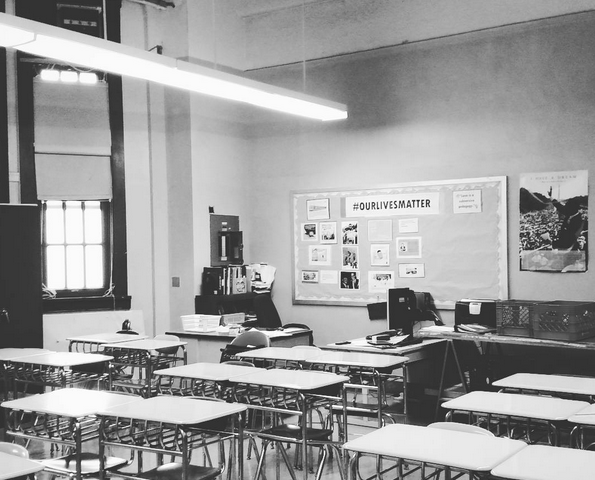
My Classroom
My feet on the ground actions are simple-not-easy. For the last three weeks sans EduCon weekend, I spent every “free” period plus lunch, after-school, and my birthday weekend grading papers. It’s the type of paper streak that makes non-teachers go from “Your job is so easy, plus you have summers and religious holidays off” to “You’re a saint, I don’t know how you deal with it.” It made writing for blogs and leisure seem like a thing I used to do in my fledgling past. It made hanging out with me perhaps intolerable because of my intolerance towards schooling and the disconnect between my own ideology and things I’ve asked to compromise on so I can stay in the classroom.
It’s like, stop it already.
Some people still think the only valid activism is the one on the streets when there’s clearly a battle The Beautiful Teacher Struggle | The Jose Vilson: