Latest News and Comment from Education

Tuesday, December 29, 2015

Mike Klonsky's SmallTalk Blog: Randi & Lily: Why all the smoke-and-mirrors about new law's opt-out provisions?

Mike Klonsky's SmallTalk Blog: Randi & Lily: Why all the smoke-and-mirrors about new law's opt-out provisions?:

Randi & Lily: Why all the smoke-and-mirrors about new law's opt-out provisions?

ESSA allows parents to opt a student out of required assessments for any reason. -- AFT
ESSA maintains the right of parents to opt their children out of statewide academic assessments and allows states to limit the amount of time students spend taking annual tests. -- NEA
These requirements do not allow students to be excluded from statewide assessments. -- D.O.E.
Are teacher union leaders shooting straight with us about ESSA, the new federal education act? Or have they just not read the bill they've worked so hard to sell to teachers and parents?
 
AFT and NEA leaders would have us believe that the new law eliminates test-and-punish requirements and allows for parents and students to opt out of continuing No Child Left Behind testing madness. 

Is that really true?

Here's AFT's take on the new law:


Preschool Without Walls - The New York Times

Preschool Without Walls - The New York Times:

Preschool Without Walls


SEATTLE — Three-year-old Desi Sorrelgreen’s favorite thing about his preschool is “running up hills.” His classmate Stelyn Carter, 5, likes to “be quiet and listen to birds — crows, owls and chickadees,” as she put it. And for Joshua Doctorow, 4, the best part of preschool just may be the hat he loves to wear to class (black and fuzzy, with flaps that come down over his ears).
All three children are students at Fiddleheads Forest School here, where they spend four hours a day, rain or shine, in adjacent cedar grove “classrooms” nestled among the towering trees of the University of Washington Botanic Gardens.
The program, in its third year, is less than seven miles from Microsoft, which means some parents sit in front of computers all day inventing the digital future, while Fiddleheads children make letters out of sticks or cart rocks around in wheelbarrows.
Founded in 2012 by Kit Harrington, a certified preschool teacher, and Sarah Heller, a naturalist and science educator, Fiddleheads is part of a larger national trend that goes beyond Waldorf education, which has long emphasized outdoor play, even in inclement weather.
Photo
Stelyn Carter, 5, left, and Alma Essers, 3, use a tree stump as their table. CreditMeryl Schenker
There’s the Chippewa Nature Center in Midland, Mich., founded in 2007, where children wear hats and mittens during daily outdoor sessions in the frigid winter months. At the All Friends Nature School in San Diego, which became a nature preschool in 2006, children often spend mornings making sand castles at the beach. And at the Drumlin Farm Community Preschoolin Lincoln, Mass., founded in 2008, children learn to feed farm animals, Preschool Without Walls - The New York Times:

CURMUDGUCATION: The Soft Bigotry of Baloney + "Fail"

CURMUDGUCATION: The Soft Bigotry of Baloney:

The Soft Bigotry of Baloney


You may not know Michael Gerson's name, but odds are you know one of his most famous pieces of writing-- "the soft bigotry of low expectations."

Well, Gerson was in the New York Times yesterday expressing his displeasure with the new version of ESEA. At the same time, he was serving up the hard baloney of reformster ideals.

Gerson opens by recapping some of the results of ESSA in a voice that-- well, maybe he's sincere, but it feels as if he's being sarcastic as what he sees as self-evidently wrong points of view, a style of writing that I am somewhat familiar with (game recognizes game).

The whole thing [NCLB] was a mess from the start. Failing schools didn’t like to be labeled failures, because it made administrators feel as though they were, like, you know, failing or something. Many teachers didn’t like the relentless emphasis on testing, which ate into their time for the unmeasurable joys of learning.  

His summary, as he winds up for the main pitch:

The Every Student Succeeds Act is a win-win-win for everyone who counts. Most Republicans are pleased that the federal role in enforcing educational standards has been effectively abolished. Many teachers are pleased to see lower stakes on standardized tests. States and localities are 
CURMUDGUCATION: The Soft Bigotry of Baloney:

"Fail"


Tweetist/blogger Jennifer Borgioli Binis has often expressed frustration with how often people play fast and loose with the word "fail," some of which she has piled up into a blog post. This whole post is really for her, because 140 characters is never enough.

I get some of her frustration. "Fail" is a harsh word to throw around, particularly in the vicinity of children. When my kids were little, their mother and I tried to never say that they had failed at something, but that they hadn't succeeded yet. When my school put together the local version of the state-mandated graduation project, we deliberately did not offer a "failing" rank on the evaluation-- instead, it just goes straight to what still needs to be completed successfully.

By the same token, formative assessments, meant to answer the question "so how are we doing," shouldn't have a "failing" grade. The assessment is supposed to provide information, like a diagnostic hookup of your car by a mechanic, or blood tests by your doctor. It's not supposed to be a matter of "did you pass or fail" but instead "so what do we need to work on next." There are some well-intentioned people out there who apparently really expected that the Common Core Big "Fail"

With A Brooklyn Accent: What Is The Paper Clip Revolution?

With A Brooklyn Accent: What Is The Paper Clip Revolution?:

What Is The Paper Clip Revolution?

3n


The paper clip became a symbol of resistance in Nazi Occupied Norway. Thousands of Norwegian teachers who refused to teach the fascist curriculum were sent to prison camps. The resistance of these teachers, as well as over 200,000 parents caused the government to abandon their plan. We as educators have decided to use this symbol to catalyze resistance to the privatization, corruption and profiteering that threaten to destroy public education in the United States. Hence we are launching "The Paper Clip Revolution"
This group will generate symbols that are easily duplicated and displayed to build resistance and morale among teachers students and parents and to undermine the parasites and bullies who have hijacked education policy We will also propose actions that make use of those symbols to give power back to educators.
One portion of this effort will be Honey Badger Squads, groups of retirees, parents and professors who will confront and challenge superintendents and principals who harass and humiliate teachers and students.
 Big Education Ape: 1942 Norwegian Teachers’ Nonviolent Resistance to Nazis | PopularResistance.Org http://bit.ly/1YPRtv6

1942 Norwegian Teachers’ Nonviolent Resistance to Nazis | PopularResistance.Org

1942 Norwegian Teachers’ Nonviolent Resistance to Nazis | PopularResistance.Org:

Got Fascism? 1942 Norwegian Teachers’ Nonviolent Resistance to Nazis Has Answers

Screen Shot 2015-12-29 at 10.25.04 AM

Above Photo: From CreativeResistance.org. Rooftop Revolutionary Pick: Fuck Fascism And Care For The Earth.
With bigotry and hatred on the rise in the United States and politicians like Donald Trump giving everyone the nightmares of an American Hitler and Nazi Party, revisiting history offers us kernels of wisdom in resisting such extremism.
In April 1940, the Nazis invaded Norway and occupied the country. In 1942, as part of an attempt to implement a fascist curriculum in the schools, Minister-President Vidkun Quisling, a Norwegian collaborator, disbanded the existing teachers’ union and required all teachers to register with the new Norwegian Teachers’ Union by February 5. Between 8,000-10,000 of Norway’s 12,000 teachers responded by signing a letter of refusal to cooperate. The Quisling government panicked and closed the schools, sending the children home to their parents. 200,000 of these annoyed parents wrote letters of protest to the government. Norwegian teachers began to hold classes in secret, in defiance of orders. The government ordered the arrest of a thousand teachers, five hundred of whom were sent to a prison camp in the Arctic.
As the trainloads of teachers were shipped north, students and families gathered along the tracks, singing and offering food to the teachers as they passed. Once in prison, the teachers formed choirs and offered lectures to one another. The government tried numerous intimidation tactics, but the strike continued. On November 4th, 1942, the Quisling government released all the teachers and abandoned their earlier plans. The Norwegian teachers, through nonviolent resistance, had defended their youth from being subjected to fascist curriculum and protected Norway from sliding into a fascist state.
The Norwegian Teachers’ Defense of Education offers pearls of strategic wisdom for us as 1942 Norwegian Teachers’ Nonviolent Resistance to Nazis | PopularResistance.Org:


These 5 education stories will dominate headlines in 2016 - Yahoo Finance

These 5 education stories will dominate headlines in 2016 - Yahoo Finance:

These 5 education stories will dominate headlines in 2016

These 5 education stories will dominate headlines in 2016


(REUTERS/Yannis Behrakis) As 2015 comes to a close, it's becoming clear that certain education stories will heat up over the next year. From a revamped SAT exam to a Supreme Court case that may change college admissions, these are the big education stories to watch.

1. The crumbling for-profit college industry
In April of this past year, Corinthian Colleges, the second largest for-profit college system in the US, abruptly announced it was shutting its doors for good. That decision followed a $30 million fine from the Department of Education (ED), which claimed Corinthian misrepresented the kinds of jobs its graduates could get.
That was not an isolated event. The entire for-profit industry has come under fire for its alleged focus on signing up students and depositing their federal financial aid checks rather than providing a quality education.
The largest for-profit college system, University of Phoenix, was suspended from recruiting military students by the Department of Defense (DoD) in October, which was notable as it pulls in more money than any other US college, public or private, from military students. 
And another for-profit college powerhouse, Education Management Corporation (EDMC), payed $95.5 million in November to settle a case alleging it falsely obtained federal and state education funds.
The nearly $100 million settlement was the largest false claims settlement with a for-profit educational institute in history.
It's not yet evident whether more for-profit colleges will be handed massive fines by the federal government or have to close as a result of financial difficulty, making it a story to watch out for in the coming year.
View gallery
.
Abigail Fisher
(AP Photo/Susan Walsh) Abigail Fisher, the Texan involved in the University of Texas affirmative action case, and Edward Blum, who runs a group working to end affirmative action, walks outside the Supreme Court in Washington, Wednesday, Oct. 10, 2012.
2. Affirmative action in the Supreme Court


In December, the US Supreme Court heard oral arguments in a case on affirmative action that could have a far-reaching impact on the ability of universities around the nation to consider race in admissions. 
Fisher v. University of Texas (UT) will determine whether it's constitutional for the University of Texas at Austin to consider race as one factor in its admission policy. 
The plaintiff — a white woman named Abigail Fisher who was denied admission to the Texas' flagship public university in 2008 — claims her race played a factor in her rejection, and that UT These 5 education stories will dominate headlines in 2016 - Yahoo Finance:

Teacher: What happened when a troubled little boy appeared at my classroom door WaPo

Teacher: What happened when a troubled little boy appeared at my classroom door Washington Post:

Teacher: What happened when a troubled little boy appeared at my classroom door


Here’s a post that shows the reality of teaching in a high-poverty school in a way that goes beyond the usual policy talking points. This is what teachers and students really deal with — and how a thoughtful teacher deals with tough situations. This was written by Michelle Strater Gunderson, a 29-year teaching veteran who teaches first grade in the Chicago Public Schools. She is a doctoral student at Loyola University in curriculum and instruction.  This appeared on the interesting Living in Dialogue blog, and I am republishing it with Gunderson’s permission.

By Michelle Gunderson
One of the things you learn as an elementary teacher in the Chicago Public Schools is to always have materials available and an extra desk or space for new students. You learn to expect the unexpected and that a child can show up on your doorstep at any minute of any day.
And usually it is not an easy matter. Many times children who come to us after the first weeks of school are displaced or have parents who are seeking a school that can help their troubled child.
These were the thoughts on my mind when a little boy appeared at my classroom door in the second week of school this fall, an hour after school had started, without an adult accompanying him to the class. I took a deep breath and tried to talk myself into a place of calm. There was so much on my teaching plate already, and I did not know if I was going to be able to embrace one more Herculean task.
And I was right. The child who was given into my care needed me in countless ways.
His family was experiencing housing insecurity, and he had been exposed to very little schooling. Everything was new – letters and sounds, standing in line to go to recess, putting a coat in a locker. The Chicago schools extended to a seven-hour day three years ago, and at every minute of that seven-hour day, this young child was being asked to climb new mountains of learning. It Teacher: What happened when a troubled little boy appeared at my classroom door - The Washington Post:

Education as Told by Charts, Graphs, Videos, and More - The Atlantic

Education as Told by Charts, Graphs, Videos, and More - The Atlantic:

Education in 2015 Visualized

Some of the most important issues of the year, from school discipline in elementary schools to students saddled with debt long after graduation.


 Education issues can be difficult to grasp; they can feel  overwhelming, intangible, or even irrelevant. Sometimes, the best and most effective means of conveying education stories are through charts, graphics, images, and videos. Here are some of the visuals from around the Internet this past year that helped visualize what mattered—student debt, early-childhood education, regional inequality in schools, campus protests, and so on—in a way that was engaging and provocative.


School Discipline:​
When Schools Are Forced to Practice Race-Based Discipline | The Atlantic


According to U.S. Department of Education’s Civil Rights Data Collection, white students made up the largest percentage of one-time suspensions and expulsions,  but black students were expelled and suspended at rates three times higher than their white peers. Education Next polled 4,000 people and concluded that a higher percentage of white respondents, teachers, the general public, and parents opposed federal discipline policies set to correct disparate-impact policies.


Regional Inequality:


Countries With The Most Students For Each School Computer Forbes / Statista

Niall McCarthy / Statista
The “digital divide”—the gap between regions that have access to modern technology as a tool, and those that don’t—is a growing problem that hinders how schools around the world are able to educate students. A report by OECD reported that some countries claim to have multiple computers available per student at school, but this does not translate to “appreciable improvements in student achievement in reading, mathematics or science in the countries that had invested heavily in Education as Told by Charts, Graphs, Videos, and More - The Atlantic:

School curricula should not shield students, but let them think for themselves | TheHill

School curricula should not shield students, but let them think for themselves | TheHill:

School curricula should not shield students, but let them think for themselves


Principal Art Hall of Friends' Central School in Wynnewood, a suburb of Philadelphia, Pa., has decided that Mark Twain's "Adventures of Huckleberry Finn" should be removed from the school curriculum, presumably because of the use of a pejorative referring to African-Americans. In doing so, Hall may have provided an unexpected bonus for his school: the chance for a new course that examines the merits of works such as "Beloved" (by Toni Morrison), "The Color Purple" (Alice Walker), "Gone With the Wind" (Margaret Mitchell), "Uncle Tom's Cabin" (Harriet Beecher Stowe), "To Kill a Mockingbird" (Harper Lee), etc., all of which use the same word with varying frequency.
Of what is Hall afraid — the discovery that there is still racism in America? Of course there is, because the world is tribal, and racism is ubiquitous. What Hall ignores is that the uniqueness and glory of the United States revolve around two facts essential to the fabric of this country: We are actually embarrassed by our racism, and we protect our minorities legally, if not always morally. We strive on a daily basis to rid ourselves of our racism, but we're fighting against the ingrained fear of anyone not exactly like ourselves, and the battle cannot help but be protracted.

What Hall chooses to ignore to the detriment of his students is that history is evolutionary. You don't end slavery without having had it. You don't stop using a word if it was never used in the first place. You don't work to abolish prejudice without admitting that there is something to abolish. Hall may have forgotten that we did not get rid of slavery for any reason other than that it was plain wrong, an abomination. Every region of white, antebellum America had people who benefitted from slaves, whether through use, trade or shipment. But decent people realized the magnitude of the crime of slavery in its every manifestation, and 300,000 Union troops were willing to lay down their lives to end it.
Yet that was not the end of racism in the United States, as any student of Reconstruction can point out. But one must understand the sorrows of racism during that period as well as the decades following to appreciate the glories of the 1960s and the passage of the Voting Rights Act.
The Declaration of Independence hinders us somewhat in appreciating what we've done. Its bromide that all men are created equal is ridiculous on its face, and has given generations the wrong idea. I don't have a great jump shot, and don't get paid a salary of $20 million a movie, but I can try out for a team or take a screen test. What the Declaration of Independence should have said is that all men (and women) would have an equal opportunity under the law to achieve according to ability. Neither our government, nor protest groups, nor any of us individually can make us all equal. However, we can see to it that everyone gets a chance, and that every type of authority treats us equally. Hall would have us forget how we've gotten as far as we have, i.e., how we've reached a time when neither U.S. presidents nor high school principals have to be white.
There's another rather basic principle at work here. What Hall is saying to us is that we're too stupid to make up our own minds. "Huckleberry Finn" profoundly demonstrates the cruelty of stratified society, and is an object lesson from which any high school student should be able to benefit. But Hall has a better idea. Rather than let his students, with the participation of what I assume is a School curricula should not shield students, but let them think for themselves | TheHill:

Get Ready for the Education Session…Again | Northeast Indiana Public Radio

Get Ready for the Education Session…Again | Northeast Indiana Public Radio:

Get Ready for the Education Session…Again


Hoosier School Heist TV is Doug Martin's channel featuring videos of his book tour across Indiana speaking on the corporate takeover of public education. Order Hoosier School Heist at http://hoosierschoolheist.com/.
Follow Hoosier School Heist on Facebook: https://www.facebook.com/HoosierSchoolHeist
Tweet with Doug Martin at: https://twitter.com/DougMartinED

It seems like every session of theIndiana General Assembly is labeled as the “education session” by someone.  This certainly is not surprising for several reasons.  First, education spending makes up approximately one third of all state spending in Indiana.  Second, education is a key component of economic development.  Third, as Horace Mann and others have said, education is the great equalizer in society.  Why shouldn’t education be featured prominently in each session?
Discussions around educational issues fall into several categories, but two that are worth mentioning here because they are likely to come up this session are technical challenges and disagreements about assessment and accountability. 
Lately, the technical challenges have surrounded the administration of the ISTEP+.  In 2013, some students were not able to log into the test.  Others were logged out before they completed the test and others were asked to “please wait,” for extended periods of time.  This year there were glitches in the grading of the exam.  Problems like these make people question the validity of the scores.  We probably should not be surprised when technical issues come up this session.  
Even if the ISTEP+ was administered without any problems, there still would be disagreements about what should be taught in schools; how we assess what happens in schools; and how we hold students, teachers, and administrators accountable. 
For almost 15 years, much of the policy discussion focused on the No Child Left Behind Act of 2001 (NCLB).  NCLB was a reauthorization of the Elementary and Secondary Education Act (ESEA) signed into law in 1965.  Late in 2015, President Barack Obama signed the latest reauthorization of the ESEA into law.  This version is known as the Every Student Succeeds Act of 2015 (ESS), and like NCLB, had broad bipartisan support. 
There can be a sense of euphoria after major legislation passes with true bipartisan support, but the reality of legislation surfaces when it is implemented.  Right now, the expectation is that ESS provides more freedom to states to determine how well they are educating students.  Theoretically, some of this freedom will find its way down to school districts and individual schools.  The optimism about ESS will rise and fall as it is implemented. 
We might be tired of the fights over education that have taken place over the last few years, but we should prepare ourselves for serious discussions about education in the coming legislative session, in part because ESS is a major shift in federal education policy and it opens up opportunities regarding state education policy. 
The discussion is likely to take place at several levels.  We can expect that theGet Ready for the Education Session…Again | Northeast Indiana Public Radio: 

Vital labor case gets more time from Supreme Court - Canton Daily Ledger

Vital labor case gets more time from Supreme Court - News - Canton Daily Ledger - Canton, IL - Canton, IL:

Vital labor case gets more time from Supreme Court

When the U.S. Supreme Court last month approved a request from government attorneys to extend time for oral arguments in “Friedrichs v. California Teachers Association” – a case involving the right of public unions to require workers in bargaining units to share in the costs of representation – it signaled the seriousness of the issue, and also the vital stakes for all working Americans.


When the U.S. Supreme Court last month approved a request from government attorneys to extend time for oral arguments in “Friedrichs v. California Teachers Association” – a case involving the right of public unions to require workers in bargaining units to share in the costs of representation – it signaled the seriousness of the issue, and also the vital stakes for all working Americans.
The court added an extra 10 minutes to the time lawyers for the state of California and the federal government have to argue their case during the Jan. 11 appearance. The defendant is the teachers union, but the state and federal government are adding their voices on behalf of the U.S. Constitution and, really, private enterprise – here, unions – for the protection of free-market transactions requiring payment for services.
Plaintiffs’ counsel also was given an additional 10 minutes.
The court will consider overturning a Supreme Court ruling from 38 years ago that states may require public workers to join a union or pay a fee to cover costs that unions incur when workers organize and affiliate as unions, negotiate at the bargaining table, enforce contracts through grievance and arbitration, and sometimes use their most formidable tool, the work stoppage.
If the plaintiffs prevail – they’re a handful of teachers who claim they oppose union efforts to increase pay and protect job security because it violates their free-speech rights – it could destroy public-employee unions in dozens of states where laws provide for “agency fees,” or “fair-share fees.” Those laws mandate that workers covered by union contracts need not be members and pay dues, but they must contribute to the portion of union revenues that cover non-political expenses like negotiations.
Once a union is the recognized bargaining agent, not so incidentally, they are required by federal law to fairly represent all workers in that bargaining unit.
Besides decimating unions’ ability to fund activities helping workers, a win for the plaintiffs is seen by some observers as a back-door way to impose a Right-To-Work environment where legislatures haven’t passed such a measure.
The case was essentially encouraged by U. S. Supreme Court Justice Samuel Alito, who last year wrote the majority opinion in “Harris v. Quinn,” a case where the court ruled against the union Vital labor case gets more time from Supreme Court - News - Canton Daily Ledger - Canton, IL - Canton, IL:


Duncan’s Former Spin Master: Alexander’s ‘Bipartisan’ Ed Bill Locks in Common Core

Arne Duncan’s Former Spin Master: Lamar Alexander’s ‘Bipartisan’ Education Bill Locks in Common Core - Breitbart:

Arne Duncan’s Former Spin Master: Lamar Alexander’s ‘Bipartisan’ Education Bill Locks in Common Core

AP Photo/Evan Vucci

The former assistant Secretary for Communications to U.S. Education Secretary Arne Duncan writes that 
Sen. Lamar Alexander (R-TN)
21%
’s enthusiasm for his “bipartisan” education bill – one that supposedly prohibits the federal government from mandating the Common Core standards – is “shamefully misleading.”

Writing at the Chicago-based communications group Education Post, where he serves as executive director, Common Core supporter Peter Cunningham asserts: “[T]he new law that the senator from Tennessee is so proud of, the Every Student Succeeds Act [ESSA], now mandates the very thing he rails against.”
“Under the new law, every state must adopt ‘college- and career-ready’ standards,” he explains. “Thus, the new law all but guarantees that Common Core State Standards—or a reasonable imitation under a different name—will likely remain in place in most states.”
To conservatives and opponents of Common Core, Cunningham’s statement is not “news.”
Alexander – who refused to answer questions about Common Core while running in a primary race for his Senate seat in 2014 – made pushing through ESSA a priority when he took the helm of the Senate education committee. Back room deals among Alexander, ranking committee member  Arne Duncan’s Former Spin Master: Lamar Alexander’s ‘Bipartisan’ Education Bill Locks in Common Core - Breitbart:

Michael Gerson: Bipartisan deal on education costs students | The Sacramento Bee

Michael Gerson: Bipartisan deal on education costs students | The Sacramento Bee:

Michael Gerson: Bipartisan deal on education costs students

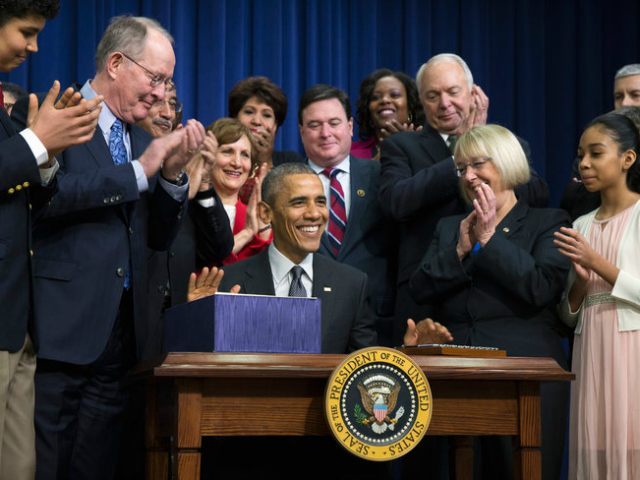
President Barack Obama shakes hands with Sen. Lamar Alexander, R-Tenn., a co-sponsor of the Every Student Succeeds Act, at the bill’s signing on Dec. 10.
President Barack Obama shakes hands with Sen. Lamar Alexander, R-Tenn., a co-sponsor of the Every Student Succeeds Act, at the bill’s signing on Dec. 10. EVAN VUCCI The Associated Press

Read more here: http://www.sacbee.com/opinion/op-ed/article51952870.html#storylink=cpy


The nation’s capital is experiencing something of a thaw in polarization and partisanship. And the largest iceberg that has broken free is the Every Student Succeeds Act, the most consequential education reform in the past 15 years.
Sen. Lamar Alexander, the Republican chairman of the Senate Education Committee, called it a “Christmas present” to American children. President Barack Obama proclaimed it a “Christmas miracle.” The president of the American Federation of Teachers said the law marks “a new day in public education.”
What does this mean for students? In 2001, No Child Left Behind, the last major federal education reform, mandated yearly testing in the basics of reading and math for children in third through eighth grades. Schools were required to show yearly progress for students of every background (including every racial background). If a school consistently failed, it was required to implement reforms and, in the worst cases, hire new teachers and reorganize. The law set the utopian goal that every child should be “proficient” in reading and math by 2014.
The whole thing was a mess from the start. Failing schools didn’t like to be labeled failures, which made administrators feel as though they were, like, you know, failing or something. Many teachers didn’t like the relentless emphasis on testing, which ate into their time for the unmeasurable joys of learning. Gov. Jerry Brown of California spoke for many when he recalled the formative prep school experience of an exam that consisted entirely of one question, asking students to give their impressions of a green leaf. “You can’t put that on a standardized test,” he explained.
The Every Student Succeeds Act ends the backseat driving of the federal government in education policy. State and local officials will now be free to set academic goals and to determine if schools are meeting them. While the law still mandates consequences for the worst-performing schools, states will determine what those consequences are. Student testing will still take place, but it won’t mean as much.
California, for example, is so happy to be free from the tyranny of testing that it has suspended the California High School Exit Examination and ordered schools to retroactively reward diplomas to students who failed the test during the past decade. It has also suspended its Academic Performance Index, which allowed parents to see how the test scores achieved by their local schools compared with those of other schools. In California, accountability will now be imposed according to “multiple measures” in eight “priority areas,” leaving parents entirely mystified about the actual performance of their local school.
The Every Student Succeeds Act is a win-win-win for everyone who counts. Most Republicans are pleased that the federal role in enforcing educational standards has been effectively abolished. Many teachers are pleased to see lower stakes on standardized tests. States and localities are pleased that they can declare all their schools successful, or at least to make accountability a fuzzy, gentle, toothless friend.
The problem? We have some experience in how schools operate in the absence ofMichael Gerson: Bipartisan deal on education costs students | The Sacramento Bee:

Read more here: http://www.sacbee.com/opinion/op-ed/article51952870.html#storylink=cpy

Monday, December 28, 2015

Pennsylvania is failing Philly's schools — so, close the schools? — NewsWorks

Pennsylvania is failing Philly's schools — so, close the schools? — NewsWorks:

Pennsylvania is failing Philly's schools — so, close the schools?

File image: Students walk the halls at De Burgos Elementary School. (Emma Lee/WHYY)


 The Pennsylvania Senate's effort to amend the PA School Code (H.B. 530), is part of the backroom wrangling over our state budget.

Senate amendments to the bill require the state to directly take over or close five individual schools every year. This Senate incursion into education is a textbook example of aggression and obstruction with no advance intelligence, no input, from "frontline ground troops." So politicians with uninformed philosophies push more and more state bureaucracy into sectors where the state is ignorant and, in fact, failing.
It is impossible to continue silently enduring simplistic views of learning and teaching practice (by non-practitioners) and simplistic "solution pills" to "fix" or increase learning, which instead continue generating more and more collateral damage: academic damage, systemic damage, financial damage, social damage, personal damage, and more.
Newsflash: There is no simplistic, quick fix, or someone would have done it long ago! In fact, Pennsylvania took over the School District of Philadelphia 15 years ago already! The state's record of academic decline, and their consistent record of precise underfunding of Philadelphia in particular, is a prime cause of our condition, a contrived disaster.
Ask yourself: After 15 years of state management, is the School District of Philadelphia better off today or worse off?
Now politicians want to go even further? The Senate proposes a required micro-management (or closure) from the state level of the five "worst" schools in Philadelphia. All for the sake of negotiating a state budget?
I ask, "What secret solution does the state have?"
There are no capital programs, no curriculum programs, no books, no supplies, no teacher incentives or punishments, no longer hours, no charter business plans, and no "common core" or "standardized" testing program nor even school closings that start at the center of the learning process. Instead they all focus on the periphery.
The learners, children, are the center. Children are people. It takes highly trained, Pennsylvania is failing Philly's schools — so, close the schools? — NewsWorks:

A List of Things I've Learned in 2015 | The Jose Vilson

A List of Things I've Learned in 2015 | The Jose Vilson:

A List of Things I’ve Learned in 2015

educolorme


For one, don’t make lists because it makes people reach for things that aren’t there.
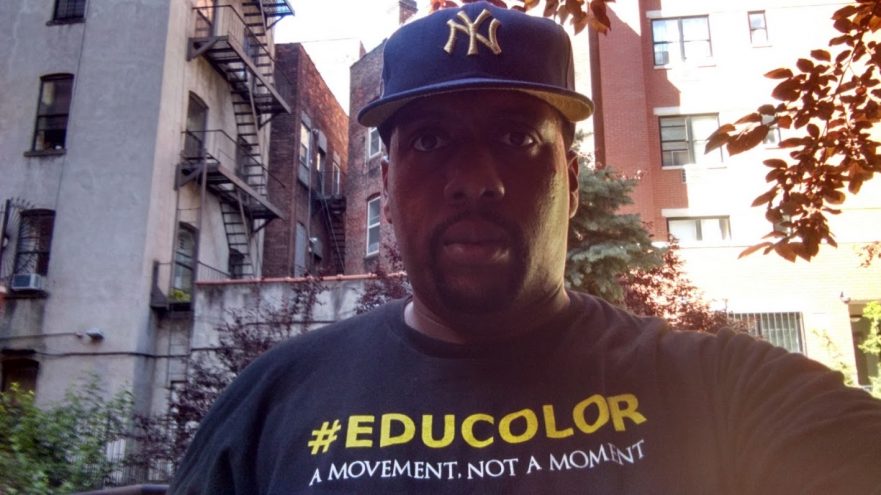
2015 is the year people forgot some of my titles. I am a full-time teacher at a middle school with a predominantly Dominican-American student body. I am a father to a toddler, a partner to a wonderful woman, a writer for some prominent outlets, and the founder of an activist collective. I don’t get much sleep, and don’t eat as well as I should. I am invested in making my thoughts into reality. I am overweight, but that hasn’t slowed me down much. I contain multitudes, and some take priorities over others. I am a proud Black Latino man, working hard to understand what that means in the context of today.
This post is dedicated to a whole list of folks I’ve had to leave behind in 2015, including some of your favorites, folks writing indirect posts at me until I had to call them out on it, folks jacking my style and using it in unethical ways (I see you), and supposed allies who created parody social justice accounts with my name involved thinking I didn’t peep that. (We did, though.) I walked into many a lion’s den and still came out roaring. I angered and vexed a few folks who once endorsed my bookThis Is Not A Test. Even some family and friends tested my mettle, and that provided plenty of learning experiences as well. With more speaking engagements came more opportunities for well-meaning white educators to walk out on me when I said the words “Black lives matter.” I haven’t stuttered all year on that principle, though.
Wouldn’t you know? We been hurt, been down before. When our pride was low, looking at the world like “Where do we go?”
I’m also dedicating this to the folks who stuck by me in solidarity and empathy, helped me become a A List of Things I've Learned in 2015 | The Jose Vilson: