Latest News and Comment from Education

Monday, November 23, 2015

Schools Matter: Guest post: What could be wrong with a "community school" model?

Schools Matter: Guest post: What could be wrong with a "community school" model?:

Guest post: What could be wrong with a "community school" model?


Allison McDowell is a Philadelphia public school parent and a member of the Alliance for Philadelphia Public Schools. This article is an expansion of her testimony to the Philadelphia School Reform Commission on November 19, 2015. While it speaks to developments in Philadelphia, it has national implications.

If you read my SRC testimony it paints a troubling picture. Given that my testimony was limited to three minutes, I wanted to add some additional thoughts to the conversation. It’s particularly important to get these ideas out there, because Philadelphia’s mayor elect Jim Kenney and his new Chief Education Officer, Otis Hackney, just took a trip to Cincinnati with the express purpose of learning more about the community school model and how it could work in our city. While Oyler, the school they visited, is lauded for its program, the long term success of the model remains uncertain.

As I see it, two groups are working concurrently on community school initiatives. They hold opposing views about what community schools are. Reformers talk about eliminating the concept of "seat time,” instead they want to promote the idea that you can learn anywhere at any pace.  I see that line of thinking as potentially very dangerous if you’re someone like me who values real bricks and mortar schools as a cornerstone of civil society. At the same time there are an increasing number of people who are involved with community school initiatives on the local level. They see community schools as neighborhood anchors. The problem is that they have absolutely no knowledge that there is another powerful group, the corporate education reformers, including Tom Vander Ark, working to undermine all they are doing.

Charter expansion. Where is the IEA? | Fred Klonsky

Charter expansion. Where is the IEA? | Fred Klonsky:

Charter expansion. Where is the IEA?

Screen Shot 2015-11-23 at 7.04.27 AM


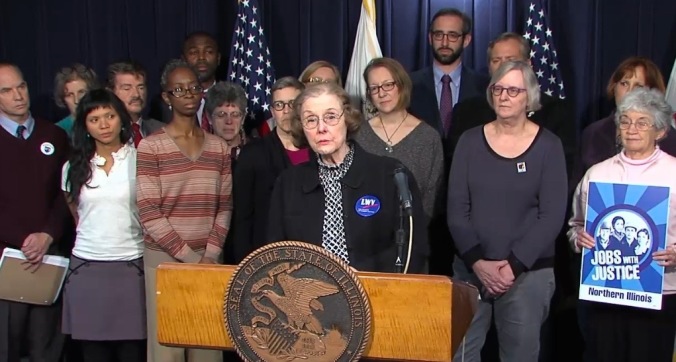
Look closely at the picture above of those attending the press conference Friday at the Thompson Center in Chicago. They were there to oppose the actions of the Illinois Board of Eduction in seeking and receiving a $43 million federal grant to open 48 more charter schools, half downstate and half in Chicago. The federal grant provides start-up money with all future costs coming from local dollars that would otherwise go to local public schools.

The Illinois Education Association, one of two state teacher unions in Illinois, was not present at the press conference.

The press conference and protest took place with plenty of notice.

On Thursday I posted on Facebook a notice I received from Illinois Jobs With Justice and Raise Your Hand.

In protest, NIJwJ along with Raise your Hand and other parents and citizens organizations will hold a press conference at the Thompson Center in the Blue Room on the fifteenth floor at 8:45 that day. Please join us there.

Progress Illinois, the website of the SEIU reported:

Elected officials at the press conference included state Reps. LaShawn Ford, Will Guzzardi (D-Chicago) and RobertCharter expansion. Where is the IEA? | Fred Klonsky:

Troubled Students and Inclusion: Effect on Students WITHOUT Disabilities

Troubled Students and Inclusion: Effect on Students WITHOUT Disabilities:

Troubled Students and Inclusion: Effect on Students WITHOUT Disabilities

Closeup portrait of angry kid raising two fists in the air and yelling with mouth wide open, isolated on white background with copy space


Contrary to Arne Duncan, and the latest DOE report claiming IEPs should be written the same for everyone, troubled students–students with behavioral/emotional disabilities–should have the right to services to address their problems. If their difficulties go unaddressed, left to the general education teacher with a class of 30 students, it could affect not only the troubled student, but the students in that class without disabilities.
Placing 90% of students with disabilities into general classes, means teachers get a hodgepodge of disability challenges. How does this affect students who don’t have such difficulties?
Seriously troubled students are one of the biggest problems facing teachers in public schools today.
Public schools must serve all students while private, parochial and charter schools can counsel troubled students out so the school environment will be favorable for learning. Most of today’s charter schools are strict and will not deal with children who act out.
We learned, in fact, that some “marching in a straight line” charter schools carry Troubled Students and Inclusion: Effect on Students WITHOUT Disabilities:

Two things NYC can do immediately to remedy the terrible and pernicious isolation of black and Latino children - The Hechinger Report

Two things NYC can do immediately to remedy the terrible and pernicious isolation of black and Latino children - The Hechinger Report:

Two things NYC can do immediately to remedy the terrible and pernicious isolation of black and Latino children


Recently, the New York City Department of Education’s Education Panel (a structure more accustomed to advising than governing) voted to omit a footnote in the city school’s admissions policy limiting the use of race as an admissions criteria.

The footnote had originally represented the city’s understanding of a Supreme Court decision precluding the use of race in school admissions decisions. Advocates have fought to eliminate this limitation.

While I agree that the current segregation of public schools is the most pernicious impediment to the academic success of students of color, I’m afraid that it will take considerably more than this gimmicky approach to accomplish. Many of us long for a secret bullet to integrate our public schools, but no such convenient remedy exists.

In a city where housing segregation parallels that of our schools, there are no easy solutions to improving academic outcomes of children of color by having them attend schools with their white and Asian counterparts. There are however, two things we can do immediately to remedy the terrible and pernicious isolation of African American and Latino youngsters.

The easier of the two would be to reinstate the long standing, now all but forgotten strategy of permitting the valedictorians from each of our middle schools regardless of their admissions exam scores to select entry from among our specialized exam driven high schools.

This practice was in place for decades and resulted in much higher representation of black and Hispanic students at Stuyvesant, Bronx Science and the other so-called specialized high schools. In a department with no historical memory, such an elegant and precedential solution to the problem of underrepresentation in these schools has eluded the mayor and chancellor.

Related: At a school in Brooklyn’s poorest neighborhood, literacy is up and disciplinary problems are down

The other solution to integrating our schools is much more difficult in that the backlash from white middle class communities could end political careers within and beyond our school system. Nevertheless, we need to proceed with all deliberate speed to unzone all of our elementary and middle schools. (High schools have been unzones for years.) In this scenario, students from anywhere in the city could Two things NYC can do immediately to remedy the terrible and pernicious isolation of black and Latino children - The Hechinger Report:

A mother’s battle exposed inequities and injustices. a question of tax cuts or education - The Boston Globe

A mother’s battle exposed inequities and injustices. A state is held in contempt of court. But corporations save their tax breaks and promised education dollars aren’t flowing. - The Boston Globe:

In Northwest, a question of tax cuts or education

A small group of demonstrators stand on the steps of the Temple of Justice and in view of the Legislative Building as they advocate for more state spending on education prior to a hearing before the state Supreme Court Wednesday, Sept. 3, 2014, in Olympia, Wash. The court ordered lawmakers to explain why they haven't followed its orders to fix the way Washington pays for public education. Lawmakers, the governor and others say the court needs to be patient and give the Legislature more time to fulfill the orders from the 2012 McCleary decision. (AP Photo/Elaine Thompson)
A small group of demonstrators stood on the steps of the Temple of Justice and in view of the Legislative Building as they advocated for more state spending on education prior to a hearing before the state Supreme Court.


CHIMACUM, Wash. — Thomas Ahearne, a Seattle lawyer, drove in his Ford pickup to this small town on the Olympic Peninsula a decade ago on an audacious mission. He planned to sue the state for violating its “paramount” constitutional responsibility, amply funding education for every child.

It was a long shot, but, if it worked, billions of dollars would flow, and the state’s 1 million schoolchildren would finally receive the education promised to them. One of the things Ahearne was hunting for in Chimacum was a brave soul willing to be the lawsuit’s public face.
Stephanie McCleary, a shy mother of two children, soon volunteered. She hardly imagined her instinctive decision to help her kids would put her at the center of a battle against the state’s most powerful players, uncovering a trail of inequities and injustices that have profound implications for this state and the rest of the nation.
The unlikely journey of Ahearne and McCleary began because Washington faced a startling crisis: Despite its image as the cutting-edge land of Microsoft, Boeing, Amazon, Starbucks, and many other corporate icons, the state ranks near last place nationally in education categories such as per-pupil funding, class size, and college attendance.
Washington has long cited a paucity of tax revenues for such failings. Yet, at the same time, it gives away more money in corporate tax breaks than any other state aside from New York, which has nearly three times the population. It is the result of what some call a “war between the states” to lure companies with treasury-draining giveaways — a trend so strong that this state’s governor likened it in an interview to corporate “extortion.”
So the odds facing Ahearne and McCleary seemed extreme. More than a battle for a better school in little Chimacum and smaller classes for McCleary’s children, it set in motion a chain of events that would lead the state’s Supreme Court justices to find the government in contempt of court and all but plead with the politicians to meet their obligations to schoolchildren.
The clash would reverberate far behind Washington’s state lines. Here was a self-described progressive state with a Democratic governor and House, an electorate that last year voted to improve school funding, and many cash-flush corporations famished for qualified graduates. If a solution to gridlock couldn’t be found here, how could other states — or the other Washington, the nation’s capital — break out of their political stalemates?
‘Every single state is a potential victim of corporate extortion of jobs.’
Quote Icon
It is a battle that only now, a decade later, is near to reaching its surprising conclusion.
But that is getting ahead of the story.

Fund-raisers for basic supplies

Stephanie McCleary was 13 years old in 1978 when the state Supreme Court ruled that Washington had failed to fulfill its constitutional mandate — the nation’s strongest — to pay for education. Its constitution says: “It is the paramount duty of the state to make ample provision for the education of all children residing within its borders, without distinction or preference on account of race, color, caste, or sex.”


Accountability and the ESEA Reauthorization Deal: Your Cheat Sheet - Politics K-12 - Education Week

Accountability and the ESEA Reauthorization Deal: Your Cheat Sheet - Politics K-12 - Education Week:

Accountability and the ESEA Reauthorization Deal: Your Cheat Sheet

Politics K-12


The newest proposed version of the Elementary and Secondary Education Act—dubbed the Every Student Succeeds Act—is almost over the congressional finish line, with votes in both chambers of Congress imminent.
So how would accountability work under the ESSA, if approved? And how does it compare to No Child Left Behind Act, Classic Edition, and the Obama administration's waivers?
Your cheat sheet here. Top-line stuff on accountability first, then some early reaction. Scroll down further if you want the nitty-gritty details on accountability.
And scroll down even further if you want more details on other aspects of the deal (an update of past Politics K-12 cheat sheets, including some new information on which programs made it into the agreement and which are on the chopping block, thanks to this helpful fact sheet from the Committee for Education Funding).
The top-line stuff: The ESSA is in many ways a U-turn from the current, much-maligned version of the ESEA law, the No Child Left Behind Act.
•States would still have to test students in reading and math in grades 3 through 8 and once in high school, and break out the data for whole schools, plus different "subgroups" of students (English-learners, students in special education, racial minorities, those in poverty.)
But beyond that, states get wide discretion in setting goals, figuring out just what to hold schools and districts accountable for, and deciding how to intervene in low-performing schools. And while tests still have to be a part of state accountability systems, states must incorporate other factors that get at students' opportunity to learn, like school-climate and teacher engagement, or access to and success in advanced coursework. 
And, in a big switch from the waivers, there would be no role for the feds whatsoever in teacher evaluation. 
• States and districts will have to use locally-developed, evidence-based interventions though, in the bottom 5 percent of schools and in schools where less than two-thirds of students graduate. States must also flag for districts schools where subgroup students are chronically struggling. The School Improvement Grant program is gone, but there are resources in the bill states can use for turnarounds.
The deal goes further on accountability than either the House- or Senate-passed legislation.And, in a win for civil rights groups, it appears there are no more so-called supersubgroups. That's a statistical technique in the waivers that allowed states to combine different categories of students for accountability purposes.
There are definitely some "guardrails" as one of the bill's sponsors, Sen. Patty Murray, D-Wash., would say. (More on just what those are below.) But the education secretary's authority is also very limited, especially when it comes to interfering with state decisionmaking on testing, standards, school turnarounds, and more. 
So there's some real ambiguity here. That will be something to watch going forward.
It's still unclear just how that the "guardrails" vs. limits on secretarial authority dynamic will play out in regulation, implementation, and any federal monitoring. But it's possible lawyers and lobbyists may have walked away as big winners here. (Even Democratic and Republican aides see certain aspects of the bill differently.) 
Put another way, there are definitely provisions in this deal that state and district leaders and civil rights advocates can cite to show that states and schools will have to continue to ensure equity. But, it will be hard for the U.S. Department of Education to implement those provisions with a very heavy hand, without at least the threat of lawsuits. So what happens from here will be largely up to states. (More on the potential regulatory fights, and lawsuits, ahead in this story from Friday.) 

Early Reaction 

Civil rights groups say they're waiting for real, live legislative language, not just a framework, before weighing in.
But, already, other accountability hawks are not happy campers.
"States are being given license to create systems that are significantly not based on student learning. That's a problem," said Sandy Kress, an original architect of the NCLB law. "This pretty much eliminates any kind of expectation for closing the achievement gap." (Another take from Chad Aldeman at Bellwether Education Partner's blog Ahead of the Heard.) 
But some state chiefs say there's no way that's happening. After all, it didn't under the NCLB waivers.
"I'm bothered when I hear people say that school chiefs won't hold schools accountable," saidBrenda Cassellius, Minnesota's education chief. "That's not been evident with the waivers. ... We've supported our schools and we've held them accountable. I hope America can see that."
The nitty-gritty details on accountability, based on an analysis of a late-stage version of the framework:
Plans: States would still have to submit accountability plans to the education department. These new ESSA plans would start in the 2017-18 school year. And importantly, the department would only have 90 days to take a look at what states are proposing (that's down from 120 right now) and give a thumbs up or down. And a state could get a hearing if the department turned down its plan. 
Goals:
  • No more expectation that states get all students to proficiency by the 2013-14 school year, as under NCLB Classic. (That ship has sailed, anyway). And no more menu of goals, largely cooked up by the department, as under the waivers. 
  • Instead, states can pick their own goals, both a big long-term goal, and smaller, interim goals. These goals must address: proficiency on tests, English-language proficiency, and graduation rates.
  • Goals have to set an expectation that groups that are furthest behind close gaps.
What kinds of schools will states have to focus on? 
  • States have to identify and intervene in the bottom 5 percent of performers, an idea borrowed from waivers. These schools have to be identified at least once every three years. (That's something many states already do under waivers. And some, like Massachusetts, do it every single year.)
  • States have to identify and intervene in high schools where the graduation rate is 67 percent or less. 
  • States, with districts, have to identify schools where subgroup students are struggling. 
What do these accountability systems have to consider? The list of "indicators" is a little different for elementary and middle schools vs. high schools.
  • Systems for Elementary and Middle Schools:
  • States need to incorporate a jumble of five indicators into their accountability systems. 
  • That includes three, old-school academic indicators: proficiency on state tests, English-language proficiency, plus some other academic factor that can be broken out by subgroup. (That could be growth on state tests, so that states would have a mix of both in their systems, as many already do under waivers.)
  • States also have to somehow figure in participation rates on state tests (schools with less than 95 percent participation are supposed to get dinged, somehow.) 
  • And, in a big new twist, states must add at least one, fifth indicator of a very different kind into the mix. Possibilities include: student engagement, educator engagement, access to and completion of advanced coursework, post-secondary readiness, school climate/safety, or whatever else the state thinks makes sense. Importantly, though, this indicator has to be disaggregated by subgroup. States are already experimenting with these kinds of indicators under the waivers, especially a cadre of districts in California (the CORE districts).
  • Systems for high schools:
  • Basically the same set of indicators, except that graduation rates have to be part of the mix.
  • So to recap, that means for high schools: proficiency on tests, English-language proficiency, graduation rates, plus some other indicator that focuses a little more on whether students have the opportunity to learn, or are ready for post-secondary work. And also, test participation has to be incorporated in some way.
How much do each of these indicators have to count? It depends on who you ask. Everyone agrees that those academic indicators (tests, grad rates, English-language proficiency) have to weigh more, as a group, than that non-traditional indicator that gets at a students' opportunity to learn (school climate, etc.)
From there, Democratic and Republicans aides have different takes.  A Republican aide said the academic stuff just has to be at least 51 percent of the system, and the other factor, or factors, can be up to 49 percent. A Democratic aide said the regulations might turn out differently, when all's said and done. (In this aide's view, the department could set a range for each individual indicator, which could ultimately giving the academic factors as a group significantly greater weight than the other factors.) Read more about it here. 
How do interventions work? 
  • For the bottom 5 percent of schools and for high schools with really high dropout rates:
  • Districts work with teachers and school staff to come up with an evidence-based plan.
  • States monitor the turnaround effort.
  • If schools continue to founder for years (no more than four) the state is supposed to step in with its own plan. That means states could take over the school if they wanted, or fire the principal, or turn the school into a charter, just like they do under NCLB waivers now. (But, importantly, unlike under waivers, there aren't any musts—states get to decide what kind of action to take.)
  • Districts could also allow for public school choice out of seriously low-performing schools, but they have to give priority to the students who need it most.  
  • For schools where subgroups students are struggling:
  • Most of these schools  have to come up with an evidence-based plan to help the particular group of kids who are falling behind. For example, a school that's having trouble with students in special education could decide to try out a new curriculum with evidence to back it up and hire a very experienced coach to help train teachers on it. 
  • Districts monitor these plans. If the school continues to fall short, the district steps in. The district decides just when that kind of action is necessary, though; there's no specified timeline in the deal.
  • Importantly, there's also a provision in the deal calling for states and districts to take more-aggressive action in schools where subgroups are chronically underperforming, despite local interventions. Their performance has to look really bad though, as bad as the performance of students in the bottom 5 percent of schools over time.  
What kind of resources are there for these interventions? The School Improvement Grant program, which is funded at around $500 million currently, has been consolidated into the bigger Title I pot, which helps districts educate students in poverty. Instead, states could set aside 7 percent of what used to be SIG for school improvement. The bulk of the former SIG money, though would have to flow to districts for innovation, either through a formula, or through a competition.Bottom line: There are resources in the bill for school turnarounds. But some of the money could also be used for other purposes. (Hat tip to a cheat sheet from AASA, the School Administrators Association, for explaining SIG and the deal.)
What about the tests? The testing schedule would be the same as under NCLB. But in a twist, a handful of states could apply to try out local tests, with the permission of the U.S. Department of Education. And importantly, these local tests aren't supposed to be used forever—the point is for districts to experiment with new forms of assessment (as New Hampshire is doing with performance tasks) that could eventually go statewide and be used by everyone. That way states don't get stuck with the same old assessment for years on end.
What's more, the framework allows for the use of local, nationally-recognized tests at the high school level, with state permission. So a district could, in theory, use the SAT or ACT as its high school test, instead of the traditional state exam. 
What about that supersubgroup thing mentioned higher up? Supersubgroups are a statistical technique used in the waivers that call for states to combine different groups of students (say, students in special education, English-language learners, and minorities) for accountability purposes. By my reading of the bill, it would seem that's a no-no. States now have to consider accountability for each subgroup separately. States liked the flexibility of supersubgroups. But former Rep. George Miller, D-Calif., and civil rights groups said they masked gaps. The bill appears to eliminate the use of supersubgroups.
What about the rest of the bill?
English-Language Learners
The compromise would shift accountability for English-language learners from Title III (the English-language acquistion section of the ESEA) to Title I (where everyone else's accountability is). The idea is to make accountability for those students a priority. 
Students in Special Education
The legislation mirrors a recent federal regulation when it comes to assessments for students in special education, saying, essentially, that only 1 percent of students overall can be given alternative tests. (That's about 10 percent of students in special education.)
Opt-Outs
The bill largely sticks with the Senate language, which would allow states to create their own testing opt-out laws (as Oregon has). But it would maintain the federal requirement for 95 percent participation in tests. However, unlike under the NCLB law, in which schools with lower-than-95 percent participation rates were automatically seen as failures, local districts and states would get to decide what should happen in schools that miss targets. States would have to take low testing participation into consideration in their accountability systems. Just how to do that would be up to them.
On Programs
There's more consolidation of federal education in the compromise than there was in the Senate bill. The legislation creates a $1.6 billion block grant that consolidates a bunch of programs, including some involving physical education, Advanced Placement, and education technology. (Some of these programs haven't federal funding in years.) Districts will have to spend at least 20 percent of their funding on one activity that helps students become well-rounded, and another 20 percent on at least one activity that helps kids be safe and healthy. And part of the money would have to be spent on technology. 
Some programs would live on as separate line items, including the 21st Century Community schools program, which pays for after-school programs and has a lot support on both sides of the aisle in Congress. 
Sen. Patty Murray, D-Wash. got the early-childhood investment she wanted—the bill enshrines an existing program "Preschool Development Grants" in law, and focus it in part on broadening access to child care. But the program would be housed at the Department of Health and Human Services, not the Education Department as some Democrats had initially hoped. The Education Department would jointly administer the program, however. (The reason: HHS already has some early-education programs, like Head Start. Expanding the education department's portfolio was a big no-no for conservatives.) 
That new research and innovation program that some folks were describing as sort of a next-generation "Investing in Innovation" program made it into the bill. (Sens. Orrin Hatch, R-Utah, and Michael Bennet, D-Colo., are big fans, as is the administration.)
So did a wraparound services program that shares some DNA with both Promise Neighborhoods, as well as a community schools program that Rep. Steny Hoyer of Maryland, the second-ranking Democrat in the House, really likes. 
On School Choice
No Title I portabilityThat means that federal funds won't be able to follow the child to the school of their choice.
But the bill does include a pilot project allowing districts to try out a weighted student funding formula, which would also essentially function as a backpack of funds for kids. The program would allow 50 districts to combine state, local, and federal funds into a single pot that could follow a child to the school of their choice. It is said to be a more workable alternative to Title I portability, which looked more dramatic on paper, but which few states would likely have taken advantage of because of its complexity, experts said. Importantly with this pilot, participation would be entirely up to district officials. And the language would give them a chance to better target funds to individual school needs. 
Funding and Other Issues
No changes to the Title I funding formula along the lines of what the Senate passed that would steer a greater share of the funds to districts with high concentrations of students in poverty. But there were some changes to the Title II formula (which funds teacher quality) that would be a boon to rural states.
The agreement would keep in place maintenance of effort, a wonky issue we wrote about recently, with some new flexibility added for states. (Quick tutorial: Maintenance of effort basically requires states to keep up their own spending at a particular level in order to tap federal funds.)
There was some chatter that the bill would also incorporate changes to the Family Educational Rights and Privacy Act. That's not part of the agreement. 
The framework would only "authorize" ESEA for four more years, as opposed to the typical five. That gives lawmakers a chance to revisit the policy under the next president, should they choose to do so. And its overall authorization levels are largely consistent with the most recent budget deal. 
Want more? Check out, below, extensive language with details on the Every Student Succeeds Act, the name of the ESEA agreement approved by conferees Thursday to replace No Child Left Behind Act:
One important caveat: We don't know if this is the language of the final deal that the House is slated to vote on in early December. But the language is clearly at a late draft stage if it isn't yet completed.

Don't miss another Politics K-12 post. Sign up here to get news alerts in your email inbox.

Sen. Murray: Revised No Child Left Behind law ‘great step forward’ | The Seattle Times

Sen. Murray: Revised No Child Left Behind law ‘great step forward’ | The Seattle Times:

Sen. Murray: Revised No Child Left Behind law ‘great step forward’

One day after House and Senate negotiators reached an agreement about a revised No Child Left Behind law, U.S. Sen. Patty Murray spoke about the law and its effect on Washington schools.

U.S. Sen.


Congressional negotiators reached an agreement earlier this week to revise the No Child Left Behind education law, which has long been criticized for its “one-size-fits-all” policies and emphasis on high-stakes testing.
The framework to revise the 2002 law would maintain the same number of required tests, but gives states a larger role in determining how to use the tests to access schools’ performances. Under No Child Left Behind, 88 percent of Washington schools were labeled as “failing” for the 2013-14 school year.
U.S. Sen. Patty Murray (D-WA), the ranking Democrat of the Senate’s education committee, co-authored the Senate bill to fix the education law.
She spoke briefly Friday at Seattle’s Dearborn Park International Elementary School about the potential fixes and how the changes could affect Washington’s schools.
What is different about the revised No Child Left Behind law?
“The current No Child Left Behind law is badly flawed because it is a one-size-fits-all education policy that set standards for our schools that were very difficult to meet. If they were not met then you either got a waiver or you didn’t get a waiver, and it was a one-size-fits-all response. We have changed that dramatically in our new law, which we hope to send to the president in a few weeks. This means that we will have our states and our local communities still having to have national goals that they meet, but they will determine how they meet them.”
How would this affect testing in Washington?
“This would eliminate high-stakes testing that has caused so much concern for so many of our schools. (Parents at the schools) will no longer have to have a letter coming home to them saying their school is failing. They (States) look at how their students are doing and determine for themselves…how they make progress for every one of their students. I think it is a great step forward.”
Would the revised law include preschool and early education?
“I’m very excited to get into law a provision that would expand access to early education, as part of the K-12 education bill.”Sen. Murray: Revised No Child Left Behind law ‘great step forward’ | The Seattle Times:

Sunday, November 22, 2015

Seattle Schools Community Forum: Guest Post: Rep Gerry Pollet Meets with Charter School Parents and Students

Seattle Schools Community Forum: Guest Post: Rep Gerry Pollet Meets with Charter School Parents and Students:

Guest Post: Rep Gerry Pollet Meets with Charter School Parents and Students


By Representative Gerry Pollet, 46th District:

Thursday offered a “learning moment” for students in charter schools, parents and legislators.

Blue-shirted charter school students and parents came to the state capital to urge that legislators “save” their schools. Ironically, the Supreme Court released its opinion the same day reaffirming its prior unanimous opinion that charter schools were not “common schools” and its majority opinion striking down the entire charter school initiative as unconstitutional.

A group of 8 or 9 Summit Sierra Charter HS 9th graders and two parents were leaving my office as I returned from committee hearings. Although I had a large group waiting for their scheduled appointment with me, I didn’t want to disappoint high school students who had made the trek – and, were eager to tell me about the “unique” learning experience offered by their school.

So, I stopped to engage them. It was a learning moment for me, and I hope for the students as well – as students and I found some pre-established notions challenged by thought provoking questions. There are questions which legislators should be asking – and, they have surprising answers.


First, it’s important to know that Summit Sierra was pitched as a charter school to serve “a diverse group of students and families in South Seattle, with a particular focus on either Southwest or Southeast communities, helping to close the significant demographic achievement gap.(from their own website.)

The political and educational policy pitch for charters, and Summit in particular, is about serving the students in that high need area.

However, I had received numerous emails from constituents in North and NE Seattle (served by excellent, but horribly overcrowded schools, I should note) complaining that their children who had just started attending Summit would be losing their excellent new educational opportunity. Out of the 120 newly enrolled ninth graders at this charter school, pitched as deserving public Seattle Schools Community Forum: Guest Post: Rep Gerry Pollet Meets with Charter School Parents and Students: