Latest News and Comment from Education

Sunday, November 22, 2015

CURMUDGUCATION: OH: Raking in Consultant Money

CURMUDGUCATION: OH: Raking in Consultant Money:

OH: Raking in Consultant Money


Education reform has spawned a variety of new money-making opportunities, including a burgeoning field of education consultants.

That's because one of the new steady drumbeats is that superintendents, principals, and most especially teachers-- in short, all the people who have devoted their professional lives to education-- don't know what they're doing and possess no expertise in education whatsoever. No, for real expertise, we must call in the High Priests of Reformsterdom.

That takes us to Cleveland, Ohio. I love Cleveland; I did my student teacher at a Cleveland Heights middle school while living in apartment at the corner of East 9th and Superior, and those, indeed, were the days. But Cleveland schools have a long history of difficulty. Back in the day, Ohio schools had to submit all tax increases to voter referendum; Cleveland voters routinely said no, and Cleveland schools repeatedly shut down around October when they ran out of money.

Now, in the reform era, Cleveland schools have embraced charters and privatization with a plan that stops just short of saying, "We don't know what the hell we're doing or how to run a school district, so we're just going to open it up to anybody who thinks they can run a school or has an opinion about how to run a school. Except for teachers and professional educators-- they can continue to shut the 
CURMUDGUCATION: OH: Raking in Consultant Money:


ICYMI: Some weekend eduwebs reading


Here's some edureading for the weekend. 

Five Cynical Observationa about Teacher Leadership

I mean to include Nancy Flanagan's insightful list about how teacher leadership isn't happening last week, and then, somehow, I didn't. But here it is. These days Flanagan is one of the consistently rewarding bloggers for Ed Week-- save your limited freebie reads for her.

Educators Release Updates VAM Score for Secretary Duncan

Educators for Shared Responsibility have come up with a VAM formula for evaluating Education Secretaries. Not entirely a joke. 

Classroom Surveillance and Testing

At the 21st Century Principal, John Robinson makes the striking observation that our classroom data collection bears a striking resemblance to the tools of surveillance and, well, spying. 

Drinking Charter Kool-Aid? Here Is Evidence.

Dr. Julian Vasquez Heilig has provided an essential resource. You may not read through it all today, but you'll want to bookmark it somewhere. Here's a very thorough listing of legitimate peer-reviewed research on the effectiveness of charter schools. Handling of special populations, segregation, competition, creaming-- it's all here, and all the real deal. You will want to keep this resource handy.

Stop, Start, Continue

Not always a fan of things I find at Edutopia, but this is a short simple piece focused on three things teachers should stop doing, three things we should start doing, and three things to continue doing. A good piece for sparking a little mental focus.


http://curmudgucation.blogspot.com/2015/11/icymi-some-weekend-eduwebs-reading.html

Sunday posts, pics and tweets. | Fred Klonsky

Sunday posts, pics and tweets. | Fred Klonsky:

Sunday posts, pics and tweets.

Screen Shot 2015-11-22 at 7.26.56 AM


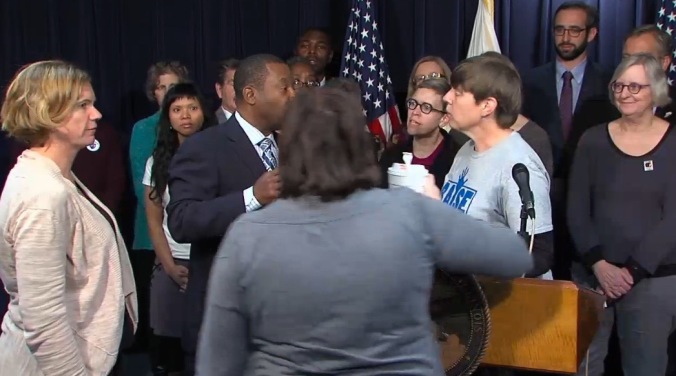
Illinois School Board President James Meeks attempts to disrupt a press conference of parent groups, educators and public officials, protesting the expansion of charter school funding in Illinois. Meeks secretly applied for a federal grant for start-up money for 48 charter schools which would then be maintained by local funding. 24 of the charters would be in Chicago and 24 would be downstate.
.
Laquan McDonald was more than another young African-American male who had the misfortune of crossing the path of a brutal Chicago cop. Mary Sunday posts, pics and tweets. | Fred Klonsky:
00massweb2-articleLarge
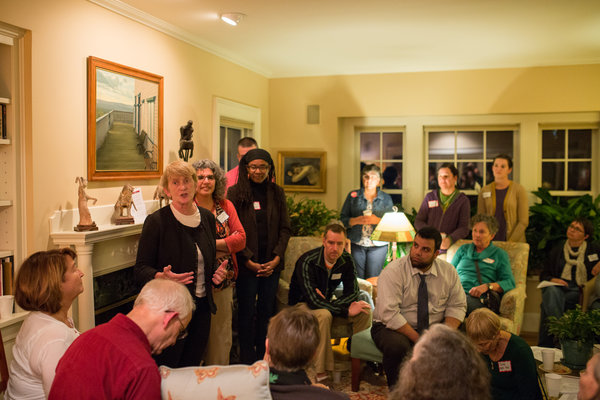
I posted this picture of Massachusetts Teachers Association, Barbara Madeloni, in my Sunday Posts today. But I am posting it again because I noticed something about it that is strange. Illinois IEA members: Can you see what is odd about this photo? Barbara is campaigning. She is meeting with members in a member’s home explaining why she should be re-elected. She is talking with them about her ideas and seeking their votes. 35 years as an IEA member and I have never seen that. https://preaprez.wordpress.com/

Mark Kirk has gone AWOL on ESEA and Pay for Success.

Bev Johns
On Monday and Tuesday please call the offices of our U.S. Senator Mark Kirk urging him to act on removing/modifying the Goldman Sachs Pay for Success part of S. 1177, the reauthorization of the Elementary andSecondary Education Act (ESEA which used to be called No Child Left Behind).
 Sen. Kirk, despite weeks of contacts on Pay for Success, apparently has done nothing, even though he was a Member of the Conference Committee between the U.S. House and the U.S. Senate on ESEA.
I received a telephone message on Thursday from Sen. Kirk’s Washington, D.C. office saying nothing could be done by Sen. Kirk.
The actual language of S. 1177, based on concepts approved by the https://preaprez.wordpress.com/

Chaz's School Daze: Why The NYU Study On The Closed Schools, When Replaced By Small Schools, Is Fatally Flawed.

Chaz's School Daze: Why The NYU Study On The Closed Schools, When Replaced By Small Schools, Is Fatally Flawed.:

Why The NYU Study On The Closed Schools, When Replaced By Small Schools, Is Fatally Flawed.


This week, NYU released a study showing that students fared better with the closing of the many large comprehensive high schools and replaced by the Bloomberg small schools. The basis for the study's conclusion was the increased graduation rate from the small schools when compared to the closed schools.  However, the study is fatally flawed since the graduation rate is a bogus parameter and easily manipulated by the school Principal to allow students to graduate academically unprepared for college and career.  Let's look at how schools manipulate the graduation rate.

First, a little history.  During the 2002-08 time period the study looked at 29 closed high schools and the results for future students who instead went to the Bloomberg small schools which showed a 15% increase in the graduation rate.  However, the study admits that students who fled these closing schools did worse then the ones who stayed and graduated,  Moreover, these students who fled were academically behind their peers in the new schools they transferred to.

Credit Recovery:
During the time period the study covered there was an explosion of credit recovery courses that artificially increased a struggling student's credit accumulation.  Even the State finally saw the abuse of the credit recovery system and required the City to put an end to it in 2012.  The primary beneficiaries were the Bloomberg small schools who needed to have a high graduation rate to show how successful they were.  Therefore, they gave struggling students loads of "credit recovery" courses, many of them were bogus.  You can read some of the stories, HereHere, and Here.

Principal Pressure:
The Bloomberg small schools were notorious in hiring "newbie teachers"  and since these teachers lacked tenure, they were pressured to pass along the school's struggling students.  Teachers who failed too many of their students were discontinued due to scholarship issues and were banned from working at the DOE.  This message resonated loud and clear with the inexperienced staff and resulted in high graduation rates despite these students academically unable to succeed in college or careers.

Student Selection: 
To ensure the Bloomberg small schools would succeed they opened with some very significant advantages like excluding many Chaz's School Daze: Why The NYU Study On The Closed Schools, When Replaced By Small Schools, Is Fatally Flawed.:

Education Reformers and their obsession with Standardized Testing - Even the NY Times can’t get the story right! - Wait What?

Education Reformers and their obsession with Standardized Testing - Even the NY Times can’t get the story right! - Wait What?:

Education Reformers and their obsession with Standardized Testing – Even the NY Times can’t get the story right!


Fellow education blogger Diane Ravitch, the nation’s premier public education advocate, opened the New York Times this morning and noted that even the New York Times has been “snowed” by the Corporate Education Reform Industry and their false narrative that the solution to the challenges facing public education in the United States is to have more standardized testing.
Diane Ravitch writes;
News flash! There is a national test that enables us to compare reading and math scores for every state! It is called NAEP. It reports scores by race, ELLs, poverty, gender, disability status, achievement gaps. This is apparently unknown to the Néw York Times and the Secretary of Education, who has said repeatedly that we need Common Core tests to compare states.
The New York Times, America’s newspaper of record, has a story todayabout Massachusetts’ decision to abandon PARCC, even though its State Commissioner Mitchell Chrster is chairman of the board of PARCC. True or Memorex? Time will tell.
But the story has a serious problem: the opening sentence.
“It has been one of the most stubborn problems in education: With 50 states, 50 standards and 50 tests, how could anyone really know what American students were learning, or how well?”
Later the story has this sentence:
“The state’s rejection of that test sounded the bell on common assessments, signaling that the future will now look much like the 
Education Reformers and their obsession with Standardized Testing - Even the NY Times can’t get the story right! - Wait What?:

A Not-Review of More Than A Score [Edu-Activated] | The Jose Vilson

A Not-Review of More Than A Score [Edu-Activated] | The Jose Vilson:

A Not-Review of More Than A Score [Edu-Activated]

MTaS-Fb


In the spring of 2014, a few books dedicated to the “Education Spring” revolt came out from various publishers, one of which was mine, and the other was More Than A Score, a collection of stories edited by Jesse Hagopian from numerous dissidents from across the nation. [Full disclosure: Haymarket Books came out with both of our books). As I consider many of them colleagues in this work (and some of them friends), I was happy that so many of them got to tell their story.
So why a review from me almost a year later? Simple. As any of the activists in this volume can tell you, these stories are still relevant to the work of moving the profession forward.I read these chapters in the authors’ voices. I was intrigued by Rosie Frascella and Emily Giles’ story of co-leading the charge to have her entire Brooklyn-based school opt out of unnecessary exams, much to the chagrin of NYCDOE and the United Federation of Teachers. I was enthralled by Barbara Madeloni’s vision for a new education system, including racial dynamics as part of her call to activate. I recalled Karen Lewis’ ascension to the leader of Chicago edu-resistance, envisioning how they organized for better schools and not just a better contract for teachers. Stephanie Rivera’s chapter on becoming a future student reads as a precursor to the ways she’s currently managing the school system as a rookie teacher.
John Kuhn’s tale of resistance in perhaps the most reform-friendly state in the nation rang of hope. I laughed aloud at the chapter co-written by Cauldierre McKay, Aaron Regunberg, and Tim Shea of the Providence Student Union, who resisted their state’s education reforms through creativity and art, two ideals that their legislators sought to reduce by overtesting their students. Folks like Helen Gym, Nikhil Goyal, Brian Jones, Malcolm London, Mary Cathryn Ricker, and Jia Lee also turned in chapters worth having in your back pocket.
But my favorite was easily Jesse Hagopian’s, which was the real beginning of the book. He sets the A Not-Review of More Than A Score [Edu-Activated] | The Jose Vilson:

Ask #SpeakerRyan and #SenatorAlexander About ‘Guardrails’ in #ESEA » Missouri Education Watchdog

Ask #SpeakerRyan and #SenatorAlexander About ‘Guardrails’ in #ESEA » Missouri Education Watchdog:

Ask #SpeakerRyan and #SenatorAlexander About ‘Guardrails’ in #ESEA

challenging standards


If it quacks like a duck it’s still a duck.  Federal involvement is still present in the rewrite from the Conference Committee and should be opposed by those concerned about Common Core State Standards.  Carrots and sticks still rule the day and authentic state direction/development must be approved by the Federal Government.
From Negotiators Come to Agreement on Revising No Child Left Behind Law and the language which explains McCluskey’s tweet:
But the secretary of education cannot dictate how states rate schools or what weight they give to measures like test scores in such ratings. The agreement also prohibits the education secretary from mandating academic standards such as the Common Core, guidelines that have prompted enormous political backlash.States are required only to set “challenging” academic standards that will prepare students to enter universities or career and technical colleges.

Just like the 15% of standards states were allowed to insert in Common Core State Standards, states will be allowed 49% of accountability measures to determine an effective school.  From House, Senate ESEA Compromise Sails Through Conference Committee:
And it goes further on accountability than either the House or Senate bills to overhaul the ESEA. Academic factors—such as test scores, graduation rates, and English-language proficiency—would have to make up at least 51 percent of a school’s rating.
The other 49 percent would be up to states, and could include things like parent engagement, teacher engagement, college readiness, and school climate. (You can find accountability language here. The agreement is still being written into legislation, but there aren’t substantive changes to this proposal. We’ll flesh out with further details as we get a better understanding of the implications here and how “guardrails” would work.)

“Guardrails” = Requirements and Requirements = Mandates and Mandates = Carrots & Sticks.  Can’t wait for those further details of the implicationsof the guardrails.Ask #SpeakerRyan and #SenatorAlexander About ‘Guardrails’ in #ESEA » Missouri Education Watchdog:

The Progressive Magazine: A School Crisis | Cloaking Inequity

The Progressive Magazine: A School Crisis | Cloaking Inequity:

The Progressive Magazine: A School Crisis


Politicians in Puerto Rico are seeking to solve decades of fiscal mismanagement by adopting the same education reforms that are hurting children and starving school districts in the mainland United States. The disaster capitalism coming to the azure waters of Puerto Rico is very similar to the school privatization and private-control education reform causing an uproar in Chicago and Detroit.
A day strike by thousands of teachers across the island of Puerto Rico on Tuesday demonstrated the intensity of their concern about the new regime.
In October, Senator Eduardo Bhatia fast-tracked Project 1456 in the Puerto Rican Senate. School closure requirements in 1456 are the first notable parallel with the Detroit and Chicago school privatization playbook. In Chicago, 50 schools (primarily in African-American neighborhoods) were recently closed under the pretext that they were under-enrolled. A University of Chicago study showed that after neighborhood school closure, students were shuffled to a new set of low-performing schools— often charter schools.
In Michigan, the state created the Education Achievement Authority (EAA), an education board similar to the one proposed in Project 1456. Michigan is different from other states because the vast majority of its charter schools are already run by for-profit companies. The Detroit News reports that the EAA and the for-profit charters have been plagued by low performance and corruption.
Since 2014, the Puerto Rican government has closed 135 schools— about 10% of the schools on the island. The results of these school closings are class sizes as large as 40 students. The new law requires the closure of 400 more public schools—30% of the remaining public schools on the island. Additionally, Project 1456 requires that the government turn at least 15% of schools into Lider (charter schools) every three years under the auspices of private control and the education authority.
While a debate rages on the quality of charter schools in the United States, most peer-reviewed literature demonstrates that charters typically The Progressive Magazine: A School Crisis | Cloaking Inequity:

Patty Murray’s ESEA Re-Write Leaves No Assessment Behind | Seattle Education

Patty Murray’s ESEA Re-Write Leaves No Assessment Behind | Seattle Education:

Patty Murray’s ESEA Re-Write Leaves No Assessment Behind

nclb


Being somewhat naive, I had hoped No Child Left Behind (NCLB) would die quietly, without notice.
Regrettably, a few somebodies were paying attention. After all, way too much money was on the line to let this colossal failure slip gently into the night. So, like so many bad federal policies backed by powerful lobbyists–NCLB could not die.
Of course, the first hurdle to reauthorization was the name. No Child Left Behind has become so toxic and synonymous with failed education policy, something had to be done.
The difficult route would have been to rewrite the bill and put as many federal dollars as possible directly into the classroom.
Dollars to fund things like: smaller class size, librarians, counselors, nurses, art, music, an aid for every student with an IEP, money to build new schools, an aid for every English Language learner, competitive teacher salaries, money for full school days, paper, pencils, band instruments, full time PE teachers, tutors for struggling students, money to rebuild crumbling schools, full time cafeteria workers, recess monitors, after school enrichment programs, (add your school’s need here).
Patty Murray’s solution: a radical rebranding –which tones down the rhetoric of failure, and adds a just a hint of smaller class size.
Now NCLB has been renamed the Every Child Achieves Act of 2015. To make it even more confusing, the reauthorization is referred to as the ESEA, going back to the original bill — the Elementary and Secondary Education Act of 1965.
The ESEA is being sold as somehow “fixing” the problems of NCLB.
Sorry, I just don’t see it.
Sure, the idiotic 100% proficiency clause for reading and math is gone — which, after Washington State lost its NCLB waiver, labeled almost every school in our state a failure.
Let’s not forget: this epic fail of federal policy ALSO provided many parents an emperor has no clothes moment regarding high stakes testing AND added fuel to this year’s Patty Murray’s ESEA Re-Write Leaves No Assessment Behind | Seattle Education:

With A Brooklyn Accent: "Something's Happening Here"- Understanding Divisions Among Whites About "Race" At Fordham and Elsewhere

With A Brooklyn Accent: "Something's Happening Here"- Understanding Divisions Among Whites About "Race" At Fordham and Elsewhere:

"Something's Happening Here"- Understanding Divisions Among Whites About "Race" At Fordham and Elsewhere


One of the most gratifying things about the response to the latest racial incident at Fordham- which featured students shouting "White Power" and even more disturbing racial slurs for 20 straight minutes at a party- has been the incredible support given by so many Fordham students of every background to the "Zero Tolerance for Racism" campaign which my Affirmative Action Seminar started.
This support has crossed all racial lines, has mobilized athletes as much as student activists, and has reached students who consider themselves conservative or moderate as well as students on the left.
The students who were at that party may be shocked at how many white students were outraged by their words, but they shouldn't be. At Fordham, as in the rest of the nation, a growing number of white students are not only part of interracial teams and friendship circles, they are part of multiracial extended families- families like mine where there is a wide spectrum of racial identities. This makes racially targeted acts of vandalism or verbal abuse directed at marginalized people- whether Blacks, Latinos, Muslims or Jews- seem very personal to a lot of students who fall into none of those categories. The people being insulted or threatened by expressions of racialized hatred are not just abstractions, they could be your cousin, your niece, your aunt or uncle, your step brother or step sister. This element of deep identification with people of color and marginalized religious groups should not be underestimated as a force in campus social movements

It's Way Past Time for America to Face These Ugly Truths | Marian Wright Edelman

It's Way Past Time for America to Face These Ugly Truths | Marian Wright Edelman:

It's Way Past Time for America to Face These Ugly Truths

UNIVERSITY OF VIRGINIA


On November 14, Georgetown University President John J. DeGioia announced the university will rename two buildings on campus named for two 19th century Georgetown University presidents: Thomas F. Mulledy, who in 1838 arranged the sale of 272 slaves from Jesuit owned Maryland plantations and used the profit to pay Georgetown’s construction debts, and William McSherry, who also sold other Jesuit owned slaves and was Mulledy’s adviser. The sale ignored the objections of some Jesuit leaders who believed using the money to pay off debt was immoral and their demands that families be kept together.
Georgetown’s action followed a student sit in outside President DeGioia’s office but it was part of a longer ongoing process examining the university’s historical connections to slavery. The renaming was one step recommended by the Working Group on Slavery, Memory and Reconciliation established by the President this school year. Recently student protesters at Yale University repeated calls to rename its Calhoun College honoring slave owning Vice President and South Carolina Senator John C. Calhoun, already a subject of campus wide discussion. For years the college featured a stained glass window depicting Calhoun with a chained Black slave kneeling in front of him. After complaints the slave’s image was removed but Calhoun’s remains as does his shameful legacy that haunts our nation still. Georgetown and Yale are among the growing number of colleges and universities struggling to come to terms with their historical connections to slave owners, slave labor, and slave profits and the scars they leave on campuses and our nation today. What values do we want to hold up for our young as worthy of honor and emulation?
Brown University in Providence, Rhode Island was the first Ivy League university to move forward with a large scale investigation of its history under the leadership of former president Ruth Simmons. In 2003 she appointed a Committee on Slavery and Justice to learn more about Brown’s past ties to slavery and wealthy benefactors involved in the trans-Atlantic slave trade. The Brown family included slave owners and slave traders as well as at least two members who became active abolitionists. The committee learned 30 members of Brown’s governing board owned or captained slave ships and slave labor was used for some of the school’s construction.
Brown is far from alone. In his groundbreaking 2013 book Ebony & Ivy: Race, Slavery, and the Troubled History of America’s Universities, Massachusetts Institute of Technology (MIT) scholar Craig Steven Wilder documented many of these connections. In the book’s prologue he says: “In short, American colleges were not innocent or passive beneficiaries of conquest and colonial slavery . . . The academy never stood apart from American slavery—in fact, it stood beside church and state as the third pillar of a civilization built on bondage.”
The nation’s oldest colleges depended on direct and indirect wealth from slavery and the slave trade. Slaves helped build many university buildings including some at Thomas Jefferson’s University of Virginia. Students sometimes brought slaves to college to serve them, as George Washington’s stepson did when he attended King’s College in New York City, now Columbia University. Many university founders and early presidents owned personal slaves including Dartmouth, Harvard, the College of It's Way Past Time for America to Face These Ugly Truths | Marian Wright Edelman:

The Good Schools in Los Angeles Are Mostly in Totally Unaffordable Neighborhoods - Schooled - Curbed LA

The Good Schools in Los Angeles Are Mostly in Totally Unaffordable Neighborhoods - Schooled - Curbed LA:

The Good Schools in Los Angeles Are Mostly in Totally Unaffordable Neighborhoods

6863559135_b0e38f1327_z.jpg


Finding a house that's affordable in Los Angeles is already a daunting task for most people, but those with kids have a whole other layer of concern: getting those kids into a good school. Real estate site RealtyTrac surveyed 7,200 zip codes across the country, as well as the test scores from schools within those zip codes, to try to find where, if anywhere, you can find both affordable housing and good schools. Unfortunately, of all the metros surveyed, Los Angeles has the largest number of neighborhoods with good schools that are also unaffordable: 183. (New York has 158, for comparison.)
The problem isn't unique to LA, though. RealtyTrac also found that out of 1,823 zip codes nationally that have "at least one good school," 1,192 (or 65 percent) of them are unaffordable, here meaning that a worker earning an average wage would have to spend more than 30 percent of their income to lock down median-priced housing there.
According to the report, and shown on the map below, the most affordable zip code in the LA metro area that also has at least one good school is 90011 in South LA, which covers parts of Historic South-Central and South Park (the older South Park south of the 10 Freeway, not the newer South Park by LA Live). The best school in the area is a charter school on Vernon Avenue (charter schools, note, often have restricted admissions). In this zip code, the median house costs $275,000; as RealtyTrac counts it, that would still cost the average wage earner about 35 percent of his or her paycheck, but it's close to affordable.
The school data comes from the Department of Education from every state. On the map, the final score for schools is based on the average test score for the state, which is represented by 1. So, the "higher above the state average the school is, the higher the grade."

· Homes Not Affordable for Average Wage Earners in 65 Percent of Zip Codes with Good Schools [RealtyTrac] The Good Schools in Los Angeles Are Mostly in Totally Unaffordable Neighborhoods - Schooled - Curbed LA:

Students in poverty less likely to pass standardized tests than others, results show | TuscaloosaNews.com

Students in poverty less likely to pass standardized tests than others, results show | TuscaloosaNews.com:

Students in poverty less likely to pass standardized tests than others, results show


In the 2013-14 school year, only 5.48 percent of Tuscaloosa City Schools 10th-graders in poverty passed the math section of the ACT test.
This past year's test results, the percentage of 10th-graders living in poverty who met or surpassed the ACT's math standards dropped to 3.56 percent.
Black and Hispanic students didn't do much better. Both student groups dropped from 6.51 and 21.05 percent to 3.84 and 5.35 percent, respectively. In comparison, the percentage of white students passing the ACT's math test increased from 44.96 percent to 49.67 percent.
The school system's percentage of non-poverty 10th-graders passing math dropped from 34.35 percent to 30.82 percent.
The achievement gap is inescapably evident in the Tuscaloosa City Schools. The percentage of poor, black and Hispanic high school students passing the math test lingers in single digits while almost half of white and non-poverty students pass with 27 to 46 percentage points higher.
The achievement gap in education refers to the difference between the test scores of minority and low-income students and the test scores of their non-low income, white and Asian peers.
Jeremy Zelkowski, an associate professor of mathematics education in the University of Alabama's College of Education, said the achievement gap is not something that's unique to the Tuscaloosa City Schools, but is a trend that's reflected in standardized tests nationwide.
"From a research perspective, that's across the country," Zelkowski said. "There's no question that socioeconomic status is the biggest tie between low achievement and high achievement."
Tuscaloosa City Schools Superintendent Paul McKendrick said he's not pleased with the low percentage of passing test scores. To hopefully improve on that, the school system is training teachers to better understand the ACT and ACT Aspire — the standardized test for grades 3-8 — and do more to assessments of students strengths and weaknesses.
But the achievement gap is hard to fix. It starts as early as elementary school.
"With the gap, that's why pre-K is so important," McKendrick said. "You can see it starts in third grade. That's why we're as much as possible trying to get more pre-K and coordinating with groups like Head Start and Success by Six. If you don't get students caught up, that achievement gap just continues."
In third grade, 32.38 percent of students in poverty passed the math section of the 2014-15 ACT Aspire. The percentage of black students who passed was 33.2, and the percentage of Hispanic students who passed was 31. The percentage of non-poverty and white students passing was 91.89 and 86.3, respectively — an achievement gap between 53 and 60 percent.
Zelkowski said unfortunately, there's not much school systems can do to close the gap.
"Those are things that schools cannot impact," he said. "What they need to do is look at schools that are in low socioeconomic areas, that are successful, and see what they did and replicate that. As far as closing the achievement gap, that can't change overnight.
"You might have to change the culture where these kids come from or even who their guardians are. When kids grow up around low achievement and their friends at school don't think education is important, how are you going to change that kid's mind about education without changing his culture?"
Changing the culture of a student's environment is not a school system's job. The resources they're given are meant to educate. But just because a school system can't change a student's home culture, Students in poverty less likely to pass standardized tests than others, results show | TuscaloosaNews.com:

Massachusetts’s Rejection of Common Core Test Signals Shift in U.S. - The New York Times

Massachusetts’s Rejection of Common Core Test Signals Shift in U.S. - The New York Times:

Massachusetts’s Rejection of Common Core Test Signals Shift in U.S.

The president of the Massachusetts Teachers Association, Barbara Madeloni, standing left, who has spoken out against high-stakes tests, at a campaign house party this month. She is seeking re-election.
Credit Christopher Capozziello for The New York Times


BOSTON — It has been one of the most stubborn problems in education: With 50 states, 50 standards and 50 tests, how could anyone really know what American students were learning, or how well?
At a dinner with colleagues in 2009, Mitchell Chester, Massachusetts’s commissioner of education, hatched what seemed like an obvious answer — a national test based on the Common Core standards that almost every state had recently adopted.
Now Dr. Chester finds himself in the awkward position of walking away from the very test he helped create.
On his recommendation, the State Board of Education decided last week that Massachusetts would go it alone and abandon the multistate test in favor of one to be developed for just this state. The move will cost an extra year and unknown millions of dollars.
Across the country, what was once bipartisan consensus around national standards has collapsed into acrimony about the Common Core, with states dropping out of the two national tests tied to it that had been the centerpiece of the Obama administration’s education strategy.

But no about-face has resonated more than the one in Massachusetts, for years a leader in education reform. This state embraced uniform standards and tests with consequences more than two decades before the Common Core, and by 2005, its children led all states in the National Assessment of Educational Progress, often called the nation’s report card, and rose above all other countries, save Singapore, in science.
The state’s participation was seen as validation of the Common Core and the multistate test; Dr. Chester became the chairman of the board that oversees the test Massachusetts joined. The state’s rejection of that test sounded the bell on common assessments, signaling that the future will now look much like the past — with more tests, but almost no ability to compare the difference between one state and another.
“It’s hugely symbolic because Massachusetts is widely seen as kind of the gold standard in successful education reform,” said Morgan Polikoff, an assistant professor of education at the University of Southern California, who is leading an evaluation of the national tests. “It opens the door for a lot of other states that are under a lot of pressure to repeal Common Core. Getting rid of these tests is a nice bone to throw.”
The fight in Massachusetts has been dizzying, with a strange alliance between the teachers’ union and a conservative think tank that years before had been a chief proponent of the state’s earlier drive for standards and high-stakes tests. As in other states, conservatives complained of federal overreach into local schooling, while the union objected to tying the tests to teacher evaluations. The debate drew money from national political players like the billionaire David Koch and the Bill & Melinda Gates Foundation.
Amid the noise, many parents had trouble understanding what the Common Core was, or argued that the nation’s public schoolchildren took Massachusetts’s Rejection of Common Core Test Signals Shift in U.S. - The New York Times:

Saturday, November 21, 2015

Louisiana’s New Governor: Hello, John Bel; Goodbye Bobby. | deutsch29

Louisiana’s New Governor: Hello, John Bel; Goodbye Bobby. | deutsch29:

Louisiana’s New Governor: Hello, John Bel; Goodbye Bobby.


Recently-unknown Democrat John Bel Edwards is officially Governor-Elect of Louisiana.
He beat nationally-known Republican David Vitter 56 percent to 44 percent.
Vitter even lost his home of Jefferson Parish to Edwards, with 51 percent of Jefferson voting for Edwards.
Years ago, Vitter was already assumed to be Louisiana’s next governor as Bobby Jindal (continued to pursue) the presidency. (Jindal had been campaigning for president on the Louisiana taxpayer dime for his entire second term as governor.)
Last week, Jindal dropped out of the presidential race. Tonight, Vitter both lost the governor’s race and declared that he would not run for reelection as US senator. Despite his hefty 10 million campaign chest (including his DC super PAC), Vitter could not overcome both his own stained reputation and the image of his being another Jindal.
It is expected that Edwards’ first order of business as governor will be to call the Louisiana legislature into special session to confront Louisiana’s budget crisis largely created by Bobby Jindal’s presidential aspirations and his own selfish goal of being Louisiana’s New Governor: Hello, John Bel; Goodbye Bobby. | deutsch29: