Latest News and Comment from Education

Saturday, September 19, 2015

Schools Matter: Houston Chronicle Exemplifies Media Coverage of KIPP

Schools Matter: Houston Chronicle Exemplifies Media Coverage of KIPP:

Houston Chronicle Exemplifies Media Coverage of KIPP

Please do go the Houston Chronicle for a clear example of how corporate media covers research on KIPP. 


Admittedly, the research firm, Mathematica (which collected millions from KIPP sponsors to conduct the study) had its part to play in emphasizing the sunny side for KIPP, Inc., but it remains the journalist's job to tell the whole story, rather than the parts that billionaires want to hear. 

My comments on the Houston Chronicle story at their site:


This article is a great example of how the media treats the billionaire philanthropist school choice for urban children. It is written to spin the Mathematica study to suit the billionaires at Atlantic Philanthropies who paid for the research in 2008.  

Here are a few core findings that you might have presented if reporters chose to report the whole story, rather than the parts that support the agenda of corporate education reformers:

--KIPP's impact, or effect size, on student learning has declined steadily since 2007 as the charter chain has almost tripled in the number of KIPP schools.

--One in four KIPP middle schools had no impact or negative impact on student learning over the 8 years of data collection by Mathematica.

--Of the elementary schools in the study, more than half the schools had marginal impact or no impact at all on achievement.  From the study:

"The impact of KIPP at the elementary school level varies by school. Among the eight KIPP elementary schools we examine, three have positive and statistically significant impacts on at least one measure of academic achievement (Figure III.1). Two additional schools have 
Schools Matter: Houston Chronicle Exemplifies Media Coverage of KIPP:


In one chart, the rules in all 50 states about opting kids out of standardized tests - The Washington Post

In one chart, the rules in all 50 states about opting kids out of standardized tests - The Washington Post:

In one chart, the rules in all 50 states about opting kids out of standardized tests


The growing “opt-out movement” — when parents don’t allow their children to take state standardized tests — has grown significantly in various states around the country this past year, leading education officials to review their testing programs and see where they can cut back. The question for many parents is whether their state allows them to opt-out their children, and if not, what the actual consequences are if they do it anyway.
In New York state, some 20 percent of students opted out of tests this past spring, far more than the year before. With so much interest, one group of teachers within the United Federation of Teachers has set up a Web site for parents explaining how they can easily opt-out with their cell phone. In Washington state, up to 53 percent of 11th-graders opted-out of the spring Common Core exams.
The National Association of State Boards of Education has collected the rules in each state and assembled them in one chart, which you can see below.
Here is the chart:


The Art of Machiavellian Education Reform | Creative by Nature

The Art of Machiavellian Education Reform | Creative by Nature:

The Art of Machiavellian Education Reform


“Machiavellianism is “the employment of cunning and duplicity in statecraft or in general conduct”. The word comes from the Italian Renaissance diplomat and writer Niccolò Machiavelli, who wrote Il Principe (The Prince), among other works.” ~ Wikipedia
Portrai Machiavelli
What so called “education reformers” have done in the United States is soMachiavellian its hard to believe, and so many people don’t. As the Italian author of the Prince put it himself, “Never attempt to win by force what can be won by deception.”
First, former president George Bush put in place NCLB laws, so that the number of charter schools grew in the U.S. and high-stakes testing expanded.
When Barack Obama ran for president he promised to change things, but was secretly used as a “cover” by DFER (Democrats for Education Reform), Bill Gates, Eli Broad, the Walton Family and their charter school Wall Street investor friends.
Billionaires Broad & Gates “agents of change” Arne Duncan & Joanne Weiss (former executive of New Schools Venture Fund, supporting charter school investments) were placed in high level positions at the U.S. Department of Education, to support charter school allied governors, mayors and Broad “Academy” trainees who had been sent to take over and “disrupt” public school districts around the nation, as superintendents.
With financing from Bill Gates (and billions acquired from The American Recovery & Reinvestment Act) charter school “affiliated” agents at the Dept of Education were able to “leverage” change by creating the Race to the Top competition, doling out money to gain The Art of Machiavellian Education Reform | Creative by Nature:

You Can’t Win a Rigged Game – Standardized Tests as “Proof” of Failure | gadflyonthewallblog

You Can’t Win a Rigged Game – Standardized Tests as “Proof” of Failure | gadflyonthewallblog:

You Can’t Win a Rigged Game – Standardized Tests as “Proof” of Failure

Kids_playing_video_games
One of my dearest high school friends was a bit of a doofus.
Who am I kidding? So was I!
One of our favorite things to do after school was plop on the coach and play shoot ‘em up video games. “Smash TV” was a particular favorite.
We’d bob and weave while clutching controllers and rapidly jamming our thumbs on the buttons.
And at such times, we‘d talk.
No great philosophical problems were solved during these mid-afternoon gaming sessions. We’d talk trash, dissing each other’s gaming skills, bragging about our own, and occasionally quizzing each other with trivia on a shared topic of interest.
We both loved movies, so my buddy used to shout out cinematic quotations and ask me to name where they came from.
“Frankly, my dear, I don’t give a damn.”
“Luke, I am your father!”
“Go ahead, punk. Make my day!”
None of these famous quotes made my buddy’s list. He preferred lines like these:You Can’t Win a Rigged Game – Standardized Tests as “Proof” of Failure | gadflyonthewallblog:

CURMUDGUCATION: Dyett: How the Hell Can This Still Be Happening #FightForDyett

CURMUDGUCATION: Dyett: How the Hell Can This Still Be Happening:
Dyett: How the Hell Can This Still Be Happening


You know, I don't really have anything new to add to a discussion of the Dyett High School hunger strike, because after thirty four days, very little has changed.

It has been almost two weeks since CPS tried to shut the strikers up by announcing a bogus "compromise" in which the city got everything that it wanted and the activitists got to sit outside the press conference, carefully locked away from any possible voice in the future of Dyett High. That was not a compromise or a capitulation-- it was officials' attempt to put out a brushfire by depriving it of oxygen.

It has been a month. A month without solid food. A month of getting the word out, of standing up to the city as it tries to deprive one more not-white not-wealthy neighborhood of the stabilizing influence of a democratically, locally controlled school.

Dyett is the worst of the reformster movement in a microcosm-- residents will be stripped of their local school, given no voice in what will replace it, because their Betters have decided what they need, what they deserve. And because small politicos want to make sure that local voices are shut out, that power is not allowed into the hands of ordinary citizens.

Dyett is all of us, sooner or later (and in some places, already)-- privatizers and profiteers shutting down democracy so that they can get their hands on those sweet sweet piles of tax money and keep their hands on the wheels of power.

I say it every time-- people who want to concern troll and tone police need to notice that the 
CURMUDGUCATION: Dyett: How the Hell Can This Still Be Happening:


Two Million

At some point this week, the hit count on this blog passed two million.
It's very gratifying, and I'd be lying if I didn't say that, as a hack writer, it's cool to have an audience.
But I don't for a moment imagine that those two million hits are about me, about two million times that people said, "That Pete Greene's a helluva guy-- let's just click on over and see what he's saying." It's about something else entirely.
That's two million times that somebody said, "This stupid thing that's happening in public education pisses me off."
That's two million times that somebody said, "Public education is foundational to our country, our democracy, our way of life, and for some reason, it seems to be under attack."
That's two million times that somebody said, "Public education matters to me, and we have got to do something about the attacks on it, even if it's only to share information, understanding and awareness."
That's two million times that somebody said, "Public education is one of the most important issues in http://curmudgucation.blogspot.com/2015/09/two-million.html

Leadership Is Overrated

Boy, I hadn't thought about this in a while, but then Mark Zuckerberg personally recommended the clip to me (well, the facebook link algorithm tossed it up on my feed) .


Go ahead and watch it. It's quick and simple and powerful.
The main point here is that leaders, while celebrated and honored, are not nearly as important to a movement as first and second followers, who make the difference between a single nut and a growing movement. Seeing that point made again sparked two separate thoughts.

Teacher Leaders

The vast majority of "teacher leader" programs are not about leadership at all-- they're about conning teachers into being first and second followers. Caspar McGrubmoney provides whatever program is being promoted (the leader) and now, so that the program doesn't look like a lonely nut http://curmudgucation.blogspot.com/2015/09/leadership-is-overrated.html

Rubin: We Need Fewer Teachers?

Jennifer Rubin tried to offer her two cents on teaching this week, but as it turns out, all she had was a plugged nickel.
Rubin's brilliant insight in the Washington Post is that we just need fewer teachers, and then schools will get better.
For the time being, we'll skip past her assumption that schools are in desperate need of fixing. That's its own argument. Instead, let's just focus on her unsupported dumb thesis.
Calling small class sizes a "fad," Rubin cites PISA honcho Andreas Schleicher who cites PISA research that found no correlation between class size and score. This is a fun factoid, but it proves nothing about the effect of class size. Look-- if I give a bunch of three foot tall people three foot tall stools to stand on and let six foot tall people stand on the ground, I will find no correlation between stool size and the ability to see over a five foot test.
If Rubin wants real research about the impact of class size, she can take her pick from this website. If she just wants to dismiss small class sizes because she doesn't want to pay for them, she should stick with the non-research she just cited.
From there, she pivots to the old Atlantic article that asks the dumb question "Is it better to have a great teacher or a small class," which is right up there with, "Would you rather marry a hideous evil person who loves you, or a beautiful person who doesn't care about you at all?" In both cases, other, better choices are readily available. The question as asked tells us nothing.
But Rubin argues that everybody wants more teachers. And by "everybody" she means "everybody who http://curmudgucation.blogspot.com/2015/09/rubin-we-need-fewer-teachers.html

Homework: A New User's Guide : NPR Ed : NPR

Homework: A New User's Guide : NPR Ed : NPR:
Homework: A New User's Guide


It's Homework Time!


If you made it past the headline, you're likely a student, concerned parent, teacher or, like me, a nerd nostalgist who enjoys basking in the distant glow of Homework Triumphs Past (second-grade report on Custer's Last Stand, nailed it!).
Whoever you are, you're surely hoping for some clarity in the loud, perennial debate over whether U.S. students are justifiably exhausted and nervous from too much homework — even though some international comparisons suggest they're sitting comfortably at the average.
Well, here goes. I've mapped out six, research-based polestars that should help guide you to some reasonable conclusions about homework.
How much homework do U.S. students get?
The best answer comes from something called the National Assessment of Educational Progress or NAEP. In 2012, students in three different age groups — 9, 13 and 17 — were asked, "How much time did you spend on homework yesterday?" The vast majority of 9-year-olds (79 percent) and 13-year-olds (65 percent) and still a majority of 17-year-olds (53 percent) all reported doing an hour or less of homework the day before.
Another study from the National Center for Education Statistics found that high school students who reported doing homework outside of school did, on average, about seven hours a week.
If you're hungry for more data on this — and some perspective — check out this exhaustive report put together last year by researcher Tom Loveless at the Brookings Institution.
An hour or less a day? But we hear so many horror stories! Why?
The fact is, some students do have a ton of homework. In high school we see a kind of student divergence — between those who choose or find themselves tracked into less-rigorous coursework and those who enroll in honors classes or multiple Advanced Placement courses. And the latter students are getting a lot of homework. In that 2012 NAEP survey, 13 percent of 17-year-olds reported doing more than two hours of homework the previous night. That's not a lot of students, but they're clearly doing a lot of work.
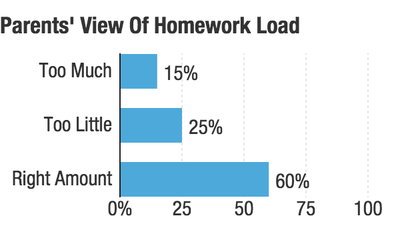
That also tracks with a famous survey from 2007 — from MetLife — that asked parents what they think of their kids' homework load. Sixty percent said it was just right. Twenty-five percent said their kids are getting too little. Just 15 percent of parents said their kids have too much homework.
Research also suggests that the students doing the most work have something else in common: income. "I think that the debate over homework in some ways is a social class issue," says Janine Bempechat, professor of human development at Wheelock College. "There's no question that in affluent communities, children are really over-taxed, over-burdened with homework."
But the vast majority of students do not seem to have inordinate workloads. And the ones who do are generally volunteering for the tough stuff. That doesn't make it easier, but it does make it a choice.
Do we know how much homework students in other countries are doing?
Sort of. Caveats abound here. Education systems and perceptions of what is and isn't Homework: A New User's Guide : NPR Ed : NPR:

Why black teachers are leaving urban schools - Yahoo News

Why black teachers are leaving urban schools - Yahoo News:

Why black teachers are leaving urban schools

What's behind the drop off in African American teachers? The answer is more complicated than you may think.


While the percentage of minority teachers has risen in the US, the number of black teachers has declined between 2002 and 20012 in nine cities, according to a recent study by the Albert Shanker Institute.
What does this mean not only for the communities in which these schools exist, but for the nation as a whole?
“Diversity is a key component to equality and opportunity,” Randi Weingarten, president of the American Federation of Teachers, told the Washington Post. “Where there’s a diverse teaching workforce, all kids thrive. That’s why we note with alarm the sharp decline in the population of black teachers in our cities.”
There are several factors which may be behind this decline. The first is low pay for teachers. According to a study by Young Invincibles, an advocacy group, the average starting salary for a teacher is $34,575 – or about $6,000 less than the average starting salary of 28 professions.
The second is the recurring emphasis that education policy tends to place on test scores. This rigidity, argues Nekita Lamour, a Haitian-American and tenured educator, disincentivises black and Hispanic educators from participating in the system: they are not being encouraged to teach their fellow man, but to the test, instead.
The Shanker Institute’s study found that over a ten-year period, from 2002 to 2012 (a period marked by an explosion in the development of charter schools, and an accompanying dialogue Why black teachers are leaving urban schools - Yahoo News:

These Chicago Protesters Have Been Starving Themselves For 34 Days #FightForDyett

These Chicago Protesters Have Been Starving Themselves For 34 Days:

These Chicago Protesters Have Been Starving Themselves For 34 Days

The group wants a local high school reopened as a green technology school.


For the past month, the same eight Chicago protesters have spent their days in front of Walter H. Dyett High School, a once-bustling but now vacant institution located on the city’s south side. They often spend their mornings strategizing, thinking of ways to make sure Dyett once again transforms into community hub. They spend long, langorous afternoons chatting with supporters and members of the media. They never spend their evenings around a dinner table.

These protesters have forgone food, consuming only liquids, for the past 34 days. They don't just want Dyett reopened -- they want it reopened on their terms. And they are ready to continue to starve themselves -- and risk their lives -- in order to make sure that happens.

The group has been on a hunger strike since Aug. 17, three years after it was first announced that Dyett High School was slated for closure due to low enrollment rates and poor academic performance. In June, the school closed its doors for good, although the Chicago Board of Education said it would weigh plans to reconstitute the Bronzeville neighborhood institution. After continual delays and inconsistencies, community members involved in the Coalition to Revitalize Dyett High School were skeptical the board would ever make a decision. They decided to take drastic action.

In the month since, protestors have seen results -- but not exactly the ones they want. Earlier this month, the city announced that it would reopen Dyett, but as an arts-focused school. The group wants -- and previously proposed -- for Dyett to be reopened as a green technology school -- a plan that they heavily researched and think will best serve community needs. The board rejected their proposal, so the hunger strike continues.

The larger issue, the protesters say, is how the district and city government ignore the input of local parents and students, especially when that input comes from racial minorities. In 2013, the city’s mayor, Rahm Emanuel, closed 49 schools -- a move that was met with widespread resistance and disproportionately impacted minority communities.

“What school district in their right mind would demonize and run away from parents that are activated to improve their schools?” protester Jitu Brown previously told The Huffington Post.

“They just ignore us because they were hell-bent on closing this school and several other schools in this neighborhood, as if there’s no hope for black kids in neighborhood schools, and that’s just not true,” he said.

Earlier this month, Chicago Public Schools CEO Forrest Claypool said the district worked with community partners when deciding the future of Dyett.

"We arrived at a solution that meets multiple needs: Creating an open enrollment neighborhood high school, producing an enrollment stream that can weather population changes, filling the critical demand for an arts high school on the south side and working with education leaders to create a technology hub," he said in a statement.

The group of eight demonstrators includes mothers, fathers, grandmothers, teachers and community organizers. There were originally 12 protestors, but several had to drop out over serious health concerns, and since that time, others have joined the group.

Below are testimonials from eight of the original protesters about why they are still on strike, and how going without food has impacted their bodies and minds.

“I’m on this hunger strike because we were rendered voiceless. We met with every bureaucrat, attended every sham hearing and smiled when we should have roared. We have a right to a These Chicago Protesters Have Been Starving Themselves For 34 Days:

Native American boy pulled from class over Mohawk haircut - The Washington Post

Native American boy pulled from class over Mohawk haircut - The Washington Post:

Native American boy pulled from class over Mohawk haircut

(Courtesy of Gary Sanden)


Jakobe Sanden walked into his second-grade classroom with his backpack and a brand new Mohawk — a hairstyle, his father says, that represents Jakobe’s Native American roots. But it’s a symbol his school called a distraction — one that got him pulled from class.
Earlier this week, 7-year-old Jakobe was sent to the principal’s office at Arrowhead Elementary School in Santa Clara, Utah. His father, Gary Sanden, said administrators told him the hairstyle violated school policy. School officials called his parents and asked them to get it cut.
“I told the superintendent I was in no means going to cut his hair because it’s a symbol of who we are,” Sanden, 43, told The Washington Post.
The issue has since been resolved, and Jakobe is still in school; but, his parents say, they had to “jump through hurdles” to keep it that way.
Sanden said their son got a Mohawk haircut last weekend — as he had many times before — and sent him to school Monday morning. Soon after, Jakobe’s mother, Teyawnna, got a call from the school.
“We had the students that weren’t used to it,” Arrowhead principal Susan Harrah told Fox affiliate KSTU. “They had called that out. So the teacher brought the student to my attention.”
Rex Wilkey, assistant superintendent for primary education, said in a statement that administrators decided the hairstyle was “possibly in violation of the school district student grooming policy” and “the student’s parents Native American boy pulled from class over Mohawk haircut - The Washington Post:

KJ's OUTSIDE MONEY California watchdog agency urges veto of behesting bill | The Sacramento Bee

California watchdog agency urges veto of behesting bill | The Sacramento Bee:
California watchdog agency urges veto of behesting bill


California's political money watchdog is pressing Gov. Jerry Brown to veto legislation that would limit when elected officials need to disclose influencing so-called "behested" payments.
Officials must disclose when they successfully encourage an organization to make a payment to another entity – for example, Sacramento Mayor Kevin Johnson incurred a penalty a few years ago for not revealing that he convinced private businesses to donate to multiple nonprofits.
Compelling those types of statements makes sense, according to Assemblyman Ken Cooley, D-Rancho Cordova. His Assembly Bill 1544 would preserve the rule for behested payments from private groups but would say officials do not need to file disclosures when they lobby the government to make a payment. Getting money from a government agency to a local group is simply part of an elected representative’s job, Cooley argued.
From January through June, lawmakers reported $28 million dollars in behested payments, including millions of dollars from public agencies to businesses or non-profits, in the form of grants and business-incentive awards.
“I feel the bill is very narrowly tailored,” Cooley said of his measure. “These statutes all arose because someone might be trying to curry favor – if I ask someone to make a gift for me or a contribution for me – but I don’t think that applies when someone is speaking to a public agency on behalf of their programs.”
But the Fair Political Practices Commission has come out against the bill, which cruised through the Legislature and now awaits Brown’s decision.
Seeking a government grant for, say, a local school district does not require sunlight, agency officials say. They say the issue lies in grants made to nonprofit or for-profit agencies – for example, grants from the Governor's Office of Business and Economic Development to local businesses – that account for some of the $15 million in annual reported requests lawmakers make to government agencies.
“This bill would roll back current law and lessen transparency,” argues a letter from FPPC chair Jody Remke to Brown. “Disclosure is vital because it helps to identify actual or perceived influence individuals may have over elected officials.”

ESEA, Disability and the Lessons of the Past | Curtis L. Decker, JD

ESEA, Disability and the Lessons of the Past | Curtis L. Decker, JD:

ESEA, Disability and the Lessons of the Past


ESEA Flex Logo


As Congress and President Obama once again consider a reauthorization of the Elementary and Secondary Education Act (ESEA), it is critical that we reflect on the lessons of the past in order to better plan for our future.
On April 11, 1965 at the signing of the ESEA, President Lyndon B. Johnson stated, "we rekindle the revolution - - the revolution of the spirit against the tyranny of ignorance." President Johnson included the ESEA as part of his war on poverty, believing that by ensuring a quality education for all children, children would be more likely to attain financial stability in adulthood.
However, forty years later, it is clear that the original intent of the ESEA has still not been met for too many children, especially children with disabilities. Indeed, according to the U.S. Census Bureau, in 2014 the poverty rate for adults with disabilities was 28.7% as opposed to 13.6% for non-disabled adults. It is imperative that we demand that all children, including those with disabilities be given access to a high quality education in order to fulfill the original intent of ESEA. To do otherwise would subject people with disabilities to a life of poverty and dependency.
When the ESEA was last reauthorized in 2001, then called the No Child Left Behind Act (NCLB), it made sweeping changes to education and redefined the role of the federal government in education. It was a controversial, flawed and hotly debated law.
But despite the many limitations of NCLB, it wasn't all bad. The requirement that State and Local Education Agencies report to the public when groups of students fail to make academic progress has been a critical tool for those of us fighting to ensure students with disabilities get the services and supports they need to be successful in ESEA, Disability and the Lessons of the Past | Curtis L. Decker, JD:

Charter schools are not an education cure-all - LA Times

Charter schools are not an education cure-all - LA Times:

Charter schools are not an education cure-all


 To the editor: The Times' support for a large expansion of charter schools in the Los Angeles Unified School District is misguided. (“A charter school expansion,” Editorial, Sept. 13)I spent four years with the district and three years working for many charter schools. What I saw as a charter school employee was sobering, including a culture of fear among teachers without union protection.

I am now, thankfully, teaching in a school district with a union. The lesson was simple and profound: Strong teachers unions make for happier teachers and happier classrooms.


The editorial assumes that the needs of teachers can be separated from those of students. It mentions that charters have a higher rate of teacher turnover while offering no explanation for why that is the case.

If The Times is truly concerned with the state of public education, it needs to talk with the people who take part in the system every day, including teachers, students and administrators. Otherwise, it wouldn't have the gall to chalk up concerns about charter expansion as merely a fear of losing state revenue.


Dov Rudnick, VeniceCharter schools are not an education cure-all - LA Times:

Opportunity and Hope in America's Public Schools | Bruce Lesley

Opportunity and Hope in America's Public Schools | Bruce Lesley:

Opportunity and Hope in America's Public Schools


"What the best and wisest parent wants for his own child, that must the community want for all of its children. Any other ideal for our schools is narrow and unlovely; acted upon, it destroys our democracy." - John Dewey, The School and Society, 1907
In America, our commitment to our public school should never be compromised because it is, truly, one of those things that make our nation great. In every state across the nation are public schools that serve as the centerpiece to individual communities.
And, for the nation, according to the Center on Education Policy, they serve the following important missions in a democratic society:
  • To provide universal access to free education
  • To guarantee equal opportunities for all children
  • To unify a diverse population
  • To prepare people for citizenship in a democratic society
  • To prepare people to become economically self-sufficient
  • To improve social conditions
Unfortunately, we are witnessing numerous attacks on our schools and our teachers, including significant budget cuts to education at the federal and state levels since 2008, that are having enormous consequences. Among other things, inequitable and inadequate funding of our schools are undermining the core missions of public education in a democratic society, particularly providing "universal access to free education" and "equal opportunities for all children."
This school year, as our nation's children have headed back to school, many of the headlines and stories are quite disturbing. First, years of budget cuts to education at the federal, state, and local levels have resulted in squeezes on teacher pay, layoffs, and hiring freezes. These funding cuts have been accompanied by a number of recent attacks on the teaching profession, including the overuse and reliance on standardized testing, the Associated Press reports that schools across the country are facing severe teacher shortages.
Consequently, many schools are increasing relying on uncertified and unlicensed teachers. According to the Department of Education, nearly 7 percent of the nation's black students attend schools where less than 80 percent of teachers meet all state certification and licensure requirements. In fact, they report that "black students are more than four times as likely, and Latino students twice as likely, as white students to attend these schools." The fact is that teacher quality matters and putting more inexperienced and unqualified teachers in the classroom negatively impacts learning. Unfortunately, that is exactly what is disproportionately occurring in poorer communities and schools.
Isabel Sawhill of the Brookings Institution speaks to the importance that money and resources play in terms of improving our nation's schools in a recent blog. She writes:
Until more people accept the need to raise teacher salaries significantly, schools are not likely to improve. . . [T]he main reason that money matters in education is because teachers matter, and attracting and retaining the best talent has to be a priority.
Budget cuts have also underfunded what is needed to run classrooms and so both parents and teachers are increasingly being asked to pay for school supplies. Rachel Abrams of the New York Times explains, "With many school district budgets as tight as ever, schools keep relying more on parents to pay for what may have been basic classroom items during their childhood. As the income inequality gap has widened, that has placed an extra burden on many families that are already struggling."
The National Retail Federation estimates that the average amount that parents spend on school supplies is up 42 percent over the last decade. And that financial burden continues to expand.
For example, columnist Jeff Yang recently told the story of how the Los Angeles public elementary school his son attends recently sent home a note with the list of school Opportunity and Hope in America's Public Schools | Bruce Lesley:

A Molly Horstman Update | deutsch29

A Molly Horstman Update | deutsch29: "A Molly Horstman Update"

A Molly Horstman Update


molly horstman
Molly Horstman


Molly Horstman was the Teach for America (TFA) hire in the Louisiana Department of Education (LDOE) who was labeled “director” of the high-stakes, ever-changing, waste-of-time ersatz “teacher evaluation system,” COMPASS, in 2012.

She left the Louisiana Department of Education (LDOE) in 2013, and given that TFA status tends to usher one from one soft career landing to another, I thought I would see where she has ended up. The fact that she has no notable training or experience to recommend her to another high position is irrelevant in the well-financed and -connected world of TFA-friendly corporate ed reform.
Nevertheless, a Google search of Horstman yielded nothing in the last couple of years.
But before proceeding with current Horstman, let’s relive some of that Horstman-centered drama from 2012-13, when the proverbial poop and fan met as her name became associated with “director of COMPASS”:
Here is Horstman’s professional bio, as taken from this National Comprehensive Center for Teacher Quality September 2012 conference bio (the topic being “Systems that Last: Great Teachers and Leaders for America’s Schools”). Horstman’s info is under the heading, “Presenter Bios”:
Molly Horstman serves as the director of Compass at the Louisiana 
A Molly Horstman Update | deutsch29: "A Molly Horstman Update"