Latest News and Comment from Education

Wednesday, September 16, 2015

In School + On Track 2015: One Million Truant Students, Billions in Economic Harm | The California Endowment Newsroom

Report on California Elementary School Truancy Crisis: One Million Truant Students, Billions in Economic Harm | The California Endowment Newsroom:

Report on California Elementary School Truancy Crisis: One Million Truant Students, Billions in Economic Harm
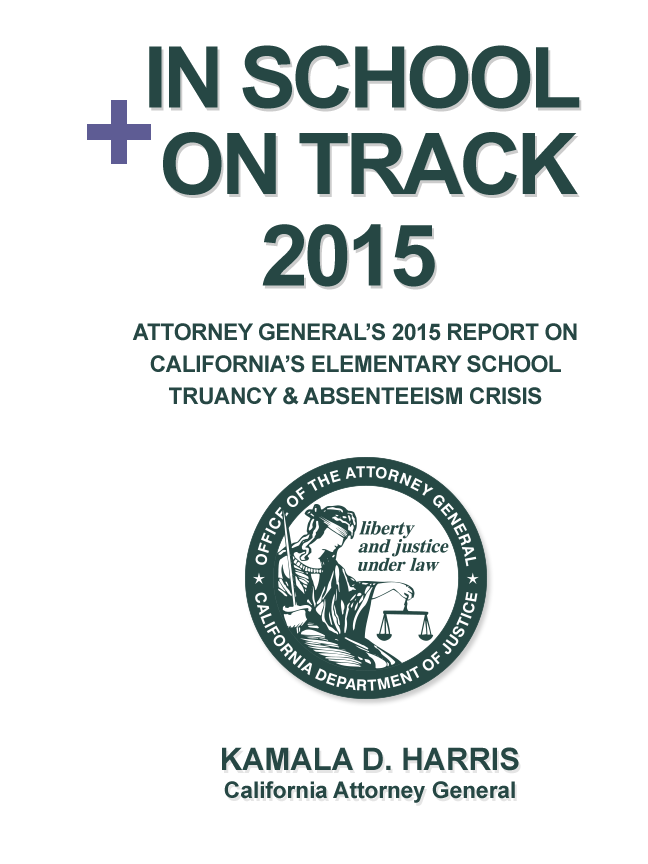


View the In School + On Track 2015 Report - Kamala D. Harris California Attorney General


LOS ANGELES – California Attorney General Kamala D. Harris today unveiled the first state-wide statistics on California’s truancy crisis which reveal that, last year alone, 1 million elementary school students were truant and 250,000 elementary school students missed 18 or more school days at a cost of $1.4 billion in lost funds to California school districts.
These findings are part a report, In School and On Track, issued today by Attorney General Harris in Los Angeles where statewide education, public policy and law enforcement leaders were convened to discuss this crisis and identify concrete solutions.
“The California Constitution guarantees every child the right to an education, yet we are failing our youngest children, as early as kindergarten,” Attorney General Harris said. “These are children as young as five years old who are out of school, falling behind, and too many of them never catch up. This crisis is not only crippling for our economy, it is a basic threat to public safety.  It’s time for accountability and to craft real solutions at every level - from parents to school districts, to law enforcement - to solve this problem.”
According to the report, elementary school truancy is at the root of the state’s chronic criminal justice problems. According to the report, missing large amounts of school is one of the strongest predictors of dropping-out, even more so than suspensions or test scores. Annually, dropouts cost California taxpayers an estimated $46.4 billion in incarceration, lost productivity and lost taxes.
Information broken down by school district and county is available here: https://oag.ca.gov/truancy and:https://oag.ca.gov/truancy/ch1
Key Findings from In School and On Track:
•    In California last year, 1 million elementary school students were truant and 250,000 students missed 18 or more school days. 
•    In some California elementary schools, 92% of students were truant last year. 
•    California school districts are losing $1.4 billion in funding due to truant students.
Solutions from In School and On Track:
•    California must create a statewide system to collect student attendance records. 
•    School districts must improve the way truant students are monitored. 
•    School administrators must meet with parents or guardians immediately when a child is truant. 
•    Law enforcement must focus on early, positive intervention to empower parents and students. 
•    Parents must be held accountable, including prosecution in the most severe cases. 
Attorney General Harris was joined at the symposium by: Los Angeles District Attorney Jackie Lacey, California Superintendent of Public Instruction Tom Torlakson, Compton City Mayor Aja Brown, Dr. Robert Ross, President & CEO of the California Endowment, Tom Saenz, President and General Counsel of the Mexican American Legal Defense and Educational Fund and Hedy Chang, Director of Attendance Works.
The California Attorney General’s office will issue this report annually.  The office’s Civil Rights Enforcement Section spent 7 months researching this crisis and convening stakeholders to devise solutions.
As the District Attorney of San Francisco, Attorney General Harris started a citywide truancy initiative in 2006.  In the course of investigating factors contributing to the city’s violent crime rate, she found that 94% of San Francisco homicide victims under age 25 were high school dropouts.  Then-District Attorney Harris formed a partnership with the school district to inform parents that they had a legal duty to ensure that their children attended school, provide parents of chronically truant students with wrap-around services and school-based mediation, and prosecute parents in the most severe cases where other interventions did not work.
Over a two-year period, then-District Attorney Harris’s initiative reduced truancy among elementary students in San Francisco by 23%, according to the San Francisco Unified School District.  The initiative also served as a model for SB 1317 (Leno), which defined “chronic truancy” for the first time under state law and established the initiative’s model of combining meaningful services with smart sanctions in the California Penal Code.  The bill was sponsored by then-District Attorney Harris and was enacted in law in 2010.
The report is available in its entirety online at: https://oag.ca.gov/truancy

New Book Demonstrates the Superiority of Public Schools - Living in Dialogue

New Book Demonstrates the Superiority of Public Schools - Living in Dialogue:

New Book Demonstrates the Superiority of Public Schools


By Bill Cole.
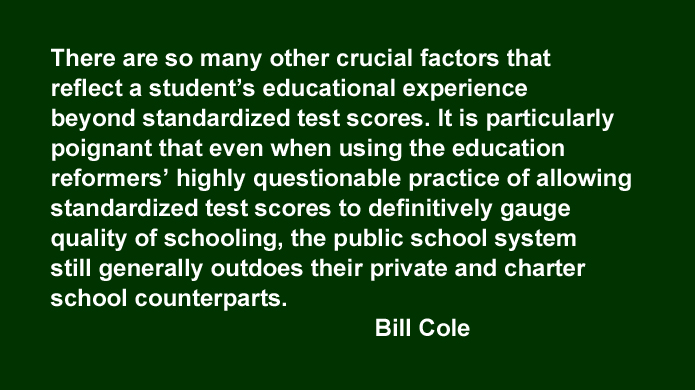
As another school year has started, one thing is certain, a vocal coalition of education reformers, market-based advocates and policymakers will continue extolling the virtues of school choice initiatives, such as private school vouchers and charter schools. These groups enthusiastically note that students in independent schools have better academic outcomes compared to their public school peers. They argue that independent schools have autonomy from bureaucracies and unions, which keep public schools from performing as well as private schools. They claim that creating a market of school options will provide competition that will motivate public schools to innovate and to perform better in order to hold on to their student body. They contend that it is somehow cruel to deprive more needy families an opportunity to attend such superior schools in the private sector. The problem with all of this soaring rhetoric is that none of it is supported by the preponderance of the research.
To begin with out-of-school factors such as socioeconomic status, parental involvement and other social supports have been shown to play a substantially larger role on student academic achievement than in-school factors. In-school factors obviously still have a significant effect on academic outcomes and to that extent interesting findings are being uncovered. In their extensive research study, the husband and wife team of Christopher Lubienski and Sara Theule Lubienski, both professors of education at the University of Illinois at Urbana-Champaign, found that public schools generally yield better academic outcomes than their private school counterparts. In their book, The Public School Advantage (see excerpt here) they use a complex statistical analysis involving hierarchical linear modeling on an enormous data set of students and their standardized test scores. The researchers also crucially controlled for out-of-school factors in reaching the conclusion that public schools affected greater improvements in student academic outcomes than did New Book Demonstrates the Superiority of Public Schools - Living in Dialogue:

Luke & Sara Bronin and the “Laws are only for the Little People” Crowd - Wait What?

Luke & Sara Bronin and the “Laws are only for the Little People” Crowd - Wait What?:

Luke & Sara Bronin and the “Laws are only for the Little People” Crowd


For weeks, Hartford mayoral candidate Luke Bronin was breaking Connecticut law by accepting a significant in-kind corporate contribution from the New York public relations firm that had hired Governor Dannel Malloy’s former spokesperson.
By using Andrew Doba as his own Press Secretary and Communications Director Bronin was violating two of Connecticut’s most important campaign finance laws, a prohibition on corporate contributions and a prohibition on contributions in excess of $1,000 when running for mayor.
It was only after Wait, What? reported on the Bronin campaign’s violations that Luke Bronin finally saw fit to end the illegal maneuver.  Connecticut’s State Elections Enforcement Commission has yet to fine Bronin’s campaign.
And yesterday, it was attorney and UConn Law School Professor Sara Bronin whose activities violated both Connecticut’s campaign finance law, and of even greater consequence, the Connecticut State Statutes that prohibits state employees from utilizing state resources to engage in political activities.
Fellow blogger and commentator Kevin Rennie revealed the latest chapter in the Bronins’ stunning and wonton disregard for the laws related to state employees and campaign finance in an article entitled, “Sara Bronin Has a Primary Request–and Sent It From Her UConn Email Account and published yesterday on his Blog, Daily Ructions.
In 2007, a similar violation by a Department of Transportation employees who was also a South Windsor Republican office holder and candidate led to punishment that included a 6 month suspension and unpaid leave that cost her $8,160 a month in her state salary.
As for Sara Bronin’s action, Kevin Rennie writes;
They are throwing everything they have at befuddled incumbent Pedro 
Luke & Sara Bronin and the “Laws are only for the Little People” Crowd - Wait What?:

An open letter to Alderman Will Burns from Julie Woestehoff Parents United for Responsible Education

Parents United for Responsible Education » Blog Archive » An open letter to Alderman Will Burns from Julie Woestehoff:

An open letter to Alderman Will Burns from Julie Woestehoff 


Open Letter to Alderman Will Burns on the Dyett Hunger Strike
from Julie Woestehoff, former Executive Director of Parents United for Responsible Education (PURE)
Dear Will,
We first met many years ago when you were State Senator Emil Jones’s education aide. Many of us in the Chicago school reform community were impressed with you then, and felt that you understood what we cared about – that is, a strong parent and community voice in school governance, and strong public schools. We found you to be approachable, smart, and helpful – one of the good guys.
I was pleased when you decided to run for office and was happy to vote for you to be my state representative and my alderman. We’ve had a very cordial relationship for many years.
In 2013, the year after the school district voted to phase out Dyett, I wrote a blog post (http://pureparents.org/?p=20323) on the web site for PURE, a group I directed until my move out of state last year. The blog praised you and other aldermen for signing on to a resolution calling for a moratorium on charter school expansion. That 2013 resolution included the point that expansion of charter schools was undermining neighborhood school enrollment, and that traditional schools should not be closed for budgetary reasons while new charter schools were being opened.
Considering this history, it is especially disappointing now to hear about your rejection of what many educators and others consider a very strong community proposal to revitalize Dyett High School, and your argument that Jitu Brown and the Kenwood Oakland Community Organization (KOCO) are staging a hunger strike for Dyett merely to gain power and money.
Most of us who toil in the trenches of community organizing and parent advocacy would find this argument hysterically funny if we had time to laugh. Compare, for example, the most recent reported salary of KOCO’s executive director –$63,000 — with that of, say, Robin Steans, executive director of the charter school-promoting corporate reform group Advance Illinois. Robin already has vast family wealth, and she still pulled down an annual salary of $178,000 in 2013. My point here is not to gratuitously poke at Robin, who has been a friend in the past, but to highlight what should be obvious — that wealthy, powerful people in this country have more handed to them on a plate than low-income, marginalized people could ever dream of. They need groups like KOCO to help raise their voices and concerns to policy makers.
As PURE’s executive director from 1995-2014, I had a front row seat to KOCO’s outstanding work supporting public education, and have been pleased to see KOCO’s Jitu Brown become one of the nation’s most charismatic and courageous leaders in the fight to save democratic public education and to demand high-quality schools for all children. Their challenges to you over the years have arisen from what I believe is a reasonable analysis that there is a disconnect between your actions and the critical needs of some of your constituents. KOCO’s decision to sponsor a hunger strike is a reflection of their extreme frustration with you and other education policy makers. The fact that several members of your community have been willing to put their lives on the line to join them, and that others are actively supporting them, suggests that many share this frustration.
I write to you now out of grave concern for my friends who are becoming ill after 30 days of this hunger strike, and for all of those children who need the adults around them to be the best leaders possible. I urge you to step back from past perceived grievances and take the first step to open up a sincere, meaningful dialogue with these members of your community who deserve your attention.
Thank you and best wishes,
Julie Woestehoff
- See more at: http://pureparents.org/?p=21358#sthash.U6RSw6GS.dpuf

An Admission of Federal Manipulation Through Race to the Top | Truth in American Education

An Admission of Federal Manipulation Through Race to the Top | Truth in American Education:

An Admission of Federal Manipulation Through Race to the Top


Joanne Weiss was the director of the Race to the Top program at the U.S. Department of Education and Education Secretary Arne Duncan’s chief of staff. She wrote an essay atStanford Social Innovation Reviewthat is enlightening in that we finally have a USDED official admit the truth about the federal role in foisting Common Core on to the states.
I encourage you to read the whole piece, but I’ll pull a few excerpts of interest.
Weiss acknowledges that budgetary challenges along with offering larger awards induced states to apply.
The competition took place during a time of profound budgetary challenge for state governments, so the large pot of funding that we had to offer was a significant inducement for states to compete.
This process is typically different than how federal grant making has been done before as she explains:
…we decided that winners would have to clear a very high bar, that they would be few in number, and that they would receive large grants. (In most cases, the grants were for hundreds of millions of dollars.) In a more typical federal competition program, a large number of states would each win a share of the available funding. The government, in other words, would spread that money around in a politically astute way. But because our goal was to enable meaningful educational improvement, we adopted an approach that channeled substantial funding to the worthiest applicants.
When you see “worthiest applicants” read those states whose priorities matched ours.
They leveraged the governors.
…we placed governors at the center of the application process. In doing so, we 
An Admission of Federal Manipulation Through Race to the Top | Truth in American Education:

Schooling in the Ownership Society: Wizzards owner Leonsis underwrites D.C. charters. Then gets a new practice arena from taxpayers.

Schooling in the Ownership Society: Wizzards owner Leonsis underwrites D.C. charters. Then gets a new practice arena from taxpayers.:

Wizzards owner Leonsis underwrites D.C. charters. Then gets a new practice arena from taxpayers.


"...we in here talking about practice. I mean, listen, we're talking about practice, not a game, not a game, not a game, we talking about practice." -- Alan Iverson
D.C. billionaire venture capitalist/philanthropist Ted Leonsis helps bankroll all of the district's privately-run charter schools through his Venture Philanthropy Partners. That includes more than $5.5 million to KIPP DC. But there's a catch to his generosity. 


You see, Leonsis has an interesting philosophy. He believes that instead of paying taxes on his investment profits, taxpayers ought to pay him. This year the payment comes in the form of a new $55 million basketball practice arena for his Washington Schooling in the Ownership Society: Wizzards owner Leonsis underwrites D.C. charters. Then gets a new practice arena from taxpayers.:

Seattle Schools Community Forum: What Next?

Seattle Schools Community Forum: What Next?:

What Next?


I have not heard back from the Soup for Teachers group about what they will do next with their incredibly effective group.  I would love to see a more pro-active parent group that advocates for specifics in Seattle Schools.

However, for funding, there is a great new group called Washington's Paramount Duty (based on our state constitution that SAYS that the "paramount duty" of the state is to "amply fund" public education).  Here's their Facebook page.  They now have - in just a couple of days - over a 1,000 members.  From the Facebook page:

Welcome to the group. As the description says, we're a grassroots group of concerned citizens and organizations who believe that our children have waited long enough for an adequately funded basic education.

A small group of us met last weekend to talk about what to do in response to the amazing outpouring of support for our teachers in Seattle, and how to harness that energy now that more and more parents are realizing just how broken our education funding is. 

Apparently our legislators say they don't hear from people on this issue. Unsurprising - it's hard to manage a public advocacy campaign when you can't even get your 5 year old to put on his or her pants fast enough to get to school on time (we've all been there as parents, haven't we?)...


So our response was to create this group, as a focal point for the conversation Seattle Schools Community Forum: What Next?:

Taxpayers paid for charter school property, but they don’t own it - The Washington Post

Taxpayers paid for charter school property, but they don’t own it - The Washington Post:

Taxpayers paid for charter school property, but they don’t own it


Taxpayers paid for the furniture, computers and other equipment that students used at 10 Ohio charter schools. But the public doesn’t own the things it paid for, according to the state supreme court.
The high court ruled in a split decision Tuesday that the assets are instead the property of White Hat Management, the for-profit company that once managed the 10 schools. If the schools want their chairs and desks back, they’ll have to buy them back, paying for them a second time with taxpayer dollars.
That might seem incredible, but that’s what the schools agreed to in their contracts with White Hat, and the contracts have to be honored, ruled Justice Judith Ann Lanzinger, writing for the majority.
“The schools were represented by their own legal counsel, and they agreed to provisions in the contracts,” Lanzinger wrote. Unless there is fraud involved, she wrote, “courts are powerless to save a competent person from the effects of his own voluntary agreement.”
Charter schools contract with for-profit management companies in many states, and the Ohio case illuminates a broader dispute over whether public money is still considered public — and therefore subject to public oversight — once it is transferred to a private entity.
In the District of Columbia, for example, the attorney general has filed two lawsuits in recent years that allege that D.C. charter school leaders used for-profit companies to divert millions of taxpayer dollars into their own pockets. The D.C. Public Charter School Board, which oversees all city charter schools,has no legal right to examine the books and records of those private Taxpayers paid for charter school property, but they don’t own it - The Washington Post:
Big Education Ape: Ohio Supreme Court Rules Private Charter School Management Firm Owns Public Assets | janresseger http://bit.ly/1Knbotq
Big Education Ape: The New American Privateers http://bit.ly/1Mcg2OK

The New American Privateers


The New American Privateers


During the early days of the United States, our government commissioned Privateers to attack and rob enemy vessels. Privateers were part of naval warfare of some nations from the 16th to the 19th century. The cost of commissioning privateers was borne by corporate investors hoping to gain a significant profit from prize money earned. Privateering was a way of mobilizing armed ships and sailors without spending public money or commissioning naval officers. And for the “investors the pay off was the captured cargo and the prize vessel itself, if serviceable, would be sold at auction with the proceeds distributed among the privateer's owners. The bottom line for the investors was Profit not Patriotism. Many of the Privateers were just plain pirates with a letter of marquee issued to its corporate owner by a government.
The swashbuckling new American Privateers do not raid ships, talk or dress like pirates, yet they function much like the privateers of old. They are commissioned by their corporate masters to capture or destroy public institutions, it is called privatization.
In simple terms privatization is putting public services in private hands to be regulated by the free market. The New American Privateers are targeting every area of public services. From public safety to education, parks and public buildings all are being “captured or destroyed” by the New American Privateers. An example how privatization works is crystallized in this headline: “Firefighters in rural Tennessee let ahome burn to the ground last week because the homeowner hadn't paid a $75 fee”.
Privateers deny the common good and say that you should be charged a user fee for such public services. Privateers say this is necessary to keep taxes low.  But add up the “user fees” and your taxes and you find out you that you are paying a lot more.  
Privateers say:” if you can’t pay your fee: your house burns down”.
In Public Education the privateer’s broadside has been “the failing schools” and “bad teachers” The Privateers are ruled by a by corporate leaders, “venture” philanthropist who’s goal is to capture or destroy public education and teachers unions and apply the free market system that is working so well in firefighting.

In 1856 when the Declaration of Paris stated that "Privateering is and remains abolished". The United States refused to sign the international accord. The New American Privateers are here today, privatizing America for profit for their corporate masters. The question is who will stop them.  
Big Education Ape: Ohio Supreme Court Rules Private Charter School Management Firm Owns Public Assets | janresseger http://bit.ly/1Knbotq


Review of “A Teacher’s Tale” - Education Post - Linkis.com

Review of “A Teacher’s Tale” - Education Post - Linkis.com:

Tireless and Tiring: Teacher John Thompson Has a New Book


JTBook
John Thompson is an Oklahoma City educator who hates education reform, loves children, isn’t afraid to acknowledge his own shortcomings, and is more than willing to point out yours. All of which makes his new book, “A Teacher’s Tale,” both inspiring and, if you happen to support reform, somewhat tiring.
Every one of the book’s 400 pages drips with disdain for test-based accountability. Thompson is especially hostile to teacher evaluation if it includes student test scores, which he believes pervert the purpose of public education. He blames modern-day reform for much of what is wrong with schools today and gives it no credit for anything that is right. He thinks reformers would do well to listen more to teachers.
Thompson’s tale is heavy on anecdote and personal experience, which is considerable. He became a high school teacher in his late thirties during the late 1980s and taught full-time until 2010. He now does a little teaching but spends most of his time researching, writing, blogging and sparring on Twitter. I am one of his favorite targets though he is respectful and avoids personal attacks. Instead, he cheerfully and relentlessly encourages reformers to simply come to their senses and abandon our wrong-headed reforms. He wears me down.
The most compelling parts of his book are his stories about the poor and mostly minority students he taught. Thompson shares story after story of troubled kids desperate for respect, recognition and empathy and insists that they are prerequisites to learning.
He recounts painful conversations with students who, in a matter of hours, were killed or committed murders that landed them in prison. He can no longer remember all of his students who died violently. He seems to spend as much time working and playing with troubled kids outside the classroom as teaching them in the classroom.
He is especially candid about the situation facing inner-city teachers trying to control classrooms filled with traumatized students in a permanent state of fear and anxiety from gangs, drugs, and broken families. His school district is a national leader in suspensions, though he insists that unruly students are not what strikes fear in a teacher’s heart. Rather it’s the knock on the door from management.
While I rarely agree with John, I respect his views and his experience and I came away from the book with even greater appreciation for the extraordinary sacrifice of teachers like him. Teachers in inner-city schools can feel like they are under siege from angry students, burned out peers, crazed parents, overwhelmed administrators and—occasionally—misguided reformers. Adding high-stakes testing and accountability into these difficult circumstances can demoralize teachers like him who are literally bleeding for their students. Whether you agree with his conclusions, he clearly cares and that counts for a lot.

How #EducationReform is Done. Circumvent the Legislature & Use a ‘Coalition of the Willing’ » Missouri Education Watchdog

How #EducationReform is Done. Circumvent the Legislature & Use a ‘Coalition of the Willing’ » Missouri Education Watchdog:

How #EducationReform is Done. Circumvent the Legislature & Use a ‘Coalition of the Willing’


circumventing MOleg


The Missouri State Board Meeting was held yesterday and one of the items for discussion (VIII, D) was Use of Student Growth Measures in the Evaluation Process.DESE’s Paul Katnik delivered a powerpoint and answered questions from State Board members about the use of student data (not aggregate data) in the evaluation process for teachers.  The powerpoint may be found here:    Use of Student Growth Measures in the Evaluation Process

My notes from the meeting:
***************************************
Katnik began his report to the Board.  The use of student data is one way districts will evaluate teachers and principals.  This will affect 67,000 Missouri teachers and this use of student data will ‘help teachers teach better’.  We looked at practices, content and how it is assessed.  Did the teacher have an effect on student learning? Can we verify improvement?  Instructional reform?  We’ve always been about improvement and growth, not ‘just’ accountability.  Missouri is different from other states; we measure growth in data (growth is over a period of time) vs achievement (a snapshot on how a student performs on one day).
The Student Learning Objective (SLO) training helped teacher to determine how their lessons fit into the standards.  Katnik stated more important is the data we are getting to show what we need to do.  If educators don’t show the growth, they can be terminated.
Peter Herschend, Board Member and Past President: How will you come back to the Board and show how the system is actually working?   Is there a rubric to show how the system is actually working?  What is the impact on student learning?
Katnik: It keeps bringing you that data.  If you are truly using this effectively you should see the growth.
Charlie Shields, Current Board President: Everything I have dealt with in nationally benchmarked.
Katnik: The authority to determine teacher evaluation is at the local level according to Missouri statute.
Joseph Driskell, Board Member: What kind of local buy in do you have from the districts?

Seattle Schools Community Forum: First Day Of School

Seattle Schools Community Forum: First Day Of School:

First Day Of School


Nearly, finally here.

From the NY Times, a cool look at first day of school throughout the decades.

A great article from Longreads about writing from Mary Karr who has put forth two memoirs.  Ms. Karr teaches her grad students using a technique that I tried years ago at Whittier Elementary with a class of 5th graders.  You pretend you are going to talk about writing, have a co-conspirator burst in the room and argue with you and then... tell the kids to write exactly what they heard and saw.  (I hit the button on a CD player and played the theme from "Mission Impossible" to set the mood after my compatriot left the room.)  The kids thought it funny and it did get them thinking about writing and memory.   From Ms Karr's piece:


So a single image can split open the hard seed of the past, and soon memory pours forth from every direction, sprouting its vines and flowers up around you till the old garden’s taken shape in all its fragrant glory
The National Sleep Foundation is having a Bright Schools competition.  Projects are due January, 29, 2016.

The National Sleep Foundation (NSF) and the National Science Teachers Association (NSTA) have joined together to inspire student achievement in science through the new Bright Schools Competition; a STEM competition targeted to students in grades 6-8. The competition is a new learning experience created to help students, parents and teachers explore the link 
Seattle Schools Community Forum: First Day Of School:

CURMUDGUCATION: A Clock?! Seriously-- a Clock!!??

CURMUDGUCATION: A Clock?! Seriously-- a Clock!!??:

A Clock?! Seriously-- a Clock!!??


This is how a public school loses the support of rational humans with brains.

On the heels of a Slate piece last week reminding us about how the juvenile justice system "eats kids for breakfast," today we get the story to go with this photo that's rocketing around the interwebs.


Because I'm only a fake journalist, I can drop any pretensions of impartiality-- everybody involved in this was a dope.

The English teacher who freaked the hell out over a home-made clock was a dope.

The police who put this 98-pound ninth grader in cuffs was a dope.

The police who was quoted as saying that Ahmed Mohamed was "less than forthcoming" was a dope. Honestly, you've just been arrested for an engineering project-- you can't possibly predict how the words out of your mouth will be interpreted. You came to school and said, "I've got a clock" and the school screamed, "He's got a bomb!" At this point, as far as you know, "I'm thirsty" will be met with "He's taking hostages and making demands!!"

The school-- MacArthur High School of Irving, Texas-- responded quickly with a letter, and whoever actually wrote the letter was also a dope.

While we do not have any threats to our school community, we want you to be aware that the Irving Police Department responded to a suspicious-looking item on campus yesterday. We are pleased to report that after the police department’s assessment, the item discovered at school did not pose a threat to your child’s safety. 

Well, there is one threat to your child's safety-- there's always the possibility that school and law enforcement officials will absolutely lose their shit because some child brought an engineering project to school.

But the letter goes on to explain where the real burden lies-- on the parents and children. "I recommend using this opportunity to talk with your child about the Student Code of Conduct and specifically not bringing items to school that are prohibited." Because I'm sure that the list of prohibited items includes home made clocks!!

Seriously-- look at this kid and consider just how anybody could conclude he's a
CURMUDGUCATION: A Clock?! Seriously-- a Clock!!??:

From Freddie Gray to closing schools, structural racism is revealed in city policies | Cloaking Inequity

From Freddie Gray to closing schools, structural racism is revealed in city policies | Cloaking Inequity:

From Freddie Gray to closing schools, structural racism is revealed in city policies


The neoliberal playbook is not only the game plan in Chicago and New Orleans… Baltimore and many other communities are facing the same private-control ideology swathed in a false cloak of civil rights.
Originally posted on Just Cities:
Freddie Gray is now a household name. Gray died on April 19, 2015 at the hands of the police, which set off a firestorm of protests in Baltimore. Protests were focused on ensuring that the police officers involved in his case were brought to justice, but were also a direct response to the conditions under which Gray lived.
Freddie Gray’s life was spent in Sandtown-Winchester, a West Baltimore neighborhood that has the highest incarceration rate in the state of Maryland. Over 47% of its children live below the poverty line. The unemployment rate is 22.7%. It is a neighborhood that has faced economic devastation. Freddie Gray’s death was horrific and unjust, but also revealed a much larger problem than just police brutality. It exposed a system of structural inequality so deep that it will not go away with the imprisonment of the police officers charged in Gray’s case.
Structural inequality…
View original 690 more words

Ohio Supreme Court Rules Private Charter School Management Firm Owns Public Assets | janresseger

Ohio Supreme Court Rules Private Charter School Management Firm Owns Public Assets | janresseger:

Ohio Supreme Court Rules Private Charter School Management Firm Owns Public Assets


Yesterday Ohio’s elected, Republican-dominated supreme court ruled that a privately held, for-profit charter management company, White Hat Management, owns the equipment and assets of several White Hat Hope Academies and Life Skills Academies that had sought to sever ties with White Hat and hire a new management company to run the schools. White Hat is owned by Akron entrepreneur and Republican mega-donor David Brennan.  The boards of ten Hope and Life Skills Academies had filed a lawsuit to recover assets purchased with public dollars that White Hat said its contract awarded to the management company.
The Columbus Dispatch describes Justice Judith Ann Lanzinger’s decision for the majority: “that charter school operators perform a governmental function and establish a fiduciary relationship with the schools they manage in purchasing school equipment, contrary to the position taken by White Hat.”  The Dispatch continues: “Current law largely does not address the duties of school operators and does not restrict the provisions of contracts between operators and charter schools, Lanzinger wrote.”
Over ten years, the Dispatch reports, the state paid approximately $100 million to the ten schools in Cleveland and Akron.  All the schools contracted with White Hat in 2005, agreeing to turn over 95 percent of each school’s state funding to pay teacher salaries, building rentals, utilities, and other expenses, an agreement known as a “sweeps contract” in which the management company receives virtually all of the school’s revenue and handles all of its operations with little day-to-day oversight by the school’s board.  The Akron Beacon Journalexplains: “The dispute arose when the school boards and White Hat parted ways.  The school boards wanted to change management companies, but White Hat said that by virtue of its contract, it owned the assets of the schools, and the boards would need to move to a new location and acquire their own equipment and supplies, or buy the assets of the schools from White Hat.  The schools argued that the assets, purchased with public money, did not belong to White Hat.”
It is not surprising that the boards of the schools failed to negotiate a careful, tough contract with the management company to protect the schools’ assets for the schools.  It has been known for years that White Hat played an active role in helping recruit members of the boards of its schools—board members whose job was supposedly to oversee the performance of the management company.  In March of 2014, Doug Livingston reported for the Akron Beacon Journal that several board members of White Hat schools admitted openly that they had been recruited by White Hat Management to sit on charter school boards, despite that the IRS expects “a bright line between the charter-school governing board and the management company hired to run the school.  The company should not create the board or recruit its members, and any evidence of boilerplate contracts from one school to the next suggests the company many be in control.”  One board member told the Beacon Journal that White Hat had asked her to serve on the boards of four of its schools.
Stephen Dyer of Innovation Ohio explains that Justice Lanzinger received a $5,000 campaign donation from David Brennan in 2004.  Chief Justice Maureen O’Connor received campaign donations from Brennan in 2002, 2008, and 2010, totaling $11,900.  Justice Judith French Ohio Supreme Court Rules Private Charter School Management Firm Owns Public Assets | janresseger:

The number of black teachers has dropped in nine U.S. cities - The Washington Post

The number of black teachers has dropped in nine U.S. cities - The Washington Post:

The number of black teachers has dropped in nine U.S. cities


The number of black public school teachers in nine cities — including the country’s three largest school districts — dropped between 2002 and 2012, raising questions about whether those school systems are doing enough to maintain a diverse teaching corps, according to a new report to be released Wednesday.
The study by the Albert Shanker Institute, a think tank funded by the American Federation of Teachers, looked at teacher data from nine cities: Boston, New York, Los Angeles, Chicago, Cleveland, New Orleans, Philadelphia, San Francisco and Washington, D.C. The research found that each city saw a drop in the number of black teachers in traditional and charter schools.
The issue of teacher diversity is important because research has suggested that students who are racially paired with teachers — black teachers working with black students and Hispanic teachers working with Hispanic students — do better academically. Teachers of color also can serve as powerful role models for minority students, who are more likely to live in poor neighborhoods than white students and less likely to know other adults who are college graduates.
“Diversity is a key component to equality and opportunity,” said Randi Weingarten, the president of the teachers federation, who is asking the Obama administration to call a White House summit on teacher diversity. “Where there’s a diverse teaching workforce, all kids thrive. That’s why we note with alarm the sharp decline in the population of black teachers in our cities.”
Researchers examined the decade between 2002 and 2012 because it was a period of rapid expansion of public charter schools and closures of traditional district schools. There also were other state and federal policy changes, such as the use of teacher evaluation systems, that caused some churn and upheaval in teaching ranks.
The largest drop took place in the District, where between 2003 and 2011, the portion of the D.C. teaching force that was white more than doubled from 16 The number of black teachers has dropped in nine U.S. cities - The Washington Post: