Latest News and Comment from Education

Saturday, May 9, 2015

Devaluation of Black Lives Starts in Classrooms | Al Jazeera America

Devaluation of Black Lives Starts in Classrooms | Al Jazeera America:

Devaluation of black lives starts in classrooms


In New York City, where youth of color live under the shadow of stop-and-frisk policing and hundreds of children are jailed each year, school authorities recently promised to limit the use of metal handcuffs on students younger than 12 years old — unless absolutely necessary. Yes, that’s considered progress.
Since the Black Lives Matter movement exploded last year, the public spotlight has focused on violence against black youth in the streets. But the devaluation of black life often begins in the classroom — not at the hands of riot police, but through more subtle forms of force.
Black students are disproportionately subjected to disciplinary measures, ranging from suspension and expulsion to physical confinement or restraint — and sometimes arrest. Like zero-tolerance law enforcement, social control is the goal, though paradoxically, those disproportionately targeted for restraint typically come from the most disempowered communities.
Following disturbing news reports of children being regularly arrested and restrained for behavioral problems, in April New York City introduced regulations on the use of restraints and measures to curb overreliance on suspensions. The guidelines, backed with reforms to increase oversight and accountability, follow measures taken by other states to make school safety policies more transparent and humane. Now, police officers who patrol city schools will report monthly on the use of restraints to the mayor’s office and “will not restrain students under 12 with metal handcuffs in schools, except in situations where other methods of restraint have failed.”
But why are such practices so ingrained in our schools’ culture, anyway? The routinized use of restraint in itself represents an underlying failure of the education system. In many cases, public schools are as racially segregated today as they were during the Jim Crow era. The divides are exacerbated by neighborhood segregation, and sometimes, by the spread of minimally regulated charter schools in communities of color, which typically face less oversight on disciplinary practices. Schools’ authoritarian tactics are especially worrying against this backdrop of systemic bias.
Amid metal detectors and security patrols, kids in the school-to-prison pipeline are prepped not for college but for the criminal justice system. Nationwide, according to federal data, black children are suspended at triple the rate(PDF) of their white peers. Similar racial disproportionality plays out in the use of restraints on students with disabilities and in rates of school-related arrest.
Girls sometimes have it even tougher: New data from New York City schools show how gender disparities also bleed into racial inequality. The number of school discipline cases involving black boys is six times higher than those involving white boys. But those involving black girls — whose treatment tends to receive less public attention — total more than 10 times the number of cases for white girls.
When attending school can be literally painful, it’s no surprise that patterns in harsh treatment parallel racial and economic gaps in academic performance and graduation rates.
Youth facing hardships need an outlet to speak out, but their schools promote silence and conformity, backed by punitive force. 
The conversation on discipline is leading to meaningful reforms in cities like New York. But schools and communities now face the challenge of building a truly safe and supportive learning environment that can break broader cycles of violence.
Fairer disciplinary programs ought to help shape children’s understanding of their role in their communities.
Schools should actively connect patterns of aggression to the systemic power imbalances weighing on poor children of color, who are exposed daily to neighborhood violence that may follow them to school. Teachers should be aware of how violence affects children outside the classroom. Only then can they start a conversation with students about personal and social responsibility, seeding a consciousness that their relationship to school should be one of mutual respect. A kid isn’t likely to grasp that insight with his hands cuffed behind his back.
Often, behavior that teachers dismiss as insubordinate may speak to deeper social crises at home, or simply to the staff’s ingrained prejudice. For girls of color especially, social instability and sexual trauma can intersect with educational barriers, but problems often go ignored until an outburst or interpersonal conflict breaks out in the hall. Youth facing these hardships need an outlet to speak out, but their schools promote silence and conformity, backed by punitive force. As one girl explained in a report on black girls and school discipline by Columbia Law School, “If you try ... to go in there, try to sit there, one on one, they can automatically think you’re there to waste time and not to go to class. It’s like they’re shutting down on us.”
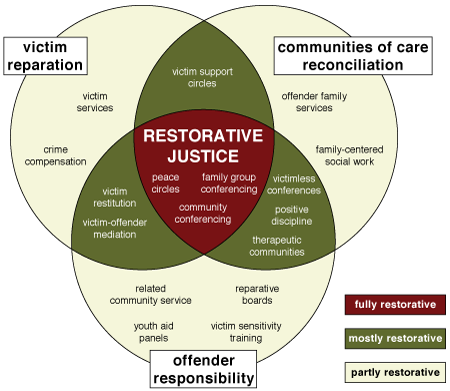
New York City’s effort to limit violent interventions marks a first step toward reforming school discipline. The city must expand its emerging network of restorative discipline programs, which are currently being piloted at a handful of schools, with notable results so far in conflict resolution. These programs provide structured discussion spaces that turn a student’s disciplinary issue into an exploration of how she might balance self-control and self-expression when dealing with peers and authority.
Discipline is only useful insofar as it teaches people that their behavior makes a difference, positively or negatively. If students feel as if school is designed to punish them for being themselves, discipline just becomes subjugation; if they feel empowered to make their communities fairer and more peaceful, youth can teach us more than we ever imagined. And there’s no more teachable moment than now. With people in the streets struggling to show that black lives matter, schools can’t afford to further devalue the black lives they’re charged with educating.
Michelle Chen is a contributing editor at In These Times, co-producer of Asia Pacific Forum on Pacifica's WBAI and student of labor history at the City University of New York Graduate Center.
The views expressed in this article are the author's own and do not necessarily reflect Al Jazeera America's editorial policy.

Just whose rights do these civil rights groups think they are protecting? - The Washington Post

Just whose rights do these civil rights groups think they are protecting? - The Washington Post:

Just whose rights do these civil rights groups think they are protecting?


A dozen civil rights groups this week issued a statement contending that parents opting their children out of high-stakes standardized tests are harming at-risk students. That sparked a response from the Network for Public Education, saying that high-stakes standardized tests are hurting these young people, not the opt-out movement. You can read both statements here.
Here’s a different look at all of this, by Wayne Au, an associate professor in the School of Educational Studies at the University of Washington Bothell, and an editor for the social justice teaching magazine Rethinking Schools. Most recently, with Joseph J. Ferarre, he co-edited the book, Mapping Corporate Education Reform: Power and Policy Networks in the Neoliberal State. His research interests include critical analyses of high-stakes testing, critical educational theory and practice, curriculum studies, and multicultural education.

By Wayne Au
On May 5, 2015, a group of civil rights organizations released a statement in opposition to the growing movement to opt out of the current wave of high-stakes, standardized testing. This testing lies at the very heart of current education reform efforts because it provides the fuel that the current education reform machine relies upon: data. Without the numerical data produced by the tests, there is no way to make simplistic comparisons, there is no justification for the corporate entry into public schools, there is no way to shape education along the logics of a competitive marketplace.
Because it challenges the validity of the tests and the data, the opt-out movement strikes at the heart of the reform movement. I feel this sharply here in my home city of Seattle as powerful men including U.S. Secretary ofEducation Arne Duncan, Washington state Superintendent of Public Instruction Randy Dorn, and Seattle Schools Superintendent Larry Nylandthreaten local test resisters with punishments. Opting out scares those in power because it undermines the education policies being done to — not by — our communities, particularly communities of color. Indeed, many of us have taken great pains to highlight the racially disparate impact of corporate education reforms, especially high-stakes standardized testing, specifically on communities of color.
Which is why I was disappointed to see a statement from several mainstream civil rights organizations opposing the opt-out movement, supposedly on the grounds of civil rights and equality. Most of us would agree that there is rampant educational inequality in our public school system (as there is in the United States in general), but there is clearly disagreement on the root causes of that inequality and the ways to address it. Many of us education activists (and yes, this includes folks of color) challenge the fundamental assumption that high-stakes, standardized testing provides “…fair, unbiased, and accurate data…” as the civil rights organizations assert in their statement, and we challenge this assumption on historical groundsempirical grounds,pedagogical groundspolitical-ideological groundscultural grounds, andtechnical groundsamongst others.
Therein lies the difference: The civil rights organizations who made their statement against opting out see high-stakes, standardized testing as a solution to educational inequality, while others, like myself, see ample evidence that high-stakes, standardized testing is exasperating educational Just whose rights do these civil rights groups think they are protecting? - The Washington Post:

Jersey Jazzman: The KIPP Propaganda Machine and Its Willing Saps In the Media

Jersey Jazzman: The KIPP Propaganda Machine and Its Willing Saps In the Media:

The KIPP Propaganda Machine and Its Willing Saps In the Media


UPDATE: Bruce was writing about this exchange as I was. Go read what he says, then come back. Much more to come.


Tomorrow morning, if you pick up a copy of the Star-Ledger (chances are, you won't), you will see a big, fat, wet kiss to the KIPP/TEAM charter schools in Newark, right on the front of the "Perspective" section. The piece went on-line a few hours ago; you can comment if you would like...

But listen to this story before you do:

Over a month ago, I got an email from Diane Ravitch, the country's best known advocate for public education and most prominent critic of corporate-style education "reform." Diane cc'd it to me and Bruce Baker, a professor of education policy at Rutgers and my advisor in the PhD program there.

It seems that Julie O'Connor, the author of the Star-Ledger's piece, was looking for comments about KIPP/TEAM. Given Diane's stature and her well-known skepticism about charter schools, it's clear that O'Connor was looking for a contrary point of view.

Diane added a few remarks, but she also referred O'Connor to Bruce and me, knowing we've done scads of work on Newark's charters: see herehereherehereherehereherehereherehereherehereherehere, and here (and that's just for starters).

Bruce and I then began an exchange with O'Connor, which I have reposted, in its entirety, below. Bruce did the reconstruction, and I added my original graphs.

Understand that Bruce is one of the busiest people I know, and I teach full-time while working on my doctorate. Nonetheless, we took a considerable amount of our time to explain, in great detail, why a simple "doing more with less" framework (yes, that is an exact quote from the piece) is far too simplistic and misleading when it comes to evaluating KIPP/TEAM.

You are welcome to come to your own conclusions based on this exchange. Here are mine:

- It's clear O'Connor was in the tank for KIPP/TEAM from the start. Several times, especially in response to Bruce, she either doesn't understand -- or chooses not to understand -- what we are saying. Several times, Bruce refers O'Connor to his blog posts; they are quite clear in their methodologies and sources, but it's as if O'Connor never even read them.

- KIPP/TEAM is feeding O'Connor talking points. She keeps returning to the same arguments in her exchange with us -- and these are the arguments that make it into the article. Over and over, she asks Bruce or me to rebut claims KIPP/TEAM is making, rather
- See more at: http://jerseyjazzman.blogspot.com/2015/05/the-kipp-propaganda-machine-and-its.html


Peg with Pen: Opt Out is the People's Movement

Peg with Pen: Opt Out is the People's Movement:

Opt Out is the People's Movement


Mike Petrilli recently stated, "If this [opt-out] thing goes national, the whole education reform movement is in serious trouble.

Indeed it is. (Listen to him state it here in the Fordham Institute podcast at the 6:43 mark.)

The Opt Out Movement is the people's movement and that makes us dangerous.

Petrilli worries about it going national? That's funny.

His arrogance, and the arrogance of corporate ed. reformers everywhere, caused them to fail to pay close attention when opt out went national over four years ago when the people organized and began the hard work of supporting teachers, students, parents and citizens across the country via a little FB group page titled OPT OUT OF THE STATE TEST: The National Movement, which then quickly grew into a website, United Opt Out National, and finally a social movement of individuals across the country working for free, on their own time before work, after work, and on the weekends. The people's movement has spread like wildfire and it is raging forward. There are so many grassroots opt out groups across the country that it is absolutely impossible to count them.

The people's Opt Out Movement is so strong and so fierce now that not only is the "whole education reform movement in serious trouble" - it's going down, and as it goes down, we expect our demands to be met.

At United Opt Out National  we believe in demanding everything for all children.

All of us opting out all over the country have NO funding. This absolutely terrifies them that we can accomplish this with no funding. If we can accomplish this, what else might we be able to do?

Think about that.

What else might we be able to do? Why not get all for all children? We, the people, must harness our power. 

We at UOO refuse to settle for less. We believe in the people. We must not fall for ploys which state that we could only possibly get a little. The state legislatures and the federal ESEA re-authorization only want to give us a little. We can demand it all.

There is a reason that many are attempting to wrestle and gain control of the opt out narrative right now. They wish to control and manage this narrative because it is indeed dangerous to their livelihood.  We have suddenly landed in their backyard just as they landed in ours. There is a reason that organizations and mainstream media refer to the ECS opt out guide (funded by Pearson and Gates) rather than the UOO guides written for the people by the people.

Those trying to co-opt the opt out message all have funding - and this funding means that they have ties to political or corporate ideology. Therefore, they will not demand all for all children because ultimately they need common core and the testing system to thrive in some shape or form in order to save their jobs, their corporations, their status and so that they may continue to push forward their privatization agenda using children, teachers and our communities.

And understand this clearly, the Opt Out Movement is not an anti-testing movement. We all trust our teachers to assess our children - our teachers know how to assess. The corporate ed. reform system of test and punish serves only one purpose - sort, rank, order children and keep them in their place. Teachers do the exact opposite. We determine a child's strengths, attempts and next steps - and we do this using developmentally appropriate practices to make sure all children thrive and love learning. Our goal is to make sure all children are successful and that all children recognize their own strengths and power to make positive change for their lives, our country and our world.

We don't need this test and punish system. We need social policies which protect our children from poverty. We need teachers to be the professionals who are trusted and respected to assess and teach our children. We need our teachers to be able to work together and support one another as professionals. We need our neighborhood schools to be fully funded and resourced so that all children can thrive. We need to reclaim our public schools - reclaim all of it for all people.  The test and punish system denies children everything they 

The Willful Ignorance of the NJ Star Ledger | School Finance 101

The Willful Ignorance of the NJ Star Ledger | School Finance 101:

The Willful Ignorance of the NJ Star Ledger


After having a series of conversations with Star Ledger reporter Julie O’Connor about her desire to write a cover story about how TEAM Academy is producing miracles in Newark, I wrote this post:
The reason for this post is explained in this paragraph:
Well, one reason I’m going there is that I’m sick of getting e-mail and phone inquiry after inquiry about the same charter schools – and only charter schools – asking how/why are they creating miracle outcomes. I try to explain that there may be more to the story. The reporter then says that the charter school’s data person says I’m wrong – validating their miracle outcomes (despite their own data not being publicly available/replicable, etc. and often with reference to awesome outcomes reported in popularly cited studies of totally different charter schools).
For a while after writing this, I figured that the NJ Star Ledger reporter who was so insistent on writing her rah rah TEAM article had simply given up. But alas no. The puff piece finally arrived today:http://www.nj.com/opinion/index.ssf/2015/05/beating_newarks_odds_kipp_charter_network_is_poise.html#incart_river
Now, it’s written as an editorial, so I guess that means it’s okay to make stuff up, ignore lots of stuff, and just generally roll with a combination of propaganda provided to you by the school and your own personal predisposition.
What’s so disturbing about this all is that the title of the editorial itself is directly refuted by the statewide analysis I provided. That TEAM relatively marginally beats expectations, and in fact, several Newark Public schools and a few other charter schools in Newark “beat the odds” so to speak, by much more. AND THE AUTHOR OF THE EDITORIAL WAS FULLY AWARE OF THIS.
I refused to call the reporter in part because I wanted there to be a full, complete transcript of our e-mail conversations. I’m sick of banging my head against this wall.
Below is a transcript of the conversation that started with an inquiry to Diane Ravitch from Julie O’Connor. Others were included on the e-mail chain and jump in at various points.

Reporter Inquiry

Prof. Ravitch,
I’m on the editorial board at The Star-Ledger in New Jersey, and I’m working on a cover story for our Perspective section about the KIPP schools in our state. The college attendance stats of KIPP seniors in Newark seem pretty impressive, and I was wondering if you have the same reaction, and what you think of KIPP’s forays into Camden.
Would really appreciate it if you could give me a call at 973-836-4902. Would like to discuss KIPP in the context of your criticisms of the broader charter school movement, and whether or not you think it is an exception.
Many thanks,
Julie O’Connor

The hand-off

Julie,
I suggest you talk to Mark Weber and Bruce Baker at Rutgers, who have studied charters in NJ. I lean on their research. The question is not whether one chain can produce successful graduates, but whether charters in general are helping the most vulnerable schools, whether they are reducing the funding and capacity of public schools, and whether their success-when it exists–is the result of selection and attrition.
Diane Ravitch

Reporter

Ok, thanks for your prompt reply.
Prof. Baker emailed me his report on free/reduced lunch and the TEAM schools, but I have been unable to reach him on the phone to discuss KIPP or my follow up questions.
Basically, I am looking for a reaction to two claims from KIPP that seem impressive: The college attendance rates (last year, 95 percent of KIPP seniors went to college, 89% to a 4-year, 6 percent to a 2-year), and the fact that KIPP kids in elementary and high school equal or outperform the average for the state of NJ (some years they do in middle school, too, though this year they didn’t).
KIPP kids are 87% free/reduced lunch and the state is in the 30s. I understand that Baker and others are skeptical about comparing KIPP kids to their peers in the Newark district. But what about comparing them The Willful Ignorance of the NJ Star Ledger | School Finance 101:

There used to be 3 main reasons state legislators hated Common Core. Now there are 8. - Vox

There used to be 3 main reasons state legislators hated Common Core. Now there are 8. - Vox:

There used to be 3 main reasons state legislators hated Common Core. Now there are 8.


Reasons state legislators gave for opposing the Common Core used to be pretty predictable. They worried the standards cost too much, were imposed without their consent, or impinged on local control.
Since 2012, though, the reasons state lawmakers don't like Common Core have exploded, as reflected in the bills they've introduced that oppose the standards:
All this happened as the Common Core was getting more legislative attention, period. State legislatures have considered 785 Common Core bills between 2011 and 2014, according to a forthcoming research paper in Publius summarized by the Brookings Institution's Governance Studies program. About 30 percent of those bills were negative — trying to drop the standards, prevent their implementation, or simply express disapproval. (The majority of state legislature bills about the Common Core were in support of the standards — a surprising finding in itself.)
Some of these are probably the same basic objection in different clothes. You can classify it as "parent engagement," "local control," or "oversight," but the general idea is the same: that Common Core takes decision-making about education away from where it should be.
Some of the other new objections show that all the big education debates are getting refracted through the Common Core lens.
Standardized testing was in place long before the Common Core — the standards just change which tests students take — but the tests have now become the focus of a backlash among suburban parents. As the education technology sector booms, concerns about students' data being used by corporations and other third parties are growing. That's not directly linked to Common Core, either, but those apps are often used to teach lessons aimed at meeting the standards.
As the paper's authors, Ashley Jochim and Lesley Lavery, write, this is why getting Common Core implementation right is key. Other controversies, such as whether teachers should be evaluated based on their students' test scores, end up influencing perception of the Common Core itself — regardless of whether they have anything to do with the standards.There used to be 3 main reasons state legislators hated Common Core. Now there are 8. - Vox:

Teachers union case could reshape U.S. labor law - StarTribune.com

Teachers union case could reshape U.S. labor law - StarTribune.com:

Teachers union case could reshape U.S. labor law

A case on dues could affect not only teachers, but cops — and labor in general. 


Supreme Court cases have a way of changing American society far beyond the intentions and expectations of the litigants who start them — or even the justices who decide them.
Marbury vs. Madison began as a fight over federal appointments and ended by establishing the court as the final arbiter of constitutional issues.
In 1967, Loving vs. Virginia struck down all state laws against interracial marriage. Today, it is cited as precedent for a much broader right to marry that encompasses same-sex couples.
So anyone who cares about the issues of law enforcement and race that have been raised so dramatically in Ferguson, Mo., North Charleston, S.C., Staten Island, N.Y., and Baltimore should care about Friedrichs vs. California Teachers Association, which the justices might hear as soon as next fall.
What could a case about teachers have to do with cops? A lot. Rebecca Friedrichs and several colleagues object to their state’s prevailing system of mandatory dues, under which they must contribute to the California Teachers Association, whether they agree with its positions in collective bargaining or not.
In 1977, the Supreme Court upheld mandatory dues in the public sector as a permissible means of avoiding “free-riding” by union-represented employees. The court feared that would spawn destabilizing conflicts among workers — as it had in unionized private industries.
Later, the justices held that employees may withhold the part of dues that goes to union lobbying and political activity, but the exercise of that right has proved difficult in practice, and public-sector unions have accumulated vast political funds and vast political power.
What’s potentially revolutionary about Friedrichs’ case, therefore, is her request that the court bar any mandatory dues in the public sector — even those that ostensibly fund only collective bargaining.
Her clever, and convincing, argument is that, unlike labor negotiations in the private sector, bargaining in the public sector inherently touches on policy issues: Wages, benefits and work rules unavoidably affect taxes, spending and governmental efficiency.
In this context, mandatory dues amount to “compelled subsidization” of a union’s “public advocacy,” as Friedrichs’ petition to the Supreme Court puts it, which a partial opt-out cannot remedy. And that violates Friedrichs’ First Amendment right to free association and expression, in that it makes her underwrite the propagation of policy views she does not necessarily support.
Now you see why this could be a blockbuster. A victory for Friedrichs would stop the automatic flow of members’ money to public-sector unions in 26 mostly blue states whose laws currently allow it. And that could very well include unions representing the police.
Among the factors that contribute to police impunity, where it exists, the political power of police unions belongs near the top of the list. Police unions have lobbied fiercely against civilian review boards and other reforms aimed at curbing alleged brutality; they demand elaborate procedural protections for officers accused of abuse.
Remember the post-Ferguson campaign to reduce “police militarization”? Police unions opposed it. As for “mass incarceration,” among the staunchest supporters of draconian sentencing laws have been correctional officers’ unions, for whom full prisons mean full employment.
Republicans and Democrats compete for endorsements from well-funded law-enforcement unions. Notably, Wisconsin’s Republican governor, Scott Walker, and the state’s Republican-controlled legislature exempted police unions, many of which supported Walker’s election campaign, from the public-sector collective-bargaining limits the state enacted in 2011.
Meanwhile, many Democrats advocate criminal-justice reforms. But, since their party depends on teachers unions and other civilian public-sector unions, they support mandatory dues payments — which fund police unions’ resistance to criminal-justice reform.
To be sure, a ruling for Friedrichs would sweep away not only more than two dozen state laws but also the court’s own 1977 ruling in favor of mandatory dues in the public sector. That controlling precedent is still on the books, which explains why the lower courts made short work of her suit — and, indeed, why her lawyers basically consented to those defeats.
They wanted to tee up their petition to the justices, who have issued two recent rulings that raised questions about the continued applicability of the 1977 decision but didn’t quite overrule it.
Friedrichs’ lawyers hope that this means the court is, indeed, ready to declare that precedent outmoded and replace it with a constitutional ban on mandatory union dues in the public sector.
Would that be judicial activism? Perhaps, but activism is no dirty word for this court; witness its willingness to revamp campaign finance laws or take on challenges to the “one man, one woman” marriage laws of most U.S. states.
If the justices agree to hear Friedrichs’ case, it would strongly imply that they want to transform labor law, too — and, with it, the country.Teachers union case could reshape U.S. labor law - StarTribune.com:

Suit against teachers unions isn't about free speech but silencing members - LA Times

Suit against teachers unions isn't about free speech but silencing members - LA Times:

Suit against teachers unions isn't about free speech but silencing members


Bain vs. California Teachers Assn. is being bankrolled by StudentsFirst, a group founded by onetime Washington, D.C., schools chancellor Michelle Rhee. (Allen J. Schaben / Los Angeles Times)


Attacks on public employee unions, especially teachers unions, have become a permanent feature of the political landscape. But you'd be hard pressed to find one as incoherent and dishonest as a lawsuit filed last month in federal court in Los Angeles against six California and national teachers unions.

The lawsuit purports to defend the "free speech" rights of its plaintiffs, four California schoolteachers. But its real goal is to silence the collective voice of union members on political and educational issues. Its lesson is simple: If you don't like the decisions your organization or community reaches through the democratic process, just refuse to pay for them.

The plaintiffs in Bain vs. California Teachers Assn., et al, say the conditions of union membership coerce them into supporting "political or ideological" viewpoints they don't share. StudentsFirst, an education reform group supported by wealthy hedge fund managers and the Walton family, is bankrolling the lawsuit. StudentsFirst was founded by onetime Washington, D.C., schools chancellor Michelle Rhee, who, before leaving the organization in 2014 under a cloud, established its philosophy that the problem with education is that teachers have too much power and job protection.

Bain vs. CTA should be viewed in the context of a long war against public employee unions. Among its landmarks were Gov. Arnold Schwarzenegger's 2005 ballot initiatives to reduce teacher tenure rights and hamstring public employee unions' authority to spend member dues on political activity. Both failed.

The lawsuit's prime target is the "agency" or "fair share" fee. Under the law and according to a 1977 Supreme Court decision known as the Abood case, workers can be assessed non-member fees to cover solely the cost of negotiations and contract enforcement, without being compelled to join the union and support its political activities with their dues. That's the arrangement in California. For decades, union opponents have been trying to get Abood overruled. The Supreme Court is pondering whether to hear one challenge from California, Friedrichs vs. California Teachers Assn. Bain "helps create a favorable political climate for the Supreme Court" to accept the Friedrichs case and overturn Abood, says Joshua Pechthalt, president of the California Federation of Teachers, a defendant in Bain. Its purpose is "pretty clear," he says: "The erosion of unions' ability to be involved with politics."

The lawsuit's promoters don't describe their goals this way, of course. The four Bain plaintiffs — two Los Angeles teachers and one each from Richmond and Arcadia — seek the right to refuse to contribute to their unions' political activities, but to do so without giving up their union membership. That sounds like a modest request, but it strikes at the very heart of collective action.

If every union member could pick and choose which positions he or she would pay for, union solidarity would evaporate.

By plying members with benefits that non-members can't enjoy, asserts StudentsFirst's attorney, Joshua Lipshutz, the unions are coercing the plaintiffs into giving up their 1st Amendment rights.

But are union members really deprived of their free speech? The answer is no, not any more than participants in any democratic process when a vote goes against them. American citizens, who influence national policy through the ballot box, can't withhold taxes that pay for policies they disagree with. Nor can members of a volunteer fire department refuse to put out a fire at a house in their district that is flying a banner for a candidate they don't like.

Almost every membership organization has dissenters. The key question is whether those dissenters have a chance to shape its policy their way. That's certainly the case with the unions sued by StudentsFirst: Their political positions are the product of open debate among members, expressed through the election of officers and delegates who gather at conventions to decide which policies to support or oppose and how much to spend to advance their goals. Indeed, one of the Bain plaintiffs, Kiechelle Russell, is a member of the House of Representatives of United Teachers Los Angeles, which sets UTLA policy.

Lipshutz says the plaintiffs aren't objecting to unions' engagement in political activity as such — they "don't take the position that unions shouldn't spend money on political issues," he says. What they're objecting to is that their union dues support positions taken through votes that didn't go their way. Effectively, the plaintiffs are claiming a free-speech right to always be in the majority.

Evidence of that permeates the Bain case. Plaintiff Bhavini Bhakta told a San Francisco Chronicle editorial writer last month that her view of the union was affected when she went to Sacramento in 2013 to testify in favor of a bill that she thought would have made teacher evaluations more effective. After hearing a CTA lobbyist testify in opposition, she concluded that the union was "fighting for the exact opposite of what I and many other teachers are fighting for." That implies that had the CTA's position matched her own, she would have had no issue with paying for political activities.

Another plaintiff, Clare Sobetski, 23 — a union representative at Richmond High School — says she sees the lawsuit as a blow against union leaders' taking members' views for granted. "There's a diversity of opinion that union leaders may not fully take into account," she told me.

The lawsuit says that the plaintiffs are effectively coerced into supporting political positions taken by their unions because withdrawing from the unions and paying an agency fee means giving up benefits that belong only to members.

These include disability and liability coverage for members and access to cut-rate credit cards and entertainment discounts. The lawsuit calls these "employment-related" benefits, but that's a flagrant distortion aimed at making them appear to be the right of every school employee, union member or not. But these benefits are financed entirely from union dues, not by employer contributions. Just because one has to be a member to enjoy them doesn't mean non-members are the victims of discrimination.

The people behind the lawsuit caricature unions as steamrollers that give members no say over their policies or practices. But the talk of "free speech" is a smoke screen: They're feeding popular prejudice against unions for their own end, which is to get their way in education policy without interference from educators.

The Bain case is a teachable moment, with the lesson drawn from an ancient fable often attributed to Aesop. It's the one about the wolf in sheep's clothing.

Michael Hiltzik's column appears Sundays and Wednesdays. Read his blog, the Economy Hub, at latimes.com/business/hiltzik, reach him at mhiltzik@latimes.com, check out facebook.com/hiltzik and follow @hiltzikm on Twitter.Suit against teachers unions isn't about free speech but silencing members - LA Times:

LABI leader caught on video: ‘Paycheck protection’ bill is ‘fatal spear to the heart’ of teacher unions | Something Like the Truth

LABI leader caught on video: ‘Paycheck protection’ bill is ‘fatal spear to the heart’ of teacher unions | Something Like the Truth:

LABI leader caught on video: ‘Paycheck protection’ bill is ‘fatal spear to the heart’ of teacher unions


Screenshot 2015-05-04 20.54.50


 By Robert Mann

To hear its supporters describe it, the so-called “pay check” protection billrecently approved by a Louisiana House committee is all about saving tax dollars and giving government workers greater choices for paying their monthly union dues.
Public school teachers, firefighters, state troopers and other law enforcement officials can have their dues deducted from their paychecks and remitted to their respective unions. House Bill 418, sponsored by Rep. Stuart Bishop, R-Lafayette, would outlaw that practice. The bill is among the highest priorities in the current legislative session for the Louisiana Association of Business and Industry (LABI). The House Labor Committee approved the legislation last week in a 9-6 vote.
In public, LABI says it has no problem with public employee unions and their members. “The employees are the one making this investment,” Stephen Waguespack, LABI’s president, told a Louisiana House committee last month, “and they deserve the right to opt in or out anytime they want.” Testifying at the same hearing, Bishop said, “I’m not against unions. I am against overstepping of the government to deduct union dues.”
In private, however, the bill’s most prominent and powerful supporter doesn’t stress money savings and greater worker freedom. Instead, he talks enthusiastically about how the bill will gut public employee unions in Louisiana, particularly the teacher unions. “This is the impetus of it [the bill],” Lane Grigsby, Cajun Industries founder and chairman, said during a private April 14 meeting of LABI leaders. “When you cut off the unions’ funding, they lose their stroke.”
Grigsby isn’t just a powerful, politically active business executive who spends gobs of money each election cycle to support his candidates and causes. He serves on LABI’s Board of Directors and chairs LABI’s Education & Workforce Development Council, the powerhouse behind HB 418. Sitting silently by his side as he spoke in April was one of LABI’s top officials, Brigitte Nieland, the organization’s vice president for Workforce Development and Research.
In a video of that meeting provided to me by someone who viewed it on LABI’s website (who requested anonymity for fear of reprisal), Grigsby makes it clear that LABI’s main reasons for supporting this bill are not enhanced worker freedoms or saving state money. “This payroll protection thing is a big deal,” Grigsby said. “And for people to say, ‘Well, it doesn’t really save any money,’ they’re just not getting the philosophical concept of what we’re doing here. This is a fatal spear to the heart of the giant. It truly is.” The “giant,” to Grigsby, is the teacher unions.
In his testimony before the House Labor Committee, Waguespack stressed the unfairness of a government institution collecting union dues. “Now, some of the leaders of the unions will probably want to make this a personal issue,” Waguespack told committee members. “Now, I got be honest with you. I don’t think that’s a fair reflection of what this discussion is. . . . We disagree on this issue. It’s not personal. This is a policy issue.”
Continue reading this on NOLA.com at this link.

Opt-out Information from a Pearson-funded Organization? | deutsch29

Opt-out Information from a Pearson-funded Organization? | deutsch29:

Opt-out Information from a Pearson-funded Organization?

members only


I just read a document summarizing state position on opting out of testing from an unlikely place: the Education Commission of the States (ECS) website.
ECS is an organization created in 1967 and chaired by governors. On its website, ECS portrays itself as neutral on issues (“we don’t take sides”) and advertises itself as “the only state-focused national organization to bring together governors, state legislators, K-12 and higher education department chiefs and other education leaders.”
On its website, ECS also takes credit for having “played a pivotal role in the transition to a standards-based education system.”
(If that phrase, “standards-based,” put you in mind of the Common Core State Standards, CCSS, stay tuned.)
Sure enough, the opt-out document above does read as a “we don’t take sides” document. However, for all of the corporate-reform-friendly cash flying around, ECS is undeniably a conduit for the privatization of public education.
Even though ECS advertises that “a majority” of its funding comes from states, DC, and US territories, ECS also clearly caters to its “sponsors” by offering special incentives for businesses and nonprofits to drop loads of cash in its coffers.
Aside from repeated advertising, ECS offers the highest-paying sponsors ($30,000 and above) access to governors and state education superintendents in a special meeting at its annual conference, the National Forum on Education Policy. It also offers higher-paying sponsors ($75,000 and above) “invitation to attend and play a role in all ECS-sponsored meetings.” (Those paying over $30k and but less than $75k just receive invitation to attend. It costs more to “play a role.”)
At the top of the list of ECS sponsors is the GE Foundation, an organization I first wrote about as part of a post in December 2013 for its “sponsoring” CCSS “architect” David Coleman’s Student Achievement Partners (SAP) to the tune of $4 million in 2011.
In 2013, the GE Foundation funded ECS for $200,000. Other notable 2013 GE Foundation grants included $1.3 million to CCSS lead organization, Achieve, Inc.; $1.2 million to one CCSS license holder, the Council of Chief State School Officers (CCSSO); $500,000 to the nonprofit arm of the other CCSS license holder, the National Governors Association (NGA); and $2.3 million to now-CCSS-centeredSAP.
In 2013, the GE Foundation also funded very-pro-CCSS Jeb Bush’s Foundation for Excellence in Education (FEE) for $1.2 million, and it gave $500,000 to the Hunt Institute– co-sponsor of the NGA symposiums that served as conduit for bringing US secretary of education Arne Duncan together with governors for the public promoting of CCSS and its federally-funded consortium assessments.
Though ECS offers the GE Foundation “a seat at the table” to interact with governors and state superintendents, it appears to be unnecessary. GE Foundation has purchased its own table via its direct contributions not only to NGA and CCSSO, but also to CCSS (and pro-CCSS-assessment) insider organizations.
A second ECS sponsor is the Lumina Foundation, which in 2013 also supported Achieve, Inc., for $250,000, and NGA, for $500,000. Other notable Lumina Opt-out Information from a Pearson-funded Organization? | deutsch29: 

Schneider is a southern Louisiana native, career teacher, trained researcher, and author of the ed reform whistle blower, A Chronicle of Echoes: Who’s Who In the Implosion of American Public Education.

She also has her second book available on pre-order, Common Core Dilemma: Who Owns Our Schools?, due for publication June 12, 2015.

CC book cover