Latest News and Comment from Education

Thursday, April 9, 2015

D.C.'s lessons for New York on teacher evaluations | Capital New York

D.C.'s lessons for New York on teacher evaluations | Capital New York:

D.C.'s lessons for New York on teacher evaluations


When Governor Andrew Cuomo proposed a new teacher evaluation system in January that would rely heavily on the judgment of outside consultants, rank-and-file teachers and principals across the city exploded in outrage.
Similar consultants have already evaluated teachers in a handful of other places across the country, including Toledo, Ohio; Montgomery County, Maryland; and perhaps most notably, Washington, D.C. And experience elsewhere suggests that having outside educators observe teachers can be successful in the short term.
But whether the use of outside evaluators improves teaching in the long run remains an open question.
Research supported by the Bill & Melinda Gates Foundation, which has advocated for more rigorous teacher evaluations, suggests that using two evaluators tends to yield more accurate assessments than using one. But such a system is costly to implement and requires careful planning, as well as buy-in from teachers, to work well.
The discussion in New York about using outside evaluators to help grade teachers has been divisive. The teachers’ and principals’ unions weren’t consulted before the plan was announced, and Cuomo initially tied increases in school funding to the plan’s passage. Now, the Legislature may hand some responsibility for a new evaluation system to the Board of Regents, with a deadline of June 30.
The Washington, D.C. system, with its reliance on outside observers to evaluate teachers, is probably the most similar to Cuomo’s proposal, but differs in key ways—most notably in the weight placed on the outsiders’ opinions.
“This type of evaluation system can help drive and sustain improvements in performance, but they have to be well communicated to teachers,” said Thomas Dee, an education researcher at Stanford University and co-author of a study that found the D.C. system to be an effective means of encouraging low-performing teachers to improve their practice.
There are lessons for New York in the Washington experience, both positive and negative.
FORMER D.C. SCHOOLS CHANCELLOR MICHELLE RHEE began implementing the city’s new teacher evaluation system, called IMPACT, more than five years ago. The old system consisted of annual teacher observations done by principals. By contrast, IMPACT relies on observational scores both from principals and from “master educators”—highly rated former teachers who work full-time for the district—as well as on student test-score growth, which increasingly is being used to evaluate teachers nationwide.
In 2008, the Washington school district invited hundreds of teachers to participate in focus groups designed to engage teachers in the new system’s design. Teachers wanted evaluators who had specific content expertise, something principals couldn’t always provide. The master educators’ program was born of this request, according to district officials.
To become master educators, teachers must survive a six-part application process. Summer training includes four rounds of video testing. Master educators complete mock evaluations for already-scored lessons, and are graded for their accuracy. They have to pass three of four tests before they perform real evaluations, and are given three additional follow-up tests throughout the year.
Forty master educators work full time to evaluate nearly 4,000 teachers, managing caseloads of about 100 teachers each semester. The district spends $6.2 million per year to fund the program, according to Maggie Thomas, assistant director of the master educator program for the D.C. public schools.
Teachers are judged by broad categories that cover things such as how well they explain content to students, how organized and time-efficient their lessons are and how they reach students with different abilities.
The IMPACT system rates teachers on a scale from “ineffective” to “highly effective.” “Ineffective” teachers are dismissed immediately and teachers rated “minimally effective” are given one year to improve before being considered for dismissal. As teachers move up the district’s professional-designation ladder from “teacher” to “expert teacher,” they are observed with less frequency. Annual IMPACT scores determine whether a teacher moves up the ladder.
But when the IMPACT plan was rolled out, some teachers, and the local teachers' union, saw it as overly punitive—more focused on firing teachers than helping them improve. In 2010, IMPACT’s first year, nearly 2 percent of teachers were fired. Then, in 2011, another 5 percent of teachers, 206 men and women, were fired for poor performance. Union officials say hundreds more have been fired since then. 
The results of IMPACT are themselves a matter of dispute. The study by Stanford’s Dee, with co-author James Wyckoff from the University of Virginia, found that the system has had a positive effect on teachers with both low and high ratings. The potential for significant bonuses and permanent raises has encouraged good teachers to get better. And the real threat of dismissal has pushed struggling teachers to leave voluntarily or to seek to improve, often with help from the master educators assigned to them. Either outcome is good for students, said Thomas, who works on the D.C. master educators program.
Another study of the IMPACT system, published by Education Sector, an education think tank run by the American Institutes for Research, reported that the teachers interviewed “almost universally liked the people who evaluated them, finding them for the most part helpful, empathetic and smart.”
But other education experts are more skeptical.
Linda Darling Hammond from Stanford University criticized IMPACT’s heavy reliance on test-score growth, which can be an unreliable way to measure teacher effectiveness. And while test scores in the district have improved since IMPACT began, a recent study by the National Urban League found that Washington produces the nation’s largest reading-proficiency gaps between black, Hispanic and white fourth-graders.
Most of the complaints about IMPACT have in fact focused on the use of test scores, rather than on the master educators. (In 2013, calculation errors resulted in erroneous evaluation scores for 44 teachers, including one who was mistakenly fired.)
But the outside evaluators have also been a source of frustration for some teachers.
Laura Fuchs, a social studies teacher, said in a statement to chancellor Kaya Henderson in 2011 that short visits from master educators don’t show the full picture of teachers’ efforts in the classroom. She complained that post-observation conferences are treated as D.C.'s lessons for New York on teacher evaluations | Capital New York:

Guiding principles for a more enlightened U.S. education policy - The Washington Post

Guiding principles for a more enlightened U.S. education policy - The Washington Post:

Guiding principles for a more enlightened U.S. education policy


race to the bottom


Michael V. McGill is the long-time superintendent of the Scarsdale school district in New York, one of o the most successful in the country. Now a professor of school leadership at Bank Street College of Education, McGill challenges the dominant vision of school reform in a new report that defines what effective policy and school leadership should like in quality schools. The paper synthesizes McGill’s views from his forthcoming book, “Race to the Bottom: Corporate Reform and the Future of Public Education” (Teachers College Press, April 2015).

By Michael V. McGill
Congress and the White House are doing the porcupine dance as they try to reauthorize the education law called No Child Left Behind (NCLB). Some of the disagreements are old: Should the federal government have more or less control over schooling? Some are newer: Must every child in grades 3-8 take federally mandated standardized tests every year?
Either way, however, the policy response from Washington and in statehouses continues to focus largely on silver-bullet strategies that lack a foundation in research and have fallen markedly short of their goals.
Current policy tries to force improvement by holding educators accountable for students’ test scores and by creating competition among teachers and schools. But these strategies are not improving learning appreciably, let alone creating schools for the 21st century. According to the National Assessment of Educational Progress (NAEP), younger children’s learning improved most in the 1970’s, before the accountability era. Since the late 1980’s, their gains have been modest, while 17 year-olds’ scores have been essentially flat. Additionally, we’ve made little recent progress in closing achievement gaps. There was a large improvement in reading between 1971 and 1980 and a smaller one after 1980, for example. However, it’s narrowed by just four points in the NCLB years.
According to most studies, charter schools do about as well on average as regular district schools. Meanwhile, Ted Kolderie, one of the movement’s early advocates, has recently written that charters have fallen short on their promise of sparking teacher-led innovation because, in recent years, they have largely promoted a single academic model. They also continue to siphon resources away from district schools.
Furthermore, the accountability and competition strategy has too often undermined the quality of education. Test prep has displaced efforts to make learning interesting and inspiring. Curriculums have gotten narrower. Educators have become increasingly demoralized. And growing numbers of parents are angry about a testing system on overkill.
In short, the accountability movement that began in the 1990’s, then became codified in NCLB, is not what America needs. Considering the human and financial resources that have been poured into the approach, its results are at best unimpressive and often worse. Instead of trying to improve education by the numbers so that performance converges on a low average, we need to establish ‘schools of tomorrow’ that will redefine what and how students learn in order to lift all of them up.

Guiding Principles for More Effective Education Policy
It’s time to consider what a more enlightened policy might look like.
After 16 years, I recently left the position of superintendent of one of the most successful school districts in the country, Scarsdale, New York. Graduation rates and college acceptances were exceptional. SAT scores were consistently in the top one percent of the top one percent.
Scarsdale and its schools have admitted advantages. Nonetheless, we can Guiding principles for a more enlightened U.S. education policy - The Washington Post:


What's next for Atlanta Public Schools? | Cover Story | Creative Loafing Atlanta

What's next for Atlanta Public Schools? | Cover Story | Creative Loafing Atlanta:

What's next for Atlanta Public Schools? 

The school system’s historic cheating trial verdict has closed the books on one of the city’s darkest moments.


CASE CLOSED: On April 1, Fulton County Superior Court jurors found 11 former Atlanta Public Schools educators guilty of racketeering and other lesser charges such as theft by taking, influencing witnesses, false swearing, and false statements. Multiple lawyers have said their clients are planning to appeal the verdict.


 Chandra Harper-Gallashaw has a pretty good view of Windsor Street from her front patio. Dawn has just broken on the first day of April and the Pittsburgh community activist and mother of four daughters is sitting in her wicker chair, watching parents and bus drivers drop off children outside the white two-story school across the street.

That Atlanta Public Schools facility is now known as Sylvan Hills Middle School following a merger of two schools. Before summer 2013, the Windsor Street school had a different name, Walter Leonard Parks Middle School, ground zero for what's been called the nation's largest school cheating scandal. It's also where Harper-Gallashaw's daughters have learned math lessons, received homework assignments, made friends, and taken standardized tests.
Thirteen-year-old Chyler Harper, a seventh grader at Sylvan Hills Middle School, used to attend nearby Charles L. Gideons Elementary School, where according to state investigators teachers erased wrong answers before filling in bubbles with correct ones. The atmosphere of cheating has damaged her trust in her teachers. She now thinks twice about whether her work is actually good whenever she's praised in the classroom.
"Teachers convinced me I was doing some good work," says Harper before heading off to school. "It hurt me because they lied to me and could've just told me the truth so I didn't feel guilty like I cheated."
Harper, one of the many students impacted by rampant standardized test manipulation, has worked hard to move past the damage done by former educators. After years of investigation, almost three-dozen indictments, and seven months of courtroom deliberations, Fulton County jurors found 11 former APS educators guilty of racketeering and other charges on April 1. The sight of bailiffs placing teachers in handcuffs and transporting principals to prison offered an image that might provide some closure to a cheating scandal that rocked a once-reputable school system, cast a shadow on the city, and provided a textbook case of high-stakes testing gone wrong.
Yet the final results offer little recourse for many students stripped of a quality education in an attempt for national recognition. Four years after state investigators linked nearly 200 educators to test score inflation, APS officials have tried to look beyond the school system's darkest moment in hopes of returning to the core mission of providing children with a quality public education. Officials have frequently discussed this goal amid calls for education reform and demands for justice for the students harmed during the seven-year ordeal. The results are mixed.
Last year a new superintendent and school board members began enacting system-wide reforms, overhauling a broken culture, and focusing on children first. About two out of every five APS students are dropouts; the city's massive gap between rich and poor undermines most parts of the education process; and distrust still lingers among students and parents, and in the greater community. Though APS has a host of new solutions, the problems facing students today largely remain the same as ones that prompted teachers to cheat in the first place.What's next for Atlanta Public Schools? | Cover Story | Creative Loafing Atlanta:

LDOE Lays an Egg: Violates FERPA and Their Own MOU Providing Data to CREDO | Crazy Crawfish's Blog

LDOE Lays an Egg: Violates FERPA and Their Own MOU Providing Data to CREDO | Crazy Crawfish's Blog:


LDOE Lays an Egg: Violates FERPA and Their Own MOU Providing Data to CREDO


 I know its reaching, but I thought I’d give everyone a little Easter reference with this surprise post.  Smile

Before I left LDOE 3 years ago I was asked to help assemble some de-identified data for a research outfit named CREDO.  At the time most of my colleagues didn’t know who CREDO was or what they were all about.  (It turns out they are a pro-charter funded propaganda machine masquerading as legitimate researchers.)   We had a standing policy not to provide this type of data to anyone. . . except a few local research universities like ULL we had established contracts with – to provide analysis services to LODE for specific grants.
Then came John White and CREDO.  We’d been telling CREDO “No” for years because the amount of data they wanted was excessive and the time involved with compiling it was also going to be pretty steep.  John White was not the State Superintendent when he started giving orders through Erin Bendilly, a Jindal appointee.  This request was one of those, and it was coordinated, reviewed, and delivered by Kim Nesmith, the “Data Quality Director” and department’s FERPA enforcer.  (The fact that this request was  being forced through quickly on John White’s behalf was confirmed by both Kim and Devora Davis, head CREDO researcher, in a conference call.)
happy Easter
FERPA tidbit:
US DOE requires State agencies to select a number between 1 and 10 to mask all their student level data to conform to FERPA. Kim actually required the department go one step further.  She insisted we mask by using less than (<) and greater than (>) symbols in the ones digits in most numbers reported.  (We can still derive the specific numbers from the LDOE Lays an Egg: Violates FERPA and Their Own MOU Providing Data to CREDO | Crazy Crawfish's Blog:

All That Glitters: Top Down Change in Minneapolis | Bright Light Small City

All That Glitters: Top Down Change in Minneapolis | Bright Light Small City:


All That Glitters: Top Down Change in Minneapolis

Top down reform is all the rage in education these days, from Arne Duncan on down to individual districts, like Memphis (taken over by the state), Little Rock, AK (wrestling with an attempted takeover by the Walton family and their Wal-Mart money), and New Orleans (all charter schools, all the time). 
Panic button? Image from Alternet
And, it is set to sink in further, here in Minneapolis.
Under the guise of wanting to provide schools “more autonomy,” the Minneapolis Public Schools is set to roll out four “autonomous” Community Partnership Schools (CPS), including north Minneapolis’ Nellie Stone Johnson (NSJ) K-8 School. In this CPS model, traditional schools will become more “autonomous,” and partner with a community organization. In Nellie Stone Johnson’s case, the presumedpartner is the Northside Achievement Zone (NAZ), which is run by school board member Don Samuels’ wife, Sondra (lingering question: will Don recuse himself from the school board’s vote regarding this intended partnership, from which his wife’s organization stands to gain?).
Autonomous schools–which promise greater freedom and independence to a school, in theory, in exchange for more “accountability”–do have an appealing, “rugged individualism” sound to them. Many schools, in Minneapolis and beyond, are of course being suffocated by too many mandates, while simultaneously being starved by too little funding (public funding for schools in MN has declined significantly, since 2000, when, surprise!, demands for greater accountabilitybegan ramping up).
And, I can imagine that many schools desperately want and need greater flexibility in how they run things, given the constantly shifting demographics and needs of today’s public school students, staff, and families.
Thus the PR appeal of Minneapolis’ intended shift to a decentralized school district, with the big dream of lots of empowered, individualized school sites throughout the city. The problem, however, is that in an era of school district CEOs and politician-friendly top down management schemes (and “what if we dismantled the Minneapolis Public Schools” queries), this proposed push towards “independence” may not be as liberating as it seems.
Case in point: Nellie Stone Johnson. This K-8 school, which serves a population of “high needs” kids, is slated for big changes next year: 
Nellie Stone Johnson demographic info from ProPublica
Nellie Stone Johnson demographic info, from ProPublica
  1. It is supposed to become a Community Partnership School (the school board will officially vote on this at an April 14 meeting; let’s hope we see democracy–and not rubber stamping–in action).
  2. It will become a K-5 school, and will therefore lose staff members and send older students to a different site. (This is it’s own form of upheaval, of course).
  3. It will also have to pilot a new, more “autonomous” funding model, called Student-Based Allocations (this has connections to an ALEC bill, where public school $$$ is supposed to “follow” a student–this is ALEC’s way to undercut funding for public education). 
All of these changes are to be made all at the same time, and a clear question that should be All That Glitters: Top Down Change in Minneapolis | Bright Light Small City:

Wednesday, April 8, 2015

California high schools violating graduation cap and gown fee law | 89.3 KPCC

California high schools violating graduation cap and gown fee law | 89.3 KPCC:

California high schools violating graduation cap and gown fee law


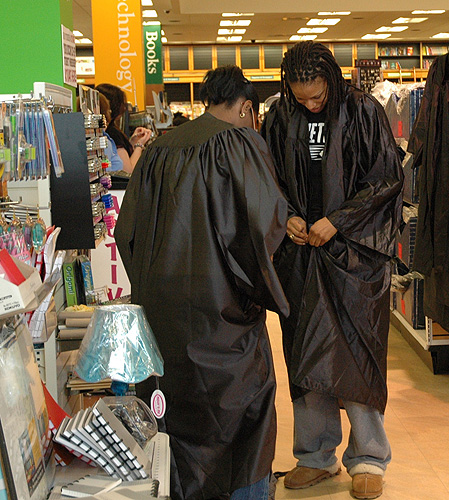
Hundreds of thousands of California seniors are getting ready for their much-anticipated public high school graduation ceremony, though many don’t know it's against the law for their schools to require them to buy a cap and gown without offering a set to use for free.
The practice violates the free public schools guarantee in the state constitution.
“The reason why this is important is to not create a two-tier system of education where those with resources and money are able to buy a better — and have a different — educational experience,” said ACLU lawyer David Sapp.
Sapp led a 2010 lawsuit that alleged public schools illegally charged parents fees for educational activities, including high school graduation ceremonies.
He says many schools are complying with the law: Los Angeles Unified School District sends its students a letter that uses the state’s wording on caps and gowns. In Norwalk-La Mirada, the school district allows all graduation seniors to use loaner sets.
However, in interviews with 12th-graders and their parents and a review of the documents that schools provide, it's clear that some districts leave many students in the dark about their options.
‘The activities director said you have to wear a cap and gown for graduation ceremony because it’s a very special event in your life and why wouldn’t you want to be wearing a cap and gown,” said Long Beach Poly High School senior Julia Jaynes.
Materials in her school’s graduation packet didn’t say whether caps and gowns are required for the graduation ceremony or whether the district will provide one to students for free.
Her parents are professionals, and can afford her senior year expenses. The yellow cap and gown they purchase will be a keepsake for her.
“My mom graduated from Poly 30 years ago and then I’m going to be walking at veterans stadium across the stage, too, and graduating. So it’s really cool,” Julia said.
Her father said the list of senior expenses is long and he wonders how families struggling to get by can afford the many graduation-related costs.
That’s the kind of financial pressure Hilda Rodriguez Guzman (no relation to this reporter) is feeling as her 12th-grader graduates from Wallis Annenberg High School, a charter campus in South LA.
“I feel horrible as a parent if I can’t give her a good experience and to celebrate all her accomplishments in the midst of everything that she’s been going through with her health,” she said.
Her daughter is graduating despite debilitating arthritis that keeps her on medication and at home some days.
Rodriguez Guzman recently learned that the state of California prohibits schoolsfrom charging a mandatory cap and gown fee.
Annenberg High, a charter within the Los Angeles Unified District, did not respond to a request for comment on whether its communication to students violated state law.
Long Beach Unified's high school packets also don’t explain the cap and gown options to seniors. But after KPCC asked officials for comment, they said they would send all 12th-graders a clarification that reads, in part:
“If you paid for a cap and gown but no longer wish to use one and would prefer to be reimbursed, please contact your school. Our high schools also make free caps and gowns available for students who wish to borrow them. Please also keep in mind that graduation dress codes will apply in the absence of a cap and gown.”
A letter sent to Pasadena High School seniors also fails to explain the cap and gown options to seniors as recommended by the California Department of Education. Half a dozen students at Pasadena's Muir High School said school officials told them caps and gowns were required and students would have to pay for them.
“First of all, we want to thank you for finding that out,” said Pasadena Unified spokesman Adam Wolfson.
He said students district-wide will likely be sent a letter clarifying that they can get a reimbursement from Jostens, the cap and gown company.
“We’re setting up a system with Jostens so if someone purchased a gown for California high schools violating graduation cap and gown fee law | 89.3 KPCC:

Opinion: PARCC Is Part of the Problem, Not Part of the Answer for NJ Schools - NJ Spotlight

Opinion: PARCC Is Part of the Problem, Not Part of the Answer for NJ Schools - NJ Spotlight:


OPINION: PARCC IS PART OF THE PROBLEM, NOT PART OF THE ANSWER FOR NJ SCHOOLS

Complex online tests can’t address chronic school underfunding, segregation, and poverty


mark weber (use)
Mark Weber
Is it just me, or are the cheerleaders for PARCC coming across as increasingly desperate?
PARCC -- Partnership for Assessment of Readiness for College and Careers -- is the new, computerized, statewide test administered to students in New Jersey, 11 other states, and Washington, D.C.
Our state just finished the first round of PARCC last month. Parents and teachers gauged the reactions of their children and students as they struggled through these assessments. Many of them had already evaluated the tests based on sample questions made available online, or at the many “Take the PARCC” events across the state.
Now the reviews are coming in, and a good number of stakeholders -- students, parents, and teachers alike -- are less than impressed with PARCC. So much so that, according to the state’s largest teachers union, the NJEA, there were more than 50,000 refusals during the first administration of the test.
Given what I’ve heard from parents and students, that number is likely to grow during next month’s testing cycle. Parents are complaining that the sample questions they’ve reviewed are confusing and age inappropriate. High-school students are grumbling that the tests are poorly written and don’t match their schools’ curricula.
Russ Walsh, a professor of education at Rider University and expert on literacy, agrees with this evaluation. Many of the sample items Walsh tested were far above grade level in their difficulty and needlessly complex.
It’s little wonder, then, that both social media and mainstream press reports are full of anecdotes about students deliberately tanking the tests. Normally, this would raise serious concerns; however, the validity of the test results was already in question. Some school districts suspended their local exams in favor of PARCC, creating unequal incentives across the state for students to do well on the new tests.
Education Commissioner David Hespe and his staff are now in a panic, as the growing number of opt-outs threatens the May administration of PARCC. Together with their allies in the We Raise NJ collation, they’ve attempted to blame the growing dissatisfaction with the tests on a campaign of misinformation.
The truth, however, is that Hespe, his staff, and the other PARCC cheerleaders have no one to blame but themselves. Rather than judiciously roll out the new tests and acknowledge their limitations, NJDOE officials confidently claimed that PARCC was afar superior assessment than NJASK, and would transform New Jersey schools for the better.
In reality, we have little idea if PARCC is a more reliable assessment or if it predicts real-life outcomes better than any other standardized test. Even the PARCC consortium, in a white paper found on its own website, admits that it doesn’t know if test results vary with the quality of instruction students receive.
Most likely, PARCC, like NJASK, will be heavily biased by socioeconomic status: average scores for schools will rise and fall based on the number of students enrolled in the federal free-lunch program.
Ironically, this is the latest argument that PARCC cheerleaders have taken up: The tests are necessary to show how schools that serve larger populations of students in economic disadvantage are “failing.” Opting out, in this construction, is a luxury for suburban parents that inner city parents can’t afford.
It’s true that standardized tests have laid bare an inexcusable gap in performance between students of differing social classes. Of course, we could see this in the results of NJASK; it’s not as if PARCC is going to give us a new insight into the intense segregation that is pervasive throughout New Jersey schools.
It’s also true that more opt-out activity appears to be taking place in the suburbs than in New Jersey’s largest cities. But that’s probably because parent, student, and community protesters are busy fighting a much larger battle over charter school Opinion: PARCC Is Part of the Problem, Not Part of the Answer for NJ Schools - NJ Spotlight:

Failing as a starter jump-started Reynolds' career - The Orange County Register

Failing as a starter jump-started Reynolds' career - The Orange County Register:

Failing as a starter jump-started Reynolds' career


One of the top relief prospects in the Angels' farm system, Danny Reynolds will start the season at Double-A Arkansas.
MORRY GASH, THE ASSOCIATED PRESS
TEMPE, Ariz. – It is probably not a stretch to say that almost every reliever in the majors was a starter who just needed to fail enough to discover where he was meant to be.
If Danny Reynolds continues on the path he discovered last year, he will be able to look back and realize his demotion in Class-A was the blessing that changed his career.
Reynolds, now one of the top relief prospects in the Angels system, went from being an organizational roster filler to a holding coveted spot on the 40-man roster within a span of 15 months, all because he got squeezed out of the rotation.
Class-A Inland Empire was shortening its rotation for the playoffs in 2013. Reynolds, who was languishing with a 5.39 ERA after his fourth season in the organization, was the odd man out. The Angels stuck him in the bullpen.
“We saw a low-90s fastball jump to mid-90s, with what at times can be an electric breaking ball,” General Manager Jerry Dipoto said. “We thought, ‘We’ve tapped into something here.’”
 A former sixth-round pick out of Durango High in Las Vegas, Reynolds returned to Inland Empire in 2014, but he wasn’t there long. He had a 1.80 ERA in 20 innings, with 19 strikeouts, and was bumped to Double-A Arkansas. At Arkansas, he posted a 3.60 ERA in 40 innings, with 41 strikeouts, which earned him a promotion to Triple-A.

All told, Reynolds had a 2.90 ERA for the season, and he gave up just 54 hits in 62 innings, with 63 strikeouts. His fastball reached 101 mph.
Reynolds was the classic example of a starter whose stuff improves when he can let it all go for a short burst, rather than worrying about maneuvering through 100 pitches.
“A lot of times when you shorten a guy, you find their stuff takes a big jump,” Dipoto said.
Reynolds, a 6-feet, 170-pounder with a baby face that has caused teammates to kid about being the bat boy, also contorts his slender frame into an unorthodox delivery. Even if he had the stuff to start, his arm probably couldn’t have taken the strain, Dipoto said.
Having discovered his future path to the big leagues, Reynolds was considered close enough that the Angels placed him on the 40-man roster. He will start 2015 at Double-A only because the Angels have so many veteran relievers with big league experience at Triple-A.
Despite his assignment, he’s still just a phone call from the majors. The Angels recalled pitchers Michael Roth, Cam Bedrosian, Drew Rucinski and Jairo Diaz from Double-A to the majors in recent seasons.
“If you would have told me when we got here in 2012 that Danny Reynolds would make the progress that he has to this point and the work habits and maturity would come as far as they were, I’d say sign me up,” Dipoto said. “And he’s delivered.”

Have you gotten a call from Ready Washington about the wonders of Common Core Standards and the SBAC? If so, this is why | Seattle Education

Have you gotten a call from Ready Washington about the wonders of Common Core Standards and the SBAC? If so, this is why | Seattle Education:


Have you gotten a call from Ready Washington about the wonders of Common Core Standards and the SBAC? If so, this is why

bill-gates
Ready Washington Coalition… of the bought
Office of Superintendent of Public Instruction
Partnership for Learning, the education arm of the Washington Roundtable. From the Gates Foundation website. received $499,492 “to support the Ready Washington Coalition and stakeholder groups to improve communications and outreach around the Common Core State Standards”.
Stand for Children Washington (Gates)
Washington STEM (Gates)
Excellent Schools Now, from their website, The steering committee of Excellent Schools Now consists of: League of Education Voters, Partnership for Learning, Schools Out Washington, Stand for Children Washington and Tabor 100. Received money through the League of Education Voters to the tune of $1,499,543 for the “Purpose: to continue public engagement and action project to advance the policies and priorities of A+ Washington through the Excellent Schools Now (ESN) Coalition.
Washington State PTA (Gates money)
Council of Presidents
State Board for Community and Technical Colleges
Department of Early Learning
League of Education Voters (Gates)
ReadyNation (Gates)
Democrats for Education Reform (Gates and corporate money)
Puget Sound Educational Service District (Who brought us Race to the Top and data mining of our students’ information)
State Board of Education (populated with the usual suspects)
The Parents Union (Gates)
College Spark Washington
Schools Out Washington (Gates)
Center for Strengthening the Teaching Profession
Washington Association of School Administrators
Washington Student Achievement Council
Washington Roundtable (Big money)
Renton Technical College (?)
Consider the source.
Most of these faux roots organizations and even some who are not, including the Washington State PTA, receive money from Bill Gates.
images

The Silencing of the Educators: A Shocking Idea, and Trending |

The Silencing of the Educators: A Shocking Idea, and Trending |:

The Silencing of the Educators: A Shocking Idea, and Trending


 In a recent post I published titled, “New Mexico UnEnchanted,” I described a great visit I recently made to Las Cruces to meet with students, parents, teachers, school board members, state leaders, and the like. In this post, I also described something I found shocking as I had never heard of this before. Under the “leadership” of Hanna Skandera — former Florida Deputy Commissioner of Education under former Governor Jeb Bush and head of the New Mexico Public Education Department — teachers throughout the state are being silenced.

New Mexico now requires teachers to sign a contractual document that they are not to “diminish the significance or importance of the tests” (see, for example, slide 7 here) or they could lose their jobs. Teachers are not to speak negatively about the tests or say anything negatively about these tests in their classrooms or in public; if they do they could be found in violation of their contracts. At my main presentation in New Mexico, a few teachers even approached me after “in secret” whispering their concerns in fear of being “found out.” Rumor also has it that Hanna Skandera has requested the names and license numbers of any teachers who have helped or encouraged students to protest the state’s “new” PARCC test(s), as well.
One New Mexico teacher asked whether “this is a quelling of free speech and professional communication?” I believe it most certainly is a Constitutional violation. I am also shocked to now find out that something quite similar is occurring in my state of Arizona.
Needless to say, neither of our states (or many states typically in the sunbelt for that matter) are short on bad ideas, but this is getting absolutely ridiculous, especially as this silencing of the educators seems to be yet another bad idea that is actually trending?
As per a recent article in our local paper – The Arizona Republic - Arizona “legislators want to gag school officials” in an amendment to Senate Bill 1172 that will prohibit “an employee of a school district or charter school, acting on the district’s or charter school’s behalf, from distributing electronic materials to influence the outcome of an election or to advocate support for or opposition to pending or proposed legislation.”
The charge is also that this is a retaliatory move by AZ legislators, in response to a series of recent protests in response to serious budget cuts several weeks ago. “Perhaps [this is] to keep [educators] from talking about how the legislature has shortchanged Arizona’s school kids by hundreds of millions of dollars since the recession, and how the legislature is still making it nearly impossible for many districts to take care of even [schools’] most basic needs.”
In addition, is this even Constitutional? An Arizona Schools Boards Association (ASBA) spokesperson is cited as responding, saying “SB 1172 raises grave constitutional concerns. It may violate school and district officials free speech rights and almost certainly chills protected speech by school officials and the parents and community members that interact with them. It will freeze the flow of information to the public that The Silencing of the Educators: A Shocking Idea, and Trending |: