Latest News and Comment from Education

Sunday, April 5, 2015

Quieting the Teacher Wars | American Federation of Teachers

Quieting the Teacher Wars | American Federation of Teachers:

Quieting the Teacher Wars


What History Reveals about an Embattled Profession

By Dana Goldstein
I began writing my book The Teacher Wars in early 2011 with a simple observation: Public school teaching had become the most controversial profession in America. Republican governors in Wisconsin, Ohio, and Indiana, and even the Democratic governor of deep-blue Massachusetts, sought to diminish or eliminate teachers’ rights to collectively bargain. Teacher tenure was the subject of heated debate in statehouses from Denver to Tallahassee, and President Obama swore in his State of the Union address to “stop making excuses” for bad teachers.1
One rising-star Republican, New Jersey Governor Chris Christie, even became a conservative folk hero after appearing in a series of YouTube videos in which he excoriated individual public school teachers—all of them middle-aged women—who rose at public events to challenge him on his $1 billion in education budget cuts, even as he cut $1.6 billion in corporate taxes.
Few other professions operate under this level of political scrutiny. In 2010, Newsweek published a cover story called “The Key to Saving American Education.” The image was of a blackboard, with a single phrase chalked over and over again in a child’s loopy handwriting: We must fire bad teachers. We must fire bad teachers. We must fire bad teachers. Wide-release movies like Waiting for “Superman” and Won’t Back Down, funded by philanthropists who made their fortunes in the private sector, portray teacher tenure and its defender, teachers unions, as practically the sole causes of underperforming schools.
Everywhere I traveled as an education reporter, from the 2008 Democratic National Convention to the 2010 meeting of former president Bill Clinton’s Clinton Global Initiative, powerful people seemed to feel indignant about the incompetence and job security of public school teachers, despite polls showing that the American public considers teachers highly respected professionals, nearly on par with medical doctors.2
To an extent, anxiety about bad teaching is understandable. Teachers do work that is both personal and political. They care for and educate our children, for whom we feel a fierce and loyal love. And they prepare our nation’s citizens and workers, whose wisdom and level of skill will shape our collective future. Given that teachers shoulder such an awesome responsibility, it makes sense that American politics is acutely attuned to their shortcomings.
So I want to begin by acknowledging: It is true that the majority of American teachers have academically mediocre backgrounds. Most have below-average SAT scores and graduate from nonselective colleges and universities.3 It is also true that one large review of practices within typical American elementary school classrooms found many children—and the majority of poor children—“sitting around, watching the teacher deal with behavioral problems, and engaging in boring and rote instructional activities such as completing work sheets and spelling tests.”4
In the Obama era, the predominant policy response has been a narrow one: to weaken teachers’ tenure protections and then use “measures of student learning”—a euphemism for children’s scores on an ever-expanding battery of hastily designed tests—to identify and fire bad teachers. One Colorado teacher told me (hyperbolically) that the disproportionate focus on punishing awful teachers made her feel “I’ve chosen a profession that, in the public eye, is worse than prostitution.”
A spate of online videos and blog posts, in which angry teachers publicly quit their jobs, has gone viral. “I can no longer cooperate with a testing regime that I believe is suffocating creativity and innovation in the classroom,” wrote Ron Maggiano, a Virginia high school social studies teacher and winner of two national teaching awards. In Illinois, Ellie Rubenstein tendered her resignation via YouTube, explaining, “Everything I loved about teaching is extinct. Curriculum is mandated. Minutes spent teaching subjects are audited. Schedules are dictated by administrators. The classroom teacher is no longer trusted or in control of what, when, or how she teaches.”5
Olivia Blanchard chose to leave her Teach for America placement in Atlanta, where hundreds of thousands of dollars in merit pay bonuses had been paid to administrators and teachers who cheated by erasing and correcting students’ answers on standardized tests before submitting them to be graded. After a round of indictments, those teachers who remained in the district were left demoralized and paranoid. When Blanchard clicked send on her resignation e-mail, she was “flooded with relief,” she recounted in The Atlantic.6
Blanchard, Maggiano, and Rubenstein represent a larger trend. Though polls show teachers feel more passionate and mission-driven about their careers than other American professionals, a MetLife survey of teachers found that between 2008 and 2012, the percent who reported being “very satisfied” with their current job plummeted from 62 to 39 percent, the lowest level in a quarter century.

History Repeating Itself

I had assumed this war over teaching was new, sparked by the anxieties of the Great Recession. After all, one-fifth of all American children were growing up poor—twice the child poverty rate of England or South Korea. Young adults were suffering from a 17.1 percent unemployment rate, compared with less than 8 percent in Germany and Switzerland. More than half of recent college graduates were jobless or underemployed for their level of education.7 A threadbare social safety net, run-amok bankers, lackadaisical regulators, the globalization of manufacturing, and a culture of consumerism, credit card debt, and short-term thinking might have gotten us into this economic mess. But we’d be damned if better teachers couldn’t help to get us out. “Great teachers are performing miracles every single day,” Secretary of Education Arne Duncan said in 2009. “An effective teacher? They walk on water.”8 The rhetoric could provoke whiplash. Even as we were obsessed with the very worst teachers, we were worshipping an ideal, superhuman few.
This confusing dichotomy led me to wonder: Why are American teachers both hated and idealized, when teachers in other nations are much more universally admired? In South Korea, teachers are referred to as “nation builders.” In Finland, both men and women name teaching as among the top three most desirable professions for a spouse. Meanwhile, that old American saw—“Those who can’t do, teach”—continues to reverberate, reflecting elite condescension toward career educators.
I suspected that the key to understanding the American view of teachers lay in our history, and perhaps had something to do with the tension between our sky-high hopes for public education as the vehicle of meritocracy and our perennial unwillingness to fully invest in our public sector, teachers and schools included.
For 200 years, the American public has asked teachers to close troubling social gaps—between Catholics and Protestants; new immigrants and the American mainstream; blacks and whites; poor and rich. Yet every new era of education reform has been characterized by a political and media war on the existing teachers upon whom we rely to do this difficult work, often in the absence of the social supports for families that make teaching and learning most effective for kids, like stable jobs and affordable housing, childcare, and healthcare.
The 19th-century common school reformers depicted male teachers—90 percent of the classroom workforce in 1800—as sadistic, lash-wielding drunks who ought to be replaced by kinder, purer (and cheaper) women. During the Progressive Era, it was working-class female teachers who were attacked, for lacking the masculine “starch” supposedly necessary to preside over 60-student classrooms of former child laborers. In the South during the civil rights era, Brown v. Board of Education prompted the racially motivated firings of tens of thousands of black teachers, as the Eisenhower, Kennedy, Johnson, and Nixon administrations looked the other way. Then, at the height of the Black Power movement in the 1960s and 1970s, it was inner-city white teachers who were vilified, for failing to embrace parental control of schools and Afrocentric pedagogical theories.
Over the course of history, teachers have been embattled by politicians, philanthropists, intellectuals, business leaders, social scientists, activists on both the right and left, parents, and even by one another. Americans have debated who should teach public school, what should get taught, and how teachers should be educated, trained, hired, paid, evaluated, and fired. Though we’ve been arguing about these questions for two centuries, very little consensus has developed.
Amid these teacher wars, many extraordinary men and women worked in public school classrooms and offered powerful, grass-roots ideas for how to improve American education. Henry David Thoreau, Susan B. Anthony, W. E. B. Du Bois, and Lyndon B. Johnson are just a few of the famous Americans who taught. They resisted the fantasy of educators as saints or saviors, and understood teaching as a job in which the potential for children’s intellectual transcendence and social mobility, though always present, is limited by real-world concerns such as poor training, low pay, inadequate supplies, inept administration, and impoverished students and families. These teachers’ stories, and those of less-well-known teachers, propel this history forward and help us understand why American teaching has evolved into such a peculiar profession, one attacked and admired in equal proportion.

A Moral Panic

Today the ineffective tenured teacher has emerged as a feared character, a vampiric type who sucks tax dollars into her bloated pension and healthcare plans, without much regard for the children under her care. Like past conflagrations over crack babies or welfare queens, which exemplified anxiety over public spending on poor people of color, today’s “bad teacher scare” employs all the classic features of a moral panic.
According to sociologists who study these events, in a moral panic, policymakers and the media focus on a single class of people (in our case, veteran public school teachers) as emblems of a large, complex social problem (socioeconomic inequality, as evidenced by educational achievement gaps). Then the media repeats, ad nauseam, anecdotes about the most despicable examples of this type of person (such as “rubber room” teachers, who collect pay, sometimes for years, while awaiting termination hearings on accusations of corporal punishment or alcoholism). This focus on the worst of the worst misrepresents the true scale and character of what may be a genuine problem.9
As a result, the public has gotten the message that public school teaching—especially urban teaching—is a broadly failed profession. The reality is concerning, but on a more modest scale: teacher-quality advocates estimate that somewhere between 2 and 15 percent of current teachers cannot improve their practice to an acceptable level and ought to be replaced each year.10
Far from confirming the perception that low-performing urban schools are uniformly bleak, talentless places, the latest research quantifies what history shows: that even the highest-poverty neighborhood schools in cities like New York and Los Angeles employ teachers who produce among the biggest test score gains in their regions. What’s more, veteran teachers who work long term in high-poverty schools with low test scores are actually more effective at raising student achievement than is the rotating cast of inexperienced teachers who try these jobs out but flee after one to three years.11
The history of American education reform shows not only recurring attacks on veteran educators, but also a number of failed ideas about teaching that keep popping up again and again, like a whack-a-mole game at the amusement park. Over the past 10 years, cities from Atlanta to Austin to New York have

- See more at: http://www.aft.org/ae/spring2015/goldstein#sthash.vuNStEVf.dpuf


Why I love teaching – and why I had to leave the profession | Anonymous | Comment is free | The Guardian

Why I love teaching – and why I had to leave the profession | Anonymous | Comment is free | The Guardian:

Why I love teaching – and why I had to leave the profession

Anonymous


Girls in a maths class
 ‘Figures show that in 2011 only 62% of newly qualified teachers were still teaching a year later – a sharp drop from 2005, when 80% were still teaching after a year.’ Photograph: Janine Wiedel Photolibrary/Alamy


Teaching is a great job. It’s something I’m good at, and at times can excel at. I’ve even had those once-a-decade moments of a child telling you something you’ve done has changed them or inspired them permanently. But “being a teacher” (the whole job and everything it entails) ground me down so much over the course of 10 years that I felt I never wanted to go near students or schools again. I genuinely believed I had no place in the teaching profession and that I had made a lucky escape.
I’m not the only one. This week figures were released by the Association of Teachers and Lecturers which showed that in 2011 only 62% of newly qualified teachers were still teaching a year later – a sharp drop from 2005, when 80% were still teaching after a year.
“Why are we losing the next generation of teachers,” asked Mary Bousted, the ATL general secretary. “Is it, I wonder, because trainee and newly qualified teachers see very early on just what teaching has become and decide that they do not want to be a part of it? Is it that they learn as they work with exhausted and stressed colleagues that teaching has become a profession which is incompatible with a normal life?”
How did I come to leave the profession? I completed my PGCE in my early 20s, before I had a young family, and went to work at a comprehensive. I was teaching English, so the preparation and marking was all-consuming, particularly in the early years after I qualified. As soon as I began having children, I realised how incompatible full-time teaching was going to be with any semblance of that miraculous notion: work-life balance.
I immediately went part-time, which presented its own problems; if you are teaching a core subject you end up with split-teacher classes, which involves detailed lesson handovers and highly organised marking/planning being passed between two teachers (or more – in one particularly complicated year I was one of four teaching the same year 9 class. I don’t know who was more confused, us or the students).
My departmental colleagues were supportive, and I worked this way for several years. But, increasingly, other things began to crowd in. Yes, that workload, the one teachers talk about constantly but I still feel is met with scepticism and suspicion. (Do you really work that much after you leave so early every day? Simply, yes. If I left when school hours finished I had to work later, after I’d eaten and the kids were in bed. And many days, I simply stayed at work long after the final bell.)
I know couples who are both teachers, who take one day each every weekend – one day for childcare, one day for marking and preparation. Separately. And I was only part-time. I found myself growing more and more resentful of the time I spent thinking, planning and worrying about my workload when I wasn’t at work.
Then there was the weight of responsibility I felt for the kids I taught, particularly regarding their exam results. Parents’ evenings were a chance to connect with parents who I didn’t see from one year to the next. Some were grateful, some simply wanted numbers, and some were confrontational: one demanded a detailed copy of every lesson plan I intended to teach for the next half term, because her child had told her he didn’t feel my lessons were interesting enough for him.
The constant doubting of my work, and the passing on of every ounce of the exam burden my way took its toll. I began to examine my dual role as a parent and a teacher with careful scrutiny: did I hold my own children’s teachers entirely responsible for how well they did in every aspect at school? Did I make their teachers feel as I felt? I hoped not, but it’s possible I did.
Eventually, I just got sick of being in a profession that I felt held no real status in this country. I had countless arguments with other parents – they felt that although there were individuals who worked hard, teachers as a whole were lazy and complained too much. Although I knew the opposite to be true, I didn’t want Why I love teaching – and why I had to leave the profession | Anonymous | Comment is free | The Guardian:


2 Reasons Why Bad Teachers Don't Get Fired

2 Reasons Why Bad Teachers Don't Get Fired:

2 Reasons Why Bad Teachers Don’t Get Fired


 Teaching is often viewed as a noble profession. Almost everyone in society has a strong connection to a teacher: Either their mom or other family member has been in the classroom for an entire career, their sixth-grade teacher changed the course of their life, or they realize the value of education in the workplace that follows. Many of the posts online about the nobility of teaching come from those in the profession themselves, who attest to the ways in which teaching has changed their lives for the better.

These are the reasons why talking about bad teachers, and how to replace them, becomes so difficult. It’s not easy to talk about a group of people who are disparaging the nobility built up around a profession, because too often it seems like an attack on the rest of the teachers, too. But teachers, and the unions that represent them, know there are a few among them who aren’t performing to par. Who, in fact, are doing the profession an injustice.
“No one wants bad teachers in classrooms,” said Randi Weingarten, the president of the American Federation of Teachers (AFT) in a discussion about education policies with the Aspen Institute. The AFT is the second largest teachers union in the country, and in this past year opposed a lawsuit that claimed the number of unsuitable teachers in California created an unequal learning environment for the state’s students. The AFT’s opposition wasn’t because the lawsuit sought to change tenure practices or fire the bad apples. Instead, Weingarten said she and the union opposed the court proceedings because the legal action pitted students against teachers.


The heart of the issue for firing bad teachers most recently was the focus of a court case in California, brought by nine students within the state and backed by Students Matter, a coalition of Silicon Valley businessmen led by entrepreneur David Welch. Though some of the articles to follow, including Time’s coverage in its November issue, garnered fierce criticism by the teaching community, it did point out that it was the first case to link the quality of a teacher with a student’s right to an education.
According to the decision in Vergara v. California, Judge Rolf M. Treu found that the effect of “grossly ineffective” teachers have adverse affects on the education students receive. “The evidence is compelling,” Treu wrote in his decision. “Indeed, it shocks the conscience.” Treu cites findings from experts who testified in the case: One ineffective teacher costs students $1.4 million in lifetime earnings within a single year. Based on a four-year study, students in the Los Angeles Unified School District (LAUSD) who were taught by a teacher in the bottom 5% of competence lost 9.54 months of learning in a single year, compared to students with average teachers.

Teacher tenure

One of the main contentions within the court case, and the larger discussion of firing underperforming teachers, is that tenure often protects the people who are making egregious errors in the classroom. LAUSD Superintendent John Deasy testified in the case on behalf of the students, saying that the tenure laws in California as they stood were “patently problematic.”
In practice, lifelong tenure in the state is determined in 14-16 months of a teacher beginning his or her career in any public school, Deasy called this a “ridiculous” short amount of time that doesn’t accurately reflect the teacher’s abilities or means of evaluating whether they are deserving of such status. Plus, the overwhelming majority of teachers receive tenure without incident. In the L.A. district for example, the rate of teachers denied tenure in years past has been as low as 2%. Deasy and Weingarten discuss the court case in depth in the video posted above.
Deasy quickly clarified that tenure should be given to teachers who have proven themselves worthy, but that one year and two months, along with likely three evaluations by a principal, isn’t enough to determine that. However, Deasy said he is confident more time wouldn’t harm the teachers who are actually going to succeed in the profession. “No system in the world would willingly design itself to get rid of great talent,” he said.
But on the flip side, Weingarten said good teachers would say that tenure ensures they are able to take risks in the classroom, to be unconventional in order to encourage learning, even when administrators or parents aren’t sure it’s the right move. In the discussion at the Aspen Institute, Weingarten gave an example of a teacher in Indiana who was dismissed because an administrator wanted to hire a friend. She also used an example from her own teaching career, in which an administrator gave her an “unsatisfactory” rating for holding a mock court case in her classroom. Had the decision not been reversed later, Weingarten said, she could have been fired in the state of New York as an untenured teacher.

The legal costs

The process for firing a teacher might begin in a school district, with discussions among school board members and union representatives. But the outcome is often decided for good in the courts system, a process that takes too long and costs enormous amounts of money. Even Weingarten, in the Aspen discussion, acknowledged that all sides should be working to make sure it doesn’t take 10 years (or even one) to fire a teacher guilty of gross misconduct or incompetency.
In California alone, the Vergara case experts estimate that 1-3% of the state’s 275,000 teachers are “grossly ineffective.” For those of you without calculators for brains, that’s roughly between 2,750 and 8,250 teachers who aren’t up to snuff. But the unions will go to bat — or court — for their members, especially when there’s any question of subjectivity. In many cases, that can lead to costs of hundreds of thousands of dollars for the school districts, amounts that are increasingly difficult to swallow in the face of what many people would say is a lack of adequate funding for public districts. In one particular case, the L.A district settled with a teacher after a five-year court battle, agreeing to pay $150,000 in lawyer fees on top of the teacher’s $300,000 in paychecks earned during that time.
Source: National Council on Teacher Quality
 Your Reaction?
Source: National Council on Teacher Quality

Are there changes ahead?

Progress by any means to solve this issue will likely be slow. For one, the issue of teacher effectiveness should never be viewed in a bubble, which the AFT believes is the case in the Vergara decision. “”It’s surprising that the court, which used its bully pulpit when it came to criticizing teacher protections, did not spend one second discussing funding inequities, school segregation, high poverty or any other out-of-school or in-school factors that are proven to affect student achievement and our children,” an AFT response to the court decision reads. The union, as well as the state of California, is appealing Treu’s ruling.
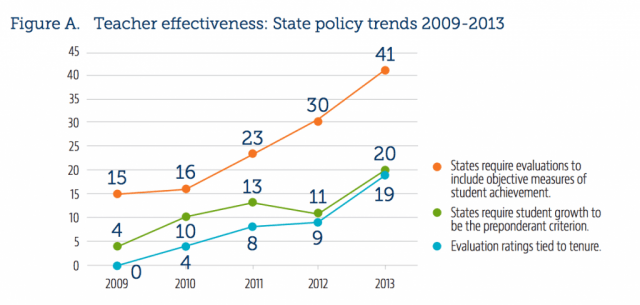
But another reason progress will likely be slow is that education is largely left to state authority. States such as Indiana and Louisiana have already tied student performance to some aspects of teacher evaluations. Those, in turn, are tied to whether a teacher in those states receive tenure. Evaluations are also tied to student performance in numerous other states, a trend that continues to grow. A report from an advocacy group, 

Read more: http://www.cheatsheet.com/business/why-is-it-so-hard-to-fire-bad-teachers.html/?a=viewall#ixzz3WRiFhqdu

Defiant NYS Teachers’ Union Tells Parents to Boycott Evaluation Tests - Cortney O'Brien

Defiant NYS Teachers’ Union Tells Parents to Boycott Evaluation Tests - Cortney O'Brien:

Defiant NYS Teachers’ Union Tells Parents to Boycott Evaluation Tests


Parents Can Opt Out - United Opt Out National

Click Here to go to United Opt Out National: 


Click Here to go to the WebsiteUnited Opt Out Team
Home
Click Here to go to the Website FairTest


It’s an unlikely battle in New York state, but it's one that has seemed to be raging ever since Andrew Cuomo was sworn in as governor. The liberal leader's fight with teachers unions has just become nastier as his new state budget puts educators on a tighter leash.
Weeks of New York state budget negotiations among political leaders, and heavy lobbying from teachers unions and charter school supporters, is apparently yielding a budget bill that modestly changes teacher tenure rules and performance evaluations, and that will give the state's failing schools another year before taking control of the schools away from their school boards, according to published reports.
It could have been worse. Cuomo had initially proposed that his government could more easily takeover struggling schools and for more charter schools to be introduced throughout the state. The former suggestion was modified, the latter was removed and will be debated later this year. 
The Syracuse.com editorial board sided with Cuomo and suggested teachers were overreacting to the new standards, especially considering the budget also gifted a 6 percent aid increase to New York schools. The editors outlined some more positive specifics that clearly benefit students.
Cuomo wrangled far-reaching changes to nearly every aspect of public education: full scholarships to attract the best and the brightest to the teaching profession; higher standards for the New York schools that teach the teachers; a "bar exam'' for teachers; a longer probationary period and demonstrated proficiency before tenure is granted; a $20,000 bonus to reward and retain the very best talent; a new teacher evaluation protocol with more rigor and independence; a mechanism for removing ineffective teachers; and a one-year deadline for failing schools to shape up or face receivership. 
Nevertheless, the classroom changes did not sit well with many New York educators. Karen E. Magee, president of NYSUT, a federation of more than 1,200 local unions, even encouraged parents to tell their kids to reject the evaluation tests.
"At this point in time, yes, we are urging parents to opt out."


 The governor isn't budging. In an interview with the Associated Press Thursday, Cuomo defended the education budget, even claiming it was the ‘most pro-teacher budget in history.’ The unions still didn’t agree:

Teachers unions scoff at the assertion. While they support the spending increase, they say Cuomo's emphasis on evaluations tied to student test performance unfairly blames teachers for the economic and social challenges many students face.
"He basically said, 'I'm declaring war on teachers and public education,'" said Michael Mulgrew, president of the United Federation of Teachers. "This was the first battle. The governor thought he was going to get all of this stuff, and he did not get it."
The education reforms Cuomo has proposed is one of the few issues (or only issue) on which we agree. If teachers are performing poorly, it should be simple to remove them, or at least hold them accountable through evaluations.
When parents place their children in teachers' hands, they deserve the assurance those teachers have been vetted. It'll interesting to see how these new guidelines affect students' test scores. In the meantime, grab some candy and watch Cuomo vs. Teachers...Round Ten? 
Defiant NYS Teachers’ Union Tells Parents to Boycott Evaluation Tests - Cortney O'Brien:


Provocative & redundant? Yes. But teacher's union report is not wrong

Provocative & redundant? Yes. But teacher's union report is not wrong - The Frederick News-Post : Editorials:

Provocative & redundant? Yes. But teacher's union report is not wrong


 A deliberately provocative report from the Frederick County Teachers Association did what it intended to do. But whether it’s provoked the right people is doubtful. Very few people, certainly a majority on the County Council, seem to believe we’re giving too much money to the school system. Education is a critical investment that has been overlooked in the county for far too long. While funding at the bare minimum level known as “maintenance of effort” was necessary to see county government through the recession, we’ve now passed the point where any sensible jurisdiction should have restored reasonable per-pupil funding increases.

The 10-point paper from the teachers union, “Frederick County: Starving its Public Schools,” argues that, as a fundamental driver of a healthy economy, school funding needs to be increased — and it does. In fact, that’s what County Executive Jan Gardner has committed to do. To see how much beyond the preliminary baseline of $245.9 million that’ll be will have to wait for Gardner’s budget release on April 15. It’s doubtful the school board will get the $268.9 million it’s asked for, especially with declining aid from the state. But an infusion of cash is needed.
The report and its title is quite plainly, as Gardner’s education aide Janice Spiegel says, meant to be inflammatory. But the provocation is unnecessary. Returning to adequate funding of education after the lean years of the final Board of County Commissioners was a campaign platform for nearly everyone who ran for the new County Council. Even so, there’s little to disagree with in the points the teachers union report makes. The county has begun to lag behind other jurisdictions.
For example, as the report reminds us, Frederick County still hasn’t resolved its low ranking with regard to starting teacher salaries. We are behind all but one jurisdiction in the state and D.C. The county’s teachers begin at $40,706 annually; Carroll, the only county with a lower wage than Frederick, starts teachers at $40,400. That’s point 9 in the report. Here are some others:
Point 7: Frederick County is one of nine that have delivered only maintenance-of-effort funding for schools. Fourteen others and Baltimore city have provided anywhere between 1 and 14 percent more from fiscal 2013 to 2015 in per-pupil spending.
Point 6: Regionally among 12 jurisdictions Frederick isn’t doing great for the percentage of personal income that goes toward schools — just 1.9 percent. That puts it on a par with Montgomery County and Arlington County, Virginia. However, here is where some context would have benefited the report. Both of these jurisdictions and a number of the ones above us in the scale have much higher incomes that aren’t reflected with a simple percentage calculation.
So where’s that money going to come from? Councilman Kirby Delauter, in an email exchange with teachers union President Gary Brennan, said, “I believe there are a lot of non-essential items ... that can be cut in order to raise all teacher salaries.” If there is, we hope Delauter makes that list available soon. We don’t think he can, though, as he’s complained only vaguely about waste during four years as a commissioner and has never offered any specifics.
If it doesn’t come from higher taxes — a political nonstarter — it means shuffling some priorities. The teachers association takes pains to argue in point 6, as we mentioned above, and 3 and 4, that schools receive an Provocative & redundant? Yes. But teacher's union report is not wrong - The Frederick News-Post : Editorials:

Push for Private Options in Education Gains Momentum - WSJ

Push for Private Options in Education Gains Momentum - WSJ:


Push for Private Options in Education Gains Momentum

More statehouses weigh measures allowing taxpayer funds to be used on alternative programs


A growing number of statehouses are considering measures that would allow school districts, parents and students increasingly to use taxpayer funds to explore alternatives to traditional state-backed public education.
The flurry of new bills—which range from supporting private-school options to putting education dollars directly into parents’ hands—comes amid concerns of federal overreach in schools and a backlash against the widespread implementation of common education benchmarks and standardized testing.
It has also gained momentum from elections last November that increased state legislatures’ numbers of Republican lawmakers—traditionally backers of school choice.
A bill that passed in the Nevada Assembly Thursday proposes tax credits for businesses that support private-school scholarships. Meanwhile, a measure to establish so-called education savings accounts, which put state funds into special savings accounts for some parents to pay for certain services directly, on Thursday passed in both chambers in Mississippi. This latest form of flexibility has caught the eyes of legislators in many states since Arizona and Florida began programs in recent years.
So far this year, at least 34 states are considering proposals to create or amend programs that offer private education options, up from 29 last year, according to the National Conference of State Legislatures. The number of states considering education savings accounts has doubled to 16 since 2014.
“It is looking like this year could beat 2011 in the number of states that expand or adopt new educational choice programs,” said Jason Bedrick, who generally supports the changes as a policy analyst with the Cato Institute, a libertarian think tank. Some 13 states enacted legislation in 2011, seen as a watershed year for new schooling options.
Supporters of such measures say students benefit from a more competitive educational field that can cater better to their specific needs.
Critics worry the policies hamper progress in traditional schools, which can lose funding when students leave their classrooms, and point to uneven academic performances in alternative programs.
The policies got a boost from elections in November, which vaulted Republicans to the largest number of state lawmakers in nearly a century, as well as from recent flash points in education such as Common Core, the set of math and reading standards adopted in more than 40 states and supported by some federal policies. As parents’ concerns over standardized exams have surfaced, some have opted to pull their children out of the tests.
Nonprofit groups such as the Friedman Foundation for Educational Choice and the Foundation for Excellence in Education have also been pushing for options like education savings accounts.
Meanwhile, efforts to reauthorize the No Child Left Behind law in Congress this year have opened a wider discussion about the federal government’s role in schools, with lawmakers such as Sen. Lamar Alexander (R., Tenn.), chairman of the Senate Health, Education, Labor and Pensions Committee, vowing to return power to the states and local schools.
“Definitely, the narrative of rising hesitation to new assessments and standards, plus the fear of federal-government intrusion, plays in well with these policies,” said Josh Cunningham, a senior policy specialist at the conference of state legislatures.
School Shakeup
At least 34 states are considering proposals to create or amend alternative schooling options.

School vouchers
State-funded scholarships that pay for students to attend private school

Education savings accounts/grants
Savings accounts from which parents can withdraw funds for certain educational expenses
Scholarship tax credits
Allows individuals and corporations to direct part of their state taxes to nonprofits that provide scholarships
Personal tax credits and deductions
States may offer tax breaks to parents as a form of reimbursement for private-school tuition and expenses
In Minnesota, Sen. David Hann, GOP minority leader of the Senate, introduced a bill this month to provide education savings accounts to parents of special-needs students. Though the measure remains in the Senate’s education committee, he hopes it will be a conversation starter.
“We have to have a change in the process of education, one that allows parents and families to have a meaningful voice in the education of their child,” he said.
Some play down the spate of measures, noting that of the dozens of bills focused on new education choices introduced last year, 13 passed into law in 10 states, according to the Education Commission of the States, a nonprofit focusing on education research.
Lily Eskelsen García, president of the National Education Association, the largest teachers union, describes the state bills as an effort to privatize public education, and says that as more families try new options like charter schools—independently run public schools—they are becoming disillusioned with the results.
In Wisconsin, Milwaukee has wrestled with educational choice. While acknowledging the district’s struggles to improve its low-performing schools, officials say efforts that direct focus away from traditional schools undermine their progress. Vouchers to attend private school, which first began in Wisconsin, drained $56 million from the district last year, according to school officials. In response, the district increased the local tax levy.
April Willis, a 34-year-old nursing assistant in Milwaukee, said money should go to public schools rather than less traditional options, arguing strong schools make a strong community. She sends her 8-year-old daughter to Gwen T. Jackson Early Childhood and Push for Private Options in Education Gains Momentum - WSJ:

To School Officials Seeking an Alternative to Eureka Math | deutsch29

To School Officials Seeking an Alternative to Eureka Math | deutsch29:

To School Officials Seeking an Alternative to Eureka Math


 As I begin this post, let me note that my position remains unchanged on the Common Core as a chiefly-non-classroom-teacher-created, untested, rushed conduit for roping states into unprecedented standardized testing, a vehicle designed to profit education companies and other “edupreneurs” at the expense of the democratic institution of public education. However, in an effort to provide districts with leverage to choose an alternative to Eureka Math, I present the information that follows.

According to the Louisiana Department of Education (LDOE), Eureka Math is theonly endorsed game in town. It is also the only supposedly “Common Core aligned” math curriculum for which LDOE plans to offer specific professional development at its June 2015 Teacher Leaders Summit.
“Primarily” (as in $3 million) Gates-funded EdReports.org also really likes Eureka Math. According to EdReports.org, only Eureka Math is fully “Common Core aligned” out of 20 math curricula that it reviewed. That the EdReports.org review will influence school officials’ selection makes this report a powerful factor for influencing the math curriculum market.
However, there is reason to believe that the EdReports.org review is slanted in favor of Eureka Math. This issue is problematic for districts that do not wish to use Eureka Math but whose district officials have taken the EdReports.org favor with Eureka math as established proof that it should be THE Common Core math curriculum.
Until now.
One of the other 19 math curricula in the EdReports.org review is Math Expressions.
According to Math Expressions author Karen Fuson, EdReports.org misrepresented Math Expressions in its evaluation of the curriculum’s  lack of “fit” with Common Core. Fuson has painstakingly detailed her assertions in this 34-page report. Fuson begins her report as follows:
In this response, I am drawing on my background as the author of over eighty research articles on mathematics teaching and learning about content in the Common Core State Standards Math and on knowledge gained by participating in and contributing to the writing of the National Research Council’s Mathematics Learning Study Committee that wrote Adding It Up and the Committee on Early Childhood Math that wrote Mathematics Learning in Early Childhood: Paths Toward Excellence and Equity.  I wrote the chapter on whole numbers for the NCTM Research Companion to the 2000 Standards and wrote the introductory chapter for the National Research Council’s How Students Learn: Mathematics in the Classroom. G1, G2, G5).  I worked on the Common Core State Standards-Math on the Feedback team and was a member of the writing team for the standards progressions describing learning progressions in these standards.
I am requesting EdReports.org to engage with me to modify their evaluations in response to the feedback I am providing below about their review.  We are all trying to improve math teaching and learning in this country, and I invite EdReports.org to contribute to that goal by modifying their review and awarding of points in response to this informative feedback. In the analysis and discussion of the report that follows, words from the report are in quotes to differentiate the report content from my discussion of the report. …
The way you summarize the results of the parts of your report does not represent your actual data well and is consequently misleading. The summary code you use for each Math Expressions grade K, G1, and G2 is Not Aligned.  But when one digs into the parts of the report about Math Expressions, one finds many positive comments and many full or partial alignments for each grade.  To be taken seriously and to inform your readers, you need to summarize your results in a fair and balanced and mathematically accurate manner. …
Fuson’s detailed dismantling of the EdReports.org poor review of Math Expressions is useful to districts seeking alternatives to solely-state-endorsed Eureka Math for two To School Officials Seeking an Alternative to Eureka Math | deutsch29:

empathyeducates – “To This Mayor [Rahm], Black and Brown Lives Do Not Matter” #DumpRahm

empathyeducates – “To This Mayor [Rahm], Black and Brown Lives Do Not Matter”:


“To This Mayor [Rahm], Black and Brown Lives Do Not Matter”

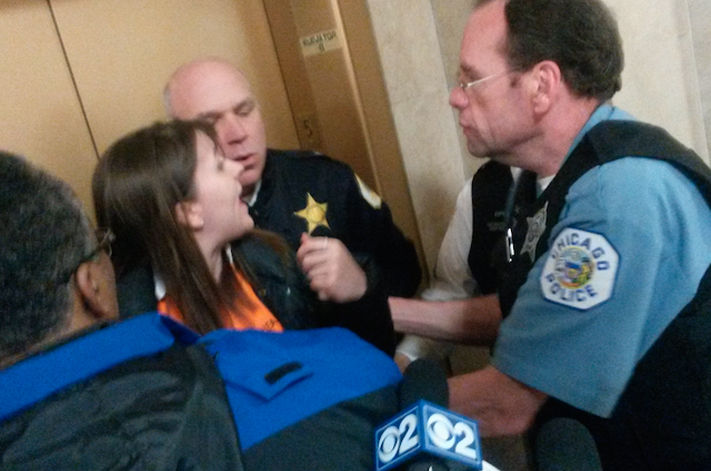
Chicago police grab a protester just outside Mayor Rahm Emanuel's office.


3 Arrested at Die-In at Rahm Emanuel’s Office

By Yana Kunichoff | Originally Published at In These Times. March 24, 2015

Protesters demand reforms to alleged abuses in Chicago’s criminal justice system, including a discriminatory “stop-and-frisk” program and secret interrogation site.
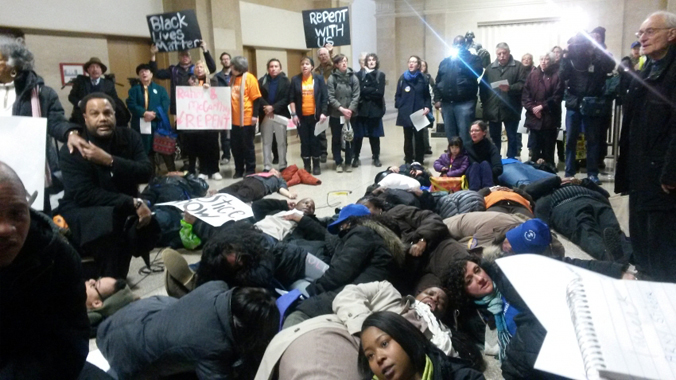
A chaotic scene played out on the fifth floor of Chicago’s City Hall Tuesday morning. In one corner, clergy members argued fervently with police officers amid a scrum of journalists to be allowed in to Mayor Rahm Emanuel’s office to present their demands on police accountability.
Behind them, dozens of protesters looked on as 30-some activists lay on the floor in a die-in—a protest action that’s become a mainstay of the Black Lives Matter movement—belting out “We Shall Overcome.” And behind the rope separating Emanuel’s office from the protest, a slowly growing number of police officers trickled in to stand between the clergy and their eventual target: the door leading to the mayor’s office.
“We just want to talk to the mayor,” came the entreaty from the negotiating clergy.
In the end, it took three arrests and nearly an hour of testimonials and consultations before four clergy members were allowed past the rope barrier to present their demands to a member of Emanuel’s staff. The protest—led by the Community Renewal Society, a religious-based social justice organization—was the latest in a series of actions aimed at pressuring Emanuel to address alleged police abuses that have come to dog his campaign for reelection ahead of the April 7 run-off.
Chicago police grab a protester just outside Mayor Rahm Emanuel's office.

Chicago police grab a protester on City Hall’s fifth floor, just outside Mayor Rahm Emanuel’s office. (Yana Kunichoff)

The day before the protest, the American Civil Liberties Union released a report showing that Chicago police stopped more than 250,000 people last summer for questioning without making any arrests—a policy that closely mirrors the “stop and frisk” program in New York City that came under heavy scrutiny before being scaled back by Mayor Bill de Blasio. And allegations that the Chicago Police Department ran an interrogation center where suspects were held without being officially booked—essentially keeping them “off the books”—have made international headlines.
The demands of the protesters that stormed City Hall on Tuesday touched on police issues across the board with three key demands: reforming the body camera pilot program, creating independent citizen oversight in place of the mayor-appointed entity currently in place, and ending stop and frisk.
“We have asked the mayor since December to meet with us and discuss police brutality, but [his office] still did not respond at all,” said Charles Anderson, an activist with CRS. “We are back because to this mayor, black and brown lives do not matter. He does not care, and he has not made any effort to show us that he cares.”
The effects of harsh policing policies fall disproportionately on Chicago’s African-American population. While only about 33 percent of the city’s population is African-American, the ACLU report found that72 percent of people stopped on the street by the CPD were black. That percentage falls particularly hard on youth—Chicago-based advocacy and research organization Project NIA’s Arresting Justice report found that 79 percent of youth under the age of 18 arrested in 2012 were African-American.

'We are back because to this mayor, black and brown lives do not matter. He does not care, and he has not made any effort to show us that he cares.'

One of the Community Renewal Society’s demands, a reform of the Chicago police body camera pilot program, aims to provide oversight over police encounters that they say is missing from the rules currently governing the program, which was launched earlier this year. The group says the program should include consequences if officers turn off their cameras during an exchange with a civilian, disclosure of the recordings to people who are recorded and public participation in evaluating the camera program.

The group is also demanding that the city do away with the Independent Police Review Authority, the mayor-appointed body charged with overseeing complaints against police. IPRA can make suggestions for action against a police officer but has no power to carry out any discipline. In 2014, IPRA sustained 6.42 percent of allegations leveled against police officers. CRS wants IPRA to not only have disciplinary powers, but to change the investigative process to create what they call “real accountability.”
Police accountability has become a key issue in Chicago’s current mayoral election. Jesus “Chuy” Garcia, empathyeducates – “To This Mayor [Rahm], Black and Brown Lives Do Not Matter”: