Latest News and Comment from Education

Thursday, February 26, 2015

Urban School Solutions Won’t Be Easy – Or Cheap | Oklahoma Observer

Urban School Solutions Won’t Be Easy – Or Cheap | Oklahoma Observer:


URBAN SCHOOL SOLUTIONS WON’T BE EASY – OR CHEAP

1 COMMENT

 26 FEB 2015   POSTED BY AHAMILTON


BY JOHN THOMPSON
I strongly support the work of the Center for Civil Rights Remedies to close the racial “discipline gap.” I want to be clear in my agreement with “Are We Closing the School Discipline Gap?” by Daniel Losen, et al.
Although I intensively studied nearly 15 years of Oklahoma City suspension data, and taught at the state’s lowest performing high school, I am surprised that in the two years after I left the classroom that the Oklahoma City Public Schools became “one of the top ten highest-suspending districts at the secondary level for all students, and is the highest suspending district in the nation for black secondary students.” Moreover, between 2010 and 2012, “overall suspension rates at the high school level also increased from 24.7% to 45.2% during the same period.”
The latest database shows that at the secondary school level, OKCPS “suspension rates for black students climbed dramatically from 36.3% to 64.2%.” [I have my own theories on why, at a time when education funding was dramatically cut, the rate ballooned, but I will limit myself to what I witnessed and studied.]
I support the efforts of Losen and the Center for Civil Rights Remedies. Students can’t learn if they are not in class and we need to invest in Restorative Justice, and other alternatives to suspensions. Neither do I claim that educators are blameless or that we don’t need to invest heavily in professional development. I just worry that systems will, once again, take the cheap and easy approach of claiming that better classroom instruction is enough to reduce suspensions.
For that reason, I will recount some of my experiences. I am not offering excuses for schools or blaming the problem solely on the history of out-of-school oppression. I’m merely placing today’s problems in a context.
Reformers tend to blame teachers’ “Low Expectations” for chronic disorder. But I was punched twice before clocking in for my first day in a neighborhood school. The assailants in the two-on-one gang-related fight I broke up were sent off, without consequences, by an overburdened assistant principal.
When I entered the classroom as a 39-year-old rookie, I already had nearly a decade of wonderful experiences nurturing poor children of color. Some of my first freshmen students and I had spent the summer in a camp for low-income kids. As always, the rural white people who ran the camp spoke effusively about the self-control and wonderful manners of the campers, who often were out of control in school. When I saw the deplorable behavior of so many of my young friends as they walked into the school, I realized that a situation this surprising and acute must be the legacy of a decades-long history. Teens, who were so responsible on the job or in church, would not be behaving this way unless it was the result of a complex and engrained set of dynamics.
In a system that only invested $1,875 per student, the job of principals was to “just keep the plate spinning until June.” It was understood that violence could only be shunted off to the edges of the school property. A decade later, No Child Left Behind [NCLB] helped increase funding, but the new resources were directed towards tested subjects, meaning that students and teachers didn’t see a meaningful increase in spending that would have made a real difference.
Much of our problem is that when teachers call for “discipline,” non-educators hear a request for punishment. Teachers tend to be so frustrated with the lack of disciplinary consequences that our complaints sound like demands for “law and order.” We cannot punish our way to safe and orderly schools. But neither can we continue to turn a blind eye to behavior that undermines instruction and teaches children the worst possible lessons about functioning in the adult world.
I was often told that students behaved well for me because I had earned their respect. Since those observations were meant as a compliment, my response took administrators aback. “That’s the problem,” I would say, teachers shouldn’t have to go to such extraordinary lengths to prove themselves to their students.
The Center for Civil Rights Remedies reports on the disparate suspensions of Oklahoma City Urban School Solutions Won’t Be Easy – Or Cheap | Oklahoma Observer:

Poor students need more help – not more standardized tests | The Sacramento Bee The Sacramento Bee

Poor students need more help – not more standardized tests | The Sacramento Bee The Sacramento Bee:


Poor students need more help – not more standardized tests 


Parents Can Opt Out United Opt Out National

Click Here to go to United Opt Out National: 


Click Here to go to the WebsiteUnited Opt Out Team


 As a teacher of more than 20 years at an inner-city high school in Los Angeles, I saw the value of federal dollars sent to our local public schools through the Elementary and Secondary Education Act. In fact, millions of America’s poorest schoolchildren depend on the Title 1 funding that was established in the law as part of the landmark 1965 “War on Poverty” legislation.

In Los Angeles, Title 1 funding allowed us to buy paper, pens and pencils that, while taken for granted in many communities, were a luxury for children and parents living in poverty. It also allowed us to hire instructional aides and provide programs that gave thousands of students the help they needed to succeed in school and prepare for college.
Congress must now decide whether to reauthorize the act, and whether to continue with the high-stakes testing mandates adopted as part of President George W. Bush’s No Child Left Behind and President Barack Obama’s Race to the Top.
Unfortunately, the focus of the education law to address poverty has been fundamentally changed. Under the Bush and Obama administrations, this essential federal money became leverage for adopting the standardized testing that has distorted public education at every level. It is no surprise that many in the education community are questioning the value of reauthorizing the act if it means more years of using test scores to decide the fate of students, teachers, schools and districts.
The issue for educators and parents is not about the value of testing per se but rather how these tests are used. Testing is essential in assessing student progress and is one tool, among many, in determining whether a young person has understood key concepts and information to move to the next level of instruction.
But No Child Left Behind and Race to the Top have turned public schools into testing factories. The overarching concern for raising test scores on standardized tests has become the engine driving the academic program to the exclusion of all else. A great deal of time is now spent on test preparation and testing while enrichment courses and programs that were once a staple of a well-rounded academic program have been eliminated.
Many elementary school children, who once relished learning and playing with their friends, are finding every excuse to avoid the monotony and fear of hours of testing. Secondary students are saddled with hours of often mind-numbing homework that have questionable academic value. Reading for pleasure, playing catch with Dad or just relaxing at home after a full day of schoolwork have become relics of a bygone era.
The alarm that educators raised 15 years ago about the overemphasis on testing has now spread across the country. Many parents are choosing to have their children “opt out” of high-stakes exams. According to a recent Gallup/PDK poll, 68 percent of parents and 54 percent of the generalPoor students need more help – not more standardized tests | The Sacramento Bee The Sacramento Bee:


Read more here: http://www.sacbee.com/opinion/op-ed/soapbox/article11177228.html#storylink=cpy

Read more here: http://www.sacbee.com/opinion/op-ed/soapbox/article11177228.html#storylink=cpy

No Child Left Behind, standardized tests, more: Q&A with school administrators | PennLive.com

No Child Left Behind, standardized tests, more: Q&A with school administrators | PennLive.com:


No Child Left Behind, standardized tests, more: Q&A with school administrators


Parents Can Opt Out United Opt Out National

Click Here to go to United Opt Out National: 


Click Here to go to the WebsiteUnited Opt Out Team


 A higher number of students are opting out of standardized tests, but they're spread out across several school districts in the central Pennsylvania.

No single district is seeing an overwhelming number of requests, but parents, students and educators are increasingly frustrated by federal policies.
No Child Left Behind, signed into law by former President George W. Bush in 2002, requires all public schools to conduct standardized tests of students every year. If they don't, they could lose their federal education funding.
Not only must they be proficient on the exams, they must show progress every year. For example, this year's third graders must get higher scores than last year's third graders - regardless if the class is full of students with learning disabilities or language barriers.
As Congress is set to consider an overhaul of No Child Left Behind, we asked local administrators the same four questions:
  • Are you seeing an increase in the number of parents choosing to have their students opt out of standardized testing?
  • What are you hearing from parents and district residents about standardized tests?
  • Does federal education policy need to be revamped?
  • Has No Child Left Behind become a burden, or is it a good tool for accountability in schools?
Here are their responses:
Joshua Doll, assistant superintendent, Dallastown Area School District, York County
The district has seen a slight increase in students opting out of standardized tests. While about five of the district's 6,000 students now opt out of the mandated tests annually, many more parents have inquired about opting out.
"They're calling, but not going through the process of opting out," he said. "We're hearing some growing concerns about the amount of time spent assessing students and the time used to prepare for the tests.
"But parents have been very cooperative and understand we're just following state and No Child Left Behind, standardized tests, more: Q&A with school administrators | PennLive.com:

Yong Zhao in Conversation: Education Should Liberate, Not Indoctrinate - World Observer Online

Yong Zhao in Conversation: Education Should Liberate, Not Indoctrinate - World Observer Online:


Yong Zhao in Conversation: Education Should Liberate, Not Indoctrinate


 I am honored to have the opportunity to interview Dr. Yong Zhao, Presidential Chair and Associate Dean for Global Education, College of Education at the University of Oregon. He is a fellow for the International Academy for Education. Zhao was born in China’s Sichuan Province and is author of Catching Up or Leading the Way (ASCD, 2009), a book I highly recommend others to read. He has a new book coming out next month: World Class Learners: Educating Creative and Entrepreneurial Students. For more information about Dr. Yong Zhao go here.

YSR: Thank you, Dr. Zhao for allowing me to interview you.
YZ: My pleasure and thank you for this opportunity.
YSR: I am going to jump right in. Here is my first question. What do you think is the most pressing problems in American Education today?
Obsession with standardized tests distorts and confuses.
YZ: I think the most pressing problems in American education today are: (1) obsession with standardized tests of a few subjects; (2) using simplistic accountability measures, instead of real investment in education such as professional development for educators, improving student living conditions, and stimulating innovation, to improve education; and (3) lack of faith in public education and public school educators.
YSR: Why do you think this is a huge problem?
YZ: This is what people need to understand. Using standardized tests to measure student performance in a few subjects distorts the whole picture of education, confuses test scores with real education that prepares competent and responsible citizens, and reduces education to test preparation. These simplistic accountability measures distract policy makers, educators, parents, and students from addressing what really matters in education, waste precious political and financial assets, and unfairly blames educators for societal problems. The lack of faith in public education could lead to the demise of the great American tradition–a decentralized public education system that strives to educate all children in their local context.
YSR: I agree with what you said. So, why is our government so stuck on high stakes testing?
High-Stakes Testing does more harm than good.
YZ: I am not exactly sure because research from both within the United States and other countries suggest clearly that high stakes testing does more harm than good.
YSR: I understand. I have seen children crying, teachers frustrated, and parents worried. We have also learned that when the stakes are high and punishment is used, there is cheating going on. I don’t think cheating to raise test scores is healthy. So my question is: What can we educators do, if anything, to stop this lunacy?
Educators need to advocate, educate, and act.
YZ: Good question. I think educators have to shoulder the responsibilities of public intellectuals–we need to advocate, educate, and act. We need to advocate what makes a good education for children, educate our students and the public about the true value of education, and act to provide an education agenda that serves all children and help them to realize their own potentials.
YSR: But, how can we move forward and provide an education agenda that serves all children and help them to realize their own potentials, when we are fraught with money being poured down the testing companies coffers?
Abandon the idea of test-based accountability via high-stakes testing.
YZ: To begin with, we should completely abandon the idea of test-based accountability, that is, get high stakes standardized testing out of education, do not use it to evaluate schools or teachers. Second, we need to return autonomy to local schools and teachers. Let educators do their job and provide support. The government, both federal and state, should work on providing equal funding for schools and eradicate poverty, instead of interfering with teaching and learning, and adding bureaucratic burden on educators and students. Finally, Yong Zhao in Conversation: Education Should Liberate, Not Indoctrinate - World Observer Online:

Tinkering with the high school graduation rate | Catalyst Chicago

Tinkering with the high school graduation rate | Catalyst Chicago:


Tinkering with the high school graduation rate 


After getting kicked out of high school, Shawn Williams (l.) and Raynard Gillespie got a second chance at Camelot, a new alternative school.  The two friends plan to attend college together and support each other.
Photo by Grace Donnelly
After getting kicked out of high school, Shawn Williams (l.) and Raynard Gillespie got a second chance at Camelot, a new alternative school. The two friends plan to attend college together and support each other.
When Chad Adams took over the helm of Sullivan High School last year, he found that records were in disarray and students who were desperately behind in credits lingered on the rolls.
Adams put together a list of over-age, under-credited students, pulled them into his office, and laid out their options: They could come to a full day of school, plus go to night school three days a week and to Saturday school to make up credits.
Or they could enroll in one of the new alternative schools opened by private, for-profit operator Pathways. Pathways only requires students to go to school for half a day and once students are used to the workbooks and online courses that are the staples of the curriculum, attendance is only required twice a week.
If the students went to Pathways, Adams monitored their progress. “The way that I perceive it, and the reason that it’s so important for me to know how they’re doing at that school, is I know they’re getting closer to graduation and that affects my graduation rate,” he says. “[But if] they stay here, they dig in a hole, get themselves in more trouble and then drop out."
Pathways is one of four companies that have opened up 15 new schools in Chicago in recent years amid a rapid expansion of alternative schools that will cost the district $50 million this year. The new crop of schools offer students a way to quickly earn credits—appealing to students who are far behind but raising questions about the quality of education they receive. Part 1  of a three-part series from a joint Catalyst Chicago/WBEZ investigation examined these questions of quality.
The schools, newly dubbed “options schools” by the district, are likely to play a major role as CPS aims to raise the graduation rate to Mayor Rahm Emanuel’s stated goal of 85 percent.
CPS, unlike the state, includes students who complete an alternative school in its graduation rate. The alternative schools have played a part in recent improvements: Since 2011, the number of alternative school graduates rose by about 25 percent and the total number of graduates rose 10 percent. About 4 percent of the total graduates in 2014 were from alternative schools.
Yet it is debatable whether alternative school graduates should be included in the formula. Meanwhile, some educators worry that the new options schools create too much incentive toTinkering with the high school graduation rate | Catalyst Chicago:

solidaridad: HOW INDEPENDENT IS CCSA’S “INDEPENDENT EXPENDITURE FOR RODRIGUEZ AND DID HIS STUDENTS FOOT THE BILL?

solidaridad: HOW INDEPENDENT IS CCSA’S “INDEPENDENT EXPENDITURE FOR RODRIGUEZ AND DID HIS STUDENTS FOOT THE BILL?:


HOW INDEPENDENT IS CCSA’S “INDEPENDENT EXPENDITURE FOR RODRIGUEZ AND DID HIS STUDENTS FOOT THE BILL?


Contact: Dan Nyaradi
Cell: 541-480-4948
2/23/15


HOW INDEPENDENT IS CCSA’S “INDEPENDENT EXPENDITURE  FOR RODRIGUEZ AND DID HIS STUDENTS FOOT THE BILL?


Los Angeles – According to its website, membership in the California Charter School Association (CCSA) is five dollars ($5.00) per child per year. The Partnership to Uplift Communities (PUC) is a charter chain opened in 1999 by Dr. Ref Rodriguez.

In 2014 alone, PUC schools contributed over $21,000.00 to CCSA, with more anticipated in 2015 as two new PUC schools were opened. Assuming each PUC school joined CCSA in a timely manner, and that dues have been consistent and paid, PUC charter schools have given about $140,000.00 to CCSA over the years.

Are tax dollars meant for student learning flowing to the charter lobby group from PUC classrooms? Or, is the $20,000.00 per year paid to CCSA considered a tax-deductible contribution from Rodriguez similar to a business association or a 501c3?

Furthermore, Rodriguez currently sits on CCSA’s Board of Trustees according to PUC’s website (2/25/15).

So, again, one must ask, how independent is CCSA’s “Independent Expenditure” on Rodriguez?


PUC SchoolYear Opened2014Cumulative Dollars
PUC CALS2000$1530$19,335
PUC CALS HS2003$1165$12,400
PUC Early College2004$2200$16,895
PUC ES Community1999$0$600
PUC Community Middle
PUC ECALS
PUC Excel
PUC Inspire
PUC Lakeview
PUC Lakeview HS
PUC Milagro
PUC Nueva Esperanza
PUC Santa Rosa
PUC Triumph
PUC Triumph HS
1999
2011
2006
2014
2004
2010
2004
2009
2010
2007
2010
$1740
$2060
$1595
$0
$1765
$1560
$1440
$1730
$1065
$1730
$1460
 
$21,905
$4,805
$10,900
$600
$11,895
$4,545
$11,230
$6,475
$4,975
$9,970
$3,655
Over $140,000.00

Sources: http://www.calcharters.org/services/membership/school.htmlthe California Department of Education http://dq.cde.ca.gov/dataquest/ and PUC’s websitehttp://www.pucschools.org/about/founders.php)
###
Paid for by Re-Elect Bennett Kayser for School Board 2015 – 419 North Larchmont Blvd., #37, Los Angeles, CA 90004 – ID #1361502 – Additional information is available at Ethics.lacity.org – Bennett2015.com – (323) 283-5574

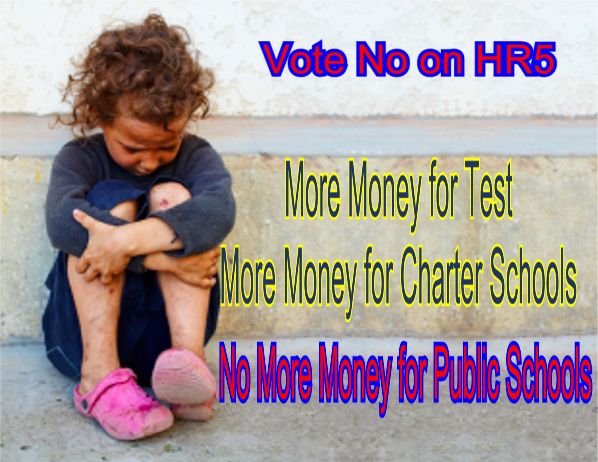
Congress should rewrite No Child Left Behind to help schools improve, not punish them on Friday - The Hechinger Report #NOonHR5

Congress should rewrite No Child Left Behind to help schools improve, not punish them on Friday - The Hechinger Report:


Congress should rewrite No Child Left Behind to help schools improve, not punish them on Friday


Embedded image permalink

 #NOonHR5

#STOPHR5 #NOonHR5 US Representatives on Twitter Find your Member Hit them with a Vote No on HR5 Tweet http://bit.ly/17s6O1b


 ter thirteen years, Congress appears poised to write a new law to replace the No Child Left Behind Act, the 2002 reauthorization of the Elementary and Secondary Education Act. The House is scheduled to vote on its version Friday, Feb 27. Meanwhile, the Senate Health, Education, Labor, and Pensions Committee has held three hearings on the law and its leaders are negotiating to develop a bipartisan bill.

This legislation has sparked heated debate over issues such as the federal role in education, testing, and funding. But there has been little discussion about a core premise of NCLB: that schools should be accountable for student performance. All sides generally agree on that. Congress could advance school improvement substantially, though, if members look at accountability systems and encourage states to adopt data dashboards in place of the relatively simple measures of school performance states currently use.

Simply put, a data dashboard provides an array of information about school performance and practices, rather than a single number like a test score, to show whether a school is succeeding. This information enables educators to focus resources and attention on particular problems and, equally importantly, to monitor and address all issues that affect their own performance. Just as a driver fills up his tank before the gas gauge reaches “E” to keep the car functioning at its highest capacity, a school using a data dashboard can monitor school climate, say, and performance, and make improvements to ensure all students learn.

Related: The biggest losers in the No Child Left Behind rewrite

Data dashboards can help alleviate some of the shortcomings in accountability systems that have been in place in the wake of NCLB and the systems that states have implemented under waivers to that law. First, accountability systems tend to focus on a narrow range of indicators, principally test scores, and thus ignore factors that should be addressed to ensure all students learn what they need to succeed. And even in states that use multiple indicators, most combine them into an index or letter grade that masks problems rather than reveals them. For example, schools with low graduation rates still can earn high letter grades if an accountability system assigns little weight to graduation rates when compiling a school report card. With data dashboards, intervention would still be implemented when students, including those who are traditionally underserved, consistently demonstrate low achievement or graduation rates. But dashboards provide a more comprehensive view of what is happening within schools and allows educators and Congress should rewrite No Child Left Behind to help schools improve, not punish them on Friday - The Hechinger Report:

Garcia condemns CPS legal attack on pregnant teachers - Jesus "Chuy" Garcia for Mayor of Chicago #Chuy2015

Garcia condemns CPS legal attack on pregnant teachers - Jesus "Chuy" Garcia for Mayor of Chicago:


Garcia condemns CPS legal attack on pregnant teachers

Wednesday, February 25, 2015 | Press 

Emanuel Administration’s defense of discrimination underscores need for accountability, ethics and an elected school board, says Garcia
FOR IMMEDIATE RELEASE
Chicago — Cook County Commissioner Jesus 'Chuy' Garcia blasted Mayor Emanuel’s school administration today for claiming that discrimination against pregnant teachers was “consistent with business necessity.”
“Discrimination may be business as usual for the Emanuel Administration, but it’s never a business 'necessity' -- and it’s always wrong,” said Garcia.
CPS has defended the discriminatory practices of Scammon Elementary School’s principal, who targeted pregnant teachers and teachers with newborns for discipline and dismissal with the tacit blessing of top CPS administrators, despite years of complaints and documentation of the discrimination.
“The CPS legal assault on these teachers speaks volumes about who the Emanuel Administration really cares about,” says Garcia. “Emanuel has gone to the wall to defend a wealthy venture capitalist whose companies profit from the schools she oversees -- while he’s defending discrimination against working mothers.”
The federal government filed a discrimination lawsuit against the Emanuel administration’s hand-picked school leadership team in December asserting that the CPS engaged in a pattern of discrimination and targeted pregnant teachers at the grade school.
“We need an elected school board that will root out unethical administrative practices -- rather than cover them up and defend their consequences,” said Garcia. “Emanuel’s school bureaucrats have chosen to attack victims of discrimination instead of ending that wrongdoing. An elected school board builds the ground for a school administration grounded in best practices, ethical governance, basic workers rights -- and accountability to neighborhood residents, rather than the special interests who’ve robbed kids and parents of quality neighborhood public schools,” says Garcia.
Contact: Monica Trevino press@chicagoforchuy.com


Women's rights

Well-being, success, and safety

Unable to repeal Common Core, foes try sabotage - Stephanie Simon - POLITICO

Unable to repeal Common Core, foes try sabotage - Stephanie Simon - POLITICO:


Unable to repeal Common Core, foes try sabotage

Conservative lawmakers in state after state are having difficulty rounding up votes to revoke the standards outright


 The red-meat speeches at this week’s Conservative Political Action Conference are likely to thunder with calls to repeal the Common Core. But out in the trenches, conservative lawmakers in state after state are running into difficulty rounding up votes to revoke the academic standards outright.

So, aided at times by unlikely allies in the teachers unions, Republican lawmakers are trying a new tactic: sabotaging, in incremental steps, the academic guidelines and the new Common Core exams rolling out this spring.
Story Continued Below
Bills to repeal the Common Core have been introduced in 19 states so far this year, down slightly from the 22 states that considered such a step last year, according to the National Conference of State Legislatures. So far, they’ve fared poorly.
Common Core opponents had high hopes for rooting out the standards from Mississippi and Arizona. But in both cases, the state senates rejected repeal bills. North Dakota lawmakers killed a repeal bill earlier this month; on Tuesday, their counterparts in South Dakota did the same.

Kansas state Rep. Ron Highland, a Republican, said he’s not even sure a repeal bill will come to the floor in his deep-red state this session, much as he would like it to: “I’m not sure we have the votes, quite frankly.”
Refusing to concede defeat, Highland said he’s considering drafting a bill to curb state funding for textbooks and tests aligned to the Common Core and for the computer equipment that schools need to administer those tests online.
And the Common Core tests developed by two federally funded consortia, Partnership for Assessment of Readiness for College and Careers and Smarter Balanced, have become a popular target in other states.
Wisconsin lawmakers are considering an effort to strip funding for the Smarter Balanced exam from the state budget and let districts pick their own assessments from a state-approved list. The New Jersey General Assembly this week overwhelmingly passed a bill to prevent the PARCC test from being used to evaluate students or teachers until 2019.
And in Colorado, where Democrats repeatedly have shot down attempts at outright repeal, Republican state Rep. Gordon Klingenschmitt is pushing a bill to withdraw the state from the federally funded PARCC testing consortium in what he sees as the first step toward reclaiming local control over education.

“I’m not trying to hit a home run,” Klingenschmitt said. “I’m trying to lay down a bunt single.”
Meanwhile, teachers unions in New Jersey, Rhode Island, Illinois, Washington and elsewhere are encouraging members to support parents who want to opt their children out of the Common Core tests. The New Jersey Education Association has even launched a six-week TV and online ad campaign featuring videos of parents expressing concern — to the point of breaking down in tears — about the PARCC exam.
Yet another creative approach to undermine the Common Core has emerged in


Read more: http://www.politico.com/story/2015/02/unable-to-repeal-common-core-foes-try-sabotage-115522.html#ixzz3SrTc6euz

5 Lessons Education Research Taught Us In 2014 : NPR Ed : NPR

5 Lessons Education Research Taught Us In 2014 : NPR Ed : NPR:


5 Lessons Education Research Taught Us In 2014

How To Measure Learning


 Studies, research papers, doctoral dissertations, conference presentations — each year academia churns out thousands of pieces of research on education. And for many of them, that's the end of it — they gather dust in the university library or languish in some forgotten corner of the Internet.

A few, though, find their way into the hands of teachers, principals and policymakers. Each year the American Educational Research Association — a 99-year-old national research society — puts out a list of its 10 most-read articles.
We've looked over that list and compiled a summary of some of what we learned from the ivory tower in 2014.
1) What's The Best Way To Teach Math To Struggling First Graders? The Old-Fashioned Way.
Math teachers will often try to get creative with their lesson plans if their students are struggling to grasp concepts. But in "Which Instructional Practices Most Help First-Grade Students With and Without Mathematics Difficulties?," the researchers found that plain, old-fashioned practice and drills — directed by the teacher — were far more effective than "creative" methods such as music, math toys and student-directed learning.
The researchers from the University of California, Irvine, and Penn State examined more than 13,000 first-grade math students in 1,300 different schools nationally.
They found that first graders who scored in the bottom 15 percent on math tests were more often subject to activities that have no evidence of fostering retention or improving performance. For example, teachers with lots of struggling students often sought to liven up their lessons by adding movement or music. But the researchers found little evidence that those methods worked.
Instead, they found that that the only activity associated with gains in performance on an adaptive, un-timed, one-one-one administered test is what we think of as traditional instruction. Namely, a teacher demonstrating how to solve a problem, followed by repeated opportunities for students to work by themselves, replicating the procedure with worksheets and drills.
These results run contrary to some interpretations of the Common Core, where students collaborate, talk through a problem, and dissect the different ways to reach a solution. The researchers found that while this kind of learning can work for some students, those already struggling in math failed to grasp concepts as easily as they did under more traditional lessons.
2) The Effectiveness Of Alignment
When a teacher's curriculum is perfectly aligned with a set of standards, meaning they're teaching exactly what they're told to, will students' test scores rise? That's the question a group of researchers set out to answer in "Instructional Alignment as a Measure of Teaching Quality."
Finding an answer to this is critical since better instructional alignment is a driving component of the Common Core.
Researchers at the University of Southern California and the University of Pennsylvania looked at 324 teachers in six large school districts (New York City; Dallas; Denver; Charlotte-Mecklenburg, N.C.; Memphis; and Hillsborough County, Fla.) in 2010.
Once the researchers created a measure for how closely aligned a teacher's curriculum was with standards, they examined the correlation of that alignment with teachers' ability to raise test scores (as measured by value-added models, which granted, have their own complications).
The results did not show a meaningful relationship between the two. Meaning, perfectly aligned curriculum is no more likely to be associated with gains in tests scores as is perfectly unaligned curriculum.
3 and 4) On The Higher-Ed Front
The big story in higher education in 2015 so far has been President Obama's proposal for two free years of community college. Two of the most-read education research articles of 2014 were focused on different aspects of community college.
In "Labor Market Returns to Sub-Baccalaureate Credentials", researchers from the Career Ladders Project and Columbia University spent seven years tracking more than 5 Lessons Education Research Taught Us In 2014 : NPR Ed : NPR:

Mayor Rahm Emanuel and Chuy Garcia face different personality challenges - #Chuy2015

Mayor Rahm Emanuel and Chuy Garcia face different personality challenges - Chicago Tribune:


Emanuel and Garcia face different personality challenges


 Mayor Rahm Emanuel has long nurtured a national reputation as a short-fused political savant, but with his re-election unexpectedly on the bubble, he finds himself trying to convince voters those defining personality traits are a positive.

Jesus "Chuy" Garcia, the Cook County commissioner hoping to unseat Emanuel in an April 7 runoff, faces the opposite problem. He is possessed of an earnest, nice-guy demeanor but now has to demonstrate to a wide pool of voters he has the vision and backbone to lead a city facing deep and difficult troubles.

And both rivals face a tight deadline to pull off those sales jobs.

In an era when political campaigns often drag on for months or years, the race for Chicago's next mayor has been compressed into a six-week sprint bound to test the savvy and resources of Emanuel and Garcia. They were the top vote-getters among five candidates in an initial round of balloting Tuesday that produced no outright winner.

As the campaign resets, the edge for Garcia lies in momentum. For Emanuel, it's money.

Emanuel underperformed in Tuesday's vote despite an enormous fundraising advantage that allowed him to dominate the airwaves with his message. That advantage is almost sure to continue into the runoff, affording Emanuel an effective mechanism to try to define the lesser-known Garcia in the minds of voters before Garcia can define himself.

At the same time, by simply surviving to fight another day, Garcia's up-to-now low-budget campaign is almost sure to gain energy, money and a fresh look from voters. "I've largely represented districts on the Southwest Side, so my name recognition isn't where a mayoral contender needs to have it," Garcia acknowledged Mayor Rahm Emanuel and Chuy Garcia face different personality challenges - Chicago Tribune: