Latest News and Comment from Education

Friday, January 30, 2015

Wisconsin Senate Bill 1: Less Flogging is still Flogging | BustED Pencils

Wisconsin Senate Bill 1: Less Flogging is still Flogging | BustED Pencils:
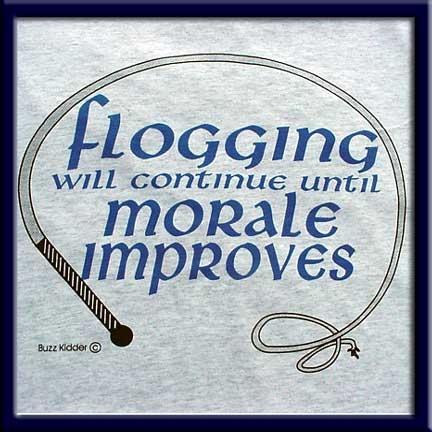


Wisconsin Senate Bill 1: Less Flogging is still Flogging

Share
flogging_1
As most of you know the Wisconsin House republicans had a hearing on their destroying public schools accountability bill (Assembly Bill #1) a few weeks ago.  Read here for a review of that disastrous day.  
It’s now been two days since I went to the capital in Madison to testify against Senate Bill #1.  In case you’re wondering, Senate Bill #1 is another silly school “accountability ” bill.  And yes I actually waited 7 1/2 hours this time because it was really important for the 6 people left in the room to hear such a blistering and historic oratory.
However, after some reflection I am really troubled by what I heard from people who were supposedly there as supporters of  public education.  Time and time again, public school administrators went to the microphone and literally thanked the Senate for putting forward a bill that was (And I’m paraphrasing), “not as bad as AB #1 and not punitive.”  In fact the School Administrator’s Alliance (SAA) “Representing the Interests of Wisconsin School Children”  called Senate Bill #1, “a significant improvement over Assembly Bill #1.”
Is it really an improvement when our public schools—the hearts of our communities—can still be privatized? And please explain how the continued use of high stakes standardized tests as an accountability tool is not punitive? Children are damaged cognitively and psychologically every time they are forced to take a high stakes standardized test.
Where’s the improvement?  There isn’t any and its extremely simple why?  Children are not struggling in schools because of a lack of accountability.  Children are struggling because accountability denies them the opportunities and essentials for success in school.  In fact, here is what I said on Tuesday,
I am here today as a citizen, a parent and a long time educator.  I start my testimony by asking the committee three questions.
  1. Does this bill provide blankets for homeless children?
  2. Does this bill provide supplemental health care and nutrition for sick and hungry Wisconsin Senate Bill 1: Less Flogging is still Flogging | BustED Pencils:

Report estimates as much as $27.7 million in Illinois charter school fraud

Charter School Vulnerabilities to Waste, Fraud, and Abuse | Center for Popular Democracy:


Report estimates as much as $27.7 million in Illinois charter school fraud
NEA President Lily Eskelsen García demands real oversight, transparency, accountability
in charter industry 


WASHINGTON—The Center for Popular Democracy (CPD) has uncovered massive oversight deficiencies and found at least $13.1 million in proven or suspected fraud in the charter school industry in Illinois. This is the latest from a series of state-specific follow-ups to its whistle-blowing May 2014 report, Charter School Vulnerabilities to Waste, Fraud, and Abuse. Today’s report, focusing on the Illinois charter school industry, alleges that this number may be as high as an estimated $27.7 million in possible fraud in 2014 alone and finds that Illinois has no system in place for monitoring charter school projects.
“Here is yet another state where lawmakers continue to dump massive amounts of public school funds into the charter industry, yet no one is held accountable at any stage of the funding pipeline,” said NEA President Lily Eskelsen García. “Operators continue to line their pockets unchecked while public schools are forced to slash programs due to lack of funding. Lawmakers need to stop treating education budgets like a slush fund for corporate charter school operators and hold them accountable to the students and communities they are supposed to be serving.”
The CPD report, Illinois’ Charter School Fraud Risk Problemidentifies three fundamental flaws with Illinois’ oversight of its charter schools:
  • Oversight depends heavily on whistleblowers and reporting by the charters themselves;
  • General auditing techniques commissioned by the charters are not specifically designed to uncover fraud, only inaccuracies and inefficiencies; and
  • Government agencies in Illinois tasked with investigating fraud are severely understaffed.
Despite instances of proven and suspected fraud and the inability to show real improvement in student achievement, Illinois charter schools have seen enrollment grow by 680 percent and funds continue to pour in. Chicago Public Schools’ budget for its charter schools is $616 million for fiscal year 2015, an increase of 15 percent compared to 2014.
“Illinois students, their families, and taxpayers cannot afford to keep losing millions of dollars in public funds at the hands of charter school operators, who essentially enforce their own rules. It’s time for the Illinois legislature, State Board of Education, and authorizers like Chicago Public Schools to step in and make sure these operators use the funds they are given to fulfill their own promises of a great education for their students,” said Eskelsen García. “There should be a sound structure for oversight and accountability whenever taxpayer dollars are applied.”
CPD recommends that the state of Illinois make major changes to its current oversight structure, including mandated audits designed to detect and prevent fraud; increased transparency and accountability; and a state-imposed moratorium on new charter schools until the state oversight system has adequately reformed.
“It’s time Illinois and all states are able to assure taxpayers that their charter oversight systems are airtight and dedicated to quality and community,” said Eskelsen García.
###
The National Education Association is the nation's largest professional employee organization, representing nearly 3 million elementary and secondary teachers, higher education faculty, education support professionals, school administrators, retired educators, and students preparing

Charter School Vulnerabilities to Waste, Fraud, and Abuse


Risking Public Money: Illinois Charter School Fraud


Diegnan Enters PARCC Exam Fray with Bill Formalizing Opt-Out Procedures - NJ Spotlight

Diegnan Enters PARCC Exam Fray with Bill Formalizing Opt-Out Procedures - NJ Spotlight:


DIEGNAN ENTERS PARCC EXAM FRAY WITH BILL FORMALIZING OPT-OUT PROCEDURES

Grassroots opposition to online testing continues to grow, while administration soldiers on with preparations for next month’s rollout


diegnan
State Assemblyman Patrick Diegnan Jr. (D-Middlesex)
As the debate rages in public over New Jersey’s new student testing, state legislators are entering the fray with several new bills that could limit the exams and how they are used.
State Assemblyman Patrick Diegnan Jr. (D-Middlesex), chairman of the Assembly’s education committee, yesterday introduced a bill to provide a process for students to sit out the upcoming PARCC exams, including a timeline for families to give a 14-day notice to their districts and a requirement that schools provide someplace supervised for opt-outs during testing.
In addition, Diegnan said he planned a second bill that would delay the use of the new tests as a measurement of school, staff, or students for as much as three years. The details are still being worked out, but he said that while the tests would still be administered, they would not yet have any consequences associated with them.
“I’m just wondering if we want to take a time-out, and reflect on where we are and where we should be,” Diegnan said yesterday. “The distrust that is out there I find to be really distressing.”
Meanwhile, another bill sponsored by state Assemblyman David Rible (R-Monmouth) passed unanimously in the Assembly that would put new safeguards on the use and disclosure of student data.
The long-term prospects of the bills are far from certain, and the Christie administration hasn’t much hedged so far in proceeding as planned with Partnership for the Assessment of Readiness for College and Careers (PARCC), starting next month, while districts continue to prepare for the exams.
But leaders of the New Jersey Education Association, the teachers union that has started a public campaign against the testing, continue to press for what they call a “testing bill of rights” out of the Legislature.
Yesterday, its chief lobbyist said she saw it would come in a package of bills, including Diegnan’s and Rible’s.
“It’s not going to be just one bill,” said Ginger Gold Schnitzer, the NJEA’s Diegnan Enters PARCC Exam Fray with Bill Formalizing Opt-Out Procedures - NJ Spotlight:

Four Seattle Teachers Declare: “We Refuse to Give the Tests” - Living in Dialogue

Four Seattle Teachers Declare: “We Refuse to Give the Tests” - Living in Dialogue:


Four Seattle Teachers Declare: “We Refuse to Give the Tests”


  By Anthony Cody and Susan DuFresne. 

Four Seattle area teachers who got to know one another in 2011, when they all attended the Save Our Schools march in Washington, DC, stood before the Renton Board of Education and read “statements of professional conscience” in which they pledged their refusal to administer standardized tests to their students. Their names are Julianna Kreuger Dauble, Judy Dotson, Susan DuFresne and Becca Ritchie.
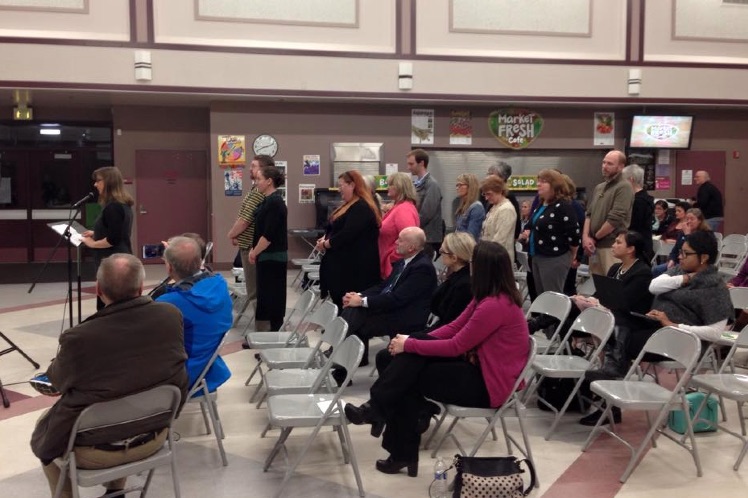
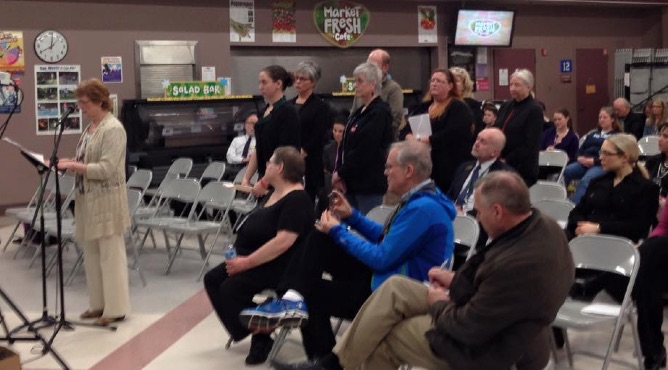
Renton, Washington, is just south of Seattle. The Renton School District has 15,000 students and a five member elected school board. The board met on the evening of Wednesday, Jan. 28, in the Sierra Heights Elementary School cafeteria. Teacher Susan DuFresne provided me with a firsthand description of the night’s events.
The process began with a simple group post on Facebook started by Becca Ritchie, saying that she wanted to write a letter and wanted feedback. That spark inspired all of us to organize around this issue.
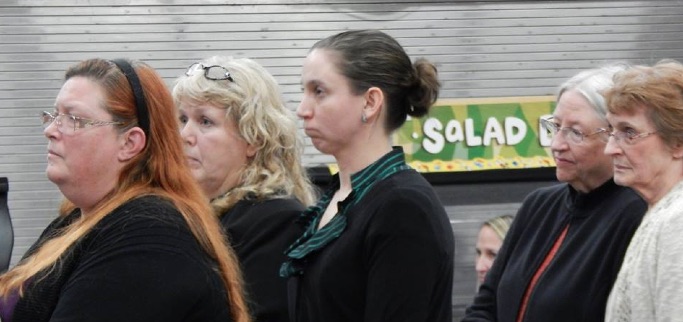
We arrived at Sierra Heights Elementary School early after three of us had been collaborating working on her speech is over the course of two weeks. Julianna teaches there, so we gathered in her classroom to practice. Jeb Binns, president of the Rainier UniServ Council, joined us to time us and offer feedback. Judy Dotson decided to join us just a few days before the board meeting so she worked on her speech for a very short time. We lined up other teachers at Julianna’s school to read from the list of objections that went beyond the boards’ three-minute allocation for each of us to speak. We also had other teachers who though they did not submit of letters a professional conscience, spoke passionately about toxic testing right after we spoke.
We entered the cafeteria at Sierra Heights elementary, which is Julianas school where the school board meeting was being held last night. We signed up as a group so that our names would be called in a stacked order after strategizing how we wanted to deliver our speeches.
The gym was packed full as there were teachers there being honored for receiving their national board certification, and students who were going to deliver speeches about studying Martin Luther King, which framed our entire message for us by serendipity. This also meant that there were parents in the crowd ready to hear their children, but who also ended up hearing our speeches.
As we were waiting for our place on the agenda when it was time allotted for the public to share comments to the board our friends from the Washington Badass Teachers Association began filing in in solidarity. Other teachers from Julianna’s 
Four Seattle Teachers Declare: “We Refuse to Give the Tests” - Living in Dialogue:

Susan DuFresne: My Statement of Professional Conscience


David Spring to Renton School Board: SBAC Test is Designed to Fail 70% of Our Students


Thursday, January 29, 2015

Mark Geragos wants to know: Who leaked Calderon affidavit? | Michelle Rhee and the Calderon Scandal

Mark Geragos wants to know: Who leaked Calderon affidavit? | The Sacramento Bee The Sacramento Bee:


Mark Geragos wants to know: Who leaked Calderon affidavit?

01/28/2015 3:52 PM 
 01/29/2015 7:49 AM

It’s been more than a year since a cable news network published an FBI affidavit accusing then-Sen. Ron Calderon of accepting bribes from an undercover agent. But Calderon’s lawyer said Wednesday that he’s still pursuing a case against the federal government to find out who leaked the sealed file.
Calderon, a Montebello Democrat, was indicted in February on two dozen criminal charges in a public corruption case that also involves his brother, former Assemblyman Tom Calderon. Many of the allegations against Ron Calderon were revealed months earlier, when Al Jazeera America published an FBI affidavit in the fall of 2013.
Calderon’s lawyer, Mark Geragos, said a judge’s threat this week to toss the case from the federal court in Sacramento won’t stop him from pursuing the source of the leak in federal court in Los Angeles, where the government’s case against the Calderon brothers is scheduled to go to trial in August. Here’s what Geragos had to say during a brief interview outside the Capitol Wednesday:


Read more here: http://www.sacbee.com/news/politics-government/capitol-alert/article8529158.html#storylink=cpy
http://www.sacbee.com/news/politics-government/capitol-alert/article8529158.html


Read more here: http://www.sacbee.com/news/politics-government/capitol-alert/article8529158.html#storylink=cpy

Draft of President Obama's Student-Data-Privacy Bill Raises Questions - Digital Education - Education Week

Draft of President Obama's Student-Data-Privacy Bill Raises Questions - Digital Education - Education Week:


Draft of President Obama's Student-Data-Privacy Bill Raises Questions

Barack-Obama-ConnectEd-ipads.jpgNew federal student-data-privacy legislation being crafted by the White House would prohibit education technology vendors from selling student information and directing targeted advertisements at students, but the legislation remains silent on other controversial industry practices, according to documents obtained by Education Week.
Since President Barack Obama announced earlier this month that he would seek a new federal "Student Digital Privacy Act," educators, advocates, and industry leaders have awaited crucial details that could reshape the responsibilities of both companies and schools when it comes to protecting students' privacy.
The White House has yet to release those details publicly.
But a draft of the proposed bill that has been circulated privately by Obama Administration officials offers key insights. It is unclear if the documents obtained by Education Week represent the most recent draft of the proposed legislation, or an early version that has since undergone revision. 
The White House did not immediately return a request for comment.
The apparently rechristened "Student Digital Privacy and Innovation Act" seemingly aims to create a uniform national playing field by pre-empting the patchwork of state laws currently in place—a key concern of industry groups.
The draft bill would also assign responsibility for enforcing violations of students' privacy under the act to the Federal Trade Commission.
And while the draft federal proposal is broadly similar to recently enacted state legislation in California, which the president hailed as a model during a speech earlier this month, it also contains key differences.
Some of those differences are likely to be looked upon favorably by privacy advocates, but two significant differences between the draft bill and the Student Online Personal Information Protection Act, or SOPIPA, signed into law by California Gov. Jerry Brown in September, are likely to be viewed as industry-friendly.
Unlike the California law, the draft version of the proposed federal bill obtained by Education Weekdoes not contain an explicit prohibition on vendors amassing profiles of K-12 students for non-educational uses.
Nor does the draft federal bill follow California's approach of prohibiting vendors from collecting Draft of President Obama's Student-Data-Privacy Bill Raises Questions - Digital Education - Education Week:

Senator Warren Clarifies The Money Matter In Revising NCLB

Senator Warren Clarifies The Money Matter In Revising NCLB:


Senator Warren Clarifies The Money Matter In Revising NCLB


 Where can Democrats find clarity in the current debate over how to rewrite No Child Left Behind legislation?

For sure, we appear to be in the midst of is an education policy turmoil where instead of right and left “meeting in the middle,” what we see instead are forces on the right and left coming together to oppose what a bipartisan coalition helped create.
Take, for instance, state adoptions of the new Common Core Standards: For years, support for the new national standards was presented as a unifying front, with the Obama administration and numerous Democratic governors joining with prominent Republicans leaders from across the country.
But opposition to the new standards from the right wing of the political spectrum is now famous. Republican lawmakers across the nation – from Louisiana to Indiana, North Carolina to Wisconsin – have led prominent advocacy and legislative campaigns either to overturn adoption of the standards, to revise the standards so they no longer reflect national guidelines, or to reject the standardized tests that were meant to accompany the Common Core
What’s less known but equally influential, is Common Core opposition coming from Democrats too. Last year, U.S. News and World Reportreported, “The push against Common Core is coming from both sides of the political aisle.” The reporter noted, “Liberals fear the curriculum, and the standardized evaluations, will amplify the high-pressure, high-stakes atmosphere that No Child Left Behind, President George W. Bush’s education initiative, helped create.”
More recently, The Seattle Times reported a key governing body of the Washington State Democratic Party “voted to condemn” the Common Core and criticized the federal government for pressuring states “into adopting the Common Core by making the standards a requirement for states or districts that wanted to win one of the big grants that the department gave out under its Race to the Top initiative.”
So it’s confusing out there in education policy land. But whenever things get confusing in a political debate, it’s important to remember the one thing that always seems to be at the heart of the dispute: money.
Now wading into the turbulent waters comes a debate on how to revise No Child Left Behind. The 2001 legislation was last a matter of serious scrutiny seven years ago, and no parties involved could come to complete agreement on what to do.
While the debate over NCLB revision entails lots of issues – including standardized testing, school services for a broad range of students, and supports for principals and teachers – make no mistake, that a big part of the debate is about the money.
The federal government spends nearly $79 billion annually on primary and secondary education programs, and state governments eagerly want to get their hands on that money.
What’s a Democrat to think?
It’s The Support, Stupid
The great NCLB debate kicked off most prominently in the Senate where Senator Warren Clarifies The Money Matter In Revising NCLB:

Teacher: I see the difference in educational privilege every day. I live it. I am disgusted by it. - The Washington Post

Teacher: I see the difference in educational privilege every day. I live it. I am disgusted by it. - The Washington Post:


Teacher: I see the difference in educational privilege every day. I live it. I am disgusted by it.


Here is a post by a Colorado teacher who vividly explains the difference in the lives of fortunate students and the less fortunate students whom she teaches. Her last post on this blog was a nuanced look into the psyche of some students of color who live in poverty, which you can read here. This public school teacher often blogs anonymously under the name Shakespeare’s Sister at Daily Kos. She teaches 11th grade AP Language and Composition in the Denver area.

Here is Shakespeare’s Sister newest post for this blog:

Recently, events in Ferguson and New York have reminded us there are still two very different Americas. What I wish more people were talking about is that there are two American educations: One for the affluent, and one for students living in poverty.
Many of the reports focus on numbers for free and reduced lunches, which is, some say, a “rough proxy for poverty,” but those labeling it in such a way have probably never set foot in a classroom.
Almost every day, I slip food to one of my students. Both of his parents are in prison. Or, one of his parents is in prison and the other is dead. We can’t quite get the full story from him. He lives with his older sister, whom he refers to as his mother because he doesn’t want to explain anything. Or he doesn’t live with her. He won’t say where he’s staying. We’ve attempted home visits but can never get anyone to answer the door.
A senior from a nearby high school spoke at the Colorado Association for Gifted and Talented’s annual conference in Denver this past October. Poised and polished and wearing a suit, he told the assembled teachers and administrators about how he had recently received a $25,000 grant from a company to allow him to continue to develop a thumbprint-activated gun prototype. He takes a special class in a public school—a scientific discovery class—in which he is allowed time to process through his scientifically Teacher: I see the difference in educational privilege every day. I live it. I am disgusted by it. - The Washington Post:

The High-Stakes Testing/Common Core Connection to New Teacher Ed. Regulations

The High-Stakes Testing/Common Core Connection to New Teacher Ed. Regulations:


common-core-teacher-ap-640x480

The High-Stakes Testing/Common Core Connection to New Teacher Ed. Regulations


High-stakes testing, Common Core and teacher education are all interconnected. Controlling for all three is a privatization package deal.
For years, there has been a push to deprofessionalize teaching and that includes going to the heart of what makes a good teacher—teacher education. By doing so, the school reformers change the way teachers work.
Not only are teachers more likely to be temporary, like Teach for America (TFA), they will be followers instead of leaders. They won’t be innovative and focus on the individual/personal needs of the student.
They will be fast-track workers who administer nonstop assessment and implement Common Core aligned curriculum to reach Common Core State Standards.
Data will mean everything to the new breed of teacher. If you examine the focus of every fast-track program, you will find it centers on high-stakes testing and data collection.
The new teacher won’t study and learn about child and adolescent development and base their decisions on real research. They will follow the script.
As many of you might have heard, new federal regulations have been drafted concerning teacher education and they are a serious concern. The kinds of changes, if they are approved, will create a teaching workforce focused on what I noted above.
The National Education Policy Center (NEPC), well-respected scholars, presented a review showing that the new federal teacher regulations to be approved on February 4, 2015 will do harm to teacher education. Kevin K. Kumashiro who is the dean of the School of Education at the University of San Francisco and who has written award-winning books about education, examined the draft of the new regulations and broke down what they mean to the teaching profession. His “vital policy concerns” are The High-Stakes Testing/Common Core Connection to New Teacher Ed. Regulations:

Pearson criticized for finding test essay scorers on Craigslist - The Washington Post

Pearson criticized for finding test essay scorers on Craigslist - The Washington Post:


Pearson criticized for finding test essay scorers on Craigslist


An effort by Pearson, the giant education company, to recruit people to score essays on state standardized tests through ads on Craigslist has sparked controversy in Texas.
Here’s what’s going on in Texas, where there has been a growing revolt among parents, school boards and educators against obsessive standardized testing:
Pearson ran an ad on Craigslist last Nov. 29 looking for people to be be hired and then trained to score the written portion of the Texas Assessment of Knowledge and Skills. Pearson has a contract with the state to write, administer and score the tests.
According to a press release released by leaders of a coalition of people in Texas seeking to reform standardized testing in the state, the ad says college graduates would be paid  $12 an hour for doing the job. According to the Craigslist ad, “Bachelor degree required – any field welcome.”
Three leaders of the coalition — Tom Pauken, a commissioner of the Texas Workforce Commission; Thomas Ratliff, a member of the State Board of Education; and Dineen Majcher, a founder of the grassroots group Texans Advocating for Meaningful Student Assessment — issued a release that said:
Prior to seeing this ad, we have heard concerns from across the state about the state’s standardized testing system, the rigidity of the state’s accountability system, and the quality of the people grading the written portion of the state’s test and the consistency of the results. Now we have a better idea why.
To be fair, Pearson and the Texas Education Agency have developed “rubrics” to help train these people to grade our student’s tests. These rubrics can be found athttp://www.tea.state.tx.us/student.assessment/staar/writing/. So, in addition to the concern that teachers are “teaching to the test,” now our test graders are being “taught how to grade the test”.
This highlights what we think is another weak link in the accountability chain. This type of training results in grading based on static formulas by people who aren’t truly qualified to grade the quality of a student’s writing skills. This results in teachers teaching students to “write for the test”, not write well. We can do better.
The three want the Texas Legislature and the Texas Education Agency to find a way to make sure that English teachers grade the written portions of the standardized tests. They wrote:
We view this as a win/win/win for Texas Public Education. The parents and taxpayers win because they have more confidence in the grading process. TEA and Pearson win because they get a higher quality grader that provides better data to evaluate our student’s performance. The teachers win because they have more confidence in the grading system and they have a potential to earn a little extra money.
 Discussions are now under way in Texas about how the Legislature in the upcoming session will change the standardized testing system, and sources say that one idea being considered is stipulating who can grade the exams.
Pearson responded to the release with a statement (you can read the whole thing here) called “Just Pearson criticized for finding test essay scorers on Craigslist - The Washington Post:

Bill Would Allow Texas Teachers To Kill Students | ThinkProgress

Bill Would Allow Texas Teachers To Kill Students | ThinkProgress:


Bill Would Allow Texas Teachers To Kill Students

 POSTED ON  
shutterstock_192514664
CREDIT: SHUTTERSTOCK
People who are concerned about the use of excessive force by law enforcement may have to deal with another fatal can of worms. If Texas state Rep. Dan Flynn (R) gets his way, teachers will have the right to use deadly force against students in Texas classrooms, in the near future.
The Lone Star State already permits teachers to have firearms in the classroom, but H.B. 868, also known as the Teacher’s Protection Act, would authorize instructors to use “force or deadly force on school property, on a school bus, or at a school-sponsored event in defense of the educator’s person or in defense of students of the school that employs the educator.” Instructors would also have the right to use deadly force “in defense of property of the school that employs the educator.” Moreover, civil immunity would be granted to those who use deadly force, meaning they would not be liable for the injury or death of student.
Such a bill could have disastrous consequences for students of color. A coalition of civil rights organizations found that black and Latino students face much higher rates of disciplinary action in schools, which exacerbates the so-called school-to-prison pipeline. By extension, if students of color are already disproportionately targeted by school authorities for their behavior, they could also become the targets of deadly force used by educators.
Flynn is one of the Lone Star state’s staunchest gun-rights advocates. He previously co-authored legislation to allow firearms on college campuses. In 2013, he successfully co-authored a law that reduced the minimum number of training hours needed for a 

The School to Prison Pipeline • BRAVE NEW FILMS: JUSTICE #2


The School to Prison Pipeline • BRAVE NEW FILMS: JUSTICE #2

We do not think our nation can thrive when it is locking up more people, at higher rates than any other country in the world. Harsh sentences for even modest offenses are breaking up families and taking away people’s basic rights. And this disproportionately affects poor people and communities of color, fortifying institutionalized racism and classism. Meanwhile, solutions such as rehabilitation, violence reduction, and increasing job opportunities have proved to be more cost-effective for taxpayers than continuing to imprison people in mass numbers, and yet those programs are not expanding at nearly the rate of prisons.

Brave New Films works with local and national justice organizations to reform the laws and industries that are denying American citizens their basic rights and opportunity to thrive in the supposed “land of the free.”