Latest News and Comment from Education

Monday, September 15, 2014

9-16-14 Hemlock on the Rocks

Hemlock on the Rocks:


'Email delete' policy is misunderstood according to LAUSD
http://laschoolreport.com/email-delete-policy-misunderstood-according-to-lausd/ED NOTES: ZIMMER AND LYDIA Ramos have little credibility. I know few people who are more corrupt and soulless than Lydia Ramos. He comportment is despicable and self-serving. She steals, she lies and she cheats . It is easy to verify all this by way of audits at her former positions and a background check, but she is no


Common Core: It Seemed Like a Good Idea Until It Existed
deutsch29 posted: "In 2008, Education Next asked 3,200 respondents (700 of whom were public school teachers) about their thoughts on having "the same set of educational standards" in order to "hold schools accountable." Respondents were divided into sub-samples and asked on" Respond to this post by replying above this line New post on deut
WATCH: Teacher Blames Teach For America For Layoffs, TFA Responds
http://huff.lv/1mukFa4 Teacher Blames Teach For America For Layoffs, TFA Responds Some public school teachers are speaking out against Teach For America, alleging that the organization's training is insufficient and that it threatens existing jobs. Katie Osgood, a teacher in Chicago, and Justin Fong, Teach For America's VP of Internal Communication, join to discuss.www.hemlockontherocks.com
rene diedrich's invitation is awaiting your response
                rene diedrich would like to connect on LinkedIn. How would you like to respond?       rene diedrich   writer/poet at Freelance     Confirm you know rene    
LAUSD's students need better libraries, not iPads - LA Times
http://www.latimes.com/opinion/op-ed/la-oe-constantino-lausd-ipads-or-libraries-20140915-story.html Op-Ed By Rebecca Constantino Like Supt. John Deasy and others in the Los Angeles Unified School District, I am concerned about the educational civil rights of the district's students. While the iPad-for-every-student controversy has gotten much media coverage lately, a long-term prob

YESTERDAY

Weingarten Hearts Cuomo (By Proxy); Willing to Undercut Teachout via Last-minute Robocall – @ THE CHALK FACE
ed notes: RANDi  Wiengarten, WTF? Is there no low she will not stoop to? On September 9, 2014, New York State democrats voted in a primary election that turned out to be an embarrassment for incumbent Andrew Cuomo. His most viable opponent was a relatively unknown Fordham University professor with no political machine behind her, Zephyr Teachout. Teachout lost, but not without taking a notable bit


9-14-14 Hemlock on the Rocks
Hemlock on the Rocks: Common Core: What’s true, false and fuzzy - The Washington Posthttp://www.washingtonpost.com/blogs/answer-sheet/wp/2014/09/11/common-core-whats-true-false-and-fuzzy/ Common Core: What's true, false and fuzzy Thomas Scarice, the superintendent of Madison Public Schools in Connecticut, has been a vocal critic of high-stakes test-based school reform. This year  he sent a letter


9-15-14 Curmudgucation - Granddad Learns About The Common Core

CURMUDGUCATION:


Efficiency vs. Excellence
We've all been discussing efficiency lately, thanks largely to the release of the GEMS report on educational efficiency, and while there's one critical point that has appeared tangentially in much of the discussion (including the original GEMS paper), I think it's worth pulling it out and looking at it by itself.Efficiency and excellence are not the same thing.In fact, excellence and efficiency ge

Granddad Learns About The Common Core
As your grandad would not say, "OMG!"The media group 617 has produced a video in support of the Core that is apparently intended to embarrass its opponents into silence. It has decidedly not worked out that way-- you will have a hard time finding the video, which seems to have suffered its own attack of embarrassment, but you can read about the reaction over at Missouri Education Watchdo

9-14-14 Curmudgucation - The Antidote to Money
CURMUDGUCATION: The Antidote to MoneyMoney has poisoned many of the conversations in this country, shaping the debates about everything from wars in foreign lands to the future of American public education. Money has an unprecedented power to control the public discussion simply by taking control of the major media (which are, after all, contained within just six corporations).Ironically, today th


9-15-14 Perdido Street School

Perdido Street School:


NYSED Employee Indicted For Stealing $2.5 Million
Been saying for a while now that the NYSED is rife for investigation:"Attorney General Eric T. Schneiderman today announced the indictment of Keisha Relf Davis, an employee of the New York State Department of Education, and an accomplice for stealing over $2.5 million from the state by diverting funds to NYC-area driving schools for services that were never rendered. As alleged, Davis receive

Cuomo Will Be Happy To Screw De Blasio Over Despite The Help The Mayor Gave To Cuomo's Re-Election Campaign
After getting rolled by Governor Cuomo last spring over charter school co-locations and a tax increase on the wealthy to pay for universal pre-K, New York City Mayor Bill de Blasio made the decision to help Cuomo this election season with his re-election campaign in order to curry more favor with King Andrew.First de Blasio helped engineer Cuomo's endorsement by the Working Families Party, then he

Cuomo Tries To "Reset" Relations With Black Community
This story comes on the heels of the story that Cuomo targeted black and Hispanic state troopers in his continent for removal, so I'm not sure how well the "reset" is going to go:ALBANY—Governor Andrew Cuomo held a meeting with African-American elected officials from Brooklyn on Friday afternoon, to help mend a strained relationship during his first term. The meeting, held in Cuomo's Man

Cuomo Had Black, Hispanic Troopers Removed From His Security Contingent
Another week, another Cuomo scandal:A month before Andrew Cuomo was elected governor in 2010, his top aides met privately with two State Police officials and proposed systematically replacing members of the governor's protective unit, including more than a dozen black troopers who suspected they were removed to "adjust the racial balance" of the elite unit.Two confidential State Police r
Quid Pro Cuomo Rakes In Hollywood Cash In Return For Tax Breaks For Movie, TV Companies
Albany remains a cesspool of corruption and Governor Andrew M. Cuomo sits right in the middle of it:New York Governor Andrew Cuomo, who added $2.1 billion to an incentive program for the movie and television industry, has collected almost $900,000 in campaign contributions from Hollywood since taking office in 2011. Cuomo, who lured NBC’s “The Tonight Show” back to New York City from Los Angeles,
9-14-14 Perdido Street School
Perdido Street School: New York State Teacher Evaluations Are Rigged,Swapna Venugopal Ramaswamy has a piece at LohHud on the absurdity of the New York State APPR teacher evaluation system, showing how the classroom observation component can be rigged by district leaders.For instance, Scarsdale has decided that no teacher will be rated "highly effective" in the classroom observation compo


Common Core Validation Committee Non-Signer Dylan Wiliam Shares a Couple Thoughts :: Frederick M. Hess

Common Core Validation Committee Non-Signer Dylan Wiliam Shares a Couple Thoughts :: Frederick M. Hess:


"The Teacher Wars" Hits the Bestseller List, Plus More

"The Teacher Wars" Hits the Bestseller List, Plus More:


“The Teacher Wars” Hits the Bestseller List, Plus More


I am astounded and thrilled to report that The Teacher Wars has debuted at #8 on the New York Times bestseller list for nonfiction. Here are some new ways to learn about the book:
A lovely and perceptive short review from The New Yorker, calling the book “engaging…thorough and fair minded”
Nick Romeo of the San Francisco Chronicle writes that the book is “careful…nuanced”
Doug Henwood interviews me on his fascinating radio show, Left Business Observer
The National Memo published a short excerpt from Chapter 6 about LBJ, teaching, and poverty
An hourlong call-in segment about the book from San Francisco NPR affiliate KALW, with host Rose Aguilar
In a podcast, New America Foundation President Anne-Marie Slaughter and I discusscultural attitudes toward teaching and gender
I’ll be posting a series of new public events across the country in the coming days and weeks, so stay tuned!

Russ on Reading: The False Promise of School Choice

Russ on Reading: The False Promise of School Choice:


The False Promise of School Choice

Governor Chris Christie was in Camden, New Jersey this week to praise the opening of some new charter schools that he is championing. A great believer in school choice, Christie said that parents should have “more choice, not less.”

I would like to take the Governor at his word on this. If I were a Camden parent and I had real “choice”, I would choose to send my child to a wealthy private school like the one Joe Kennedy, Sr. sent two of his sons to, Choate Rosemary Hall. I think all of us might do the same.

Choate, of course, is one of the go to private schools for the privileged in America. Located in Wallingford, Connecticut, its leafy sprawling 458 acre campus, is home to “one of the leading schools in America.” Its alumni roll reads like a Who’s Who of American politics, industry, arts and letters, and sports. Graduates include a John F. Kennedy, Edward Albee, John Dos Passos, Glenn Close, Michael Douglas, nuclear physicist Katherine Way, Senator Bob Kasten and literally hundreds more prominent folks. They also have one of the top ice hockey programs for boys and girls in all of New England.

Not surprisingly, students at Choate appear to graduate “college and career ready.” Many of them furthering their education at places like Harvard and Yale.

OK, Ok, I know we can’t send all of our Camden students to Choate. After all it costs about 52,000 dollars a year to educate a boarding student there. So, if we can’t send all of our Camden kids to Choate, maybe we can provide them with Choate-like curriculum right in South Jersey.

What does the Choate curriculum look like? Here are a few highlights.

·          There are more than 300 courses in the curriculum
·         Coursework includes community service and global studies
·         A two-year intensive Science Research Program includes mentored laboratory work during the summer at universities in the United States and abroad. 
·         The Capstone Program allows sixth form (senior) students to explore an area of the curriculum in depth. Working under a Russ on Reading: The False Promise of School Choice:

There’s Something Happening Here | janresseger

There’s Something Happening Here | janresseger:


There’s Something Happening Here

Last spring in a profound commentary the editors of Rethinking Schools magazine argued that school accountability based on high-stakes standardized tests merely disguises class and race privilege as merit.  While individual children of all economic and racial groups are likely to score all over the spectrum on standardized tests, in the aggregate scores are likely to be higher among privileged children.   And if schools in our racially and economically segregated society are judged by the students’ test scores, the schools serving wealthier children will appear to be doing a better job just because the children who attend the schools bring their privilege with them to school.
Ohio, like other states, ignores this reality by attaching its rating system for schools and school districts to the standardized test scores of the students. The state credits standardized test scores to the quality of the school district’s teachers and the curriculum and ignores other variables that might be affecting the test scores.
Ohio is currently in transition between a school district rating system that awarded ratings of  “Excellent, Effective, Continuous Improvement, Academic Watch and Academic Emergency” to our new system which will feature school district grades of “A, B, C, D, and F.” Next year districts will receive overall letter grades; late last week the Ohio Department of Education released complicated report cards for school district performance during the 2013-2014 academic year, report cards that award a miasma of letter grades and raw scores.  Most all the grades, however, are for scores on various standardized tests, with the graduation rate and attendance added in, along with a formula-based grade for “value added.”
In the concluding chapter of Public Education Under Siege, Mike Rose and Michael Katz address the trend across the states (including Ohio) to rate school districts on test scores alone: “Perhaps the greatest strength of the current reform movement is its focus on inequality… (but) Because reformers want to keep focus with ‘no excuses’ on the unacceptable performance of poor children, they insist on addressing outcomes (in the form of test scores) rather than on inequality of resources and social conditions.  This is an understandable There’s Something Happening Here | janresseger:

Mike Klonsky's SmallTalk Blog: WEEKEND QUOTABLES

Mike Klonsky's SmallTalk Blog: WEEKEND QUOTABLES:


WEEKEND QUOTABLES

Bethlehem, Pa. NAACP President Esther Lee 
"We could end up with segregation in another form," [Esther Lee] said of charter schools. "It's not 1909, but it's close." -- Express Times
Chicago principal, Troy LaRaviere
The [custodial] cuts mean “residents of Chicago lose out, and the corporations profit from our losses." -- Chicago Public Schools to lay off 476 custodians
Karen Lewis meets Ras Baraka.
Karen Lewis
Lewis, a former chemistry teacher, pointed to Newark as a learning lab for the right formula for political victory. "Money doesn't vote, people do. I believe a lot of hedge fund folks dumped money into [Newark mayoral candidate] Shavar Jeffries' campaign. Baraka was outspent, but he won," Lewis said. "The key is how do you connect with people and the others that are important to them. That's what elections are about, ultimately." -- Chicago teachers union leader and mayoral hopeful comes to Newark to learn from Mayor Mike Klonsky's SmallTalk Blog: WEEKEND QUOTABLES:

Common Core math standards add up to a big money for education companies | The Hechinger Report

Common Core math standards add up to a big money for education companies | The Hechinger Report:


Common Core math standards add up to a big money for education companies

Teachers have to be savvy shoppers as glut of new products enters the marketplace

By
The politically controversial standards curriculum standards known as the Common Core have been in the headlines for months, in Louisiana and across the country. But for most teachers and educators the standards have been quietly transforming classroom instruction for years. And for textbook publishers and other vendors, the new standards add up to new business. Sarah Carr reports on the dizzying array of new education products that claim to be Common Core aligned.
When thousands of math teachers descended on New Orleans earlier this year, two words proved more seductive than chocolate. Or sex. Or even quadratic equations.
Common Core.
The teachers were in town to attend the National Council of Teachers of Mathematics annual conference. The exhibit hall featured endless booths stocked with Common Core textbooks, Common Core legos, Common Core geometry sets, Common Core MOOCs (which stands for massive open online courses). There were even flying robots that vendors said could help children learn the Common Core.
“We sometimes laugh and say that Staples is going to make a lot of money on a rubber stamp that says ‘100 percent Common Core-aligned,’” said Linda Gojak, the council’s former president.
Greta Anderson, a 5th grade math teacher at New Orleans' Dibert elementary school, has helped her peers adjust to the new Common Core curricular standards. (Photo: FirstLine schools)
Greta Anderson, a 5th grade math teacher at New Orleans’ Dibert elementary school, has helped her peers adjust to the new Common Core curricular standards. (Photo: FirstLine schools)
Gojak chuckles when I ask her if vendors feel pressured to put the Common Core stamp on their products.
“If they want to sell it,” she says.
A few companies are using the Common Core craze as a reason to sell more stuff and make more money. Stacy Monsman, a math coach in an Ohio school district, noticed a glut of products almost immediately.
“When Common Core comes out, literally within a few weeks you saw materials with that sticker on it and there’s no way, the Common Core just came out,” she said. “There’s no way that a good thorough job could have been done to truly incorporate everything into some kind of material.”
But Gojak and others say most vendors really want to align their products with the Common Core — whether they are textbook publishers who are rewriting lesson plans, or the creators of MOOCs aimed at explaining the standards to teachers. But all this change takes time.
So in the short term, at least, teachers need to be cautious consumers, said Greta Anderson, the chair of the math department at New Orleans’ Dibert elementary school.
“Everything is saying right now that they are ‘Common Core-aligned’ and some things are really top notch and others aren’t,” Anderson said. “It takes deeply knowing the standards. It takes looking at Common Core math standards add up to a big money for education companies | The Hechinger Report:

What U.S. schools can learn from Poland
Source: Encyclopaedia Britannica, Inc. (kids.eb.com) By any measure, Poland has made remarkable education progress since the fall of the Berlin Wall. On the most recent 2012 international tests of 15-year-olds, known as PISA tests, Poland ranked 9th in reading and 14th in math among all 65 countries and sub-regions that took the test. It used to be on par with the United States, a mediocre perform

Colorado: Innovation Schools Do Not Mean Less Testing - UNITED OPT OUT: The Movement to End Corporate Education Reform

Colorado: Innovation Schools Do Not Mean Less Testing - UNITED OPT OUT: The Movement to End Corporate Education Reform:


Colorado: Innovation Schools Do Not Mean Less Testing


UOO Banner


Truancy 2014 - Executive Summary | State of California - Department of Justice - Kamala D. Harris Attorney General

Truancy 2014 - Executive Summary | State of California - Department of Justice - Kamala D. Harris Attorney General:


In School + On Track 2014 - Kamala D. Harris California Attorney General


Executive Summary: Every Kid Counts


California’s elementary school truancy crisis is a persistent problem that limits the potential of California’s children and costs school districts and the state billions of dollars each year. High rates of absenteeism interfere with students’ right to an education under the California Constitution. They drive crime and incarceration, and hurt our economy. And most importantly—they put California’s most vulnerable students at a lifelong learning disadvantage.
If every kid in California counts, then we must count every kid. While we can—and should—invest in programs to improve our schools, these benefits will never reach students who do not even make it to class. California must make it a priority to improve elementary school attendance in order to fulfill the promise of the state’s new Local Control Funding Formula (LCFF), to improve educational outcomes for all students, and to help our children compete in California’s global economy.


In School + On Track 2013

Attorney General Kamala D. Harris’s first statewide report on elementary school truancy and chronic absence, In School + On Track 2013, revealed that elementary school students who miss school are more likely to struggle academically1 and eventually to drop out of school altogether.2 Dropouts cost the state more than $46 billion dollars each year,3 including more than $1 billion in juvenile crime costs alone.4 Above all, districts and counties may not realize the true scope of their attendance problems because chronic absence is masked by an insufficient statewide infrastructure for tracking attendance in California.5


In School + On Track 2014

In School + On Track 2013 highlighted the unacceptable rates of elementary school truancy using attendance records from the 2011-2012 school year. This year’s report indicates that those rates were not isolated or unique—truancy rates are persistent in California. In the 2012-2013 school year, the school year immediately preceding last year’s report, 1 in 5 elementary school students were truant, or 744,085 students. This marks an increase of 1.2% from 2011-2012.6 Because California takes an entire year to release its official truancy figures, official truancy rates are only available for years that predate the 2013 report.
This year, due to a partnership with Aeries Student Information System, we have access to new estimated rates of absenteeism for disadvantaged student populations from the 2013-2014 school year.7 The findings from this research are alarming.
According to estimates based on a sample of California school districts, over 250,000 elementary school students were chronically absent in 2013-2014—defined as missing 10% or more of the school year, adding up to roughly 18 or more school days.8 Even more troubling, over 50,000 elementary students were chronically truant, and over 40,000 missed at least 36 days of school in one year.9 Absences are also highest in the earliest years of school most critical for developing foundational skills like reading. As was true in In School + On Track 2013, we can only estimate these more severe indicators of attendance problems because California does not collect information on students’ total absences, chronic absenteeism, or chronic truancy.


Income & Racial Disparities

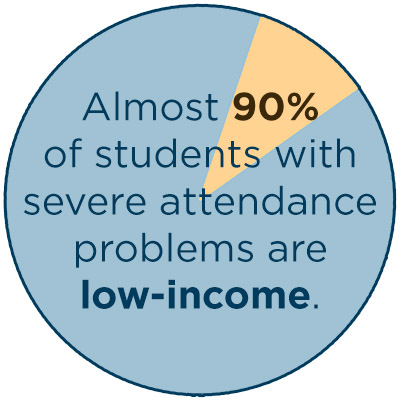
Almost 90% of students with severe attendance problems are low-icome
Almost 90% of the elementary students with the most severe attendance problems—those who miss 36 days or more of school per year—are estimated to be low-income. And 1 in 10 low-income students missed 10% or more of the 2013-2014 school year. These students have rightfully been targeted for increased resources under LCFF, and improving their attendance is an important step to advancing their educational opportunity.
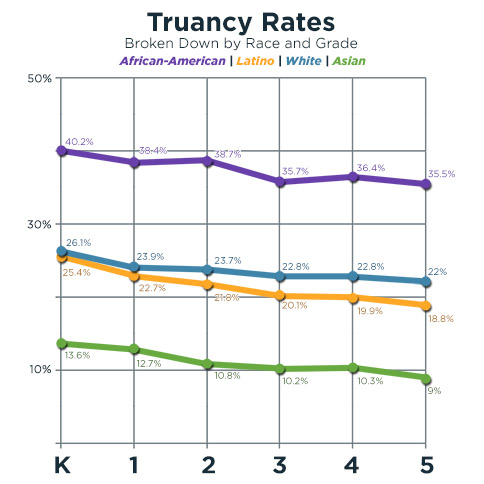
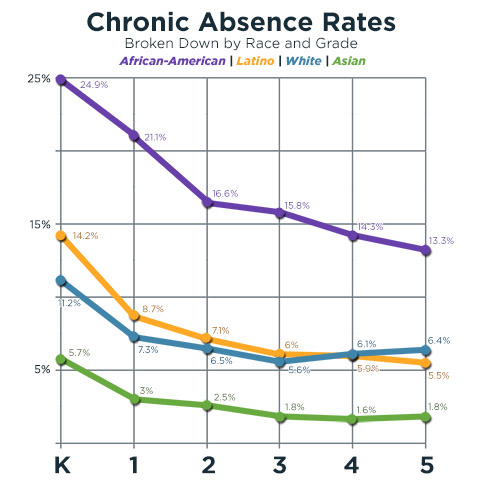
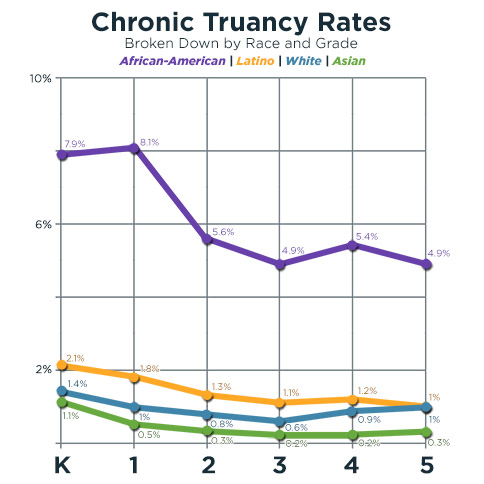
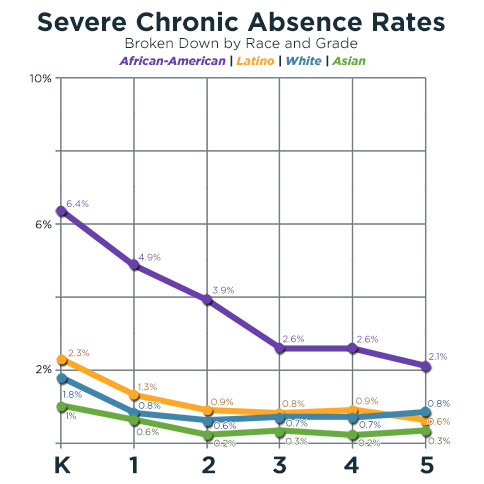
Racial disparities in attendance are particularly troubling. Thirty-seven percent of African American elementary students sampled were truant, the highest of any subgroup (including homeless students) and 15 percentage points higher than the rate for all students. Taken statewide, almost 73,000 African American elementary students are estimated to have been truant in the 2013-2014 school year. Nearly 1 in every 5 African American elementary school students—over 33,000 in total—missed 10% or more of the school year, a rate over two and a half times that of white students in 2013-2014. Most troublingly, African American elementary school students are chronically truant at nearly four times the rate of all students, and are more than three times as likely to miss 36 days of school or more per year. Moreover, absences are highest during the most important years when children learn to read, an important benchmark for long-term academic success and predictor of dropout rates.
Because the state is not collecting this critical information, the attendance crisis among African American children has largely remained hidden. Therefore, we cannot conclusively explain the stark contrast between African American elementary students’ rates of absence and that of nearly every other subgroup. We do know, however, that African American children experience many of the most common barriers to attendance—including health issues, poverty, transportation problems, homelessness, and trauma—in greater concentration than most other populations. We discuss these barriers in more detail in Chapter II.
This attendance disparity must be a wake-up call for local and state policymakers. We need not, and should not, accept these figures as inevitable. This is a solvable problem. If local agencies have the information necessary to illuminate these patterns, they can direct resources to the students and families that need the most. In Chapter II, we highlight innovative models for engaging and empowering communities of color and other disadvantaged populations to resolve barriers to attendance.
Truancy Rate

3+ unexcused absences/tardies
Truancy Rates line graph
Chronic Absence Rate

18+ missed days for any reason
Chronic Absence Rates line graph
Chronic Truancy Rates line graph

Chronic Truancy Rate

18+ unexcused absences
Severe Chronic Absence Rates line graph

Severe Chronic Absence Rate

36+ missed days for any reason
Other at-risk students also display troubling patterns of absenteeism. In grades K-6, 30% of homeless students in the sample were truant in 2013-2014, and approximately 15% missed 18 or more days of school. Finally, truancy and chronic absence rates for American Indian and Alaska Native students are similar to those for African American students, but the smaller sample size for this population has led to less consistency in the rates observed. Latinos are also more likely to be chronically absent than White students, though they suffer from less of a disparity than that observed for African Americans.Truancy 2014 - Executive Summary | State of California - Department of Justice - Kamala D. Harris Attorney General: