Latest News and Comment from Education

Thursday, August 21, 2014

Arne Duncan Listening to Teachers on Testing? | ED.gov Blog

Listening to Teachers on Testing | ED.gov Blog:


Listening to Teachers on Testing
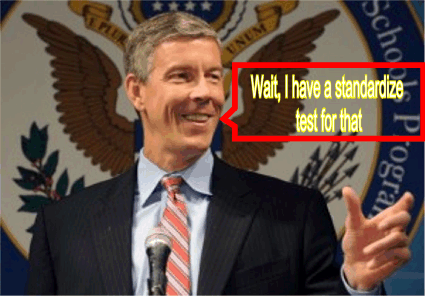

As teachers gear up for a new school year, I want to offer two thoughts. One is a message of celebration and thanks. The other is a response to a concern that has come up often in many conversations with teachers and families, and which deserves an answer.
First, the thanks. America’s students have posted some unprecedented achievements in the last year – the highest high school graduation rate in the nation’s history, and sharp cuts in dropout rates and increases in college enrollment, especially for groups that in the past have lagged significantly. For these achievements, we should celebrate America’s teachers, principals, and students and their families. These achievements are also indications of deeper, more successful relationships with our students. All of us who’ve worked with young people know how much they yearn for adults to care about them and know them as individuals.
These achievements come at a time of nearly unprecedented change in American education – which entails enormously hard work by educators. Nearly every state has adopted new standards, new assessments, new approaches to incorporating data on student learning, and new efforts to support teachers.
This transition represents the biggest, fastest change in schools nationwide in our lifetime. And these efforts are essential to prepare kids to succeed in an age when the ability to think critically and creatively, communicate skillfully, and manipulate ideas fluently is vital. I have heard from many teachers that they have not received all the support they’d want during this transition. Yet America’s teachers are making this change work – and I want to recognize and thank them for that and encourage their leadershipin this time of change.
That’s the easy part of this message. The harder part has to do with concerns that many teachers have brought to my door.
My team and I hold regular conversations with teachers, principals and other educators, often led by Teacher and Principal Ambassador Fellows, who take a year away from their schools to advise my agency. Increasingly, in those conversations, I hear concerns about standardized testing.
Assessment of student progress has a fundamental place in teaching and learning – few question that teachers, schools and parents need to know what progress students are making. And few question the particular importance of knowing how our most vulnerable students are progressing. Indeed, there’s wide recognition that annual assessments – those required by federal law – have done much to shine a light on the places and groups of students most in need of help. Yet in too many places, it’s clear that the yardstick has become the focus.
There are three main issues I’ve heard about repeatedly from educators:
  1. It doesn’t make sense to hold them accountable during this transition year for results on the new assessments – a test many of them have not seen before – and as many are coming up to speed with new standards.
  2. The standardized tests they have today focus too much on basic skills, not enough on critical thinking and deeper learning.
  3. Testing – and test preparation – takes up too much time.
I share these concerns. And I want our department to be part of the solution.
To those who are reading the last sentence with surprise, let me be clear: assessment is a vital part of teaching and learning, but it should be one part (and only one part) of how adults hold themselves responsible for students’ progress. Schools, teachers and families need and deserve clear, useful information about how their students are progressing. As a parent of two children in public school, I know I want that. And in fact, most teachers and principals I talk with want to be held responsible for students’progress – through a sensible, smart combination of factors that reflect their work with students – not the level students came in at, or factors outside of their control.
But assessment needs to be done wisely. No school or teacher should look bad because they took on kids with greater challenges. Growth is what matters. No teacher or school should be judged on any one test, or tests alone – always on a mix of measures – which could range from classroom observations to family engagement indicators. In Nevada, educators include a teacher’s contribution to the school community in their measures; in Hawaii, schools consider student feedback surveys and professional growth, such as leading workshops or taking university coursework). Educators in Delaware look at measures of planning and preparation such as lesson plans and descriptions of instructional strategies to be used for students with diverse needs. Federal policy rightly stays out of picking those individual measures, but ensures that in evaluating teachers, states and districts include student growth, and consider multiple measures.
But the larger issue is, testing should never be the main focus of our schools. Educators work all day to inspire, to intrigue, to know their students – not just in a few subjects, and not just in “academic” areas. There’s a whole world of skills that tests can never touch that are vital to students’ success. No test will ever measure what a student is, or can be. It’s simply one measure of one kind of progress. Yet in too many places, testing itself has become a distraction from the work it is meant to support.
I believe testing issues today are sucking the oxygen out of the room in a lot of schools – oxygen that is needed for a healthy transition to higher standards, improved systems for data, better aligned assessments, teacher professional development, evaluation and support, and more. This is one of the biggest changes education in this country has ever seen, and teachers who’ve worked through it have told me it’s allowed them to become the best teachers they’ve ever been. That change needs educators’ full attention.
That’s why we will be taking action in the coming weeks that give states more flexibility in key areas that teachers have said are causing worry.
States will have the opportunity to request a delay in when test results matter for teacher evaluation during this transition. As we always have, we’ll work with them in a spirit of flexibility to develop a plan that works, but typically I’d expect this to mean that states that request this delay will push back by one year (to 2015-16) the time when student growth measures based on new state assessments become part of their evaluation systems – and we will work with states seeking other areas of flexibility as well. We want to make sure that they are still sharing growth data with their teachers, and still moving forward on the other critical pieces of evaluation systems that provide useful feedback to educators.  We will be working in concert with other educators and leaders to get this right. These changes are incredibly important, and educators should not have to make them in an atmosphere of worry. Some states will choose to take advantage of that flexibility; others, especially those that are well along in this transition, will not need a delay. The bottom line is that educators deserve strong support as our schools make vital, and urgently needed, changes. As many educators have pointed out, getting this right rests also on high-quality assessments. Many educators, and parents, have made clear that they’re supportive of assessment that measures what matters – but that a lot of tests today don’t do that – they focus too much on basic skills rather than problem solving and critical thinking. That’s why we’ve committed a third of a billion dollars to two consortia of states working to create new assessments that get beyond the bubble test, and do a better job of measuring critical thinking and writing.
I’m concerned, too, when I see places where adults are gaming tests, rather than using them to help students.
And we also need to recognize that in many places, the sheer quantity of testing – and test prep – has become an issue. In some schools and districts, over time tests have simply been layered on top of one another, without a clear sense of strategy or direction. Where tests are redundant, or not sufficiently helpful for instruction, they cost precious time that teachers and kids can’t afford. Too much testing can rob school buildings of joy, and cause unnecessary stress. This issue is a priority for us, and we’ll continue to work throughout the fall on efforts to cut back on over-testing.
There’s plenty of responsibility to share on these challenges, and a fair chunk of that sits with me and my department. We encouraged states to move a whole lot of changes simultaneously, because of the enormous urgency to raise standards and improve systems of teacher support – not for another generation of students, but for today’s students.
But in how this change happens, we need to listen carefully to the teachers, principals and other educators who are living it on a daily basis – and we need to be true to our promise to be tight on outcomes, but loose on how we get there.
From my first day on this job, the objective has been to work in a spirit of flexibility to help states and communities improve outcomes for kids. We need to make changes, but we are also making progress. I’m determined that, working in partnership, we’ll continue to do both – be flexible and make progress for our kids.
Change is hard, and changes of significance rarely work exactly as planned. But in partnership, making course alterations as necessary, we will get there.
Arne Duncan is U.S. Secretary of Education.

State review faults Missouri education department’s handling of CEE-Trust contract | The Kansas City Star

State review faults Missouri education department’s handling of CEE-Trust contract | The Kansas City Star:


State review faults Missouri education department’s handling of CEE-Trust contract

Missouri’s education department stumbled several ways when it hired CEE-Trust a year ago to propose a complete overhaul of the Kansas City Public Schools, a state auditor’s report said Tuesday.
The state’s contract with reform-minded CEE-Trust of Indianapolis was plagued with potential bias and conflicts of interest involving the Ewing Marion Kauffman Foundation, which helped fund the $385,000 contract, the report said.
Department emails and bidding documents, reported by The Star in December, showed how the foundation and Missouri Education Commissioner Chris Nicastro had been communicating for months in 2013 and had originally hoped that the department could hire CEE-Trust without a bid process.
Nicastro and the foundation were eager to spur ideas from CEE-Trust, whose past work in education promoted dramatic system redesigns featuring a network of independent public schools in which those that are successful can operate autonomously.

Read more here: http://www.kansascity.com/news/local/article1253591.html#storylink=cpy

The problem, Deputy State Auditor Harry Otto said Tuesday, was that when the state school board directed the department to go through a bidding process last summer, the way the department ultimately chose CEE-Trust did not properly guard against bias.
“We believe it was a flawed process,” Otto told The Star.
State officials who had been working with CEE-Trust and the Kauffman Foundation for months before the bidding process were involved in scoring the bids. The state awarded the contract to CEE-Trust even though a competing bidder with seemingly more industry experience offered to do the work at less than a third of the cost.
The state’s subjective scoring system did not adequately explain how CEE-Trust’s bid earned a significantly higher score for experience, reliability and expertise over the less expensive vendor, the report said.
There was a 56 percent difference in scoring of the subjective judgment criteria between CEE-Trust’s bid and the second-place bidder, the report said. The auditors reviewed nine other education service contracts the state awarded in 2013 and found that the differences in subjective criteria points
State review faults Missouri education department’s handling of CEE-Trust contract | The Kansas City Star:

Read more here: http://www.kansascity.com/news/local/article1253591.html#storylink=cpy


Read more here: http://www.kansascity.com/news/local/article1253591.html#storylink=cpy

8-21-14 Curmudgucation

CURMUDGUCATION:


Duncan Tries To Hear Teachers
US Secretary of Education Arne Duncan is here with some back-to-school blogging to assure folks that he is totes listening to somebody. His back-to-school conversation comes with two messages.First, he wants to send out a big thank you to all the folks who helped create some super-duper data points last year-- specifically, the high school graduation rate and the college enrollment rate. I might b

More Bad Polling News For CCSS
While we're making note of how Common Core is tanking in the Education Next and PDK/Gallup polls, let's pull out one other poll from earlier in the summer. This one also us ed the word "plummets," which has become a serious contender for leading the Common Core Headline Word Bank.Conducted and released in June of 2014, the Rasmussen Reports national phone survey checked the support for t

8-20-14 Curmudgucation
CURMUDGUCATION: Patronizing Teachers for the CoreWhen you read this sentence at the start of a blog post, you know things are about to head south rapidly:One of the most frequent questions I get from coaches is about how to coach teachers in the Common Core (CCSS).This is the lede from "Coaching Towards the Common Core State Standards" over at Ed Week. Our coaching...um...coach is Elena

Shanker Blog » The Thrill Of Success, The Agony Of Measurement

Shanker Blog » The Thrill Of Success, The Agony Of Measurement:


The Thrill Of Success, The Agony Of Measurement

Posted by  on August 21, 2014
The recent release of the latest New York State testing results created a little public relations coup for the controversial Success Academies charter chain, which operates over 20 schools in New York City, and is seeking to expand.
Shortly after the release of the data, the New York Post published a laudatory article noting that seven of the Success Academies had overall proficiency rates that were among the highest in the state, and arguing that the schools “live up to their name.” The Daily News followed up by publishing an op-ed that compares the Success Academies’ combined 94 percent math proficiency rate to the overall city rate of 35 percent, and uses that to argue that the chain should be allowed to expand because its students “aced the test” (this is not really what high proficiency rates mean, but fair enough).
On the one hand, this is great news, and a wonderfully impressive showing by these students. On the other, decidedly less sensational hand, it’s also another example of the use of absolute performance indicators (e.g., proficiency rates) as measures of school rather than student performance, despite the fact that they are not particularly useful for the former purpose since, among other reasons, they do not account for where students start out upon entry to the school. I personally don’t care whether Success Academy gets good or bad press. I do, however, believe that how one gauges effectiveness, test-based or otherwise, is important, even if one reaches the same conclusion using different measures.
It’s not possible, using available data, to check the testing performance for Success Academies’ students upon initial entry (which is kindergarten for all the schools currently operating). This is because the state begins testing in third grade. We can, however, try to get a rough idea (or, more accurately, illustrate the futility of trying) by taking a quick look at the latest (2014) math results for third graders attending Success Academies (at least those campuses for which testing data are available). The distributions are presented in the table below.
As you can see, the Success Academy third grade math proficiency rates range from 85 to 100 percent, with most of them falling above 90 percent. Moreover, huge proportions of these third graders — between about 50 percent and almost 90 percent — score above the cutoff for level 4 (“advanced”). Citywide, the third grade rates in 2014 were 14.8 percent (level 4) and 38.6 percent (level 3 + level 4). The comparisons are similar in previous years.
Now, it may be the case that Success Academy students enter kindergarten performing at very low levels, and that the school performs remarkable feats for its students before they reach third grade, bringing virtually all of them up to proficiency level, and a very large group to the “advanced” level 4, over that 3-4 year time period. Or, perhaps, Shanker Blog » The Thrill Of Success, The Agony Of Measurement:

8-21-14 Ed Notes Online

Ed Notes Online:


Approval Expected for ISIS Charter School Application to SUNY, Cuomo Demands Coloco Space from deBlasio
We are overjoyed at this proposal since we expect tenured teachers will be beheaded.... Mona Davids, Campbell Brown We are pro school choice... Eva Moskowitz The final solution on the lack of teacher quality issue... Students First  Oh, I could go on, but ambition flags when it's a beautiful day outside.


George Schmidt on Karen Lewis for Mayor - and More; Randi Offers Karen a million bucks if she runs
AFT President Randi Weingarten said she'd give $1 million to Chicago teachers union chief Karen Lewis if she ran against Mayor Rahm Emanuel....Chicago Sun-TimesThe cynic in me says, what better way to get rid of a potential rival? A million bucks will be a drop in the bucket against Rahm but Randi is a genius. A win-win for her no matter what the outcome.The intriguing Chicago mayoral race can be

8-20-14 Ed Notes Online Week
Ed Notes Online: The Trouble With Frank BruniHow far are we from the day when Whoopi, Campbell and the rest of the ed deform crowd flat out blame the death of Michael Brown on bad teachers? Joining the anti-teacher fray is former NY Times food writer Frank Bruni, another clueless NY Times columnist writing on education (see David Brooks, Thomas Friedman, Joe Nocera, Brent Staples, and even one bad

State OKs 10% pay cut to ease DPS deficit | The Detroit News

State OKs 10% pay cut to ease DPS deficit | The Detroit News:


State OKs 10% pay cut to ease DPS deficit


State education officials have approved a plan by Detroit Public Schools to slash pay 10 percent districtwide to help erase the district’s $127 million deficit.

State Superintendent Mike Flanagan announced Wednesday he approved the district’s updated five-year deficit elimination plan for the district to continue receiving state school aid.
The pay cut, which will impact all teachers and administrators starting Oct. 1, came after the district was forced to make budget cuts to offset expected revenue from a failed countywide tax millage. The wage concession for teachers would generate $13.3 million in savings. Districtwide, the savings will be $21.1 million.
The district’s financial plan also calls for the closure of 24 schools or buildings over four years, starting with the 2015-16 academic year.
Parents, educators and community stakeholders met Wednesday morning in front of Ludington Middle School to denounce the cuts, as well as the district’s previously announced plans to increase class sizes.
Brian Kindle has two children beginning Head Start in the fall, and a 15-year-old at Cody High School. He said he’s worried about how pay cuts will impact his kids.
“I say hands off first responders, kids and teachers,” he said. “I’m here to support parents and their children, and to ask Gov. Snyder not to vote for the proposal.”
Kindle said he fears additional cuts will result in further neglect of students in the classroom.
“We should have classrooms on every corner, instead of liquor stores,” he said. “That would be great, but we don’t have a society that encourages it. But I will remain on the forefront supporting our children.”
The pay cuts also worry Kim Tack, who teaches science and social studies at Ludington. She has taught in the building for three years, and has been a DPS employee for 19 years.
“They’re talking about a 10 percent pay cut, and at the same time, our insurance premiums have more than doubled,” said Tack. “How am I supposed to pay for my house?”
Michelle Morden teaches English language arts at the middle school. She’s been with DPS for 17 years.
“This is going to affect my whole financial situation, and it’s going to have a huge impact on my family,” she said. “It’s also going to impact the way we


From The Detroit News: http://www.detroitnews.com/article/20140820/SCHOOLS/308200061#ixzz3B2cqFBG3

An Interview With Dr. Yohuru Williams on Corporate Education Reform: 'We Aren't Buying It." | M. Shannon Hernandez

An Interview With Dr. Yohuru Williams on Corporate Education Reform: 'We Aren't Buying It." | M. Shannon Hernandez:


An Interview With Dr. Yohuru Williams on Corporate Education Reform: 'We Aren't Buying It."


 Teachers from across the nation stood in solidarity on July 27, 2014, using their voices to speak out about many of the issues plaguing the nation's public education system. The mood at the front entrance of the U.S. Department of Education in Washington, D.C., was one of hope at times, with teachers sharing inspiring stories of the progress they are making with their students, despite the onslaught of high-stakes testing and unrealistic demands placed upon them. At others times, the mood was solemn when parents, voices breaking when they became emotional, shared their stories of neighborhoods being completely dismantled due to public school closures when charter schools were erected, pushing all sense of community to the side. Perhaps the most heartbreaking accounts of that day were the students who spoke from the platform at the front entrance of the U.S. Department of Education, pleading with policy makers to please bring back the joy of learning.

Dr. Yohuru Williams, BAT activist, and Professor of History at Fairfield University, was one of the keynote speakers that day. As he delivered a speech directed to Arne Duncan, U.S. Secretary of Education, who was sitting in his office several floors above the front entrance, the teachers, parents, students, and concerned citizens of the crowd rallied around his message. Dr. Williams delivered his speech, highlighting many of the ways corporations and billionaires continue to destroy public education through "reform" tactics, which are in fact, causing re-segregation in communities, pushing highly-qualified teachers out of the profession, and reducing our nation's youth to merely test scores.
This past week I reached out to Dr. Williams and asked for further commentary on several of the points he made during his speech at the U.S. Department of Education that day. As millions of teachers and students head back to school in the upcoming weeks, Dr. Williams wanted to inspire public educators, despite the many hardships they face, to find a way to become more involved, on the activist front, in this war on public education.
Below are four italicized pieces of Dr. William's public address to Arne Duncan, followed by his message to teachers as they begin a new academic year.
"Mr. Duncan, you should know that the educators who make up the BATS live by three principles: People over Profits, Parity over Charity, and Choice over Chance--because if you let the people decide the future of public education we would spare no expense to ensure that our children had access to the highest quality of instruction, in the safest spaces, with a full complement of courses and counseling, health and An Interview With Dr. Yohuru Williams on Corporate Education Reform: 'We Aren't Buying It." | M. Shannon Hernandez:

Some Predictions as the New School Year Arrives… | Taking Note

Some Predictions as the New School Year Arrives… | Taking Note:


Some Predictions as the New School Year Arrives…

With the arrival of the new school year, what can we expect?  Here are 6 predictions and a big question.
Prediction #1. More school districts will back away from relying  heavily on standardized test scores to hold teachers accountable. It seems to me that many educators and other leaders are aware what often results from ‘test-based accountability’: cheating, low morale, higher absenteeism/truancy, and growth in homeschooling.
When Washington, DC, Chancellor Kaya Henderson announced that she was putting her system’s method of judging and firing teachers (based primarily on bubble scores) on hold, the US Department of Education expressed dismay, but Henderson deserves credit for acknowledging that the approach [1]was causing more trouble than it was worth. Not only has DC’s central office budget been bloated by the cadre of highly-paid ‘inspectors,’ but test scores have flattened, while cheating incidents continue to be an issue.
Henderson cited the support from the Bill and Melinda Gates Foundation for a moratorium. In New York, Governor Andrew Cuomo now supports a moratorium on the use of test scores, something long advocated by the American Federation of Teachers and their state and local affiliates in the state.
I think we will see more of this. Whether the Department of Education wakes up to a new reality is the big unknown.
I believe that the best possible outcome of a widespread moratorium would be a concerted effort to create a useful and reliable way of judging teachers and the schools they work in.  “Multiple measures” rolls easily off the tongue, but we need to agree on what those measures are.[2]
Prediction #2. The tide may turn in the ongoing ‘war against teachers.’  We will hear more from Diane Ravitch and other defenders of the profession, and less from the attacking crowd.
Diane Ravitch is energized.  Her blog recently received its 14 millionth page view.  That remarkable Some Predictions as the New School Year Arrives… | Taking Note:

8-21-14 Schools Matter

Schools Matter:


See KIPP Co-Founder, Dave Levin, Model Total Control & Total Compliance at Million Dollar Summit
Keep it Up - A Balloon Metaphor at KIPP School Summit 2014 from KIPP Foundation on Vimeo.
MA Taxpayers Fed Up With Up Expansion of Segregated Corporate Charters
This is the beginning of the end for another failed experiment by profiteers and businessmen to feed on public education.  From the Boston Globe: Voter support for more charter schools in Massachusetts appears to be weak, according to a new Boston Globe poll, highlighting a politically risky situation for charter school supporters if they pursue a ballot question. The poll found that 47 percent of

Money For Tanks And Tear Gas, But None For Education
From The Real News Network:Rev. Osagyefo Uhuru Sekou is a Freeman Fellow with the Fellowship of Reconciliation. A St Louis, MO, native, the Rev attended high school there and has strong family ties to the area. He is the Pastor for Formation and Justice at the First Baptist Church in Jamaica Plain, MA, and is spending the summer as a Scholar in Residence at the Martin Luther King Education and Res

Read Ken Derstine to Understand CorpEd in Philadelphia
Here is the intro:IntroductionPrior to becoming Secretary of Education in the Obama administration, Arne Duncan was the Chief Executive Officer of the Chicago Public Schools for seven years. Until he became Secretary of Education, Duncan was on the board of the Broad Foundation. The Broad Foundation is one of the leading “philanthropies” promoting privatization through its Broad Superintendents Ac


Tennessee's No-Growth Model for Minorities: 4% of Black Students Meet All ACT Benchmarks in 2014
 As shown above, 8 percent of black students met 3 or more benchmarks in 2013.  Below is the chart showing the percentages of students meeting all four benchmarks in 2014 (click to enlarge):

New PDK/Gallup Poll Shows 60 Percent of Public Opposed to Common Core
We'll be posting from the new 2014 PDK/Gallup poll of public attitudes toward the public schools.  Here's the one that caught my eye first:
New York's High Stakes Test Data of "Diminished Usefulness" Due to Opt Out Numbers
New York parents and students who opted out of the last round of testing should be proud and energized, even though the state's chief miseducator remains unbowed so far by the opt out numbers that are finally coming to light. This school year should be one of organizing resistance in every town and village to choose education and reject the unending corporate testing agenda that is destroying what
8-20-14 Schools Matter
Schools Matter: Poem by Doug StormTreeThe girth and grip of the tulip trunk thrustWrist deep into the soil of the school playgroundFronts an edifice risen only to crumble.Unfallen and aged, escaping the steel chain,Your crown unbestowed, no body bendssupplicant to you, though all are at base abject.You seek no fealty but stand resoundingagainst the proclamations of pretenders.When your reign ends


Fatuous Pablum | EduShyster

Fatuous Pablum | EduShyster:


Fatuous Pablum


 David Kirp says that teaching isn’t a business—and that makes a lot of people really mad…

kirp-improbablescholars1EduShyster: Let me try to break this to you gently. Your recent New York Times piece,Teaching Is Not a Business, didn’t win you a lot of friends on Twitter. In fact, one of your detractors referred to your entire oeuvre as*fatuous pablum.*
David Kirp: Wow—I seem to have provoked, not just outrage, but a mixed metaphor. Pablum, which is actually spelled pabulum, is something you eat.
EduShyster: Perhaps the point was that if one consumes too much pablum, one grows fatuous. I’m curious though, did you hear from any of your critics directly?
Kirp: None of them wrote to me. I have to say, by the way, that trust and community have been themes of my writing for many, many years and this is the only time I’ve provoked such intemperate responses. The emails I received from readers and the letters to the Times were overwhelming positive. The best letter I got asked a question that I think bears repeating: when you think about what most influenced you in your life or your choice of careers, how many of you point to the text book you read or the computer program you worked on? I think that’s a gorgeous way of putting it.
EduShyster: I saw a couple of specific criticisms that popped up again and again. One was that you refuse to acknowledge that high-performing charters are the answer; another is that you refuse to acknowledge that choice is the answer. Do you have an answer for Fatuous Pablum | EduShyster: