Latest News and Comment from Education

Friday, August 1, 2014

8-1-14 Perdido Street School

Perdido Street School:


Cuomo Has His Own Bridge Scandal
Hey, what do you know - another link between Christie and Cuomo.They both have a bridge scandal: ALBANY—State investigators are looking into the controversial Tappan Zee Bridge loan and whether a board controlled by Governor Andrew Cuomo violated state laws when it approved the money.The state Authorities Budget Office, an independent body, is examining allegations the Environmental Facilities Cor

Pearson Owns New York
The gravy train for Pearson continues in John King's and Andy Cuomo's New York:Becoming a teacher in New York state is getting more expensive.The price of basic teacher certification exams has more than doubled this year and it's taking a toll, educators said....Essentially, the regimen of tests and assessments needed for a certification degree has gone from $317 to $652 this year.That's on top of

The "Fuck Cuomo" Factor
For three and a half years now, Andrew Cuomo has governed the state through fear.Jimmy Vielkind at Capital NY writes that "fear factor" is gone:What the episode has done, people involved in government and longtime observers say, is make it OK, for the first time since Cuomo came to office, to defy him.Where once other officials wouldn't publicly oppose the famously controlling governor,

7-30-14 Perdido Street School
Perdido Street School: US Attorney Warns Governor Cuomo Over Witness Tampering, Obstruction Of Justice ChargesThe battle between US Attorney Preet Bharara and Governor Andrew Cuomo over the Moreland mess just got ratcheted up some more:In an escalation of the confrontation between the United States attorney in Manhattan, Preet Bharara, and Gov. Andrew M. Cuomo over the governor’s cancellation of h



Introducing Your Special Guest Stars: Miller, Fennell, Sanchez, & the YES Prep Crew :: Frederick M. Hess

Introducing Your Special Guest Stars: Miller, Fennell, Sanchez, & the YES Prep Crew :: Frederick M. Hess:


Another Top Piece by Jeff Bryant: Juking the Stats in New Orleans | janresseger

Another Top Piece by Jeff Bryant: Juking the Stats in New Orleans | janresseger:


Another Top Piece by Jeff Bryant: Juking the Stats in New Orleans

In the summer of 2006, not quite a year after Hurricane Katrina, I traveled for a week to New Orleans.  At the Justice and Witness Ministries of the United Church of Christ, I wrote an annual autumn publication for our churches on an issue of racial or economic justice in public schools that we hoped to highlight for them in that particular school year.  I planned to write the 2007 UCC Message on Public Education (released in fall 2006) on what had happened to the public schools in New Orleans after the 2005 hurricane—the subsequent layoff of all the teachers, and the beginning of the charter experiment seeded by huge grants from the U.S. Department of Education, the Bill and Melinda Gates Foundation and others.
With a good map and a rental car, I made my way to a mass of interviews I had set up with parents, former teachers, the former president of the teachers’ union, parent advocates, a civil rights attorney, a member of the Orleans Parish School Board, members of Beecher United Church of Christ, and public education advocates who had been identified to me.  My trip changed me.  New Orleans was still completely devastated, and the implications for the city’s poorest citizens were catastrophic.  I did not want to believe that in the United States, politicians would use a situation of massive devastation to undertake an education governance experiment on poor families and their children.
Most of the people I spoke with were still numb with shock.  Many were working during the day and returning at night to pull the walls apart in their houses—to “gut them out” as it was called—so they could begin rebuilding, but almost nobody had reached the rebuilding stage.  One elementary school I saw in New Orleans East remained windowless, with weeds so high they tangled wildly over the roof.  Some public schools that had not even been seriously damaged were shut down without being repaired. Fortier High School, an historic neighborhood high school, had been taken over by Tulane and other universities and turned into Lusher Charter High School, a place where the children of faculty at the area’s Another Top Piece by Jeff Bryant: Juking the Stats in New Orleans | janresseger:

Keep trying to understand us Mike – You’re not there yet | Missouri Education Watchdog

Keep trying to understand us Mike – You’re not there yet | Missouri Education Watchdog:


Keep trying to understand us Mike – You’re not there yet


 Anything you can do I can do better - Annie Get Your Gun - Betty Hutton and Howard Keel


Mike Petrilli of Fordham latest piece appears to be his attempt to tell the opponents of common core that he understands us. He concedes the point of federal involvement in the standards (which Fordham has done before). He admits that the standards aren’t “the best” and even acknowledges that there are a number of text book suppliers who are making a mess of them. But there is one glaring problem with his concession piece – he simultaneously agrees that states can set standards and claims that states are no good at setting standards.
The CC standards have been sold to the public (once CSSI et al were forced to actually contend with the public) as necessary because so many states had poor quality standards, even after NCLB forced them to review, clarify and improve their standards.
“I find that the pros far outweigh the cons, beginning with the original Fordham conclusion that the standards themselves, on their merits, are superior in content and rigor to those that three-quarters of the states were using in 2010.”
See, 3/4 of the states, though charged with developing high quality standards, were incompetent to do so, therefore we needed some smart group of outsiders to do it for us.
But then just a few paragraphs later he says the standards are basically the floor and that they are counting on states to augment the standards to improve them.
“Yes, they can absolutely be improved. That’s why we’re supportive of what states like Florida have done to augment the standards… Creating additional standards for high-achieving math students who are gunning for selective colleges and/or STEM careers makes a ton of sense.”
So states like Florida who had bad standards with NCLB and whose governor you wrote felt it important to join with the governor of Illinois to develop better standards together, is now deemed qualified enough to improve these jointly developed standards on their own. Which is it Mike?  Are the states qualified to write their own standards or not?
If they are able to write their own and identify their own shortcomings, then why did we need a nationally developed set of standards in the first place?
Much of the rest of his article completely overlooks how the standards were eventually sold to the public.
“They are fewer and clearer.” If they are fewer because they left out pieces that states are Keep trying to understand us Mike – You’re not there yet | Missouri Education Watchdog:

5 Characteristics of an Innovative Organization | Connected Principals

5 Characteristics of an Innovative Organization | Connected Principals:


5 Characteristics of an Innovative Organization


As the year has wrapped up for most North American schools, I look back at my year and realize how blessed I am to not only be able to travel the world and share my experience with others, but also the opportunity to still work with Parkland School Division on a part-time basis.  I think that this allows me to still “do the work” in schools while also having the ability to share it with others as well.  The balance that this has created to both see other organizations and share my work, and vice-versa, has been immeasurable for my learning.
From what I have learned about Parkland School Division, I believe it is a world-class organization, that is not just talking about newer opportunities for learning for our students, but is creating powerful learning environments for our entire community.  We still teach the curriculum and we still have to “follow the rules”, but we try to be innovative within the parameters that are provided.  The content that we have to teach is often decided for us, but the way that we teach, and more importantly our students learn, is where the magic truly happens.
So how did this happen?  Well to be honest, we still have a lot of work to do, but that will always be the case.  We are a “learning organization” which, by the nature of the term alone, means that we are focused on continuous growth as a district.  It is not only that we have leaders that model themselves as learners, but it is done as at the organizational level as a whole.  This growth as a group has led to the development of individuals.
Looking back, here are five things that have really stuck out to me this year and have helped us to grow.
1.  Promotion and modelling of risk-taking.
The term “risk-taking” is one of those “buzzwords” that drives many people crazy.  An “innovative environment” will always promote this, but it does not mean that it is happening.  It is only when the leaders of organization model the risk-taking that they talk about, does it happen en masse in schools.  I have watched our superintendent Tim Monds, try many different things in his own learning that have been displayed openly to others in Parkland School Division.  It started with things such as using Twitter, more focus on cloud tools such as Evernote and Google Apps for Education, and more recently, sharing his monthly message through YouTube videos.   His understanding and willingness to try different ways of learn and sharing has trickled 

All Things Education: The Common Condescension

All Things Education: The Common Condescension:


The Common Condescension


Politico had a particularly agitating article about the Common Core out yesterday entitled, "Moms winning the Common Core war."

First  of all "war"? I am about to declare war on writers of ridiculous headlines. . .

Anyway, to get to the content of the article. Basically, Common Core advocates have decided that they need a new PR strategy:
Supporters of the Common Core academic standards have spent big this past year to persuade wavering state legislators to stick with the new guidelines for math and language arts instruction. Given the firestorm of opposition that took them by surprise, they consider it a victory that just five states, so far, have taken steps to back out. 
But in a series of strategy sessions in recent months, top promoters of the standards have concluded they’re losing the broader public debate — and need to devise better PR.
Granted there is plenty of misinformation surrounding this debate, and there are plenty of people who are misinformed, but this approach is maddening. It's the same reformy solution to disagreement and dissent that we've witnessed for nearly a decade, i.e., there's nothing wrong with the substance of our reforms, it's just the style with which they're presented. Or, to use business parlance, there's nothing wrong with our product, we just need to sell/market it better. 

The contempt is just dripping:
“The Common Core message so far has been a head message. We’ve done a good job talking about facts and figures. But we need to move 18 inches south and start talking about a heart message,” said Wes Farno, executive director of the Higher State Standards Partnership, a coalition supported by the U.S. Chamber of Commerce and the Business Roundtable.
And,
We’re so good at all our statistics and data and rational arguments … [but] emotion is what gets people feeling passionate,” Oldham said. “It may not be the most comfortable place for the business community … [but] we need to get better at doing it.”

People who criticize the Common Core are just emotional. We have to speak emotional back to them. Here we've been giving them the facts and well, I'll be! That doesn't work. Those emotional people, the are too simple-minded to handle All Things Education: The Common Condescension:

NYC Educator: Andy and Sandy

NYC Educator: Andy and Sandy:


Andy and Sandy


I live about two blocks away from the water, which is nice, except when it comes to visit you. During Hurricane Sandy, it did that in a big way. My living room, kitchen and dining room were full of water. However, I had flood insurance, and it actually paid us to fix the house.

So when I got an application from NY Rising last April, I didn't bother to fill it out. After all, my house was fixed. We have new floors, new walls, new paint, and I went crazy and replaced the ceiling too, adding lights and all sorts of cool things. We even replaced my framed picture of Boris and Natasha with something that more resembles art.

Like everyone around here, we hope that we won't get another Sandy. One way to minimize damage in areas like ours is to raise your house up. When we first moved here there was a federal program that paid for maybe 70% of that, but given we were flat broke, laying out 30K was out of the question. Now the feds pay 30K max, so we'd have to lay out at least 70K. Kind of pricy to fix something for which you're insured.

But lo and behold, Governor Andy came to my town and announced that he had 300 million dollars to raise homes. Now before he was paying only to raise homes that were required to be raised. But now, he was paying to raise homes like mine that faced no such requirement. This sounded like a great idea.

But when I called NY Rising, it turned out I wasn't eligible. Stupid me, not applying for money I didn't need to fix my home that was already fixed. You see, in Andrew Cuomo's world you need to apply in April in order to be eligible for programs he announces in July. How reckless of me to not NYC Educator: Andy and Sandy:

Scalding school closing report unlikely to get a hearing | catalyst-chicago.org

Scalding school closing report unlikely to get a hearing | catalyst-chicago.org:


Scalding school closing report unlikely to get a hearing

A scalding report that criticizes CPS for the way it handled the mass closing of schools last year likely will not get a public hearing as requested by state task force members. 
As for why, that’s in dispute. 
State Rep. Linda Chapa La Via, chair of the House Elementary and Secondary Education Committee, said she requested a hearing but has little hope that it will ever be held. “Everything is politics,” she said with a sigh.
However, Steve Brown, House Speaker Mike Madigan’s spokesman, said that Chapa LaVia doesn’t need permission to hold a hearing. He was incredulous as to why she doesn’t just move forward.
Chapa Lavia did not respond when re-contacted. Also, representatives Cynthia Soto and Esther Golar, both of whom sit on the task force, did not respond to calls and emails on the subject.
Members of the Chicago Educational Facilities Task Force said they are convinced that Madigan’s office—with the encouragement of Mayor Rahm Emanuel—is preventing the hearing. They suspect that Emanuel wants to avoid a discussion on the school closing process during an election year. 
“It was shut down,” said Clarice Berry, a task force member and president of the Scalding school closing report unlikely to get a hearing | catalyst-chicago.org:

Brown administration looks to diminish influence of API :: SI&A Cabinet Report :: The Essential Resource for Superintendents and the Cabinet

Brown administration looks to diminish influence of API :: SI&A Cabinet Report :: The Essential Resource for Superintendents and the Cabinet:


Brown administration looks to diminish influence of API


(Calif.) Move over API. You’re not the top dog for determining school success anymore, the president of the state’s Board of Education said this week.
Instead, if Mike Kirst gets his way, the Academic Performance Index – long the state’s go-to tool for measuring how well schools are performing – will become in the eyes of the public just one component of a much larger, more robust reporting tool already required under the new Local Control Funding Formula.
 “In the past the API was the be-all, end-all and now it’s just part of a much bigger system. People need to move beyond the API,” Kirst said in an interview Wednesday.
While the LCFF – ushered through the Legislature by Gov. Jerry Brown last summer – provides additional school funding and gives local governing boards greater control over spending decisions, the law also requires that districts develop Local Control and Accountability Plans that show how the expenditures are being used to meet the eight state priorities, including pupil achievement, parent engagement, school climate and the implementation of state standards and student access to rigorous curriculum.
The API is just one data element among seven currently in the new law that address pupil achievement. There are an additional 16 data elements among the state’s other seven priority areas.
Currently, the API has been suspended for two years to allow for K-12 education’s transition to Common Core State Standards and new, aligned testing. But in the near future parents, policy makers and the media will come to depend on the LCAP instead.
The 2014-15 fiscal year was the first year that districts needed to prepare an LCAP as part of their goal setting and budget processes. Under the system, districts must report many other indicators beyond test scores –student attendance rates, suspensions, middle school dropout rates and test scores for foster youth.
Meanwhile, the state board must adopt by October 2015 a new evaluation rubric to help calibrate the strengths and weaknesses of student improvement plans outlined in the LCAP.
Kirst said work is underway for the new rubric, which might include other performance indicators beyond those already being used in the LCAP. State board staff, working with the education research and services firm WestEd, is in the process of convening education experts and Brown administration looks to diminish influence of API :: SI&A Cabinet Report :: The Essential Resource for Superintendents and the Cabinet:

UPDATE: VIDEO of Campbell Brown on Colbert Report - Mum's the Word


Campbell Brown on Colbert Report - Mum's the Word 


Did Campbell Brown get a visit form the Money Fairy? She ain't sayin'!


But Your Mother IS:

Who's Really Behind Campbell Brown's Sneaky Education Outfit? | Mother Jones
Who's Really Behind Campbell Brown's Sneaky Education Outfit? | Mother Jones: Who's Really Behind Campbell Brown's Sneaky Education Outfit?The former CNN anchor says her nonprofit seeks to protect kids from predators in the classroom. Its real agenda may be union-busting.Early one morning in July, former CNN anchor Campbell Brown appeared onMSNBC's Morning Joe, pen in hand, notes fanned out in fro

Thursday, July 31, 2014

Common Core: A Matter of Perspective | WagTheDog

Common Core: A Matter of Perspective | WagTheDog:


Common Core: A Matter of Perspective


20130810-131430
Part of the reason there has been such strong disagreement and debate regarding the Common Core is people “see” ed reform and the new Standards very differently, depending on their perspective.
When talking about ed reform with someone you may not agree with, it is very important to pay close attention to the words they use and don’t hesitate to ask for clarification rather than just assume you know what they mean.
For example when teachers express concern and reject the use of standardized test scores to evaluate student achievement and teacher quality, many ed reformers will respond and even the media will report that teachers don’t want to be evaluated or held accountable for their performance.
That would be like a doctor questioning why his patient doesn’t want his temperature taken because he protested when the nurse walked in the examining room with a rectal thermometer.
In both examples a particular method of gathering data was objected to, but it would be wrong to claim that the patient or teachers are opposed to any effort at gathering information to evaluate their health or job performance.
I believe that many ed reformers are looking at education from a macro perspective or Common Core: A Matter of Perspective | WagTheDog:

What National Group Is Funding the Pro-Common Core Lawsuit in Louisiana? | deutsch29

What National Group Is Funding the Pro-Common Core Lawsuit in Louisiana? | deutsch29:


What National Group Is Funding the Pro-Common Core Lawsuit in Louisiana?

July 31, 2014
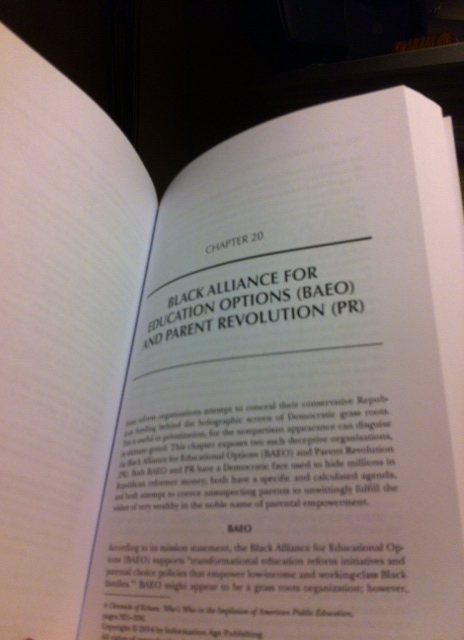
BAEO chapter

On July 29, 2014, the Louisiana State Board of Elementary and Secondary Education (BESE) voted 6 to 4 to become plaintiffs in the pro-Common Core (CCSS) lawsuitwhose plaintiffs include nine individuals and the charter management company, Choice Foundation. (Click here for Choice Foundation’s home page. However, the information on their schools has not been updated since 2011.)
The group footing the bill for this lawsuit is a well-funded, national “choice” group known as the Black Alliance for Educational Options (BAEO).
In my July 22, 2014, post on the issue, I mention that I wrote about BAEO in my book, A Chronicle of Echoesan encyclopedic whistle blower on the exploitation of public education. In Chronicle of Echoes, BAEO shares a chapter with another “pro-choice” group, Parent Revolution.
For those who are considering buying my book– and for those who just would like to What National Group Is Funding the Pro-Common Core Lawsuit in Louisiana? | deutsch29:

This Will Make Some Special Education Advocates Really Happy

This Will Make Some Special Education Advocates Really Happy:


This Will Make Some Special Education Advocates Really Happy

JOHN KING EDUCATION
New York State Education Commissioner John King Jr.'s proposal to change testing for some students with severe disabilities
won't happen next school year. (AP Photo/Michael Sisak) | ASSOCIATED PRESS


 NEW YORK -- New York students with disabilities will be held to the same academic standards and take the same standardized tests as other kids their age next school year, the U.S. Education Department said Thursday, spurning the state's efforts to change the policy.

Some special education advocates hailed the Education Department decision, saying it will enable students with disabilities to continue receiving the same opportunities as peers. "We think it's a victory for the potential of every child," said Denise Marshall, executive director of the Council of Parent Attorneys and Advocates Inc. "We thank the department for sticking to their guns."
The Education Department said Thursday that New York, as well as Minnesota, South Carolina, Delaware and Georgia, could hold onto waivers from the No Child Left Behind Act for another year. A federal official told New York schools chief John King in a letter that the state "may continue to implement" flexibility of the Elementary and Secondary Education Act though the 2014-15 school year, keeping state standards for students with disabilities the same as they had been.
King had proposed allowing up to 2 percent of New York students with severe disabilities to be tested at their instructional ability -- not their chronological grade year -- up to two full grade levels below current grade level. The change would, for example, allow a 5th grader with autism to be tested on exams written for third graders.
King made the proposal after taking heat for months over the state's implementation of the Common Core State Standards, a set of learning benchmarks being adopted by most states. State officials had said the outcry from special education teachers was especially loud.
The schools chief's idea for testing students with disabilities was part of his bid toThis Will Make Some Special Education Advocates Really Happy: 

“White House Symposium on Transformative Family Engagement” Was Held Today | Engaging Parents In School…

“White House Symposium on Transformative Family Engagement” Was Held Today | Engaging Parents In School…:


“White House Symposium on Transformative Family Engagement” Was Held Today


I had previously posted about the Kellogg Foundation-sponsored White House Symposium on Transformative Family Engagement, and it was held today.
I’d be interested in hearing a report from anyone who attended.
Here’s the information I have about it so far:
White House symposium focuses on family engagement appeared in The Washington Post, but says surprisingly little about what actually happened at the event.

The Kellogg Foundation put-out a press release 
this morning about the event. The most interesting info in it is a summary about a poll they had taken of parents. Here are some results:
The event also dovetails with the release of a recent public opinion poll, commissioned by the Kellogg Foundation*, of 1,000 parents nationwide, which found that 96 percent of parents believe they play a role in ensuring their child has a quality education, but that teachers (73 percent), principals (58 percent) and local officials (46 percent) also have meaningful roles. Among other findings:
U.S. parents believe that involvement in their child’s education is most critical between birth and pre-school (42 percent). That percentage increases among African American and Hispanic parents to 51 and 47 percent, respectively.
Ten percent of all parents, rising to 18 percent of Hispanic parents, say they are actively involved in “White House Symposium on Transformative Family Engagement” Was Held Today | Engaging Parents In School…:

Stereotypes, Testing and the 'Soft Bigotry of Low Expectations' | NewBlackMan (in Exile)

Stereotypes, Testing and the 'Soft Bigotry of Low Expectations' | NewBlackMan (in Exile):


Stereotypes, Testing and the 'Soft Bigotry of Low Expectations'
by William A. Darity, Alan A. Aja, & Darrick Hamilton | HuffPost

Earlier this month a divided Fifth Circuit Court of Appeals upheld the University of Texas' right to use race amongst its criteria for undergraduate admissions, however limited that right may be. While the decision will be viewed as a small victory for supporters of race-based affirmative action, there is little reason to believe that the widely held claim that black and Latino students enter selective universities as comparatively inferior students will not cease to rear its ugly head. It is a pervasive stereotype that minority students must face from matriculation to graduation, a stigma with undoubted adverse psychological and economic consequence that follows them well beyond higher education and into the labor market.

This claim, reasserted in a study published in 2012 in the Journal of Labor Economics by two Duke faculty members and a graduate student (Peter Arcidiacono, Esteban Aucejo, and Kenneth Spenner), anchors on a combination of black students' relative standardized-test scores and the authors' prior beliefs about the operation of affirmative action in admissions. It also should be noted that Arcidiacono has been a member of the research team for Project SEAPHE, a collective led by one of the chief architects of the war against affirmative action waged in California, UCLA Law School professor Richard Sander.

In their study, which was undertaken at the highly selective Duke University, the authors express concern about the pattern of students switching from majors in the natural sciences, engineering, and economics, which they view as more demanding majors, to majors in the humanities and social sciences, ostensibly less demanding majors. For black students, they argue, the tendency to switch from the "harder" majors to the "softer" majors is fully explained by the Stereotypes, Testing and the 'Soft Bigotry of Low Expectations' | NewBlackMan (in Exile):

Sabotaging our children and our schools | Parents United for Public Education

Sabotaging our children and our schools | Parents United for Public Education:


Sabotaging our children and our schools


This afternoon, the House GOP leadership announced that it would not return to Harrisburg to vote on a proposed cigarette tax bill that had been delayed in the state Senate. The failure to pass the bill means Philadelphia schools are more than $83 million short of last year’s inadequate funding. This is Parents United’s statement about the latest failure of the state leadership.
Republican lawmakers have scheduled golf outings and fundraisers for next week but they won’t find time for the simple act of passing a marginal cigarette tax for Philadelphia schools – the only district in the state run by the state of Pennsylvania.
The House GOP decision to refuse the barest of funding gestures is a planned sabotage of our schools, our children, and our city. It proves that under Governor Tom Corbett, the “crisis” in Philadelphia has never been accidental, unpredictable, or a surprise. It’s been a purposeful act of cruelty and neglect.
Parents United for Public Education calls upon the School District of Philadelphia to stand for the safety and academic well-being of Philadelphia children. There should be no cuts to schools as a result of the state legislature’s failure. Moreover, the District must conduct a needs-based assessment of every school and restore key personnel to assure the academic success and health of children. Schools should not open otherwise.
Parents United will consult with legal counsel about our rights and options in the weeks ahead. We believe our children’s lives and well-being are at stake, and will do what’s necessary to protect them from the unforgiveable failure and patent cruelty of too many of our elected officials.Sabotaging our children and our schools | Parents United for Public Education: