Latest News and Comment from Education

Friday, July 18, 2014

7-18-14 LA School Report - What's Really Going on Inside LAUSD

LA School Report - What's Really Going on Inside LAUSD (Los Angeles Unified School District):


PAC spending for Johnson gives him $200,000 advantage
PAC spending for Johnson gives him $200,000 advantage As the week comes to a close, Alex Johnson has expanded his overall lead in financial support over George McKenna in their quest to win election as the new District 1 board member in LA Unified, according to the latest figures from the City Ethics Commission. At mid-day, he held the same ratio of support, about 8-to-1, in individual contributio
Magnolia charter troubles having an impact beyond LA Unified
Magnolia charter troubles having an impact beyond LA Unified New troubles for the non-profit charter school network, Magnolia Public Schools (MPS), are beginning to raise concerns beyond LA Unified, where the sudden closure of two schools for fiscal mismanagement expanded yesterday into what could be a larger investigation. In a letter outlining a recent fiscal audit that led to the closure of the
Morning Read: Vergara splits Tuck and Torlakson campaigns
Morning Read: Vergara splits Tuck and Torlakson campaigns Vergara ruling becomes campaign issue State Superintendent of Public Instruction candidate Marshall Tuck this week launched a petition calling on his opponent, incumbent Superintendent Tom Torlakson, not to appeal a lawsuit ruling that struck down statutes giving California teachers firing protections and rights to tenure and seniority. EdS


7-17-14 LA School Report - What's Really Going on Inside LAUSD
LA School Report - What's Really Going on Inside LAUSD (Los Angeles Unified School District): Morning read: National poll shows public suport for preschoolMorning read: National poll shows public suport for preschool Poll shows support for public preschool funding In a new national poll conducted by a bipartisan research team, respondents voiced their strong support for expanding public preschool,


PAA opposes US Senate charter expansion bill S.2304 | Parents Across America

PAA opposes US Senate charter expansion bill S.2304 | Parents Across America:


Parents OPPOSE S.2304,
the “Expanding Opportunity Through Quality Charter Schools Act”
Downloadable version of this position paper here.


On May 7, 2014, S.2304 was introduced to the US Senate for consideration. The bill is currently in the Senate Health, Education, Labor and Pensions Committee. It is the Seante’s response to HR 10, the House version of charter school expansion legislation, which passed on May 9, 2014, on a vote of 360 to 45. PAA opposed HR 10. We also oppose this Senate bill:
PAA’s position: PAA opposes efforts to privatize public education through the expansion of charters, vouchers or other privately-run programs at the expense of regular public schools. Over the years, PAA has shared our concerns that:
  • Charter schools have turned out to be no better academically overall, and many cases worse than traditional schools.
  • Charter school “choice” too often lies with the charter school and not the families, as reports of skimming and push-out practices grow.
  • Some franchises like Chicago’s Noble Network use regressive discipline measures and expel students at many times the district rate.
  • Charter schools historically enroll fewer students with disabilities or English language learners.
  • The increased proliferation of charter schools could be harmful to students and communities, and may waste scarce education dollars.
PAA OPPOSES S.2304: PAA is opposed to any legislation that promotes expansion of charter schools without addressing most of the above problems. At a time when so many public schools are drastically cutting their basic budgets, why would Congress provide millions more to private school management companies that have not proven they are better alternatives?
PAA’s recommendations:
  • We believe in improving the schools we have, rather than shutting schools down in order to expand charter schools.
  • All charter schools should have neighborhood boundaries and accept all children from within those boundaries whose parents choose to enroll their child at the charter school. Charter school enrollment processes should be consistent with and as simple as those of neighborhood public schools.
  • Charter schools should not require fees, charge financial penalties, or otherwise create a financial barrier for students to be in school.
  • Charter schools and all other schools receiving public funds must be equally transparent and accountable to the public.

For more detail on PAA’s position on charter schools, please see http://tinyurl.com/bczrjqa
- See more at: http://parentsacrossamerica.org/paa-opposes-s-2304/

7-18-14 Schools Matter

Schools Matter:


Barbara Madeloni Discusses Testing, Teaching, Income Inequality

Understanding Why the TURN Cancer Has to Be Cut Out of AFT and NEA
Posted at @theChalkace July 18, 2014With a concerted effort among AFT and NEA misleadership shills to make TURN appear be a kinder and gentler form of corporate union takeover, it's important to "replay the tape" in order to understand the history that has been made and the history that is being made.  There are some who pretend to believe that TURN cannot be all bad if they invite Karen

Twins?
Jonah EdelmanSeneca Crane


7-17-14 Schools Matter
Schools Matter: Charter Cap in Massachusetts Will Not Be LiftedIt is gratifying to know that the legislature of the Commonwealth of Massachusetts, where public schools were born, took a significant step this week to support Horace Mann's notion of quality public schools for all children.  As Mann said some 160 years ago, "agitate, agitate, agitate, but always for a good cause." The good

7-18-14 Seattle Schools Community Forum

Seattle Schools Community Forum:


Seattle School Board Appoints Larry Nyland as Interim Super
The Board seems in agreement of the appointment of Dr. Larry Nyland, former superintendent in Marysville (and a former Superintendent of the Year) to be the interim superintendent. More to come.  Board seems enthused.

Feds Change Medicaid Coverage to Help Kids with Autism
From Disability Scoop:In what advocates are calling a major win, federal officials are for the first time telling states that Medicaid coverage must include treatments like applied behavior analysis for children with autism.Medicaid programs nationwide must offer “medically necessary diagnostic and treatment services” to kids with autism, the Centers for Medicare and Medicaid Services told states

Friday Open Thread
It looks to be a busy day in Seattle Public Schools.  Banda is now officially going to Sacramento (and boy, that lack of enthusiasm from the Sacramento Bee) and we await the discussion/announcement today of an interim who is likely to be in place for the next 6-9 months. I have found out some interesting things about one of the potential interim candidates that I will post in a separate thread.  I

7-17-14 Seattle Schools Community Forum
Seattle Schools Community Forum: Special Education in our Country - One ViewI haven't seen this education writer before but all I can say is she's good (and a great advocate for Special Education students and their parents.)  Thank you, Dr. Nancy Bailey.  As she says:Let’s take back reform and revive, rally, and recover public schools.Here she takes on Arne Duncan (red mine):The fact is there has

Analysis of Kindergartners Shows Wide Differences in School Readiness Skills

Analysis of Kindergartners Shows Wide Differences in School Readiness Skills:


Analysis of Kindergartners Shows Wide Differences in School Readiness Skills

Sesame Workshop Releases Educational Framework After Study Reveals More Than 40% of Children Enter Classrooms with One or More Factors That Can Negatively Affect School Success


 Sesame Workshop Pre-K Risk Factors

New research shows there is still a strong relationship between socio-economic factors and how well American children fare when entering kindergarten. In fact, a new study finds 44 percent of children enter kindergarten with one or more risk factors based on their home environment. These risk factors are incrementally associated with lower school readiness scores for children than for those with no such circumstances. Despite an increase in programs to level the playing field by giving disadvantaged children opportunities for preschool education, these gaps persist.
The findings are part of the Kindergartners' Skills at School Entry report released today by Sesame Workshop, the nonprofit educational organization behind Sesame Street. The report, commissioned by the Workshop and written by Mathematica Policy Research, provides an analysis of the Early Childhood Longitudinal Study, Kindergarten Class of 2010-11 focusing on the school readiness and abilities of beginning kindergartners.

"Preparing children for school has been part of Sesame Workshop's mission since the beginning," said Dr. Jennifer Kotler Clarke, Vice President, Research & Evaluation, Sesame Workshop. "There has not been an examination of children's school readiness of this magnitude in more than 10 years and it's important to us to understand the needs of children as they enter school. Given the risk factors children face, which put them at a disadvantage for school success, we are continuing to find ways to use our educational content to help change these outcomes."

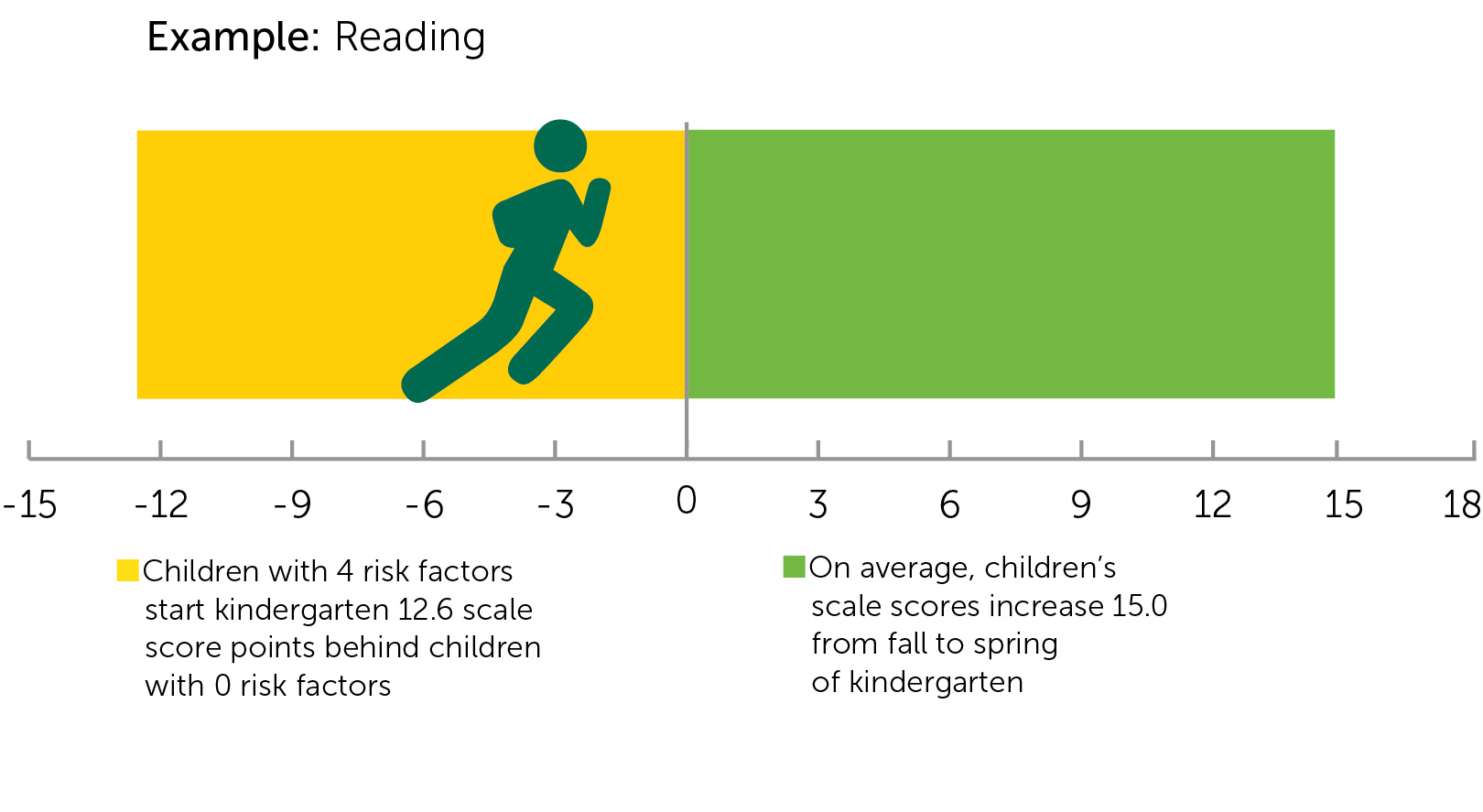
The analysis examined four risk factors that have been shown to affect children's development and school achievement: single parent households, mothers with less than a high school education, households with incomes below the federal poverty line, and non-English speaking households. High-risk children (those with all four risk factors) were found to be almost a year behind their peers with no risk factors in their reading and math abilities.

The researchers also created composite readiness scores based on teacher ratings of children's academic and social skills. Based on the researchers' calculation, less than one-third of children were rated by teachers as "in-progress" or better on both reading and math skills.

"These nationally representative data show that at-risk children start kindergarten well behind their more advantaged peers," notes Jerry West, senior fellow at Mathematica and director of the study. "The evidence points to an opportunity to better support their healthy development before they enter kindergarten."

Sesame Workshop is sharing its Sesame Street Framework for School Readiness in response to the findings of the Kindergartners' Skills analysis. The Framework is a guide for content developers to use to better understand the features of a typical developmentally age-appropriate content Analysis of Kindergartners Shows Wide Differences in School Readiness Skills:

Public employee testimony Constitutionally protected :: SI&A Cabinet Report :: The Essential Resource for Superintendents and the Cabinet

Public employee testimony Constitutionally protected :: SI&A Cabinet Report :: The Essential Resource for Superintendents and the Cabinet:


Public employee testimony Constitutionally protected

Public employee testimony Constitutionally protected


(Wash., D.C.) In a case likely to expand some free speech protections for public employees, the U.S. Supreme Court this month ruled that the First Amendment shields court testimony that is outside the scope of the employee’s normal duties and which is given as “a matter of public concern.”
In such instances, said the justices in overruling lower courts, the employee should not be subject to disciplinary action by his or her employer.
In its unanimous and relatively brief opinion in Lane v. Franks, authored by Justice Sonia Sotomayor, the court concluded that Edward Lane, an employee at a community college program, possessed First Amendment protection for his testimony in a criminal prosecution resulting from fraud in that program.
“Almost 50 years ago, this Court declared that citizens do not surrender their First Amendment rights by accepting public employment,” Sotomayor wrote, citing the landmark 1968 Pickering v. Board of Education. “Rather, the First Amendment protection of a public employee's speech depends on a careful balance 'between the interests of the [employee], as a citizen, in commenting upon matters of public concern and the interest of the State, as an employer, in promoting the efficiency of the public services it performs through its employees.'”
The case involved Edward Lane, who sued Central Alabama Community College president Steve Franks after Lane was fired from his job as director of the school's program for at-risk youth. Lane had discovered that a state representative was on the program's payroll despite doing no work for the group.
When he demanded that she show up for work and she refused, he removed her from the payroll, despite, according to him, being told by his superiors not to do so. Franks later laid off 29 probationary employees, including Lane. All but Lane and one other employee were returned to their positions.
Franks had argued that under Garcetti v. Ceballos (2006) the First Amendment does not protect a public employee’s speech made pursuant to the employee’s official job duties and, thus, does not insulate the employee from discipline for such speech.
But the Supreme Court justices held that “Truthful testimony under oath by a public employee outside the scope of his ordinary job duties is speech as a citizen for First Amendment purposes. That is so even when the testimony relates to his public employment or concerns information Public employee testimony Constitutionally protected :: SI&A Cabinet Report :: The Essential Resource for Superintendents and the Cabinet:

7-18-14 Wait What? - Jonathan Pelto: Gubernatorial Candidate and A Really Nice Guy

Wait What?:


Wait What? 

rnw-wm-hc-pelto-murphy-0704-1-jpg-20140706
Jon Pelto and Ebony Murphy petition to run for governor

“Dr.” Terrence Carter – Lexington University:  Order Now, Graduate Today
The individual known as “Dr.” Terrence Carter – who, thanks for Malloy’s Commissioner of Education, Stefan Pryor and Special Master Steven Adamowski is scheduled to be hired by the New London Board of Education on Monday told the Hartford Courant that he received his doctorate from “Lexington University.” As the Hartford Courant’s Jon Lender reports, […] The post “Dr.” Terrence Carter – Lexington

Meet the latest Corporate Education Reform Industry Charlatan “Dr.” Terrence Carter
Incoming School Chief Called Himself Ph.D. For Years Without An Accredited Doctorate For more than eight years, “Dr.” Terrence Carter, the incoming New London superintendent of schools and self-described education reform expert, bragged that he had a Ph.D. At one point, Carter’s bio materials claimed that he had a doctorate from Stanford University. In another […] The post Meet the latest Corporat


Great Profile Piece in Reminder News – Jon Pelto and Ebony Murphy petition to run for governor
From the Reminder News, written by Melanie Savage   Jon Pelto and Ebony Murphy petition to run for governor After months of careful consideration, Mansfield resident Jonathan Pelto recently made the decision to choose a running mate and then petition to be included on the ballot for the upcoming election for governor of the state […] The post Great Profile Piece in Reminder News – Jon Pelto and Eb

7-17-14 Wait What? - Jonathan Pelto: Gubernatorial Candidate and A Really Nice Guy
Wait What?: Wait What? Connecticut Labor Leader attacks Pelto/Murphy (including on education)Yesterday, the Political Director of the Machinists Union posted a commentary piece at My Left Nutmeg (http://www.myleftnutmeg.com/) belittling Ebony Murphy and my effort to give voters an alternative to the Democratic and Republican candidates in this year’s election for governor. My Left Nutmeg then prov

New Research: Vouchers Increase Segregation and Offer Benefits to the Few | Cloaking Inequity

New Research: Vouchers Increase Segregation and Offer Benefits to the Few | Cloaking Inequity:


New Research: Vouchers Increase Segregation and Offer Benefits to the Few

Screen Shot 2014-07-18 at 9.14.23 AM
We already know that vouchers increase segregation and offer benefits to the few. We don’t need to implement decades of vouchers to just turn back later.
Findings from a newly released peer-reviewed study entitled Understanding How Universal Vouchers Have Impacted Urban School Districts’ Enrollment in Chile published in Education Policy Analysis Archives show that educational and mobility opportunities for families and students participating in a universal (everyone has access to them) voucher system are not equally distributed. Some families and students use and benefit from the system, while others will remain marginalized. Who benefits? The statistical results in this study demonstrate that students of relatively higher SES living in mid-high or mid-low poverty districts receive the benefit from vouchers. These students may move from one public school to another, from a public school to private-voucher school in the same area, from one district to another, or from a public school in an area to a private-voucher school in another district. Meanwhile, low-income counterparts living in high-poverty areas are excluded from the lionshare of the benefits in the voucher system and tend to remain at their public neighborhood school.
Voucher programs, which provide public funding for students to attend private schools, have become more popular in the United States in the last several decades. Currently there are 22 traditional voucher programs in operation across 14 states (including D.C.), and another 16 neo-voucher programs across six additional states for a total of 38 voucher programs in 20 states.[i] While most existing voucher programs in the U.S. are small-scale and targeted at low-income students (e.g. the Milwaukee Parental Choice Program, the Cleveland Scholarship and Tutoring Program, and the Washington DC program), there has recently been a push to expand programs to include students from middle-income families. For example, Florida, Indiana and Pennsylvania have considered legislation recently to either create new or expand existing school voucher programs for the middle class by loosening income requirements to apply and expanding state funding.
The push to extend voucher programs rests on the assumption that they will spur competition between public and private campuses, make schools more responsive to families and students, increase student achievement, and improve the effectiveness of all schools (Chubb & Moe, 1990; Friedman, 1962; Gallego, 2002; Gallego, 2004; Peterson, 2009; Sapelli & Vial, 2002). In addition, some researchers (e.g. Ladner & Brouillette, 2000) have argued that vouchers will improve school effectiveness by promoting competition between districts and between districts and private schools. A second assumption for supporting vouchers consists of the belief that vouchers will improve the educational opportunities of disadvantaged students (Sugarman, 1999), as well as contribute to their social integration with middle- and upper-class students. The argument is as follows: Since school choice is already available to upper-class families through residential mobility or through enrollment in private schools, expanding this right to low-income families through vouchers reduces stratification as parental income becomes less important in determining who attends private schools (Neal 2002, Nechyba, 2000).
marijuana-whipped-cream
Contrarily, voucher opponents posit that scaling-up vouchers will result in “cream skimming” and greater stratification between and within the public and private education sectors (Bellei, 2009; Goldhaber, 1999; Ladd, 2003, Hsieh & Urquiola, 2004; Hsieh & Urquiola, 2006; Torche, 2005). As a result, some schools (those that enroll New Research: Vouchers Increase Segregation and Offer Benefits to the Few | Cloaking Inequity:

What's at Stake in Public Education | Diane Ravitch

What's at Stake in Public Education | Diane Ravitch:


What's at Stake in Public Education

Posted: Updated: 
int Article
PUBLIC SCHOOLS


Jeff Bryant notes that many in the national media were stunned when the NEA called for Secretary Arne Duncan's resignation. For years, they believed the secretary's press releases instead of investigating the festering discontent against his ill-informed policies. Many journalists are oblivious to the protests by teachers -- like the one at Garfield High school in Seattle -- against the use of student test scores to judge their quality. Many journalists never noticed growing protests by students against obsessive testing in cities like Providence. Many never heard about parents groups objecting to profiteering by test publishers or dismissed them as publicity stunts. Many have been oblivious to the devastating effects of budget cuts by state legislatures that at the same time that they open unsupervised charter schools that impoverish community public schools. With some notable exceptions, like the Detroit Free Press and the Akron Beacon Journal, the mainstream media has simply ignored a widespread assault on the principle of free public education, democratically controlled, open to all. Instead, they print press releases written by corporations about "miracle schools," where every child graduates and goes to college, without bothering to check facts.
Reporters quote spokespeople from right-wing think tanks that support privatization or from groups like Democrats for Education Reform, which represents hedge fund managers even though they are neither teachers nor parents nor have any other claim to authority (DFER recently referred to NEA as "the lunatic fringe" in the New York Times for denouncing Duncan, even though NEA speaks for three million teachers and DFER speaks for a handful of fabulously wealthy equity speculators).
What is most astonishing is to see the almost total indifference or ignorance of the mainstream media to an unprecedented and well-coordinated effort to privatize public education. Reporters don't care that certain individuals and corporations are accumulating millions of dollars in taxpayer funding while schools are cutting their budgets and closing their libraries and increasing class sizes. Reporters don't care that state authorities are allowing schools to open whose founders are not educators and What's at Stake in Public Education | Diane Ravitch: