Latest News and Comment from Education

Friday, October 11, 2013

Oregon's least diverse elementary schools all are charters: Chalk It Up | OregonLive.com

Oregon's least diverse elementary schools all are charters: Chalk It Up | OregonLive.com:

Oregon's least diverse elementary schools all are charters: Chalk It Up


The six least diverse Oregon elementary schools all are charter schools, according to a new Oregon Department of Education analysis. That is, they have the fewest low-income students, students who speak English as a second language and students who are black, Latino, Pacific Islander or Native American.
To help level the playing field on school ratings this year, The Oregon Department of Education looked at schools' demographics to figure out which schools had similar student bodies. It made public those rankings on Thursday, and I noticed the cluster of charter schools at one end of the elementary list today.
Four of those six schools registered top-tier performance on this year's school report cards.
Charter schools are public schools that are open to all. Many offer a distinctive style of 

2013 OREGON SCHOOL RATINGS

Annenberg Institute study: Struggling schools are set up to fail | Edwize

Annenberg Institute study: Struggling schools are set up to fail | Edwize:

Annenberg Institute study: Struggling schools are set up to fail


Are high-needs students disproportionately assigned to struggling schools? A study released Thursday by the Annenberg Institute for School Reform reveals that low-performing high schools are unfairly overburdened by late-enrolling students (also known as “over the counter” students), who tend to be new immigrants, special-needs students, previously incarcerated teens, transient or homeless youth, over-age students and those with histories of behavioral incidents in previous high schools.
The study also reports that late-enrolling students are disproportionately assigned to schools that have already been targeted for closure. At Christopher Columbus High School, for instance, which the DOE began phasing out in 2011, late-enrolling students accounted for 37 percent of the population; the city average was 14 percent.
Annenberg Institute Principal Associate Norm Fruchter, one of the study’s authors, concludes that “compelling evidence suggests that the DOE’s inequitable assignment of late-enrolling students to struggling high schools reduces the opportunities for success for both the students and their schools.”
The report doesn’t come as a surprise to teachers in schools with large percentages of late-enrolling students. Christine Rowland, who taught at Columbus, recalls that the stream of late-enrolling students “put incredible pressure on the school.”
 Late entry students provide incredible challenges for programming. Classes fill up, leading to challenges in giving students the courses and programs they need to succeed. Then courses fill up, leading to a need to open up additional sections of a course. This may mean someone needing to take on a sixth class, someone teaching out of license, or even hiring an additional teacher. [But] schools are only budgeted based on estimated register (not including over-the-counter students), and funding for the additional students [does] not arrive until November. This meant that additional teachers could not be taken on, since

All Education Matters: Debt Ceiling And Student Loans

All Education Matters: Debt Ceiling And Student Loans:

Debt Ceiling And Student Loans


The Center for American Progress wrote a recent piece on why the debt ceiling debacle matters to Millennials, or at least those who might soon be student loan borrowers. If we do not raise the debt ceiling, it will be catastrophic, something that doesn't need to be rehashed here, because there is an abundance of analysis on the topic that is readily available online. However, it is worth noting what will happen to student loans for future borrowers if the debt ceiling is not raised.

Here's how the Center explained it:

If Congress fails to extend the debt ceiling, it is possible that new student loans would not be issued until the debt ceiling is increased. In the long run, the Bipartisan Student Loan Certainty Act of 2013, which Congress passed earlier this year, ties federal student loan rates to interest rates on Treasury bonds. Fortunately, current federal student loan borrowers are locked into their rates for the duration of their loan and their interest rates would not be affected by rising Treasury rates.
But if the government defaults on its debt, causing a rise in Treasury 

LA Unified’s iPads pilot phase continues on bumpy road: schools back out, suffer technical glitches | Pass / Fail | 89.3 KPCC

LA Unified’s iPads pilot phase continues on bumpy road: schools back out, suffer technical glitches | Pass / Fail | 89.3 KPCC:

LA Unified’s iPads pilot phase continues on bumpy road: schools back out, suffer technical glitches

iPads in Schools

Grant Slater/KPCC

A student uses an iPad during class in Huntington Park.
The Los Angeles Unified School District is continuing to experience problems with its iPad project - with some schools opting out of the pilot phase and others experiencing Wi-Fi network problems.
All pilot schools were slated to receive their iPads by the end of the month, but deployment has hit several snags. Four schools have backed out of pilot phase saying they want to see more planning, said district spokeswoman Shanon Johnson. She would not release the names of the schools.
Other schools seeing delays and some students that have received the devices are 

The Folly of the SAT Writing Section - James S. Murphy - The Atlantic

The Folly of the SAT Writing Section - James S. Murphy - The Atlantic:

The Folly of the SAT Writing Section

Who can write a decent essay in 25 minutes?


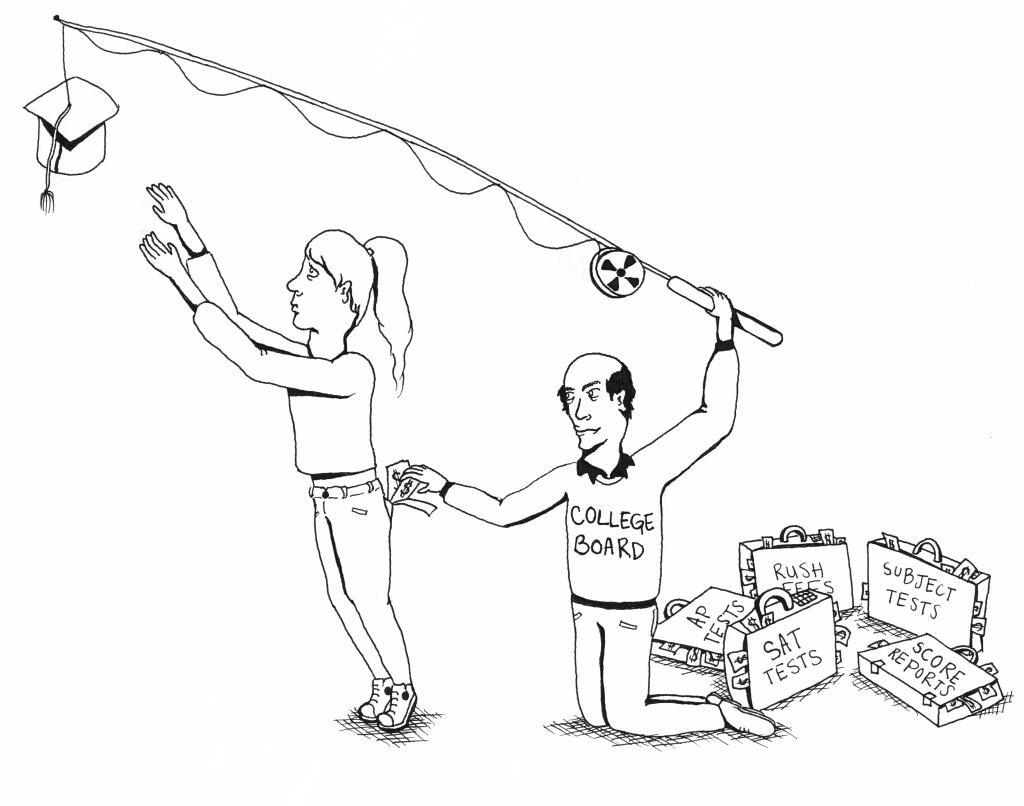
 The SAT is changing.  Again.  For the second time in just over a decade, the College Board, which administers the exam, is planning to redesign the exam.  The details of the redesign aren’t public yet, but it looks like the result will be similar to the last time:  Several cosmetic changes will raise the anxiety of students and their parents but will likely fail to address the deepest problem with the test or even make it worse.  This is good news for people like me, who make a living as an SAT tutor, but bad news for everybody else.
When the redesigned SAT premiered after several years of planning in 2005, there were two major changes, one to content and another to structure.   The old Math and Verbal (renamed Critical Reading) sections were joined by a Writing section, which includes an essay assignment that asks test takers to “develop a point of view on an issue,” such as, “Should we question the decisions made by figures of authority?” or “Can success be a disaster?”  And, as a result of adding Writing to the test, the total length of the test increased by 25 percent, the number of sections went from seven to ten, sections were shortened, and the number of questions in the Math and Reading Sections went down, making each 

Superintendent Mike Miles: Dallas ISD’s investigative unit is abusive, intimidating | Dallas Morning News

Superintendent Mike Miles: Dallas ISD’s investigative unit is abusive, intimidating | Dallas Morning News:

Superintendent Mike Miles: Dallas ISD’s investigative unit is abusive, intimidating

0
1
0
Superintendent Mike Miles, left, and Don Smith, who oversees the Office of Professional Responsibility
A few months before Dallas ISD trustees considered moving the district’s investigative unit, Superintendent Mike Miles had his own plans for the powerful department.
Board members, after floating the idea for more than a year, spent Thursday night considering shifting the Office of Professional Responsibility from Miles’ control. Under the proposal, the Office of Professional Responsibility would report to the Internal Audit department, which answers to the board and not the administration.
Miles didn’t say a word during the discussion Thursday night.
But documents included in the recent investigation of Miles reveals his thoughts on OPR. According to notes from when the district’s top investigator met with Miles, the superintendent called the group abusive and intimidating.
Don Smith, who heads OPR, said Miles told him that OPR “must be on the same page” and “need to follow my guidance.” Miles said that there has been an “overreach of OPR” and “not just because of this case,” according to Smith’s notes.
Smith’s notes recall conversations he had with the superintendent during the district’s initial investigation into Miles in June. The report was eventually handed off to attorney Paul Coggins to complete, after Miles tried to interfere with OPR’s investigation and didn’t fully cooperate. The Coggins report found that Miles violated board policy and tried to disparage trustees.
“The superintendent continued saying ‘we need OPR [and that] from the beginning I have said no big brother and divisive to the group.’” according to Smith’s notes in report by Coggins.
On June 26, Miles talked to him about the future of OPR. Miles told him that the district’s investigations 

10-11-13 The Whole Child Blog — Whole Child Education

The Whole Child Blog — Whole Child Education:


Insights on Leveraging Teacher Leadership
Teachers lead learning in their classrooms every day, but teacher leadership often extends beyond the classroom. Teachers lead their colleagues in professional learning and growth. They lead their communities in bringing change to schools. They might focus on leading within their schools and localities, or they might use social media to share their ideas with fellow educators around the world. Bu
Early Childhood Education: Balancing Expectations and What Young Learners Really Need
Download Podcast Now [Right-Click to Save] What does "education" mean for our youngest learners? The first years of school are as important for an educated population as any other period, perhaps more. Additionally, research shows that implementation of high-quality preschool programs can be beneficial for the lifelong development of children in low-income families and that an upfront
ED Pulse Poll Results: Where Does Early Childhood Education Fit Within Our National Priorities?
ASCD continually seeks to provide solutions to the challenges that face educators of all levels. Recently the ASCD SmartBrief ED Pulse poll addressed where quality early education falls within U.S. priorities and goals. The topic of early childhood education has always been important to certain groups in the United States. But recently it has received more widespread discussion as the governme

The Whole Child Blog 10-10-13 — Whole Child Education
The Whole Child Blog — Whole Child Education: THE WHOLE CHILD BLOGEarly Childhood Education: Balancing Expectations and What Young Learners Really NeedOctober 10, 2013 by Whole Child PodcastDownload Podcast Now [Right-Click to Save]What does "education" mean for our youngest learners? The first years of school are as important for an educated population as any other period, perhaps more.


4LAKids - some of the news that doesn't fit: Common Core: N.Y. DISTRICTS WITH MORE SPANISH-SPEAKING STUDENTS STRUGGLE WITH NEW TESTS

4LAKids - some of the news that doesn't fit: Common Core: N.Y. DISTRICTS WITH MORE SPANISH-SPEAKING STUDENTS STRUGGLE WITH NEW TESTS:

Common Core: N.Y. DISTRICTS WITH MORE SPANISH-SPEAKING STUDENTS STRUGGLE WITH NEW TESTS


WRITTEN BY GARY STERN, THE JOURNAL NEWS/WHITE PLAINS, NY |  HTTP://LOHUD.US/16VT5DU

Oct. 10, 2013   |  Most school districts are trying to come to terms with disappointing results on the new, harder state tests for grades 3 to 8.
But districts with large numbers of Spanish-speaking students got absolutely blasted on the new tests and now have to figure out how to move forward.
“We have children come to us in seventh, eighth, ninth grade with no English skills and little education,” said Robin Brennan, president of the North Rockland Teachers’ Association. “The whole idea of judging these kids, without different criteria for their different needs, is absurd.”
The test results for these districts were stark. In North Rockland schools, 82 percent of seventh-graders failed to hit targets for math. In Port Chester, 85 percent of fourth-graders missed English language arts targets. In Ossining, 84 percent of eighth-graders came up