Latest News and Comment from Education

Saturday, January 28, 2012

For-Profit Colleges: Separate but not equal and the New Jim Crow | Dailycensored.com

For-Profit Colleges: Separate but not equal and the New Jim Crow | Dailycensored.com:

For-Profit Colleges: Separate but not equal and the New Jim Crow

School segregation and the doctrine of separate but equal were the law of the land until 1954 when the Supreme Court ruled in Brown v Board of Education: We conclude that, in the field of public education, the doctrine of “separate but equal” has no place. Separate educational facilities are inherently unequal. .

Sixty years later we have a new type of segregation called for profit colleges. These Wall Street and private equity funded online virtual schools are populated mostly by the low income and minorities, and charge two to five times the tuition of public universities and community colleges.

At these for profit colleges, about 50% of tuition goes to marketing and

Kindergarten? Transitional class? More preschool? Shifting state law and budget has parents confused - Inside Bay Area

Kindergarten? Transitional class? More preschool? Shifting state law and budget has parents confused - Inside Bay Area:

Kindergarten? Transitional class? More preschool? Shifting state law and budget has parents confused

By Sharon Noguchi snoguchi@mercurynews.com
Updated: 01/26/2012 10:17:30 PM PST

For decades, California parents with kids nearing their fifth birthday knew that right about now, they needed to start thinking about registering for kindergarten.

But a new law, a funding crisis and California's Byzantine budgeting ways have turned that certainty on its head. Not only parents, but also schools and even state officials are confused about who can start school in August.

It used to be that children turning 5 years old by Dec. 2 could enroll in kindergarten that year. A new state law rolls back that cutoff date to Nov. 1 this year and orders districts to offer a year of "transitional kindergarten" for children left out.


Math festival for children will be Sunday at UC Berkeley

By Pamela Gocobachi
Correspondent

Students in grades 6-12 who enjoy solving puzzling math problems are invited to attend the Julia Robinson Mathematics Festival hosted by UC Berkeley on Sunday.¿

Participants will work with teachers, professors and graduate students to use math skills to solve fun problems for a chance to win prizes such as books and games.

The festival, named for former UC Berkeley math professor Julia Robinson, aims to share the joys and wonders of math with Bay Area children. Robinson made significant contributions to the solution of Hilbert's Tenth Problem from Hilbert's famous list of the most important mathematical problems for the 20th century.

Obama College-Aid Proposals Underscore Importance of Pell Grants | The Defenders Online | A Civil Rights Blog

Obama College-Aid Proposals Underscore Importance of Pell Grants | The Defenders Online | A Civil Rights Blog:

Obama College-Aid Proposals Underscore Importance of Pell Grants

“A, B, C or D? Really?!?” « Red Pen Warrior

“A, B, C or D? Really?!?” « Red Pen Warrior:

“A, B, C or D? Really?!?”

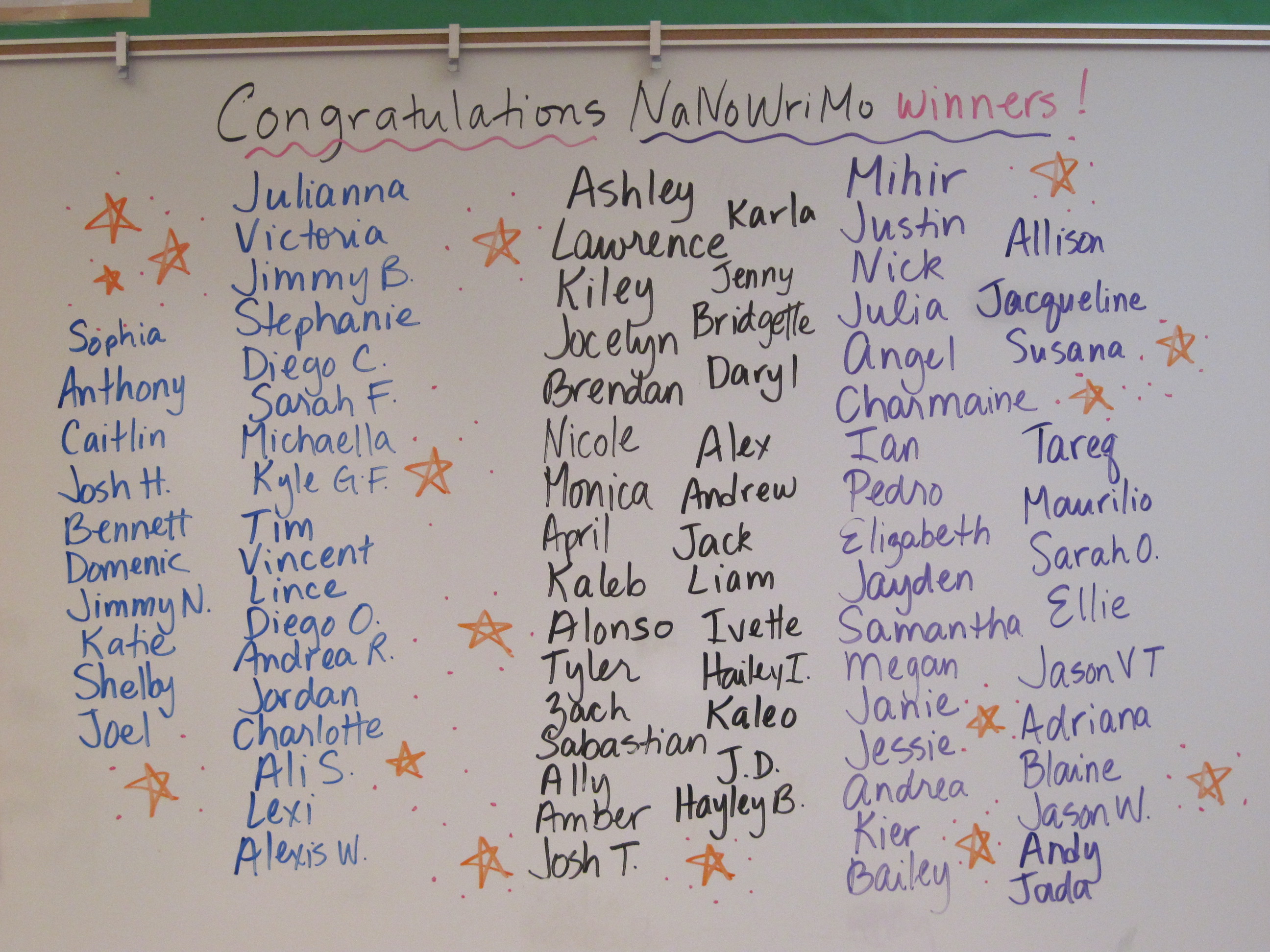
Our frenzied novel writing was repeatedly interrupted on November 30 as students let out yelps of joy when they met their word count goals. Even I disturbed the quiet when I took a writing break, loaded my novel into the NaNoWriMo word validator, and saw “WINNER!” flash across my screen.

“I made it!” I yelled, jumping out of my chair and bowing to my students as they applauded my success. Whew.

What’s This #EDUCON Buzz? « My Island View

What’s This #EDUCON Buzz? « My Island View:

What’s This #EDUCON Buzz?

There are certain education conferences that people look forward to attending each and every year. Certainly the big national conferences with thousands of attendees and hundreds of vendors are the conferences most familiar to educators. The state organizations usually draw big crowds of educators as well. At one time this is how educators networked and saw the newest of the new, and the best of the best. All of that is represented at big education conferences.

With the introduction of the internet, conferencing as an activity has changed. There is a transparency to conferences that was not possible before. Social Media has armed educators with the power to report out exactly what is happening at any conference. Not only are there tweeted comments about the conference, people often comment on specific sessions for all the world to see, blemishes and all. For those who closely follow conference tweets through the use of hashtags, there are many horror stories of presenters who crashed

Why California Students Do Not Know Chicano History - Institute for Democracy and Education

Why California Students Do Not Know Chicano History - Institute for Democracy and Education:

Why California Students Do Not Know Chicano History

Why California students do not understand Chicano/Latino history. 1987- 2011. By Duane Campbell

Textbooks for California schools are selected by the State Board of Education based upon recommendations of their Curriculum Committees and the state frameworks and standards. It is urgent that the History-Social Science Framework be revised to provide an accurate history of the contributions of Mexicans, Mexican Americans, Latinos and Asians to the history of the state and of the nation. The current Framework reflects the historiography of the 1950’s. It was written in 1986 by senior scholars, they in turn were educated in the early 1970’s or before. It is substantially out of date.

Standards and frameworks are products of the people who make the decisions. Frameworks like standards pick winners and losers; the choices which committees make favor one group over another group- choices are based upon the political power of those represented on the committees. The Framework is supposed to be revised each 7 years but it has not been revised. The current Framework reflects the historiography of the 1970’s and the political balance of power of the 1980’s.

During the winter and spring of 2009, a committee of teachers and other educators appointed by the State Board of Education met to review the current History-Social Science

#EDreform - In the Ghetto


As the snow flies
On a cold and gray Chicago mornin'
A poor little baby child is born
In the ghetto

And his mama cries
Cause if there's one thing that she don't need
It's another hungry mouth to feed
In the ghetto

People, don't you understand
The child needs a helping hand
Or he'll grow to be an angry young man some day
Take a look at you and me,
Are we too blind to see,
Do we simply turn our heads

And look the other way
Well the world turns
And a hungry little boy with a runny nose
Plays in the street as the cold wind blows
In the ghetto

And his hunger burns
So he starts to roam the streets at night
And he learns how to steal
And he learns how to fight
In the ghetto

Then one night in desperation
A young man breaks away
He buys a gun, steals a car,
Tries to run, but he don't get far
And his mama cries
As a crowd gathers 'round an angry young man
Face down on the street with a gun in his hand
In the ghetto

As her young man dies,
On a cold and gray Chicago mornin',
Another little baby child is born
In the ghetto
And his mama cries

Saturday coffee + Old school « Fred Klonsky

Saturday coffee. « Fred Klonsky:

Saturday coffee.

A slight dusting of snow fell overnight.

This morning it is sunny, windy and crisp.

Matthew and Harley are running a half marathon along the Lakefront.

I think that’s crazy for a whole bunch of reasons. But Matthew and Harley love running and are in great shape.

Beating the unions with the unions’ help. ALEC calls teachers Nazis.

ALEC calls teacher unions Nazis.

Anthony Cody in EdWeek:

As state after state rewrites their education laws in line with the mandates from Race to the Top and the NCLB waiver process, the teaching profession is being redefined. Teachers will now pay the price – be declared successes or failures, depending on the rise or fall of their students’ test scores. Under NCLB it was schools that were declared failures. In states being granted waivers to NCLB, it is teachers who will be subjected to this ignominy. Of course we will still be required to label the bottom 5% of our schools as failures, but if the

Old school.

The Five Stairsteps.

Popout

Orlando Sentinel: Parent Trigger Bills Are Half-Cocked Ideas | Scathing Purple Musings

Orlando Sentinel: Parent Trigger Bills Are Half-Cocked Ideas | Scathing Purple Musings:

Orlando Sentinel: Parent Trigger Bills Are Half-Cocked Ideas

Florida’s corporate financed parent trigger advocates staged a touchy-feely presser last week between the committee hearings which railroaded the bill onward. While the editors of the Orlando Sentinel stays away from directly criticizing the proponents HB 1191 and SB 1718, they effectively go after the wisdom of parent trigger that opponents habe been trying to let Floridians know about.

It’s understandable that parents who have seen little improvement in their children’s poor-performing Florida schools would have itchy trigger fingers.

So what does the Legislature propose? Putting a powerful weapon in the hands of untrained parents. On Tuesday, state House and Senate committees endorsed so-called “parent trigger” bills that would empower 51-percent parent majorities to select a “turnaround plan” for schools with a

Who's Developing Whom? - Teacher in a Strange Land - Education Week Teacher

Who's Developing Whom? - Teacher in a Strange Land - Education Week Teacher:

Who's Developing Whom?

Why don't schools routinely tap their best teachers to organize and deliver custom-tailored professional development to their peers?

Interesting question.

It seems like a no-brainer, actually. It's standard operating procedure for most professions--the master litigator advising and modeling for researchers just out of law school, the CPA counseling junior partners about weathering tax season--or bright newbies offering training on technical tools veteran haven't yet utilized.

There was a mini-conversation at Twitter over this question:

@BreaktheCurve (Craig Jerald): Never been able to figure out why teachers don't revolt & protest against time-wasting PD.

Virginia may stop requiring some 3rd grade SOLs - The Answer Sheet - The Washington Post

Virginia may stop requiring some 3rd grade SOLs - The Answer Sheet - The Washington Post:

Virginia may stop requiring some 3rd grade SOLs

The Virginia Senate has approved a bill that would require that third graders take the Standards of Learning exams only in math and English, meaning they would no longer have to to take history and science SOLs.

Is that a good idea or a bad one?

The bill, SB 185, would scale back the standardized testing regime for third graders in order to allow them to have more concentrated time learning to read and do math. It awaits a vote in the House.

The idea to cut back on required SOLs in third grade comes from a study that was commissioned last year by the legislation’s sponsor, Sen

A List Serv Conversation | Seattle Education

A List Serv Conversation | Seattle Education:

A List Serv Conversation

I am very fortunate to be a part of several list servs with people participating from all walks of life, with different viewpoints and much to offer.

This week someone posted to the our Parents Across America statewide list serv that we all appreciated. I asked John if I could share what he wrote on this blog and he gave his consent.

John Cummings is a parent, a teacher and a member of Parents Across America, Seattle.

Hey,

I might be in the minority but I feel that conversations such as the conversation on this thread, are really important for our group. The reason why I think this way is because (to allude to a very tired and old cliché) it

From the Corporate Press: Privatization Promoter Pia Lopez: Can we find common ground on schools? - Sacramento Bee

Pia Lopez: Can we find common ground on schools? - Sacramento Opinion - Sacramento Editorial | Sacramento Bee:

Pia Lopez: Can we find common ground on schools?

plopez@sacbee.com

PUBLISHED SATURDAY, JAN. 28, 2012


As a historian who takes the long view, Diane Ravitch, author of "The Death and Life of the Great American School System," is rightly skeptical of "easy solutions" to the problems of American education. In her visit to The Bee's offices on Jan. 20, she showed she has little tolerance for quick fixes, panaceas or miracle cures.

In education, she says, "there are no shortcuts, no utopias and no silver bullets" – and recalling Dumbo, "no magic feathers that enable elephants to fly."

What most draws her historian's ire is boasting and hyperbole – charter schools (or school choice or testing) are the solution, teachers unions (or ineffective teachers) are theproblem, Teach for America teachers are the best, poverty is not a problem. On and on.

She's right that we should question those who think they have all the answers and demonize anyone who thinks otherwise.

But Ravitch herself is not immune from exaggeration or "black and white" categorization. She lumps education reformers in one basket – which she labels as "corporate reformers" dominated by a "billionaire boys' club" (Bill Gates, Eli Broad and others) – and claims they are in the thrall of free markets and seek to privatize public education.

Where do Sen. Ted Kennedy and Rep. George Miller fit in? Or civil rights leaders trying to improve their communities and public schools?

As a nation, it seems to me we've got to find a way to stop talking past each other and get to some common ground. We all have an interest in seeing that public schools are enginies

An Educational Technology Bill of Rights Targets Censorship in Schools - Education - GOOD

An Educational Technology Bill of Rights Targets Censorship in Schools - Education - GOOD:

An Educational Technology Bill of Rights Targets Censorship in Schools

tech.bill.of.rights
Widespread public outrage over SOPA rallied Americans against the threat of internet censorship. But though the bill may be dead, there's plenty of censorship happening every day in our nation's public schools. Schools ban students from accessing websites from National Geographic to YouTube and Wikipedia, and all too often choose to confiscate smartphones and tablets instead of turning them into learning devices.

The bans are usually motivated by a fear of lawsuits—no district wants to be sued a parent whose child inadvertently accesses inappropriate images online—or distractions, but banning technology isn't the answer. Late last year, the teacher-generated Twitter hashtag #pencilchat cleverly mocked schools' technophobia. Now,