Johann Neem: Restoring the Promise of Public Education
Johann Neem is a historian of education. He understands the central importance of public education in our democracy.
He wrote this thoughtful, important commentary about the task ahead for the Biden presidency:
Restoring the Democratic Promise of Public Schools: An Integration Agenda for the Biden Administration– Guest Blog Post by Johann N. Neem
The last four years have taught us just how fractured America is. After a decisive but divisive election, President-elect Joseph Biden now begins the most difficult work ever: trying to weave back together a social fabric that has, after years of neglect, come unraveled. Biden has promised “to restore the soul of America.” At the heart of his vision must be a reinvigorated and renewed commitment to the democratic purposes of public education.
San Francisco’s School Plan Could Offer Other Districts Hope
With relatively low virus rates, the city faces a dilemma over a return to in-person instruction.
SAN FRANCISCO — When the coronavirus came here in March, local leaders seemed to do things right. They issued the nation’s first shelter in place order, promptly shut down schools and businesses and made masks routine. It worked: The city has experienced some of the lowest test positivity rates in the country.
Now, city officials are forging ahead with a tentative school reopening plan hatched earlier this month, and it couldn’t have come at a worse time. The coronavirus has entered a frightening new stage nationwide — triggering school districts around the country to shutter, including in New York City and the entire state of Kentucky — and putting San Francisco on the horns of a dilemma.
The district’s goal of opening some schools could bring relief to thousands of parents and students, but their plan was written for another reality. Virus rates are suddenly spiking, prompting Gov. Gavin Newsom of California on Thursday to issue a nighttime curfew affecting nearly every county in the state, though San Francisco is below the threshold. As a result, officials here face pushback from some unions, teachers and parents.
Ohio Legislative Leader Rams Through Voucher Changes that Hurt Students in Poor, Title I Schools
This post has been updated. The Ohio House has now passed SB 89.
The Ohio Senate is up to its old tricks.
Five years ago right at the end of a spring session of the Ohio Legislature, a group of state senators added a long amendment to House Bill 70, which was about expanding the number of full service, wraparound community learning centers—schools with medical and social services located right in the school. The amendment had nothing to do with the subject of the original bill. The amendment’s purpose was to establish the state takeover of the school district in Youngstown and set up a procedure for state takeovers of other so-called “failing” school districts. A deal had been cut. No opponent testimony was permitted. The Ohio Senate passed the amended HB 70 and sent it back for quick approval by the Ohio House. Within hours, Governor John Kasich had signed it, and without public input, an appointed Academic Distress Commission supplanted the elected school board in Youngstown.
This time the subject is vouchers.
Last spring, just as everything shut down due to the arrival of the COVID-19 pandemic, both houses of the Ohio Legislature debated changes in the EdChoice voucher program and came up with two separate bills. EdChoice eligibility is currently described by legislators as “performance-based.” The state designates EdChoice schools by these schools’ low ratings on the state’s school district report card, which everybody agrees is flawed. Last spring the program was expected to double in size. At angry hearings, school districts complained because EdChoice vouchers are funded through something called “the school district deduction.” The House plan would have funded the vouchers out of the state budget; the Senate plan kept the school district deduction.
The United States Is Not a Democracy. Stop Telling Students That It Is
When U.S. voters recently cast their ballots, an unchecked pandemic raged through the nation, uprisings against racism and police violence stretched into their eighth month, and new climate change-intensified storms formed in the Atlantic.
The reactionary and undemocratic system by which we select our president was an insult to the urgency of the moment. Although millions more people voted for Joe Biden than for Donald Trump — the difference is now 5.4 million — it took several days to learn who won, thanks to the Electoral College. To the relief of many, it appears that this time — unlike in 2000 and 2016 — the candidate who got the most votes nationwide also won the presidential election.
If our students only learn about this exceptionally strange system from their corporate-produced history and government textbooks, they will have no clue why this is how we choose our president. More importantly, they will have a stunted sense of their own power — and little reason to believe they might have the potential to create something better.
To review: A voter in Montana gets 31 times the electoral bang for their presidential ballot than a voter in New York. A voter in Wyoming has 70 times the representation in the U.S. Senate as a voter in California, while citizens in Puerto Rico and Washington, D.C. have none. The Republican Senate majority that recently confirmed Amy Coney Barrett to the Supreme Court was elected by 14 million fewer votes than the 47 senators who voted against her confirmation.
While brand new teachers in St. Johns county get a six thousand dollar raise, veteran teachers, if they got the best and brightest bonus or school recognition money, are about to get a pay cut. Coming soon to Clay and Duval Counties.
People who have dedicated their lives to the children of the area are about to either lose money or not see any notable pay raise. Welcome to Florida
From News4Jax,
“It’s an unfair bill for veteran teachers. Although the people at the lower end of the pay salary scale will be moved up, veteran teachers are going to get a much lesser raise,” St. Johns Education Association Chief Negotiator Justin Vogel said.
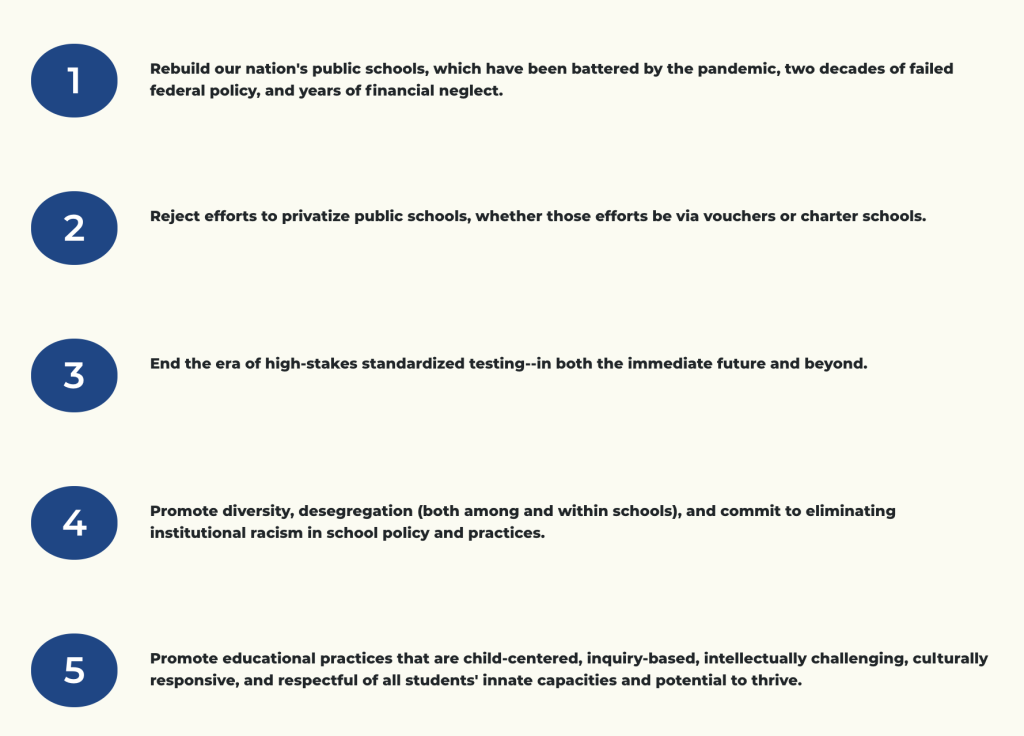
NPE AND GRASSROOTS GROUPS WEIGH IN ON US SECRETARY OF EDUCATION AND AGENDA
The @Network4pubEd leads a coalition of more than 50!! grassroots organizations calling for 5 principles that should be acknowledged in the selection of the next US Secretary of Education. I am honored to have served as a founding board member of NPE since 2013.
Announcing the new book, “Black Lives Matter at School: An Uprising for Educational Justice”–co-edited by Denisha Jones and Jesse Hagopian, foreword by Opal Tometi
The educators, students, and community activists whose stories are documented here are fighting for a transformative vision of what public schools can be, and the grassroots efforts we will need to get there. “Black Lives Matter at School” is an essential resource for all those seeking to build an antiracist school system.—Ibram X. Kendi, National Book Award-winning and #1 New York Times Bestselling Author
With a powerful foreword from Opal Tometi (co-founder of Black Lives Matter), Black Lives Matter at School: An Uprising for Educational Justice succinctly generalizes lessons from successful challenges to institutional racism that have been won through the Black Lives Matter at School movement.
This book will inspire educators to join the Black Lives Matter at School movement at a moment when antiracist work in education could not be more urgent.
Check out the new video trailer for the book and share it with an educator, parent, student, or community organizer who may be interested in joining the movement:
Pre-orders for the forthcoming, Black Lives Matter at School are available by clicking this link
An amazing group of educators, students, writers, and organizers are contributing authors to Black Lives Matter at School:
Tamara Anderson, Awo Okaikor Aryee-Price, Wayne Au, Takiema Bunche-Smith, Erika Strauss Chavarria, Rosy Clark, Anthony Dandridge, Marshé Doss, Maria C. Fernandez, Brian Ford, Rosie Frascella, Laleña Garcia, Beth Glenn, Nathaniel Genene, Kiersten Greene, Angela Harris, Raquel James-Goodman, Jennifer Johnson, Brian Jones, Erika Jones, B. Kaiser, Makai Kellogg, Bettina L. Love, Dana Morrison, Cecily Myart-Cruz, Dermott Myrie, Israel Presley, Marynoel (Noel) Naa Lamiley Riby-Williams, Christopher Rogers, Kalani Rossman, and Jeff Stone.
Praise for Black Lives Matter at School:
“We need this book right now. The shadow-loving fungus of white supremacy won’t continue to send its spores to infect our children if we act now to bring the curative light of anti-racist knowledge, compassion, and justice into their lives. Built upon the Black Lives Matter at School organization’s Week of Action, this volume provides the adults in our educational institutions with inspiration, organizing principles, strategies, and examples to take ‘bold action against anti-Blackness.’ The authors – visionary educations of what is possible – call on all of us to radically reshape learning environments to make them safe, supportive, and transformative for all students (and teachers). Please read ASAP!” — Lisa Delpit, Executive Director of the Center for Urban Education and Innovation at Florida International University
“There is no easy way to talk about the complexities of race facing our school system in America—but we have to talk about it if we are ever going to achieve the schools our children deserve. The Black Lives Matter at School movement has been disrupting the complacency of those who, for too long, have been comfortable not having these conversations about the impact of racism in the schools. Black Lives Matter at School is a playbook for undoing institutional racism in the education system. — Michael Bennett, NFL defensive lineman, Superbowl champion, and author, Things That Make White People Uncomfortable
“This book asserts that we are at a critical moment in time, where the racial uprisings underpin the absolute need to transform education and it’s foundational practices. Black Lives Matter is a movement sweeping the globe and affirms that our babies lives matter. It’s time for educators to be bold, standing up for our students and communities. Our students are looking to us to lead the fight against injustice and dismantle systemic racism as we aspire to realize the schools our students deserve.” — Cecily Myart-Cruz, UTLA President, NEA Black Caucus Chair
“This book makes the strong case for why we need to elevate Black lives and people in our curriculum and pedagogy year-round. This book serves as a blueprint to achieve this honorable goal.” — José Luis Vilson, author, This Is Not A Test, A New Narrative on Race, Class, and Education
“Black Lives Matter at School centers the humanity of our children. It is a sharp rebuke of white supremacy—the very thing that interrupts the healthy development of Black youth. School communities must affirm Black lives. Educators have to dismantle systems of oppression—systems that we influence daily. We have to be radically different from the missionary educator depicted in popular culture. BLM at School is essential. Period.”— Stacy Davis Gates, Vice President, Chicago Teachers Union
“Toni Morrison reminds us: ‘If you can’t imagine it, you can’t have it.’ This book helps us to imagine Black Lives Mattering in schools. With accounts from teachers across the country doing the work, along with student interviews, poems, posters, and historical background, this is a primer for anti-racist educators to see the way forward in terms of reshaping school curriculum, diversifying teacher hiring, and transforming school discipline.”— Jeanne Theoharis, author, A More Beautiful and Terrible History: The Uses and Misuses of Civil Rights History
Post-Election Teaching Strategies is the headline of my latest Education Week Teacher column. Four teachers share suggestions for post-election lessons, including focusing on local issues and practicing media literacy. Here are some excerpts:
is the headline of my latest Education Week Teacher. Four students write about their online learning experiences, and it’s not a pretty picture…. Here are some excerpts:
Megan_Rexazin / Pixabay Here are new additions to THE BEST POSTS PREDICTING WHAT SCHOOLS WILL LOOK LIKE IN THE FALL : Many districts, including @officialSCUSD , would be smart to make the same decision and put tons more resources into supporting tchrs dev better remote tching AND more social services to support the students we're losing https://t.co/TklGSL3lhf — Larry Ferlazzo (@Larryferlazzo) No
Write to Reward Your Reader is by Bill Birchard and was just published at the Harvard Business Review. And, it’s a real interesting one. He basically repackages (with some twists) what a lot of us teach our students about writing in a neuroscience framework that is very concise, emphasizing that good writer should follow these rules: Keep it simple Keep it specific Keep it stirring Keep it social
I thought that new – and veteran – readers might find it interesting if I began sharing my best posts from over the years. You can see the entire collection here . I’m starting with posts from earlier this year. I’ve previously posted