Diane Ravitch's blog | A site to discuss better education for all

Diane Ravitch's blog | A site to discuss better education for all

Diane Ravitch's blog | A site to discuss better education for all
President-elect Joe Biden has a far-reaching education agenda that begins with actions to help schools reopen for in-person instruction, as well as plans to reverse key Trump administrative actions and more.
In a recent, on-the-record webinar, the Biden campaign’s national policy director, Stef Feldman, fielded questions from the Education Writers Association and its members from around the country.
Below are key excerpts from that wide-ranging, one-hour conversation on October 22, 2020. Journalists and others are welcome to quote from the transcript here, though we ask that you cite the EWA webinar as the source. You can also watch the full video.
On some issues, Feldman declined to make firm commitments. For example, she stopped short of saying whether a Biden administration would grant states a waiver for a second year of statewide testing required under the federal Every Student Succeeds Act. “This is an important question that a Biden/Harris transition team would have to look at,” she said. “In some ways, the answer to this question depends on how much CONTINUE READING: Top Biden Aide Talks Reopening Schools, Education Funding, Charters and More - Education Writers Association
The first day of my first year of teaching began with a bundle of nerves and a half-eaten honey bun. At 5:30 a.m., I drove from the cheap apartment I shared with five roommates to the high school in Prince George’s County, Maryland, where, 22 years old and just a year out of college, I’d been hired to teach English. My trunk was full of colorful posters, flip charts, and laminated quotes from my favorite writers. I was hoping to make my stuffy, windowless classroom a more inviting space for my students.
As I drove, I practiced how I would present myself, searching for the sort of first impression that would make me seem authoritative yet approachable. Could I be the “cool” teacher, inviting students to share what was happening in their lives, but also a figure of authority? Could I be empathetic, sensitive to the difficulties transpiring in their lives, yet not let such circumstances create a spiral of low expectations? Could I emphasize the importance of doing well on the state exam, while also making sure my students knew I didn’t believe that learning could be measured by a multiple-choice test on a single day of the year? I am only slightly embarrassed to say that in search of insight and inspiration, I had watched several Denzel Washington and Morgan Freeman movies in the weeks leading up to that day.
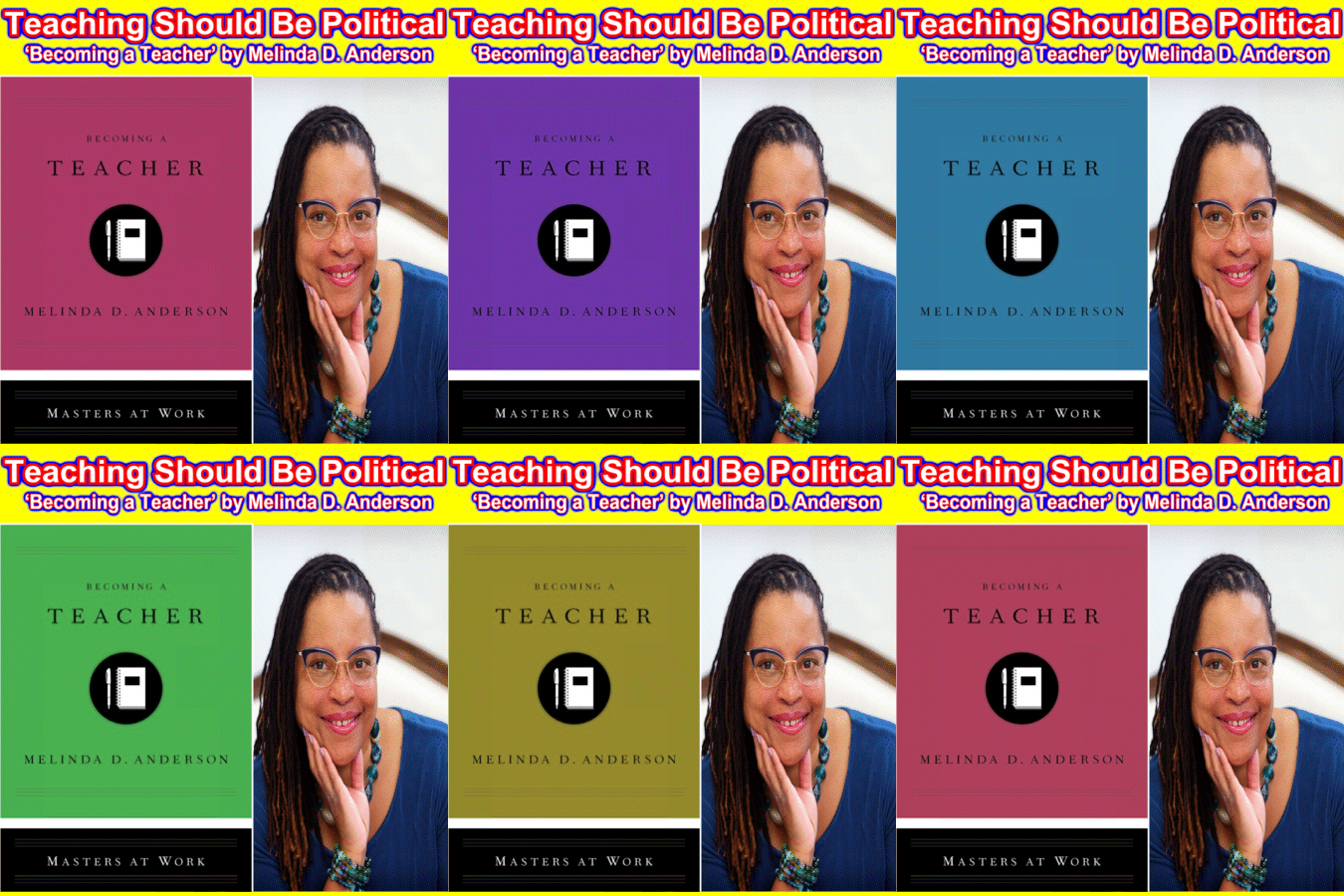
These memories came back to me while reading Becoming a Teacher, by Melinda D. Anderson, an education journalist based in Washington, D.C. Anderson follows LaQuisha Hall during the 2018–19 academic year, just after Hall had been named Baltimore City Public Schools Teacher of the Year, and into the following, pandemic-disrupted year. Hers was hardly a representative experience. Except that in important ways, it was.
Anderson’s profile, part of a Masters at Work series of slim volumes, reaches back to Hall’s uncertain first days in a high-school classroom, more than a decade and a half ago, to trace a transformation. A core theme of the book is a notable, and by now almost unavoidable, shift in perspective taking place among Black educators—and other teachers, too—working in places that have endured decades of systemic racism, economic disinvestment, generational poverty, crime, and violence. Starting out as a 21-year-old transplant from North Carolina, Hall hadn’t understood what became steadily clearer to her: The work of teaching, for her and for her teenage students, was most meaningful when it was part of a larger commitment to addressing the realities of the historically oppressed and underresourced communities they were growing up in.
To be ushered by Anderson into Hall’s current classroom at Carver Vocational- CONTINUE READING: Review: ‘Becoming a Teacher’ by Melinda D. Anderson - The Atlantic
The Ohio Legislature will waste no time before trying to enact—before the end of the current legislative session at the end of December—a Fair School Funding Plan, which was proposed in the spring of 2019. The Ohio House has been holding hearings for months on what, this week, became Substitute House Bill 305. Last week Senate Education Chair, Peggy Lehner, and 14 additional co-sponsors introduced a companion bill, Senate Bill 376.
The Columbus Dispatch‘s Catherine Candisky summarizes the Ohio Legislature’s attempt to move forward immediately to pass the new school funding blueprint: “A bipartisan group of state lawmakers on Friday unveiled a complex and long-sought overhaul of Ohio’s school funding system that would provide another $1.99 billion a year—about a 24% increase—to K-12 schools when fully implemented. The proposal to change the way state aid is calculated and distributed to public schools establishes the per-pupil cost of ‘a quality education,’ and determines how much funding each local community should be able to cover itself and how much should come from the state. It aims to keep overall funding levels relatively even across the state despite widely varied tax bases across Ohio’s more than 600 school districts.”
The term-limiting of several of the plan’s co-sponsors is accelerating the timeline for seeking the bill’s passage before the end of 2020.
Here is the primary reason why a new school funding plan is needed in Ohio. Materials released when the new funding plan was introduced in the spring of 2019 showed that before the current biennium, in 503 of the state’s 610 school districts, state school funding was capped or the district had fallen onto a hold-harmless guarantee. Then the current biennial CONTINUE READING: Ohio Legislature Looks to Adopt New School Finance Plan During 2020 Lame Duck Session | janresseger
Every job has its share of surprises. A key piece of equipment breaks down. A traffic accident forces a change in delivery routes. A client calls to say you’ve won the contract–but they need the order filled three months earlier than planned. No matter where you work, you need to be able to improvise to meet your objectives, or at least cut your losses.
“The Presidency was no different,” former tenant in the White House Barack Obama said in describing his job.
He describes his Party’s fight for the Affordable Care Act in 2009-2010 in his first term. Improvising political decisions with both Democrats and Republicans while juggling scores of other issues that beset any President captures what he and his partners had to do repeatedly. Obama knew well those compromises, dotted with sudden and unexpected twists and turns, had to be dealt with. Improvisation was the order of the day when it came to health care.
Re-read the epigraph. It also applies perfectly to teachers teaching and their unplanned decision-making that they manage in trying to meet their lesson objectives.
Non-teachers would be amazed at the many decisions teachers make during a 45-minute lesson, the frequency of on-the-fly, unplanned decisions, and the seemingly effortless segues teachers make from one task to another. Decisions tumble out one after another in questioning students, starting and stopping CONTINUE READING: Teachers as Improvisers | Larry Cuban on School Reform and Classroom Practice
SACRAMENTO—State Superintendent of Public Instruction Tony Thurmond announced today that the California Department of Education (CDE) has released, for the first time, statewide absenteeism data that provides information about the types of reasons students are absent. The “absenteeism by reason” (AR) reports available on the CDE Dataquest website offer an extensive statewide view of absenteeism numbers that can assist local educational agencies (LEAs) in their efforts to develop targeted attendance intervention strategies and support.
“Knowing why students are missing school is a crucial step in helping them stay in school,” said Thurmond. “These data add an extra layer of transparency to existing absenteeism information and a level of detail that school districts can utilize as they evaluate the effectiveness of existing attendance plans and compare absenteeism rates with other districts. It also creates an opportunity for school attendance staff throughout the state to collaborate and share best practices on methods to improve attendance, identifying specific actions that can help students and their families overcome attendance barriers.”
The CDE developed the new AR reports based on student absence data submitted and certified by LEAs and independently reporting charter schools through the California Longitudinal Pupil Achievement Data System (CALPADS). The catalyst for providing this data came from a recommendation proposed by the State Superintendent’s Improving Data Collection Workgroup that was convened in the summer of 2019. One of the goals for the workgroup was to improve the availability of publicly reported data. Although AR information is annually collected through CALPADS, this critical measure of student attendance has not been reported until now.
The data available in this release include the 2017–18 and 2018–19 academic years. The AR report categories are: excused absences, unexcused absences, absences due to out-of-school suspension, and incomplete independent study absences. Even if a student has excused absences, they are considered chronically absent if they miss 10 percent of the days they were expected to attend school.
The reports provide data disaggregated by race/ethnicity, student groups, grade level, and by academic year. The reports also include filters that allow the data to be viewed along a variety of dimensions, including by school type (charter and non-charter schools), for alternative and traditional schools, for chronically absent and non-chronically absent students, and by gender.
In addition to statewide data, the reports are also available at the district and school levels. Downloadable data files that support many aspects of the new AR reports are also available. To view the AR reports, visit the CDE Dataquest website. Downloadable data files can be found on the CDE Data & Statistics web page.
| Reporting Category |
Average Days Absent |
Excused Absences | Unexcused Absences | Out-of-School Suspension Absences | Incomplete Independent Study Absences |
|---|---|---|---|---|---|
|
African American |
13.2 |
38.1% |
52.7% |
2.6% |
6.5% |
|
American Indian or Alaska Native |
13.6 |
45.2% |
43.9% |
2.0% |
8.8% |
|
Asian |
6.2 |
66.3% |
31.0% |
0.5% |
2.2% |
|
Filipino |
7.3 |
64.2% |
32.1% |
0.6% |
3.1% |
|
Hispanic or Latino |
10.3 |
51.1% |
42.7% |
1.2% |
5.0% |
|
Pacific Islander |
12.3 |
49.1% |
44.9% |
1.2% |
4.9% |
|
White |
9.1 |
64.0% |
29.4% |
1.0% |
5.5% |
|
Two or More Races |
9.3 |
58.4% |
33.5% |
1.3% |
6.8% |
|
Not Reported |
10.3 |
50.8% |
38.0% |
1.2% |
9.9% |
|
English Learners |
9.7 |
51.0% |
44.0% |
1.1% |
3.8% |
|
Homeless Youth |
14.3 |
39.8% |
50.6% |
1.7% |
7.9% |
|
Students With Disabilities |
12.8 |
51.9% |
41.5% |
2.0% |
4.6% |
|
Foster Youth |
15.3 |
36.4% |
51.0% |
4.3% |
8.3% |
|
Migrant Youth |
8.1 |
54.3% |
41.2% |
1.7% |
2.8% |
|
Socioeconomically Disadvantaged |
10.9 |
49.1% |
43.9% |
1.4% |
5.6% |
| Statewide | 9.8 | 54.1% | 39.5% | 1.2% | 5.2% |
# # # #
Tony Thurmond — State Superintendent of Public Instruction
Communications Division, Room 5602, 916-319-0818, Fax 916-319-0100