Latest News and Comment from Education

Tuesday, September 29, 2020

Opinion | What Parents Need to Know About School Coronavirus Case Data - The New York Times

Opinion | What Parents Need to Know About School Coronavirus Case Data - The New York Times

What Parents Need to Know About School Coronavirus Case Data
Some reported cases come from districts that are operating fully remotely, or districts in which the cases occurred before school was open.


It is the start of a school year unlike any other. Many schools, especially in large urban districts, are fully remote. In New York, school opening was announced and then delayed. Some schools have opened and then grappled with quarantine. Others started closed and are now opening.
As this has been happening, I’ve been talking and writing a lot about school opening and the best ways for parents and educators to gauge the risks involved. My central message has been that we need to focus on the denominators.
What does that mean?
Much of the reporting on schools has focused on cases of Covid-19. There are several dashboards, including in The Times, which do an excellent job of collecting the available information on coronavirus cases in schools. That information is limited, but it has grown over time.
What these reports lack, though, is a sense of the size of the pool. Knowing that there are five cases associated with a school may be useful information, but it is difficult to interpret that information without knowing whether those cases occurred in a school of 15 students or a school of 1,500.

One way to think about it: If there are five cases in a school of 15, then if your child interacts with other children randomly, there is a 35 percent chance that they interact with someone who has Covid-19. If there are 5 cases in a school of 1,500, there is a 0.33 percent chance. That’s the denominator.
Denominators are part of the larger context, but they are not the only piece.
We also need to understand what schools are doing. Are they undertaking mitigation? Masking? Distancing? Are they open at all? Some reported cases come from districts which are operating fully remotely, or districts in which the cases occurred before school was open. In both of those situations, the cases have nothing to do with schools, they just happen to be among school-affiliated people. Without linking the cases to their context, it is very difficult to understand what the numbers mean. CONTINUE READING: Opinion | What Parents Need to Know About School Coronavirus Case Data - The New York Times

Dear Students, Now That The 2020 School Year Kicked Off, Please Help Us Find Our Way - Philly's 7th Ward

Dear Students, Now That The 2020 School Year Kicked Off, Please Help Us Find Our Way - Philly's 7th Ward

DEAR STUDENTS, NOW THAT THE 2020 SCHOOL YEAR KICKED OFF, PLEASE HELP US FIND OUR WAY


To the Tremendous Energy at the Start of an Unprecedented School Year
Growing up, I attended a small Catholic grade school in East Camden. We were a small community, but a community nonetheless. At the start of every school year, I could depend on seeing the same familiar faces; whether I cared for some of those faces or not is another story. But I digress.
Two things made our school uniquely different in my adolescent view. First, we were taught Catholicism; it was core content. However, it made for interesting conversations with the elders of my Black Baptist Church-going family. Second was that white kids didn’t attend our school; our school was an amalgam of Latinx and Black kids with mostly, if not only, white teachers and administrators.
It wasn’t the same for high school.
I attended a Catholic high school and while I was sadly accustom to learning from all white teachers, it was the first time that I would share classroom space with white kids. Although I had all white teachers in grade school, our student body gave me a level of comfort; we and our families were the CONTINUE READING: Dear Students, Now That The 2020 School Year Kicked Off, Please Help Us Find Our Way - Philly's 7th Ward

Join Katherine Stewart and Me to Discuss the Assault on Public Schools | Diane Ravitch's blog

Join Katherine Stewart and Me to Discuss the Assault on Public Schools | Diane Ravitch's blog

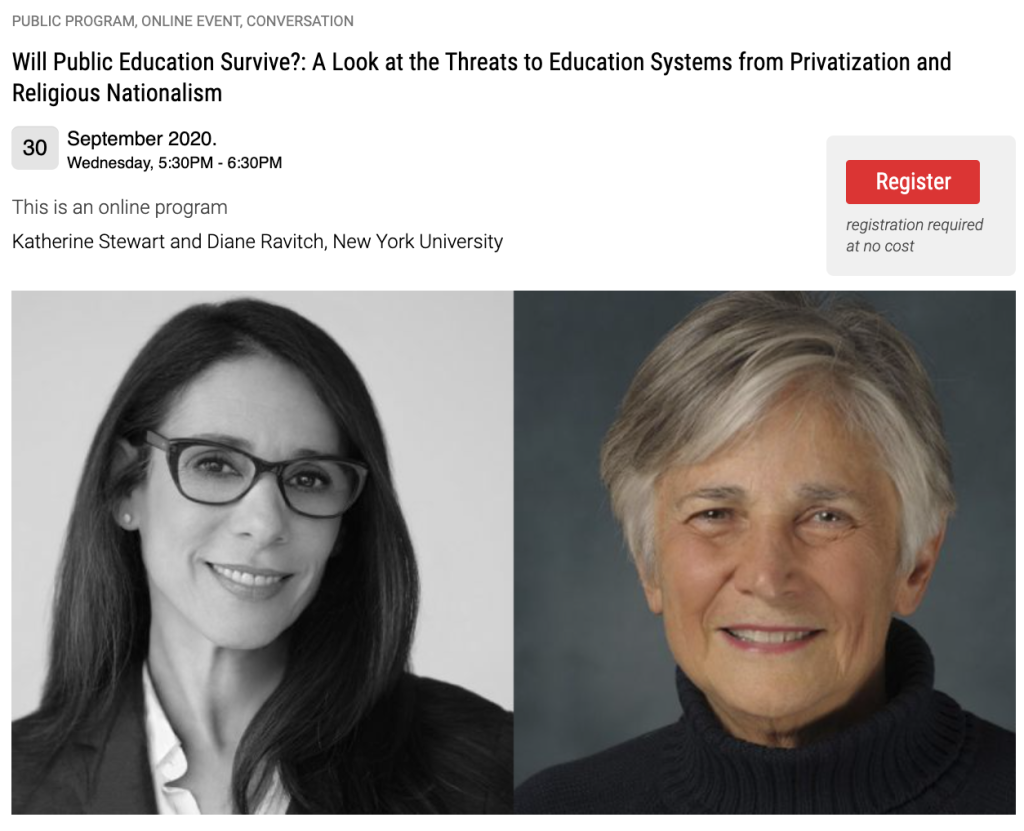
Join Katherine Stewart and Me to Discuss the Assault on Public Schools


[intro]
The rise of the Religious Right has coincided with the privatization movement in public schools. While some may feel that this is coincidental, there is reason to believe there is a directly causal relationship between these two factors. Two scholars, from different disciplines, will discuss how their work comes together to help explain the history and current state of efforts to diminish, if not dismantle, the American public education system. Katherine Stewart has written on the rise and increasing power of the Religious Right in her book The Power Worshipers. She will be joined by Diane Ravitch who has written extensively on education and, in her recent book Slaying Goliath, explores the history of the school privatization movement and the efforts to oppose it.
Please note, this is an online event held on the video conference platform, Zoom. Registrants will receive an email with links to join the program.
Join Katherine Stewart and Me to Discuss the Assault on Public Schools | Diane Ravitch's blog

Meet Sacramento’s ‘Squad’: Four Women Fighting For Progressive Issues And Police Reform This Election - capradio.org

Meet Sacramento’s ‘Squad’: Four Women Fighting For Progressive Issues And Police Reform This Election - capradio.org

Meet Sacramento’s ‘Squad’: Four Women Fighting For Progressive Issues And Police Reform This Election


You may have heard of “The Squad” on Capitol Hill — four progressive, elected women of color standing up against the status quo on both sides of the aisle — but Sacramento now has its own local “Squad,” too. 

The city’s version is made up of Katie Valenzuela, Tamika L’Ecluse, Mai Vang and Zima Creason, who came together during the June demonstrations in solidarity with George Floyd. Now, the four electeds are demanding police reform and accountability. But they also hope to become a force that will bring greater progressive change. 

The nickname started after they came forward with an initiative — called Sac Take the Pledge — urging officials to stop accepting campaign donations from law enforcement groups. 

“We didn’t give ourselves that name, but we were given that name by the community because we represent in that way,” said Creason, a member of the San Juan Unified School District board. “We want to be brave and have the hard conversations.” 

They’re already organizing against Measure A, the city’s “Strong Mayor” ballot measure, and are also working to get fellow “Squad” member Mai Vang elected to City Council. And the group says they’re just getting started.

Critics argue that the progressive movement is still small, and that their promises may be bigger than what they can deliver. 

“It’s easy to say that in a campaign, but when they get in [to office] and they have the obligation of serving their community, they realize some of those positions they’ve advocated for in a campaign CONTINUE READING: Meet Sacramento’s ‘Squad’: Four Women Fighting For Progressive Issues And Police Reform This Election - capradio.org

Teacher Tom: Where They are the World's Leading Experts

Teacher Tom: Where They are the World's Leading Experts

Where They are the World's Leading Experts


A couple weeks ago I wrote a piece about what is popularly referred to as "loose parts," or what I prefer to call "junk and debris." One reader referring to a body of research that consistently finds that children engaged in loose parts play use more math language and more elaborate vocabulary than children playing with traditional toys or during structured play and wondered why that would be.


I don't know for sure, of course, but I expect that it has to do with the fact that open-ended, unscripted playthings cause children to engage in more cooperative play, which requires communication, not with adults, but with other kids who are likewise learning math and vocabulary. Whereas "toys" and adult-lead activities tend to be more predictable, with many of their answers built into them, children interacting with loose parts are more likely to run across new concepts and unexpected challenges, situations that require children to CONTINUE READING: 
Teacher Tom: Where They are the World's Leading Experts

Billionaire Reed Hastings Gives $925,000 to Charter Candidate for LAUSD | Diane Ravitch's blog

Billionaire Reed Hastings Gives $925,000 to Charter Candidate for LAUSD | Diane Ravitch's blog

Billionaire Reed Hastings Gives $925,000 to Charter Candidate for LAUSD


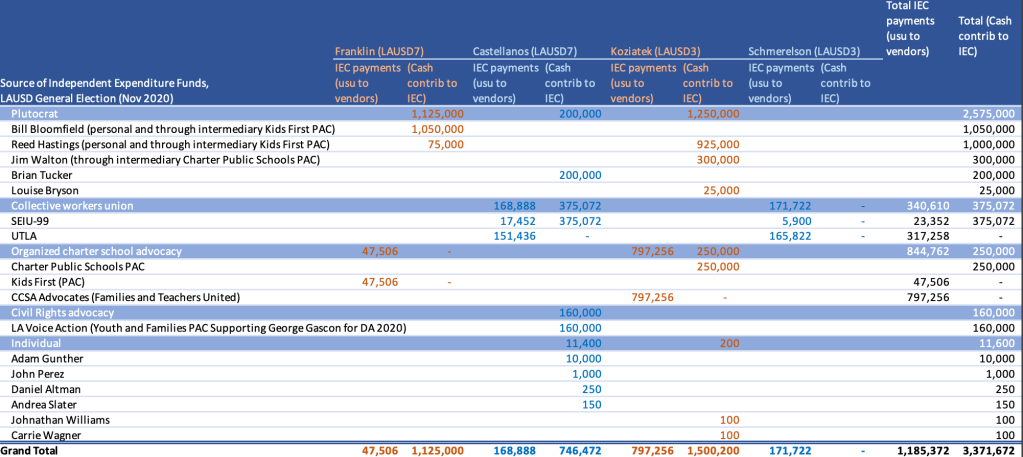
Once again, control of the Los Angeles Unified School District school board is up for grabs, and once again the billionaires hope to buy control so they can expand the number of charter schools. The latest financial disclosures show that Reed Hastings of Netflix has contributed $925,000 to try to defeat veteran educator Scott Schmerelson. Billionaire Jim Walton of the Walmart family added another $300,000. The charter lobby is flush with money to buy TV ads and flyers that smear Schmerelson and use vicious anti-Semitic tropes in their attack ads. The charter lobby is angry at Schmerelson for two reasons: 1. He fights fearlessly for the 80% of students in public schools. 2. He released the explosive fact that 80% of Los Angeles’ charter schools have vacancies, not waiting lists. His opponent Marilyn Koziatek has no experience in the public schools; she holds an administrative job in a charter school.
Download the .pdf here.
Note: Sara Roos of Los Angeles (blogger Red Queen in LA) prepared the graph of political expenditures based on public records.

Another Look at “Tinkering Toward Utopia” | Larry Cuban on School Reform and Classroom Practice

Another Look at “Tinkering Toward Utopia” | Larry Cuban on School Reform and Classroom Practice

Another Look at “Tinkering Toward Utopia”


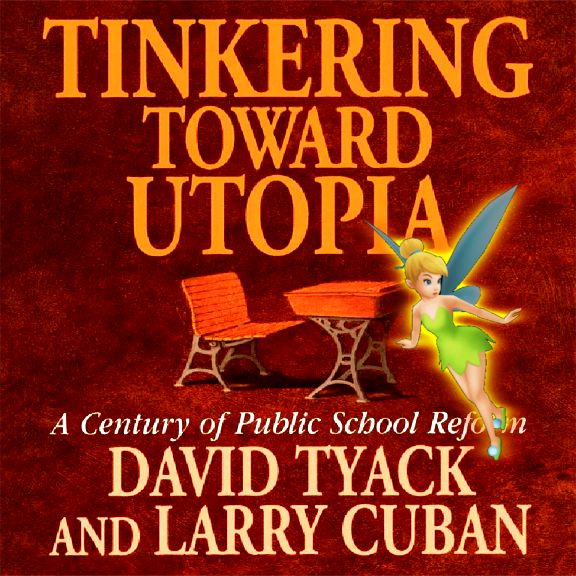
2020 marks a quarter-century since Tinkering was published. Still in print, the short book on the history of school reform that David Tyack* and I wrote has been praised and panned. Over the years, David and I have spoken and written about the ideas we expressed in the book about history of U.S. school reform and subsequent shifts that we have seen in reform-minded policies pushed by federal and state authorities. And, of course, the hyperbole that accompanied each reform’s rhetoric, action, and implementation.
We have been asked many questions over the years about the logic of the central argument we made and evidence we had to support it. We have been asked about why schooling (both private and public) seem so familiar to each generation of parents even with new buildings, furnishings, and technologies.
Not long ago, however, I was asked one question that I don’t remember ever being asked: Whose utopia are you tinkering toward?
That question returns to me during the current pandemic as U.S. public schools  shut down for a half-year erratically open for in-person schooling but, more often than not, with remote instruction. The question got me thinking anew about the ever-shifting aims of reformers who champion how schools should be. “Should be” is the key phrase in reform because buried within each major reform that has swept across U.S. schools with either gale-force winds or stiff breezes is a vision of a utopian schooling and a “good” place for children to be.
As schools re-open still in the midst of Covid-19, online instruction for the CONTINUE READING: Another Look at “Tinkering Toward Utopia” | Larry Cuban on School Reform and Classroom Practice

Please be careful, NYC elementary school teachers | JD2718

Please be careful, NYC elementary school teachers | JD2718

Please be careful, NYC elementary school teachers


This is not your fault. This was not your decision.
Odds are, no one asked you, the person who knows the job best, what you thought. What you think.
The planning for today, Tuesday September 29, the first day of elementary school in NYC, that planning has been dumped on principals. Some principals are smart and clever. But no principal has been trained in organizing a school to operate.
I’m not there, and I’m excited and nervous for the first day. I am not the only high school teacher who is terrified of those little kids – I do not know how you do it.
I hope the little ones are used to seeing adults in masks by now. I know first day meltdowns occur, and hope you get lucky and have none. But thinking about that makes me tens.
I’m more concerned by procedures – in those schools where the principal was not necessarily so great at the planning details. How smooth is the entry? Is social distancing more or less maintained? Have they figured out what to do with kids who come on the wrong day? Or has your school been absolutely excellent at making sure that parents only come on the right day? Is there a good procedure for moving kids to your room? I guess double lines are out… I love double lines. I’m hoping that once they are in your room they are in better hands, and the teaching (socially distanced of course) takes over and provides structure. Even us high school folks make classroom rules – though probably not as creatively as you.
All of those entry procedures (and dismissal, too), all of that was up to the principal to plan. 1800+ CONTINUE READING: Please be careful, NYC elementary school teachers | JD2718

Many Arkansas Teachers Refuse In-Person Classes Amid COVID-19 Concerns | 89.3 KPCC

Many Arkansas Teachers Refuse In-Person Classes Amid COVID-19 Concerns | 89.3 KPCC

Many Arkansas Teachers Refuse In-Person Classes Amid COVID-19 Concerns


In Little Rock, Arkansas, more than a hundred teachers didn't show up for class on Monday.
Instead, at least 166 instructors represented by Little Rock Education Association say they are concerned about COVID-19 and only willing to teach remotely. Until the district allows for remote-only instruction or increases school safety, they say they will stay home, according to a union statement.
"Our schools are NOT safe. Someone is going to get sick and someone is going to die if we continue in the current manner," association President Teresa Knapp Gordon said in a statement.
The statement detailed a lack of adherence to COVID-19 safety guidelines and concerns about the rising number of coronavirus cases.
"This is not a strike," Gordon continued. "We are completely and totally willing to work and serve our students virtually in a manner that keeps everyone safe and alive."
The district, however, isn't budging.
Mike Poore, Little Rock School District superintendent, said in a letter that there are "no plans to close schools."
On Monday, a combination of substitutes, district staff and members of the state CONTINUE READING: Many Arkansas Teachers Refuse In-Person Classes Amid COVID-19 Concerns | 89.3 KPCC

CURMUDGUCATION: AI: Still Not Ready for Prime Time

CURMUDGUCATION: AI: Still Not Ready for Prime Time

AI: Still Not Ready for Prime Time


You may recall that Betsy DeVos sued to say, often, that education should be like hailing a Uber (by which she presumably didn't intend to say "available to only a small portion of the population at large). You may also recall that when the awesomeness of Artificial Intelligence is brought up, sometimes in conjunction with how great an AI computer would be at educating children.

Yes, this much salt
Well, here comes reminder #4,756,339 that this kind of talk should be taken with an acre of salt. This time it's an article in The Information by Amir Efrati, and it starts out like this:

After five years and an investment of around $2.5 billion, Uber’s effort to build a self-driving car has produced this: a car that can’t drive more than half a mile without encountering a problem.


We're talking $2.5 billion-with-a-B dollars spent with nothing usable to show for it. Unfortunate for something that has been deemed for Uber as "key to its path to profitability." Meanwhile, corporations gotta corporate-- a "self-driving" Uber killed a pedestrian in Temp, Arizona back in 2018, and the court has just ruled that while Uber itself is off the hook, the "safety driver" will be charged with negligent homicide. She mad the not-very-bright assumption that the car could do what its backers said it could do.

Meanwhile, Microsoft has absorbed partnered with OpenAI, the folks whose GPT-3 language emulator program is giving everyone except actual English speakers chills of excitement. Not CONTINUE READING: CURMUDGUCATION: AI: Still Not Ready for Prime Time

A FIRING OFFENSE – Dad Gone Wild

A FIRING OFFENSE – Dad Gone Wild

A FIRING OFFENSE


“No matter what happens in the world, however brutal or dystopian a thing, not all is lost if there are people out there risking themselves to document it. Little sparks cause fires, too.”
― Tomasz Jedrowski, Swimming in the Dark
The field of student assessments is a complex one. Its a field heavily reliant on high level math, complex algorythm, and a deep understanding of subject matter. Used properly, assessments can give great insight into student progress, where the gaps in learning fall, and effective practices. It can give better guidence on the deployment of resources and help shape policy in order to benefit kids, and ultimately society.
Unfortunately the flip side can be particularly damaging. It can lead to the prescription of unneccessary and harmful learning plans. Resources being squandered due to mis-perceptions. Mis-interpretations and mis-use can result in teachers and schools being painted in an inaccurate light, giving the public the misperception that they are failing kids, and as a result, hampering educator efforts.
For these reasons and more, great care needs to be taken in intrepetating data and creating a narrative around those intrepations. Two things that Tennessee’s Commissioner of Education Penny Schwinn failed to do when she stood in front of reporters and declared that data showed that due to the pandemic, and specifically a lack of students attending brick and mortar schools, proficency scores in literacy were expected to fall by 50% and math by 60%. Needless to say, CONTINUE READING: A FIRING OFFENSE – Dad Gone Wild

Monday, September 28, 2020

1619 | Teacher in a strange land

1619 | Teacher in a strange land

1619


When I was a junior in HS, my American History teacher was in a serious car accident in the fall, and did not return to teaching. This was 1967, and Social Studies teachers weren’t thick on the ground. The situation was personally worrisome: I had somehow persuaded this history teacher to let me take his required class as an ‘Independent Study’ so I could take both band and choir (which were infinitely more important to me than American History).
As rounds of fill-in teachers appeared, I was basically living in fear that my arrangement with Mr. Gilbert would be uncovered. He apparently left no record that I was even part of his class load. I might have to drop out of the choir—and I loved the choir—being coerced to return to conventional, one-chapter-a-week-test-on-Friday American History. It could go on my permanent record, or something.
Then fate smiled. My school district hired a young, spanking-new graduate of Western Michigan University, in December. She was cool with my studying American History on my own, added my name to the official grade book, and offered me her college history texts. Assignments would be short papers—and conversations with her. She recommended paperbacks I might enjoy.
In one of those conversations, I mentioned that her college Am-Hist textbooks presented things differently from our HS text. Things like the smallpox-infested blankets and how Andrew Jackson might not be a totally upright guy.
She smiled her praise. Good work, she said. You now understand that the people who CONTINUE READING: 1619 | Teacher in a strange land

Are teachers ready to help students navigate chaos?

Are teachers ready to help students navigate chaos?

How can teachers help students grapple with the chaos surrounding us?
Too many aspiring teachers lack sufficient knowledge and preparation to guide students through these tough times


No matter whether elementary teachers return to physical or virtual classrooms, this will be a year for the history books. Even kindergartners have plenty of questions about the presidential election, the pandemic and the movement to end systemic racism.
What’s less clear is how prepared elementary school teachers are to put these seismic events into context.
More aspiring elementary teachers failtheir professional entry exams on the first attempt than pass them, a rate unheard of in other professions. The rate of failure for aspiring Black and Latinx teachers is even higher than for aspiring white teachers, making lack of content knowledge preparation yet another obstacle to the diversification the teaching profession so dearly needs.
This problem has been created in large part by institutions’ failing to acknowledge that elementary teachers need to acquire specialized content knowledge — not just professional coursework — to be effective.
Many working on an elementary education degree are given free rein to take whatever general education course interests them, and one called The Sexual Revolution of the 1960sno doubt proves more compelling to the average college student than a course entitled From the American Revolution to the Civil War.
A look at the courses required by teacher preparation programs reveals scant attention to the broad social studies knowledge aspiring elementary teachers need to provide essential context to world events. At most of these institutions, the deficiency is not about a lack of sufficient credit hours. Instead, it’s a failure, first, to diagnose knowledge gaps at the point of admission to a teacher preparation program, and second, to narrow choices available to aspiring teachers with demonstrable gaps in their knowledge.
Not until the end of their preparation, with most of their coursework under their belts, do most aspiring teachers find out what they don’t know — a rude awakening when they get back the results of their state’s licensing tests.
Some teacher educators have pushed back at me on this point, asserting CONTINUE READING: Are teachers ready to help students navigate chaos?

Sound Advice for Parents of Young Children | Diane Ravitch's blog

Sound Advice for Parents of Young Children | Diane Ravitch's blog

Sound Advice for Parents of Young Children


Denisha Jones, an expert in early childhood education and a lawyer (and a member of the board of the Betwork for Public Education) has prepared an excellent report for Defending the Early Years.
DEY advocates for sound educational practices for young children, and their advice in this report is balanced and humane.
Be sure to read the recommendations at the end of the report.
It begins:
Though the push to online learning/remote schooling was necessary to deal with a global pandemic, it ushered in fundamental changes to the lives of young children, their families, and their teachers. The speed at which schools were closed and how quickly we expected children and families to learn online or at home made it difficult for CONTINUE READING: Sound Advice for Parents of Young Children | Diane Ravitch's blog

The Students Left Behind by Remote Learning — ProPublica

The Students Left Behind by Remote Learning — ProPublica

The Students Left Behind by Remote Learning
Has a desire to keep the coronavirus out of schools put children’s long-term well-being at stake?


This story was co-published with The New Yorker and is not subject to our Creative Commons license.
Shemar, a 12-year-old from East Baltimore, is good at math, and Karen Ngosso, his fourth grade math teacher at Abbottston Elementary School, is one reason why. “I would try to pump him up and tell him, ‘You’re a good student,’” she said. But she knew that he didn’t get enough sleep, and he was often absent. His home situation, like those of many of her students, was unstable: his mother suffered from drug addiction, and they moved frequently.
Ngosso kept an eye on Shemar even after he started fifth grade, which is when I met him, in late 2018, at First & Franklin Presbyterian Church, a few blocks from the transitional housing where he and his mother were living. I volunteered to tutor Shemar, and once a week I picked him up from school and we’d do homework at a coffee shop.
Shemar has a remarkably good sense of direction, which came in handy when he had to catch multiple buses and the light rail to get to school from wherever home happened to be. He has a knack for impish one-liners, often prefaced by “Can I just say something?” He is the only kid I’ve tutored who will, without fail, stop mid-text to ask about a word he doesn’t recognize. “Personification?” he’ll ask. “What’s that?” His own vocabulary is charmingly esoteric — once, he said that an older sister had “bamboozled” him into going to the store; another time, he asked me to tighten his swim goggles “just a smidgen.”
His mother takes Suboxone every day at a clinic, but stability is elusive. She and Shemar often stay up late watching TV, and when Shemar made it to school he was often drowsy in class. But being around teachers and other kids revived him. I continued to see him when he entered sixth grade, and on days when I picked him up he was typically tearing around the jungle gym with friends, with an unself- CONTINUE READING: The Students Left Behind by Remote Learning — ProPublica

Teacher Tom: "If I Could Take on All of Their Pain, I Would"

Teacher Tom: "If I Could Take on All of Their Pain, I Would"

"If I Could Take on All of Their Pain, I Would"


Parents, if they love their children at all, at least sometimes worry about what their offspring might say about them in some future therapy session. We strive to love them in a way that guides them to grow up to be strong, confident, thoughtful, and caring, even as we know that the degree to which they fall short of the ideal will inevitably be blamed, at least in part, on us. It doesn't seem fair, especially since we don't get graded on a curve. Sometimes even the most ghastly parents produce saints, while the most conscientious of us are doomed to watch our children struggle and even suffer. That's because there is more at play than parenting, as important as it is. There are so many other factors involved in how any of us "turn out," from genetic to environmental, that only the most abusive and neglectful of parents will ever really know exactly what role they've played in who their child grows up to be, and what an awful knowledge that would be.


The best of us try so hard to help them, to be with them, and to absorb as much of their pain as we can. Parents often say things like, "If could take on all of their pain, I would." It's part of what human love is. In turn, we hope to shelter them from as much pain as possible, and by no means do we want or expect them to absorb any of our pain. But they love us too, and they are human too, which means that they must take on some of our pain. We're wise to avoid laying the whole awful truth on them, of course, the time for that knowledge will come soon enough, but some of our pain will always get through and they will suck it up like sponges because this is part of what it means to love. Likewise, they CONTINUE READING:  Teacher Tom: "If I Could Take on All of Their Pain, I Would"

Capital & Main: Which Plutocrats Are Funding Fight Against Tax Reform | Diane Ravitch's blog

Capital & Main: Which Plutocrats Are Funding Fight Against Tax Reform | Diane Ravitch's blog

Capital & Main: Which Plutocrats Are Funding Fight Against Tax Reform


California has been underfunding its public schools for years. The state has vast wealth but low taxes for commercial real estate, due to Prop 13, which was enacted in 1978 as part of a taxpayer revolt. It froze taxes on commercial real estate at 1975 levels.
Who are the plutocrats funding the fight against Prop 15? Investigative journalism Capital & Main followed the money.
As reporter Bobbi Murray shows, the tax system is badly skewed and vastly profitable properties are under taxes.
Prop. 15, the second of 12 initiatives to appear on California’s ballot, would establish a “split-roll” system to tax corporate and commercial property at presently assessed values instead of at rates based on purchase prices set by Proposition 13 in 1978. Chevron, for example, has saved over $100 million a year on taxes, as CONTINUE READING: Capital & Main: Which Plutocrats Are Funding Fight Against Tax Reform | Diane Ravitch's blog