Latest News and Comment from Education

Wednesday, July 15, 2020

Making Black Lives Matter in School | Diane Ravitch's blog

Making Black Lives Matter in School | Diane Ravitch's blog

Making Black Lives Matter in School


The following article appeared in the Grio and was co-authored by Dr. Andre Perry, Jitu Brown, Keron Blair, Richard Fowler, Stacy Davis Gates and Tiffany Dena Loftin.
George Floyd, Breonna Taylor, and now Rayshard Brooks — all Black people whose lives and purposes were snuffed out by White Supremacy. These four slain Americans were fathers, brothers, mothers, sisters, and one-time students of our nation’s public education system.
If we acknowledge the truth about the systemic racism in our country, we must also acknowledge the impact that racism has on our children and their classrooms. For us, #BlackLivesMatter is more than just a hashtag or social media post. #BlackLivesMatter is a policy doctrine that should govern how we think about safety, health care, the economy and certainly our nation’s public schools.
For Black lives to matter, we must reconstitute our nation’s classrooms and ensure that they are places that push back against the epidemic of racism and anti-Blackness. Its symptoms include under-resourced school buildings, oversized classrooms, over-policing, less CONTINUE READING: Making Black Lives Matter in School | Diane Ravitch's blog
Big Education Ape: BLACK LIVES MATTER at SCHOOL 2020 National Student Voter Toolkit – Black Lives Matter At School - https://bigeducationape.blogspot.com/2020/07/black-lives-matter-at-school-2020.html

Teacher Tom: What Mrs. Jennings Understood: Why Standardization is Always the Enemy of Learning

Teacher Tom: What Mrs. Jennings Understood: Why Standardization is Always the Enemy of Learning

What Mrs. Jennings Understood: Why Standardization is Always the Enemy of Learning


I went to kindergarten back in the 1960's. We played outdoors, built with blocks, pretended, and made some art. I don't think there was any particular curriculum or ideology behind the program offered by Mrs. Jennings and Mrs. Ruiz. We mostly played, much like the kids do at Woodland Park, although I remember one classroom project in which we sat around tables, each responsible for coloring in a part of a train -- box cars, coal cars, passenger cars. I got the engine. Mrs. Jennings gave very specific instructions about how to color our pictures. We were to strive to color side-to-side, using only horizontal motions, and to stay within the lines.

It was the kind of project I always enjoyed. To this day I love the challenge of creating artwork that requires fine motor deftness and precision. I chose to make my engine mostly red and was quite impressed with how wonderful the finished product looked. I'd already learned to take aesthetic pleasure in staying within the lines, but the whole horizontal coloring concept was an epiphany to me, a concept I employed in coloring projects throughout the rest of my youth.


The following day we arrived at school to find that Mrs. Jennings had taped our individual pictures to the wall to create a train, my red engine at the front. I was proud of that engine, but man was I appalled at my classmates' work. Most of them had failed to stay within the lines, and from what I could tell only I had adhered to the horizontal coloring method. Yet there was Mrs. Jennings, not scolding anyone, not correcting anyone, not making anyone do it over, but CONTINUE READING: Teacher Tom: What Mrs. Jennings Understood: Why Standardization is Always the Enemy of Learning

Mr. G for District 3: Chris Guerrieri's Education Matters: As Pence says to ignore the CDC, the CDC says America is in for some super dark times

Mr. G for District 3: Chris Guerrieri's Education Matters: As Pence says to ignore the CDC, the CDC says America is in for some super dark times

As Pence says to ignore the CDC, the CDC says America is in for some super dark times


Oh my gosh, this is surreal. You couldn't sell this as a screenplay because Holywood would say it was too unbelievable.

Vice president Pence yesterday said CDC recommendations should not stop anyone from opening schools.

From WWLTV.com, 


Pence was blunt Tuesday in dismissing those guidelines in favor of a quick reopening. 
"To be very clear, we don't want CDC guidance to be a reason why people don't reopen their schools," he said. 
He pointed to possible lower risk factors among children for catching coronavirus, which could make them poor vectors for virus transmission. 


Um has Pence never met a kid or seen a school? Mr. Vice Presidnet they have these things called parents CONTINUE READING: Mr. G for District 3: Chris Guerrieri's Education Matters: As Pence says to ignore the CDC, the CDC says America is in for some super dark times

School Opening Optimism Collapses: In Midst of COVID-19 Surge, Many Districts Will Open Online Only | janresseger

School Opening Optimism Collapses: In Midst of COVID-19 Surge, Many Districts Will Open Online Only | janresseger

School Opening Optimism Collapses: In Midst of COVID-19 Surge, Many Districts Will Open Online Only


Until last week it seemed that nobody—apart from the school administrators and teachers considering staggered schedules this fall to ensure social distancing as smaller groups of children share classroom space and buses—seemed to be thinking about the feasibility of opening school this fall.  Then last week, when President Trump and Education Secretary Betsy DeVos demanded that schools reopen full time, five days a week, everybody finally began paying attention to the sometimes competing needs of students for routine and in-person support from their teachers, of educators for direct connection with children, and parents for the supervision schools would provide when they have to go back to work. There has also been the puzzling contradiction between pediatricians who recently said kids can go back to school safely and the data in our newspapers which say COVID-19 is spiking even higher in some places than back in March, when schools shut down to protect everybody.
By Monday night, however, with a spate of press reports about schooling this fall in a number of the nation’s biggest cities, optimism collapsed. We have learned that in a number of large school districts where the coronavirus is spiking, students will begin the school year online full time. The Washington Post‘s Laura Meckler reports: “Resisting pressure from President Trump, three of the nation’s largest school districts said Monday that they will begin the new school year with all students learning from home.  Schools in Los Angeles, San Diego, and Atlanta will begin entirely online, officials said Monday.  Schools in Nashville plan to do the same, at least through Labor Day.”
The NY Times Shawn Hubler and Dana Goldstein remind us that a lot of students are involved, and that the government’s failure to contain the virus is the reason: “The Los Angeles and San CONTINUE READING: School Opening Optimism Collapses: In Midst of COVID-19 Surge, Many Districts Will Open Online Only | janresseger

SB 98: State Meal Mandate Update - Nutrition (CA Dept of Education)

SB 98: State Meal Mandate Update - Nutrition (CA Dept of Education)

SB 98: State Meal Mandate Update


Senate Bill (SB) 98, Education Finance: Education Omnibus Budget Trailer Bill (Chapter 24, Statutes of 2020) was amended and signed into law on June 29, 2020. You can view this law on the California Legislative Information web pageExternal link opens in new window or tab.
California Education Code (EC) Section 49550 requires school districts and county offices of education (COE) to provide nutritionally adequate meals to pupils who are eligible for free and reduced-price (F/RP) meals every school day. EC Section 47613.5 extends this requirement to charter schools, including those charter schools offering nonclassroom-based instruction for eligible pupils on any school day that the pupil is scheduled for educational activities lasting two or more hours at a school site, resource center, meeting space, or other satellite facility operated by the charter school.
Section 34 of the 2020 Budget Act amends EC Section 49550 and EC Section 47613.5 to add distance learning as an instructional model and requires school districts, COEs, and charter schools to provide nutritionally adequate meals for pupils who are eligible for F/RP meals whether engaged in in-person instruction or distance learning.
A nutritionally adequate meal (breakfast and lunch) must meet the federal meal pattern requirements and is defined in EC Section 49531 as:
A nutritionally adequate breakfast...is one that qualifies for reimbursement under the most current meal pattern requirement for the federal School Breakfast Program, as defined in Section 220.8 of Title 7 of the Code of Federal Regulations (7 CFR). A nutritionally adequate lunch is one that qualifies for reimbursement under the most current meal pattern for the federal National School Lunch Program, as defined in Section 210.10 of 7 CFR.
Distance learning means instruction in which the pupil and instructor are in different locations and pupils are under the general supervision of a certified employee of the local educational agency. Distance learning may include, but is not limited to, all of the following:
  1. Interaction, instructions, and check-ins between teachers and pupils through the use of a computer or communications technology
  2. Video or audio instruction in which the primary mode of communication between the pupil and certified employee is online interaction, instructional television, video, telecourses, or other instruction that relies on computer or communications technology
  3. The use of print materials incorporating assignments that are the subject of written or oral feedback
Non-classroom based charter schools do not provide distance learning as defined in EC Section 43500(a). As a result, this new requirement does not apply to non-classroom based charters who were defined as such pursuant to EC Section 47612.5 as of the 2019 – 2020 fiscal year.
This law is contingent upon the California Department of Education receiving an approved waiver to allow noncongregate feeding and meal service time flexibility from the U.S. Department of Agriculture (USDA) for each day of the scheduled school year. On June 25, 2020, the USDA released nationwide waivers to allow noncongregate feeding and meal service time flexibility through June 30, 2021.
The Nutrition Services Division will provide more information on this subject in an upcoming Management Bulletin.
Contact Information
If you have any questions regarding the subject, please contact your county’s School Nutrition Programs (SNP) Specialist. A list of SNP Specialists is available in the Download Forms section of the Child Nutrition Information and Payment System, Form ID Caseload. You can also contact Jeremy Partsch, SNP Unit Office Technician, by phone at 916-322-3005 or 800-952-5609, Option 2, or by email at jpartsch@cde.ca.gov to be directed to your SNP Specialist.
Questions:   Nutrition Services Division | 800-952-5609


SB 98: State Meal Mandate Update - Nutrition (CA Dept of Education)

NYC Educator: Do We Need to Open for Student Emotional and Social Well-being?

NYC Educator: Do We Need to Open for Student Emotional and Social Well-being?

Do We Need to Open for Student Emotional and Social Well-being?


I hear we need to open the buildings from a lot of people. Some of them, in fact, are people I respect. Alas, most are not. But the argument, that kids are missing something really important, is not even debatable. The flaw with that argument is this--even if we open the buildings, kids aren't going to get what they were missing.

Let's look at the de Blasio-Carranza plan, such as it is. From what I've seen, it entails kids sitting social distanced from one another. This is not how I wanted to be with my friends as a child or teenager, and I doubt much has changed since then. In our school, in fact, we can't even remove the desks from rooms. We have no place to put them, so there will be a pile of unused desks in every classroom. (You can see me interviewed on this topic on NY 1 right here.) Maybe we can use them for climbable sculptures in PE classes.

This is going to be uncomfortable for all of us, but I think our youngest students will be hurt most. Imagine coming out of quarantine, coming out of being shut off from the very social contact that makes you a kid. From there, you're placed in a corner somewhere and told not to move. If you're getting your hair done these days, you'll notice there are plastic curtains between customers to avoid the spread of COVID. Let's say that de Blasio gets embarrassed enough to provide this protection.

So there you are, six years old, in a corner surrounded by the kind of plastic you'd usually have to visit a garage to see. You're wearing a mask and so are all your friends. Or maybe they aren't your friends and maybe they never will be. After all, there's no recess. There's no play time. Just sit in your corner and do the work the teacher can't come over and help you with. The teacher needs to let the papers sit for 24 hours so as to preclude contamination, so you won't be getting them back for a while.

Once you do, you'll have more work to do, since the teacher was unable to help you in class yesterday, and can't do so now either. Hopefully you don't need too much extra help in this class or others, because you ain't getting it. There will be some variation with older students. Maybe they'll be a little less depressed. Maybe they'll be a little more depressed. In fact, maybe they'll be a lot more depressed. Bill de Blasio's prescription is not going to help CONTINUE READING: 
NYC Educator: Do We Need to Open for Student Emotional and Social Well-being?


Tuesday, July 14, 2020

Teachers Are Worried About Schools Reopening & Here Are 15 Of Their Biggest Concerns

Teachers Are Worried About Schools Reopening & Here Are 15 Of Their Biggest Concerns

Teachers Are Worried About Schools Reopening & Here Are 15 Of Their Biggest Concerns


While some states have made progress in reducing new coronavirus cases, many others are battling new surges in infections after moving to reopen businesses. Despite these recent spikes, President Donald Trump has been pushing states to reopen schools for full-time, in-person instruction. As debate over reopening schools heats up, teachers are worried about schools reopening and have shared their biggest concerns.
Across the country, school districts are grappling with when and how to reopen amid the ongoing coronavirus pandemic. While the Trump administration has called for schools to fully reopen in the fall, many teachers have questioned how safe and feasible such a demand really is. From questions about the practicality of social distancing on school buses and in small classrooms to concerns about who'll pay for the needed sanitizing supplies and face masks, it's clear that reopening schools is much more complicated than it initially sounds, and educators rightfully have concerns.
In New Jersey, English teacher Sarah Mulhern Gross crowdsourced nearly 400 questions from her fellow New Jersey educators. These included questions as to whether surviving spouses would be provided with a life insurance payout if a teacher died after contracting COVID-19 while teaching? Whether teachers could be held liable and sued if a student contracted COVID-19 from their classroom? Will districts cover the health insurance costs of a substitute teacher who gets sick when covering for an infected teacher?
The list goes on. Questions about testing, cleaning, funding, contact tracing, exposure protocol, job security, hybrid learning models, and how schools will ensure parents are properly monitoring their children's health fill the list, emphasizing teachers' well-thought out concerns. Below are 15 additional concerns teachers have raised about reopening schools while coronavirus cases continue to rise:

Where Is The Funding?

In a tweet shared on July 6, the head of the country's second largest teacher's labor union pushed back against the president's call to reopen schools in the fall by asking where funding and safety plans for said reopening were.
"Where is the funding?" Randi Weingarten, president of the American Federation of Teachers tweeted. "Where are the safety plans?"

How And When Will Cleaning Happen If Kids Are In The Classroom More? CONTINUE READING: Teachers Are Worried About Schools Reopening & Here Are 15 Of Their Biggest Concerns

Do #BlackLivesMatter in schools? Why the answer is ‘no.’ - The Washington Post

Do #BlackLivesMatter in schools? Why the answer is ‘no.’ - The Washington Post

Do #BlackLivesMatter in schools? Why the answer is ‘no.’


We’ve seen a movement arise in recent months, led by Black Lives Matter, demanding racial and social justice following the police killing of an unarmed black man, George Floyd, in Minneapolis in May. Protesters have filled the streets of hundreds of cities and towns, calling for an end to America’s institutional racism and the defunding of police.
As part of the national discussion, this question arises: Do #BlackLivesMatter in schools? The two authors of this post, Subini Annamma and David Stovall, say the answer is no and take a deep dive into the subject to explain why.
Annamma is an associate professor of education at Stanford University, and Stovall is a professor of African American studies and criminology, law and justice at the University of Illinois at Chicago.
They wrote the piece with footnotes, which I am leaving in to make it easier to see the list of source material and further your reading on these subjects.
By Subini Annamma and David Stovall
In calls to defund and abolish police and prisons, some are suggesting those resources be reallocated to schooling. We agree that abolishing punitive systems and reinvesting in the community is necessary. But we also need to ask: Do #BlackLivesMatter in schools? CONTINUE READING: Do #BlackLivesMatter in schools? Why the answer is ‘no.’ - The Washington Post

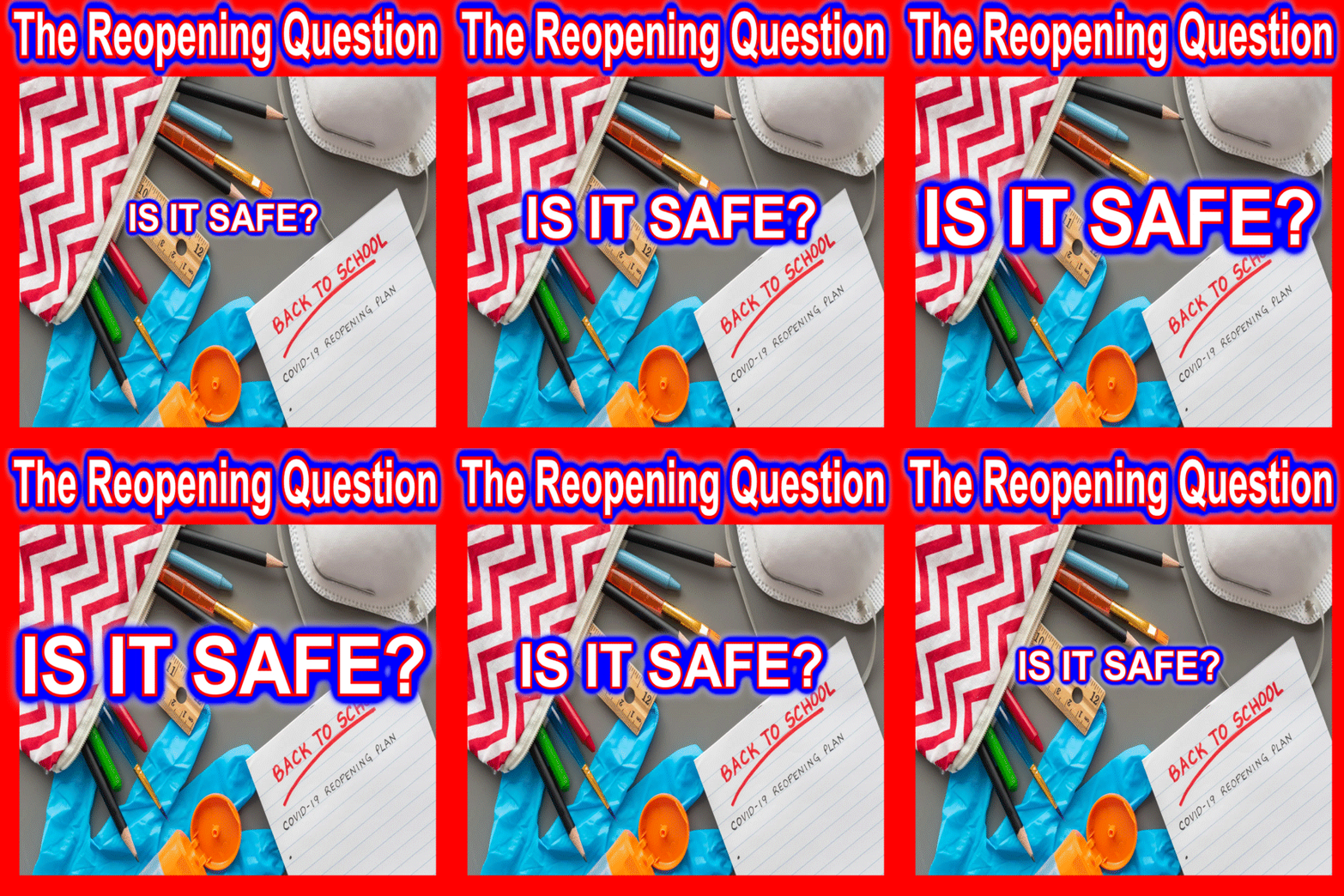
The Reopening Question: Is It Safe? | Diane Ravitch's blog

The Reopening Question: Is It Safe? | Diane Ravitch's blog

The Reopening Question: Is It Safe?


There is one basic principle that must be honored in deciding whether and when to reopen schools: SAFETY FIRST.
No child or teacher or staff member should die because of a rush to reopen.
NBC News reported:
WASHINGTON — As the calls from the White House to fully reopen schools grow louder, evidence continues to pile up to show that scenario is unlikely to happen, at least not on the national scale President Donald Trump desires. That’s not because state and local officials aren’t trying, but because the spread of the virus is beginning to overwhelm even the best-laid plans.
Dallas Independent School District Superintendent Michael Hinojosa, for example, had been working on a blueprint to reopen schools in August as part of a long and delicate process. But with the virus now surging across Texas, the outbreak may make the decision for him.


“Initially I thought we would be ready, but I’m starting to have second thoughts,” Hinojosa told MSNBC’s CONTINUE READING: The Reopening Question: Is It Safe? | Diane Ravitch's blog

Shawgi Tell: Starve It, Demonize It, Discredit It, Privatize it - Miserable Bankruptcy of Neoliberal "Takeover" Reports | Dissident Voice

Miserable Bankruptcy of Neoliberal "Takeover" Reports | Dissident Voice

Miserable Bankruptcy of Neoliberal “Takeover” Reports


For decades, one of the main strategies used by neoliberals to destroy public enterprises and eliminate the public interest has been: Starve It, Demonize It, Discredit It, Privatize it.
Since the late 1970s, neoliberals and their state have made greater use of the “Takeover” reporting method to justify wrecking and privatizing social programs and public enterprises, especially public education.
In practice, this neoliberal strategy means continually cutting funding for public enterprises and making it very difficult, even impossible, to do things properly and effectively, even though an enormous amount of money actually exists. Then the targeted public entity is vilified and blamed for not surviving brutal funding cuts. The targeted entity is methodically and repeatedly disgraced, shamed, and reproached. It is blamed for everything under the sun even though it is the victim of numerous neoliberal assaults. Then, once antisocial public opinion is consolidated, the targeted public enterprise is privatized—handed over to powerful private interests in the name of “efficiency,” “accountability,” “sustainability,” “competition,” “choice,” and “results.”
Neoliberals call this attack on the public “restructuring.” Such language debases the meaning of things and sanitizes assaults on the public. It is an attempt to conceal the fact that “restructuring” always enriches owners of CONTINUE READING: Miserable Bankruptcy of Neoliberal "Takeover" Reports | Dissident Voice

Jeff Bryant: After Years of Underfunding, Now Public School Teachers Are Supposed to Save the Nation’s Economy? | Ed Politics

After Years of Underfunding, Now Public School Teachers Are Supposed to Save the Nation’s Economy? | Ed Politics

AFTER YEARS OF UNDERFUNDING, NOW PUBLIC SCHOOL TEACHERS ARE SUPPOSED TO SAVE THE NATION’S ECONOMY?


“After 9/11, New York City police and firefighters were hailed as heroes,” said Mary Parr-Sanchez, president of the New Mexico affiliate of the National Education Association, when I spoke with her about how educators have responded to the pandemic in her state. “After this, I hope teachers will be viewed as the community pillars that they really are,” she said.
Parr-Sanchez may get what she wished for.
In the early months of the coronavirus outbreak, the nation relied on health care and grocery store workers for survival, but that labor force couldn’t possibly turn around a crashing economy. Then, conservative governors across the nation, particularly in the South and West, thought bringing back the leisure and hospitality workforce would revive business and commerce. That didn’t turn out so well. So now a broad range of policy makers and political actors are turning to school teachers to get the economy humming again.
In May, as the pandemic was just about to explode from hotspots in the Northeast to a nationwide contagion, Forbes contributor Nick Morrison argued, “Until children go back to school, parents will have to remain at home looking after them, and it will be impossible to fully restart the economy.”
New York Times op-ed writer Spencer Bokat-Lindell, marveling at how European countries were able to reopen schools, wrote, “Restarting classes is essential not only to parents’ mental health and children’s development, but also to reviving the economy.”
“We cannot have a functioning economy, or any hope of reducing economic inequalities, without a functioning educational system,” wrote Paul Starr for the American Prospect in June.
“A consensus is emerging among top economists and business leaders,” reported Heather Long for the Washington Post in July, “that getting kids back into day cares and schools is critical to getting the economy back to normal.” She quoted chief CONTINUE READING: After Years of Underfunding, Now Public School Teachers Are Supposed to Save the Nation’s Economy? | Ed Politics

New York City: How Does a District with More than One Million Students Plan to Reopen? | Diane Ravitch's blog

New York City: How Does a District with More than One Million Students Plan to Reopen? | Diane Ravitch's blog

New York City: How Does a District with More than One Million Students Plan to Reopen?


Leonie Haimson writes here how New York City hopes to reopen its public schools, which enroll more than one million students.
Haimson has chided the city for years about its failure to reduce class sizes, and that long history of neglect is making it even more difficult to find space to reopen with small classes.
DOE officials have determined that to maintain proper social distancing, a range of 9-12 students per classroom will be allowed, varying according to the size of the classroom.
Because class sizes are much larger than this in nearly every school, schools will have to separate their students into two or three or sometimes four groups who will take turns attending school in person, to be provided with remote learning when not in school. Families can also choose full-time remote learning with their children never attending school in person.
As a result of vastly different levels of school and classroom overcrowding across the city, some schools will be able to offer about half of their students in-person instruction each day; while others may only be able to allow each student to attend school one or two days a CONTINUE READING: New York City: How Does a District with More than One Million Students Plan to Reopen? | Diane Ravitch's blog

The Administration's Favorite Word: Privatize - Will the pandemic kill public schools? – BillMoyers.com

The Administration's Favorite Word: Privatize – BillMoyers.com

The Administration’s Favorite Word: Privatize
Will the pandemic kill public schools?


The big news today was the administration’s escalating insistence that our public schools must reopen on schedule for the fall. Today, on “Fox News Sunday,” Secretary of Education Betsy DeVos told Chris Wallace (who is one of the Fox News Channel’s actual reporters), “We know that children contract and have the virus at far lower incidence than any other part of the population, and we know that other countries around the world have reopened their schools and have done so successfully and safely.”
Wallace asked her if it was fair to compare countries that have as few as 20 new cases a day with the U.S., which is currently seeing 68,000. DeVos dodged the question.
She vowed to cut off federal funding for public schools that do not reopen. Wallace asked, “Under what authority are you and the president going to unilaterally cut off funding, funding that’s been approved from Congress and most of the money goes to disadvantaged students or students with disabilities?” “You can’t do that,” he continued.
Then DeVos said something interesting: “Look, American investment in education is a promise to students and their families. If schools aren’t going to reopen and not fulfill that promise, they shouldn’t get the funds, and give it to the families to decide to go to a school that is going to meet that promise,” she said.
This is the best explanation I’ve seen for why the administration is so keen on opening up the schools. DeVos is not an educator or trained in education or school administration. She is a billionaire Republican donor and former chair of the Michigan Republican Party. She is a staunch proponent of privatizing the public school system, replacing our public schools with charter schools, as her wealthy family managed to do with great success in Michigan, CONTINUE READING: The Administration's Favorite Word: Privatize – BillMoyers.com

CURMUDGUCATION: The Test Many School Districts Failed Before The Pandemic Even Started

CURMUDGUCATION: The Test Many School Districts Failed Before The Pandemic Even Started

The Test Many School Districts Failed Before The Pandemic Even Started


You’ve heard about an emotional bank account, a metaphor for the investments in personal relationships that keep them healthy and able to deal with the bumps and bruises that come along in any relationship. Build trust and deposit in the account in good times, make withdrawals in the lean times, and maintain a healthy balance. Organizations such as school districts have similar accounts, and 2020 is turning out to be the year some districts are finding out just how deep—or shallow—their reserves are.


Many districts are used to getting plenty of work from teachers without paying for it, either financially or emotionally. Teachers routinely work beyond their contracted hours, spend their own money on supplies, and fulfill many duties beyond simply instructing their students; all of this is part of the gig. Good teachers make regular deposits in the bank accounts of their district and their students. But district administrations have a wide variety of reactions.

Some districts are led by people who are appreciative and supportive, who look after their teachers and maintain conditions that help staff do their best work. These district leaders treat staff like valued, professional teammates. They build trust. They make regular deposits to the bank account.

Other districts are not so well led. Too may districts are bossed by people who consider the teaching CONTINUE READING: 
CURMUDGUCATION: The Test Many School Districts Failed Before The Pandemic Even Started


Intro to Next Book (Part 2) | Larry Cuban on School Reform and Classroom Practice

Intro to Next Book (Part 2) | Larry Cuban on School Reform and Classroom Practice

Intro to Next Book (Part 2)


Here is another segment of the Introduction to my next book, “Confessions of a School Reformer.” Part 1 was published July 9, 2020
Since the early 1900s, three overlapping social and political movements have churned across the U.S. and left marks on government, business, and community institutions, including public schools: The Progressive movement (1900s-1950s), the Civil Rights Struggle (1950s-1970s), and  Binding Schools to the Economy (1980s-present).
In all three movements, the dominant but often unspoken assumption was that human behavior can be made perfect. Faith that individuals and institutions can improve and correct errors has been at the center of American reform for centuries.
Religious dissenters carried that belief across the Atlantic Ocean on the Mayflower.  Nineteenth century anti-slavery advocates fought for abolition and succeeded with the end of the Civil War.  Along with “abolitionists” other social reformers flourished in New England and the Midwest fighting for prison reform, ending poverty, building Utopian communities, and caring for the mentally ill.  Joining these social reformers were Horace Mann, Henry Barnard, and a cadre of school reformers who envisioned a Common School for American children that would make a “more perfect union.”
Progressives like President Theodore Roosevelt, settlement house founder Jane CONTINUE READING: Intro to Next Book (Part 2) | Larry Cuban on School Reform and Classroom Practice

Let’s End this Debate and Talk about Best Practices for Remote Teaching | JD2718

Let’s End this Debate and Talk about Best Practices for Remote Teaching | JD2718

Let’s End this Debate and Talk about Best Practices for Remote Teaching


One way or other, the debate will end.Last week the Chancellor announced that NYC schools would engage in some sort of blended learning – a hybrid model – for September. Sometimes kids would be in school, sometimes kids would be out getting remote instruction, but they would have five days, and some would be in school. Teachers would come to school each day. Some kids and some teachers would opt out or be medically excused (completely different processes).
I’ve written a bit about issues with scheduling and safety that are so serious that I believe this plan is dangerous and will lead to chaos if not stopped. And a lot of other people are talking about it. It should be stopped. It can be stopped. It will be stopped.
The Chancellor is unlikely to just back down because of scattered resistance from teachers or schools. But the resistance may start to come from many schools. Or the union may feel the unease of members, and back away from its support for the idea. Or Cuomo may not permit NYC schools to reopen. Or the pandemic may surge again in the northeast, and make much of this moot. But one way or another, I think we will be remote in September.
And that’s a problem. We just finished the better part of a term remote. And I don’t know if you noticed, it didn’t go well. Not for most of us. Not for most kids. We learned about problems. Some of us found CONTINUE READING: Let’s End this Debate and Talk about Best Practices for Remote Teaching | JD2718