Latest News and Comment from Education

Tuesday, June 23, 2020

Defunding the police in Detroit schools: A youth perspective | Eclectablog

Defunding the police in Detroit schools: A youth perspective | Eclectablog

Defunding the police in Detroit schools: A youth perspective


The following essay was written by students in the Detroit Public Schools Community District. At a time when the Overton Window view about the role of policing in our society is shifting ever more to the left, their voice is important and deserves to be heard. Organized by the group 482Forward which is working for a quality education for EVERY child in Detroit, the contributors to this piece are:
  • Malacah Mason–Contributing writer
  • Emily Wilson–Contributing writer
  • Laila Nasher–Contributing writer
  • Ely Vasquez–Contributing writer
  • Surabhi Prasad–Contributing writer
  • Jecholiah Marriott–Contributing writer
  • Yvonne Navarrete-Castaneda–Contributing writer
  • Sunidhi Majalikar–Contributing editor
  • Naomi Wilson–Contributing editor
You can read about a recent action taken by 482Forward members HERE.

Black Youth and Encounters with Police:

I was 14 and in the 8th grade when a girl assaulted me and I defended myself. They took us down to the counselor’s office. They closed the door. It was just me, her, the counselor, and the officer that they also called in. They let the girl explain her point of view but I didn’t get the same chance. So I was like, “am I going to get a chance to explain”? But every time I tried to cut in, they cut me off. I was getting pushback for what I did. Even though the whole thing was self-defense. But with the way it was going, I couldn’t even respond. If I had responded, the officer probably would have used it against me. I was taught my rights, so I figured that if I had said something, they would CONTINUE READING: Defunding the police in Detroit schools: A youth perspective | Eclectablog

Audio: Why There's A Push To Get Police Out Of Schools | 89.3 KPCC

Audio: Why There's A Push To Get Police Out Of Schools | 89.3 KPCC

Why There's A Push To Get Police Out Of Schools


At least two-thirds of American high school students attend a school with a police officer, according to the Urban Institute, and that proportion is higher for students of color. Now, the national uprising for racial justice has led to a push to remove police officers from security positions inside schools. School systems in MinneapolisMilwaukeeDenverPortland, Ore., and two districts in the Bay Area have all moved in recent weeks to suspend or phase out ties with police.
Deputy Who Tossed a S.C. High School Student Won't Be Charged ...
Jesse Hagopian, a teacher and activist in Seattle, says removing police from schools has been a key demand of the Black Lives Matter movement for years.
"There's just so much research that shows that they aren't making our kids safe."
Data show that schools with cops are more likely to refer children to law enforcementincluding for non-serious violent behaviors. In 43 states and the District of Columbia, Black students are more likely to be arrested than other students while at school, according to an analysis by the Education Week Research Center.
"And there's been horrific acts of police violence in schools," Hagopian adds.
He points to two separate incidents captured on body cameras in the fall semester of 2019. One officer in Florida put a 6-year-old girl in handcuffs as she sobbed. Another in New Mexico was shown shoving an 11-year-old girl against a wall. Both CONTINUE READING: Audio: Why There's A Push To Get Police Out Of Schools | 89.3 KPCC 

For Police-Free Schools: The Loving Communities Response Fund for Racial Justice | Schott Foundation for Public Education

For Police-Free Schools: The Loving Communities Response Fund for Racial Justice | Schott Foundation for Public Education

For Police-Free Schools: The Loving Communities Response Fund for Racial Justice


You’ve seen the videos of the devastating impact of police violence against people of color in the streets. As you express outrage — and take action, we urge you to look deeper. 
Look within our schools.
Watch the video of a police officer slamming a high school girl to the ground and dragging her from her classroom before arresting her.

Or a six-year old student who was sitting listening to a story when she was handcuffed and led crying and pleading to a police squad car.

As graphic as they are, these are not isolated incidents: for example, over a recent five-year period more than 30,000 children under age 10 were arrested. Yes, arrested. Children as young as kindergartners are being taken from school in handcuffs to be booked like criminals for behavior that can and should be handled by caring education professionals dedicated to creating safe learning environments. 
Help us in this critical moment to remove police from our schools.
Support the movement to remove police from our schoolsThe Schott Foundation is a Black-led national public fund serving as a bridge between philanthropic partners and education advocates to advance racial justice and to build a movement that provides all students an opportunity to learn. In response to these extraordinary times, Schott, in partnership with three national coalitions — the Alliance to Reclaim Our SchoolsDignity in Schools Campaign, and Journey for Justice Alliance — launched the Loving Communities Response Fund for Racial Justice to support community-led, grassroots education justice organizations responding to racial justice emergencies.

The Loving Communities Response Fund for Racial Justice deploys funding and technical support to communities to ensure that the people and organizations most impacted by an extraordinary moment have the capacity and support to lead in the transformative moment. Our participatory grantmaking process moves resources to the people and communities most in need. In March 2020, the fund supported youth and families directly impacted by school CONTINUE READING: For Police-Free Schools: The Loving Communities Response Fund for Racial Justice | Schott Foundation for Public Education

Update on Efforts to Expand Internet Access - Year 2020 (CA Dept of Education)

Update on Efforts to Expand Internet Access - Year 2020 (CA Dept of Education)

State Superintendent Tony Thurmond and Digital Divide Task Force Receive Update on Multiple Efforts to Expand Internet Access for All


State Superintendent Tony Thurmond and leaders serving on the Closing the Digital Divide Task Force received a progress report Friday on multiple ongoing efforts and commitments made to date to expand services for the state’s most vulnerable students and families
During Friday’s hearing, the task force, co-chaired by Senator Connie Leyva (D-Chino), heard presentations from internet service providers including Charter, Comcast, Cox Communications, Frontier Communications, T-Mobile, and Verizon on their commitments to expand free and discounted services to more California students, particularly those living in poverty and rural households.
An archived broadcast of Friday’s task force hearing can be found on the California Department of Education (CDE) Facebook pageExternal link opens in new window or tab..
“We believe in giving credit where credit is due, and we’re grateful that many companies have stepped up and answered the call to work with us to help our students access devices and internet,” said Thurmond. “Though we are making progress, we still have a lot of work ahead in order to ensure all our students are connected and able to learn. Affordable computing devices and internet are not only necessary for distance learning but also for lifelong success.”
“Since the task force started working in mid-April on the digital divide issues facing many California students, we have strengthened our cross-sector partnerships that prioritize closing the ongoing technology gaps in our state, “ said Leyva.
“It’s critical that we continue to work hard to meet the technological needs of students, particularly now that the COVID-19 pandemic has shown that distance learning is critical during times of crisis to ensure continued student growth and achievement. We must capitalize on the current momentum to make lasting change for students and communities that urgently need reliable digital access.”
In the months since school campuses across the state closed and educators and students shifted to distance learning, the California Department of Education (CDE) has helped facilitate the shipment of 38,591 tech devices and 64,000 mobile hotspots to schools and districts throughout California. The hotspots and devices, which include laptops and tablets donated by Google, Microsoft, and Amazon, will be delivered to 269 districts, schools, districts, and county offices.
In addition to the devices, the CDE will be granting $5 million to local educational agencies to purchase 20,000 more devices or hotspots. The funds are from the California Public Utilities Commission’s California Advanced Services Fund.
Still, staggering need persists and only grows more urgent as schools plan to resume learning this fall. Although tens of thousands of devices and hotspots have been shipped to schools across California, CDE estimates more than 700,000 computing devices and more than 300,000 hotspots are still necessary to meet students’ needs moving forward. It will cost at least $500 million to meet the technology needs of all students, not counting the costs associated with expanding broadband infrastructure.
California students received a substantial boost earlier this week: an anonymous pledge of $4.7 million to procure more computing devices and hotspots. The commitment was facilitated by the Californians Dedicated to Education Foundation (CDE Foundation), the private non-profit partner of the CDE since 2011, through the California Bridging the Digital Divide Fund. The fund is a joint effort of the Governor’s Office, State Board of Education, CDE, and CDE Foundation. Individual contributions may be made on the CBDD Fund web pageExternal link opens in new window or tab., and corporate and institutional donors may contact Mary Nicely at mnicely@cde.ca.gov.
Friday’s task force hearing included a presentation from the California Public Utilities Commission on the Federal Communications Commission’s upcoming multibillion dollar Rural Digital Opportunity FundExternal link opens in new window or tab. reverse auction, an initiative to bring high speed fixed broadband service to rural homes and small businesses that lack it. As much as $2.5 billion could be available to California in this effort, and State Superintendent Thurmond asked internet service providers present at Friday’s hearing to provide an update on whether their companies will be applying for these funds. 
            Task Force members also heard an update from Caltrans on an initiative to expand broadband infrastructure along state highway right of waysExternal link opens in new window or tab..
# # # #
Tony Thurmond — State Superintendent of Public Instruction
Communications Division, Room 5602, 916-319-0818, Fax 916-319-0100
Update on Efforts to Expand Internet Access - Year 2020 (CA Dept of Education)


Jesse Hagopian: Why Seattle Educators Demand Cut to Police Budget | Diane Ravitch's blog

Jesse Hagopian: Why Seattle Educators Demand Cut to Police Budget | Diane Ravitch's blog

Jesse Hagopian: Why Seattle Educators Demand Cut to Police Budget


Jesse Hagopian is a high school teacher and social justice activist in Seattle. He has been a leading force on behalf of Black Lives Matter Movement.
He wrote this opinion article for the Seattle Times to explain why Seattle educators want money redirected from policing to social services.
He writes:
Seattle’s Education Association representative assembly — the union body that represents Seattle’s teachers, nurses, librarians, instructional assistants, office professionals and educational support staff — has overwhelmingly passed seven resolutions in solidarity with the movement for Black lives. These included removing police from schools and the King County Labor Council, (which was achieved by a recent vote of the council), educating SEA members on alternatives to calling 911 on students, and my own resolution to defund the Seattle Police Department and reinvest the money in education, health care and programs to support families.
These bold resolutions, adopted June 8, were surely CONTINUE READING: Jesse Hagopian: Why Seattle Educators Demand Cut to Police Budget | Diane Ravitch's blog

Imagine if coronavirus school closures were permanent

Imagine if coronavirus school closures were permanent

Now imagine if your school closed for good
Coronavirus school closures give us a glimpse into the experience of tens of thousands of families in urban neighborhoods where schools shuttered permanently

Adapted and reprinted from Know Your Price: Valuing Black Lives and Property in America’s Black Cities by Andre Perry, with permission from Brookings Institution Press, © 2020 by Brookings Institution.
“When will schools open?” It’s a question that parents, employers and school leaders are struggling to answer amid a national pandemic that doesn’t seem to be letting up soon.
We’re all struggling in this new normal where our homes are standing in for schools and workplaces. Something has to give. Sometimes there simply isn’t enough room at the dining room table for homework, dinner and employment (if you have the luxury of working from home). I love my child, but, like many parents, I’m desperate for the day his school reopens. The longer this drags out, though, the more I’ve been thinking about the even bigger trauma faced by families whose schools close for good.
This period of social distancing is giving us a glimpse of what it’s like when a school is shuttered permanently, a tragedy tens of thousands of families have had to deal with over the last two decades. Like the coronavirus, the impact of permanent school closures disproportionately hit Black and urban neighborhoods. Of the 22,101 public schools that have closed since 2004, 3,927 (17 percent) of them were in Black-majority census tracts, and 3,395 of those schools (86 percent) were in urban areas.
$550 billion — the investment needed to bring schools nationwide up to standard due to damage caused by postponing repairs, according to a 2013 federal estimate.
Schools are linchpins of a community’s overall physical landscape and of what researcher Eric Klinenberg defines as social infrastructure: the physical places and organizations that shape the way people interact. We use schools as polling stations and for neighborhood association meetings. Many students have fun on the playground when the school is closed. Schools hold the history and culture of a place through yearbooks, trophy cases, and photo archives. School traditions often connect one generation to the next, providing a sense of community stability and cohesion.
While the closures are often unavoidable — many districts close schools CONTINUE READING: Imagine if coronavirus school closures were permanent

Valerie Strauss: Is the Obsession with Standardized Testing Ending? | Diane Ravitch's blog

Valerie Strauss: Is the Obsession with Standardized Testing Ending? | Diane Ravitch's blog

Valerie Strauss: Is the Obsession with Standardized Testing Ending?


Standardized testing has been used in American schools for a century, though never on the scale of the past twenty years. It first was introduced into some schools as IQ tests, which were used (wrongly) to judge students’ innate ability and to assign them to different tracks, which then determined their life outcomes. I wrote about the IQ tests in my 2000 book “Left Back: A Century of Battles Over School Reforms.” The psychologists who created the tests believed that IQ was innate, inherited, and fixed. They asserted that the tests demonstrated the superiority of whites who spoke English well. Their views were welcomed and used by racists and anti-immigrant groups to support their policies. They were used to defend segregation and to restrict immigration. Their critics pointed out that the tests measured culture and life circumstances, not innate intelligence.
One of the psychologists who developed IQ tests and wrote a racist book about the results was Carl C. Brigham of Princeton. Brigham later created the prototype for the multiple-choice SAT in the 1930s, which replaced the essay-based “College Boards” in 1941.
Many schools used standardized tests in the second half of the twentieth century. Some states required periodic state tests, like the Iowa tests. No state required CONTINUE READING: Valerie Strauss: Is the Obsession with Standardized Testing Ending? | Diane Ravitch's blog

SSO COVID-19 Protective Mask Supply Survey - Nutrition (CA Dept of Education)

SSO COVID-19 Protective Mask Supply Survey - Nutrition (CA Dept of Education)

SSO COVID-19 Protective Mask Supply Survey


This is the second survey being sent to our Seamless Summer Option (SSO) sponsors in order to assist our sponsoring agencies who are serving their community during the 2020 summer season. The California Department of Education (CDE) Nutrition Services Division is assessing the protective mask needs for SSO program operators who will be providing meals this summer.
The CDE wants to provide every opportunity for you to receive the protective masks you need as soon as possible, so please complete the survey by Friday, June 26, 2020. You are required to answer all questions in this survey unless they are noted as optional.
After completing the survey, you will receive an email confirmation.
For more comprehensive COVID-19 guidance, please visit the CDE School and Child and Adult Day Care Meals web page.
Contact Information
If you have any questions regarding this message, please contact Sean Hardin, Staff Services Manager II, by email at shardin@cde.ca.gov, or by phone at 916-323-7175.
Questions:   Nutrition Services Division | 800-952-5609


SSO COVID-19 Protective Mask Supply Survey - Nutrition (CA Dept of Education)

NYC Educator: The Future's Uncertain and the End Is Always Near

NYC Educator: UFT Executive Board June 22, 2020 --The Future's Uncertain and the End Is Always Near

UFT Executive Board June 22, 2020 --The Future's Uncertain and the End Is Always Near


5:50 Roll Call—

6:00 UFT Secretary LeRoy Barr
—Thanks us for calling in.  Minutes have passed via email.  Reminds us to get out and vote tomorrow, that it’s important to have our voices heard.
 
UFT President Michael Mulgrew—Sadly, we have lost three members this week, two retirees and one in service.

Moment of silence.

Last full week of school. Thanks all CLs who’ve been reporting on walkthroughs. DOE at first thought it would program all schools from central, then they thought 70-80% of students would show. Failed to account for number of teachers, but are moving toward reality.

Childcare issue is a challenge for city,  must come up with solution for parents, including teachers.

DOE is not moving on this issue or others. Blue book square footage fails to account for desks, walls, various and sundry. CLs saying numbers are not correct. We have to take control.

There are some good people at DOE but they’re stuck in political agendas. We need to break schools into cohorts and programs. Not often CSA and UFT are in agreement.

Had school safety meeting today with Jeff Povalitus, Janella Hinds and CLs. Every person on phone said square footage was wrong. We need to figure how to program with social distancing. Data from walkthroughs important.

Trying to start process for medical accommodations, but we must maintain confidentiality. This is a very straight process, not open to interpretation. We will follow CDC guidelines, hope for a process to send out to membership. Principal cannot ask people about medical status. If schools have to adjust, they have to adjust. We won’t get info on time and can’t wait until October.

Virus exploding all over SW US.  Hospitals starting to gear up for Aug-Sept. second wave. Will spread quite a big and likely bounce back to NY. Some people still think masks are CONTINUE READING: 
NYC Educator: UFT Executive Board June 22, 2020 --The Future's Uncertain and the End Is Always Near

Monday, June 22, 2020

Union to California’s teachers: Brace for cuts steeper than the Great Recession

Union to California’s teachers: Brace for cuts steeper than the Great Recession

Union to California’s teachers: Brace for cuts steeper than the Great Recession
CTA President Toby Boyd said forthcoming cuts will be “like nothing we’ve ever seen,” projecting loss of up to 50,000 teachers


In a signal that California public education leaders are bracing for the possibility of drastic funding cuts, the state’s teachers association is counseling local unions how to forestall the worst in their districts.
A California Teachers Association bargaining advisory issued last month drew heavily on lessons learned from the Great Recession, when more than 30,000 educators were laid off amid slashes to services and programs. Their advice to teachers unions? Know the numbers and bargain hard to stave off permanent cuts.
CTA President Toby Boyd said forthcoming slashes to public education funds will be “like nothing we’ve ever seen,” with the possibility of 50,000 teacher layoffs even if the state receives federal assistance.
Uncertainty abounds when it comes to this year’s state K-12 education budget, which supports most public school districts with the bulk of their funding. Perhaps not much solace, education leaders say, at least they are experienced in making cuts during a recession.
The legislature sent the state budget to Gov. Gavin Newsom’s desk on Monday, but it’s uncertain what happens next.
Newsom has until June 30 to sign, edit it with line-item cuts or veto it. He’s warned of 10% cuts to the Local Control Funding Formula, or how schools are funded, in his May revision. But the Legislature since has promised to rescind that, betting that federal aid in the form of the $3 trillion HEROES Act designed to stimulate a pandemic-stalled economy will materialize.
Even before the coronavirus outbreak closed schools in mid-March, many California public school districts were cash-strapped and considering layoffs. They’ve made emergency technology purchases to launch remote learning in the months since, and face added costs of reopening, such as providing personal protective equipment and additional cleaning.
On top of the public health and economic challenges, districts are fielding new calls to respond to national calls against racism and police violence by slashing budgets of campus police departments in the wake of George Floyd protests.
“I equate this to what happened in 2008/2009 as being Triple A baseball compared to Major League,” Boyd said. “This is going to be devastating to a lot of educational systems in the CONTINUE READING: Union to California’s teachers: Brace for cuts steeper than the Great Recession

Hundreds of parents, teachers, and educators rallied in front of the U.S. Dept. of Education to demand change for Black students.| wusa9.com

Black Students Matter rally calls for equity in education | wusa9.com

‘Please don't call me your average Black boy’ | Black Students Matter rally highlights disparities in education
Hundreds of parents, teachers, and educators rallied in front of the U.S. Dept. of Education to demand change for Black students.


WASHINGTON D.C., DC — Hundreds of families, educators, and students kicked off Juneteenth with a march from Freedom Plaza in downtown D.C. to the U.S. Dept. of Education to demand justice for Black students and to end disparities in education.
The Black Students Matter rally highlighted the systemic issues impacting the Black community and Black students across the D.C. area.

7-year-old Cavanaugh Bell read an emotional plea for change as part of the students' rally:
"'There's no way you did all your work that fast.' 'I wouldn't believe you by looking at you that you were that smart or my favorite.' 'He's not your average Black boy.' I heard all of those things from my teachers before I was in kindergarten. Please don't call me your average Black boy. We are extraordinary, and the ground shakers that this world needs to build a better future."

Organizers of the rally, Educators for Equity, are calling for five demands centered around equity and education.
  • Defund DC police by redirecting money to programs and resources that focus on mental health
  • Equitable district funding
  • Revised curriculum reflective of African American students
  • Abolish for-profit standardized testing
  • Focus on fixing schools rather than shutting them down

More Cartoons on Covid-19 Pandemic | Larry Cuban on School Reform and Classroom Practice

More Cartoons on Covid-19 Pandemic | Larry Cuban on School Reform and Classroom Practice

More Cartoons on Covid-19 Pandemic


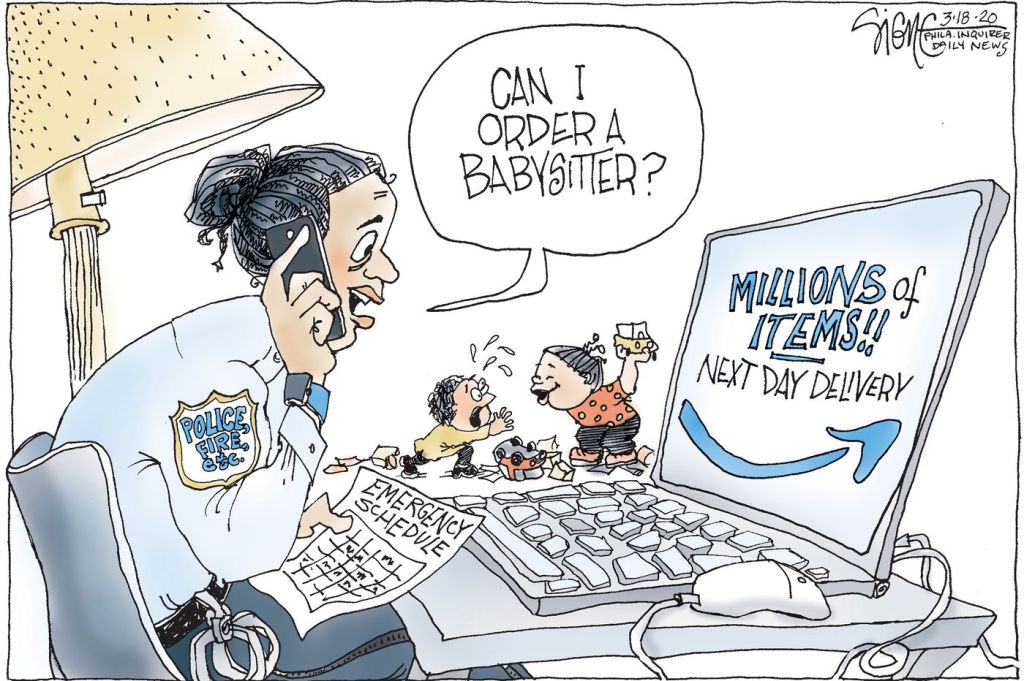
I have selected cartoons I have not used before. Enjoy1


More Cartoons on Covid-19 Pandemic: More Cartoons on Covid-19 Pandemic | Larry Cuban on School Reform and Classroom Practice


The often ugly reality black students face in our schools - The Washington Post

The often ugly reality black students face in our schools - The Washington Post

The often ugly reality black students face in our schools


While protesters are taking to the streets of America to protest police brutality and racial injustice, black and other students and alumni of color are using social media to tell personal stories of racism that they encountered in school — public and private, K-12 and college.
The posts are mostly anonymous, often on pages that are specific to individual schools — such as the elite private schools Sidwell Friends in Washington, D.C., and Princeton Day School in New Jersey.
As reported by the New York Times, students are starting pages and inviting other students, alumni and even teachers to tell their stories. There are now scores of them, often beautifully composed text boxes that share stories of what it was and is to be black at those schools.
This post is from Alden S. Blodget, a white educator who spent decades working in private independent schools that claimed to have “diverse” and “inclusive” communities but didn’t. He said he tried to talk with black students to learn about their reality but didn’t get far. He writes:
They weren’t going to share painful experiences with some old white guy who ran a mostly white school, especially when those experiences criticized the school and belied our claims to having created a welcoming, diverse community. I was asking for their trust in a system that they didn’t experience as trustworthy …
Now, he writes, he sees promise in this new social media movement, writing, “Their collective voices challenge the empty rhetoric of our idealistic claims.”
Blodget was both a student of independent schools and a teacher of English and drama, as well as an administrator in five different schools in several states during his nearly four-decade academic career. He has published numerous pieces about education.
From 2000 until 2014, he worked with University of Southern California neuroscientist Mary Helen Immordino-Yang, offering workshops for teachers to explore the implications of her research and that CONTINUE READING: The often ugly reality black students face in our schools - The Washington Post

Betsy DeVos is an abysmal failure and our nation’s schoolchildren are paying the price - The Washington Post

Betsy DeVos is an abysmal failure and our nation’s schoolchildren are paying the price - The Washington Post

Betsy DeVos is an abysmal failure and our nation’s schoolchildren are paying the price


Months after schools across the country closed to stop the spread of the coronavirus, it’s still not clear how, or even if, children can safely return to classrooms in the coming weeks and months. Despite the best efforts of teachers suddenly plunged into teaching remotely, the loss of learning has been staggering, especially for low-income students. This would be the moment, you’d think, when the nation’s top education policy official would step up and attempt to offer leadership and best practices going forward. Instead, Secretary of Education Betsy DeVos is missing in action, at least when it comes to the issues that matter most.
Almost two months ago, the American Federation of Teachers released a plan detailing how schools could reopen safely. Their recommendations include mandatory hand-washing on entering the school and capping class sizes to encourage physical distancing. Last month, the conservative American Enterprise Institute released one as well; among other things, it urges schools to evaluate students for learning gaps as a result of the closures.
The Education Department, by contrast, is all but silent, issuing little in the way of guidance, and doing little to review what did and didn’t work. Anecdotal evidence suggests many parents and teachers found virtual learning dissatisfactory, while surveys found a large number of students didn’t attend their online classes regularly. A poll of North Carolina parents found a majority believed their children learned less online than in-person. The Education Department’s response? According to The Post’s Laura Meckler, just this month, “the department invited education officials to a panel discussion on the CONTINUE READING: Betsy DeVos is an abysmal failure and our nation’s schoolchildren are paying the price - The Washington Post