Latest News and Comment from Education

Wednesday, January 22, 2020

Public School Funding: In Too Many States, It’s All about Subtracting and More Subtracting | janresseger

Public School Funding: In Too Many States, It’s All about Subtracting and More Subtracting | janresseger

Public School Funding: In Too Many States, It’s All about Subtracting and More Subtracting

Let’s review the importance of school finance. It you think this topic is too arcane to think about, consider who has been teaching us about the importance of school funding for two years now, and you’ll realize it’s not abstract or complicated at all. Really it is just an elementary school story problem: If you have a public school budget made up of local, state, and federal tax revenue, and you take away some money by cutting taxes after a recession, and then you take away some more money for charter schools, and then you take away some more money for vouchers, how much will you have left?
For two years now, striking schoolteachers have forced us all to examine what little funding will remain.  They have shown us in the most concrete way the implications of school policy emphasizing test-and-punish school accountability and increased school privatization—all overlaid upon an institution whose revenue base has fallen.  Public school teachers on strike in West Virginia, Kentucky, Oklahoma, Arizona, Colorado, Los Angeles, Oakland, and most recently Chicago have demonstrated the untenable conditions in their schools created by collapsing revenue—children struggling in classes of 40 students, teachers pushed out of the profession when their salaries fall so low they cannot afford to rent an apartment, and schools lacking counselors, social workers, librarians, and school nurses. From state to state, teachers have repeated and reinforced the primary causes of this problem in a way that ought to help us remember: States have failed to raise enough revenue to support the public schools and then state legislatures have driven a lot of taxpayer dollars away from public schools and into privatized charter schools and vouchers for students to pay private school tuition.
In the ways they have persistently underfunded public schools and the degree to which they have created policies to drain public funds out of the public schools and into privatized charter schools and vouchers, state legislators have demonstrated their lack of commitment to the principles of adequate school funding and its equitable distribution. Most of the state CONTINUE READING: Public School Funding: In Too Many States, It’s All about Subtracting and More Subtracting | janresseger

Education Deans for Justice and Equity? | Cloaking Inequity

Education Deans for Justice and Equity? | Cloaking Inequity

EDUCATION DEANS FOR JUSTICE AND EQUITY?


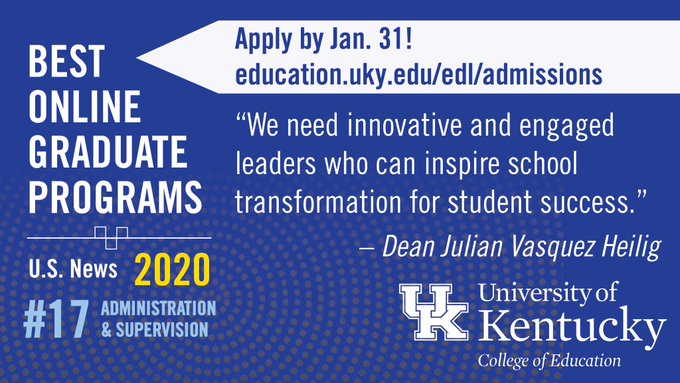
I truly believe that our deans and other academic leaders can translate their community-engaged, community-relevant work that they have undertaken as researchers and teachers  into higher education leadership roles. I am seeking to do that on a daily basis in my role as dean at the University of Kentucky College of Education.
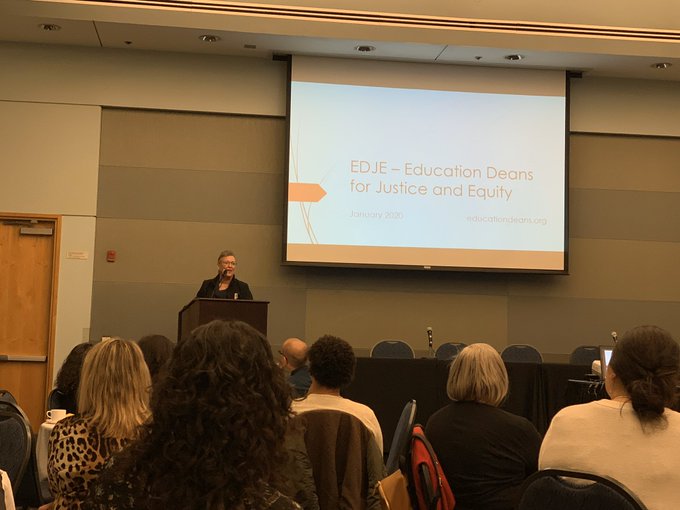
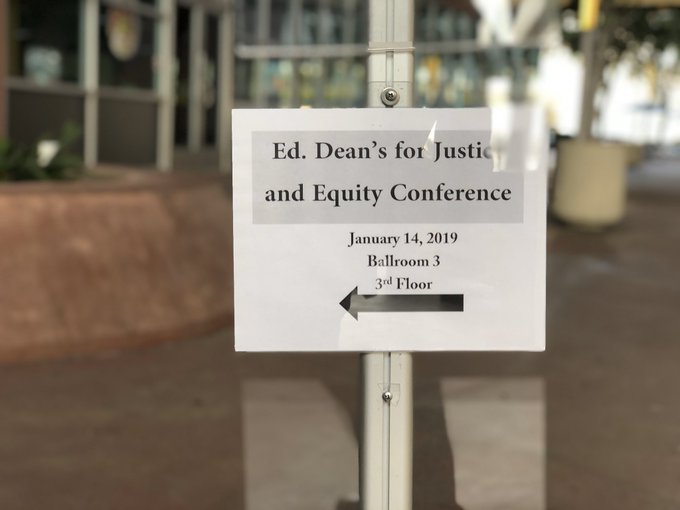
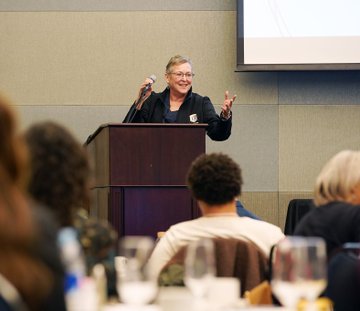
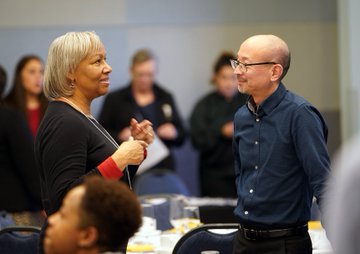
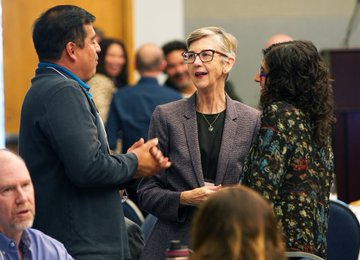
As a result I was drawn to attend the Education Deans for Justice and Equity conference meeting in Los Angeles this past week.
Here are the mission and principles from their website.
Public education has, in many ways, functioned historically to sort and marginalize various groups, and so-called “reforms” often exacerbate the problems.  The purposes and the promises of public education are to prepare all students to succeed and flourish in life, and we insist this cannot be done without explicitly and intentionally addressing inequities and injustices in education, particularly regarding nationality, language, race, social class, gender, sexuality, religion, ability, and other dimensions of diversity.   As deans of education, we have a moral responsibility to act on the following principles, individually and collectively.

Mission Statement

Education Deans for Justice and Equity (EDJE) is a nationwide alliance of education deans that advances equity and justice in education by speaking and acting collectively and in solidarity with communities regarding policies, reform proposals, and public debates.

Guiding Principles
  • We believe public education is a basic human right and an essential cornerstone of a democratic society.
  • We believe in the importance of taking action to resist policies and practices of discrimination and exclusion.
  • We believe in protecting and advocating for the well-being and dignity of all children, families, and communities.
  • We believe that the structures of poverty and inequality, which have a profound impact on educational attainment, must be dismantled.
  • We believe schools and colleges of education have a moral responsibility to listen to and learn from communities that have not been well-served by public education.
  • We believe that this national network of deans and other educators will influence, inform, and challenge policies, reform proposals, public debates, and social movements.
I am honored to be a member of the network and look forward to ensuring that the University of Kentucky College of Education adheres to principles of equity and justice. Please encourage your academic leaders at your nearby college of education to engage in these important conversations.
Please Facebook Like, Tweet, etc below and/or reblog to share this discussion with others.
Check out and follow my YouTube channel here.
Twitter: @ProfessorJVH
Click here for Vitae.

2020 Medley #2 | Live Long and Prosper

2020 Medley #2 | Live Long and Prosper

2020 Medley #2


SHOULD YOUR TAX MONEY BE USED TO EXPEL KIDS WHO LIKE RAINBOWS?
Kentucky has no plan providing vouchers for students to attend religious schools. Why is that good? As of now, private schools in Kentucky that expel (or force out) a child because they like rainbows, like the one in this article, cannot receive any state funding.
Depending on what happens with the case currently before the Supreme Court, however, this could change.
Public money for public schools!
A Christian school in Louisville expelled a student last week after her family said school officials discovered the girl had celebrated her birthday with a rainbow-themed cake.

Kimberly Alford told The Courier Journal that until Jan. 6, her 15-year-old daughter had been a freshman at Whitefield Academy, a private school at CONTINUE READING: 
2020 Medley #2 | Live Long and Prosper

CURMUDGUCATION: A Teacher's Role In The Post-Truth Era

CURMUDGUCATION: A Teacher's Role In The Post-Truth Era

A Teacher's Role In The Post-Truth Era

This piece from Sean Illing at Vox-- “Flood the zone with shit”: How misinformation overwhelmed our democracy-- captures the issue as well as anything I've seen in the past few years. Here are a couple of key bits:

We live in a media ecosystem that overwhelms people with information. Some of that information is accurate, some of it is bogus, and much of it is intentionally misleading. The result is a polity that has increasingly given up on finding out the truth.

How is that affecting the times?

We’re in an age of manufactured nihilism.

The issue for many people isn’t exactly a denial of truth as such. It’s more a growing weariness over the process of finding the truth at all. And that weariness leads more and more people to abandon the idea that the truth is knowable.

Illing suggests that this is deliberate, a strategy aided by technology and perfected by folks like Vladamir Putin.

In October, I spoke to Peter Pomerantsev, a Soviet-born reality TV producer turned academic who wrote a book about Putin’s propaganda strategy. The goal, he told me, wasn’t to sell an ideology or a vision of the future; instead, it was to convince people that “the truth is unknowable” and that the only sensible choice is “to follow a strong leader.”

And there it is.

We're used to the idea of propaganda aimed at getting us to believe something in particular, that it is designed for linear goals-- we will get people to believe that a balanced breakfast is the most CONTINUE READING: 
CURMUDGUCATION: A Teacher's Role In The Post-Truth Era

Schools Matter: Espinoza v. Montana Department of Revenue

Schools Matter: Espinoza v. Montana Department of Revenue

Espinoza v. Montana Department of Revenue

“In the long run, charter schools are being strategically used to pave the way for vouchers. The voucher advocates, who are very powerful and funded by right-wing foundations and families, recognize that the word voucher has been successfully discredited by enlightened Americans who believe in the public sector. So they’ve resorted to two strategies. First, they no longer use the word “vouchers.” They’ve adopted the seemingly benign phrase “school choice,” but they are still voucher advocates.” — Jonathan Kozol

The end goal of school privatization projects like charter schools has always been vouchers. While both charters and vouchers prevent the public from being able to control the curriculum taught with public dollars, vouchers are far worse in that regard. Vouchers represent an attack on democratic institutions and they represent an attack on rationality in general. Espinoza v. Montana Department of Revenue, a case about to be heard in front of the Supreme Court of the United States (SCOTUS), could open the flood gates to scare community tax dollars being squandered on dominionist curricula and schools that can openly discriminate.


Vouchers mean Jeanne Allen's dream of teaching children that Jesus rode dinosaurs will finally come true
image by Monty Propps https://b3ta.com/board/7293522
With a SCOTUS populated by arch-reactionaries like Kavanaugh and Gorsuch, it's highly likely that the Establishment Clause of the First Amendment will either be ignored or explained away in order to justify funding extremist religious organizations. You know Espinoza v. Montana Department of Revenue represents a major threat to public education when charter-voucher promoting organizations like the Center for Education Reform file an amicus brief in favor of the right-wing plaintiff. Reactionaries Jeanne Allen and Paul Clement also got a piece published in Time in favor of using public funds to teach religious extremism.


Robert D. Skeels is a social liberation writer, attorney, public education advocate, immigrant rights activist, and law professor. He lives, works, writes, and organizes in Los Angeles with his wife and cats. Robert holds a BA in Classical Civilization from the University of California at Los Angeles (UCLA), a JD from Peoples College of Law (PCL), and passed the California Bar Exam on his first attempt. A US Navy Veteran, he is a proud member of Veterans for Peace. A student of Liberation Theology and Paulo Freire's work, Robert volunteers for community and 12 step groups. Robert's articles and essays appear in publications including Jacobin, Truthout, CounterPunch, Dissident Voice, Schools Matter, Daily Censored, Regeneración, K12NN, LA Progressive, and The Los Angeles Daily News. In 2013 Robert ran for the LAUSD School Board against a billionaire funded corporate reform candidate, finishing second in a field of five, with over 5,200 votes.

Schools Matter: Espinoza v. Montana Department of Revenue

EDUCATION’S LEECHES | The Merrow Report

EDUCATION’S LEECHES | The Merrow Report

EDUCATION’S LEECHES

George Washington woke up on December 14, 1799, with a very sore throat.  When it worsened, the doctors were summoned.  Naturally, Washington, who had left office just two years earlier, received the very best care from the most knowledgeable and competent doctors, those at the top of the medical profession.**
Their expert diagnosis: Washington’s four ‘humors’ or bodily fluids, were out of balance.  This analysis was based on a 1500-year-old Greek theory and accepted as scientific fact: The human body is regulated by four fluids: blood, phlegm, bile, and black bile.    “The group of fourth- and third-century BC physicians known as the Hippocratics who formulated (and more importantly wrote about) their theories, were the first organized group to consider that illness had natural—not supernatural—causes.”
Illness, they believed, resulted when the four humors were out of balance, as they must have been in Washington’s case.
The doctors set about rebalancing Washington’s system. To do this, they followed a scientifically approved medical procedure:  They drained 80 ounces of his blood, close to 40 percent of his body’s total!  
Whether they did this by opening one or more of his veins or by attaching leeches to his body is unclear.  Both procedures were normal.
Unfortunately, the treatment did not work; in fact, it might have killed him, or at least hastened his demise, because our first President died later that same day.
Did bloodletting kill George Washington?  “Many doctors, in fact, believed that bloodletting or the removal of a portion of an ill person’s blood could improve their condition. CONTINUE READING: EDUCATION’S LEECHES | The Merrow Report

Supreme Court Case May Open Door to Vouchers Nationwide

Supreme Court Case May Open Door to Vouchers Nationwide

Supreme Court Case May Open Door to Vouchers Nationwide

Betsy DeVos’ unwavering support of private school vouchers long precedes her tenure as U.S. Education Secretary.  Despite being supported by the resources and influence of the federal government, however, DeVos’ efforts to expand vouchers legislatively have been stymied by lack of support in Congress (even when the GOP held majorities in both houses) and stubborn public opposition. American voters have rejected programs that transfer scarce taxpayer dollars away from public schools to pay for private school tuition.
For champions of school privatization, there is too much at stake, too much money invested in the school privatization agenda to wave the white flag. Which is why the push to expand vouchers is also being waged in the courts.
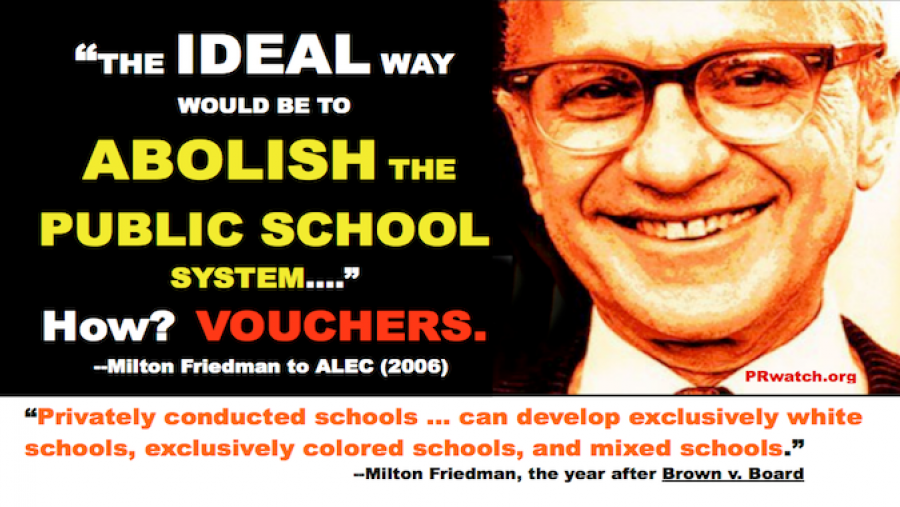
Image result for SCHOOL VOUCHER Milton Friedman
“Taxpayers and voters have made it overwhelmingly clear that they do not want vouchers, rejecting them time and time again,” said NEA President Lily Eskselsen García. “Betsy DeVos and her allies are using the Supreme Court to push their political agenda that seeks to dismantle our neighborhood public schools.”
Through a series of legal actions, the Institute for Justice (IJ) – whose funders have included the Koch Brothers and the DeVos Family Foundation – have targeted provisions in state constitutions that forbid public money being used for religious purposes, including private religious schools.
This week, the U.S. Supreme Court will be hearing arguments on whether these provisions violate the U.S. Constitution. A decision in IJ’s favor in Espinoza v Montana Department of Revenue could undermine constitutional provisions in 37 CONTINUE READING: Supreme Court Case May Open Door to Vouchers Nationwide