Latest News and Comment from Education

Friday, September 27, 2019

Sacramento, Calif., Cops Who Shot and Killed an Unarmed #StephonClark Are Headed Back to the Streets

Sacramento, Calif., Cops Who Shot and Killed an Unarmed #StephonClark Are Headed Back to the Streets

Sacramento, Calif., Cops Who Shot and Killed an Unarmed #StephonClark Are Headed Back to the Streets

The two Sacramento, Calif., cops who shot and killed an unarmed Stephon Clark as he stood in his grandparents’ backyard last year not only will face no charges—but they have been cleared to return to duty.
Minutes after the Justice Department decided not to pursue civil rights charges against Officers Terrence Mercadal and Jared Robinet in the March 2018 shooting death of Clark, Sacramento police on Thursday announced they had cleared them as well, the Sacramento Bee reports.
Echoing the Justice Department’s finding of no culpability on Mercadal’s and Robinet’s parts, Sacramento Police Chief Daniel Hahn said, “The use of deadly force in this case was lawful. Our internal investigation concluded that there were no violations of department policy or training.”
But while that finding came as no surprise, no matter how unwelcome for Clark’s family, Hahn’s next statement was jarring:
“The officers involved in this case will return to full, active duty.”
Clark’s brother, Stevante Clark, in a Facebook message he posted Thursday as he and other family members met with DOJ and Sacramento police officials, expressed bitterness about the outcome.
“These people have failed when it comes to #Accountability,” he wrote, the Sacramento Bee reports, later telling the paper: “I’m not surprised or shocked, we’ve been denied justice for generations. The only thing that caught me off CONTINUE READING: Sacramento, Calif., Cops Who Shot and Killed an Unarmed #StephonClark Are Headed Back to the Streets

TODAY'S EDUCATION RESEARCH REPORT

Education Research Report


TODAY'S EDUCATION RESEARCH REPORT

TODAY

Do Kids Fall Behind in Math Because There Isn’t Enough Grade-Level Material, or Because There’s Too Much? It’s Both

Complete report New Classrooms Innovation Partners W alk into almost any classroom in America, and you’ll find at least some students who’ve fallen behind the academic standards for their grade — meaning they’re at risk of not learning everything they’ll need to be ready for college and the lives they want to lead. Helping these students get back on the path to grade-level proficiency is one of t
Automatic Enrollment Increases Contributions to Supplement Retirement Programs by K-12 and University Employees

This study examines the impact of the adoption of automatic enrollment provisions by schools and universities in the state of South Dakota for its supplemental retirement saving plan (SRP). In South Dakota, educational personnel are also covered by a defined benefit pension plan and by Social Security. Thus, career public employees in South Dakota can expect a life time annuity from these two pro
The School to Prison Pipeline: Long-Run Impacts of School Suspensions on Adult Crime

. Schools face important policy tradeoffs in monitoring and managing student behavior. Strict discipline policies may stigmatize suspended students and expose them to the criminal justice system at a young age. On the other hand, strict discipline acts as a deterrent and limits harmful spillovers of misbehavior onto other students. This paper estimates the net impact of school discipline on stude
Breaking Down Barriers: Understanding Hispanic High School Students’ Perceptions on the Transition to College

. Hispanic students make up roughly 18 percent of all college students and are one of the largest minority groups on U.S. campuses. However, Hispanic students tend to meet ACT College Readiness Benchmarks at lower rates, on average, than their non-Hispanic White counterparts. In addition, Hispanic students may face added barriers in navigating the landscape of the college application process, le
SEPTEMBER 2019 Using Chronic Absence Data to Improve Conditions for Learning

Reducing chronic absence goes hand in hand with cultivating positive conditions for learning. When schools provide engaging, supportive, welcoming and culturally responsive environments, families are inclined to help their children get to school, and students are motivated to attend, even when there are hurdles to getting there. Likewise, when students attend class consistently, positive conditio
Mathematics Anxiety in the Transition From Elementary School to Junior High

Mathematics anxiety negatively impacts cognitive processing, performance, expectations, motivation, and future choices. However, research has not examined patterns in students’ mathematics anxiety levels over time. The current study addresses this gap by exploring group-based trajectories in mathematics anxiety during the transition to junior high school. Five trajectories are described: consiste

YESTERDAY

Kids in poor, urban schools learn just as much as others

Schools serving disadvantaged and minority children teach as much to their students as those serving more advantaged kids, according to a new nationwide study. The results may seem surprising, given that student test 
Education Research Report


Confessions of a Reluctant Radical | Diane Ravitch's blog

Confessions of a Reluctant Radical | Diane Ravitch's blog

Confessions of a Reluctant Radical


Cheryl Gibbs was not an activist. She just wanted to teach her children in a Virginia public school and ignore politics. But step by step, she realized that there was a coordinated attack on public schools. One thing led to another. She joined the union. She became a union rep. She became a BAT.
And when she retired, she became a full-fledged member of the Resistance. The Resistance fights privatization. It fights the replacement of experienced teachers by TFA and artificial intelligence. It fights for real education, real teachers, real public schools.
She begins:
When I began teaching twenty years ago, my activism was caring about children; loving them, helping them discover their most complete, healthy, and most fulfilled selves as they grew. I  read the mainstream news and voted. That was about the extent of it. 
I joined the union, like many teachers, to have the liability insurance that I knew a teacher might need when classes included at-risk and emotionally disordered students. When I was asked to be a union co-rep for my building, the promise was, “You only have to attend one meeting a month and fill-in when the “real rep” isn’t available.” I reluctantly agreed to serve.
Yet here I am. 
Voluntarily retired two years earlier CONTINUE READING: Confessions of a Reluctant Radical | Diane Ravitch's blog

Stigma Buster: Schools Look at Mental Health Days for Students

Stigma Buster: Schools Look at Mental Health Days for Students

Stigma Buster: Schools Look at Mental Health Days for Students

As more school districts across the country implement programs to address student mental health, cutting through the stigma that surrounds this issue is a formidable challenge. Too often a discussion about mental health is constrained by uncomfortable silences, suggestions that teenagers are maybe just lazy or incapable of handling any sort of pressure, or just outright denial.
This past summer, a group of students in Oregon did their part to help open up the conversation. They successfully lobbied the state legislature to pass a law that added mental health to the list of excusable absences. When the bill was signed into law in June, Oregon joined Utah as the one of the only states in the country to establish mental health days for students.
To skeptics, the law seemed unnecessary (many schools already permit these absences) and liable to spark a surge in absentee students.
Supporters say these concerns miss the point. The law is important because it opens up lines of communication, says Debbie Plotnick of Mental Health America. She hopes the change will help kids feel more comfortable talking with their parents and teachers.
“Acknowledging that students may be experiencing a mental health issue and allowing them to be excused to tend to their mental health encourages CONTINUE READING: Stigma Buster: Schools Look at Mental Health Days for Students

The AFT’s Randi Weingarten attacks Medicare for All. – Fred Klonsky

The AFT’s Randi Weingarten attacks Medicare for All. – Fred Klonsky

THE AFT’S RANDI WEINGARTEN ATTACKS MEDICARE FOR ALL

The president of the American Federation of Teachers Randi Weingarten has decided to go against her own union’s official position and join her centrist Democratic allies in opposing national health care, also known as Medicare for All.
In 2018, the AFT approved a resolution in support of defending and expanding the Affordable Care Act, then under attack by the Republicans.
RESOLVED, that the AFT reaffirms that the most sensible and cost-effective solution for health coverage is a single-payer system modeled after the federal Medicare system, such as that proposed by S.B. 1804 and H.R. 676; and
RESOLVED, that the AFT will educate and mobilize its members and our broader community to support universal healthcare coverage.
On Monday, Weingarten wrote a commentary for Politico defending work-based health insurance and  therefore opposing Medicare for All, calling them “false choices.”
Like many other labor leaders, I have sat across a bargaining CONTINUE READING: The AFT’s Randi Weingarten attacks Medicare for All. – Fred Klonsky

Lavish Lobbying Ensures that Washington, D.C. Charter Schools Remain Unregulated | janresseger

Lavish Lobbying Ensures that Washington, D.C. Charter Schools Remain Unregulated | janresseger

Lavish Lobbying Ensures that Washington, D.C. Charter Schools Remain Unregulated

Rachel M. Cohen is a fine investigative reporter, whose stories have appeared in The American ProspectThe InterceptThe Atlantic, the Washington PostSlateThe Nation, and a number of other publications. Her most recent investigation explores a topic that is much in the news: the seeming impossibility of regulating charter schools more than two decades after enabling legislation across state legislatures—and Congressional legislation for Washington, D.C.—created them as an experiment in innovation.
Government oversight of charter schools makes sense to many of us.  Charter schools are a form of government contracting.  They are publicly funded and privately operated.  As publicly funded institutions, they ought to be responsible for adhering to the laws that protect their students’ rights.  And surely, charter schools ought to be regulated to protect the investment of tax dollars. But in Washington, D.C., as in many other places, charter school operators and advocates continue to push hard against even modest public oversight.
For the Washington City PaperCohen investigates the all the forces that have prevented public oversight of charter schools in the nation’s capital—a city where Congress is directly involved in local school district affairs: “When (Bill) Clinton signed the School Reform Act into law in the spring of 1996, it was over the strong objection of D.C.’s non-voting Congressional delegate, Eleanor Holmes Norton, who protested Congress’ interference in the city’s local affairs.” “In 2001, D.C.’s inspector general and its chief financial officer, Charles Maddox and Natwar Gandhi, respectively, testified before Congress asking for greater authority to oversee local charter school finances. The following year Gandhi turned to the (D.C.) Council to ask for legislative authority over the schools, saying that all charters should be assessed by a single auditing firm, selected by the D.C. government.”
Local leaders demanded additional oversight of charter schools in the District of Columbia for CONTINUE READING: Lavish Lobbying Ensures that Washington, D.C. Charter Schools Remain Unregulated | janresseger


Chicago: CTU Votes Overwhelmingly to Strike | Diane Ravitch's blog #REDFORED

Chicago: CTU Votes Overwhelmingly to Strike | Diane Ravitch's blog

Chicago: CTU Votes Overwhelmingly to Strike


NEWS RELEASE:
For Immediate Release
ctulocal1.org
CONTACT: Ronnie Reese 312-329-6235RonnieReese@ctulocal1.org

Ninety-four percent of CTU members vote to authorize strike for schools Chicago’s students deserve

Chicago Teachers Union House of Delegates governing body will set strike date at Wednesday, Oct. 2, meeting.
CHICAGO, September 26, 2019—The Chicago Teachers Union this evening released totals of the Sept. 24-26 strike authorization vote. The CTU Rules and Election Committee reported that as of 9:30 p.m., the Union passed the 75 percent threshold of members voting “yes.” Ninety-four percent of teachers, clinicians, PSRPs, nurses, librarians voted to authorize a strike to win the schools Chicago’s students deserve.
The vote stands as a mandate from CTU members for Chicago Public Schools to uphold promises of equity and educational justice made by Mayor Lori Lightfoot, and that those promises must be in writing in an enforceable contract. This is the only way to hold the district to its word after decades of austerity, budget cuts, understaffing, school closings and privatization.
The CTU House of Delegates will convene for its next scheduled meeting on Wednesday, Oct. 2, to set a strike date. The earliest the Union could CONTINUE READING: Chicago: CTU Votes Overwhelmingly to Strike | Diane Ravitch's blog


SCUSD Ends 2018-19 With Unrestricted General Fund Surplus - Sacramento City Teachers Association

SCUSD Ends 2018-19 With Unrestricted General Fund Surplus - Sacramento City Teachers Association

SCUSD Ends 2018-19 With Unrestricted General Fund Surplus

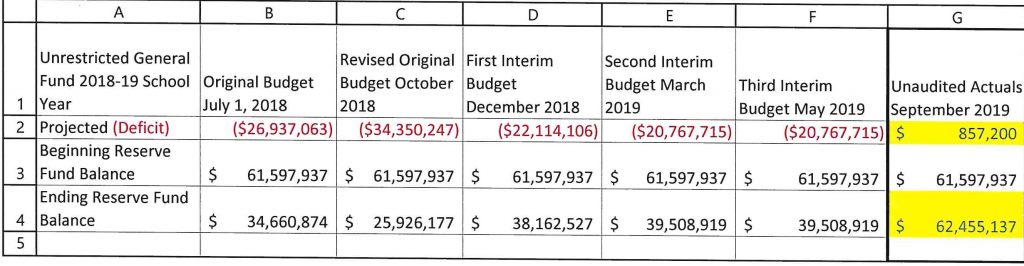
In 2018-19, the Sacramento City Unified School District submitted five budgets.
In each of the budgets, the District projected massive deficit spending from $20 to $34 million, while District administrators and the School Board repeatedly told the public that the District was on the verge of being taken over by the State.
Last night (Labor Day, September 2, 2019), the District released its end-of-the-year actual unaudited budget financial report. Rather than a massive deficit, however, the District ran an unrestricted general fund surplus of $857,200, further confirming that the District was never on the brink of insolvency.

2018-19 Budgets vs Unaudited Actuals
SCUSD Ends 2018-19 With Unrestricted General Fund Surplus - Sacramento City Teachers Association


What if everything you know about teacher pay was provided by a racist who thinks immigrants are mentally deficient? – Fred Klonsky

What if everything you know about teacher pay was provided by a racist who thinks immigrants are mentally deficient? – Fred Klonsky

WHAT IF EVERYTHING YOU KNOW ABOUT TEACHER PAY WAS PROVIDED BY A RACIST WHO THINKS IMMIGRANTS ARE MENTALLY DEFICIENT?

Libertarian union-hater, Michael Antonucci, has always been a teacher low pay denier and teacher shortage denier.
But now Antonucci has reached down into the racist gutter for his latest attempts to discredit the data on teacher pay and teacher shortages.
Nowhere is this better illustrated than in an extensive essay in the fall 2019 issue of National Affairs. Written by Andrew G. Biggs and Jason Richwine, it is titled “The Truth About Teacher Pay.” The authors masterfully rebut almost everything we have been led to believe about public school compensation, staffing and working conditions. They tear down virtually every graven image the education establishment has put on display for the past 50 years.
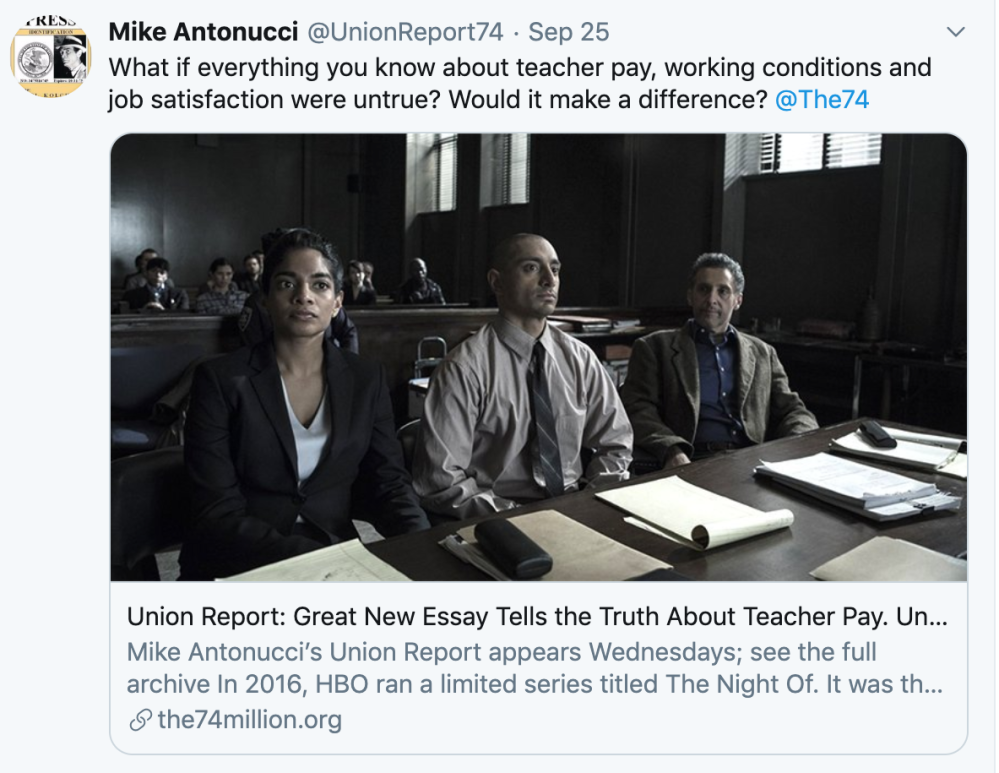
 Screen Shot 2019-09-26 at 1.52.33 PM
Whoa! That would be some tear down.
Excuse me if I’m suspicious of the source for Antonucci’s data.
I remember Jason Richwine.
Jason Richwine?
I know that name.

CURMUDGUCATION: RAND Plays Corporate Reformy Buzzword Bingo

CURMUDGUCATION: RAND Plays Corporate Reformy Buzzword Bingo

RAND Plays Corporate Reformy Buzzword Bingo


RAND Corporation, with its vision to be "the world's most trusted source for policy ideas and analysis." regularly contributes to the total thinky tank output of material that wants to be viewed as "a report" or "research" or "a study" or "a paper," but is more like an op-ed or blog post that has put on a tie and juiced up its vocabulary.

This week they cranked out a new one entitled "Reimagining the Workforce Development and Employment System for the 21st Century and Beyond." Its scope is fuzzy and wide, like a wooly mammoth that has overindulged in pizza and beer, and while it doesn't lay all the blame there, it does take some shots at K-12 education, and in doing so manages to tick off plenty of the boxes on the Reformster Talking Points Bingo Card.

Authors with no actual background in education? Checkcheck, and check. (For bonus points, two of the three are economists.)

Bloodless gobbledeegook? By the truckload. For instance, the authors note that during childhood "people make decisions about schooling and other aspects of human capital acquisition." Yes, I often think back fondly to when I sat down with my children to discuss their human capital acquisition. Them was the days.


21st century skills? Yep. Employers are "struggling to find workers with 21st century skills that go beyond routine cognitive skills and stock academic knowledge to capture competencies in such areas as information synthesis, creativity, problem-solving, communication and teamwork." Wait-- those are 21st century skills? Really? Communication?? Because it makes me wonder how CONTINUE READING: CURMUDGUCATION: RAND Plays Corporate Reformy Buzzword Bingo